
India Government Super App Platforms Market Size and Share
Market Overview
| Study Period | 2020 - 2031 |
|---|---|
| Forecast Data Period | 2026 - 2031 |
| Base Year Market Size (2025) | USD 1.02 Billion |
| Market Size (2026) | USD 1.23 Billion |
| Market Size (2031) | USD 3.20 Billion |
| Growth Rate (2026 - 2031) | 21.07 % |
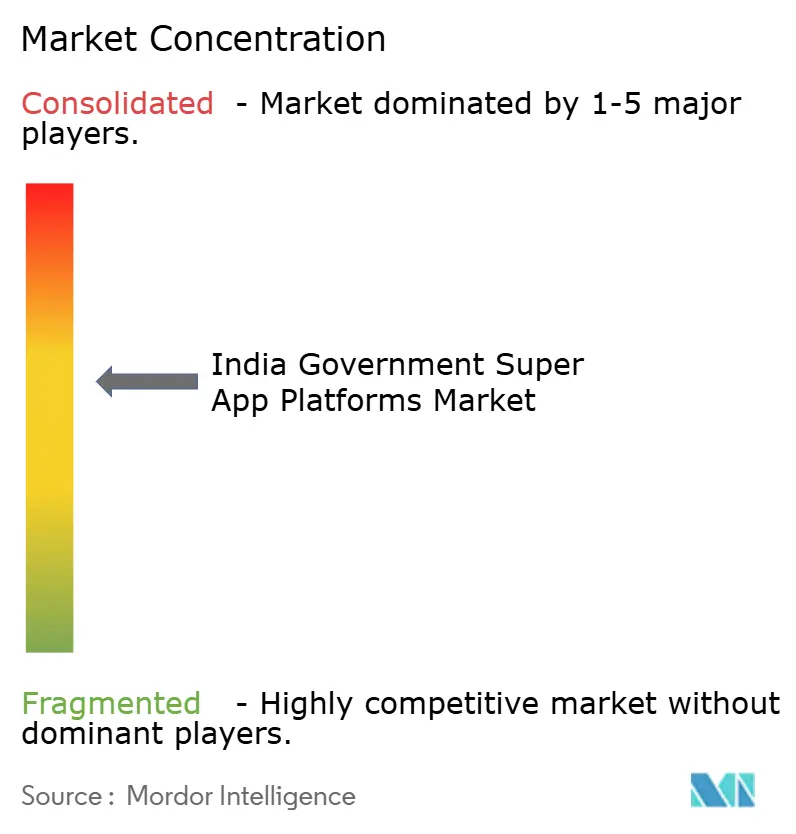
| Market Concentration | Medium |
Major Players *Disclaimer: Major Players sorted in no particular order Image © Mordor Intelligence. Reuse requires attribution under CC BY 4.0. | |
India Government Super App Platforms Market Analysis by Mordor Intelligence
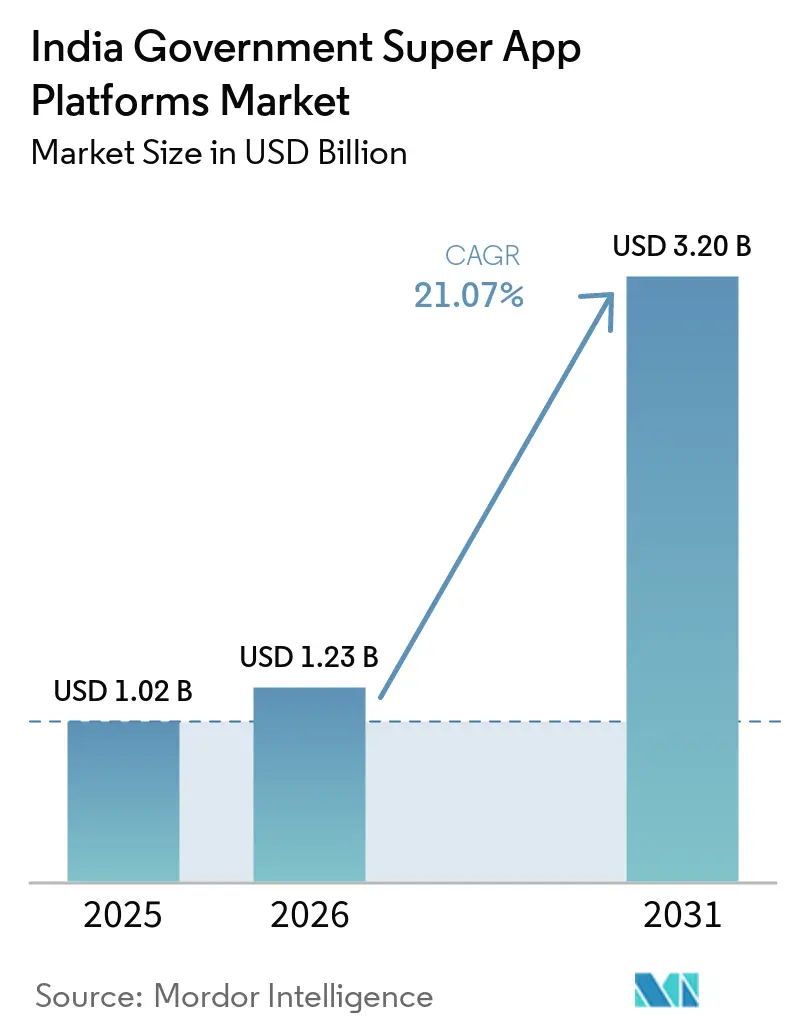
The India government super app platforms market size is expected to increase from USD 1.02 billion in 2025 to USD 1.23 billion in 2026 and reach USD 3.20 billion by 2031, registering a CAGR of 21.07% over 2026-2031. The India government super app platforms market is moving from separate departmental portals toward integrated services that combine identity verification, payments, welfare access, and compliance processes. Digital access, common public digital infrastructure, and state-level service modernization are widening the opportunity for platform providers. Procurement decisions increasingly favor systems that can connect with national identity, payment, and document systems while protecting sensitive citizen information. Vendors with strong integration capabilities, government delivery experience, and adaptable deployment models are positioned to benefit as central and state agencies expand shared service platforms.
Key Report Takeaways
- By platform, native mobile apps held 67.88% of the India government super app platforms market share in 2025, while web and progressive web apps are projected to expand at a CAGR of 22.08% through 2031.
- By deployment type, cloud held 45.66% share in 2025, while hybrid deployment is projected to advance at a CAGR of 21.89% through 2031.
- By application, citizen services accounted for 31.28% of the India government super app platforms market size in 2025, while identity, credentials, and wallet services are projected to grow at a CAGR of 22.76% through 2031.
- By end user, state or provincial governments held 59.88% share in 2025, while the central government is projected to grow at a CAGR of 21.99% through 2031.
Note: Market size and forecast figures in this report are generated using Mordor Intelligence’s proprietary estimation framework, updated with the latest available data and insights as of January 2026.
India Government Super App Platforms Market Trends and Insights
Drivers Impact Analysis*
| DRIVER | (~) % IMPACT ON CAGR FORECAST | GEOGRAPHIC RELEVANCE | IMPACT TIMELINE |
|---|---|---|---|
| Rising Demand for One-Stop Citizen Service Delivery | +4.8% | National, concentrated in Uttar Pradesh, Maharashtra, and Rajasthan | Short term (≤2 years) |
| India Stack as the Digital Identity and Payments Foundation | +4.2% | National | Short term (≤2 years) |
| AI-Enabled Services, Vernacular Interfaces, and Automated Case Routing | +2.4% | South India and the National Capital Region, with spillover to tier-2 cities | Medium term (2–4 years) |
| Interoperability Across Center-State and Agency Systems | +2.2% | National, with emphasis on center-state interfaces | Medium term (2–4 years) |
| Shared Platform Cost Savings Through PM GatiShakti and UMANG | +1.6% | National | Long term (≥4 years) |
| Data Protection and Public-Control Requirements | +0.6% | National | Medium term (2–4 years) |
| Source: Mordor Intelligence | |||
Rising Demand for One-Stop Citizen Service Delivery
India’s responsibility to deliver welfare, identity, and regulatory services at scale supports the demand for integrated public platforms. UMANG expanded from 166 services in 2017 to 2,572 by June 2026 and processed 796.69 crore cumulative transactions, indicating sustained use of consolidated service access.[1] Kerala and Chhattisgarh have also introduced or expanded integrated state service platforms, adding a state procurement layer alongside central initiatives. This structure creates recurring requirements for vendors capable of supporting multiple departments, languages, and local operating conditions. The India government super-app platforms market also benefits from the requirement that new public digital services connect to established identity, payment, and document-verification rails. Integration requirements can make spending more durable because departments need compatible systems to deliver services at scale.
India Stack as the Digital Identity and Payments Foundation
Aadhaar, UPI, DigiLocker, and ABHA provide shared foundations for government-facing platforms, reducing the need for agencies to build separate identity and transaction systems. Aadhaar generated 144 crore numbers and recorded 2,707 crore authentication transactions in 2024-25, while UPI processed 21.70 billion transactions worth INR 28.33 lakh crore (USD 329.42 billion) in January 2026.[2] The scale of these systems makes reliable integration more important than adding isolated front-end features. DigiLocker’s Family ID coverage across Rajasthan, Maharashtra, Madhya Pradesh, and Uttar Pradesh extended its role from document storage to household eligibility verification.[3] ABHA-linked records also support health-related service delivery, which increases the value of interoperable credential management. For the India government super app platforms market, vendors that can securely connect to these public systems have a clearer path to meeting government procurement requirements.
AI-Enabled Proactive Services, Vernacular Interfaces, and Automated Case Routing
Artificial intelligence is changing public platforms from request-response tools into systems that can guide users to relevant services. In July 2026, the National e-Governance Division empaneled 6 AI implementation partners from more than 80 bidders, creating a standardized route for government bodies to engage qualified providers. Andhra Pradesh’s Mana Mitra showed how messaging-based access can provide government services without requiring users to download a separate app. Voice and vernacular interfaces can reduce barriers for people who have limited literacy, limited storage capacity, or inconsistent connectivity. They can also allow Common Service Centers to focus staff time on complex cases rather than routine document requests. The India government super app platforms market can therefore gain from AI tools that work across languages and channels while preserving accountable service processes.
Interoperability Across Center-State and Agency Systems
Government services remain distributed across many central and state agencies, often with different technical standards and data practices. The National e-Governance Division reported the integration of nearly 2,000 services on the DigiLocker and e-District platforms, demonstrating both progress and the scale of remaining work. PM GatiShakti had integrated more than 1,400 data layers from 44 ministries and departments by February 2026, offering a practical example of cross-agency information coordination. Each service connection still requires alignment on data sharing, application programming interfaces, and operational accountability. The DIGIT platform provides an open-source, microservices-based approach that states can use to avoid closed, proprietary architectures.[4] As these requirements become more common in tenders, interoperability is likely to carry more weight in the India government super app platforms market.
Restraints Impact Analysis*
| RESTRAINT | (~) % IMPACT ON CAGR FORECAST | GEOGRAPHIC RELEVANCE | IMPACT TIMELINE |
|---|---|---|---|
| Legacy System Lock-In and Slow Core Modernization | -3.6% | Bihar, Uttar Pradesh, Madhya Pradesh, and the Northeast states | Long term (≥4 years) |
| Procurement Complexity and Multi-Agency Governance | -2.0% | National, more acute at the state level | Medium term (2–4 years) |
| Digital Exclusion in Rural and Low-Connectivity Areas | -1.8% | Rural India, the Northeast, and tribal areas | Long term (≥4 years) |
| Privacy, Consent, and Data Residency Requirements | -1.4% | National | Medium term (2–4 years) |
| Source: Mordor Intelligence | |||
Legacy System Lock-In and Slow Core Modernization
Many state departments still rely on older databases, monolithic systems, and closed interfaces that are difficult to connect with newer platforms. Systems established during earlier e-governance programs often lacked interoperability requirements, leaving agencies with costly modernization work. This challenge is strongest where departments must retain existing records and service processes while adding real-time interfaces. Vendors that can use middleware, microservices wrappers, or modular implementation methods may be better placed than providers focused only on new installations. The India government super app platforms market can face delayed launches and higher support requirements when legacy systems require extensive tailoring. These projects can also pressure vendor margins because integration work continues after the initial platform deployment.
Procurement Complexity Under GFR Rules and Multi-Agency Governance
Government procurement often involves scope definition, tender publication, technical review, commercial evaluation, contract approval, and legal clearance. Large platform contracts may take 12 to 24 months to move from initial planning to award, delaying the realization of policy objectives. State deployments may require approvals from information technology, finance, delivery departments, NIC, and sometimes national agencies. Pre-qualified vendor arrangements are intended to reduce repeated tendering and shorten the route to deployment. However, vendors still need credentials and delivery records that meet public-sector requirements. These procedures can slow the growth of India's government super app platforms market, even when demand for integrated citizen services is strong.
*Our forecasts treat driver/restraint impacts as directional, not additive. The impact forecasts reflect baseline growth, mix effects, and variable interactions.
Segment Analysis
By Platform: Web and Progressive Web Apps Narrow the Native App Lead
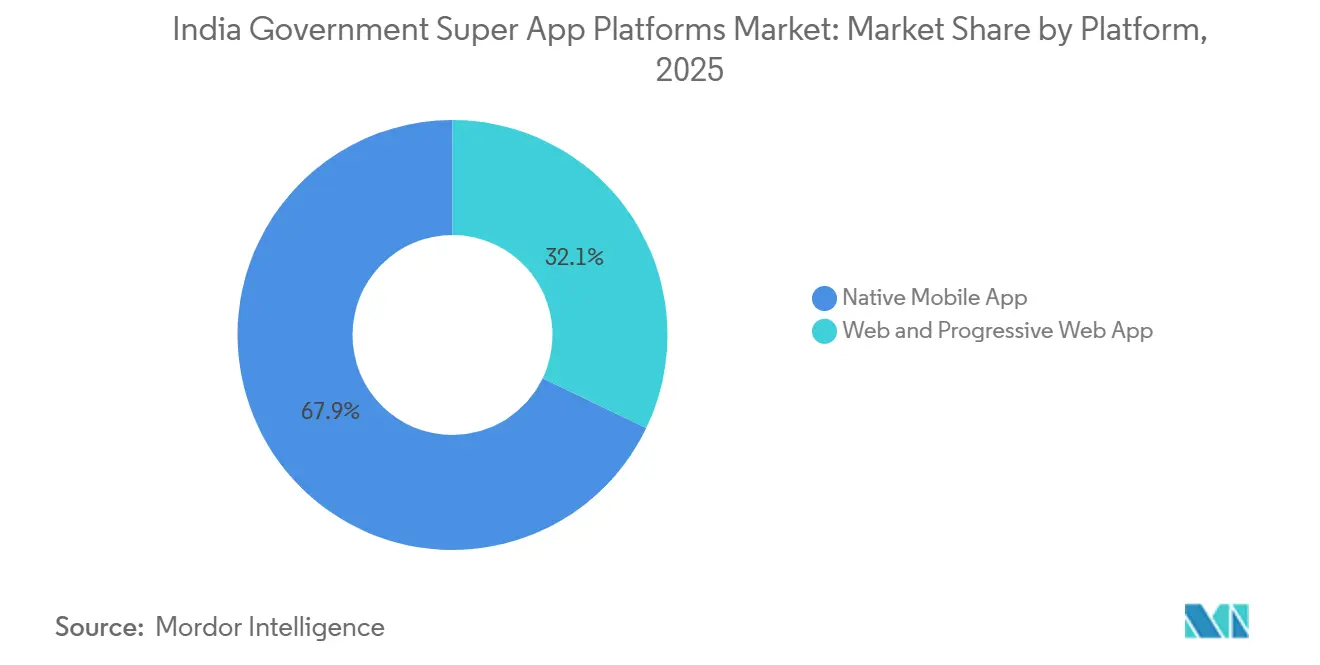
Native mobile apps are expected to hold 67.88% of the India government super app platforms market share in 2025. Their lead reflects smartphone-led access and their ability to provide offline functions, device-based security, and consistent authentication experiences. NCAER reported that 71.4% of internet users accessed the web only through mobile devices, while 20.4% of digital service users needed assistance from someone outside their household. These conditions support mobile designs that can store selected information locally and guide users through structured workflows. Native applications also remain suitable for users who repeatedly access municipal, welfare, transport, or payment services. Their continued role does not prevent agencies from supporting additional access channels.
Web and progressive web apps are projected to register a CAGR of 22.08% through 2031, the highest among platform formats. UMANG is available through a mobile application, a website, an interactive voice response system, and SMS, demonstrating the practical value of channel flexibility. Progressive web applications can help agencies serve users with older Android devices where downloading a large application is difficult. Browser-based delivery also supports voice interfaces and messaging links without requiring an app store installation. Chhattisgarh’s Seva Setu and Andhra Pradesh’s Mana Mitra illustrate the shift toward lightweight, channel-based access. The India government super app platforms market is likely to support both native and web-based delivery because citizen access conditions vary by device, literacy level, and network availability.
By Deployment Type: Hybrid Deployments Rise on Sovereign Cloud Mandates
Cloud deployment is expected to hold 45.66% of the India government super app platforms market share in 2025. It has become a preferred model for new deployments because agencies can add capacity and security services without having to build every resource internally. MeitY’s cloud framework guides public agencies in selecting hosting arrangements based on the sensitivity of the information involved. Managed cloud environments can help state information technology departments support fluctuating demand across services. They also allow providers to update software and security controls more consistently. On-premise infrastructure remains relevant for systems that require strict operational control or have complex migration paths.
Hybrid deployment is projected to grow at a CAGR of 21.89% through 2031. The 2026 cloud selection framework classifies Aadhaar, UPI, PAN, voter ID, and similar critical datasets as Category A information that must be stored on sovereign or government-controlled cloud infrastructure. This approach allows agencies to keep sensitive records in controlled environments while using scalable capacity for public-facing services where permitted. AWS India and Yotta Data Services announced a collaboration for NIC’s Meghraj 2.0 initiative, which uses AWS Outposts for sensitive workloads within NIC data centers. The arrangement illustrates how a hybrid architecture can separate sensitive processing from peak-load service delivery. For the India government super app platforms market, this model creates opportunities for providers that can manage data controls, integration, and operational continuity together.
By Application: Identity and Wallet Services Outpace Citizen Services Growth
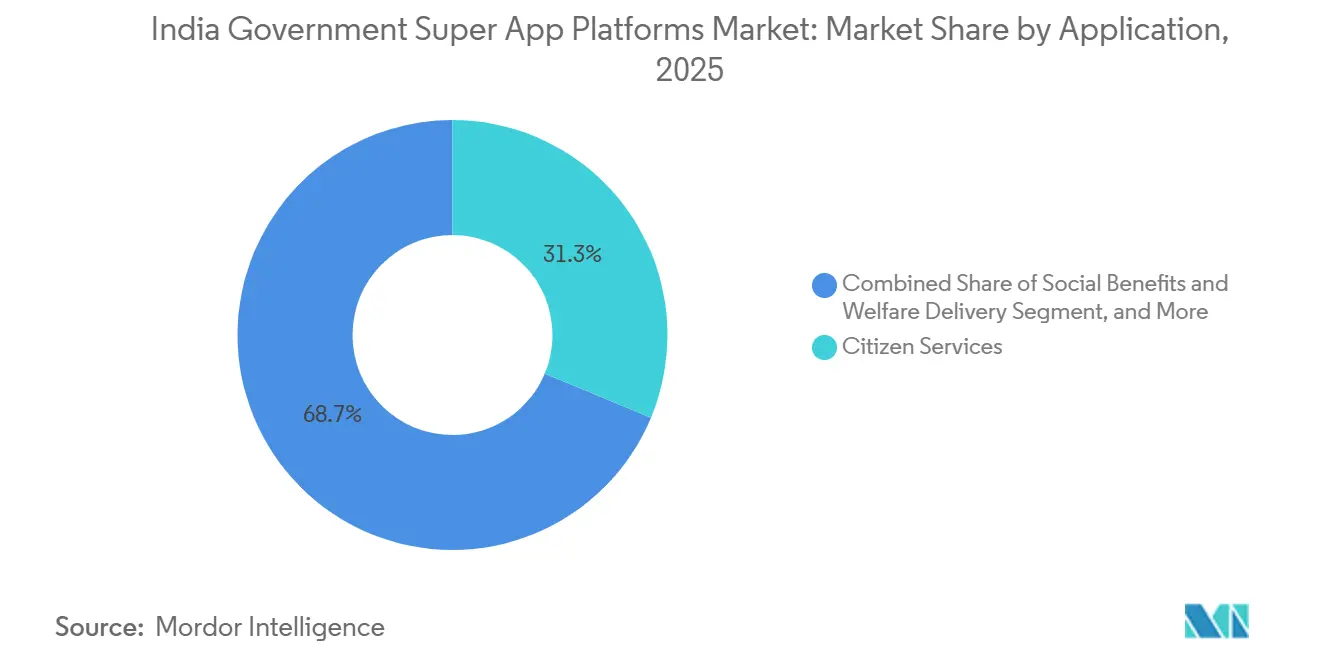
Citizen services are expected to account for 31.28% of the India government super app platforms market size in 2025. This category includes common interactions such as certificates, utility payments, scholarship updates, transport services, and application tracking. It has the broadest user base because it covers services that citizens access frequently across departments. A single access point can reduce the need for repeated registration and document submission when agencies apply data-sharing controls properly. Agencies also use these platforms to bring existing services into a more consistent user experience. The breadth of citizen services keeps this application category central to platform design and delivery priorities.
Identity, credentials, and wallet services are projected to grow at a CAGR of 22.76% through 2031. DigiLocker’s expanded Family ID integration supports eligibility checks across multiple services without requiring a separate household registry for every agency. UPI provides the payment rail for fees, collections, and transfers, while Aadhaar-based processes support identity verification. ABHA-linked records extend credential use into health-related services. Licensing, permitting, and registration functions also support consolidation, eliminating duplicate work previously created by separate portals for citizens and agencies. The Indian government super app platforms market, therefore, has a growing need for systems that manage credentials securely and apply them across authorized service journeys.

By End User: State Procurement Dominates While Central Government Accelerates
State or provincial governments are expected to hold 59.88% of the India government super app platforms market share in 2025. Most high-volume citizen services, including health, education, land records, agriculture, and local government functions, are administered at the state level. State agencies must integrate departmental systems while adapting services to local rules, languages, and delivery channels. The 30 states connected to UMANG by 2025 demonstrate the scale of ongoing state integration requirements. Each integration can involve separate data structures and service processes, creating sustained work for delivery partners. Both modernization needs and local service responsibilities, therefore, shape state demand.
The central government is projected to grow at a CAGR of 21.99% through 2031. Central agencies are expanding common infrastructure and pursuing larger unified systems that departments can use across functions. The Digital Public Infrastructure roadmap identifies integrated public service delivery across areas such as health, payments, and agriculture as part of the country’s longer-term direction. Central projects can establish shared technical and compliance standards that influence state procurement. They can also create reusable patterns for identity, payment, document management, and grievance resolution. The India government super app platforms market is likely to see central systems complement state services rather than replace the need for locally configured platforms.
Geography Analysis
Southern states are developing some of the most advanced multi-service architectures in the India government super app platforms market. Andhra Pradesh’s Mana Mitra delivers 1,126 government services through a WhatsApp interface and serves 58.2 lakh users, demonstrating how a state can use established messaging channels to expand service access. Kerala is expected to launch Nammude Keralam in February 2026, while Karnataka uses the DIGIT platform to support urban service modernization. Tamil Nadu and Telangana have developed data infrastructure and AI programs that support more proactive service models. These states are well-positioned to test hybrid systems in which sensitive records remain in controlled environments while public-facing layers scale as needed.
Western and northern states offer the largest near-term procurement volumes due to their population scale and established digital governance programs. Rajasthan’s IFMS 3.0 modernization and Madhya Pradesh’s NeVA phase-2 work indicate continued demand for specialized departmental platforms. Bihar’s Bihar-One project shows that states with lower levels of digitization are also committing to integrated citizen service platforms. Rural internet penetration is projected to reach 48.31 subscribers per 100 population in 2025-26, while fixed broadband speed is expected to reach a national average of 60.85 Mbps by March 2026. The India government super app platforms market can expand in this geography as modernization projects move beyond major cities.
Eastern India and the Northeast are emerging implementation areas rather than the largest current revenue base. BharatNet is expected to make 2.15 lakh of India’s 2.22 lakh Gram Panchayats service-ready with optical fiber by January 2026. The Department of Telecommunications’ Samriddh Gram initiative provides a model for combining connectivity with assisted digital delivery. These regions require platforms that support lower bandwidth, local languages, and third-party-assisted access. Consent management and data handling procedures require particular attention when intermediaries assist citizens in completing transactions.
Competitive Landscape
The India government super app platforms market is moderately consolidated among the largest providers, while specialized integrators and open-source providers remain active in specific workflows. Infosys, Wipro, HCL Technologies, Tech Mahindra, Accenture, and Capgemini compete on system integration experience, compliance qualifications, and existing government relationships. AWS India, Google Cloud India, and Microsoft India provide cloud infrastructure and advisory capabilities for public deployments. eGov Foundation’s DIGIT platform offers a public digital goods approach based on open-source and microservices principles. This provider mix gives agencies a choice between large-scale integrators and more focused platform specialists.
Providers are moving away from closed, monolithic implementations and toward modular systems that connect through open interfaces. This shift reflects the need to integrate with India Stack components and departmental systems that agencies cannot replace immediately. HCLTech is expected to sign a memorandum of understanding with the Odisha government and Sarvam AI in July 2026 for a proposed sovereign AI data center and global delivery center in the Odisha Sovereign AI Park. AWS India’s Meghraj 2.0 collaboration with Yotta and NIC is another example, focusing on a hybrid arrangement for sensitive government workloads. These developments show that providers are differentiating through data controls, local infrastructure, and integration models, rather than application features alone.
Newgen Software’s recognition as a Major Player in an AI-enabled government case-management assessment reflects its focus on a defined public-sector workflow. NIC e-Governance Services India Limited and C-DAC shape technical expectations through application programming interface, security, and interoperability requirements. Data localization and consent obligations increase the value of providers that can demonstrate operational control over sensitive information. The India government super app platforms market remains open to specialists, but they must operate within shared infrastructure and public procurement standards.
India Government Super App Platforms Industry Leaders
-
Amazon Web Services, Inc. (AWS India)
-
IBM Corporation
-
Google LLC
-
Microsoft Corporation
-
SAP SE
- *Disclaimer: Major Players sorted in no particular order
Recent Industry Developments
- July 2026: HCL Technologies and Sarvam AI signed MoUs with the Odisha government to establish an AI data center and global delivery center in the Odisha Sovereign AI Park, with a proposed investment of INR 14,257 crore (approximately USD 1.66 billion). The project targets sector-specific AI applications for public and private sector enterprises, including multilingual AI-based citizen services and a direct investment in the government platform's AI infrastructure stack.
- July 2026: MeitY, through NeGD, empanelled six technology firms, TCS, NEC Corporation India, Kyndryl Solutions, Innefu Labs, CoRover, and Cactus Technology Solutions, to deploy AI solutions across central government departments, state governments, and public sector undertakings, selected from over 80 bidders. The empanelment framework, valid for two years with an extension option, establishes pre-approved vendor pools that allow government departments to engage AI partners directly, bypassing per-project tendering.
- April 2026: NITI Aayog released the DPI@2047 roadmap, a two-phased strategy for India’s digital public infrastructure: through 2035, inclusion and capacity building; and 2047, grassroots innovation and economic prosperity. It identifies government super app platforms as a core citizen service delivery vehicle across the health, payments, and agriculture domains.
- February 2026: AWS India and Yotta Data Services announced a collaboration to deploy AWS Outposts for NIC’s Meghraj 2.0 initiative, enabling a hybrid cloud infrastructure that runs sensitive government workloads within NIC data centers while scaling citizen-facing services to the AWS India region during peak demand, the first major operationalization of MeitY’s hybrid cloud architecture mandate for government platforms.
India Government Super App Platforms Market Report Scope
The India Government Super App Platforms Report is Segmented by Platform (Native Mobile App, and Web and Progressive Web App), Deployment Type (Cloud, On-Premise, and Hybrid), Application (Citizen Services, Identity, Credentials, and Wallet Services, Payments, Fees, and Revenue Collection, Social Benefits and Welfare Delivery, Licensing, Permits, and Registrations, and Other Applications), and End User (Central Government, and State Or Provincial Government). The Market Forecasts are Provided in Terms of Value (USD).
| Native Mobile App |
| Web and Progressive Web App |
| Cloud |
| On-Premise |
| Hybrid |
| Citizen Services |
| Identity, Credentials, and Wallet Services |
| Payments, Fees, and Revenue Collection |
| Social Benefits and Welfare Delivery |
| Licensing, Permits, and Registrations |
| Other Applications |
| Central Government |
| State Or Provincial Government |
| By Platform | Native Mobile App |
| Web and Progressive Web App | |
| By Deployment Type | Cloud |
| On-Premise | |
| Hybrid | |
| By Application | Citizen Services |
| Identity, Credentials, and Wallet Services | |
| Payments, Fees, and Revenue Collection | |
| Social Benefits and Welfare Delivery | |
| Licensing, Permits, and Registrations | |
| Other Applications | |
| By End User | Central Government |
| State Or Provincial Government |
Key Questions Answered in the Report
What is the size of the India government super app platforms market?
The India government super app platforms market is expected to increase from USD 1.02 billion in 2025 to USD 1.23 billion in 2026 and reach USD 3.20 billion by 2031, at a CAGR of 21.07%.
What is driving demand for government super app platforms in India?
Demand is supported by integrated citizen service delivery, India Stack integration, shared service platforms, AI-enabled interfaces, and the modernization of state and central systems.
Which platform format leads government super app adoption in India?
Native mobile apps led with 67.88% share in 2025, while web and progressive web apps are projected to record the highest growth at a CAGR of 22.08% through 2031.
Why are hybrid deployments gaining adoption for public platforms?
Hybrid models allow sensitive data to remain in sovereign or government-controlled infrastructure while citizen-facing workloads can use scalable cloud capacity.
Which application is growing fastest in this sector?
Identity, credentials, and wallet services are projected to grow at a CAGR of 22.76% through 2031, supported by Aadhaar, DigiLocker, UPI, and ABHA integration.
Who are the main users of government super app platforms?
State or provincial governments led with 59.88% share in 2025, while the central government is projected to grow fastest at a CAGR of 21.99% through 2031.