
India Fixed Wireless Access Market Size and Share
Market Overview
| Study Period | 2020 - 2031 |
|---|---|
| Forecast Data Period | 2026 - 2031 |
| Base Year Market Size (2025) | USD 2.13 Billion |
| Market Size (2026) | USD 2.56 Billion |
| Market Size (2031) | USD 5.58 Billion |
| Growth Rate (2026 - 2031) | 16.86 % |
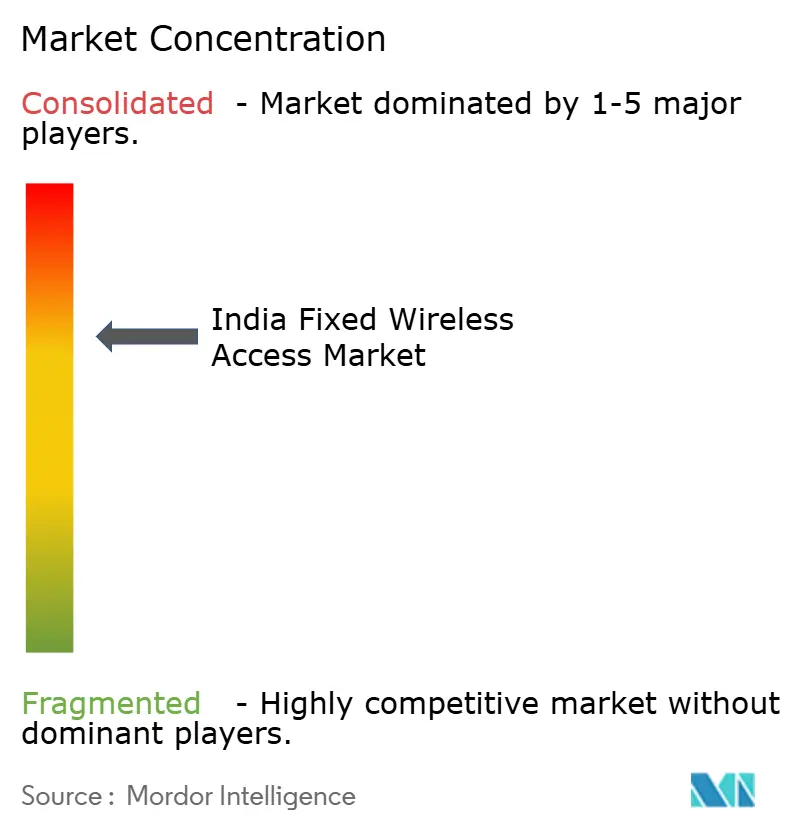
| Market Concentration | Medium |
Major Players *Disclaimer: Major Players sorted in no particular order Image © Mordor Intelligence. Reuse requires attribution under CC BY 4.0. | |
India Fixed Wireless Access Market Analysis by Mordor Intelligence
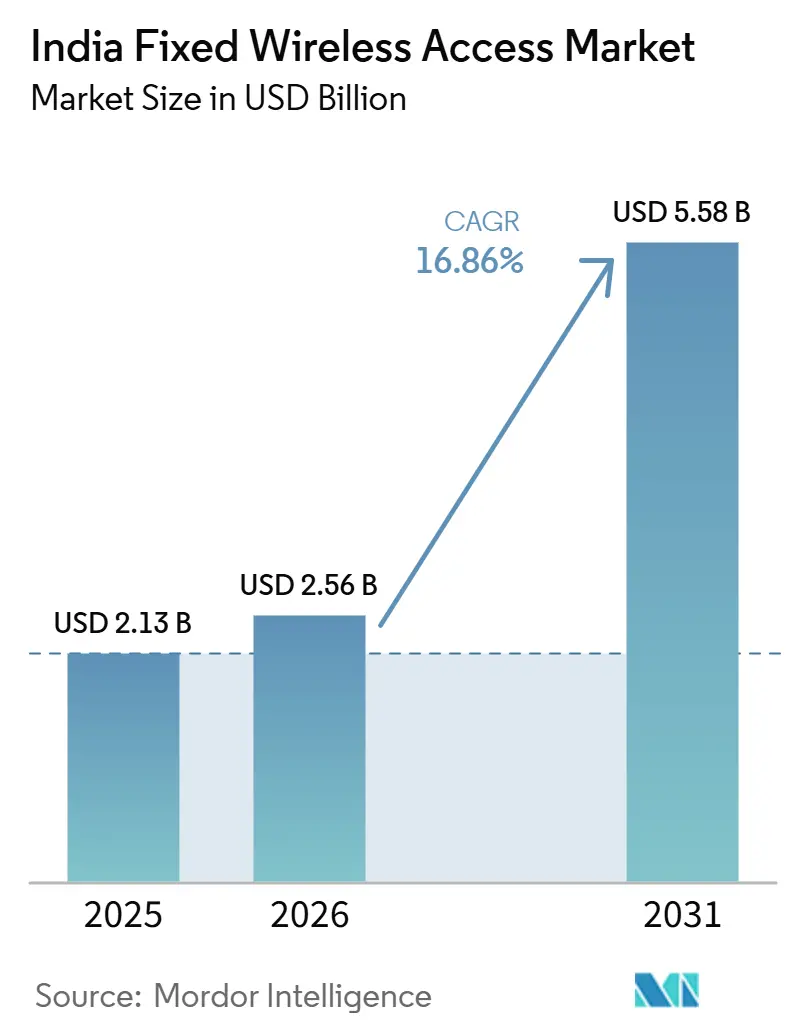
The India Fixed Wireless Access Market size was valued at USD 2.13 billion in 2025 and is estimated to grow from USD 2.56 billion in 2026 to reach USD 5.58 billion by 2031, at a CAGR of 16.86% during the forecast period (2026-2031). Subscriber growth has already supported this outlook, with fixed wireless access reaching 17.54 million subscribers by April 2026 and recording the fastest monthly growth among broadband access categories. The commercial base for that expansion rests on India’s 5G rollout, which reached 99.9% of districts and crossed 508,000 5G base stations by 2025, providing operators with a broad radio network while fiber deployment remains slow or costly. Demand is no longer confined to large cities, as the rural-urban split moved close to parity by March 2026, widening the addressable base beyond tier-1 and tier-2 locations. Competition remains strongest at the service layer, where Reliance Jio Infocomm and Bharti Airtel lead subscriber gains, while Nokia, Ericsson, Samsung, HFCL, and Tejas Networks compete for radio, core, and customer premises equipment contracts. BharatNet Phase 3, backed by INR 1.39 trillion (USD 18 billion), is set to strengthen rural backhaul, while fiber price pressure and policy uncertainty around high-frequency spectrum remain timing constraints rather than barriers to the India fixed wireless access market.
Key Report Takeaways
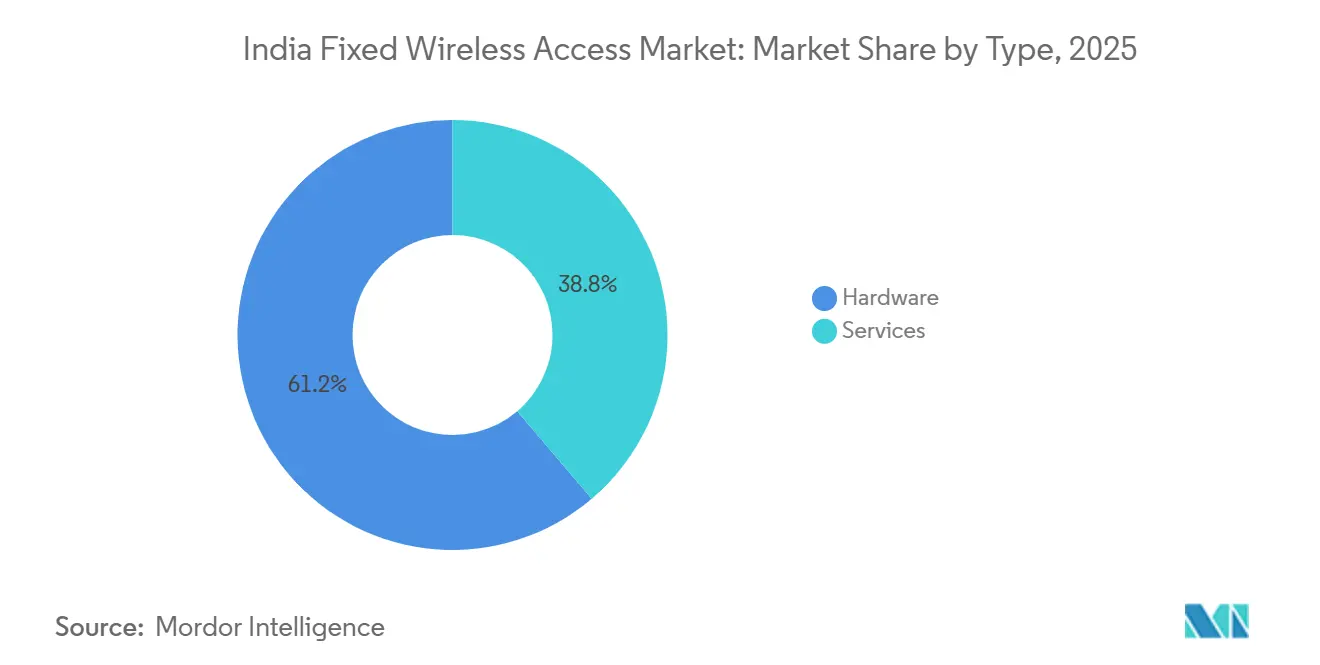
- By type, hardware held 61.22% of revenue share in the India fixed wireless access market in 2025, while services are projected to expand at a 16.92% CAGR through 2031.
- By application, residential connections accounted for 66.76% of revenue share in the India fixed wireless access market in 2025, while government and public safety are projected to grow at a 17.11% CAGR through 2031.
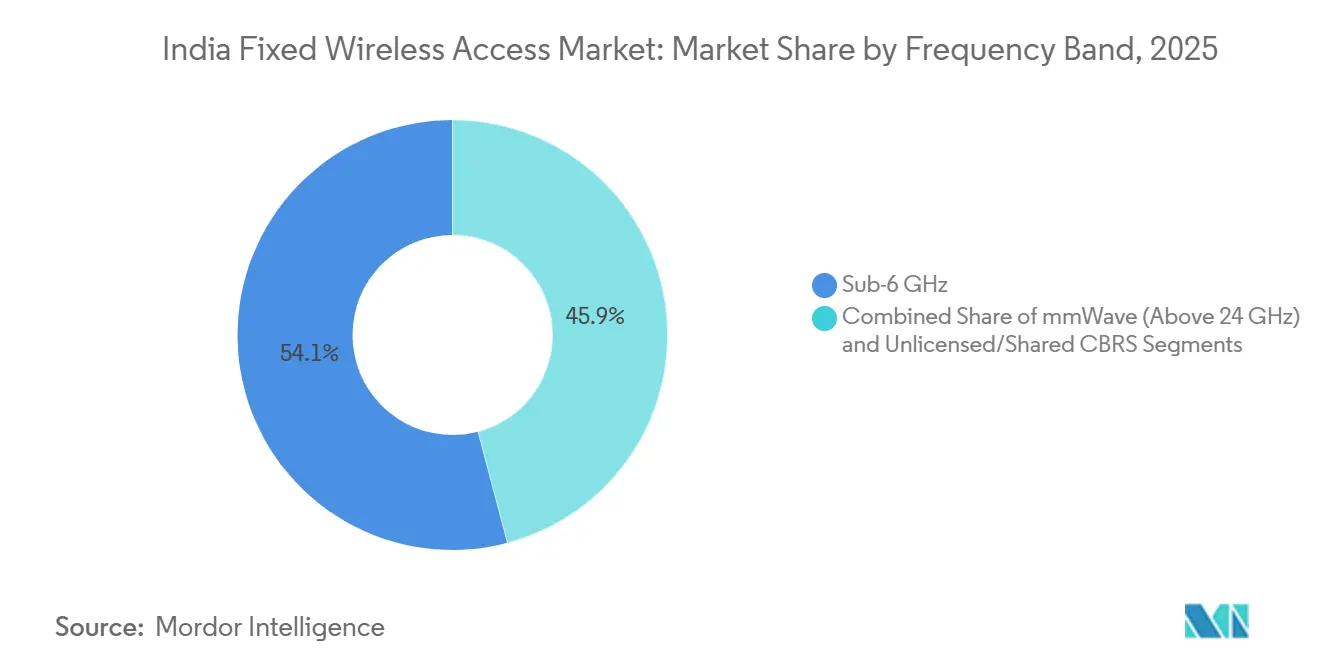
- By frequency band, sub-6 GHz held 54.12% of revenue share in the India fixed wireless access market in 2025, while mmWave above 24 GHz is expected to expand at a 17.77% CAGR through 2031.
- By deployment mode, indoor CPE accounted for 62.13% of revenue share in the India fixed wireless access market in 2025, while self-install window-mount CPE is projected to advance at a 17.82% CAGR through 2031.
Note: Market size and forecast figures in this report are generated using Mordor Intelligence’s proprietary estimation framework, updated with the latest available data and insights as of January 2026.
India Fixed Wireless Access Market Trends and Insights
Drivers Impact Analysis*
| Driver | (~) % Impact on CAGR Forecast | Geographic Relevance | Impact Timeline |
|---|---|---|---|
| 5G Standalone Rollout Expands Fiber-Like Wireless Capacity | +4.5% | National, concentrated gains in metropolitan and tier-2 cities | Short term (≤ 2 years) |
| BharatNet-Linked Rural Broadband Build-Out Supports Fast FWA Take-Up | +3.5% | Rural India, early gains in Andhra Pradesh, Uttar Pradesh, Bihar | Medium term (2-4 years) |
| FWA Becomes the Preferred Last-Mile Option Where Fiber Monetization is Slow | +2.5% | Tier-2 and tier-3 cities, semi-urban zones nationally | Short term (≤ 2 years) |
| Enterprise Backup Connectivity Demand Rises With SD-WAN and Cloud Deployment | +1.8% | National, concentrated in industrial corridors and IT hubs | Medium term (2-4 years) |
| Self-Install CPE and Lower Truck-Roll Intensity Improve Unit Economics | +1.2% | National | Short term (≤ 2 years) |
| Bundled Digital Services Improve FWA Stickiness and Reduce Churn | +0.8% | National, primarily urban and semi-urban | Long term (≥ 4 years) |
| Source: Mordor Intelligence | |||
5G Standalone Rollout Expands Fiber-Like Wireless Capacity
India’s move from non-standalone to standalone 5G architecture has had the clearest impact on the quality and scale of fixed wireless access services. Both major operators pushed their fixed wireless access platforms toward 5G standalone cores by 2025, improving service control and enabling stronger responses to fiber broadband in dense areas. Ericsson reported that combined Jio and Airtel fixed wireless access connections reached 12 million by September 2025, which showed that subscriber uptake was already responding to this network transition. The Indian fixed wireless access market also benefits from the lower latency and improved traffic handling that 5G standalone enables in apartment clusters and high-traffic neighborhoods. Airtel’s February 2025 device contract with Nokia and Qualcomm showed that operators were not treating fixed wireless access as an add-on service, because they were already aligning customer equipment and Wi-Fi performance with national rollout plans.[1]Bharti Airtel Limited, “Airtel Awards Contracts to Nokia to Expand 5G Fixed Wireless Access Devices Powering High-Speed Internet Connectivity Nationwide,” Bharti Airtel, airtel.in That combination of better core architecture, broader radio coverage, and device readiness has kept the Indian fixed wireless access market on a faster adoption path than most fixed broadband categories.
BharatNet-Linked Rural Broadband Build-Out Supports Fast FWA Take-Up
BharatNet has become more than a fiber program because it improves the economics of the last-mile wireless link in places where household fiber remains difficult to monetize. Phase 3 of the amended BharatNet program carries an outlay of INR 1.39 trillion (USD 18 billion) and targets an additional 40,000 gram panchayats and 600,000 villages over 3 years. Once fiber reaches the gram panchayat level, operators can use fixed wireless access as the final connection layer instead of extending expensive fiber all the way to each home. TRAI data showed that rural 5G fixed wireless access subscriptions stood at 6.15 million in March 2026, almost equal to the urban base of 6.17 million, and confirmed that the Indian fixed wireless access market was already scaling beyond major cities. BharatNet’s ring-topology design and remote fiber monitoring structure also matter, because fixed wireless access aggregation nodes depend on dependable backhaul rather than only on radio reach. This has given India's fixed wireless access market a broader rural runway than earlier wireless broadband models could sustain.
FWA Becomes the Preferred Last-Mile Option Where Fiber Monetization is Slow
In areas where fiber is present but household uptake remains below the level needed for a full payback, fixed wireless access gives operators a practical way to use existing network investment more quickly. Monthly subscriber additions in 2025 showed that fixed wireless access had started to outpace fixed broadband growth, shifting operator attention toward faster household activation rather than slower civil work. The service is especially useful in apartments and semi-urban homes, where pulling fiber through buildings or streets can take longer and cost more than installing a device. That makes the India fixed wireless access market better suited to tier-2 and tier-3 expansion, where demand exists but legacy wireline economics remain uneven. Faster provisioning also improves capital efficiency, as operators can add paying subscribers without waiting for a full-fiber drop to each premise. As a result, the Indian fixed wireless access market has shifted from a coverage substitute to a monetization tool in fiber-adjacent areas.
Enterprise Backup Connectivity Demand Rises With SD-WAN And Cloud Deployment
Business demand has been developing along a different curve from household demand, because enterprises now treat fixed wireless access as a serious WAN link rather than just a backup. This shift appears clearly in application forecasts, where government and public safety are expected to record the fastest growth through 2031. BSNL’s Quantum 5G FWA launch in Hyderabad in June 2025 targeted enterprises, MSMEs, and smart manufacturing clusters, which showed that enterprise-grade use cases were already moving into live service design. Indian Railways adopted 5G and 4G SD-WAN for critical communications in January 2026, which reinforced the role of wireless connectivity in high-reliability network settings.[2]Nirad Networks, “Indian Railways Adopts Nirad Networks 5G/4G SD-WAN for Critical Communications,” Nirad Networks, niradnetworks.com Nokia also stated in May 2025 that it was preparing millimeter-wave fixed wireless access products for banking, utilities, and defense users in India, which aligned vendor road maps with enterprise bandwidth requirements. As cloud use deepens and service continuity becomes more important, the Indian fixed wireless access market is gaining a more stable enterprise demand layer beyond consumer broadband.
Restraints Impact Analysis*
| Restraint | (~) % Impact on CAGR Forecast | Geographic Relevance | Impact Timeline |
|---|---|---|---|
| Spectrum Availability and Policy Clarity Remain Uneven Across Bands | -1.5% | National, most acute in mmWave 26 GHz policy gaps | Short term (≤ 2 years) |
| Fiber Price Compression Caps Premium FWA ARPU Expansion | -1.0% | Urban India, tier-1 and tier-2 cities | Medium term (2-4 years) |
| Outdoor CPE and mmWave Reliability Issues Slow Mass Adoption in Dense Urban Areas | -0.8% | Dense urban metro markets | Medium term (2-4 years) |
| CPE Affordability Remains a Barrier in Price-Sensitive Households | -0.6% | Rural India and low-income urban households | Long term (≥ 4 years) |
| Source: Mordor Intelligence | |||
Spectrum Availability And Policy Clarity Remain Uneven Across Bands
Policy clarity around the 26 GHz band has remained incomplete, slowing decisions on high-throughput fixed wireless access deployments. Reliance Jio’s proposal to repurpose 26 GHz spectrum for Wi-Fi-based broadband was still under technical review in June 2026, which showed that the operating framework for some non-IMT use cases was not yet settled. TRAI’s May 2025 consultation paper on microwave spectrum assignment across several bands highlighted the same issue, as the broader spectrum structure for wireless backhaul and related use cases was still being worked through.[3]Telecom Regulatory Authority of India, “Consultation Paper on Assignment of Microwave Spectrum in 6 GHz (Lower), 7 GHz, 13 GHz, 15 GHz, 18 GHz, 21 GHz Bands, E-Band, and V-Band,” Telecom Regulatory Authority of India, trai.gov.in This matters for the India fixed wireless access market because mmWave equipment decisions, enterprise deployment schedules, and vendor sourcing plans all depend on regulatory certainty. The uncertainty weighs more heavily on smaller device vendors and specialized enterprise users, as they cannot keep procurement and deployment plans open for long. Until policy decisions are finalized, the Indian fixed wireless access market is likely to continue expanding, initially in sub-6 GHz bands, while high-frequency use cases advance more selectively.
Fiber Price Compression Caps Premium FWA ARPU Expansion
Fixed wireless access operators continue to face pricing pressure from fiber providers, especially in large cities and maturing tier-2 markets, where consumers already closely compare plans. Entry-level fixed wireless access plans starting at INR 499 per month (USD 5.7 million is not applicable, therefore omitted) for 40 Mbps narrowed the visible pricing gap between wireless broadband and wireline alternatives. The same source noted that fixed wireless access ARPU of INR 600-700 per month stood materially above mobile broadband ARPU, underscoring why operators still want to protect a premium position where they can. The challenge is that installation cost cuts and wider fiber reach make it harder to keep that premium wide over time. Operators have responded by adding OTT services, cloud storage, and smart-home features to improve plan stickiness rather than relying solely on connectivity pricing. Even so, price-sensitive households can still switch easily, so the Indian fixed wireless access market faces clear limits on how far premium ARPU can expand in the most contested urban corridors.
*Our forecasts treat driver/restraint impacts as directional, not additive. The impact forecasts reflect baseline growth, mix effects, and variable interactions.
Segment Analysis
By Type: Hardware Scale Rests on Faster CPE Deployment
Hardware accounted for 61.22% of the India fixed wireless access market share in 2025, reflecting the pace at which operators deployed customer premises equipment for new connections. Indoor 5G gateways with integrated Wi-Fi 6 became the standard customer device in mass-market rollouts, because they allowed operators to package broadband and hardware as a single service proposition. The Indian fixed wireless access market also saw access units such as femtocells and picocells gain relevance in enterprise buildings and multi-dwelling settings where indoor radio coverage needed reinforcement. GSA reported that global 5G fixed wireless access CPE shipments grew 26% in 2025, and India accounted for more than 50% of its fixed wireless access CPE shipments that were 5G-enabled, underscoring the country’s rapid move toward current-generation hardware. This hardware-heavy structure suited a market where subscriber growth still depended on how quickly devices could be placed and activated at the edge.
Services are projected to grow at a 16.92% CAGR through 2031, indicating that the Indian fixed wireless access industry is moving from one-time equipment value to recurring connectivity and platform revenue. Airtel’s February 2025 contract with Nokia covered 5G outdoor fixed wireless access gateway receivers and Wi-Fi 6 access points manufactured in India, which linked scale deployment with domestic supply support. HFCL’s 5G indoor fixed wireless access CPE, built on MediaTek’s T750 chipset with zero-touch management and an AI-enabled application, showed that local vendors were also improving the serviceability of the device layer. As the installed base grows, the Indian fixed wireless access market is likely to capture more value from managed connectivity, cloud support, security features, and bundled content rather than from hardware alone.


By Application: Residential Scale Leads While Public Networks Grow Fastest
Residential connections accounted for 66.76% of the Indian fixed wireless access market in 2025, confirming that household broadband remained the anchor use case. That dominance stemmed from the large number of homes that still lack full fiber-to-the-home coverage, especially in semi-urban and lower-density districts. Airtel’s AirFiber presence in more than 2,000 cities also showed that operators continued to focus on urban multi-dwelling units, where permissions and civil works can delay fiber builds. The India fixed wireless access market, therefore, expanded first through residential adoption, even as business and public use began to grow. That balance gives operators a large subscriber base today while still leaving room for higher-value contracts in other applications.
Government and public safety are projected to expand at a 17.11% CAGR through 2031, which made it the fastest-growing application in the Indian fixed wireless access market. Indian Railways’ January 2026 adoption of 5G and 4G SD-WAN for critical communications demonstrated that public infrastructure agencies were willing to adopt wireless-first architectures in critical operating environments. BSNL’s Quantum 5G FWA launch in Hyderabad also pointed to broader use in enterprises, MSMEs, and smart manufacturing clusters, where network resilience matters more than entry-level pricing. Commercial and industrial demand in the Indian fixed wireless access industry is therefore moving from optional connectivity toward a more deliberate enterprise access layer tied to productivity, continuity, and site flexibility.
By Frequency Band: Sub-6 GHz Drives Coverage While mmWave Builds Capacity
Sub-6 GHz held 54.12% of the Indian fixed wireless access market share in 2025, reflecting its role as the primary coverage band for mass deployment. Its propagation profile fits India’s need for wider reach per tower and lower obstruction sensitivity, especially where services must scale across mixed urban and rural terrain. Mid-band 5G has therefore become the practical base layer for residential connections and broad subscriber growth. Unlicensed and shared CBRS options also remain relevant in campus and industrial deployments where private or localized connectivity matters more than national mobile-grade spectrum control. This mix has made the India fixed wireless access market more adaptable across use cases, rather than tying all growth to a single spectrum path.
mmWave above 24 GHz is expected to grow at a 17.77% CAGR through 2031, indicating where the next capacity push is likely to emerge. Airtel’s agreement to acquire 400 MHz of 26 GHz spectrum from Adani Data Networks across 6 circles positioned it to address high-density and enterprise use cases where throughput demand is stronger. Nokia also said in May 2025 that it was preparing millimeter-wave fixed wireless access products for banking, utilities, and defense customers in India. That combination of operator spectrum positioning and vendor product planning suggests that the Indian fixed wireless access market will keep sub-6 GHz as its scale layer, while mmWave will serve more targeted, high-capacity deployments.

By Deployment Mode: Indoor CPE Leads While Self-Install Gains Speed
Indoor CPE accounted for 62.13% of the India fixed wireless access market in 2025, making it the dominant deployment mode. Plug-and-play gateways that combine Wi-Fi 6 and eSIM support remain the standard option for urban and semi-urban households because they simplify activation and fit apartment living conditions. This mode also suits operators who want a faster connection process without the need for extensive fieldwork at each site. The India fixed wireless access market has therefore built early scale through equipment that is easy to ship, install, and support across a large customer base. That has been especially important in locations where service demand is rising faster than technician capacity.
Self-install window-mount CPE is projected to grow at a 17.82% CAGR through 2031, which shows how strongly operators value lower provisioning costs and shorter activation cycles. These devices reduce truck-roll needs because subscribers can position the unit themselves while still improving signal quality compared with standard indoor placement. GSA reported that flexible, self-install indoor and outdoor CPEs accounted for 58% of outdoor CPE shipments globally in 2024, aligning with India’s rural and edge deployment needs. HFCL’s indoor fixed wireless access CPE with zero-touch management, remote upgrades, and AI-supported provisioning showed that Indian vendors were building for that self-service model as the Indian fixed wireless access market widened geographically.
Geography Analysis
Rural subscribers accounted for 49.63% of the India fixed wireless access market share in March 2026, while urban subscribers accounted for 50.37%, underscoring how quickly demand moved beyond metro-led adoption. Urban centers drove the first wave, with 5.5 million of 5.72 million total 5G fixed wireless access subscribers located in urban areas in January 2025. By March 2026, rural 5G fixed wireless access subscriptions had reached 6.15 million and nearly matched the urban base of 6.17 million, while rural monthly growth also edged past urban growth. This made the India fixed wireless access market unusual among large broadband markets, as rural-scale deployment arrived much earlier than many operators would normally expect.
Andhra Pradesh led state-level concentration with more than 900,000 5G fixed wireless access subscribers in November 2025, followed by Maharashtra with 820,000 and Bihar with 740,000. Southern and western states benefited from stronger 5G tower density and better fiber backhaul, which supported early subscriber buildup. Bihar’s position was especially important because it showed that the Indian fixed wireless access market could scale in lower-income states when pricing and service availability aligned. Northern and eastern India now represent the main runway for expansion, because fiber-to-the-home penetration remains low and many locations still face a large broadband access gap. Airtel added more than 4,300 sites in Uttar Pradesh East in April 2026 and more than 2,900 sites across the Upper North region in June 2026, which supported further fixed wireless access capacity in areas where rural demand remains strong.
Tier-2 cities with populations between 100,000 and 500,000 have emerged as an attractive part of the Indian fixed wireless access market because legacy cable and DSL options remain limited in many of them. These cities can support stronger ARPU because subscribers often pay for performance that older broadband modes cannot deliver. Northeastern states and tribal districts are also likely to benefit as BharatNet Phase 3 extends ring-topology fiber into previously underconnected areas. TRAI’s decision to report 5G fixed wireless access separately from January 2025 onward has also improved circle-level visibility, which helps direct spectrum use and infrastructure investment across the Indian fixed wireless access market.
Competitive Landscape
The India fixed wireless access market is moderately consolidated at the service layer but more fragmented across radio, core, and CPE supply. TRAI data showed that Reliance Jio’s 5G fixed wireless access base reached 8.58 million and Airtel’s reached 3.74 million by March 2026, which gave the 2 operators clear leadership in subscriber additions. That service concentration shapes pricing, rollout speed, and customer acquisition across the Indian fixed wireless access market, even though no single vendor controls the full equipment stack. The vendor side remains more open, with Nokia, Ericsson, Samsung, HFCL, and Tejas Networks all competing for different parts of the deployment value chain.
One strategic move came in February 2025, when Airtel awarded contracts to Nokia and Qualcomm for 5G fixed wireless access and Wi-Fi solutions produced in India, which tied scale rollout to domestic manufacturing support. Another came from Nokia’s November 2025 launch of the FastMile Gateway 4, a compact 5G indoor gateway with Wi-Fi 7 and speeds up to 4 Gbps, signaling the next device upgrade cycle for operators. HFCL also strengthened its local supplier position with 5G indoor CPE built on MediaTek’s platform, featuring zero-touch management and remote upgrade capability for large-scale field deployment. These moves show that the Indian fixed wireless access market is no longer driven only by subscriber numbers, because device design, software manageability, and local sourcing now affect competitive standing as well. They also suggest that equipment competition will remain active even if the subscriber base remains concentrated among a small number of operators.
Domestic players have gained a stronger position because policy support and localization needs favor suppliers that can manufacture and service equipment inside India. This gives the India fixed wireless access market a broader supplier base at the hardware layer than many outside views might suggest. BSNL’s indigenous 5G fixed wireless access launch also signaled that public-sector procurement could create a separate enterprise route for local vendors and system integrators. White-space opportunities remain strongest in industrial sites, smart-city projects, and enterprise connectivity packages where operators have not yet built highly specialized fixed wireless access service tiers for every vertical.
India Fixed Wireless Access Industry Leaders
Reliance Jio Infocomm Limited
Bharti Airtel Limited
Vodafone Idea Limited
VVDN Technologies Pvt. Ltd.
D-Link (India) Limited
- *Disclaimer: Major Players sorted in no particular order

Recent Industry Developments
- June 2026: Bharti Airtel deployed over 2,900 new 5G sites across the Upper North region in a single month, with over 1,066 sites in Punjab alone, targeting tier-3 markets and rural corridors to extend FWA capacity and close the gap with Jio's subscriber base in these circles.
- April 2026: Bharti Airtel expanded its 5G network footprint in Uttar Pradesh East with over 4,300 new sites, directly targeting a telecom circle where rural FWA adoption had been among the highest nationally and fixed-line broadband penetration remained below the national average.


India Fixed Wireless Access Market Report Scope
The Indian fixed wireless access (FWA) market's revenue is generated through the sale of FWA hardware, including customer premises equipment (CPE) and access units, as well as recurring subscription fees, installation and activation services, managed connectivity services, maintenance, and network support provided by fixed wireless service providers operating across Sub-6 GHz, mmWave, and CBRS frequency bands. The Indian fixed wireless access market report is segmented by type (hardware and services), application (residential, commercial, industrial, and government and public safety), frequency band (Sub-6 GHz, mmWave (above 24 GHz), and unlicensed/shared CBRS), and deployment mode (indoor CPE, outdoor CPE, and self-install window-mount CPE). The market forecasts are provided in value (USD).
| Hardware | Consumer Premise Equipment (CPE) |
| Access Units (Femto and Picocells) | |
| Services |
| Residential |
| Commercial |
| Industrial |
| Government and Public Safety |
| Sub-6 GHz |
| mmWave (Above 24 GHz) |
| Unlicensed/Shared CBRS |
| Indoor CPE |
| Outdoor CPE |
| Self-Install Window-Mount CPE |
| By Type | Hardware | Consumer Premise Equipment (CPE) |
| Access Units (Femto and Picocells) | ||
| Services | ||
| By Application | Residential | |
| Commercial | ||
| Industrial | ||
| Government and Public Safety | ||
| By Frequency Band | Sub-6 GHz | |
| mmWave (Above 24 GHz) | ||
| Unlicensed/Shared CBRS | ||
| By Deployment Mode | Indoor CPE | |
| Outdoor CPE | ||
| Self-Install Window-Mount CPE |


Key Questions Answered in the Report
What is the India fixed wireless access market size in 2026 and 2031?
The India fixed wireless access market was valued at USD 2.56 billion in 2026 and is projected to reach USD 5.58 billion by 2031, at a CAGR of 16.86% over 2026-2031.
What is driving fixed wireless access adoption in India?
The strongest factors are the 5G standalone rollout, BharatNet-linked rural backhaul expansion, and the use of FWA as a faster last-mile option where fiber monetization is still slow.
Which application leads demand in India fixed wireless access?
Residential connections led with a 66.76% share in 2025, showing that household broadband remains the main demand base.
Which application is growing the fastest through 2031?
Government and public safety is projected to record the fastest growth at a 17.11% CAGR, supported by smart infrastructure, rail communications, and mission-critical network use.
Which frequency band currently leads and which one is growing fastest?
Sub-6 GHz led with a 54.12% share in 2025 because it supports broad coverage, while mmWave above 24 GHz is projected to grow the fastest at a 17.77% CAGR.
How competitive is the service layer in India?
The service layer is moderately consolidated, with Reliance Jio and Bharti Airtel leading subscriber additions, while the equipment and CPE supply side remains more fragmented across several vendors.
Page last updated on:





