
India Diaper Market Size and Share
Market Overview
| Study Period | 2022 - 2032 |
|---|---|
| Forecast Data Period | 2027 - 2032 |
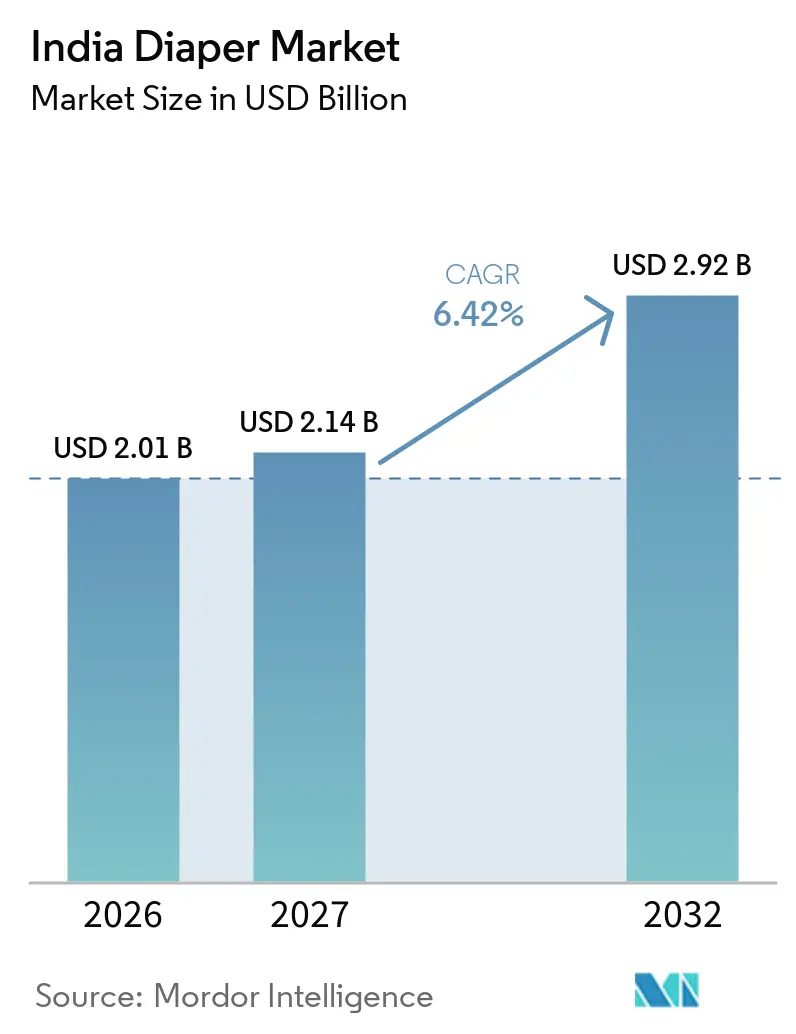
| Base Year Market Size (2026) | USD 2.01 Billion |
| Market Size (2027) | USD 2.14 Billion |
| Market Size (2032) | USD 2.92 Billion |
| Growth Rate (2027 - 2032) | 6.42 % |
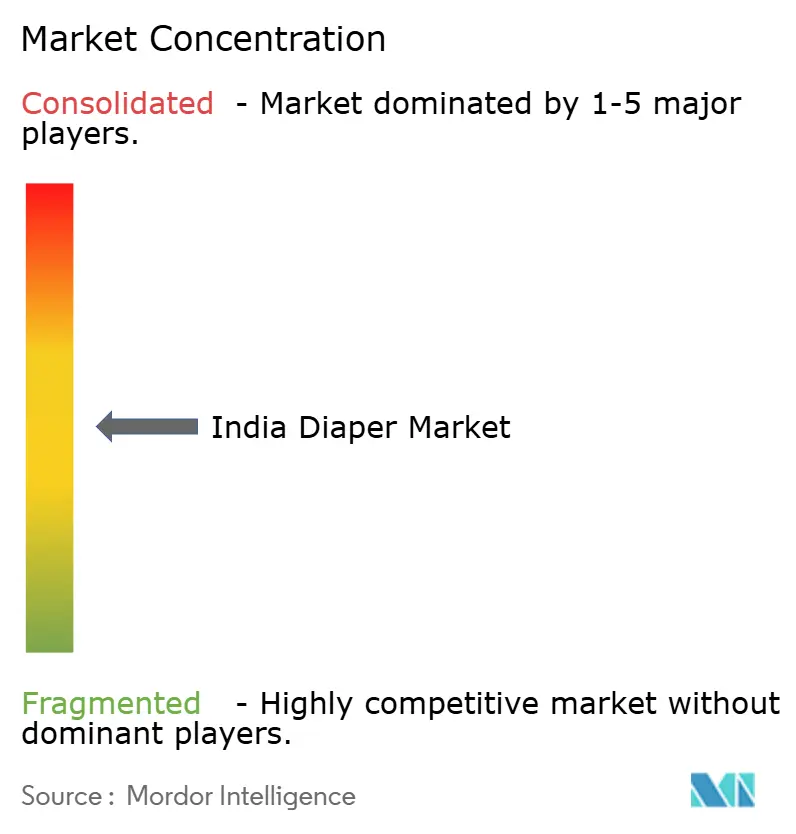
| Market Concentration | Medium |
Major Players *Disclaimer: Major Players sorted in no particular order Image © Mordor Intelligence. Reuse requires attribution under CC BY 4.0. | |
India Diaper Market Analysis by Mordor Intelligence
The India diaper market is expected to grow from USD 2.01 billion in 2026 to USD 2.14 billion by 2027 and USD 2.92 billion by 2032, at a 6.42% CAGR over 2027-2032. The India diaper market is supported by broader use of disposable products among urban households and by rising demand for adult continence care. The September 2025 reduction in goods and services tax on baby and adult diapers from 12% to 5% improves affordability, especially where the price difference from cloth products has delayed conversion [1]. Unicharm completed its Ahmedabad facility in February 2025, adding 30% to its India production capacity and strengthening local supply for the India diaper market. Demand is still constrained by low rural penetration, social discomfort around adult diaper use, and exposure to material costs. These conditions favor companies that can combine accessible prices, reliable distribution, and products suited to different household needs.
Key Report Takeaways
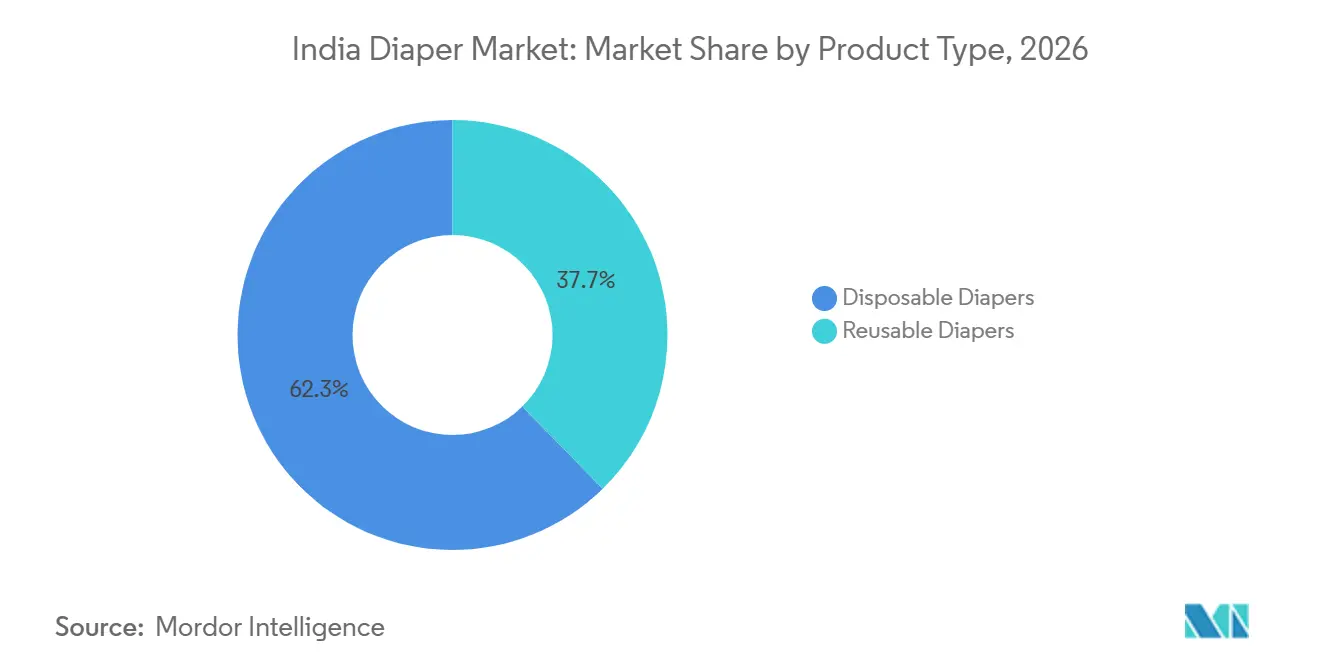
- By product type, Disposable Diapers held 62.31% of the India diaper market share in 2026, while Reusable Diapers are forecast to grow at an 8.20% CAGR through 2032.
- By end-user, Baby Diapers accounted for 47.22% in 2026, while Adult Diapers are projected to expand at a 7.54% CAGR through 2032.
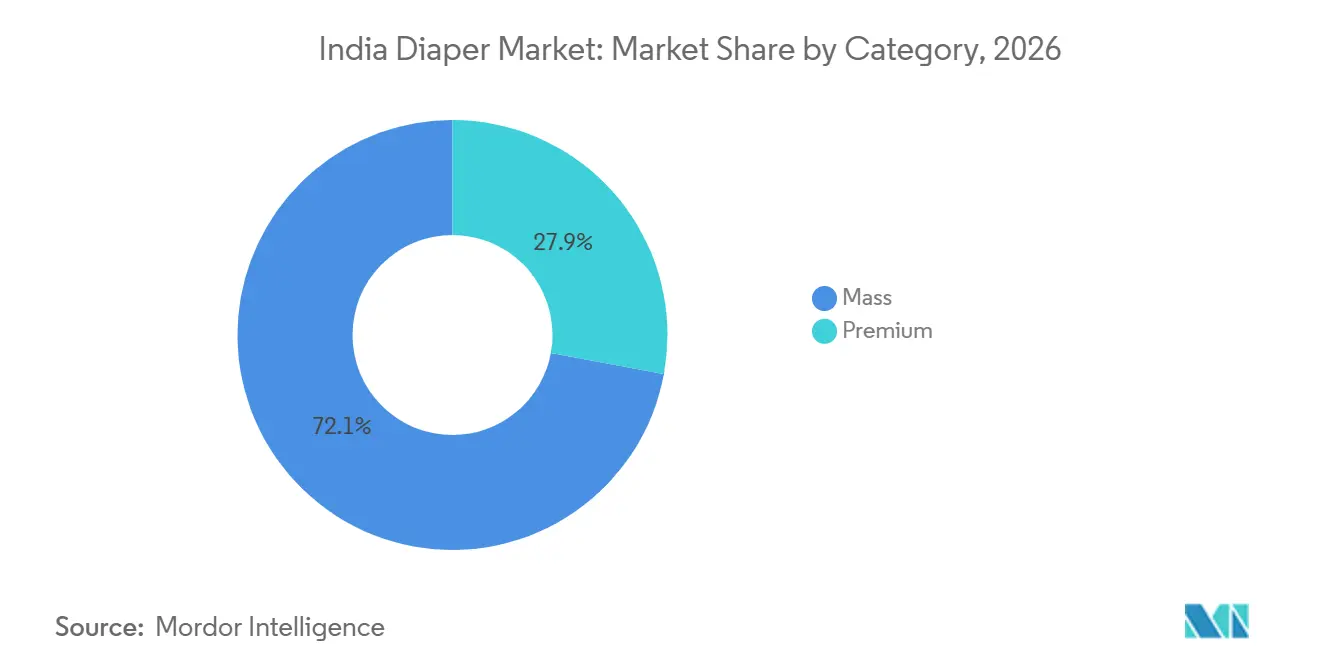
- By category, Mass held a 72.01% share in 2026, while Premium is forecast to advance at a 7.28% CAGR through 2032.
- By distribution channel, Supermarkets and Hypermarkets accounted for a 37.83% share in 2026, while Online Retail Stores are projected to grow at a 6.88% CAGR through 2032.
Note: Market numbers in this report are based on Mordor Intelligence's proprietary estimation framework, which combines nine months of actuals with Q4 projections for base year 2026.
India Diaper Market Trends and Insights
Drivers Impact Analysis*
| Driver | (~) % Impact on CAGR Forecast | Geographic Relevance | Impact Timeline |
|---|---|---|---|
| Rising Awareness of Infant Hygiene Practices | +1.2% | Urban India and Tier-2 cities; expanding to semi-urban markets | Medium term (2-4 years) |
| Growing Prevalence of Adult Urinary Incontinence | +1.1% | Pan-India; concentrated in urban and peri-urban areas | Long term (≥ 4 years) |
| Increasing Awareness of Postpartum Incontinence Management | +0.7% | Urban and peri-urban India; Tier-1 hospital catchment areas | Medium term (2-4 years) |
| Rising Adoption of Convenient Disposable Diapers | +1.0% | Metro cities; Tier-1 and Tier-2 cities | Short term (≤ 2 years) |
| Growing Elderly Population Requiring Continence Care | +0.9% | Pan-India; South and West India with older age-cohort concentration | Long term (≥ 4 years) |
| Increasing Preference for Sustainable Diaper Alternatives | +0.5% | Urban metro cities; D2C-active markets | Medium term (2-4 years) |
| Source: Mordor Intelligence | |||
Rising Awareness of Infant Hygiene Practices
India records an annual birth cohort of 23 million, which provides a large base for infant diaper demand. Awareness remains uneven, leaving considerable room for adoption in India's diaper market. An urban-rural study reported adequate knowledge of correct diaper use among 40.6% of urban mothers and 14.5% of rural mothers [2]. National Health Mission and Poshan Abhiyaan programs support a wider hygiene environment, even though diapers are not provided at scale through these programs [3]. The GST rate cut in September 2025 gives manufacturers a clearer price point when reaching first-time buyers outside the largest cities, according to the Press Information Bureau. Companies can build use of diapers more effectively when education, pack sizes, and price points are aligned with local household budgets.
Growing Prevalence of Adult Urinary Incontinence
Adult diaper demand has a wider clinical base than care for bedridden patients alone. A 2025 study found urinary incontinence among 42.1% of perimenopausal women in its Kerala sample, according to the Asian Journal of Biomedical and Pharmaceutical Sciences. Another 2025 study examined urinary incontinence among women aged 50 years and older in an urban Chennai locality, according to the International Journal of Healthcare Sciences. The India diaper market can therefore serve people managing varying degrees of continence needs in daily life. Greater acceptance of discreet purchasing and self-care can reduce reliance on caregiver-led purchase decisions. Brands that use clear and nonjudgmental language can make adult products more relevant to active users as well as to institutional care settings.
Increasing Awareness of Postpartum Incontinence Management
Postpartum care is a distinct opportunity within the India diaper market because it connects continence needs with maternal recovery. A 2025 observational study found pelvic floor disorders in 63.6% of the postpartum women in its sample, while only 5.96% knew of rehabilitation options, according to the Journal of Health and Allied Sciences. Low awareness can delay care and limit demand for products designed for short-term recovery needs. Hospital catchment areas and urban clinics provide practical settings for education on postpartum continence. Existing adult diaper offerings may address some functional needs, but the supplied evidence does not identify a dedicated branded product for this use. Greater information from healthcare professionals can support more appropriate product selection without treating postpartum care as a stigmatized subject.
Increasing Preference for Sustainable Diaper Alternatives
Reusable Diapers are projected to grow at an 8.20% CAGR through 2032, the highest rate within the product type breakdown. This segment addresses households that consider repeated use, material choice, and waste reduction when purchasing infant care products. Its growth also shows that the India diaper market is not defined only by disposable formats. Reusable products require washing facilities, time, and planning, which makes their current use more practical in urban settings. The model may appeal to parents who compare the repeated cost of disposables with the longer use period of a reusable item. Manufacturers must still provide clear care instructions and dependable quality because poor product experience can reduce repeat use.
Restraints Impact Analysis*
| Restraint | (~) % Impact on CAGR Forecast | Geographic Relevance | Impact Timeline |
|---|---|---|---|
| High Costs of Premium Diaper Products | -1.1% | Tier-2, Tier-3 cities, and rural India; urban price-sensitive segments | Medium term (2-4 years) |
| Cultural Stigma Surrounding Adult Diaper Usage | -0.7% | Pan-India; more acute in semi-urban and rural geographies | Long term (≥ 4 years) |
| Skin Irritation Concerns From Prolonged Usage | -0.5% | Pan-India; relevant across urban and rural consumer segments | Short term (≤ 2 years) |
| Low Penetration of Diapers in Rural Markets | -0.9% | Rural India, 65% of the national population | Long term (≥ 4 years) |
| Source: Mordor Intelligence | |||
High Costs of Premium Diaper Products
Premium product prices continue to limit routine diaper use for many households. Branded disposable diapers cost INR 8 to INR 20 per unit in the supplied material, which can make frequent use difficult for lower-income families. Material costs for superabsorbent polymers and nonwoven fabrics can further restrict manufacturers' ability to lower prices while protecting margins. The GST reduction to 5% provides relief, but it does not remove the price difference between branded products and low-cost alternatives, according to the Press Information Bureau. In the India diaper market, households may reserve diapers for travel or nighttime rather than use them every day. This pattern reduces consumption even when families recognize the product's convenience or hygiene benefits.
Cultural Stigma Surrounding Adult Diaper Usage
Social discomfort remains a barrier to adult diaper adoption, particularly where continence concerns are not openly discussed. Stigma can delay product trial and make caregivers reluctant to seek a suitable product. It can also prevent users with moderate symptoms from considering diapers as a practical everyday option. This restraint matters because the India diaper market depends on greater acceptance among people who are active outside the home. Discreet retail options, clear product information, and practical messaging can reduce some of this hesitation. The issue is likely to persist longer in areas where access to health information and specialized retail is limited.
*Our forecasts treat driver/restraint impacts as directional, not additive. The impact forecasts reflect baseline growth, mix effects, and variable interactions.
Segment Analysis
By Product Type: Disposable Products Lead While Reusable Formats Expand
Disposable Diapers held a 62.31% share in 2026, giving the format a clear position in household purchasing. Pampers, MamyPoko, and Huggies support that position through broad recognition and distribution. Disposable products remain suited to households that prioritize convenience, travel use, and simple changes. Pants-style designs are important because they respond to the needs of mobile children and caregivers. The format still faces competition from cloth alternatives where price and washing routines remain familiar.
Reusable Diapers are forecast to grow at an 8.20% CAGR through 2032, which is the highest product type growth rate in the supplied data. This part of the India diaper market appeals to households that consider repeated use and material choice. Reusables can lower the need for repeated purchases, but their practical value depends on access to washing and drying facilities. That requirement keeps the category more relevant to urban users than to households with constrained home infrastructure. The segment and disposable products serve different needs rather than replacing each other in every household. Product quality and clear usage guidance will remain important for companies seeking repeat purchase in reusable formats.

By End-User: Baby Diapers Provide Scale While Adult Diapers Grow Faster
Baby Diapers accounted for 47.22% of the India diaper market size in 2026. This category benefits from a large annual birth cohort and established consumer brands. Pampers, MamyPoko, and Huggies remain visible in this segment, while Indian suppliers also compete through value-oriented products. Infant hygiene awareness and lower retail prices can support wider use among first-time buyers. The segment has stable demand characteristics because product needs are linked to early childhood care. Yet adoption remains uneven between urban and rural households.
Adult Diapers are forecast to grow at a 7.54% CAGR through 2032, the fastest end-user growth rate in the supplied data. The segment is supported by continence needs that affect more than elderly and bedridden users. A Kerala study reported a 42.1% prevalence rate among perimenopausal women in its sample, according to the Asian Journal of Biomedical and Pharmaceutical Sciences. This gives the India diaper market a broader potential user base, although stigma remains a major constraint. Products that offer comfort, discretion, and easy access can make the category more suitable for active adults. Continued education will be needed before clinical need translates into regular usage for more consumers.
By Category: Mass Products Anchor Volume While Premium Products Add Value
Mass held a 72.01% share in 2026, reflecting the central role of affordability in the India diaper market. Value-oriented products fit the spending capacity of a wide share of households. Major brands can protect volume by offering accessible packs and maintaining quality above unorganized alternatives. The tax reduction provides a further opportunity to reduce entry prices or preserve margins while reaching consumers in smaller cities. Mass products are especially important in locations where cloth still sets the reference price. Companies that can maintain consistent availability have an advantage in this category.
Premium is projected to expand at a 7.28% CAGR through 2032. This category is linked to products that emphasize absorbency, breathable materials, and comfort-related features. Urban households with higher spending capacity may be more willing to pay for those attributes. At the same time, premium pricing creates a clear limit in households where diapers are purchased selectively. The India diaper market must balance skin-safety features and higher-quality materials with the need for accessible prices. The difference between premium and mass offerings may narrow when lower tax costs reduce the absolute price gap.
By Distribution Channel: Physical Retail Retains Reach While Online Stores Gain Speed
Supermarkets and Hypermarkets accounted for 37.83% of the India diaper market size in 2026. Large stores help shoppers compare brands, formats, and pack sizes during planned household purchases. Shelf visibility is especially valuable for companies entering a new city or introducing a differentiated product. Physical retail also supports discovery among buyers who have not previously used branded diapers. Pharmacies and Drugstores have a separate role in adult products because their healthcare setting can make first-time purchases feel more private. Broad physical distribution remains essential because digital access is not uniform across India.
Online Retail Stores are expected to grow at a 6.88% CAGR through 2032. Digital channels can make repeat purchases easier and can reduce discomfort for people buying adult diapers. They also allow brands to explain features and usage before the buyer makes a selection. Online retail does not remove the need for physical distribution because rural access and digital confidence remain variable. The India diaper market can benefit when companies use physical stores for trial and online channels for replenishment. This combined approach is particularly relevant for products where privacy and recurring purchase matter.
Competitive Landscape
The India diaper market has a moderate concentration, with players like Pampers, MamyPoko, Huggies, Procter & Gamble, Unicharm, and Kimberly-Clark competing in diapers through established brands, broad distribution, and product differentiation. Their scale helps them introduce new formats and support large retail networks. Unicharm's investment in its Ahmedabad facility increased India diaper production capacity by 30% in February 2025. This local capacity provides a practical supply advantage as the category expands. Smaller domestic suppliers are more exposed to material cost changes and have less capacity for nationwide brand building.
Competition in baby products includes differences in format, comfort, and price. Pants-style products have become an important point of differentiation for mobile children and busy caregivers. Kimberly-Clark's Huggies launched Natural Soft Overnite Diapers in India in November 2025, targeting nighttime protection with enhanced absorbency and an extended back panel. The India diaper market therefore rewards companies that tailor products to specific occasions rather than relying only on broad category branding. Firms that pass through part of the tax benefit can improve trial among price-sensitive households.
The adult category has a different competitive structure. Friends held more than 50% of the adult diaper category in the supplied material, indicating a strong leadership position within that segment. Nobel Hygiene raised INR 170 crore, equivalent to USD 20 million, in May 2025 to support deeper adult diaper penetration, distribution expansion, and brand investment. The India diaper market also has room for products designed around postpartum continence needs, although the supplied material identifies no dedicated branded product for this use. Companies that approach this need with appropriate education and clear product positioning may create a differentiated offering.
India Diaper Industry Leaders
-
Procter & Gamble
-
Kimberly-Clark Corporation
-
Unicharm Corporation
-
Essity Aktiebolag (publ)
-
Nobel Hygiene Limited
- *Disclaimer: Major Players sorted in no particular order
Recent Industry Developments
- February 2026: India-based Nobel Hygiene introduced Teddyy Bio-Earth, a baby diaper developed in collaboration with Avgol and Polymateria, featuring biodegradable nonwoven materials designed to reduce environmental impact. The company claims that approximately 75% of the diaper's total weight is biodegradable within two years under specified environmental conditions, marking an advancement in sustainable diaper manufacturing.
- April 2025: Swara Baby Products (Baby Hug Pro) launched India's first tree-free diaper technology under its Baby Hug Pro brand, which cuts wood pulp usage from 100% to about 7%. The company recently received SEBI approval for an INR 1,000 crore IPO to fund a new manufacturing facility in Madhya Pradesh.
- February 2025: Unicharm Corporation completed its third Indian manufacturing facility in Ahmedabad, Gujarat, representing a USD 131 million total investment. The plant, replacing a facility destroyed by fire in 2020, raises Unicharm's total India diaper production capacity by 30% and incorporates advanced fire-safety systems and 35,000 square meters of future solar infrastructure, aligning with the company's 2030 renewable-energy transition target.
India Diaper Market Report Scope
The India diaper market encompasses the manufacturing, distribution, and sale of disposable and reusable diapers designed for babies and adults, addressing hygiene, comfort, and incontinence management needs. The India Diaper Market is Segmented by Product Type (Disposable Diapers and Reusable Diapers), End-User (Baby Diaper and Adult Diaper), Category (Premium and Mass), and Distribution Channel (Supermarkets and Hypermarkets, Pharmacies and Drugstores, Online Retail Stores, and Other Distribution Channels). The Market Forecasts are Provided in Terms of Value (USD).
| Disposable Diapers |
| Reusable Diapers |
| Baby Diaper |
| Adult Diaper |
| Premium |
| Mass |
| Supermarkets and Hypermarkets |
| Pharmacies and Drugstores |
| Online Retail Stores |
| Other Distribution Channels |
| By Product Type | Disposable Diapers |
| Reusable Diapers | |
| By End-User | Baby Diaper |
| Adult Diaper | |
| By Category | Premium |
| Mass | |
| By Distribution Channel | Supermarkets and Hypermarkets |
| Pharmacies and Drugstores | |
| Online Retail Stores | |
| Other Distribution Channels |
Key Questions Answered in the Report
What is the projected growth rate for diapers in India?
The category is forecast to grow at a 6.42% CAGR from 2027 to 2032, reaching USD 2.92 billion by 2032.
Which product type has the largest share in India?
Disposable Diapers led with 62.31% share in 2026, supported by convenience and broad brand availability.
Which diaper segment is growing fastest in India?
Reusable Diapers are projected to grow at an 8.20% CAGR through 2032, the highest rate by product type.
Why are adult diapers gaining demand in India?
Adult Diapers are forecast to expand at a 7.54% CAGR through 2032, supported by broader awareness of continence care and discreet purchasing options.