
India Container Homes Market Size and Share
Market Overview
| Study Period | 2021 - 2032 |
|---|---|
| Forecast Data Period | 2027 - 2032 |
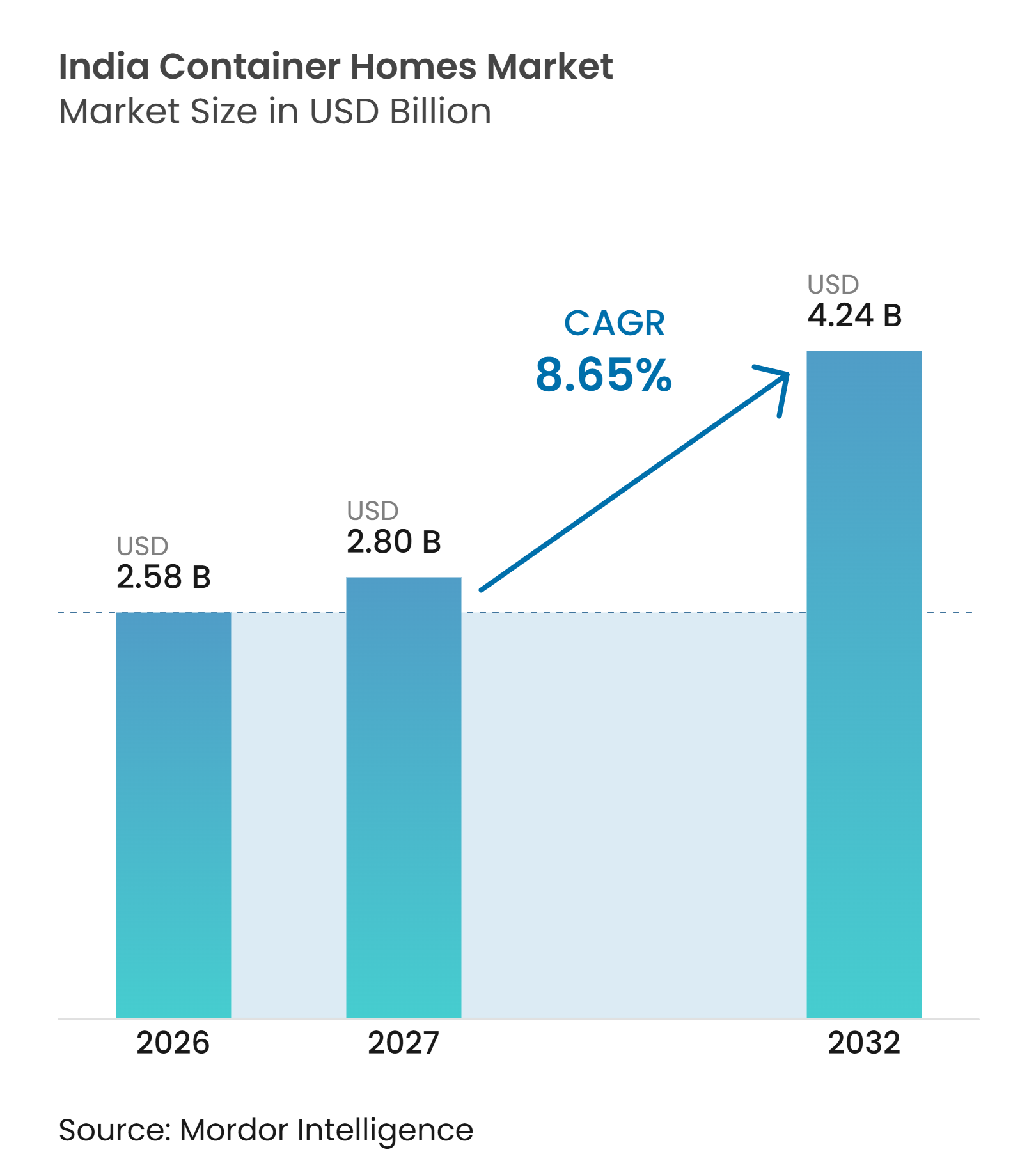
| Base Year Market Size (2026) | USD 2.58 Billion |
| Market Size (2027) | USD 2.80 Billion |
| Market Size (2032) | USD 4.24 Billion |
| Growth Rate (2027 - 2032) | 8.65 % |
| Market Concentration | Low |
Major Players *Disclaimer: Major Players sorted in no particular order Image © Mordor Intelligence. Reuse requires attribution under CC BY 4.0. | |
India Container Homes Market Analysis by Mordor Intelligence
The India Container Homes Market size stood at USD 2.58 billion in 2026 and is projected to reach USD 2.80 billion in 2027 and USD 4.24 billion by 2032, registering a CAGR of 8.65% between 2027 and 2032.
The India container homes market is supported by demand for affordable urban housing, temporary project accommodation, and relocatable emergency shelter. Pradhan Mantri Awas Yojana Urban 2.0, known as PMAY-U 2.0, sanctioned 18.3 lakh homes by August 2026 and provides a policy route for alternative construction technologies through its Technology and Innovation Sub-Mission. The National Monetization Pipeline 2.0 is also creating a multi-year base of highway, rail, power, port, and urban projects that need fast site accommodation. The India container homes market therefore favors suppliers that can provide certified units, repeatable factory processes, and reliable delivery schedules. Thermal control, corrosion protection, municipal approvals, and finance availability remain material limits on residential adoption.
Key Report Takeaways
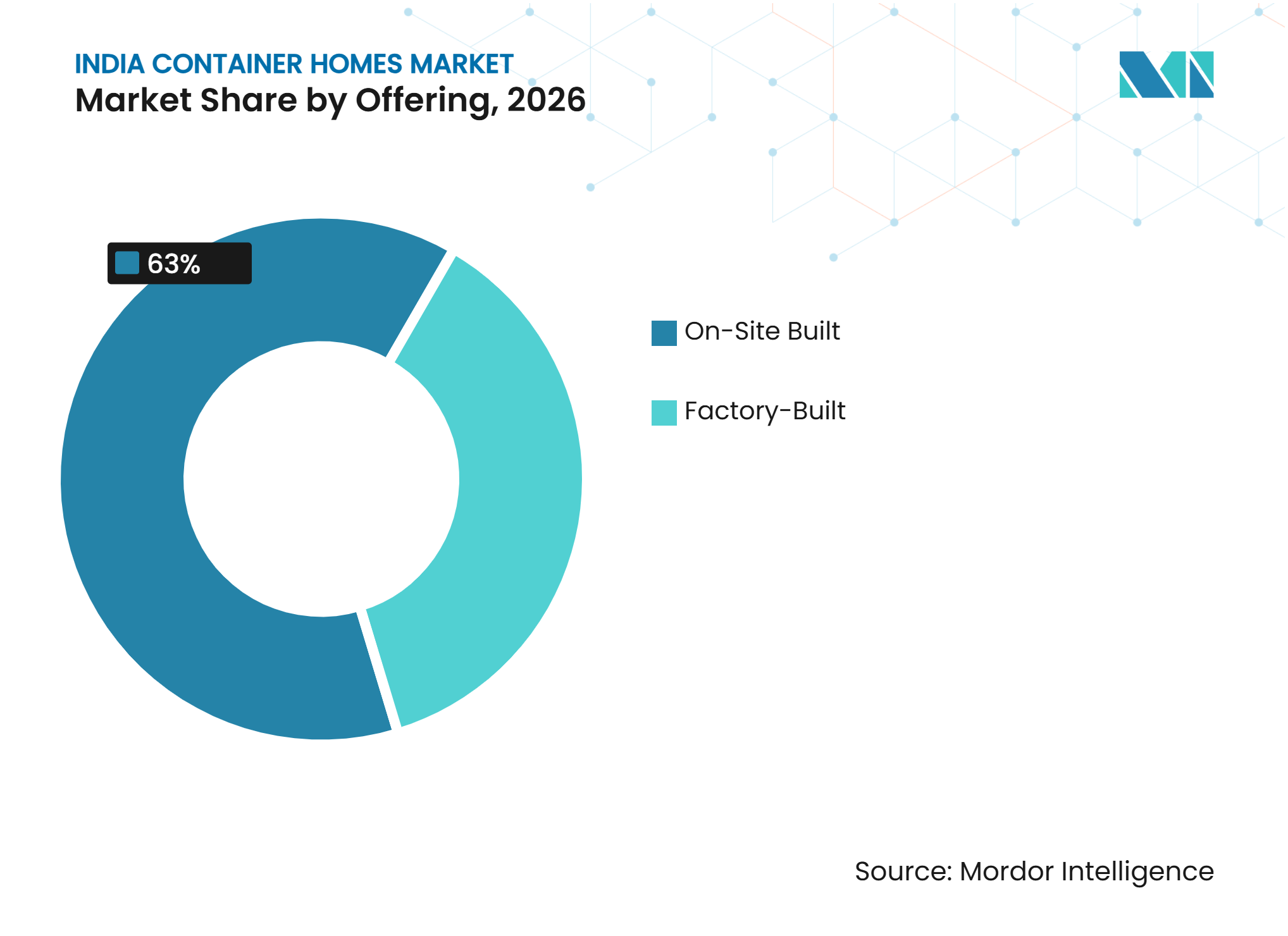
- By offering, on-site built structures held 63% of the India container homes market share in 2026, while factory-built units are projected to expand at a 9.55% CAGR through 2032.
- By construction type, fixed structures accounted for 54.5% of the India container homes market size in 2026, while movable structures are forecast to grow at a 9.8% CAGR through 2032.
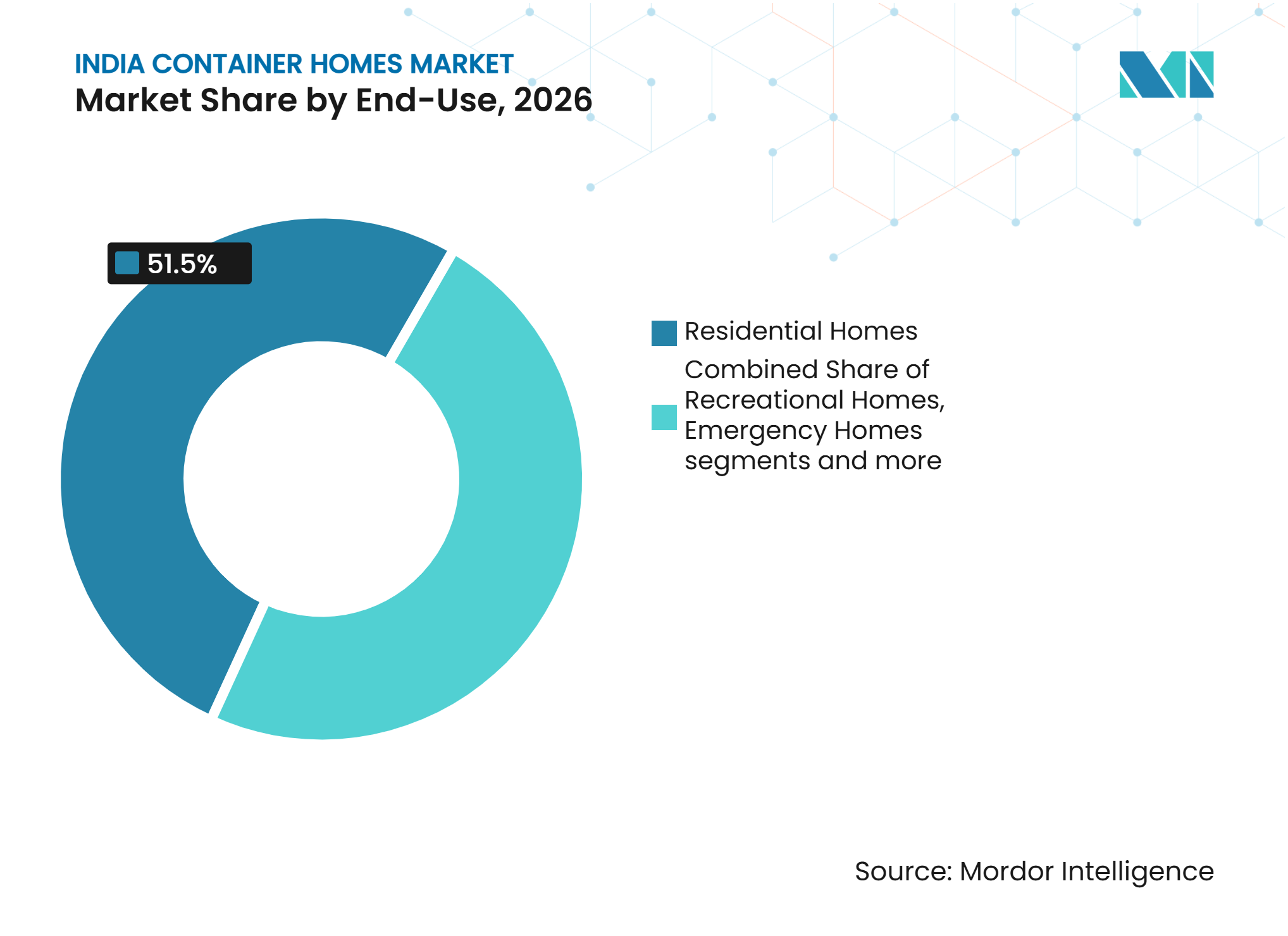
- By end use, residential homes represented 51.5% of the India container homes industry share in 2026, while emergency homes are expected to grow at a 10.1% CAGR through 2032.
- By state, West India held 31% of the India container homes market size in 2026, while South India is forecast to grow at a 9.2% CAGR through 2032.
Note: Market numbers in this report are based on Mordor Intelligence's proprietary estimation framework, which combines nine months of actuals with Q4 projections for base year 2026.
Market Trends and Insights
Drivers Impact Analysis of India Container Homes Market*
| Drivers | (~) % Impact on CAGR Forecast | Geographic Relevance | Impact Timeline |
|---|---|---|---|
| Affordable Housing Programs and Urban Growth | +2.5% | North, West, and South India urban clusters | Medium term (2-4 years) |
| Low-Cost and Fast Construction | +1.8% | Pan-India, with early gains in metro and tier-2 cities | Short term (≤ 2 years) |
| Infrastructure Labor Camps and Site Accommodation | +1.5% | Pan-India highway, rail, and power corridors | Medium term (2-4 years) |
| Disaster-Relief Housing | +1.2% | Assam, Odisha, and the South India coastal belt | Short term (≤ 2 years) |
| Tourism, Farmhouse, and Hospitality Units | +0.8% | South and West India, and North India hill stations | Long term (≥ 4 years) |
| Source: Mordor Intelligence | |||
Affordable Housing Programs and Urban Growth
PMAY-U 2.0 is central to the India container homes market because it links affordable housing demand with technology-based construction. The program provides financial assistance of up to INR 2.5 lakh (USD 2,869.18) per unit for 1 crore additional urban families by 2029 under Beneficiary-Led Construction, Affordable Housing in Partnership, Affordable Rental Housing, and the Interest Subsidy Scheme[1]. The program had sanctioned 18.3 lakh dwellings by August 2026, including 14.4 lakh through Beneficiary-Led Construction. Its Technology and Innovation Sub-Mission gives technology suppliers a route to demonstrate compliant systems in public housing projects. The Affordable Housing in Partnership vertical had sanctioned 23,602 homes across 16 states in 2026, showing that institutional demand is geographically broad[2]. Factory-made units are well placed where project milestones, geotagging, and payment controls require predictable construction progress.
Low-Cost, Fast Construction Versus Conventional Builds
Speed remains a practical purchasing factor for the India container homes industry, particularly when a project must be occupied quickly. Off-site fabrication lets foundation and site preparation progress while the unit is produced under controlled factory conditions. This process reduces the amount of work that must be completed after materials reach the location. It also offers a clearer production sequence than a fully site-built structure, which can be affected by weather, labor availability, and local material delivery. The construction benefit is strongest for standardized layouts that can be repeated across worker accommodation, small dwellings, and service units. Buyers still assess the full installed cost because insulation, coatings, plumbing, electrical work, and transport can narrow the initial cost advantage.
Labor Camps and Site Accommodation for Infrastructure Projects
The National Monetization Pipeline 2.0 supports demand for project accommodation across the India container homes market. The program covers INR 16.7 lakh crore (USD 191.66 billion) of infrastructure asset monetization for fiscal years 2026 through 2030, including INR 5.8 lakh crore (USD 66.56 billion) of private investment. Its coverage of highways, railways, ports, power, and urban infrastructure creates a recurring need for durable accommodation at active sites. Container units can be specified as bunkhouses, offices, washroom facilities, kitchens, or storage spaces, allowing a contractor to build a functional camp with repeatable components. Movable units are useful where workfronts shift along a corridor or where contractors need to recover the unit after a project phase ends. The Ministry of Housing and Urban Affairs has also discussed a scheme to support temporary housing for construction workers through labor cess funds, which could strengthen formal procurement once implemented.
Disaster-Relief Housing
Disaster response provides a separate demand channel for the India container homes market because emergency shelter must be supplied quickly and remain usable beyond an immediate crisis. India uses national and state disaster management systems to coordinate response and recovery across floods, cyclones, earthquakes, and other events. The National Disaster Management Authority works with State Disaster Management Authorities and the National Disaster Response Force during these events. Container units can offer a lockable and reusable alternative to short-life tent accommodation when they are designed for transport and repeated deployment. After a relief period, the same units may serve as worker housing, local offices, classrooms, or permanent dwellings where approvals permit. This reuse potential can improve asset utilization, although performance in hot and humid climates still depends on adequate insulation, ventilation, drainage, and corrosion control.
Restraints Impact Analysis of India Container Homes Market*
| Restraints | (~) % Impact on CAGR Forecast | Geographic Relevance | Impact Timeline |
|---|---|---|---|
| Heat, Humidity, and Corrosion Performance | -1.2% | Warm-humid coastal zones in South and West India | Long term (≥ 4 years) |
| Price Competition from Masonry and Portable Cabins | -0.8% | Pan-India tier-2 and tier-3 markets | Short term (≤ 2 years) |
| Limited Finance for Non-Conventional Homes | -0.6% | Rural and semi-urban clusters across all states | Medium term (2-4 years) |
| Unclear Municipal Approval Routes | -0.5% | Urban agglomerations across all states | Medium term (2-4 years) |
| Source: Mordor Intelligence | |||
Heat, Humidity, and Corrosion Performance
Thermal and moisture performance is a persistent restraint for the India container homes market. The National Building Code of India identifies 5 climate zones, including hot-dry, warm-humid, composite, temperate, and cold conditions, which require different building responses[3]. Steel enclosure systems need insulation, vapor control, roof treatment, and ventilation that match local temperature and humidity conditions. Coastal locations also expose steel surfaces to moisture and salt-laden air, increasing the need for durable protective coatings and routine inspection. These measures add cost and require capable installation practices, especially in warm-humid parts of Tamil Nadu, Kerala, West Bengal, and coastal Karnataka. Suppliers that document thermal and structural performance can reduce risk for institutional buyers, but the additional specification remains a barrier for low-budget residential projects.
Price Competition from Masonry and Low-Cost Portable Cabins
Price competition constrains the India container homes market where masonry labor and conventional material supply remain readily available. A basic container shell does not represent the delivered cost of a habitable dwelling. Insulation, weather coatings, window openings, internal finishes, bathrooms, kitchens, transport, lifting, and site connections can all add to the final price. Low-cost portable cabins can also compete for temporary use cases where buyers place less value on long-term durability or architectural flexibility. This makes speed, mobility, and quality control important parts of the value proposition instead of relying only on an upfront price comparison. In tier-2 and tier-3 locations, suppliers must show how a relocatable unit can save time, preserve asset value, or meet a specialized site need.
*Our forecasts treat driver/restraint impacts as directional, not additive. The impact forecasts reflect baseline growth, mix effects, and variable interactions.
India Container Homes Market Segment Analysis
By Offering:
On-Site Assembly Anchors the Market, Factory-Built Gains GroundOn-site-built structures held 63% of the India container homes market share in 2026, supported by their use in labor camps and affordable housing projects. These units are assembled from prefabricated steel panels and container shells at the project site. The approach helps contractors adapt layouts to uneven land, constrained locations, and changing local requirements. It can also reduce the need to transport a completed module by crane or specialized vehicle. On-site assembly remains relevant where a project needs customized room sizes, phased installation, or a lower initial transport burden. The India container homes industry continues to use this model for dispersed projects where local assembly teams are available.
Factory-built units are forecast to record a 9.55% CAGR through 2032, making them the faster-growing offering. Their appeal rests on repeatable production, greater process control, and clearer documentation of what has been built before delivery. The Technology and Innovation Sub-Mission under PMAY-U 2.0 encourages construction approaches that can demonstrate approved technologies for public housing. A factory setting can support standard checks for structure, insulation placement, finishes, and utility interfaces before the unit reaches the site. This format is useful for institutional customers that need a reliable handover date and consistent unit quality. The India container homes market is therefore likely to retain a large on-site base while factory-built systems gain importance in standardized and compliance-sensitive projects.


By Construction Type:
Fixed Structures Dominate, Movable Units Outpace the MarketFixed structures accounted for 54.5% of the India container homes market size in 2026, reflecting demand for residential, nursing home, and long-duration site accommodation uses. These units are usually placed on engineered foundations when a project requires a stable location and a permanent service connection. Structural modification of a steel unit must be assessed carefully because door openings, window openings, and combined modules can change load behavior. IS 800:2007 provides a code of practice for general steel construction in India. Fixed projects also face a more detailed local approval process because planning authorities may treat them as permanent buildings. This position makes technical documentation, structural sign-off, and utility planning important during early design.
Movable units are projected to grow at a 9.8% CAGR through 2032, exceeding the overall market forecast. Their main benefit is that they can move between project locations rather than remain tied to a single site. This supports highway, rail, power, and urban construction programs where the workforce must follow active workfronts. The National Monetization Pipeline 2.0 offers a broad infrastructure setting for this use case, with a fiscal 2026-2030 project horizon. Movable units can also be staged for emergency response or repositioned for seasonal hospitality activity. In many locations, their temporary nature may simplify deployment, but buyers still need to verify local rules for placement, services, safety, and occupancy.
By End Use:
Residential Demand Anchors Market, Emergency Segment AcceleratesResidential homes represented 51.5% of the India container homes market share in 2026, making housing the largest end-use category. Demand includes urban households seeking a lower-maintenance home, rural households building on owned land, and buyers interested in compact second homes. Public housing policy strengthens this demand base because PMAY-U 2.0 is designed to expand access to urban housing through several support channels. Residential adoption depends on more than the container itself because a finished home must meet expectations for comfort, durability, water, sanitation, power, and local approvals. The India container homes industry must therefore compete with conventional construction on delivered living quality as well as installation speed.
Emergency homes are forecast to grow at a 10.1% CAGR through 2032, the highest rate among end-use categories. Their role is shaped by the need for durable shelter that can be mobilized after floods, cyclones, and other disruptive events. A reusable steel-framed unit can remain in service after a response period if it is maintained and repositioned appropriately. It may later support worker accommodation, classrooms, clinics, or local government facilities. The National Disaster Management Authority and state agencies provide an institutional framework for disaster preparedness and response in India. Suppliers that provide transportable units with clear safety, hygiene, and climate specifications have a stronger basis to serve this use case. This opportunity does not remove the need for local storage, maintenance plans, and procurement procedures before an emergency occurs.


Geography Analysis
West India
West India accounted for 31% of the India container homes market share in 2026, supported by the scale and diversity of its construction activity. Maharashtra has demand across metropolitan housing, industrial development, hospitality, and workforce accommodation. Gujarat benefits from port-linked container access, which can reduce logistical friction for manufacturers that source container shells or related materials. Rajasthan adds a separate farmhouse and tourism demand base, particularly where buyers value compact structures that can be installed on privately held land. Under PMAY-U 2.0, the Affordable Housing in Partnership component had sanctions in 16 states in 2026, supporting a wider institutional setting for approved construction methods. The regional opportunity is strongest for suppliers that combine site planning with documented structural and thermal performance. Compliance with the National Building Code and relevant steel construction requirements influences how permanent projects proceed.
South India
South India is forecast to grow at a 9.2% CAGR through 2032, giving it the fastest regional expansion rate in the India container homes market. Karnataka has technology corridors and a surrounding market for farmhouses and smaller hospitality assets. Tamil Nadu combines industrial demand with a coastal environment that requires careful material and moisture management. Kerala’s tourism activity can support compact accommodation concepts, while Andhra Pradesh and Telangana add construction and secondary-city demand. The climate range across the region requires insulation, ventilation, rain management, and protective coatings that are selected for the specific location. The National Building Code identifies warm-humid and composite conditions that are relevant to this design process. Suppliers that make these measures part of the base specification can address buyer concerns around comfort and service life. This regional growth is therefore connected to product adaptation as much as to new demand.
North, East, and Central India
North India is shaped by infrastructure contracting and demand for portable farmhouses near large urban centers. The National Monetization Pipeline 2.0 allocates INR 4.4 lakh crore (USD 50.50 billion) to highways and logistics parks, which can support site accommodation needs along major corridors. East India has a different use pattern because recurrent flood and cyclone exposure can create demand for relocatable shelter and pre-positioned units. This setting favors models that can be transported, installed, maintained, and then reused after the immediate response period. Central India is developing through state housing activity and energy infrastructure projects, which can create demand for both dwellings and workforce facilities. Across these mixed geographies, the India container homes market must address wide differences in climate, municipal practices, and transport distance. The Reserve Bank of India housing finance directions define housing finance activity, but they do not specifically resolve every lending question related to non-conventional dwellings. Clearer financial treatment could improve the residential case in smaller cities and semi-urban locations.
Competitive Landscape
Market Concentration
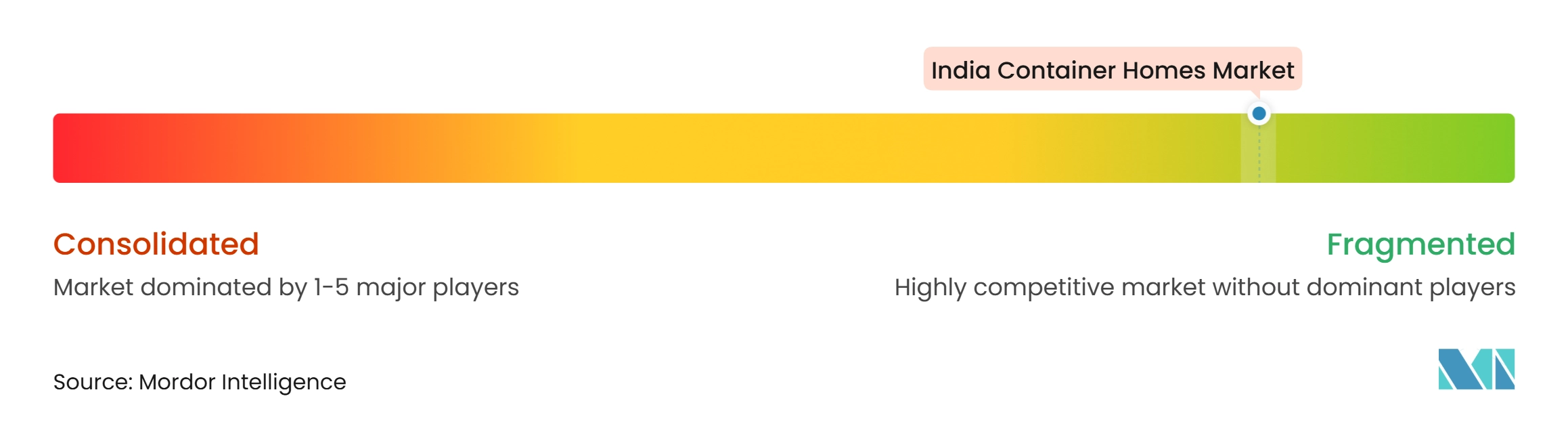
The India container homes market is fragmented in nature, with no single supplier having a dominant national position, so local delivery capability, price, and product adaptation are important competitive factors. Smaller fabricators often serve infrastructure and temporary accommodation demand where response time and local service matter. Specialized modular suppliers focus more on residential, hospitality, and institutional customers that want consistent finish quality and documented performance. PMAY-U 2.0 gives approved technologies a route into public housing projects, which makes compliance capability a meaningful competitive advantage.
Competition increasingly depends on whether a supplier can deliver a complete building solution rather than a basic steel shell. The National Building Code and IS 800:2007 are relevant reference points for structural design and prefabricated building systems. Suppliers can differentiate through insulation packages, corrosion control, utility integration, standard floor plans, and installation support. Factory-built systems may have an advantage where customers need repeatable quality checks before dispatch. On-site assembly remains competitive where projects need flexible layouts and lower transport complexity. The India container homes market therefore supports different operating models instead of a single preferred production format.
Strategic positioning is also moving toward use cases with defined procurement needs, including labor accommodation, emergency shelter, care facilities, and tourism projects. Infrastructure demand is supported by the fiscal 2026-2030 National Monetization Pipeline 2.0, which creates a relevant customer base for relocatable units. Public housing suppliers can seek technology recognition under PMAY-U 2.0, while residential suppliers must address buyer concerns on finance and municipal acceptance. The market has room for solutions that link design, production, installation, and after-sales service.
India Container Homes Industry Leaders
-
Champion Prefabs
-
Champion Infratech
-
GGR Enterprises
-
Bombay Portable Cabins Private Limited
-
Eeco Portable Solutions Private Limited
- *Disclaimer: Major Players sorted in no particular order
India Container Homes Market Companies Covered in this Report
- Champion Prefabs
- Champion Infratech
- GGR Enterprises
- Bombay Portable Cabins Private Limited
- Eeco Portable Solutions Private Limited
- Metasteel Prefab Private Limited
- Prp Steel Buildings Private Limited
- Arportable Cabins India Private Limited
- Perfect Prefab Private Limited
- Innbox Modular Prefab
- Metastar Infra Private Limited
- Seema Containers & Prefab
- AB Sea Container Pvt. Ltd.
- The Habitainer (Praxis Labs Private Limited)
- Unique Engineering Works
- Hayajami Porta Solutions Private Limited
- Royal Prefab
- EPACK Prefab Private Limited
- Ascent Porta
- Sfab Engineers (I) Private Limited
Recent Industry Developments in India Container Homes Market
- October 2026: The Indian Army issued a GEM tender for four container-based, field-relocatable shelters for delivery to Chamoli, Uttarakhand. The procurement covered the shelter structures and associated components, including wall panels, flooring, roofing, doors, windows, a solar power system, an erection gantry, and sanitary and electrical fittings.
- October 2026: Tata Power advertised a tender for prefabricated construction works for a labor colony at its proposed 1,800 MW Shirawta Pumped Storage Project in Pune district, Maharashtra. The procurement indicates demand for prefabricated site-accommodation facilities during the development of large-scale energy infrastructure projects.
- September 2026: The Sports Authority of India (SAI) deployed container-based accommodation prototypes at facilities in Patiala and Bengaluru to help athletes preparing for the Asian Games acclimatize.
India Container Homes Market Report Scope
Segmentation Overview
| Factory-Built |
| On-Site Built |
| Fixed |
| Movable |
| Residential Homes |
| Recreational Homes |
| Emergency Homes |
| Nursing Homes |
| North India |
| South India |
| West India |
| East India |
| Central India |
| By Offering | Factory-Built |
| On-Site Built | |
| By Construction Type | Fixed |
| Movable | |
| By End-Use | Residential Homes |
| Recreational Homes | |
| Emergency Homes | |
| Nursing Homes | |
| By Region | North India |
| South India | |
| West India | |
| East India | |
| Central India |
Key Questions Answered in the Report
What is the projected size of India container homes by 2032?
The India container homes market is forecast to reach USD 4.24 billion by 2032, growing at an 8.65% CAGR from 2027 to 2032.
Which offering leads container homes demand in India?
On-site built structures lead with a 63% share in 2026, while factory-built units have the fastest offering-level growth at a 9.55% CAGR.
Why are movable container homes gaining adoption in India?
Movable structures are forecast to grow at a 9.8% CAGR because they can follow infrastructure work fronts and support temporary or emergency deployment.
Which end use is growing fastest for container homes in India?
Emergency homes are forecast to expand at a 10.10% CAGR through 2032, supported by demand for reusable and quickly deployable shelter.
Which part of India has the fastest growth outlook for container homes?
South India is projected to grow at a 9.20% CAGR through 2032, supported by technology, industrial, tourism, and secondary-city demand.
What limits wider residential adoption of container homes in India?
Buyers face thermal and corrosion requirements, installed-cost pressure, unclear municipal pathways, and limited finance options for non-conventional dwellings. These factors are especially relevant when purchasers compare a finished unit with locally available masonry housing.