
Hypochlorous Acid Market Size and Share
Market Overview
| Study Period | 2021 - 2031 |
|---|---|
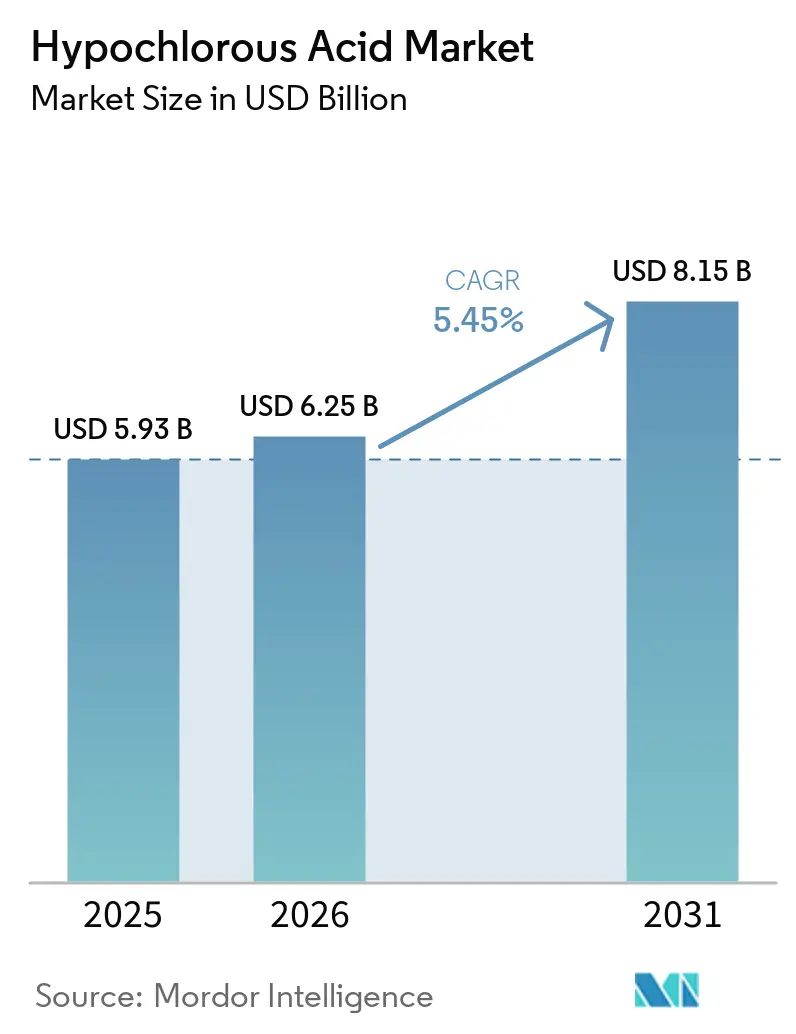
| Market Size (2026) | USD 6.25 Billion |
| Market Size (2031) | USD 8.15 Billion |
| Growth Rate (2026 - 2031) | 5.45 % |
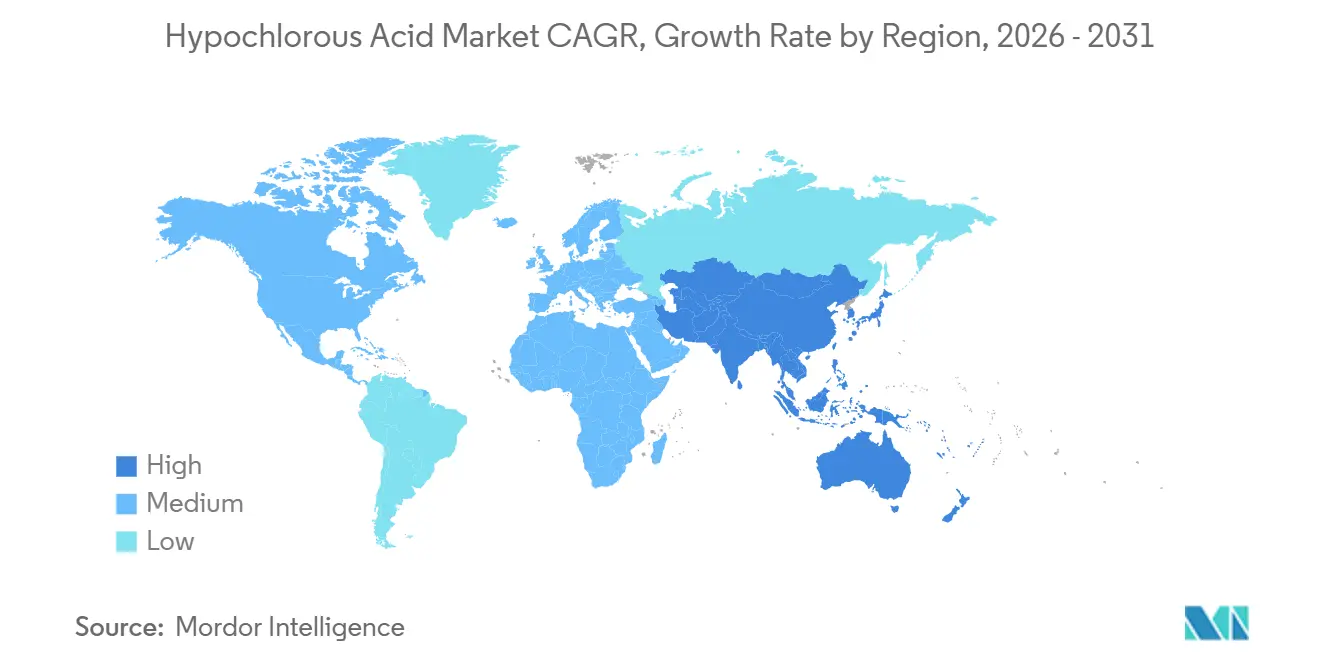
| Fastest Growing Market | Asia-Pacific |
| Largest Market | North America |
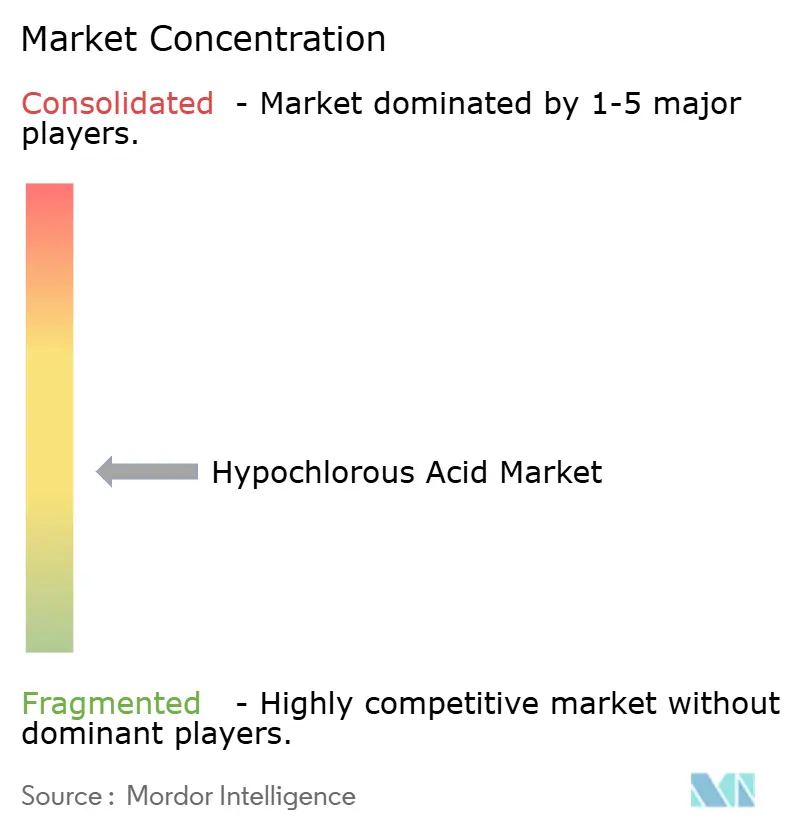
| Market Concentration | Medium |
Major Players *Disclaimer: Major Players sorted in no particular order Image © Mordor Intelligence. Reuse requires attribution under CC BY 4.0. | |
Hypochlorous Acid Market Analysis by Mordor Intelligence
The Hypochlorous Acid Market size was valued at USD 5.93 billion in 2025 and is estimated to grow from USD 6.25 billion in 2026 to reach USD 8.15 billion by 2031, at a CAGR of 5.45% during the forecast period (2026-2031). Demand is moving toward disinfectants that leave limited residue and offer a favorable safety profile for people and the environment. Buyers are also increasing their use in wound management, food processing, water systems, and institutional cleaning. On-site electrochemical generation is changing procurement because facilities can produce solutions where they are used instead of relying on bulk deliveries. This model reduces exposure to hazardous transport requirements and supply disruptions while creating recurring demand for equipment, cartridges, and service. Product instability, fragmented regulation, and different efficacy requirements across countries continue to limit the speed of adoption in the hypochlorous acid market.
Key Report Takeaways
- By product type, sodium hypochlorite held 54.67% of the hypochlorous acid market share in 2025, while calcium hypochlorite is projected to advance at a 6.56% CAGR through 2031.
- By application, disinfecting agent held 43.13% of the hypochlorous acid market share in 2025 and is projected to advance at a 6.87% CAGR through 2031.
- By end-use industry, water treatment held 40.56% of the hypochlorous acid market share in 2025, while agriculture and horticulture are projected to advance at a 6.33% CAGR through 2031.
- By geography, North America held 37.06% of the hypochlorous acid market share in 2025, while Asia-Pacific is projected to advance at a 5.89% CAGR through 2031.
Note: Market size and forecast figures in this report are generated using Mordor Intelligence’s proprietary estimation framework, updated with the latest available data and insights as of January 2026.
Market Trends and Insights
Drivers Impact Analysis of Hypochlorous Acid Market*
| Driver | (~) % Impact on CAGR Forecast | Geographic Relevance | Impact Timeline |
|---|---|---|---|
| Demand for Safer, Low-Residue Disinfection | +1.5% | Global, with highest velocity in North America and Northern Europe | Short term (≤ 2 years) |
| Expansion of Healthcare-Associated Infection Control | +1.2% | North America & EU core; spill-over to APAC and MEA | Medium term (2–4 years) |
| Growth of Municipal and Industrial Water Reuse | +0.9% | North America, Australia, Middle East, and water-stressed APAC markets | Medium term (2–4 years) |
| Food-Safety and Fresh-Produce Sanitization Requirements | +0.8% | Global, with concentrated impact in North America, EU, and APAC export corridors | Short term (≤ 2 years) |
| On-Site Generation Reducing Chemical Logistics Exposure | +0.7% | Global; highest adoption momentum in EU, US, and urban APAC hubs | Long term (≥ 4 years) |
| Source: Mordor Intelligence | |||
Demand for Safer, Low-Residue Disinfection
Institutional and consumer buyers are reassessing disinfectant portfolios for residue toxicity, environmental persistence, and human safety. Hypochlorous acid degrades to a dilute saline solution after use, which supports use in food processing and pediatric healthcare settings. The World Health Organization review published in 2025 found strong in vitro bactericidal activity for hypochlorous acid among chlorine-based compounds and reported no observed toxicity to mammalian cells in the evidence reviewed for wound care[1]. The review also compared its safety and antimicrobial evidence favorably with povidone-iodine for wound care. Procurement teams can use this evidence when considering a switch from legacy biocides, which can shorten the path from testing to wider use in the hypochlorous acid market. The same safety profile is relevant when facilities must balance cleaning performance with worker exposure, product residue, and the need to use a solution on frequently touched surfaces.
Expansion of Healthcare-Associated Infection Control
The United States recorded an estimated 518,000 healthcare-associated infections in acute-care hospitals in 2023, affecting one in 38 hospitalized patients on a given day. Surgical site infection rates moved unfavorably in 2024, which renewed attention to hospital disinfection procedures. Hypochlorous acid is used in clinical settings where organizations need solutions that are effective against drug-resistant pathogens and tolerated on sensitive surfaces. The World Health Organization's global action plan for infection prevention and control for 2024 to 2030 calls for investment in programs that prevent healthcare-associated infection. Wound irrigation creates a separate clinical opportunity for producers with stabilized formulations and the regulatory support needed for medical claims. This use requires clinical evidence and product consistency, which separates medical-oriented suppliers from producers focused only on general cleaning applications.
Growth of Municipal and Industrial Water Reuse
Municipal potable-water systems, wastewater reclamation plants, and cooling-tower circuits remain important demand settings for chlorine-based oxidants. Water systems require dependable disinfection and residual maintenance across their distribution networks. Existing dosing, monitoring, and residual measurement infrastructure has long been built around hypochlorite chemistry. This installed base supports recurring demand even where utilities face pressure to reduce chemical handling risks. The hypochlorous acid market can benefit when water reuse projects expand, although operators will continue to assess the stability, delivery format, and cost of each solution. Municipal and industrial users also need solutions that fit their existing operating procedures, which makes compatibility with established equipment an important adoption consideration.
Food-Safety and Fresh-Produce Sanitization Requirements
Fresh-produce contamination events have increased attention to sanitation practices in North America, the European Union, and Asia-Pacific export markets. The United States Food and Drug Administration issued Food Contact Notification 1811 for electrolytically generated hypochlorous acid used with meat, poultry, fish, seafood, fruits, vegetables, and shell eggs. Japan revised its Organic Processed Food Japanese Agricultural Standard in July 2024 to permit electrolytic hypochlorous acid water as a sterilant for post-harvest organic produce. This change widened the addressable use of the hypochlorous acid market in certified organic supply chains. Continuous-mist sanitation in cold storage and packing facilities is also gaining attention, where limits on chlorine residue in recirculated air restrict other options. This extends the role of hypochlorous acid beyond wash-water treatment and gives operators another way to manage sanitation between handling cycles.
Restraints Impact Analysis of Hypochlorous Acid Market*
| Restraint | (~) % Impact on CAGR Forecast | Geographic Relevance | Impact Timeline |
|---|---|---|---|
| Concentration and Shelf-Life Sensitivity | -1.1% | Global; most acute in tropical, high-temperature markets in Southeast Asia, MEA, and South America | Short term (≤ 2 years) |
| Fragmented, Claim-Specific Regulatory Classification | -0.7% | Global | Medium term (2–4 years) |
| Limited Standardization of Efficacy and Contact-Time Claims | -0.5% | Global, with greatest cost impact in healthcare procurement and export-market registration cycles | Medium term (2–4 years) |
| Source: Mordor Intelligence | |||
Concentration and Shelf-Life Sensitivity
Hypochlorous acid becomes less stable when formulations use conditions that maximize antimicrobial performance. Exposure to ultraviolet light, elevated temperature, pH variation, and organic contamination can reduce concentration and usable shelf life. This creates cold chain needs and makes bulk shipments to humid or tropical locations harder to manage. Commission Implementing Regulation (EU) 2025/831 required a long-term storage stability test as a post-authorization commitment for the authorized calcium hypochlorite product family[2]. Stabilization methods, including nanobubble infusion, buffered pH management, and chelant addition, therefore, remain central areas of competition in the hypochlorous acid market. Customers who cannot store large quantities may need smaller and more frequent deliveries, which can increase unit costs while limiting opportunities for large-volume contracts.
Fragmented, Claim-Specific Regulatory Classification
Hypochlorous acid may be treated as a surface disinfectant, biocide, food additive, medical device, wound-care antiseptic, or pesticide in different jurisdictions. Each route has separate evidence requirements, submissions, timelines, and renewal obligations. Health Canada brought its Biocides Regulations into force on May 31, 2025, creating a new framework for surface disinfectants and sanitizers. A product with food-contact clearance in the United States still requires separate authorization processes for other claims and regions. These rules favor companies with the resources to sequence filings across several markets, while smaller producers may face delays and higher costs. Different efficacy and contact-time expectations further increase documentation work because a single validated protocol may not meet every purchasing or regulatory requirement.
*Our forecasts treat driver/restraint impacts as directional, not additive. The impact forecasts reflect baseline growth, mix effects, and variable interactions.
Hypochlorous Acid Market Segment Analysis
By Product Type:
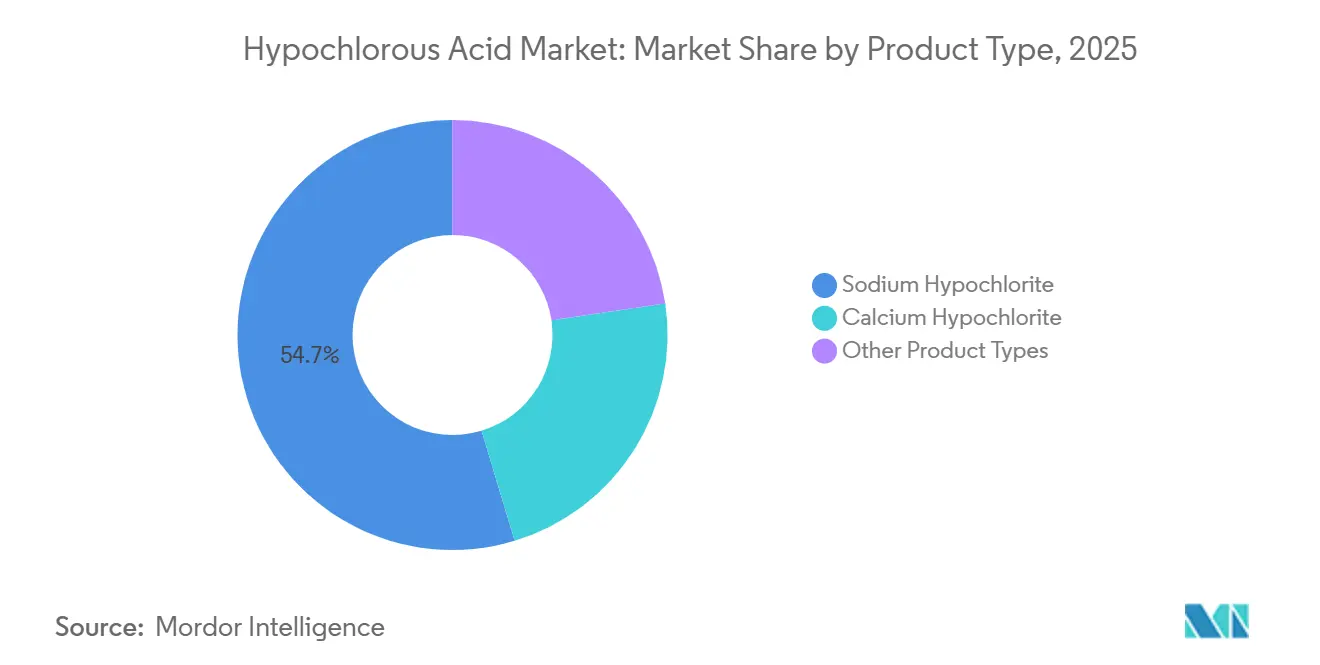
Sodium Hypochlorite Leads, Calcium Hypochlorite AcceleratesSodium hypochlorite held 54.67% of the hypochlorous acid market share in 2025, supported by its established role in municipal water treatment, household bleach, and institutional cleaning. Utilities and food processors have invested in equipment designed for hypochlorite dosing, monitoring, and residual measurement. Those systems make a switch to another chemistry more difficult for large operators. Calcium hypochlorite is projected to advance at a 6.56% CAGR through 2031 because it offers greater ambient-temperature stability and suits recreational water treatment, point-of-use tablets, and agricultural disinfection.
Other product types include stabilized hypochlorous acid solutions with pH levels of 6.5 to 7.5, electrolyzed-water formulations, and ready-to-use sprays. These formats serve clinical wound care and premium consumer personal care, where differentiation can support better margins. Overcapacity in chlor-alkali manufacturing has intensified price competition for undifferentiated liquid sodium hypochlorite. The European Commission granted Union Authorization for the AWPF Calcium Hypochlorite Biocidal Product Family in May 2025, which clarified access conditions for calcium hypochlorite products across the European Union. The hypochlorous acid industry is, therefore, divided between high-volume commodity products and specialized formats that can earn a unit-price premium. Calcium hypochlorite offers a practical option where liquid handling is difficult, while stabilized formats serve use cases that place greater value on shelf life, safety, and clinical support.

By Application:
Disinfecting Agent Drives Revenue and Innovation SimultaneouslyDisinfecting agent accounted for 43.13% of the hypochlorous acid market size in 2025 and is projected to advance at a 6.87% CAGR through 2031. Its use spans institutional surface cleaning, healthcare device reprocessing, food-contact decontamination, and consumer hygiene. Hypochlorous acid has activity against Gram-positive bacteria, Gram-negative bacteria, spores, fungi, and enveloped viruses. This range allows one formulation to serve settings that formerly required several specialized products.
Sanitizing agent applications support food service and retail settings that prefer registered sanitizers to full disinfectants. Lower-concentration solutions used in this category can provide more favorable worker-safety characteristics. Wound care and skin cleansing, along with surface and equipment disinfection, have higher margins but face more intensive regulation. The World Health Organization 2025 review noted favorable safety and evidence for hypochlorous acid in diabetic foot wounds. Sonoma Pharmaceuticals, Inc. received a United States Food and Drug Administration 510(k) clearance for Microdacyn Wound Irrigation Solution in June 2026, extending its wound-care claims and packaging options. The contrast between medical applications and process-water uses shows why application requirements, rather than active chemistry alone, shape product positioning and margins.
By End-Use Industry:
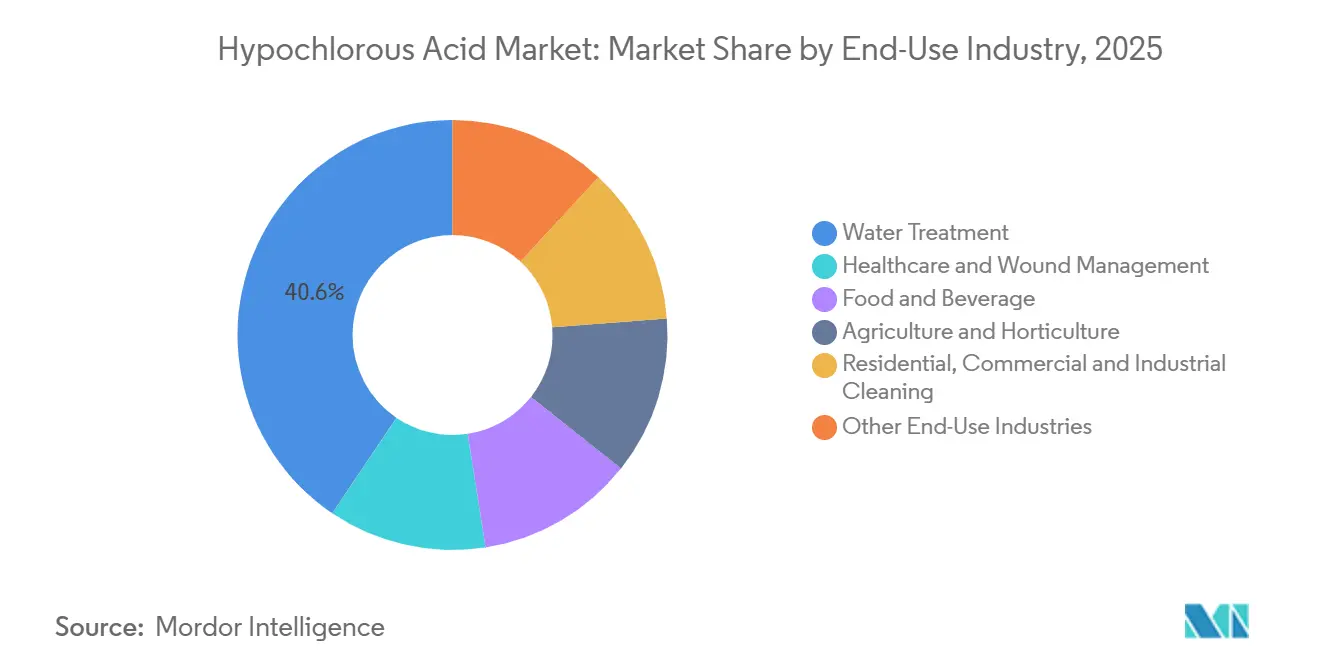
Water Treatment Anchors Revenue, Agriculture and Horticulture Rewrite the Growth CurveWater treatment captured 40.56% of the hypochlorous acid market size in 2025 because municipal infrastructure requires chlorine residual maintenance across distribution networks. This requirement supports the continuous demand for hypochlorite-based products in many developed markets. Healthcare and wound management rely on acute-care disinfection and an expanding body of evidence for wound irrigation. Food and beverage operations use these products for produce washing and equipment sanitation, supported by the United States Food and Drug Administration food-contact notification framework.
Agriculture and horticulture are projected to advance at a 6.33% CAGR through 2031 as the hypochlorous acid market reaches controlled-environment horticulture, aquaculture biofilm management, and organic post-harvest sanitation. Japan's July 2024 standard revision permitted electrolytic hypochlorous acid water for organic produce sanitation, which supports greenhouse operators and certified-produce exporters. The segment is also moving beyond crops into veterinary and livestock health applications. Residential, commercial, and industrial cleaning remains volume-intensive and margin-thin, with mass-market brands distributing sodium hypochlorite at scale. The hypochlorous acid industry has opportunities where generator technology replaces field treatments based on chlorine tablets. Agricultural customers can use on-demand electrolyzed water at irrigation points, reducing dependence on conventional chemical distribution while giving generator providers a role in ongoing operations.
Geography Analysis
North America Hypochlorous Acid Market
North America held 37.06% of the hypochlorous acid market share in 2025, supported by water treatment infrastructure, hospital disinfection procurement, and food, wound-care, and surface-disinfection applications. The United States Environmental Protection Agency List N registration provided a recognized purchasing criterion for emerging pathogen control. This helped hospitals and food processors evaluate hypochlorous acid products against their disinfection requirements. Canada's Biocides Regulations entered into force on May 31, 2025, and require a transition to the new authorization system for affected surface disinfectant products. Sonoma Pharmaceuticals, Inc. operates a Guadalajara facility that supports distribution in more than 55 countries, showing the role of Mexico in regional production and export supply.
APAC Hypochlorous Acid Market
Asia-Pacific is projected to advance at a 5.89% CAGR through 2031. Growth is tied to municipal water disinfection in urbanizing secondary cities, food-processing export requirements, and clinical wound care. Japan has a multi-channel regulatory structure that supports food, healthcare, and agricultural use. The Ministry of Agriculture, Forestry, and Fisheries updated the organic standard in July 2024, while food safety authorities have assessed hypochlorous acid water for food use. South Korea and Association of Southeast Asian Nations countries are at an earlier adoption stage, with food exports and hospital infection control serving as key demand anchors.
EMEA and South America Hypochlorous Acid Market
In Europe, Germany, the United Kingdom, and Nordic countries show strong institutional and industrial cleaning use. Regulation (EU) 528/2012 governs biocidal product authorization, while Regulation (EU) 2025/831 established a Union-level compliance benchmark for the authorized calcium hypochlorite family. Briotech expanded product availability in Finland, the Netherlands, Sweden, Germany, and France in 2025. South America and Middle East and Africa remain earlier-stage areas where water treatment and healthcare investment support demand. High temperatures and limited storage infrastructure constrain adoption in several Middle East and African locations.
Competitive Landscape
The hypochlorous acid market is moderately concentrated, with the top five players including AQUALUTION, BACTIGUARD AB, Ozo Innovations, Sonoma Pharmaceuticals, Inc., and The Clorox Company. Specialized producers compete on stabilization, on-site generation, clinical evidence, and claim approvals. EcoloxTech, Inc. and Envirolyte Industries International Ltd. use electrolyzer platforms and control software to differentiate themselves from commodity chemical suppliers. Their business model can add service and consumable revenue to a product category with limited formulation differentiation, while generic suppliers remain exposed to logistics-based price competition and technology-oriented suppliers pursue higher-value use cases.
Kersia Group completed its USD 130 million acquisition of Neogen Corporation's cleaners and disinfectants business in July 2025. The transaction added 3 United States production sites, registrations in more than 20 countries, and access to the North American pork and poultry biosecurity business. The acquisition shows that agricultural biosecurity is an important route to scale in the hypochlorous acid market. Sonoma Pharmaceuticals, Inc. reported USD 19.529 million in full-year fiscal 2026 revenue, up 37% year over year, and reported positive adjusted EBITDA for the quarter ended June 30, 2026. Its distribution reaches across more than 55 countries, helping spread formulation and regulatory costs over a broader customer base.
Stabilized wound irrigation remains open to companies that can obtain clinical and regulatory support. On-site systems for mid-size food processors are another opportunity because these customers may not have the capital for industrial-scale equipment. Simple Science LLC, Ozo Innovations, and PureAquaox address consumer and small-business uses, while Esteripharma S.A. de C.V. and AQUALUTION focus on pharmaceutical-grade and medical applications. Aquaox LLC uses nanobubble technology to improve penetration and extend shelf life, showing how engineering at the generation stage can become a competitive distinction. The hypochlorous acid market rewards firms that combine reliable product stability with valid claims, distribution capacity, and equipment support.
Hypochlorous Acid Industry Leaders
-
AQUALUTION
-
BACTIGUARD AB
-
Ozo Innovations
-
Sonoma Pharmaceuticals, Inc.
-
The Clorox Company
- *Disclaimer: Major Players sorted in no particular order
Hypochlorous Acid Market Companies Covered in this Report
- AQUALUTION
- Aquaox LLC
- BACTIGUARD AB
- Briotech
- EcoloxTech, Inc.
- Envirolyte Industries International Ltd.
- Esteripharma S.A. de C.V.
- Force of Nature
- Kersia Group
- Ozo Innovations
- PureAquaox
- Simple Science LLC
- Sonoma Pharmaceuticals, Inc.
- The Clorox Company
- UltraPure
Recent Industry Developments in Hypochlorous Acid Market
- August 2026: WellSpring Consumer Healthcare launched seven new hypochlorous acid products across Bactine, vH Essentials, A+D, and Solarcaine, expanding the ingredient’s availability through mass retail channels. The launches broaden the consumer application of hypochlorous acid in skincare and personal healthcare products.
- May 2026: Magic Molecule announced that its FDA-cleared Daily Skin Spray would become the first hypochlorous acid solution sold in the health and beauty aids department at Sprouts Farmers Market. The retail expansion increases consumer access to hypochlorous acid-based skincare products and supports broader adoption of hypochlorous acid formulations.
Global Hypochlorous Acid Market Report Scope
Hypochlorous acid is a weak acid formed when chlorine reacts with water and is recognized for its antimicrobial and oxidizing properties. It is used in formulations and treatment systems where microbial control, sanitation, and surface or tissue cleansing is required.
The Hypochlorous Acid Market is segmented by product type, application, end-use industry, and geography. By product type, the market is segmented into sodium hypochlorite, calcium hypochlorite, and other product types. By application, the market is segmented into disinfecting agent, sanitizing agent, oxidizing agent, wound care and skin cleansing, surface and equipment disinfection, and other applications. By end-use industry, the market is segmented into water treatment, healthcare and wound management, food and beverage, agriculture and horticulture, residential, commercial and industrial cleaning, and other end-use industries. The report also covers the market size and forecasts for hypochlorous acid in 15 countries across major regions. For each segment, the market sizing and forecasts have been done on the basis of value (USD).
Segmentation Overview
| Sodium Hypochlorite |
| Calcium Hypochlorite |
| Other Product Types |
| Disinfecting Agent |
| Sanitizing Agent |
| Oxidizing Agent |
| Wound Care and Skin Cleansing |
| Surface and Equipment Disinfection |
| Other Applications |
| Water Treatment |
| Healthcare and Wound Management |
| Food and Beverage |
| Agriculture and Horticulture |
| Residential, Commercial and Industrial Cleaning |
| Other End-Use Industries |
| Asia-Pacific | China |
| India | |
| Japan | |
| South Korea | |
| ASEAN Countries | |
| Rest of Asia-Pacific | |
| North America | United States |
| Canada | |
| Mexico | |
| Europe | Germany |
| United Kingdom | |
| France | |
| Italy | |
| NORDIC Countries | |
| Rest of Europe | |
| South America | Brazil |
| Argentina | |
| Rest of South America | |
| Middle East and Africa | Saudi Arabia |
| South Africa | |
| Rest of Middle East and Africa |
| By Product Type | Sodium Hypochlorite | |
| Calcium Hypochlorite | ||
| Other Product Types | ||
| By Application | Disinfecting Agent | |
| Sanitizing Agent | ||
| Oxidizing Agent | ||
| Wound Care and Skin Cleansing | ||
| Surface and Equipment Disinfection | ||
| Other Applications | ||
| By End-Use Industry | Water Treatment | |
| Healthcare and Wound Management | ||
| Food and Beverage | ||
| Agriculture and Horticulture | ||
| Residential, Commercial and Industrial Cleaning | ||
| Other End-Use Industries | ||
| By Geography | Asia-Pacific | China |
| India | ||
| Japan | ||
| South Korea | ||
| ASEAN Countries | ||
| Rest of Asia-Pacific | ||
| North America | United States | |
| Canada | ||
| Mexico | ||
| Europe | Germany | |
| United Kingdom | ||
| France | ||
| Italy | ||
| NORDIC Countries | ||
| Rest of Europe | ||
| South America | Brazil | |
| Argentina | ||
| Rest of South America | ||
| Middle East and Africa | Saudi Arabia | |
| South Africa | ||
| Rest of Middle East and Africa | ||
Key Questions Answered in the Report
What is the size of the hypochlorous acid market?
The hypochlorous acid market stands at USD 6.25 billion in 2026 and is projected to reach USD 8.15 billion by 2031.
What is driving demand for hypochlorous acid products?
Low-residue disinfection, hospital infection-control needs, water reuse, food sanitation, and on-site generation systems support demand.
Which product type held the largest share in 2025?
Sodium hypochlorite held a 54.67% revenue share in 2025, supported by municipal water treatment and institutional cleaning applications.
Which application is expected to grow the fastest through 2031?
The disinfecting agent is projected to advance at a 6.87% CAGR through 2031.