
Hyperspectral Industrial Inspection Systems Market Size and Share
Market Overview
| Study Period | 2020 - 2031 |
|---|---|
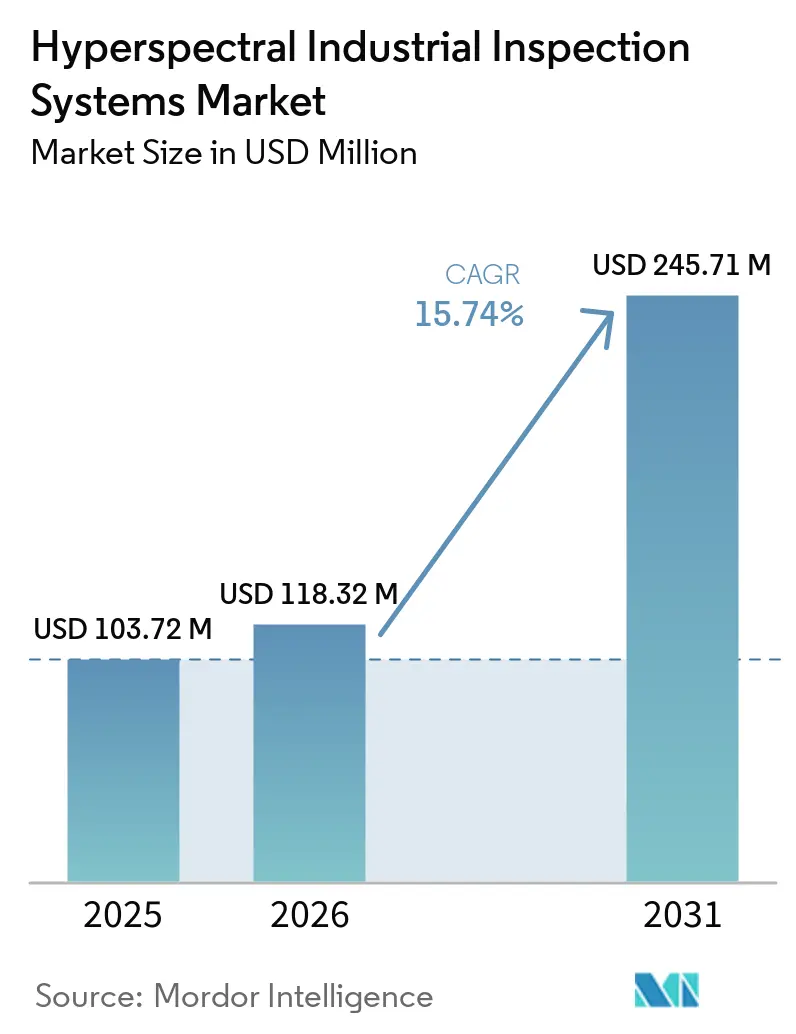
| Market Size (2026) | USD 118.32 Million |
| Market Size (2031) | USD 245.71 Million |
| Growth Rate (2026 - 2031) | 15.74 % |
| Fastest Growing Market | Asia-Pacific |
| Largest Market | North America |
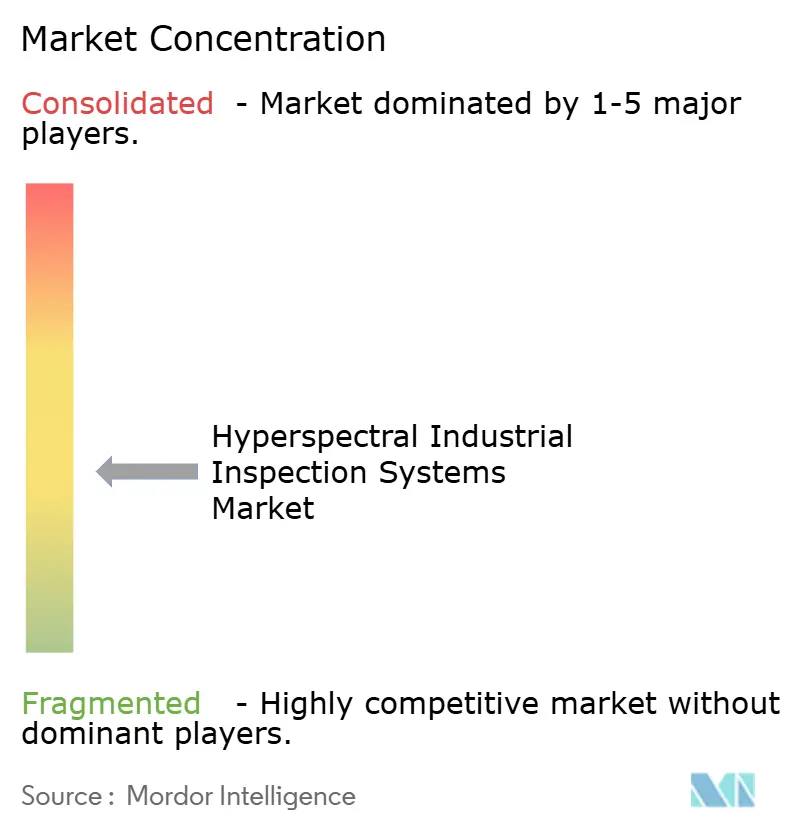
| Market Concentration | Medium |
Major Players *Disclaimer: Major Players sorted in no particular order Image © Mordor Intelligence. Reuse requires attribution under CC BY 4.0. | |
Hyperspectral Industrial Inspection Systems Market Analysis by Mordor Intelligence
The Hyperspectral Industrial Inspection Systems Market size is expected to increase from USD 103.72 million in 2025 to USD 118.32 million in 2026 and reach USD 245.71 million by 2031, growing at a CAGR of 15.74% over 2026-2031. The market is expanding as AI classification reduces the time required to identify material signatures on production lines. Lower costs for shortwave infrared sensors and edge computing are making systems more accessible beyond large plants. Packaging responsibility rules, battery quality requirements, and food traceability obligations are increasing demand for chemical-level verification. Suppliers are responding by combining cameras with spectral libraries, classification software, and integration services. Export restrictions on some advanced InGaAs detectors may limit access in selected destinations and favor suppliers with alternative supply options.
Key Report Takeaways
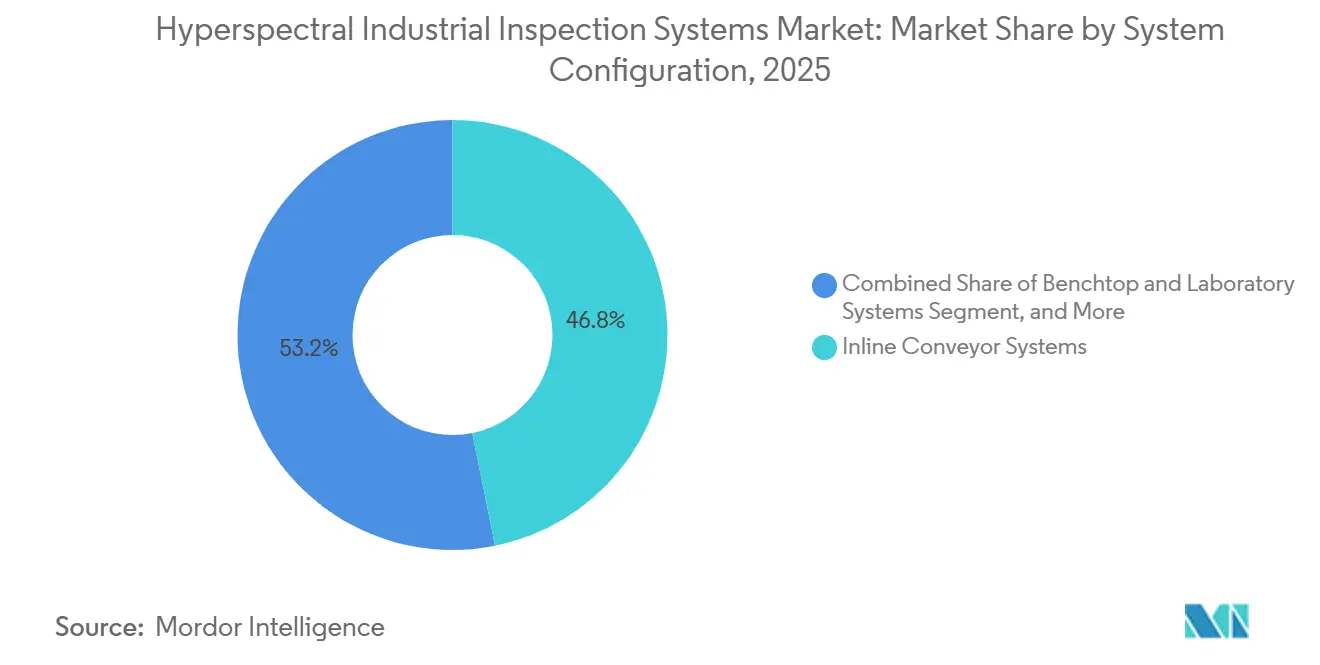
- By system configuration, Inline Conveyor Systems held 46.84% of the hyperspectral industrial inspection systems market share in 2025, while Robotic and Automated Inspection Systems are projected to expand at a 16.38% CAGR through 2031.
- By imaging technology, Push-Broom and Line-Scan systems accounted for 51.75% revenue share in 2025, while Snapshot technology is projected to grow at a 17.16% CAGR through 2031.
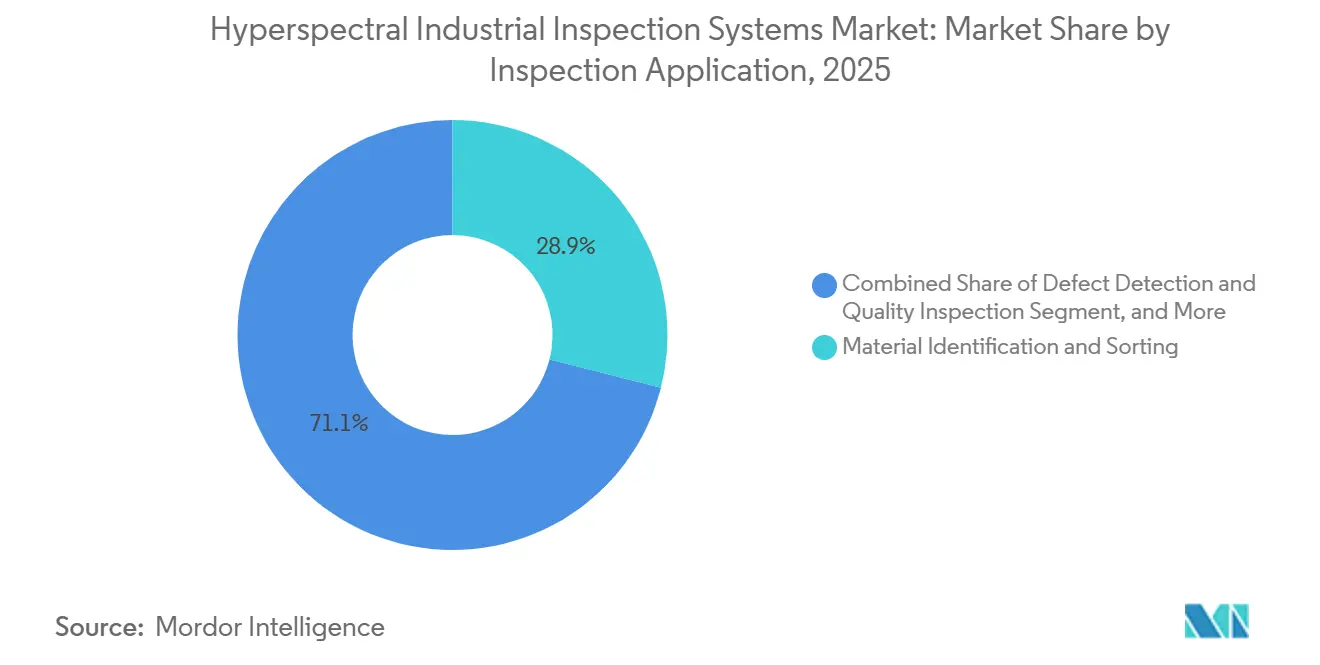
- By inspection application, Material Identification and Sorting accounted for 28.94% of revenue in 2025, while Process Monitoring and Predictive Quality is projected to grow at a 16.52% CAGR through 2031.
- By end-user industry, Food and Beverage captured 30.64% revenue share in 2025, while Battery and Advanced Materials Manufacturing is projected to grow at a 17.36% CAGR through 2031.
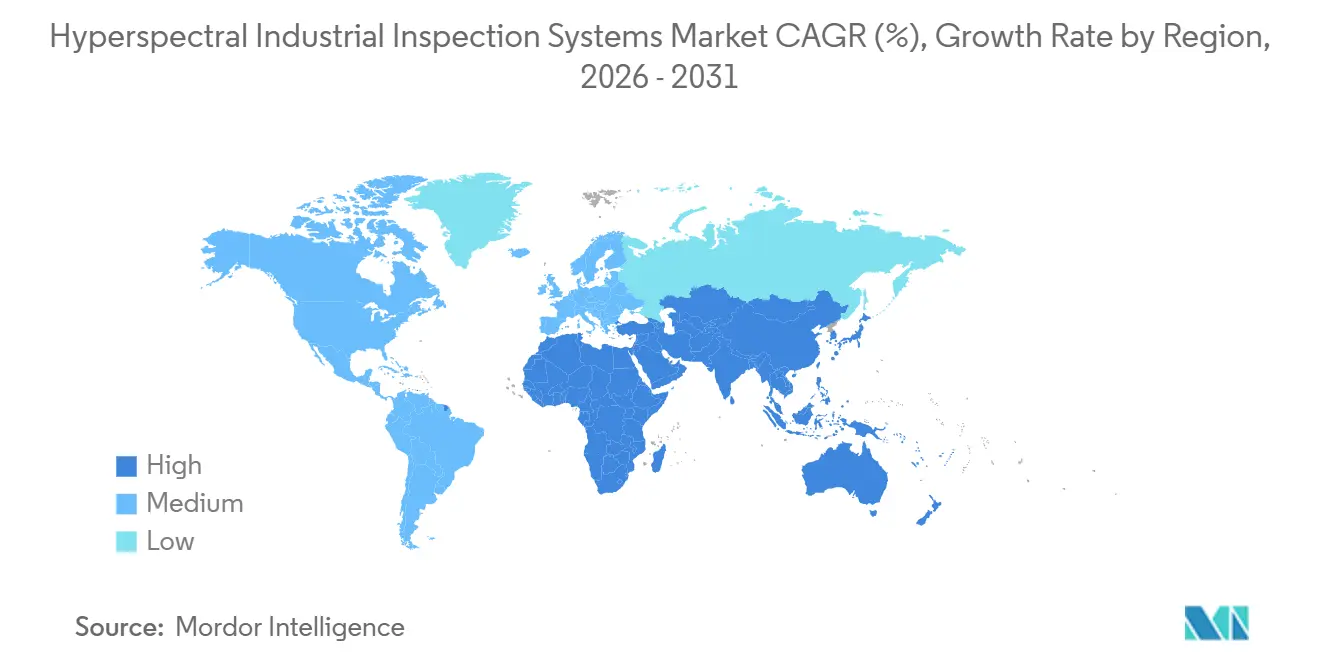
- By geography, North America held 34.87% revenue share in 2025, while Asia-Pacific is projected to record a 17.21% CAGR through 2031.
Note: Market size and forecast figures in this report are generated using Mordor Intelligence’s proprietary estimation framework, updated with the latest available data and insights as of January 2026.
Global Hyperspectral Industrial Inspection Systems Market Trends and Insights
Drivers Impact Analysis*
| Driver | (~) % Impact on CAGR Forecast | Geographic Relevance | Impact Timeline |
|---|---|---|---|
| AI-Enabled Spectral Classification at Production Speed | +3.5% | Global, with early gains in North America and Europe and faster adoption in Asia-Pacific | Short term (≤ 2 years) |
| Declining SWIR Sensor and Edge-Compute Costs | +2.8% | Global, strongest in cost-sensitive mid-tier manufacturing across Asia-Pacific and South America | Medium term (2-4 years) |
| Rising Demand for Non-Destructive Inspection | +2.4% | Global, concentrated in North America, Europe, and Asia-Pacific semiconductor corridors | Medium term (2-4 years) |
| Plastic Recycling Purity and Extended Producer Responsibility Targets | +1.8% | Europe, North America, and Asia-Pacific | Short term (≤ 2 years) |
| Battery, Semiconductor, and Advanced-Material Process Control | +1.6% | Asia-Pacific, North America, and Europe | Medium term (2-4 years) |
| Domain-Specific Spectral Models in Machine-Vision Platforms | +1.0% | Global, with future adoption in the Middle East and Africa | Long term (≥ 4 years) |
| Source: Mordor Intelligence | |||
AI-Enabled Spectral Classification at Production Speed
The hyperspectral industrial inspection systems market is benefiting from faster AI classification on production lines. A 2026 study reported that preprocessing and classification for a push-broom sorter each took just over 30 microseconds. Those tasks used 5% of the available time between frames on standard multicore hardware. This leaves most available processing capacity for further operations. Sensor frame rate and illumination consistency are, therefore, becoming more important considerations when buying. Fraunhofer IPMS is developing an AI-directed spectrometer that records data only from flagged areas, thereby reducing data volume while maintaining detection accuracy.
Declining SWIR Sensor and Edge-Compute Costs
Cost reductions are widening the prospective customer base for the hyperspectral industrial inspection systems market. Emberion stated in April 2025 that its wafer-level packaging achieved a 100% bond yield across a wafer containing 100 quantum-dot SWIR sensors. The company targeted a packaged sensor cost of EUR 50 (USD 54) at the 2025 IRS average rate, for large-volume production. It also targeted the first cameras with the packaging technology for 2026. HAIP Solutions integrated on-device preprocessing and classification into its BlackIndustry SWIR 1.7 Pro Max camera, reducing the need for separate server infrastructure. Smaller systems can help mid-sized manufacturers evaluate use cases that previously required larger capital commitments.
Rising Demand for Non-Destructive Inspection
Demand for non-destructive testing is supporting adoption in the hyperspectral industrial inspection systems market. A 2025 study classified 5 corrosion stages in marine steel with 96.18% accuracy using hyperspectral imaging and machine learning. The result supports chemical characterization without contact or destructive sampling. Composite materials and advanced alloys require inspection methods that distinguish material composition from visible geometry. This requirement is relevant to aerospace, automotive, and electronics production. In pharmaceutical plants, process verification needs also support the use of inline systems for blend uniformity and contamination checks.
Plastic Recycling Purity and Extended Producer Responsibility Targets
Packaging rules are creating a direct demand case for hyperspectral sorting equipment. The Association of Plastic Recyclers reported that 7 U.S. states had enacted comprehensive packaging EPR laws by 2025.[1]Association of Plastic Recyclers, “EPR for Packaging Laws,” Association of Plastic Recyclers, plasticsrecycling.org The United Kingdom's 2025 packaging amendment added requirements that strengthen the need for recycled content and for evidence of contamination. Research published in 2025 achieved 98.2% by-weight recovery of flexible polypropylene at a 94.4% grade, compared with 77.2% in unsorted feedstock. These results indicate that spectral sorting can support purity documentation for recycling operators. The hyperspectral industrial inspection systems market can therefore gain from compliance-led investment as well as productivity upgrades.
Restraints Impact Analysis*
| Restraint | (~) % Impact on CAGR Forecast | Geographic Relevance | Impact Timeline |
|---|---|---|---|
| High Integration, Illumination, and Data-Infrastructure Cost | -1.4% | Global, most acute in Asia-Pacific mid-tier manufacturing and Middle East and Africa facilities with limited IT infrastructure | Medium term (2-4 years) |
| Spectral Calibration Drift and Site-to-Site Model Transfer | -0.8% | Global, especially multi-plant deployments in North America and Europe | Long term (≥ 4 years) |
| Shortage of Labeled Industrial Spectral Libraries | -0.6% | Global, especially specialty materials, mining, and advanced composites | Long term (≥ 4 years) |
| Export Controls on InGaAs and Advanced Detector Components | -0.4% | Asia-Pacific, primarily China, and the Middle East and Africa | Medium term (2-4 years) |
| Source: Mordor Intelligence | |||
High Integration, Illumination, and Data-Infrastructure Cost
System-level expenditure remains a major constraint for the hyperspectral industrial inspection systems market. An inline installation can include a camera, a frame grabber, illumination, a conveyor interface, and an edge server. These items can be difficult to justify at plants with varied and short production runs. Uneven illumination can introduce spectral artifacts and reduce classification accuracy. A high-speed SWIR camera can also generate data volumes that exceed the capacity of standard factory networks. These combined requirements have driven adoption to concentrate in high-volume food and pharmaceutical applications, while mining and general plastics have moved more slowly.
Spectral Calibration Drift and Site-to-Site Model Transfer
Calibration drift raises the ongoing cost of deploying hyperspectral systems across several facilities. Sensor aging, temperature changes, illumination degradation, and lens contamination can alter wavelengths or intensity readings. These changes can cause a model trained on one system to produce inconsistent outputs on another. A 2025 CVPR paper used 765 image pairs to develop an automatic spectral calibration method, but it also identified remaining challenges in low-light spectral bands. Operators with 10 or more sites may need to recalibrate repeatedly rather than assume that one validated model works everywhere. Suppliers that provide adaptive calibration and centralized model management may be better positioned for enterprise procurement.
*Our forecasts treat driver/restraint impacts as directional, not additive. The impact forecasts reflect baseline growth, mix effects, and variable interactions.
Segment Analysis
By System Configuration: Inline Conveyors Support High-Volume Production While Robotics Adds Flexibility
Inline Conveyor Systems held 46.84% market share in the hyperspectral industrial inspection systems market in 2025. Their installed base reflects long-standing use of conveyors in food processing, plastics recycling, and pharmaceutical facilities. Continuous movement gives products a predictable orientation under the camera. This configuration also aligns directly with push-broom imaging. Benchtop and laboratory systems remain important for quality assurance and research work. They support the development of spectral libraries that can later be used in production environments.
Portable and handheld systems are used for mining and field inspection, where samples cannot easily be brought to a fixed instrument. Their lower throughput is accepted when portability is more important than processing speed. Robotic and Automated Inspection Systems are projected to grow at a 16.38% CAGR from 2026 to 2031. Collaborative robots can inspect irregular shapes, 3D surfaces, and components with changing orientations. They can also adjust inspection paths by reprogramming rather than making physical line changes. ISO 10218 and ISO/TS 15066 standards support deployment in work areas shared by people and robots.



By Imaging Technology: Line-Scan Systems Remain Established While Snapshot Systems Gain Momentum
Push-Broom and Line-Scan technologies accounted for 51.75% of the hyperspectral industrial inspection systems market in 2025. The architecture provides high spectral resolution and stable signal quality during continuous acquisition. It also synchronizes effectively with conveyor speed. Specim introduced the FX19 in February 2026 with coverage from 1,130 to 1,920 nm and speeds of up to 527 frames per second. The product illustrates ongoing development in industrial line-scan systems. Tunable-filter and whiskbroom systems remain suited to specialized uses that require high spectral flexibility.
FTIR imaging remains more constrained in fast-production roles and is better suited to offline or sampling-based work. Snapshot technology is projected to grow at a 17.16% CAGR from 2026 to 2031. It captures a full spectral data cube without the motion artifacts associated with moving objects. A 2025 study demonstrated a snapshot VIS-NIR imager that reconstructed 2,048-by-2,048-by-61-band cubes at 12.35 frames per second. Cubert's ULTRIS SWIR 1 operates between 980 and 1,650 nm at 80 Hz in a 30 by 30 by 85 mm format with no moving parts.[2]Cubert GmbH, “ULTRIS SWIR 1 High-Speed Hyperspectral SWIR Imaging,” Cubert, cubert-hyperspectral.com These characteristics support deployment on robotic end effectors and UAV payloads.
By Inspection Application: Sorting Provides a Proven Base While Predictive Quality Builds Adoption
Material Identification and Sorting accounted for 28.94% of the hyperspectral industrial inspection systems market share in 2025. Food safety, recycling, and pharmaceutical raw material verification have established a clear return case for this application. The systems can link capital spending to improvements in compliance and throughput. Defect Detection and Quality Inspection represent another significant area of demand. Electronics and semiconductor manufacturers use chemistry-aware inspection to identify defects in circuit boards and wafers. Contamination and Foreign-Material Detection is also expanding in food and meat processing.
Composition, moisture, and thickness measurement support battery electrode coating and pharmaceutical tablet analysis. Process Monitoring and Predictive Quality is projected to grow at a 16.52% CAGR from 2026 to 2031. This application shifts the role of inspection from rejecting finished defects to informing process adjustments. A 2025 U.S. patent described a battery electrode system that used continuous line-scan images to adjust mixer and substrate-belt speeds after detecting coating variation. The approach can identify problems before they proceed into later cell assembly steps. It can also reduce material loss from defective electrode production.
By End-User Industry: Food and Beverage Remains the Largest User While Battery Production Accelerates
Food and Beverage accounted for 30.64% of the hyperspectral industrial inspection systems market in 2025. The sector uses the technology to detect foreign material, assess authenticity, and verify composition. A 2025 scientific review documented applications of foreign-matter detection, species verification, and pesticide-residue measurement in meat, grain, and nuts. A 2026 study also showed that a 164-band VNIR camera could predict internal heat-loss characteristics of pork belly from surface scans. This extends inspection beyond visible defects without requiring destructive sampling. Pharmaceutical manufacturing and semiconductor and electronics production also have meaningful demand, subject to their respective quality requirements.
Mining and mineral processing face limits because labeled libraries for unusual mineral mixtures remain scarce. Plastics recycling is seeing rising demand as EPR policies increase sorting and reporting requirements. Battery and Advanced Materials Manufacturing is projected to expand at a 17.36% CAGR from 2026 to 2031. Gigafactory investments in China, South Korea, the United States, and Germany are supporting inspections at the electrode coating, separator, and cell assembly stages. Early detection can prevent defects from carrying into module formation.
Geography Analysis
North America held 34.87% of the hyperspectral industrial inspection systems market share in 2025. Advanced food processing, pharmaceutical manufacturing, and semiconductor fabrication facilities form the region's main demand base. U.S. deployment is concentrated in food processing areas in the Midwest, the pharmaceutical corridor from New Jersey to North Carolina, and semiconductor centers in Arizona and Texas. Canada's provincial EPR programs are supporting demand for plastics sorting systems. The Association of Plastic Recyclers documented ongoing packaging EPR activity across North America.
Europe is the second-largest regional market for hyperspectral industrial inspection systems. Germany supports demand through advanced manufacturing in semiconductors, automotive electronics, and recycling. The EU-funded HyperImage project is developing AI-integrated multi- and hyperspectral platforms for industrial use and aims to achieve yield improvements of 10%-20%.[3]European Commission CORDIS, “HyperImage A Universal Spectral Imaging Sensor Platform for Industry, Agriculture and Autonomous Driving,” CORDIS, cordis.europa.eu Packaging obligations in Germany, France, Italy, and the United Kingdom are encouraging recycling operators to verify polymer-grade purity. Spain and Italy also offer food inspection opportunities, including testing for edible oil adulteration.
Asia-Pacific is projected to grow at a 17.21% CAGR from 2026 to 2031. China's battery, electronics, and food safety requirements underpin demand, while South Korea's semiconductor base and Japan's industrial modernization program add further support. Panasonic announced its AG-HSS10 AI inspection software in August 2026 for food processing, semiconductor components, and electronics manufacturing. Konica Minolta's Specim ownership extends hyperspectral sorting capabilities into Japanese manufacturing. South America, the Middle East, and Africa remain earlier-stage areas, with projects in mineral exploration, food export certification, and petrochemical quality control. Local integration support is becoming more important as procurement grows in these regions.

Competitive Landscape
The hyperspectral industrial inspection systems market is moderately fragmented. Specim, Headwall Photonics, Resonon, BaySpec, and Telops Inc. form an important technology group. Norsk Elektro Optikk, Brimrose, and ChemImage serve narrower defense-adjacent, mining, and pharmaceutical applications. Competition is moving beyond camera specifications toward complete platforms. Suppliers that combine spectral libraries, AI classification, and integration support can capture more value. This approach responds to customer needs for working production systems rather than stand-alone sensors.
Specim launched RETEX in April 2026 as a modular AI-based textile identification system. It is available in 4 tiers, from a classification engine to a complete industrial sorting system.[4]Specim, “Specim RETEX AI-Based Hyperspectral Solution for Textile Sorting,” Specim, specim.com The platform identifies cotton, polyester, polyamide, viscose, wool, acrylic, and blended textiles. Surface Optics launched the 710-HyCore and 710-OmniCore systems in March 2026. The systems are calibrated against NIST-traceable references and are targeted at mid-market integrators. These moves reflect a wider effort to make deployment easier for industrial customers.
Mid-market turnkey systems are a clear opportunity for facilities with annual revenue of USD 50-200 million. Such operators may have adequate capital budgets but limited integration resources. Headwall Photonics showcased the Holographix MicroSpec Duo Spectrometer for OEM instruments at Photonics West 2026, supporting its move toward embedded production-line applications. CMOS-compatible SWIR detectors could disrupt existing InGaAs price structures if they become commercially viable at automotive-grade costs. They could also reduce exposure to restrictions on advanced detector arrays. Domain-specific model libraries may become a further basis for competition as suppliers seek software partners for new material categories.
Hyperspectral Industrial Inspection Systems Industry Leaders
Specim, Spectral Imaging Ltd.
Headwall Photonics, Inc.
Resonon, Inc.
BaySpec, Inc.
Telops Inc.
- *Disclaimer: Major Players sorted in no particular order

Recent Industry Developments
- August 2026: Panasonic Corporation announced the AI inspection software NT Series "AG-HSS10," integrating hyperspectral image acquisition via the AG-HSV10M camera with AI training and automatic inline inspection judgment for food processing, semiconductor component inspection, and electronics manufacturing in Japan. Commercial release was planned for early October 2026. The platform was built on AI inspection technology refined across 15 Panasonic domestic factory sites.
- July 2026: Hinalea Imaging Corp. launched the Hinalea VNIR Ultra hyperspectral imaging system covering 400-1,000 nm across 301 spectral bands at 4 nm FWHM resolution using a tunable Fabry-Pérot interferometer. The system targeted laboratory, microscopy, and photon-limited industrial inspection.
- April 2026: Specim launched Specim RETEX, a complete hyperspectral and AI-based solution for textile material identification and automated separation. It distinguishes cotton, polyester, polyamide, viscose, wool, acrylic, and blended materials, including previously unseen elastane blends. The solution is offered in 4 modular product tiers for industrial textile recycling.
- January 2026: HORIBA introduced the PoliSpectra 27, a compact industrial spectrometer platform factory-configurable for push-broom hyperspectral imaging. Its intended uses include semiconductor wafers, industrial quality control, and film-thickness measurement.


Global Hyperspectral Industrial Inspection Systems Market Report Scope
The hyperspectral industrial inspection systems market comprises solutions that use hyperspectral imaging technology to capture and analyze data across a broad range of spectral bands. These systems enable manufacturers to identify material properties, detect defects, assess product quality, and support automated inspection across industries such as food and beverages, pharmaceuticals, electronics, and manufacturing.
The Hyperspectral Industrial Inspection Systems Market Report is Segmented by System Configuration (Inline Conveyor Systems, Robotic and Automated Inspection Systems, Benchtop and Laboratory Systems, and Portable and Handheld Systems), Imaging Technology (Push-Broom / Line-Scan, Snapshot, Tunable-Filter, Whiskbroom / Point-Scan, and FTIR-Based Imaging), Inspection Application (Material Identification and Sorting, Defect Detection and Quality Inspection, Contamination and Foreign-Material Detection, Composition, Moisture, Thickness Measurement, Process Monitoring and Predictive Quality, and Other Inspection Applications), End-User Industry (Food and Beverage, Plastics Recycling and Waste Management, Pharmaceutical Manufacturing, Semiconductor and Electronics, Battery and Advanced Materials Manufacturing, Mining and Mineral Processing, and Other End-User Industries), and Geography (North America, South America, Europe, Asia-Pacific, Middle East, and Africa). The Market Forecasts are Provided in Terms of Value (USD).
| Inline Conveyor Systems |
| Robotic and Automated Inspection Systems |
| Benchtop and Laboratory Systems |
| Portable and Handheld Systems |
| Push-Broom / Line-Scan |
| Snapshot |
| Tunable-Filter |
| Whiskbroom / Point-Scan |
| FTIR-Based Imaging |
| Material Identification and Sorting |
| Defect Detection and Quality Inspection |
| Contamination and Foreign-Material Detection |
| Composition, Moisture, and Thickness Measurement |
| Process Monitoring and Predictive Quality |
| Other Inspection Applications |
| Food and Beverage |
| Plastics Recycling and Waste Management |
| Pharmaceutical Manufacturing |
| Semiconductor and Electronics |
| Battery and Advanced Materials Manufacturing |
| Mining and Mineral Processing |
| Other End-User Industries |
| North America | United States |
| Canada | |
| Mexico | |
| South America | Brazil |
| Argentina | |
| Chile | |
| Rest of South America | |
| Europe | Germany |
| United Kingdom | |
| France | |
| Italy | |
| Spain | |
| Rest of Europe | |
| Asia-Pacific | China |
| Japan | |
| India | |
| South Korea | |
| Australia | |
| Rest of Asia-Pacific | |
| Middle East | United Arab Emirates |
| Saudi Arabia | |
| Rest of Middle East | |
| Africa | South Africa |
| Egypt | |
| Rest of Africa |
| By System Configuration | Inline Conveyor Systems | |
| Robotic and Automated Inspection Systems | ||
| Benchtop and Laboratory Systems | ||
| Portable and Handheld Systems | ||
| By Imaging Technology | Push-Broom / Line-Scan | |
| Snapshot | ||
| Tunable-Filter | ||
| Whiskbroom / Point-Scan | ||
| FTIR-Based Imaging | ||
| By Inspection Application | Material Identification and Sorting | |
| Defect Detection and Quality Inspection | ||
| Contamination and Foreign-Material Detection | ||
| Composition, Moisture, and Thickness Measurement | ||
| Process Monitoring and Predictive Quality | ||
| Other Inspection Applications | ||
| By End-User Industry | Food and Beverage | |
| Plastics Recycling and Waste Management | ||
| Pharmaceutical Manufacturing | ||
| Semiconductor and Electronics | ||
| Battery and Advanced Materials Manufacturing | ||
| Mining and Mineral Processing | ||
| Other End-User Industries | ||
| By Geography | North America | United States |
| Canada | ||
| Mexico | ||
| South America | Brazil | |
| Argentina | ||
| Chile | ||
| Rest of South America | ||
| Europe | Germany | |
| United Kingdom | ||
| France | ||
| Italy | ||
| Spain | ||
| Rest of Europe | ||
| Asia-Pacific | China | |
| Japan | ||
| India | ||
| South Korea | ||
| Australia | ||
| Rest of Asia-Pacific | ||
| Middle East | United Arab Emirates | |
| Saudi Arabia | ||
| Rest of Middle East | ||
| Africa | South Africa | |
| Egypt | ||
| Rest of Africa | ||


Key Questions Answered in the Report
What is the hyperspectral industrial inspection systems market size?
The market size is USD 118.32 million in 2026 and is forecast to reach USD 245.71 million by 2031, at a 15.74% CAGR.
Which system configuration leads demand?
Inline Conveyor Systems led with 46.84% share in 2025 because they suit continuous high-throughput production. Benchtop, portable, and robotic formats address different operating needs across major facilities.
Which imaging technology is growing fastest?
Snapshot technology is projected to grow at a 17.16% CAGR through 2031 because it can inspect moving and irregular objects without motion artifacts.
Why do food manufacturers use hyperspectral inspection?
Food and Beverage was the largest end-user group in 2025, using systems for foreign-material detection, authenticity checks, and composition verification.
Which region is expected to grow fastest?
Asia-Pacific is projected to grow at a 17.21% CAGR through 2031, supported by battery, electronics, and food inspection demand.
What limits wider adoption of hyperspectral systems?
Integration costs, illumination control, data infrastructure needs, and calibration drift remain significant implementation challenges.
Page last updated on:


 Your data is secure and never sold or shared.


