
Hydrostatic Transmission Market Size and Share
Market Overview
| Study Period | 2021 - 2031 |
|---|---|
| Market Size (2026) | USD 5.42 Billion |
| Market Size (2031) | USD 7.24 Billion |
| Growth Rate (2026 - 2031) | 5.96 % |
| Fastest Growing Market | Asia-Pacific |
| Largest Market | Asia-Pacific |
| Market Concentration | Medium |
Major Players *Disclaimer: Major Players sorted in no particular order Image © Mordor Intelligence. Reuse requires attribution under CC BY 4.0. | |
Hydrostatic Transmission Market Analysis by Mordor Intelligence
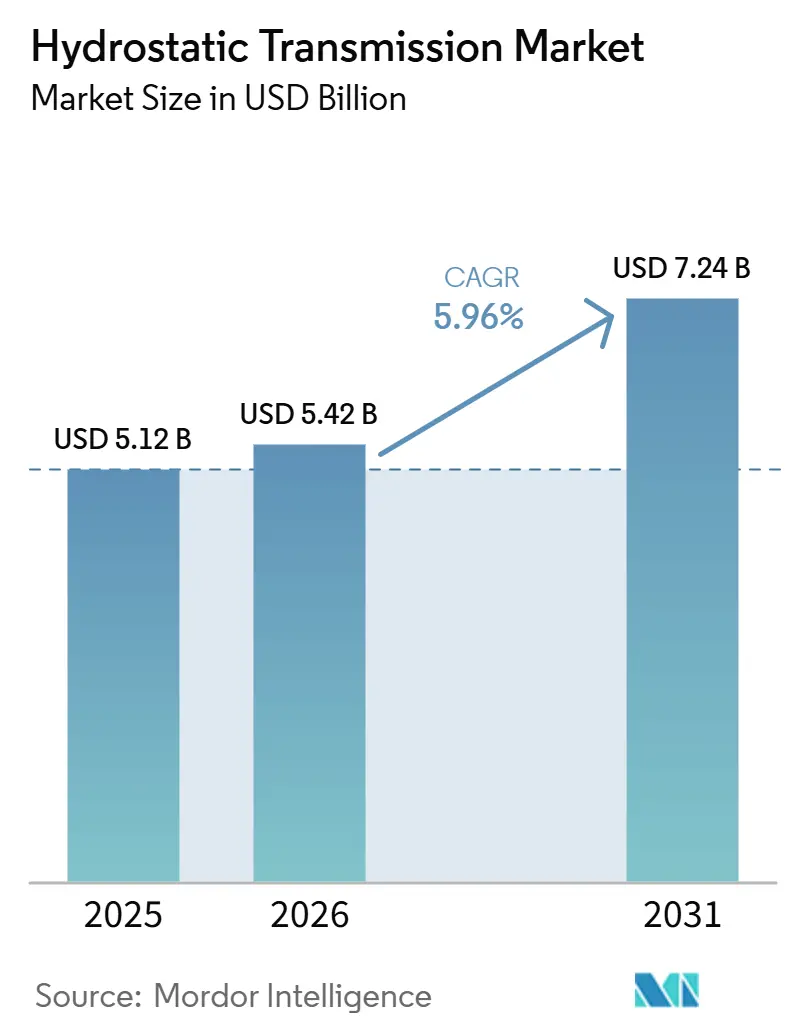
The Hydrostatic Transmission Market size was valued at USD 5.12 billion in 2025 and is estimated to grow from USD 5.42 billion in 2026 to reach USD 7.24 billion by 2031, at a CAGR of 5.96% during the forecast period (2026-2031). The hydrostatic transmission market is supported by sustained equipment demand in construction and agriculture, where high starting torque and smooth speed variation offer practical advantages in daily operation. The market is also benefiting from the wider adoption of electronically managed drivetrains, as shared control of engine throttle and transmission displacement is increasing system value faster than unit shipments alone. Precision farming is adding another layer of demand, as modern machines increasingly require closed-loop systems that can respond to digital speed commands and field-level control logic linked to Implement Bus (ISOBUS) workflows. Hybrid machine design is providing further support to the market, with advanced hydraulic architectures being positioned as complementary to battery-electric and hydrogen-ready equipment rather than as a legacy alternative. Competitive conditions remain moderate, with large suppliers holding strong positions in proprietary closed-loop platforms while specialist manufacturers continue to win in narrower applications that value faster customization and lower switching barriers.
Key Report Takeaways
- By capacity, Heavy-Duty systems held 46.22% share in 2025, while Light-Duty systems are projected to expand at a 6.21% CAGR through 2031.
- By component, Hydraulic Pumps led with 34.57% share in 2025, while Valves and Control Systems are forecast to grow at a 6.71% CAGR through 2031.
- By transmission type, Closed-Loop Hydrostatic Transmissions accounted for 68.36% share of the hydrostatic transmission market size in 2025 and are expected to grow at a 6.18% CAGR through 2031.
- By application, Agricultural Machinery held 36.85% of the hydrostatic transmission market share in 2025, while Construction Equipment is expected to grow at a 6.67% CAGR through 2031.
- By geography, Asia-Pacific held 41.92% of the hydrostatic transmission market share in 2025 and is projected to expand at a 6.43% CAGR through 2031.
Note: Market size and forecast figures in this report are generated using Mordor Intelligence’s proprietary estimation framework, updated with the latest available data and insights as of January 2026.
Global Hydrostatic Transmission Market Trends and Insights
Drivers Impact Analysis*
| Drivers | (~) % Impact on CAGR Forecast | Geographic Relevance | Impact Timeline |
|---|---|---|---|
| Increasing Adoption of Hydrostatic Systems in Off-Highway Equipment | +1.9% | Global, concentrated in Asia-Pacific and North America | Short term (≤ 2 years) |
| Growing Demand for Energy-Efficient Hydraulic Drive Solutions | +1.4% | Global, strongest in Europe and North America | Medium term (2-4 years) |
| Rising OEM Preferences for Integrated Hydrostatic Drivetrains | +0.9% | Global, with early adoption in Germany and Japan | Medium term (2-4 years) |
| Expansion of Precision Agriculture | +0.8% | Asia-Pacific, North America, Europe | Long term (≥ 4 years) |
| Growing Adoption of Automation in Industrial Machinery | +0.7% | Global | Medium term (2-4 years) |
| Source: Mordor Intelligence | |||
Increasing Adoption of Hydrostatic Systems in Off-Highway Equipment
Off-highway machinery remains the largest operating base for hydrostatic drives, providing the hydrostatic transmission market with steady demand from construction and agricultural equipment programs. OEMs continue to prefer hydrostatic propulsion systems across many vehicle classes because they decouple engine speed from ground speed, improving controllability under changing load conditions and reducing energy waste during stop-and-start cycles. In real-world use, machines often transition from low-speed, torque-intensive work to transport motion within the same operating shift. The commercial rationale now extends beyond simple replacement, as buyers increasingly move toward better-specified systems with higher electronic content rather than basic mechanical or open-loop alternatives. This pattern is boosting revenue per system, even as fleet replacement cycles remain uneven across regions. It also helps the hydrostatic transmission market remain relevant as equipment categories become more automated and electronically coordinated.
Growing Demand for Energy-Efficient Hydraulic Drive Solutions
Energy efficiency has become a practical buying standard, and the hydrostatic transmission market is responding with more advanced drive layouts and control logic. Danfoss stated in 2025 that its variable-speed drive portfolio for industrial hydraulic applications can deliver energy savings of up to 60%, demonstrating how suppliers are moving beyond isolated hardware changes toward system-level efficiency gains[1]Danfoss, “Danfoss Launches Variable Speed Drive Portfolio for Industrial Hydraulic Applications, Offering Energy Savings of up to 60%,” Danfoss, danfoss.com. Bosch Rexroth also signaled this direction with EUR 560 million (USD 604.8 million) in 2025 investments across research, development, and facilities for digitally managed hydraulic and electro-hydraulic systems. Supplier differentiation is shifting from standalone pump performance toward control software, service tools, and electronically coordinated hydraulic functions. Regulatory pressure is reinforcing this shift in Europe and North America, where emissions compliance encourages machine builders to adopt systems that can document fuel use and operating performance more consistently. As a result, the hydrostatic transmission market is seeing value growth driven by richer specifications rather than volume expansion alone.
Expansion of Precision Agriculture
Precision farming is reshaping how agricultural machines are specified, strengthening the hydrostatic transmission market in both established and emerging mechanization zones. Modern self-propelled equipment increasingly requires drivetrains that can accept digital speed instructions, make rapid corrections during field operations, and support data-linked workflows across planting, spraying, and harvesting. India's Agriculture Infrastructure Fund targets INR 1 trillion (USD 12 billion) and aims to expand mechanization access in areas that previously relied on manual or animal-powered work. TAFE also introduced its 6065 Series with a hydrostatic transmission option at Agritechnica 2025, demonstrating that this capability is moving beyond premium tractor classes into broader product ranges. This combination of wider entry-level adoption and higher-value precision integration is creating two distinct demand layers within agricultural equipment, keeping the hydrostatic transmission market tied not only to machine sales but also to the growing digital sophistication of farm operations.
Growing Adoption of Automation in Industrial Machinery
Automation is opening a separate demand path for the hydrostatic transmission market, as autonomous and semi-autonomous machines require programmable, continuously variable drive behavior rather than fixed operating patterns. Applications such as automated guided vehicles, robotic forklifts, and autonomous outdoor equipment require smooth torque delivery, rapid control response, and compatibility with sensor-led command structures. A 2025 review in Processes identified AI-enabled adaptive control and remote monitoring as major development directions for hydrostatic systems in engineering machinery, aligning with the growing need for fault detection and connected maintenance support. Danfoss added to this transition with its Hybrid Load Control launch in October 2025, combining load-independent and load-dependent pump control in a single hardware and software package that reduces the number of sensors, wire harness complexity, and potential failure points. This architecture is suited for machines expected to operate with less operator input, as control precision can be embedded directly into the hydraulic system rather than handled by additional coordination hardware. This is helping the hydrostatic transmission market expand further into equipment classes where software and motion control are now central buying criteria.
Restraints Impact Analysis*
| Restraints | (~) % Impact on CAGR Forecast | Geographic Relevance | Impact Timeline |
|---|---|---|---|
| Growing Competition from Electromechanical and Hybrid Drive Systems | -0.8% | Europe, North America | Medium term (2-4 years) |
| High Maintenance Requirements of Hydraulic Components | -0.5% | Global | Long term (≥ 4 years) |
| High Initial Cost of Adoption | -0.4% | Emerging markets in the Asia-Pacific and the Middle-East | Short term (≤ 2 years) |
| Source: Mordor Intelligence | |||
Growing Competition from Electromechanical and Hybrid Drive Systems
Competition from electromechanical solutions is increasing, though the pressure is concentrated in lighter, more urban-duty cycles rather than across the entire hydrostatic transmission market. In partial-load applications, electric drive systems can achieve higher efficiency, particularly when operating patterns are repetitive and torque demand is lower. The situation differs in heavier equipment, where continuous torque density, packaging efficiency, and field durability continue to support hydrostatic designs. A National Science Foundation (NSF)-backed industry study published in 2024 found that professionals broadly expect the shift away from conventional hydraulic technologies in large mobile equipment to take 10 to 15 years, with hydraulic systems still favored for reliability, lifecycle cost, and lower adoption risk[2]National Science Foundation, “Industry Perspectives on Electrifying Heavy Equipment, Trends, Challenges, and Opportunities,” NSF, nsf.gov. This creates a split market, with some light-duty urban applications gradually shifting toward electromechanical layouts while heavy- and mixed-duty applications retain fluid power on core engineering grounds. In the hydrostatic transmission market, the more effective response is not to resist electrification, but to align with hybrid architectures that preserve hydraulic strengths.
High Initial Cost of Adoption
Upfront system costs remain a barrier in price-sensitive regions, especially where closed-loop designs require precision pumps, electronic control units, licensed software, and trained service support. Buyers in smallholder agriculture and light construction often prioritize initial purchase price over lifecycle optimization, making basic gear-drive or simpler hydraulic alternatives easier to approve. This pressure intensifies where dealer service coverage is limited, as commissioning, calibration, and troubleshooting costs rise when local technical capacity is insufficient. Maintenance requirements compound this challenge, as hydraulic cleanliness, fluid-handling discipline, and component servicing all demand more structured support than low-specification alternatives. India's construction machinery environment adds another cost layer through localization and certification requirements that can raise landed system prices for foreign suppliers in one of the fastest-growing end markets. Suppliers that offer modular configurations and phased control upgrades are better positioned to convert demand without compromising long-term contract value.
*Our forecasts treat driver/restraint impacts as directional, not additive. The impact forecasts reflect baseline growth, mix effects, and variable interactions.
Segment Analysis
By Capacity: Industrial Scale Anchors Heavy-Duty Leadership
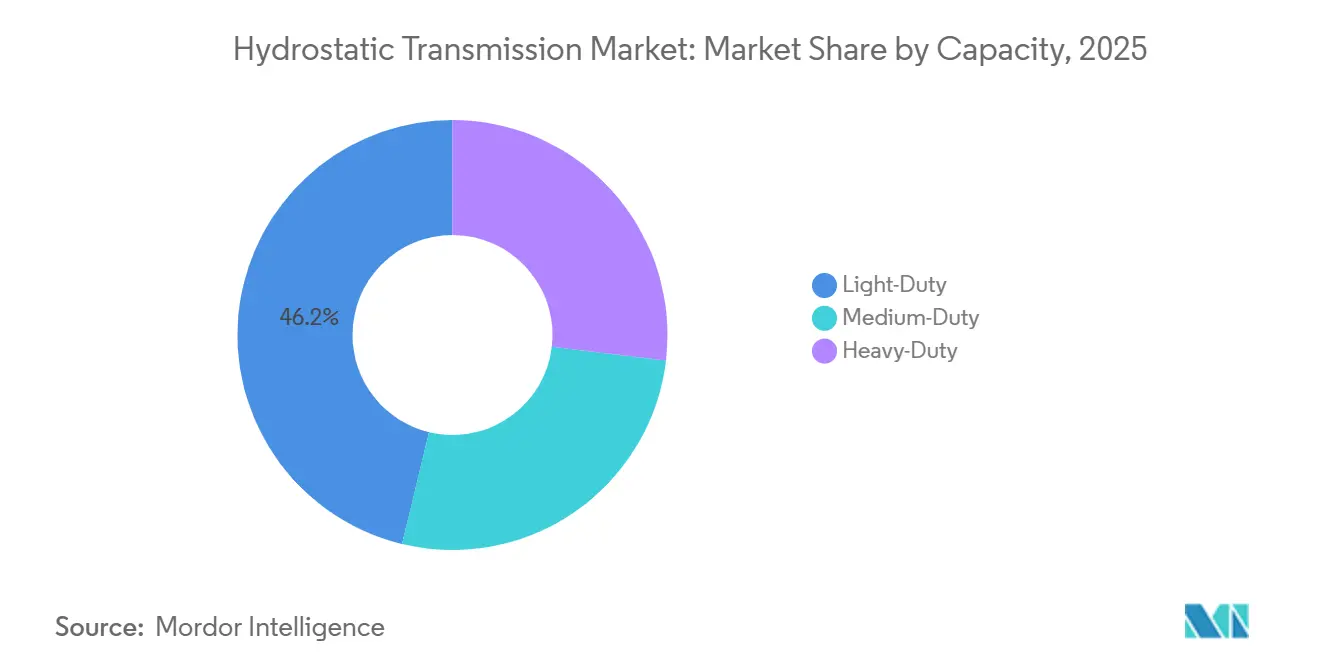
Heavy-duty hydrostatic transmissions held a 46.22% share in 2025, keeping this tier at the center of revenue generation in the hydrostatic transmission market. Their lead stems from large construction machines, mining equipment, and high-horsepower harvesting platforms where power density and long operating cycles rule out lighter transmission options. These systems are typically specified for continuous output above 100 kW, making them the highest-priced capacity class in the product mix. The concentration of value in this tier also supports the strong position of suppliers with advanced axial piston pump portfolios and long-standing OEM design relationships. In practical terms, heavy-duty demand is shaped less by unit volumes alone and more by the premium attached to precision-machined, electronically managed closed-loop assemblies.
Medium-duty systems serve the broad middle of the equipment base and provide the hydrostatic transmission market with a more stable stream of recurring demand between the heavy and compact ends of the spectrum. They support mid-range tractors, telehandlers, compact wheel loaders, and a variety of industrial machines that require stepless speed variation without the full engineering burden of very high power systems. Material handling equipment has become a dependable user group within this tier as warehouse modernization and logistics fleet renewal continue across large distribution hubs. Light-duty systems are the fastest-growing capacity segment, with a 6.21% CAGR through 2031, reflecting expanding use in compact utility vehicles, robotic turf platforms, and small logistics machines. Hydro-Gear and Tuff Torq remain active in this product space as manufacturers extend their offerings toward more feature-rich compact drive packages. The 2025 Processes review also identifies adaptive control and remote diagnostics as development paths that are beginning to reach smaller machines through lower-cost control units. This is shifting competition in light-duty products away from pure price and toward software capability, packaging efficiency, and easier commissioning. For the hydrostatic transmission industry, this capacity segment is becoming less of a commodity category and more of an entry point into connected motion systems.



By Component: Smart Controls Accelerate Component Mix Shift
Hydraulic pumps accounted for a 34.57% share in 2025, making them the largest revenue contributor at the component level within the hydrostatic transmission market. Their importance stems from their central role in converting mechanical input into hydraulic energy and from their higher unit cost relative to most downstream parts. Variable-displacement axial piston pumps have become the default choice for closed-loop systems because they can instantly adjust displacement in response to load and control signals. That capability directly supports efficiency, controllability, and integration with electronic management systems, and it explains why pump technology remains a strong source of pricing power for established suppliers.
Hydraulic motors remain closely tied to pump selection, and many OEMs increasingly purchase matched pump-motor sets as integrated propel subsystems rather than treating them as separate components. Filters and other auxiliary components may represent a smaller share of value, but they remain critical because contamination control strongly influences uptime, service intervals, and the usable life of closed-loop systems. Valves and control systems are the fastest-growing component group, with a 6.71% CAGR through 2031, as the hydrostatic transmission market steadily moves from hardware-defined circuits toward software-managed hydraulic behavior. Danfoss reinforced this direction in October 2025 with Hybrid Load Control, a combined control solution that reduces sensors, wiring, and system failure points in propel applications. The strategic value of this shift extends beyond efficiency, as more advanced control modules also improve diagnostics, support automation, and simplify performance tuning across different machine platforms. ISO 4413 compliance expectations are also pushing procurement toward more thoroughly documented and better-controlled hydraulic architectures, particularly among large OEMs in Europe and North America. That combination of technical pull and compliance pressure is steadily changing the internal component mix of the hydrostatic transmission market, with control intelligence capturing a larger share of value within each completed system.
By Transmission Type: Closed-Loop Architecture Sets the Efficiency Benchmark
Closed-loop hydrostatic transmissions held a 68.36% share in 2025 and also posted the fastest growth outlook at a 6.18% CAGR, giving this architecture the strongest position within the hydrostatic transmission market. Their lead reflects engineering strengths that are difficult to match in demanding mobile machinery, including higher system pressure, better transient response, and tighter speed and torque control. In these systems, fluid circulates directly between the pump and motor rather than returning to the reservoir after each cycle, which improves responsiveness and operating efficiency. That layout also makes closed-loop architecture the preferred platform for digital displacement controls, regenerative features, and sophisticated load-sensing behavior. For premium excavators, wheel loaders, harvesters, and similar machinery, closed-loop design has become the standard specification rather than an optional upgrade.
The hydrostatic transmission market continues to see support for closed-loop systems from published technical work, as smarter control under variable load conditions demonstrates measurable performance advantages. A 2026 study in the International Journal of Dynamics and Control found that optimized closed-loop hydraulic power drives under varying loads deliver better energy-saving behavior than fixed-parameter control approaches. Open-loop hydrostatic transmissions still hold a useful role in turf care, compact construction, light material handling, and selected industrial applications where cost, service simplicity, and lower pressure requirements matter more than peak performance. Their lower component count and easier fluid management keep them attractive in regions with limited dealer support or short equipment ownership cycles. Even so, the price gap between open-loop and entry-level closed-loop systems is narrowing as control hardware scales and more OEMs seek future software upgrade capability. That migration path is one of the clearest reasons closed-loop configurations are outpacing the overall growth rate of the hydrostatic transmission market. It also indicates that competition is increasingly centered on control depth and upgrade potential, not only on baseline hydraulic functionality. Over time, this should continue to shift customer preference toward architectures that are easier to integrate into automated and hybrid machines.
By Application: Infrastructure Investment Fuels Construction Segment Growth
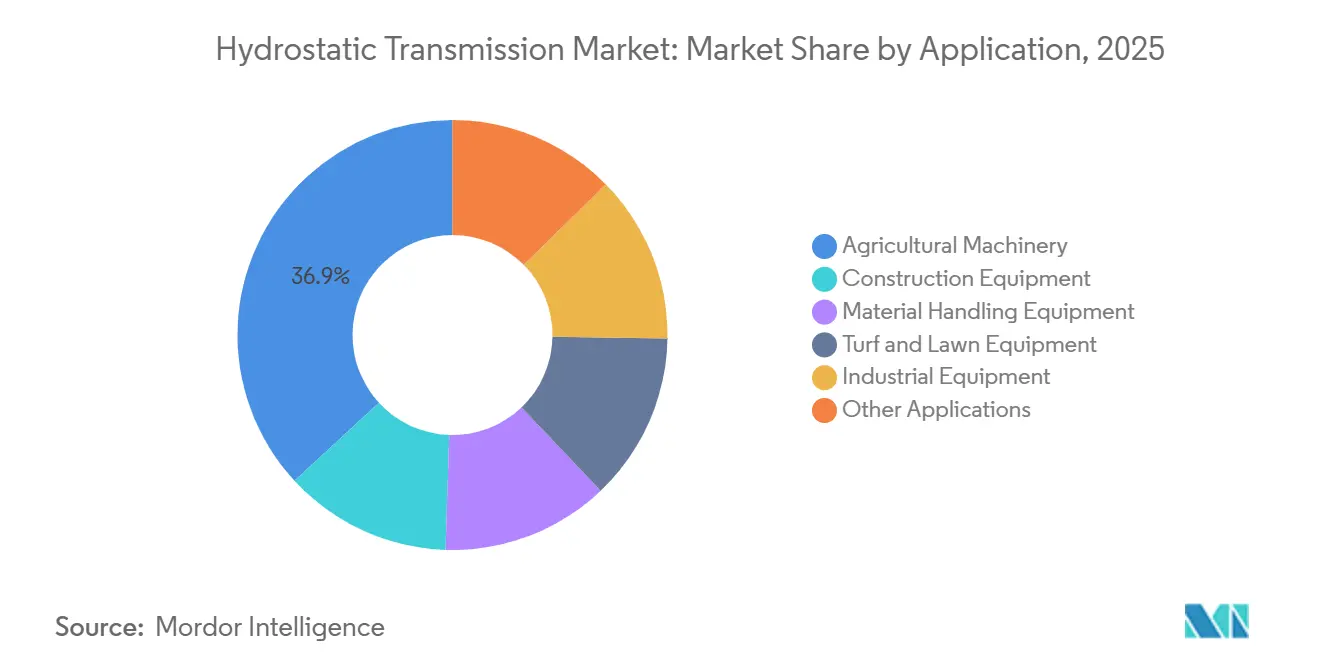
Agricultural machinery accounted for 36.85% of the hydrostatic transmission market in 2025, making it the largest application segment. That position reflects a long-running OEM preference for hydrostatic drives in self-propelled sprayers, forage harvesters, and large combine harvesters, where uninterrupted torque delivery improves field productivity and operating precision. The transmission is no longer treated only as a driveline component in these machines, as it now supports digitally guided operations such as GPS-linked movement and variable-rate field applications. Turf and lawn equipment remains a stable niche, particularly in North America and Japan, where riding mowers and turf care demand support a steady installed base. Material handling equipment also adds consistent volume as distribution centers, forklifts, and telehandlers continue to cycle through fleet renewal programs linked to logistics expansion.
Construction equipment is the fastest-growing application, with a 6.67% CAGR through 2031, making it one of the most important future growth channels for the hydrostatic transmission market. India's National Infrastructure Pipeline continues to support this demand through large, planned investments in roads, rail, and urban transit, which sustain orders for excavators, loaders, and compact construction machines. Saudi Arabia's infrastructure agenda under Vision 2030 is also directing major capital into construction activities that require heavy- and medium-duty equipment across large project sites. Hydrostatic transmissions are well suited to these duty cycles because they provide high torque at very low travel speed and continuous output variation without clutch interruption. That matters in dense urban worksites and mixed-terrain environments where precise control often matters as much as peak power. Industrial equipment and other specialized applications continue to add incremental demand, where fluid power remains the most practical way to regulate motion under changing operating loads. Taken together, these application patterns show that the hydrostatic transmission market is supported by both mature agricultural demand and faster-moving construction-led investment.
Geography Analysis
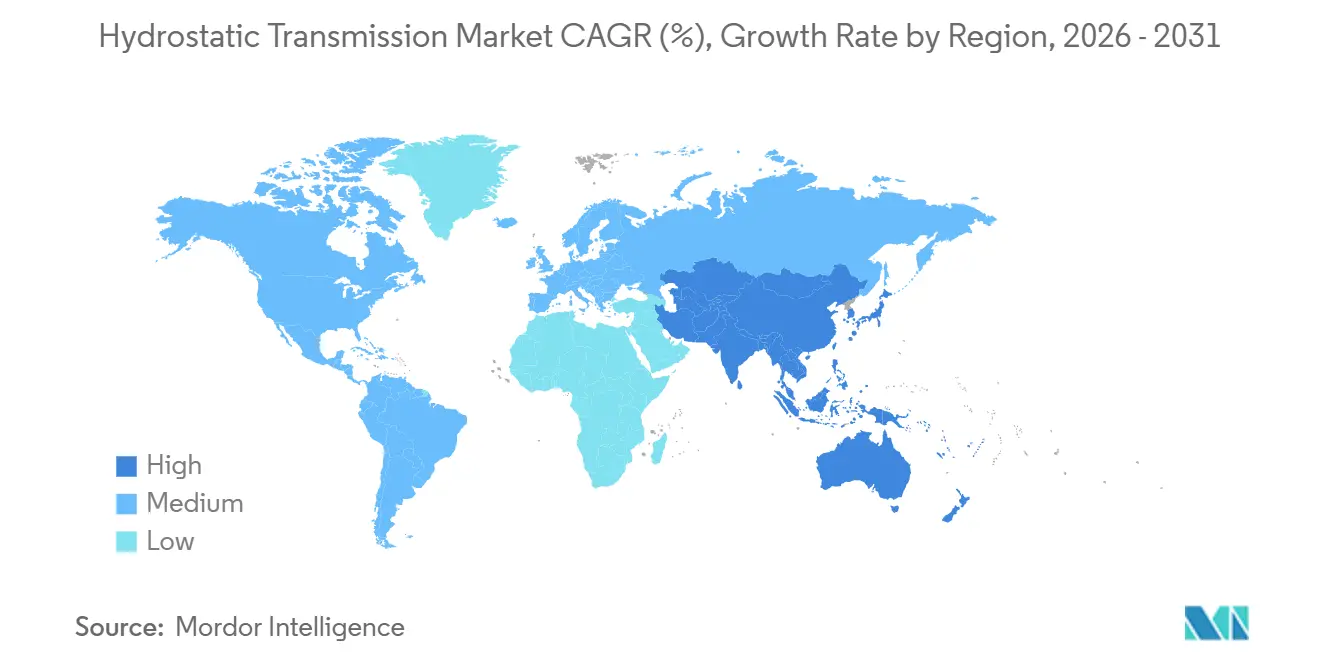
Asia-Pacific held a 41.92% share in 2025 and is projected to grow at a 6.43% CAGR through 2031, giving the region the strongest position in the hydrostatic transmission market. China remains the largest contributor within that base, as domestic construction machinery demand continues to support high volumes of heavy-duty hydrostatic systems across excavators, dozers, and road-building platforms. India adds further momentum, with its National Infrastructure Pipeline targeting USD 1.4 trillion in planned investment across transport and urban systems, supporting steady demand for compact and medium-duty machinery. Japan and South Korea contribute through technology, with precision agricultural and industrial equipment programs that support premium specifications and long-standing co-development ties with global suppliers. Southeast Asia is emerging as a secondary growth layer, as manufacturing shifts, logistics buildout, and agricultural mechanization expand demand from a lower installed base.
North America and Europe together form the premium revenue cluster of the hydrostatic transmission market, with higher content value per machine than most other regions. North America benefits from farm equipment replacement, established material-handling fleets, and a regulatory environment that favors electronically controlled systems capable of supporting documentation of fuel and emissions performance. Europe is a technology-focused market, where Germany's precision engineering base and Italy's specialist vehicle manufacturing ecosystem support early adoption of digital displacement, electro-hydrostatic, and advanced control innovations. Bosch Rexroth reported EUR 6.45 billion in 2025 sales, equivalent to USD 7.0 billion, and EUR 6.6 billion in order intake, equivalent to USD 7.1 billion, with order intake exceeding sales for the first time since 2022 as hydraulic and electro-hydraulic demand improved across mobile machinery.
South America remains closely tied to Brazil's large-scale agricultural base, where demand for combine and sprayer replacements supports a consistent market for hydrostatic drivetrains. Argentina introduces procurement timing risk due to macroeconomic instability, though this does not alter the longer replacement cycle for core agricultural equipment. The Middle-East and Africa present a mixed picture: Gulf markets are purchasing more construction machinery for large development programs, while many Sub-Saharan markets continue to face cost and service network barriers. Over the longer term, hydrostatic adoption in Africa may rise as mechanization improves and imported equipment linked to infrastructure projects broadens exposure to these systems.

Competitive Landscape
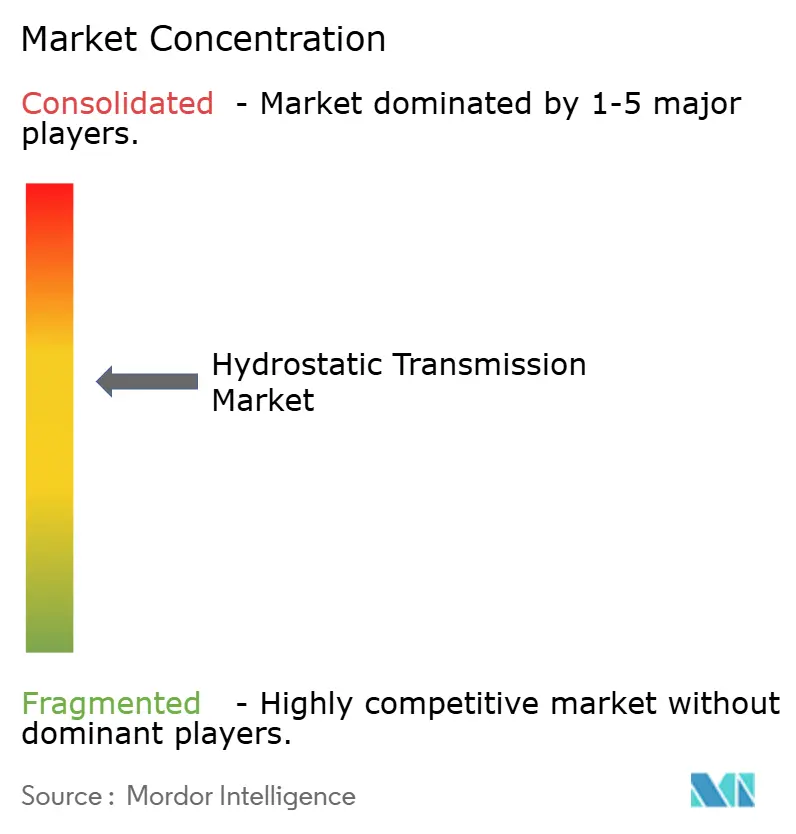
The hydrostatic transmission market is moderately consolidated, with Danfoss, Bosch Rexroth, Parker Hannifin, and Eaton forming the Tier-1 group across closed-loop platforms, software integration, and long-term original equipment manufacturer (OEM) relationships. Their advantage rests not only on hardware depth but also on their ability to deliver validated control systems, application engineering support, and multi-year co-development programs that smaller firms find difficult to match. Competitive behavior is increasingly shifting toward software differentiation, as customers now place greater value on system intelligence, diagnostics, and coordination across the broader machine architecture. Bosch Rexroth's 2025 investment of EUR 560 million (USD 604.8 million) in digital hydraulic platforms reflects this shift. As a result, the entry barrier is rising for suppliers that can build hydraulic hardware but cannot meet expectations for embedded software, validation, and compliance.
Strategic partnerships are becoming increasingly important in the hydrostatic transmission market as suppliers seek to shorten development cycles and improve machine-level integration. In March 2026, Bosch Rexroth and Kawasaki Precision Machinery signed a memorandum of understanding to develop next-generation off-highway machines and hydrogen solutions, combining Rexroth's software, electronics, and electrical systems with Kawasaki's precision hydraulic hardware and excavator expertise. Danfoss also reinforced its position in October 2025 through its Hybrid Load Control offering, which simplified the control architecture in hydrostatic propel applications and reduced sensor and wiring complexity. These developments indicate that suppliers are defending market share by making hydraulic systems smarter and easier to integrate into evolving machine platforms.
Open opportunities in the hydrostatic transmission market are most visible in light-duty autonomous platforms, medium-duty electro-hydrostatic hybrids, and retrofit packages that add electronic control to older installed bases. Specialist firms such as Casappa, Bondioli and Pavesi, Carraro Drive Tech, and Poclain Hydraulics compete in these narrower segments by tailoring products more quickly and working within shorter customer development cycles. Eaton's 2026 showcase of its hot shift PTO with soft start technology demonstrates how established driveline suppliers are extending control innovation into adjacent product areas beyond conventional propulsion. Large suppliers continue to set the technology pace, while several smaller players retain room to grow through specialization, responsiveness, and application-led engineering.
Hydrostatic Transmission Industry Leaders
Eaton
PARKER HANNIFIN CORP
Danfoss
Bosch Rexroth AG
Dana Limited
- *Disclaimer: Major Players sorted in no particular order

Recent Industry Developments
- March 2026: Bosch Rexroth and Kawasaki Precision Machinery signed a Memorandum of Understanding at CONEXPO-CON/AGG in Las Vegas to develop next-generation off-highway machines and hydrogen solutions. The partnership combines Rexroth's system software, electronics, and electrics portfolio with Kawasaki's hydraulic hardware and excavator expertise, targeting autonomous operation, worksite safety, and the energy transition for the global construction equipment market.
- October 2025: Danfoss launched Hybrid Load Control for hydrostatic propel applications, combining load-independent and load-dependent pump control behaviors in a single hardware-software unit, reducing sensor count, wire harness complexity, and potential failure points.


Global Hydrostatic Transmission Market Report Scope
A hydrostatic transmission uses pressurized hydraulic fluid to transfer power from an engine to drive wheels or implements. It eliminates gears and clutches, providing an infinitely variable speed range and seamless forward/reverse transitions. This technology is typically found in heavy-duty machinery such as zero-turn mowers, tractors, and skid steers.
The hydrostatic transmission market is segmented by capacity, component, transmission type, application, and geography. By capacity, the market is segmented into light-duty, medium-duty, and heavy-duty. By component, the market is segmented into hydraulic pumps, hydraulic motors, valves and control systems, filters, and other auxiliary components. By transmission type, the market is segmented into closed-loop hydrostatic transmission and open-loop hydrostatic transmission. By application, the market is segmented into agricultural machinery, construction equipment, material handling equipment, turf and lawn equipment, industrial equipment, and other applications. The report also covers the market size and forecasts for hydrostatic transmission in 16 countries across major regions. The market sizes and forecasts are provided in terms of value (USD).
| Light-Duty |
| Medium-Duty |
| Heavy-Duty |
| Hydraulic Pumps |
| Hydraulic Motors |
| Valves and Control Systems |
| Filters |
| Other Auxiliary Components |
| Closed-Loop Hydrostatic Transmission |
| Open-Loop Hydrostatic Transmission |
| Agricultural Machinery |
| Construction Equipment |
| Material Handling Equipment |
| Turf and Lawn Equipment |
| Industrial Equipment |
| Other Applications |
| Asia-Pacific | China |
| India | |
| Japan | |
| South Korea | |
| Rest of Asia-Pacific | |
| North America | United States |
| Canada | |
| Mexico | |
| Europe | Germany |
| United Kingdom | |
| France | |
| Italy | |
| Russia | |
| Rest of Europe | |
| South America | Brazil |
| Argentina | |
| Rest of South America | |
| Middle-East and Africa | Saudi Arabia |
| South Africa | |
| Rest of Middle-East and Africa |
| By Capacity | Light-Duty | |
| Medium-Duty | ||
| Heavy-Duty | ||
| By Component | Hydraulic Pumps | |
| Hydraulic Motors | ||
| Valves and Control Systems | ||
| Filters | ||
| Other Auxiliary Components | ||
| By Transmission Type | Closed-Loop Hydrostatic Transmission | |
| Open-Loop Hydrostatic Transmission | ||
| By Application | Agricultural Machinery | |
| Construction Equipment | ||
| Material Handling Equipment | ||
| Turf and Lawn Equipment | ||
| Industrial Equipment | ||
| Other Applications | ||
| By Geography | Asia-Pacific | China |
| India | ||
| Japan | ||
| South Korea | ||
| Rest of Asia-Pacific | ||
| North America | United States | |
| Canada | ||
| Mexico | ||
| Europe | Germany | |
| United Kingdom | ||
| France | ||
| Italy | ||
| Russia | ||
| Rest of Europe | ||
| South America | Brazil | |
| Argentina | ||
| Rest of South America | ||
| Middle-East and Africa | Saudi Arabia | |
| South Africa | ||
| Rest of Middle-East and Africa | ||


Key Questions Answered in the Report
What is current market size of Hydrostatic Transmission Market?
The Hydrostatic Transmission Market size was valued at USD 5.12 billion in 2025 and is estimated to grow from USD 5.42 billion in 2026 to reach USD 7.24 billion by 2031, at a CAGR of 5.96% during the forecast period (2026-2031).
Which application generates the most revenue today?
Agricultural Machinery led with 36.85% share in 2025, supported by long-standing use in sprayers, forage harvesters, and large combines.
Which application is growing the fastest through 2031?
Construction Equipment is projected to expand at a 6.67% CAGR, helped by infrastructure investment in India, Saudi Arabia, and other fast-growing regions.
Why are closed-loop systems preferred in many machines?
Closed-loop designs held 68.36% share in 2025 because they offer higher pressure capability, faster response, and better speed and torque control in demanding duty cycles.
Page last updated on:





