
Hydrogen Tank Composite Bonding Adhesives Market Size and Share
Market Overview
| Study Period | 2021 - 2031 |
|---|---|
| Market Size (2026) | USD 325.20 Million |
| Market Size (2031) | USD 574.40 Million |
| Growth Rate (2026 - 2031) | 12.05 % |
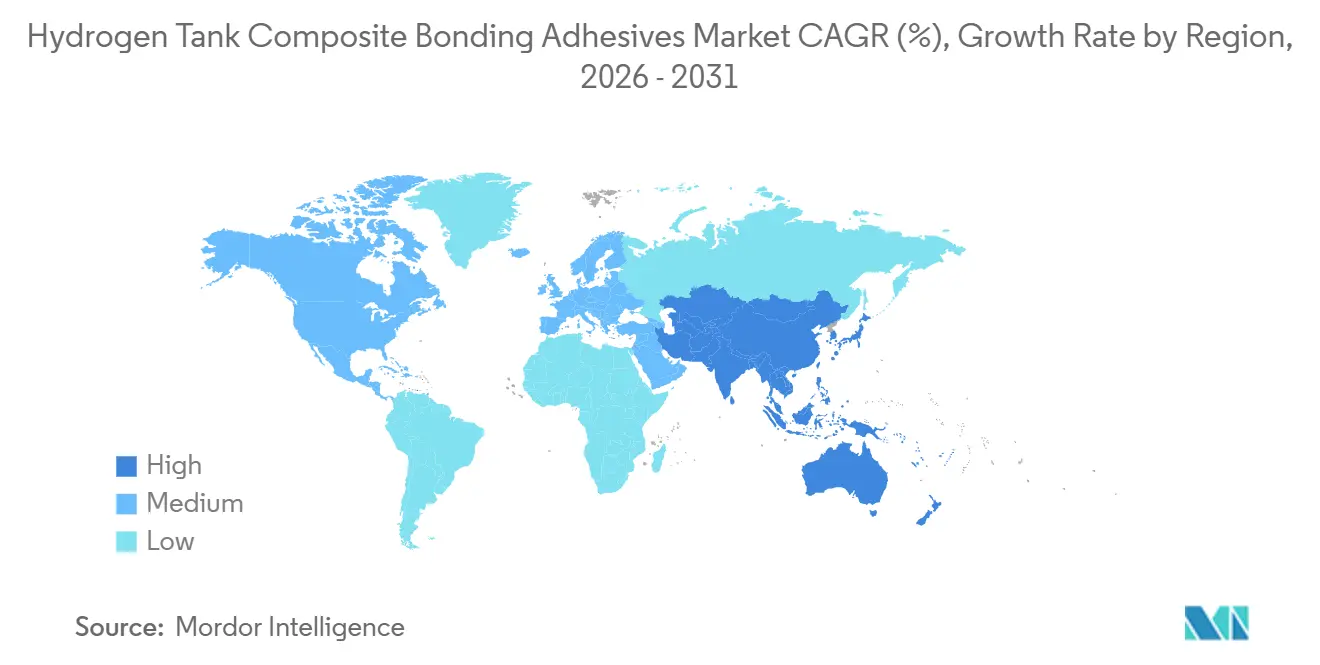
| Fastest Growing Market | Asia-Pacific |
| Largest Market | Asia-Pacific |
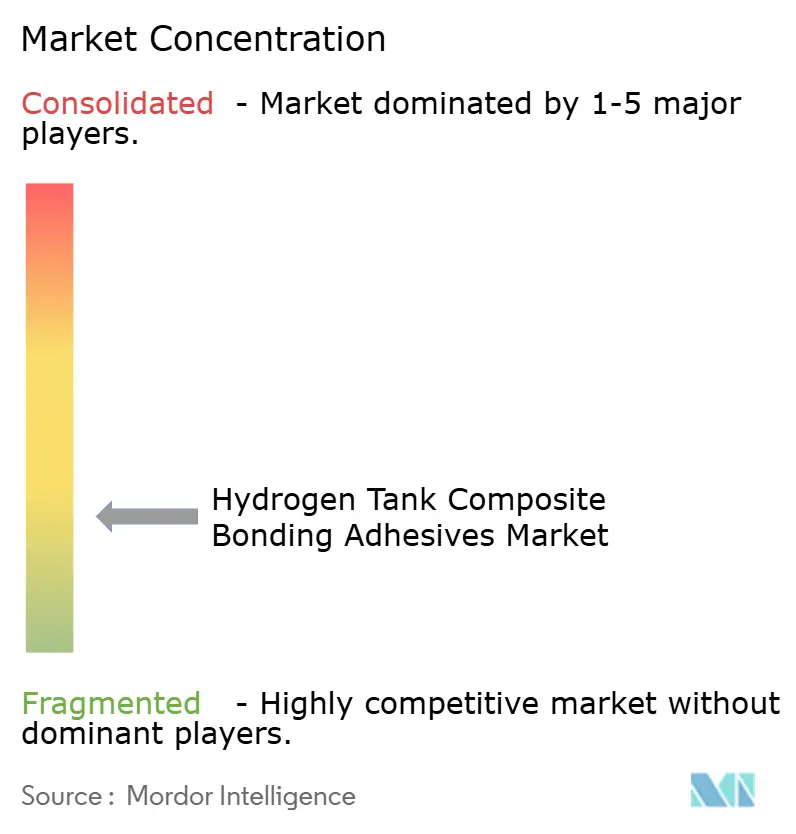
| Market Concentration | Low |
Major Players *Disclaimer: Major Players sorted in no particular order Image © Mordor Intelligence. Reuse requires attribution under CC BY 4.0. | |
Hydrogen Tank Composite Bonding Adhesives Market Analysis by Mordor Intelligence
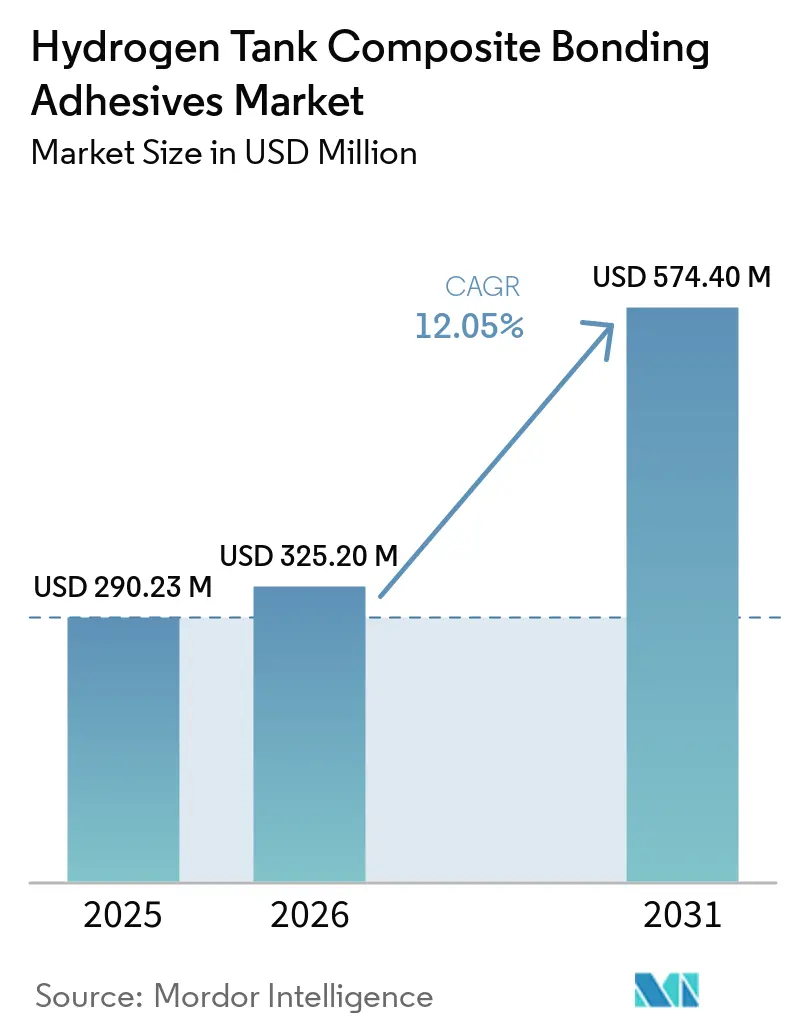
The Hydrogen Tank Composite Bonding Adhesives Market was valued at USD 290.23 million in 2025 and is estimated to grow from USD 325.20 million in 2026 to reach USD 574.40 million by 2031, at a CAGR of 12.05% during the forecast period (2026–2031). The hydrogen tank composite bonding adhesives market is supported by the serial production of Type IV high-pressure vessels for fuel cell electric vehicles. More demanding qualification procedures under ISO 19881:2025 and United Nations Regulation No. 134 also raise the importance of proven bonding systems. Composite tanks operating above 70 MPa require dependable liner-to-overwrap bonds because this interface faces repeated pressure and temperature loads. Qualification programs can take 18 to 36 months, which favors suppliers with validated formulations as production volumes increase. Suppliers that combine qualification support, automated dispensing integration, and hydrogen-compatible polyurethane development can improve their position as tank programs move into larger-scale production.
Key Report Takeaways
- By chemistry, epoxy adhesives held 43.23% of the hydrogen tank composite bonding adhesives market share in 2025, while polyurethane adhesives are projected to advance at a 13.44% CAGR through 2031.
- By tank type, type III hydrogen tanks held 34.56% of the hydrogen tank composite bonding adhesives market share in 2025, while type IV hydrogen tanks are projected to advance at a 14.02% CAGR through 2031.
- By application, liner-to-composite bonding held 54.38% of the hydrogen tank composite bonding adhesives market share in 2025 and is projected to advance at a 13.68% CAGR through 2031.
- By end-use, Fuel Cell Electric Vehicles (FCEVs) held 44.45% of the hydrogen tank composite bonding adhesives market share in 2025, while hydrogen storage and distribution is projected to advance at a 14.17% CAGR through 2031.
- By geography, Asia-Pacific held 31.64% of the hydrogen tank composite bonding adhesives market share in 2025 and is projected to advance at a 13.93% CAGR through 2031.
Note: Market size and forecast figures in this report are generated using Mordor Intelligence’s proprietary estimation framework, updated with the latest available data and insights as of January 2026.
Market Trends and Insights
Drivers Impact Analysis of Hydrogen Tank Composite Bonding Adhesives Market*
| Driver | (~) % Impact on CAGR Forecast | Geographic Relevance | Impact Timeline |
|---|---|---|---|
| Expansion of Type IV Hydrogen Tank Serial Production | +2.8% | Asia-Pacific core (China, Japan, South Korea), spillover to North America and Europe | Short term (≤ 2 years) |
| Higher Storage Pressure and Weight-Reduction Requirements | +2.4% | Global, with concentrated demand in commercial vehicle corridors of APAC and EU | Medium term (2-4 years) |
| Hydrogen-Compatible Bonding for Polymer Liners and Carbon-Fiber Overwraps | +2.1% | Global, with early demand concentration in APAC and Germany | Short term (≤ 2 years) |
| Adhesive Qualification as a Safety-Critical Tank-Certification Input | +1.8% | Global; driven by UN R134 adoption in EU and ISO 19881 in APAC markets | Medium term (2-4 years) |
| Adoption of Automated Dispensing and Towpreg Manufacturing | +1.5% | North America, EU, South Korea, and Japan | Medium term (2-4 years) |
| Demand for Faster Cure Cycles and Higher Production Yield | +1.2% | Global, with greatest urgency in China and South Korea where volume ramp is most aggressive | Short term (≤ 2 years) |
| Source: Mordor Intelligence | |||
Expansion of Type IV Hydrogen Tank Serial Production
Type IV composite pressure-vessel production is increasing the demand for qualified adhesive systems across the Asia-Pacific. CIMC-Hexagon rolled out China’s first 20-foot Type IV hydrogen multi-element gas container at its Hebei facility in February 2026. The company described the facility as Asia’s largest Type IV cylinder production site, showing the shift from pilot activity to serial manufacturing. Larger multi-element gas containers require more bonding material per vessel than light-duty fuel cell electric vehicle cylinders. This production pattern can favor suppliers that can support high-throughput dispensing, repeatable cure cycles, and tank-level qualification. The hydrogen tank composite bonding adhesives market, therefore, benefits when capacity additions move from demonstration units to repeatable commercial output.
Higher Storage Pressure and Weight-Reduction Requirements
Storage systems designed for 70 MPa operation place demanding fatigue requirements on bonded interfaces. Pressure vessels can undergo 8,000 to 11,000 pressure cycles during their service life, particularly stressing boss-to-liner and liner-to-composite joints. A 2026 scientific review discussed hydrogen-related blistering and crack growth at the liner-to-composite interface during rapid depressurization. Weight reduction also matters because carbon-fiber-reinforced tanks must meet vehicle range and payload needs. Toughened adhesive systems can help manufacturers maintain structural performance while optimizing the amount of reinforcement used. These requirements make bond-line durability and production consistency central purchasing criteria in the hydrogen tank composite bonding adhesives market.
Hydrogen-Compatible Bonding for Polymer Liners and Carbon-Fiber Overwraps
Polymer liner selection determines the surface preparation, primer, and bonding requirements used in a tank. Polyamide 6, polyamide 11, and high-density polyethylene liners respond differently to surface treatments and flexible bond-line designs. Arkema stated in January 2026 that Rilsan polyamide 11 had hydrogen permeation rates 12 times lower than high-density polyethylene under saturation conditions. The company also presented Pliogrip two-component polyurethane structural adhesives for tank-end bonding applications. Two-component polyurethane can offer useful toughness during low-temperature excursions, while epoxy remains established for controlled manufacturing conditions. The hydrogen tank composite bonding adhesives market must therefore match adhesive chemistry to liner material and expected operating conditions rather than rely only on previous epoxy use.
Adhesive Qualification as a Safety-Critical Tank-Certification Input
ISO 19881:2025 was published in June 2025 and set performance-based requirements for gaseous hydrogen land-vehicle fuel containers[1]. The standard covers design, materials, manufacturing, testing, and marking, making material validation an integral part of tank development. Qualification programs assess exposure to cycling, temperature extremes, and pressure fatigue, increasing the cost of changing an approved formulation. Adoption of automated dispensing and towpreg manufacturing also makes precise bead placement and reliable cure behavior more important. Faster cure cycles and higher production yield matter most where production ramps are aggressive, including China and South Korea. These conditions give the hydrogen tank composite bonding adhesives market a safety-led demand base rather than a purely price-led one.
Restraints Impact Analysis of Hydrogen Tank Composite Bonding Adhesives Market*
| Restraint | (~) % Impact on CAGR Forecast | Geographic Relevance | Impact Timeline |
|---|---|---|---|
| Multi-Year Requalification Barriers for Approved Adhesive Systems | -1.8% | Global; most acute in EU and Japan where type-approval cycles are longest | Long term (≥ 4 years) |
| Material Compatibility Risk Across Liners, Primers, Fibers, and Adhesives | -1.4% | Global; particularly constraining for OEMs qualifying new liner materials in APAC | Medium term (2-4 years) |
| High Cost of Hydrogen-Specific Validation and Non-Destructive Inspection | -1.1% | Global, with greatest burden on small and mid-sized adhesive formulators | Medium term (2-4 years) |
| Technology Displacement Risk from Linerless and Thermoplastic Composite Tanks | -0.7% | Global | Long term (≥ 4 years) |
| Source: Mordor Intelligence | |||
Multi-Year Requalification Barriers for Approved Adhesive Systems
A change to an adhesive formulation can require a full or partial requalification cycle under ISO 19881 or United Nations Global Technical Regulation No. 13 testing protocols. This process protects tank safety but can delay adoption of reformulated products. Existing suppliers in qualified original equipment manufacturer programs face less substitution pressure than new entrants. New suppliers may need 24 to 36 months before commercial volumes develop, while tank qualification pipelines can last 3 to 5 years. The hydrogen tank composite bonding adhesives market can therefore reward early qualification work and sustained technical support. The high cost of hydrogen-specific validation and non-destructive inspection further raises the entry barrier for small and mid-sized formulators.
Material Compatibility Risk Across Liners, Primers, Fibers, and Adhesives
A composite tank bonding system can involve liner material, primer, adhesive, carbon-fiber sizing chemistry, and overwrap matrix resin. A mismatch at any interface can create a failure mode that is difficult to identify without destructive or advanced non-destructive inspection. United Nations Economic Commission for Europe material-compatibility documentation requires evidence of hydrogen-environment compatibility or component performance under worst-case conditions[2]. Fraunhofer IFAM found in its HYTANK work that atmospheric-pressure plasma, vacuum ultraviolet irradiation, and laser treatment produced different adhesion outcomes depending on the composite matrix and surface residue. The results caution manufacturers against transferring qualification data between different liner or fiber batches without validation. Technology displacement risk from linerless and thermoplastic composite tanks remains longer term, but it may change adhesive use as these architectures receive further certification.
*Our forecasts treat driver/restraint impacts as directional, not additive. The impact forecasts reflect baseline growth, mix effects, and variable interactions.
Hydrogen Tank Composite Bonding Adhesives Market Segment Analysis
By Chemistry:
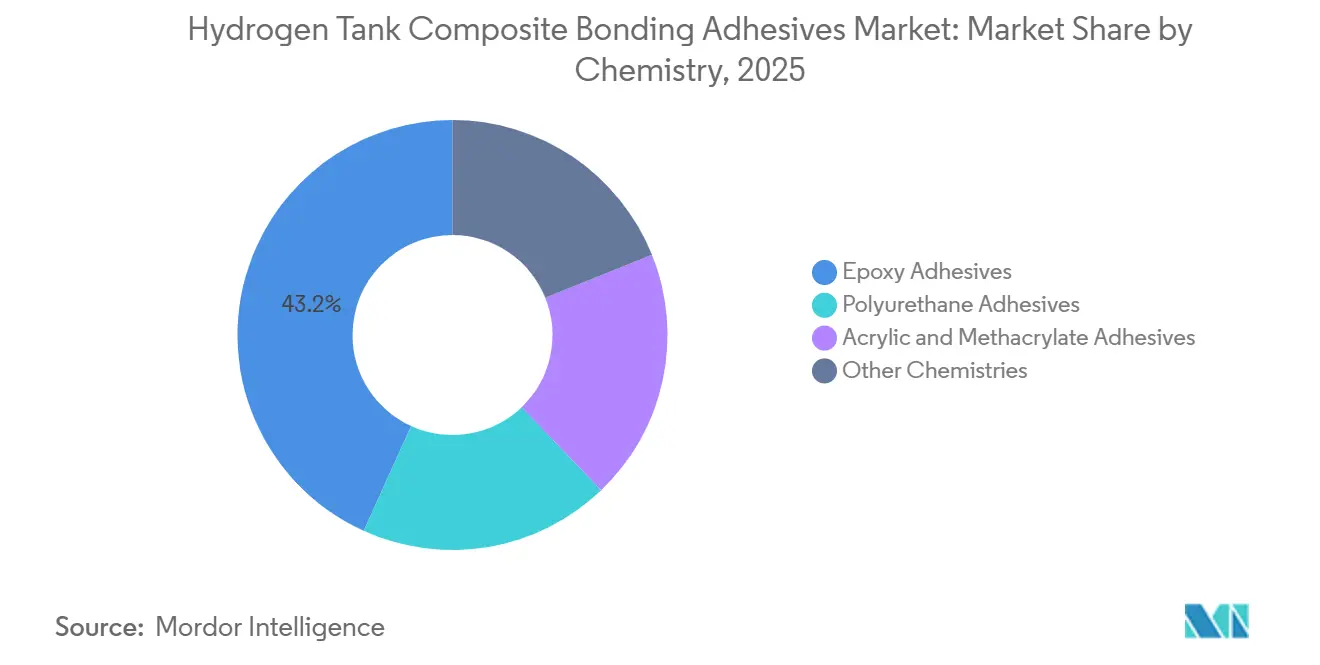
Epoxy Adhesives Dominate, While Polyurethane Adhesives Gain in Flex-Bond ApplicationsEpoxy adhesives held 43.23% of the chemistry segment in 2025, supported by their long qualification history in pressure-vessel manufacturing. Their predictable cure behavior suits controlled manufacturing environments and repeated pressure cycling. Polyurethane adhesives are projected to advance at a 13.44% CAGR through 2031. Their growth reflects demand for tougher bonds in boss-to-liner joints and end-cap assemblies, especially during low-temperature excursions. Acrylic and methacrylate adhesives offer ambient-temperature cure and adhesion to lower-surface-energy substrates, which can help reduce processing time on Type IV polyamide liners.
Other chemistries, including silicone and silane-modified adhesives, serve sealing and vibration-damping roles where flexibility is more important than structural strength. Epoxy adhesives remain important because qualified systems are difficult to replace in established tank programs. Polyurethane adhesives are more likely to gain use in new tank designs and higher-throughput assembly lines than through the replacement of approved epoxy systems. The hydrogen tank composite bonding adhesives industry also includes suppliers developing towpreg-ready epoxy formulations that improve handling and thermo-mechanical performance.

By Tank Type:
Type III Hydrogen Tanks Lead on Legacy, Type IV Hydrogen Tanks Accelerate on Policy TailwindsType III hydrogen tanks held 34.56% of the tank type segment in 2025. Their position reflected the installed base of aluminum-liner composite vessels used in industrial gas, stationary storage, and compressed natural gas conversion applications. Type IV hydrogen tanks are projected to advance at a 14.02% CAGR through 2031. Fuel cell electric vehicle programs favor all-polymer-liner designs because of their weight-per-unit-pressure advantages. Type IV designs also require detailed material qualification, creating demand for adhesive families validated for specific liner and overwrap combinations.
A single approved adhesive family used on a major fuel cell electric vehicle platform can generate substantial demand over the program life. Type V hydrogen tanks remain at an early commercial stage and use linerless designs. Their adhesive requirements are more focused on dome-to-cylinder interfaces than liner bonding. Hexcel Corporation and HyPerComp Engineering Inc. unveiled a Type IV composite overwrapped pressure vessel using HexTow IM11-R/12K carbon fiber in September 2025. The companies are progressing through certification for aerospace and space applications, which require different qualification investments from commercial hydrogen-mobility systems. This structure keeps the hydrogen tank composite bonding adhesives market responsive to both mobility and aerospace development programs.
By Application:
Liner-to-Composite Bonding Anchors the Market’s FoundationLiner-to-composite bonding held 54.38% of the application segment in 2025 and is projected to advance at a 13.68% CAGR through 2031. This interface joins a thermoplastic liner, usually polyamide 6, polyamide 11, or high-density polyethylene, to a carbon-fiber-reinforced matrix. Bonded surface area increases with vessel capacity and remains exposed to pressure cycling over the tank’s life. Boss-to-Liner Bonding is another important application because the metallic-to-polymeric joint experiences stress during pressurization and thermal cycling. Component Assembly and Other Applications include end-cap and joint bonding, repair, and maintenance work.
An automated application can improve repeatability at curved liner and composite surfaces. Fraunhofer IFAM demonstrated automated adhesive bonding on a full-scale carbon-fiber-reinforced polymer liquid-hydrogen tank segment in 2026. The work used robotic end-effectors with spring-loaded roller guidance to maintain consistent nozzle-to-substrate standoff. Consistent bead geometry can reduce failures during hydrostatic proof testing. China’s T/CITS 243-2025 standard defined performance requirements and test methods for epoxy resins used in hydrogen-storage-bottle inner-liner bonding in January 2025. This framework supports a clearer compliance baseline for bonding materials in China’s Type IV tank manufacturing.
By End-Use:
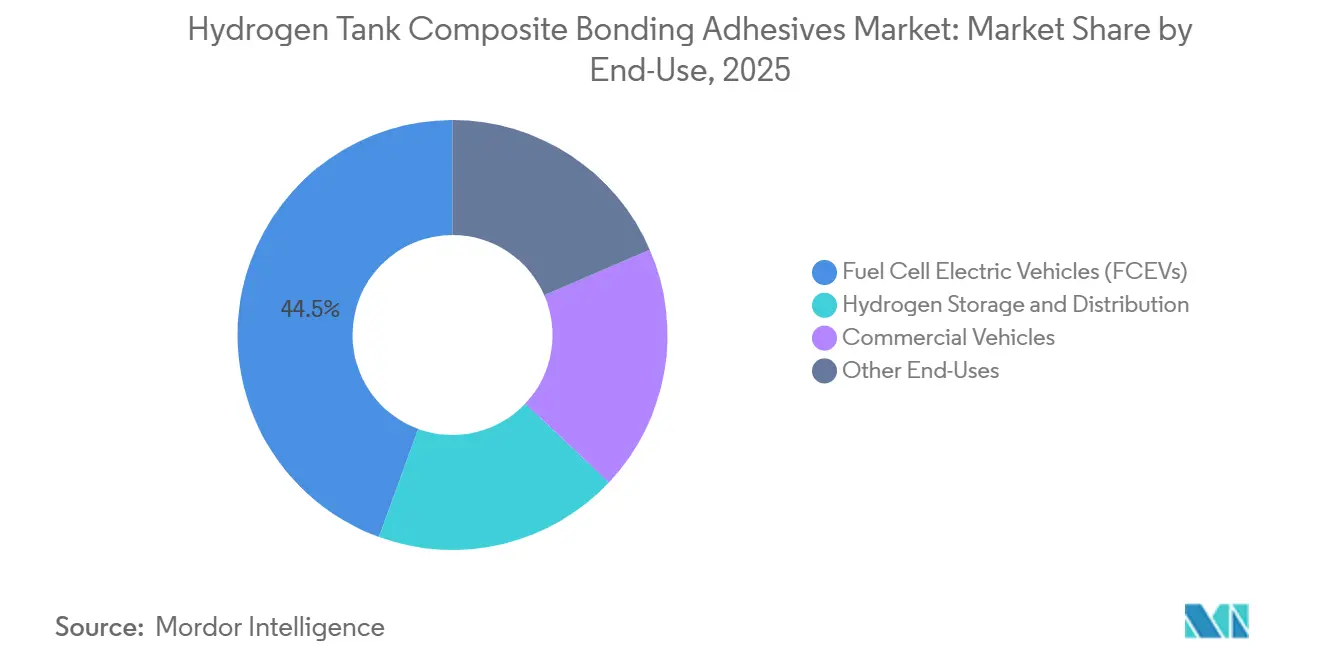
FCEVs Command Market Share, Hydrogen Storage and Distribution Scales FastFuel Cell Electric Vehicles (FCEVs) held 44.45% of the end-use segment in 2025. On-vehicle Type IV tanks require rigorous adhesive qualification under vehicle type-approval frameworks. Hydrogen storage and distribution is projected to advance at a 14.17% CAGR through 2031. Multi-element gas containers, tube trailer cylinders, and refueling-station buffer tanks require composite bonding systems with their own size, pressure rating, and certification needs. Commercial vehicles, including hydrogen fuel cell trucks and buses, use tanks operating from 350 bar to 700 bar and require more adhesive per vehicle than many passenger-car systems.
Industrial gas storage, aerospace, defense, marine, and rail applications provide additional end-use demand. Longer procurement contracts can support these uses and are less dependent on passenger fuel cell electric vehicle adoption. Infrastructure tanks can require larger bonding areas than on-vehicle storage systems. This expands the hydrogen tank composite bonding adhesives market beyond passenger transportation. Suppliers must still adapt formulations and process support to each pressure class and certification pathway. The hydrogen tank composite bonding adhesives industry benefits when vehicle and infrastructure programs develop in parallel.
Geography Analysis
APAC Hydrogen Tank Composite Bonding Adhesives Market
Asia-Pacific held 31.64% of the hydrogen tank composite bonding adhesives market share in 2025 and is projected to advance at a 13.93% CAGR through 2031. Japan established an early demand base through fuel cell electric vehicle commercialization and hydrogen safety standards, while South Korea continues to support hydrogen mobility and related infrastructure through its national roadmap. China is strengthening its role through domestic tank production and standards for Type IV liner and bonding-resin performance. T/CITS 243-2025 provides a specific testing framework for epoxy resins used in inner-liner bonding. India is an emerging opportunity as the National Hydrogen Mission targets 5 million metric tons of green hydrogen production by 2030.
North America Hydrogen Tank Composite Bonding Adhesives Market
North American demand in the hydrogen tank composite bonding adhesives market is anchored in aerospace, defense, and industrial gas applications. Fuel cell electric vehicle demand is developing, although it has grown more slowly than in the Asia-Pacific region. The United States Department of Energy continues to support hydrogen-storage research, including permeation validation and carbon-fiber cost reduction. Mexico can serve as a manufacturing and logistics extension of the United States production corridors.
EMEA and South America Hydrogen Tank Composite Bonding Adhesives Market
Europe is supported by heavy-duty vehicle emissions rules and its concentration of automotive and Tier 1 supplier capacity. Germany remains central to demand because of its automotive base and aerospace hydrogen work. Fraunhofer IFAM and Airbus Operations GmbH lead the HYTANK project in Stade, Germany, which focuses on cryogenic carbon-fiber-reinforced polymer tank development. South America, and Middle-East and Africa remain early-stage areas for the hydrogen tank composite bonding adhesives market. Suppliers entering these regions are primarily focused on refueling-station buffer tanks and industrial hydrogen storage before broader vehicle demand develops.
Competitive Landscape
The hydrogen tank composite bonding adhesives market is highly fragmented. Competition in the hydrogen tank composite bonding adhesives market depends more on qualified tank programs and engineering support than on adhesive price alone. A supplier with formulations approved across several original equipment manufacturer programs can have a durable advantage. The 18 to 36 months needed to qualify a new system reinforces this position. Smaller formulators can still compete in repair bonding, stationary storage, and other applications with lower qualification barriers.
Sika AG agreed in February 2026 to acquire Akkim, a Turkish global adhesives and sealants manufacturer. The transaction is expected to strengthen Sika’s production coverage and distribution capabilities for internationally distributed original equipment manufacturer supply chains in the hydrogen tank composite bonding adhesives market. Hexcel Corporation and HyPerComp Engineering Inc. presented a Type IV composite pressure-vessel development for aerospace and space certification in September 2025.
Opportunities remain for formulations pre-qualified for Type IV, 700 bar, polyamide 6, or polyamide 11 tank configurations. Such systems can help original equipment manufacturers reduce qualification lead times in the hydrogen tank composite bonding adhesives market. Adhesives that are compatible with thermoplastic composite overwraps can also prepare suppliers for linerless Type V architectures. Repair-grade formulations that cure at ambient temperature may meet an emerging need as deployed fuel cell electric vehicle fleets age. Automated dispensing with feedback on bead geometry and gap fill is becoming more relevant for tank original equipment manufacturers using automated production lines.
Hydrogen Tank Composite Bonding Adhesives Industry Leaders
-
Huntsman International LLC
-
Henkel AG & Co. KGaA
-
Sika AG
-
3M
-
H.B. Fuller Company
- *Disclaimer: Major Players sorted in no particular order
Hydrogen Tank Composite Bonding Adhesives Market Companies Covered in this Report
- 3M
- Arkema
- Gurit Services AG
- H.B. Fuller Company
- Henkel AG & Co. KGaA
- Huntsman International LLC
- Master Bond
- Mitsubishi Chemical Group
- Permabond LLC
- Resoltech
- Scott Bader Company Limited
- Sika AG
- Solvay
Recent Industry Developments in Hydrogen Tank Composite Bonding Adhesives Market
- February 2026: Sika AG acquired Akkim Sealants & Adhesives, a Turkish manufacturer of adhesives and sealants, to strengthen its production capacity and distribution network in the adhesives and sealants segment, in line with its Strategy 2028. The transaction supports the company's reach in the hydrogen tank composite bonding adhesives market.
- February 2026: CIMC-Hexagon Hydrogen Energy Development (Hebei) Co., Ltd. announced the rollout of China’s first 20-foot Type IV hydrogen cylinder multi-element gas container from its Hebei facility. The company designated the site as Asia’s largest Type IV cylinder production facility, driving demand for hydrogen tank composite bonding adhesives.
Global Hydrogen Tank Composite Bonding Adhesives Market Report Scope
Hydrogen tank composite bonding adhesives are specialized materials used to bond composite structures and components in high-pressure hydrogen storage tanks. They provide strong adhesion, structural integrity, chemical resistance, and durability under pressure and temperature variations, supporting the safe storage and transportation of hydrogen.
The Hydrogen Tank Composite Bonding Adhesives Market is segmented by chemistry, tank type, application, end-use, and geography. By chemistry, the market is segmented into epoxy adhesives, polyurethane adhesives, acrylic and methacrylate adhesives, and other chemistries (including silicone adhesives and hybrid and silane-modified adhesives). By tank type, the market is segmented into Type III hydrogen tanks, Type IV hydrogen tanks, and Type V hydrogen tanks. By application, the market is segmented into liner-to-composite bonding, boss-to-liner bonding, component assembly, and other applications (including end-cap and joint bonding and repair and maintenance bonding). By end-use, the market is segmented into fuel cell electric vehicles (FCEVs), hydrogen storage and distribution, commercial vehicles, and other end-uses (including industrial gas storage, aerospace and defense, marine, and rail). The report also covers the market size and forecasts for hydrogen tank composite bonding adhesives in 15 countries across major regions. For each segment, the market sizing and forecasts have been done on the basis of value (USD).
Segmentation Overview
| Epoxy Adhesives |
| Polyurethane Adhesives |
| Acrylic and Methacrylate Adhesives |
| Other Chemistries (Silicone Adhesives, Hybrid and Silane-Modified Adhesives) |
| Type III Hydrogen Tanks |
| Type IV Hydrogen Tanks |
| Type V Hydrogen Tanks |
| Liner-to-Composite Bonding |
| Boss-to-Liner Bonding |
| Component Assembly |
| Other Applications (End-Cap and Joint Bonding, Repair and Maintenance Bonding) |
| Fuel Cell Electric Vehicles (FCEVs) |
| Hydrogen Storage and Distribution |
| Commercial Vehicles |
| Other End-Uses (Industrial Gas Storage, Aerospace and Defense, Marine and Rail) |
| Asia-Pacific | China |
| India | |
| Japan | |
| South Korea | |
| Rest of Asia-Pacific | |
| North America | United States |
| Canada | |
| Mexico | |
| Europe | Germany |
| United Kingdom | |
| France | |
| Italy | |
| Rest of Europe | |
| South America | Brazil |
| Argentina | |
| Rest of South America | |
| Middle-East and Africa | Saudi Arabia |
| South Africa | |
| Rest of Middle-East and Africa |
| By Chemistry | Epoxy Adhesives | |
| Polyurethane Adhesives | ||
| Acrylic and Methacrylate Adhesives | ||
| Other Chemistries (Silicone Adhesives, Hybrid and Silane-Modified Adhesives) | ||
| By Tank Type | Type III Hydrogen Tanks | |
| Type IV Hydrogen Tanks | ||
| Type V Hydrogen Tanks | ||
| By Application | Liner-to-Composite Bonding | |
| Boss-to-Liner Bonding | ||
| Component Assembly | ||
| Other Applications (End-Cap and Joint Bonding, Repair and Maintenance Bonding) | ||
| By End-Use | Fuel Cell Electric Vehicles (FCEVs) | |
| Hydrogen Storage and Distribution | ||
| Commercial Vehicles | ||
| Other End-Uses (Industrial Gas Storage, Aerospace and Defense, Marine and Rail) | ||
| By Geography | Asia-Pacific | China |
| India | ||
| Japan | ||
| South Korea | ||
| Rest of Asia-Pacific | ||
| North America | United States | |
| Canada | ||
| Mexico | ||
| Europe | Germany | |
| United Kingdom | ||
| France | ||
| Italy | ||
| Rest of Europe | ||
| South America | Brazil | |
| Argentina | ||
| Rest of South America | ||
| Middle-East and Africa | Saudi Arabia | |
| South Africa | ||
| Rest of Middle-East and Africa | ||
Key Questions Answered in the Report
What is the size of the hydrogen tank composite bonding adhesives market?
The hydrogen tank composite bonding adhesives market stands at USD 325.20 million in 2026 and is projected to reach USD 574.40 million by 2031.
What is driving demand for hydrogen tank composite bonding adhesives?
Type IV tank serial production, 70 MPa storage requirements, hydrogen-compatible liner bonding, and safety qualification requirements are supporting demand.
Which chemistry led the market demand in 2025?
Epoxy adhesives held 43.23% of the chemistry segment in 2025.
Why is liner-to-composite bonding important in hydrogen tanks?
The liner-to-composite bonding held 54.38% of the application segment in 2025 because it secures the liner and composite overwrap during repeated pressure cycles.