
Hydrogen Storage Materials Market Size and Share
Market Overview
| Study Period | 2021 - 2031 |
|---|---|
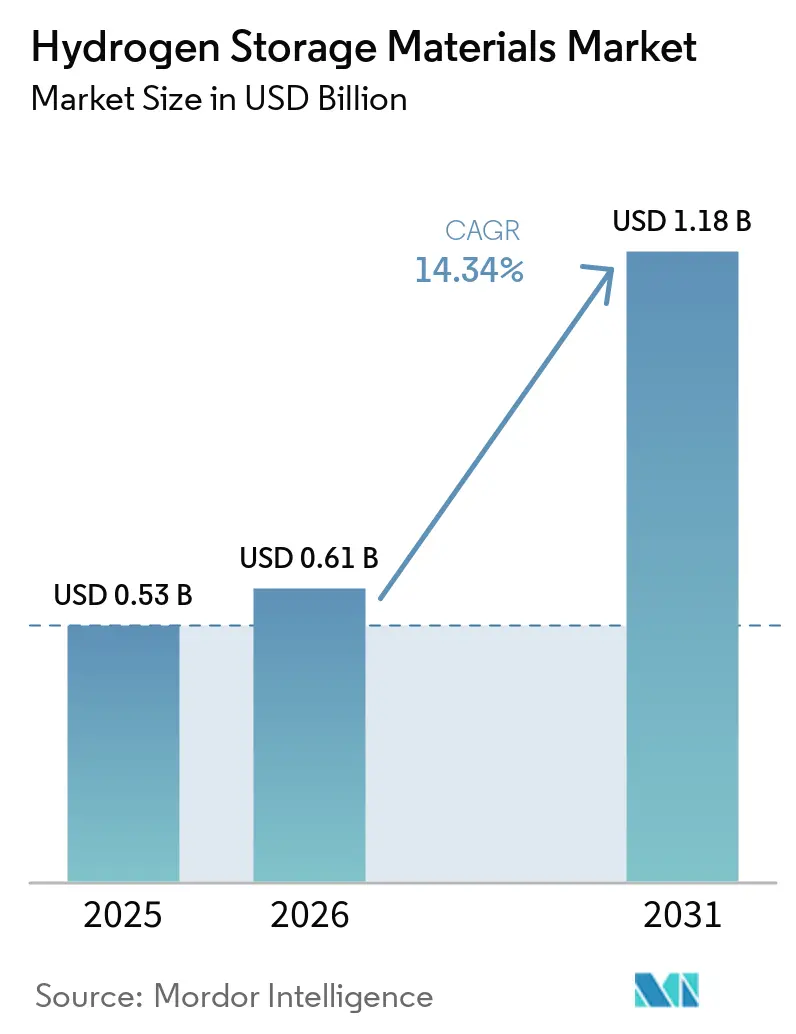
| Market Size (2026) | USD 0.61 Billion |
| Market Size (2031) | USD 1.18 Billion |
| Growth Rate (2026 - 2031) | 14.34 % |
| Fastest Growing Market | Asia-Pacific |
| Largest Market | Asia-Pacific |
| Market Concentration | Medium |
Major Players *Disclaimer: Major Players sorted in no particular order Image © Mordor Intelligence. Reuse requires attribution under CC BY 4.0. | |
Hydrogen Storage Materials Market Analysis by Mordor Intelligence
The Hydrogen Storage Materials market size was valued at USD 0.53 billion in 2025 and is estimated to grow from USD 0.61 billion in 2026 to reach USD 1.18 billion by 2031, at a CAGR of 14.34% during the forecast period (2026-2031). Deployment of fuel cell commercial vehicles, green hydrogen infrastructure, and industrial decarbonization programs supports demand for advanced storage solutions because each activity requires hydrogen to be held, managed, and delivered under specific operating conditions. Steel, ammonia, refining, and cement projects require dependable hydrogen buffers that can support process reliability, particularly where hydrogen demand must be balanced with variable production or delivery schedules. Mobility applications require cycling stability above 1,500 charge-discharge cycles, while industrial sites need high volumetric density, and distributed systems need thermal stability, which gives material performance a direct role in equipment selection. These requirements broaden the hydrogen storage materials market beyond compressed-gas systems and support demand across several material categories, including systems designed for mobility, on-site industrial buffering, and distributed power uses. Underground hydrogen storage projects also require material-based buffers at withdrawal points, which can support pressure management and safety margins and create a related demand stream for the hydrogen storage materials market.
Key Report Takeaways
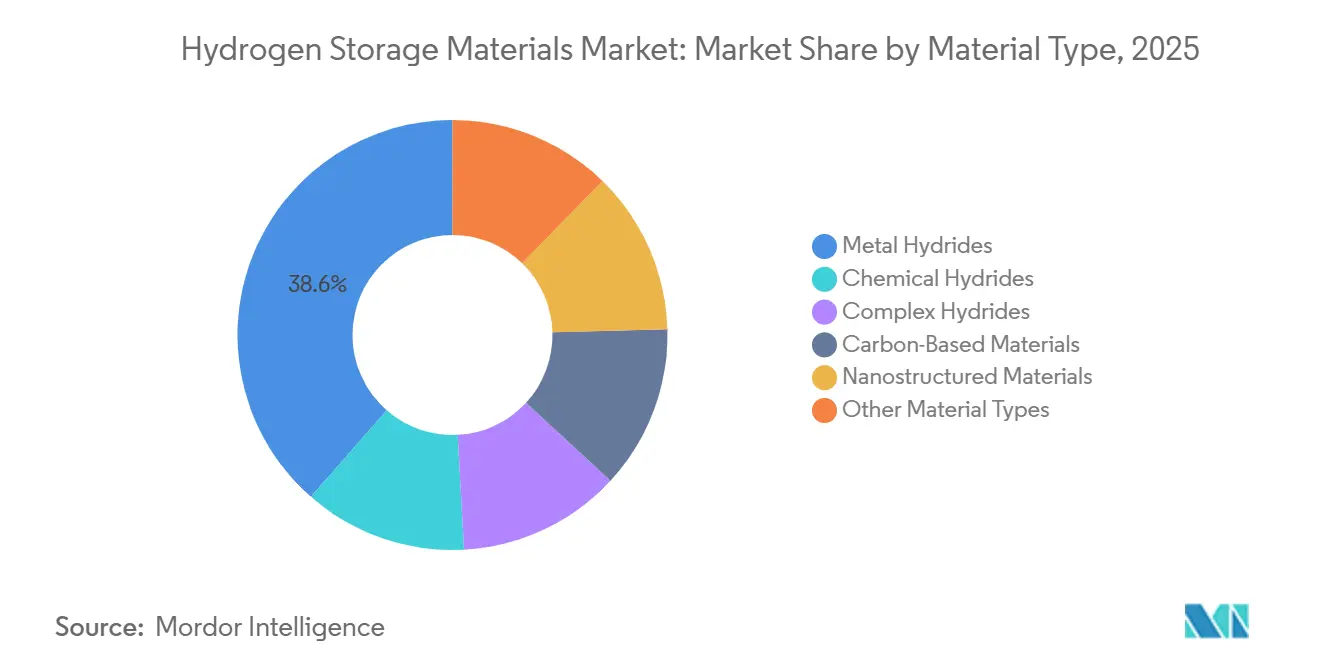
- By material type, metal hydrides held 38.56% of the hydrogen storage materials market share in 2025, while chemical hydrides are projected to advance at a 15.34% CAGR through 2031.
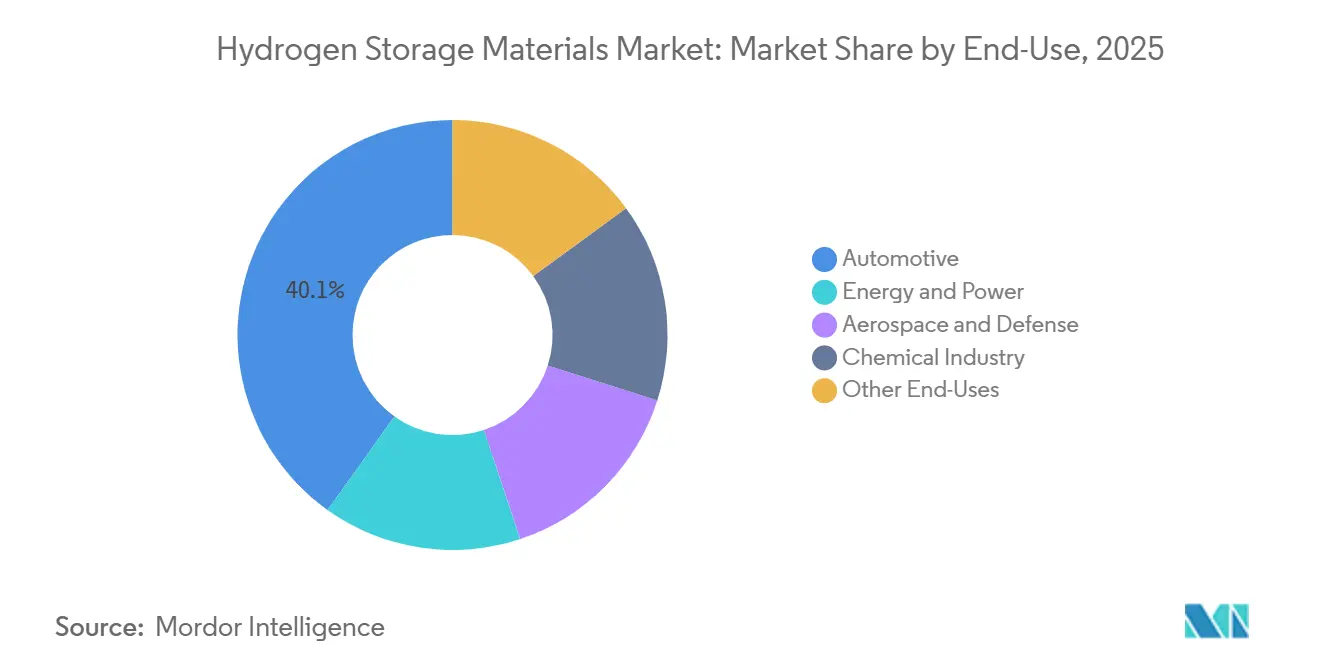
- By end use, automotive held 40.13% of the hydrogen storage materials market share in 2025, while energy and power is projected to advance at a 16.12% CAGR through 2031.
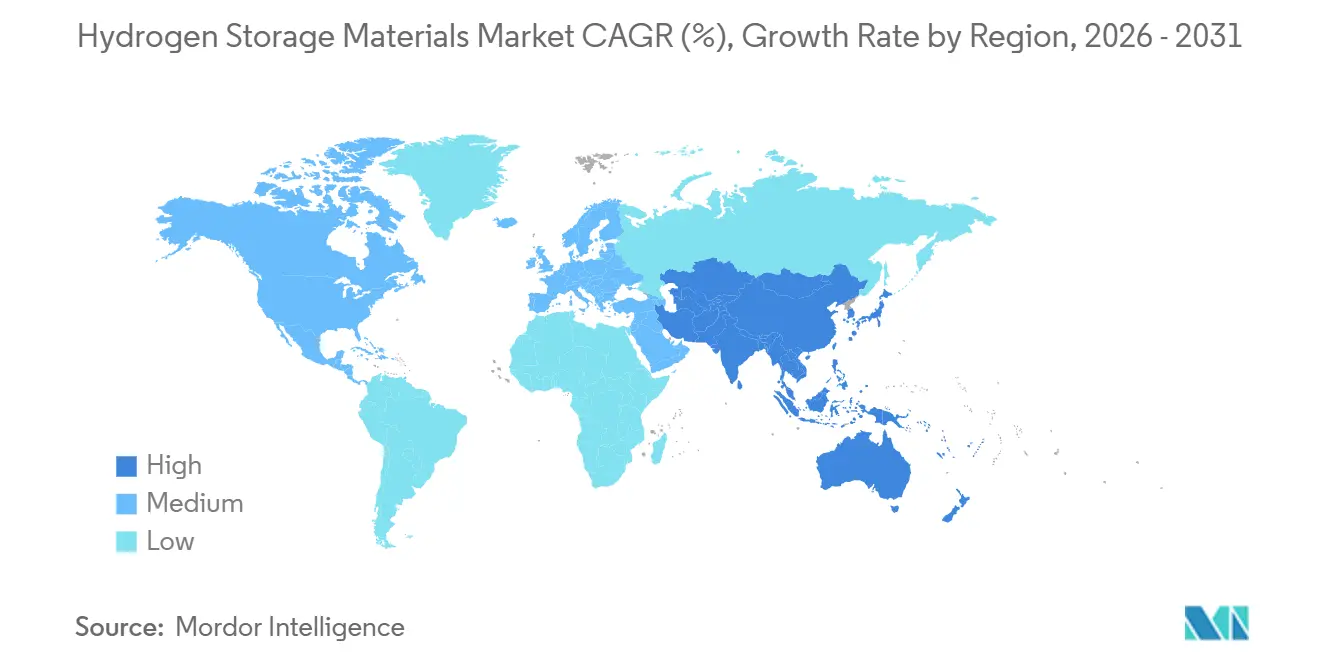
- By geography, Asia-Pacific held 37.07% of the hydrogen storage materials market share in 2025 and is projected to advance at a 15.68% CAGR through 2031.
Note: Market size and forecast figures in this report are generated using Mordor Intelligence’s proprietary estimation framework, updated with the latest available data and insights as of January 2026.
Market Trends and Insights
Drivers Impact Analysis of Hydrogen Storage Materials Market*
| Driver | (~) % Impact on CAGR Forecast | Geographic Relevance | Impact Timeline |
|---|---|---|---|
| Green-Hydrogen and Long-Duration Energy-Storage Investment | +4.2% | Global; highest in Europe, Asia-Pacific, and North America | Medium term (2-4 years) |
| Fuel-Cell Vehicle and Commercial-Mobility Deployment | +3.8% | Asia-Pacific core, spillover to EU and North America | Short term (≤ 2 years) |
| Industrial Decarbonization in Refining, Ammonia, Methanol, Steel and Cement | +2.5% | Global; concentrated in EU, China, and Middle-East | Long term (≥ 4 years) |
| Hydrogen Refueling and Distributed-Storage Infrastructure Expansion | +2.1% | Asia-Pacific and Europe; early expansion in North America | Short term (≤ 2 years) |
| Nanostructured Materials Improving Kinetics and Usable Capacity | +1.8% | Global; early gains in Japan, South Korea, and United States | Long term (≥ 4 years) |
| Source: Mordor Intelligence | |||
Green-Hydrogen and Long-Duration Energy-Storage Investment
Green hydrogen infrastructure investment is changing the demand profile for storage materials across the hydrogen storage materials market. Developers increasingly pair electrolyzer installations with material-based buffer storage to improve electrolyzer utilization and reduce the mismatch between variable renewable output and hydrogen demand. This design supports higher use of electrolyzer assets, adds flexibility during renewable generation changes, and creates a storage requirement that differs from hydrogen’s role as a chemical feedstock. In the hydrogen storage materials market, these integrated projects can require buffer capacity before hydrogen reaches industrial customers, such as refueling stations. The International Finance Corporation, Siemens Financial Services, and Fullerton Capital signed definitive agreements in June 2026 to co-lead a USD 105 million equity investment in Hygenco, supporting the expansion of green hydrogen capacity in India[1]. India, therefore, adds a demand center beyond the established East Asian and European clusters, while the Renewable Energy Directive III (RED III) encourages industrial use of renewable hydrogen and projects that need certified storage systems.
Fuel-Cell Vehicle and Commercial-Mobility Deployment
Commercial mobility is an immediate source of demand for solid-state and hybrid storage materials in the hydrogen storage materials market. Heavy-duty buses and long-haul trucks require different storage performance than passenger vehicles, including duty cycles above 1,500 charge-discharge cycles, strict gravimetric density targets, and payload integration. These requirements can favor advanced metal hydride and composite systems over basic compressed-gas storage, where operators need durability, packaging efficiency, and dependable cycling performance. In the hydrogen storage materials market, fleet procurement can also require suppliers to meet specific material qualification and safety standards before production programs begin. Germany’s Federal Ministry of Transport received 526 funding applications worth EUR 455 million for hydrogen-powered commercial vehicles and related refueling infrastructure by June 2026. South Korea’s roadmap targets 2.75 million hydrogen vehicles and 1,200 refueling stations by 2040, while China links fuel cell electric vehicle manufacturing with domestic alloy production, and original equipment manufacturer (OEM) cycles lasting 36-48 months can lock in material specifications into the early 2030s.
Industrial Decarbonization in Refining, Ammonia, Methanol, Steel and Cement
Industrial decarbonization supports a stable demand base for the hydrogen storage materials market. Refining consumed 41 Mt of hydrogen globally, ammonia consumed 33 Mt, and methanol consumed 16 Mt in 2025, with these established uses operating at Technology Readiness Level 9 and depending on a reliable point-of-use hydrogen supply. Hydrogen-based direct reduced iron (H2-DRI) requires dependable on-site buffers at sites replacing blast furnaces, where process continuity and hydrogen availability are closely linked. The hydrogen storage materials market can therefore address industrial needs that go beyond delivery volumes by supporting controlled hydrogen availability at the point of consumption. The International Energy Agency stated that steelmaking had the highest sensitivity to carbon pricing among industrial hydrogen uses, making total delivery costs important to project economics. A 2025 National Renewable Energy Laboratory assessment found that off-grid renewable electrolytic hydrogen could compete with fossil-based alternatives for steel and ammonia decarbonization in several United States locations under the Inflation Reduction Act tax credits.
Hydrogen Refueling and Distributed-Storage Infrastructure Expansion
Hydrogen refueling networks create direct demand for material-based buffer storage at individual stations in the hydrogen storage materials market. On-site systems can manage demand variability and reduce dependence on trucked compressed hydrogen, particularly as station throughput rises and fleet refueling patterns become more regular. The Alternative Fuels Infrastructure Regulation (AFIR) requires hydrogen refueling availability along Trans-European Transport Network core roads by 2030, with stations no more than 200 km apart, at least 1 metric ton per day capacity, and 700-bar dispensing capability. In the hydrogen storage materials market, these station requirements support demand for systems that can manage pressure changes, daily delivery schedules, and dispensing requirements on site. France opened its first motorway hydrogen refueling station accessible to heavy goods vehicles on the A4 in November 2025, supplied by Lhyfe under a renewable hydrogen contract. Metal hydride or chemical hydride buffer systems can become more favorable than trucked compressed gas as station throughput increases, and demand may follow station construction by 12-24 months.
Restraints Impact Analysis of Hydrogen Storage Materials Market*
| Restraint | (~) % Impact on CAGR Forecast | Geographic Relevance | Impact Timeline |
|---|---|---|---|
| High Material and System Cost Versus Conventional Storage | -1.8% | Global | Short term (≤ 2 years) |
| Slow Absorption-Desorption Kinetics and Thermal-Management Burden | -1.3% | Global | Medium term (2-4 years) |
| Raw-Material Exposure and Batch-to-Batch Material Variability | -0.9% | Global; most acute in Asia-Pacific supply chains | Long term (≥ 4 years) |
| Source: Mordor Intelligence | |||
High Material and System Cost Versus Conventional Storage
Metal hydride and chemical hydride systems cost 2-4 times more than conventional compressed-gas cylinder alternatives. The cost gap creates adoption barriers among price-sensitive industrial buyers and fleet operators, especially where buyers must import alloys, pay related logistics costs, and carry the cost of temperature-sensitive or pressure-sensitive material handling. Many industrial purchasers choose compressed hydrogen despite its safety and volumetric-density limitations when advanced systems lack policy support or long-term offtake contracts. The hydrogen storage materials market also faces raw-material exposure because rare-earth and titanium prices have shown 30%-40% volatility across multiyear commodity cycles. This volatility complicates long-term supply contracts, cost forecasting, and pricing discussions between buyers and suppliers. The European Union’s Carbon Border Adjustment Mechanism can raise the effective cost of energy-intensive alloy production outside the European Union, which may favor European producers that demonstrate lower-carbon manufacturing.
Slow Absorption-Desorption Kinetics and Thermal-Management Burden
Slow absorption-desorption kinetics remain a central technical restraint for the hydrogen storage materials market. Many metal hydride systems need external heat to release hydrogen at commercially useful rates, which adds capital cost, equipment requirements, and operational complexity compared with high-pressure compressed-gas storage. A 2025 study in Sustainable Energy & Fuels showed that magnesium-based composites with transition-metal catalysts could achieve dehydrogenation onset below 200 °C and retain cycling stability for 30 test cycles. A 2026 Nature Communications study demonstrated reversible hydrogen release below 393 K in reactive hydride composites based on LiBH₄, Mg(NH₂)₂, and LiH, which could support integration with fuel-cell waste heat. In the hydrogen storage materials market, this thermal-management burden limits adoption where systems must remain compact, light, and responsive during operation. Aerospace and defense use face strict weight and thermal-signature constraints, while scaling laboratory results to industrial batch sizes remains technically demanding and may keep this limitation significant through the middle of the forecast period.
*Our forecasts treat driver/restraint impacts as directional, not additive. The impact forecasts reflect baseline growth, mix effects, and variable interactions.
Hydrogen Storage Materials Market Segment Analysis
By Material Type:
Metal Hydrides Anchor Revenue, While Chemical Hydrides Drive GrowthMetal hydrides held 38.56% of global revenue in 2025. Decades of nickel-metal hydride battery production created alloy manufacturing capabilities that producers adapted for hydrogen-specific grades with modified thermodynamic profiles, established production knowledge, and supplier relationships. SANTOKU CORPORATION commercialized titanium-iron formulations that replaced 40%-50% of alloy mass with lower-cost iron and achieved 20% higher gravimetric hydrogen capacity per weight unit than conventional AB5-type formulations. A 2026 Chemical Science study introduced a data-driven framework to predict phase equilibrium in AB2-type Laves phase alloys and identify low-stability hydrides for two-stage compression. In the hydrogen storage materials market, procurement concern over rare-earth exposure directs research toward FeTi- and TiMn-based alloys with more stable raw-material sourcing profiles and potentially lower exposure to volatile inputs.
Chemical hydrides are projected to advance at a 15.34% CAGR through 2031 within the hydrogen storage materials market size. Liquid organic hydrogen carriers (LOHCs) are moving toward industrial deployment, and ammonia cracking is maturing for on-site hydrogen generation, which supports carrier-based storage along import and distribution routes. Hydrogenious LOHC Technologies received regulatory approval in April 2025 for its Hector LOHC hydrogenation plant at CHEMPARK Dormagen, with planned storage capacity of 1,800 metric tons of hydrogen per year. Complex Hydrides offer higher theoretical gravimetric density but face reversibility constraints that limit near-term commercial deployment. Carbon-Based Materials and Nanostructured Materials made up the remaining categories, while 2025 research found that palladium nanoneedle networks on magnesium nanoparticle films improved dehydrogenation kinetics by at least 2 times.

By End-Use:
Automotive Leads Demand, While Energy and Power Expands FastestAutomotive held 40.13% of global revenue in 2025. Bus and heavy-duty truck OEMs in China, South Korea, and Germany procured materials that could cycle above 1,500 charge-discharge cycles without measurable capacity fade, reflecting the operating demands of commercial fleets. Long OEM qualification programs, typically lasting 36-48 months, created an advantage for certified suppliers, set material specifications for later vehicle programs, and made supplier displacement more difficult after selection. Aerospace and defense applications have a higher material value per kilogram and require solid-state architectures that meet thermal-signature, vibration-resistance, and field-safety requirements. Chemical industry demand from ammonia, methanol, and refining provided steady demand through point-of-use buffering at existing sites, supporting a stable application base alongside vehicle programs.
Energy and power is projected to advance at a 16.12% CAGR through 2031. Grid operators are deploying hydrogen-based long-duration storage to complement variable wind and solar generation in the hydrogen storage materials market, where storage can help manage the timing difference between renewable output and power-system demand. Large-scale grid applications can increase upstream demand for storage materials in locations that were previously peripheral to hydrogen supply chains. Other end-uses include backup power, maritime fuel cells, and materials-handling forklifts, which have distinct requirements for safety, operating conditions, and delivery timing.
Geography Analysis
APAC Hydrogen Storage Materials Market
Asia-Pacific held 37.07% of global revenue in 2025 and is projected to advance at a 15.68% CAGR through 2031. China remained the largest production base for metal hydride alloys and a major deployment location for integrated hydrogen infrastructure, which linked materials supply with an expanding domestic demand base. Japan began construction of a commercial-scale liquefied hydrogen import terminal in 2025-2026, according to the International Energy Agency. India received a USD 105 million institutional equity investment for Hygenco in June 2026, and construction of 3-4 commercial plants was underway in fiscal year 2026-27. ASEAN countries and the Rest of the Asia-Pacific are developing solid-state hydrogen systems for microgrids and island-grid supply chains, extending demand beyond the region’s primary national markets.
North America and Europe Hydrogen Storage Materials Market
North America and Europe formed a significant demand block with different growth drivers. In the United States, the Inflation Reduction Act's hydrogen production tax credits improved the competitiveness of electrolytic hydrogen in several states. Salt caverns under construction in the United States require material-based buffers at withdrawal interfaces, which can create an additional source of demand for systems managing pressure changes and safety margins. Germany completed the world’s longest natural-gas pipeline repurposing project for hydrogen in 2025. Germany’s Hydrogen Acceleration Act, passed in February 2026, classified LOHC facilities as projects of overriding public interest through 2045, supporting chemical hydride infrastructure deployment.
EMEA and South America Hydrogen Storage Materials Market
South America, and Middle-East and Africa, and the Rest of Europe represented an emerging demand group. Chile and Argentina are advancing green hydrogen export strategies linked to Patagonian wind resources, with procurement expected to grow as projects approach commissioning during 2028-2030. Saudi Arabia’s National Hydrogen Strategy targets 4 million metric tons of annual hydrogen production capacity by 2030, placing storage-material selection at the center of export project cost optimization. South Africa has rare-earth and platinum-group metal resources that support storage alloys and fuel cells, giving the country a role in materials supply as well as deployment.
Competitive Landscape
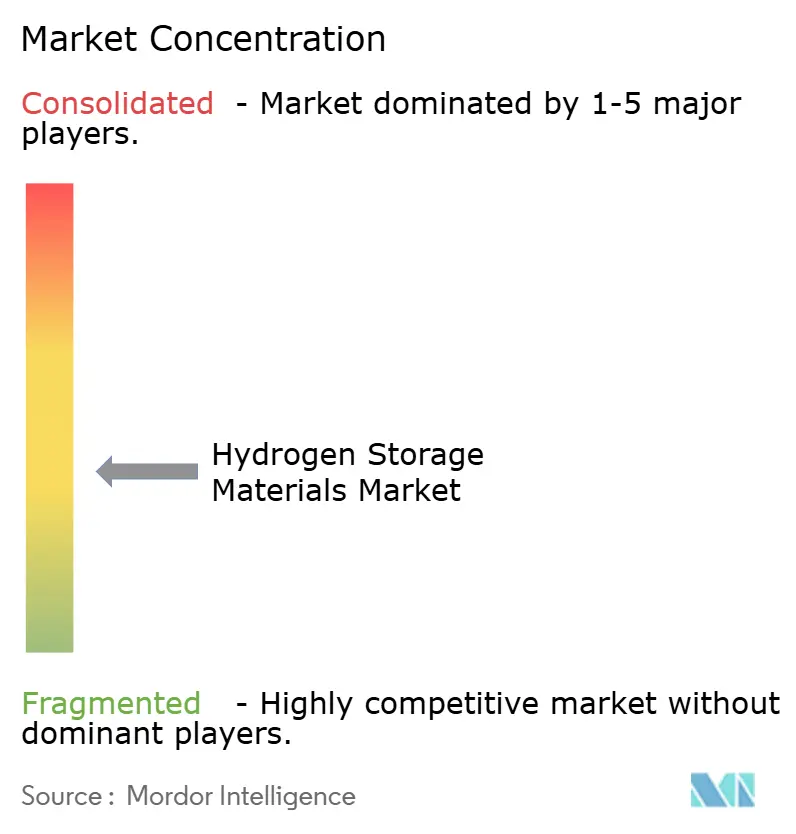
The hydrogen storage materials market is moderately concentrated, with the top five players including Japan Metals & Chemicals Co., Ltd., BAOTOU FDK CO., LTD., Hexagon Purus, Worthington Enterprises, and EnerVenue, Inc. Competition is strongest in automotive supply, where long OEM qualification periods mean that smaller producers can face exclusion from high-volume programs without certified materials or established customer relationships. Producers with rare-earth processing expertise can use their established material knowledge to support specifications that are difficult for new suppliers to match. SANTOKU CORPORATION received a United States Patent and Trademark Office patent US12,590,355 in March 2026 for a rare-earth alloy material with optimized absorption-pressure isotherm ratios[2]. The patent shows the importance of formulation-specific intellectual property in supplier selection and long-term contracts across the hydrogen storage materials market.
Hydrogenious LOHC Technologies is developing the Hector storage plant and contracted work for a hydrogen release plant, pursuing operating scale and supply-chain depth in the European chemical hydride segment. In October 2025, it signed front-end engineering design (FEED) and engineering, procurement, and construction management (EPCM) contracts with Griesemann Gruppe for a plant at the Bayernoil refinery in Vohburg, Bavaria. The planned facility is designed to release up to 5 metric tons of renewable fuel of non-biological origin (RFNBO)-certified, green hydrogen per day, which supports hydrogen use in freight and industrial applications. H2MOF Technology Limited uses metal-organic frameworks (MOFs) for ambient-temperature and low-pressure storage, while Harnyss LLC commercializes solid-state storage at pressures as low as 17 bar (approximately 247 psi). These companies target drone, e-bike, microgrid, and backup-power uses where safety and system simplicity are important selection factors in the hydrogen storage materials market.
Thermally integrated modules combine alloy or complex hydride materials with heat exchangers that can use fuel-cell waste heat for desorption, which can reduce the need for dedicated external heating and lower total system cost. This design approach addresses a technical issue that affects material selection in applications with frequent hydrogen release cycles and limited room for separate heating equipment. Third-party safety certification often takes 18-36 months for automotive applications and creates a barrier for developers without established supplier networks, testing resources, or prior vehicle-program experience. Certified incumbents can therefore retain an advantage in volume procurement programs, while new entrants focus on applications where incumbent alloy producers have fewer established offerings and where safety, lower operating pressure, or compact system design carries greater weight in the purchasing decision.
Hydrogen Storage Materials Industry Leaders
-
Japan Metals & Chemicals Co., Ltd.
-
BAOTOU FDK CO.,LTD.
-
Hexagon Purus
-
Worthington Enterprises
-
EnerVenue, Inc.
- *Disclaimer: Major Players sorted in no particular order
Hydrogen Storage Materials Market Companies Covered in this Report
- BAOTOU FDK CO.,LTD.
- EnerVenue, Inc.
- H2MOF Technology Limited
- Harnyss LLC
- Hexagon Purus
- Hydrexia
- Hydrogenious LOHC Technologies
- Japan Metals & Chemicals Co., Ltd.
- Luxfer Gas Cylinders
- NPROXX
- Quantum Fuel Systems
- SANTOKU CORPORATION
- Steelhead Composites, Inc.
- Treibacher Industrie AG
- Worthington Enterprises
- Xiamen Tungsten Co. Ltd
Recent Industry Developments in Hydrogen Storage Materials Market
- June 2026: International Finance Corporation (IFC), Siemens Financial Services, and Fullerton committed USD 105 million in equity investment in Hygenco to support the development of multiple commercial-scale green hydrogen projects in India. The planned expansion of hydrogen production infrastructure is expected to increase requirements for hydrogen storage systems and materials, including high-strength metals, advanced composites, and materials capable of safely containing hydrogen under pressure.
- February 2026: The German Bundestag passed the Hydrogen Acceleration Act (Wasserstoffbeschleunigungsgesetz), classifying LOHC hydrogenation and dehydrogenation facilities as projects of overriding public interest until 2045. The legislation supports faster permitting and development of industrial-scale LOHC storage projects, strengthening the deployment of hydrogen storage infrastructure in Germany.
Global Hydrogen Storage Materials Market Report Scope
Hydrogen storage materials are materials engineered to absorb, adsorb, or chemically bind hydrogen, enabling its storage at practical densities and operating conditions. They are being developed to improve hydrogen storage capacity, safety, reversibility, and efficiency for applications across transportation, energy systems, and industrial sectors.
The Hydrogen Storage Materials Market is segmented by material type, end-use, and geography. By material type, the market is segmented into metal hydrides, chemical hydrides, complex hydrides, carbon-based materials, nanostructured materials, and other material types. By end-use, the market is segmented into automotive, energy and power, aerospace and defense, chemical industry, and other end-uses. The report also covers the market size and forecasts for hydrogen storage materials in 15 countries across major regions. For each segment, the market sizing and forecasts have been done on the basis of value (USD).
Segmentation Overview
| Metal Hydrides |
| Chemical Hydrides |
| Complex Hydrides |
| Carbon-Based Materials |
| Nanostructured Materials |
| Other Material Types |
| Automotive |
| Energy and Power |
| Aerospace and Defense |
| Chemical Industry |
| Other End-Uses |
| Asia-Pacific | China |
| India | |
| Japan | |
| South Korea | |
| ASEAN Countries | |
| Rest of Asia-Pacific | |
| North America | United States |
| Canada | |
| Mexico | |
| Europe | Germany |
| United Kingdom | |
| France | |
| Italy | |
| NORDIC Countries | |
| Rest of Europe | |
| South America | Brazil |
| Argentina | |
| Rest of South America | |
| Middle East and Africa | Saudi Arabia |
| South Africa | |
| Rest of Middle East and Africa |
| By Material Type | Metal Hydrides | |
| Chemical Hydrides | ||
| Complex Hydrides | ||
| Carbon-Based Materials | ||
| Nanostructured Materials | ||
| Other Material Types | ||
| By End-Use | Automotive | |
| Energy and Power | ||
| Aerospace and Defense | ||
| Chemical Industry | ||
| Other End-Uses | ||
| By Geography | Asia-Pacific | China |
| India | ||
| Japan | ||
| South Korea | ||
| ASEAN Countries | ||
| Rest of Asia-Pacific | ||
| North America | United States | |
| Canada | ||
| Mexico | ||
| Europe | Germany | |
| United Kingdom | ||
| France | ||
| Italy | ||
| NORDIC Countries | ||
| Rest of Europe | ||
| South America | Brazil | |
| Argentina | ||
| Rest of South America | ||
| Middle East and Africa | Saudi Arabia | |
| South Africa | ||
| Rest of Middle East and Africa | ||
Key Questions Answered in the Report
What is the size of the hydrogen storage materials market?
The hydrogen storage materials market stands at USD 0.61 billion in 2026 and is projected to reach USD 1.18 billion by 2031.
What is driving demand for hydrogen storage materials?
Fuel cell commercial vehicles, green hydrogen infrastructure, and industrial decarbonization programs are supporting demand for advanced storage systems.
Which material type led the market share in 2025?
Metal hydrides accounted for 38.56% of the market share in 2025.
Which end-use segment is projected to grow fastest through 2031?
Energy and power is projected to advance at a 16.12% CAGR through 2031 as hydrogen supports long-duration storage needs.