
Hydrogen Liquefaction Materials Market Size and Share
Market Overview
| Study Period | 2021 - 2031 |
|---|---|
| Market Size (2026) | USD 0.88 Billion |
| Market Size (2031) | USD 1.23 Billion |
| Growth Rate (2026 - 2031) | 7.02 % |
| Fastest Growing Market | Asia-Pacific |
| Largest Market | Asia-Pacific |
| Market Concentration | Medium |
Major Players *Disclaimer: Major Players sorted in no particular order Image © Mordor Intelligence. Reuse requires attribution under CC BY 4.0. | |
Hydrogen Liquefaction Materials Market Analysis by Mordor Intelligence
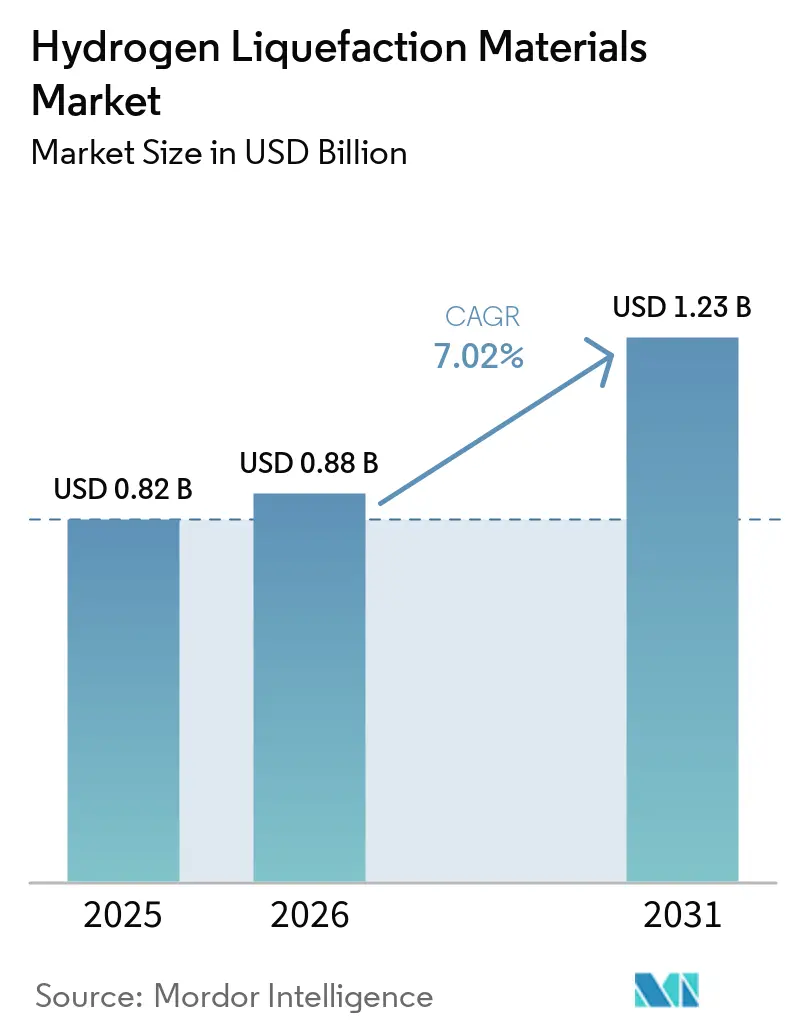
The Hydrogen Liquefaction Materials market size was valued at USD 0.82 billion in 2025 and is estimated to grow from USD 0.88 billion in 2026 to reach USD 1.23 billion by 2031, at a CAGR of 7.02% during the forecast period (2026-2031). The hydrogen liquefaction materials market is being supported by investment in commercial liquid hydrogen supply chains, which require specialized insulation, cryogenic metals, catalysts, and sealing materials. Project developers are increasingly considering materials as a design constraint because storage tanks, carriers, and transfer systems need to operate at cryogenic temperatures over long service periods. Qualification requirements and limited supplier experience can give established suppliers stronger positions in projects that need proven materials. Growth in distribution infrastructure is also increasing the need for materials used in storage, containment, and transfer systems. Higher electricity use and the technical limits of newer insulation concepts may slow project timing, but they do not change the underlying requirement for reliable cryogenic materials.
Key Report Takeaways
- By material type, thermal insulation materials held 34.23% of the hydrogen liquefaction materials market share in 2025, while catalyst materials are projected to advance at an 8.11% CAGR through 2031.
- By application, cryogenic heat exchangers held 32.16% of the hydrogen liquefaction materials market share in 2025, while storage, containment and transfer systems are projected to advance at an 8.32% CAGR through 2031.
- By end-use, hydrogen production and liquefaction plants held 38.05% of the hydrogen liquefaction materials market share in 2025, while hydrogen storage and transportation are projected to advance at an 8.67% CAGR through 2031.
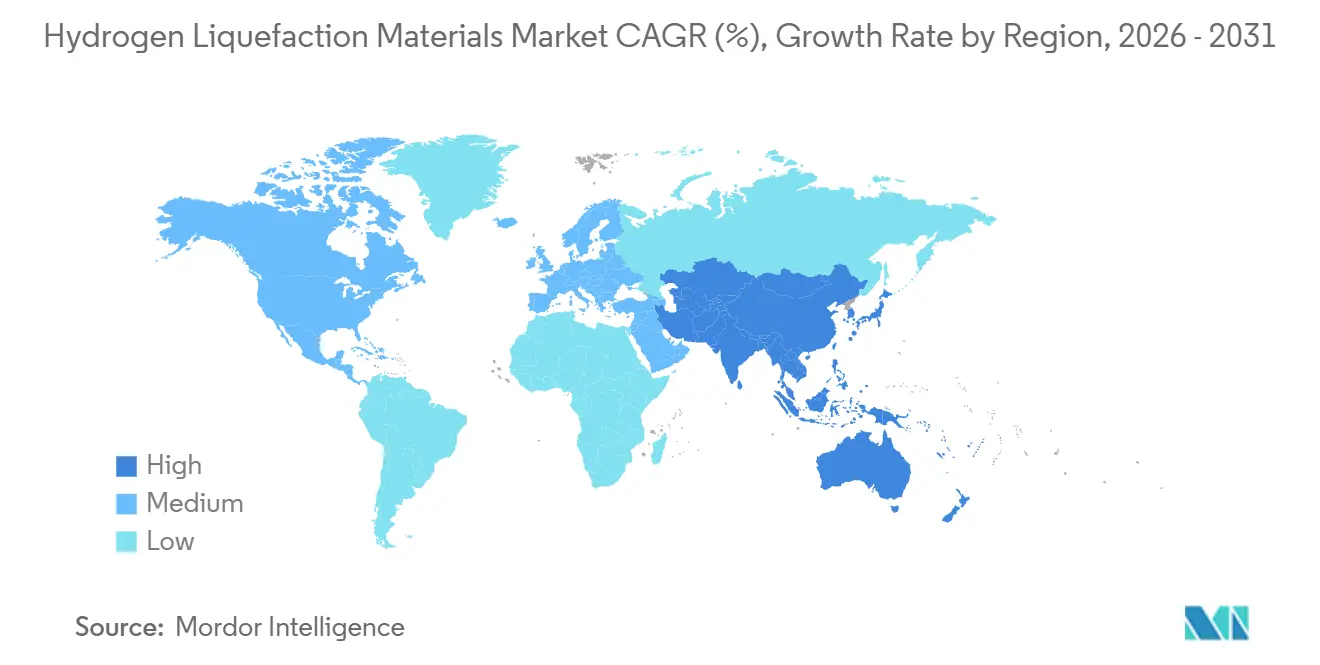
- By geography, Asia-Pacific held 42.46% of the hydrogen liquefaction materials market share in 2025 and is projected to advance at a 7.78% CAGR through 2031.
Note: Market size and forecast figures in this report are generated using Mordor Intelligence’s proprietary estimation framework, updated with the latest available data and insights as of January 2026.
Market Trends and Insights
Drivers Impact Analysis of Hydrogen Liquefaction Materials Market*
| Driver | (~) % Impact on CAGR Forecast | Geographic Relevance | Impact Timeline |
|---|---|---|---|
| Expansion of Liquid Hydrogen Supply Chains | +2.0% | Global, with concentrated activity in Asia-Pacific and Northwestern Europe | Medium term (2-4 years) |
| Demand for High-Density Hydrogen Transport and Storage | +1.5% | Asia-Pacific core, spillover to Europe and North America | Medium term (2-4 years) |
| Hydrogen Mobility and Heavy-Duty Transport Deployment | +1.3% | Europe and North America, early-stage adoption in South Korea and Japan | Short term (≤ 2 years) |
| Growth of Aerospace and Space-Launch Liquid Hydrogen Demand | +1.0% | United States and Japan, with European spillover via Ariane 6 and ESA programs | Short term (≤ 2 years) |
| Hydrogen Liquefaction Energy-Efficiency Improvements | +0.7% | Global, led by China, EU innovation programs, and Japanese national R&D | Long term (≥ 4 years) |
| Source: Mordor Intelligence | |||
Expansion of Liquid Hydrogen Supply Chains
Commercial liquid hydrogen (LH2) supply chains are creating demand for cryogenic insulation, alloys, catalysts, and sealing materials over several years. The hydrogen liquefaction materials market benefits when tank, carrier, and pipeline designs move into procurement because those designs require tested material systems. In January 2026, Kawasaki Heavy Industries, Ltd. and Japan Suiso Energy, Ltd. signed a contract to build a 40,000 m³ liquefied hydrogen carrier. The carrier’s cargo insulation system will require multilayer insulation that can perform at a commercial scale. Storage and carrier designs can lock in insulation selections for long operating periods, which raises switching costs for suppliers. This pattern can strengthen supplier relationships in the hydrogen liquefaction materials market because a replacement system must meet the same safety and performance requirements.
Demand for High-Density Hydrogen Transport and Storage
Liquid hydrogen provides a high-density option for transport and storage, increasing requirements for containment materials, cryogenic metals, and sealing systems. The hydrogen liquefaction materials market is affected by tank size because larger systems require more rigorous thermal management and structural design. Research on bulk-fill cryogenic insulation evaluated perlite and glass bubbles in helium and hydrogen background gases, reflecting the need to assess alternatives for large storage systems. Larger tanks can extend designers beyond the validated operating conditions of some vacuum-insulated panel systems. This encourages assessment of bulk-fill insulation and related system designs where background gases may be present. The resulting qualification work can favor suppliers that already have material performance data for liquid hydrogen service.
Hydrogen Mobility and Heavy-Duty Transport Deployment
Heavy-duty transport is increasing interest in liquid hydrogen systems that can support longer operating ranges and rapid refueling. The truck design increases the need for sealing and polymer materials that withstand repeated movement between ambient conditions and −253 °C. The H2Accelerate TRUCKS project targeted the deployment of 125 fuel cell trucks across 6 European countries, with first deliveries scheduled during 2026. A wider network of refueling stations would require liquid hydrogen storage and transfer equipment with durable cryogenic materials. This demand can support the hydrogen liquefaction materials market, where equipment suppliers use qualified sealing and polymer components across repeated installations. Infrastructure developers can use common component specifications to support repeated station deployments.
Growth of Aerospace and Space-Launch Liquid Hydrogen Demand
Space-launch activity is increasing the demand for liquid hydrogen and related ground-based cryogenic infrastructure. The hydrogen liquefaction materials market can benefit from this activity because launch sites need storage, transfer, and process equipment that operate at low temperatures. In June 2026, Air Liquide signed 2 contracts with ArianeGroup for Ariane 6 operations, covering cryogenic equipment for rocket manufacturing and the supply of liquid hydrogen and liquid oxygen propellants[1]. These applications require materials that maintain thermal performance and product purity during recurring operations. Aerospace specifications can influence expectations for material quality and system reliability in other liquid hydrogen applications. This creates an additional route for specialized materials suppliers to build technical experience in the hydrogen liquefaction materials market.
Restraints Impact Analysis of Hydrogen Liquefaction Materials Market*
| Restraint | (~) % Impact on CAGR Forecast | Geographic Relevance | Impact Timeline |
|---|---|---|---|
| High Energy Consumption of Hydrogen Liquefaction | -1.2% | Global, most pronounced in Europe and markets with elevated industrial electricity prices | Medium term (2-4 years) |
| High Capital and Lifecycle Cost of Cryogenic Materials | -0.9% | Global; most constraining for emerging markets in South America and Middle-East and Africa | Long term (≥ 4 years) |
| Nanocomposite Dispersion, Aging, and Scale-Up Uncertainty | -0.5% | Global; concentrated in R&D-intensive markets such as EU, United States, Japan | Long term (≥ 4 years) |
| Source: Mordor Intelligence | |||
High Energy Consumption of Hydrogen Liquefaction
The energy required to cool hydrogen to −253 °C remains a material restraint for projects across the hydrogen liquefaction materials market. Industrial-scale plants consumed 6 kilowatt-hours per kilogram (kWh/kg) to 15 kWh/kg, and a medium-scale plant in China reported 15.1 kWh/kg during commissioning. Process designs using liquefied natural gas (LNG) cold energy and mixed refrigerant Brayton cycles may reduce energy consumption, although these designs need specific site conditions and additional capital investment. Higher power costs can reduce plant utilization and delay maintenance work, which can defer recurring demand for insulation and sealing materials. In March 2026, Kawasaki Heavy Industries, Ltd. started demonstration operation of its KM Comp-H2 centrifugal hydrogen compressor for liquefaction plants at its Harima plant. Improvements in equipment efficiency could support future project economics, although wider commercial deployment will take time.
High Capital and Lifecycle Cost of Cryogenic Materials
Cryogenic materials for liquid hydrogen service have higher costs than conventional industrial materials, which can delay investment decisions. The hydrogen liquefaction materials market depends on materials that satisfy demanding insulation, metal, and sealing requirements before procurement can begin. Qualification testing for insulation systems, cryogenic alloys, and fluoropolymer seals can add 12-18 months to project schedules. Design decisions on containment insulation can affect long-term shipping economics, including heat transfer and boil-off performance over a carrier’s operating life. Engineering research has examined hydrogen embrittlement in welded joints for liquid hydrogen storage tanks, highlighting the need to consider material compatibility in structural systems. International Organization for Standardization (ISO) and ASTM International testing requirements can add documentation and engineering costs for smaller project developers.
*Our forecasts treat driver/restraint impacts as directional, not additive. The impact forecasts reflect baseline growth, mix effects, and variable interactions.
Hydrogen Liquefaction Materials Market Segment Analysis
By Material Type:
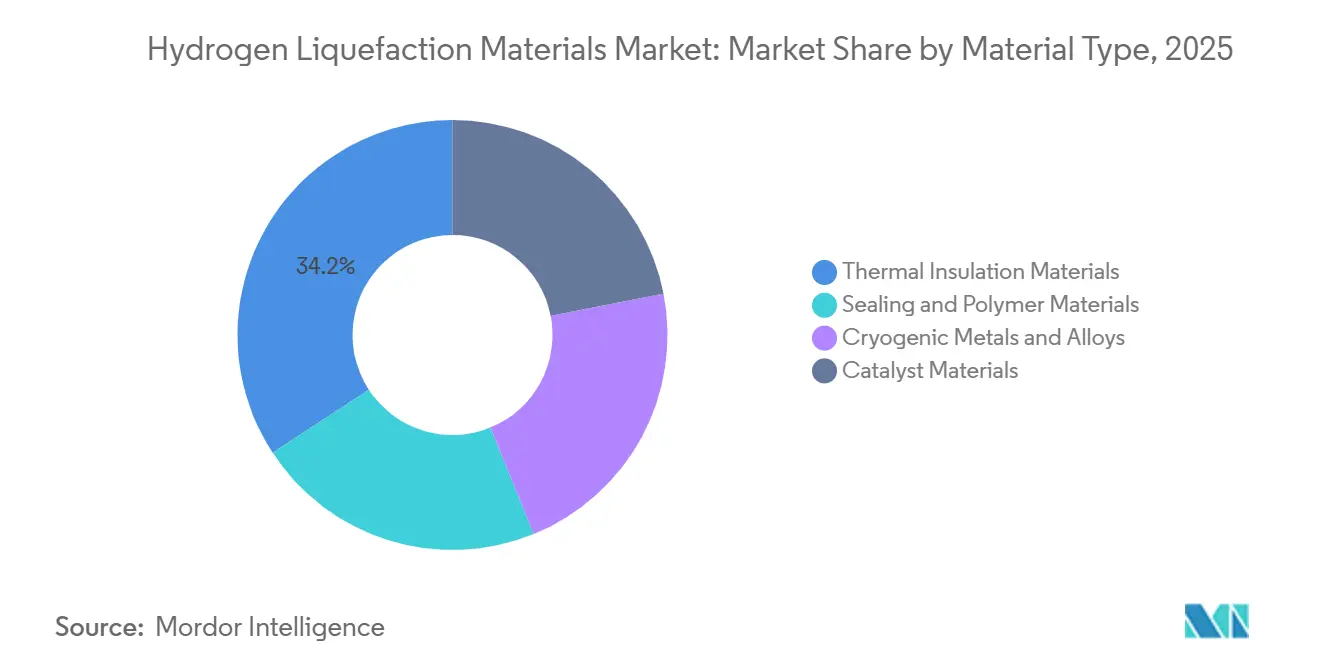
Thermal Insulation Materials Dominate Market Share, Catalyst Materials Drive Future GrowthThermal insulation materials held 34.23% in 2025. Multilayer insulation, vacuum-insulated panels, perlite, and aerogel systems are used in cold boxes, liquefaction equipment, and large storage vessels. These products reduce heat transfer in systems that must retain liquid hydrogen at cryogenic temperatures. Within the hydrogen liquefaction materials market, the segment also includes materials for large carriers and stationary storage tanks. Cryogenic metals and alloys include austenitic stainless steels, 9% nickel steel, and aluminum alloys used in tanks and heat exchanger assemblies. Their mechanical integrity at −253 °C is important for safe long-term operation.
Catalyst materials are projected to advance at an 8.11% CAGR through 2031 within the hydrogen liquefaction materials market. Ortho-to-para hydrogen conversion releases heat inside a liquefier, which makes catalyst selection important to plant energy performance. Research from the HyCat project documented reliance on hydrous ferric oxide catalysts and the supply risk associated with a concentrated catalyst base. Research published in 2025 also considered rare-earth magnetocaloric intermetallic compounds and porous materials such as MIL-Br molecular sieves for para-hydrogen conversion. Sealing and polymer materials remain important across material categories because valves, pumps, and turbo equipment require materials that preserve sealing performance in hydrogen service. NICHIAS Corporation developed fluorinated rubber crosslinking technology for hydrogen-contact applications, including BLAZER perfluoroelastomer (FFKM) grades for valves, pumps, and turbo equipment.

By Application:
Cryogenic Heat Exchangers Lead, While Storage, Containment and Transfer Systems Expand FasterCryogenic heat exchangers held 32.16% in 2025. Plate-fin and coil-wound configurations are central to liquefaction cold boxes and must maintain heat-transfer performance over long operating periods. This application uses specialized alloys, thermal interface materials, and structural supports designed for cryogenic conditions. Insulation and cold boxes also require vacuum-insulated panels, perlite fill, and thermal support spacers that match plant process conditions. Liquefaction equipment includes the materials used in compressors, expanders, and ortho-para converters.
Storage, containment and transfer systems are projected to advance at an 8.32% CAGR through 2031. Receiving terminals, bunkering stations, and distribution hubs need materials for tanks, transfer lines, valves, and related containment systems. The hydrogen liquefaction materials market size for this application is being shaped by efforts to scale storage capacity and control boil-off losses. Research on large liquid hydrogen tanks has assessed insulation concepts for stationary systems, including the behavior of stacked vacuum-insulated panels. Tank scale-up toward 50,000 m³ can require hybrid bulk-fill insulation and active recondensation solutions where high-vacuum multilayer insulation alone is not sufficient. Materials development, therefore, remains closely linked to the build-out of large liquid hydrogen infrastructure.
By End-Use:
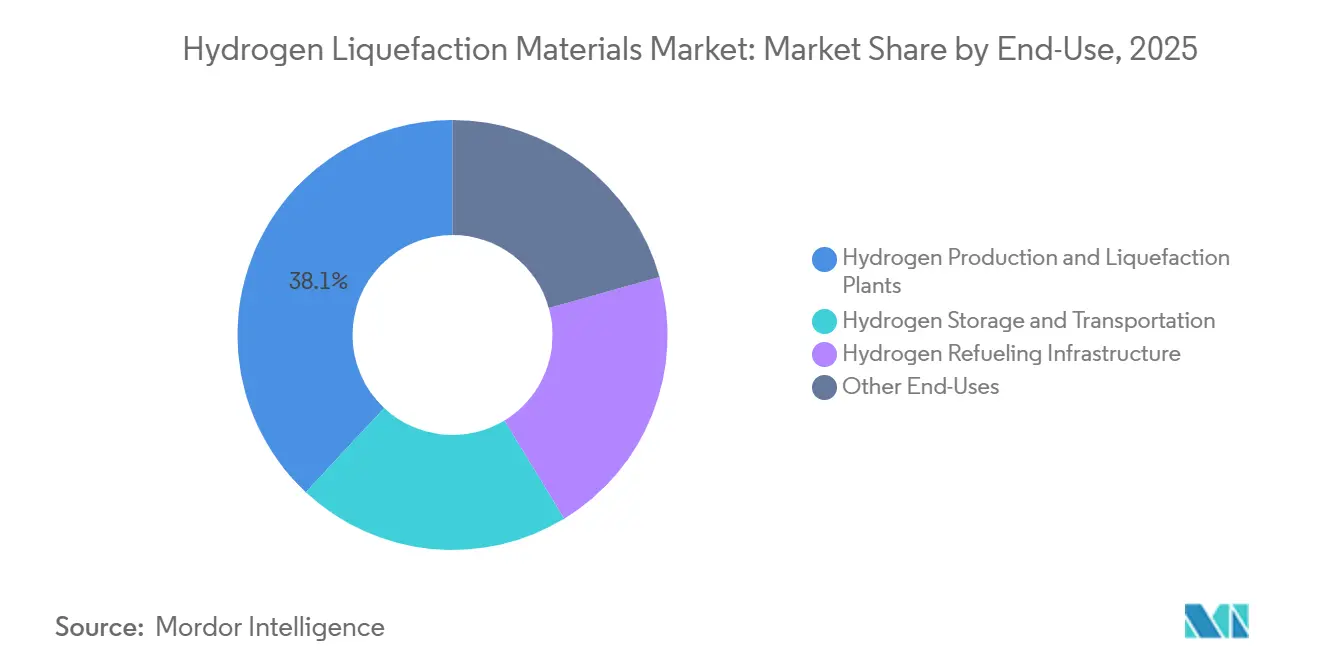
Hydrogen Production and Liquefaction Plants Lead, While Hydrogen Storage and Transportation Gains MomentumHydrogen production and liquefaction plants held 38.05% in 2025. These facilities require substantial initial procurement of insulation, heat exchanger alloys, catalyst loadings, and cold-box sealing systems. Large engineering, procurement, and construction contracts concentrate demand in this end-use area during plant construction. Hydrogen refueling infrastructure is a developing end-use segment, although the installed base of liquid hydrogen stations remains limited outside Japan, South Korea, and California. Aerospace ground support and industrial cold storage also require cryogenic materials. These uses add demand without changing the main role of liquefaction plants in material procurement.
Hydrogen storage and transportation are projected to advance at an 8.67% CAGR through 2031. Pilot demonstrations are moving toward commercial distribution systems that use cryogenic International Organization for Standardization containers, road tankers, rail containers, and maritime vessels. Storage and transportation have high material intensity per kilogram of hydrogen because low boil-off targets require effective insulation. In June 2026, Kawasaki Heavy Industries, Ltd. announced construction of a liquid hydrogen equipment testing facility at its Harima plant, with operations targeted from fiscal 2027. The facility is intended to speed validation of equipment, materials, and components for commercial-scale liquefaction and distribution systems. This work supports the hydrogen liquefaction materials industry as distribution projects require standardized and proven material systems.
Geography Analysis
APAC Hydrogen Liquefaction Materials Market
Asia-Pacific held 42.46% in 2025 and is projected to advance at a 7.78% CAGR through 2031. Japan’s liquid hydrogen infrastructure program is supporting demand for insulation, alloys, and sealing materials across terminal, carrier, and transfer applications. In January 2026, Kawasaki Heavy Industries, Ltd. and Japan Suiso Energy, Ltd. signed a contract for a 40,000 m³ liquefied hydrogen carrier. The hydrogen liquefaction materials market size in the region is also supported by the need to qualify materials for large tanks and transport systems. Japan and South Korea have active programs for liquid hydrogen storage and transport, while China is building research capacity in hydrogen technology. These conditions support sustained demand for material suppliers that can meet cryogenic performance requirements.
North America Hydrogen Liquefaction Materials Market
North America is generating aerospace demand, commercial space activity, and heavy-duty transport development, which require liquid hydrogen infrastructure. Linde PLC announced investments in Mims, Florida, and Brownsville, Texas, to support the commercial space sector in July 2025. These facilities support the broader need for cryogenic storage, transfer, and gas-handling equipment. The development of liquid hydrogen refueling standards for heavy-duty transport can also create recurring requirements for materials used in refueling hardware. Suppliers with certified components may benefit as equipment specifications become more standardized. The region’s aerospace activity can also raise requirements for reliability, purity, and thermal performance in the hydrogen liquefaction materials market.
EMEA and South America Hydrogen Liquefaction Materials Market
Europe is an innovation-active region where mobility projects and import-terminal development are supporting materials demand. Air Liquide’s June 2026 ArianeGroup contracts cover cryogenic equipment for rocket manufacturing and liquid hydrogen and liquid oxygen supply for Ariane 6 operations. South America remains at an earlier commercial stage, although Hyundai Motor deployed 8 XCIENT fuel-cell trucks in Uruguay in March 2026. The Middle-East and Africa are considering liquid hydrogen as a future export carrier, with renewable-energy projects that may require liquefaction infrastructure as investment decisions progress. These regions can create later opportunities for suppliers that have experience with large cryogenic systems. This regional mix leaves Europe centered on complex applications while later-stage regions prepare for infrastructure investment.
Competitive Landscape
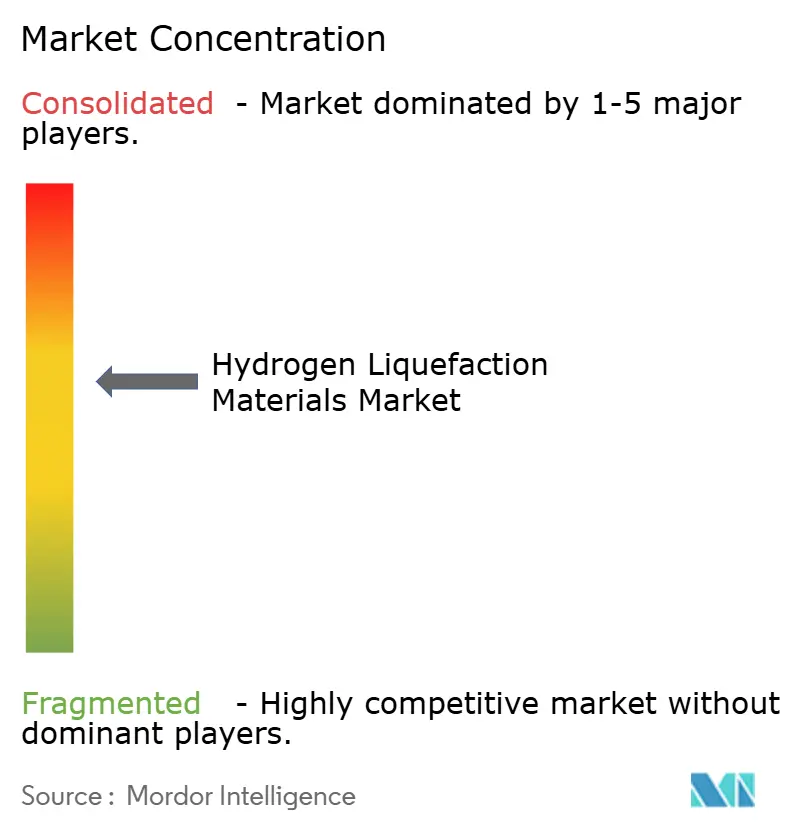
The hydrogen liquefaction materials market is moderately concentrated, with the top five players including Linde PLC, Air Liquide, INOX-Air Products Inc., Chart Industries, and Kawasaki Heavy Industries, Ltd. Baker Hughes Company completed its USD 13.6 billion acquisition of Chart Industries in July 2026. The transaction brought air and gas handling, thermal management, and lifecycle services into an integrated energy technology platform. The combined platform can connect cryogenic equipment with long-term service capabilities. This may reduce opportunities for independent suppliers in selected equipment categories while increasing the value of qualified material partnerships.
Air Liquide and Linde PLC follow different strategies in the hydrogen liquefaction materials market. Air Liquide made a final investment decision in July 2025 for ELYgator, a 200-megawatt (MW) electrolyzer in Maasvlakte, Port of Rotterdam, with commissioning planned by the end of 2027. Linde PLC has worked with Daimler Truck on the subcooled liquid hydrogen refueling standard, which could guide materials specifications in heavy-duty transport. NICHIAS Corporation serves a specialized role with fluoropolymer sealing products for valves, pumps, and turbo equipment.
Nikkiso Co., Ltd. supplied a liquefied hydrogen pump skid in April 2026 for the Kawasaki Heavy Industries, Ltd. and Kobe Steel cogeneration project at Port Island, Kobe[2]. In August 2026, Nikkiso Co., Ltd. launched the SMP 34 submerged motor pump for liquid hydrogen, liquefied natural gas, ammonia, and nitrogen service, with hydraulic efficiency of up to 80%. Messer SE Co. KGaA agreed to take a 30% equity stake in 4 renewable hydrogen production sites and secured a 10-year supply contract with Lhyfe in 2026. IHI Corporation and Kawasaki Heavy Industries, Ltd. have positions in Japan’s domestic liquid hydrogen infrastructure build-out. Opportunities remain in alternative ortho-para conversion catalysts, cryogenic polymer composites, and active recondensation materials for large maritime tanks.
Hydrogen Liquefaction Materials Industry Leaders
-
Linde PLC
-
Air Liquide
-
INOX-Air Products Inc.
-
Chart Industries
-
Kawasaki Heavy Industries, Ltd.
- *Disclaimer: Major Players sorted in no particular order
Hydrogen Liquefaction Materials Market Companies Covered in this Report
- Air Liquide
- Baker Hughes Company
- Chart Industries
- IHI Corporation
- INOX-Air Products Inc.
- Kawasaki Heavy Industries, Ltd.
- Linde PLC
- Messer SE and Co. KGaA
- NICHIAS Corporation
- NIKKISO
Recent Industry Developments in Hydrogen Liquefaction Materials Market
- July 2026: Baker Hughes completed the USD 13.6 billion acquisition of Chart Industries in July 2026, adding Chart’s cryogenic equipment, heat exchangers, and gas/liquid handling capabilities to its portfolio. The integration strengthened capabilities across hydrogen liquefaction and cryogenic storage, supporting demand for specialized materials such as cryogenic metals, alloys, insulation, and sealing materials used in liquefaction systems.
- June 2026: Air Liquide and ArianeGroup signed two contracts covering cryogenic equipment for Ariane 6 manufacturing and propulsion, along with a renewed three-year supply agreement for liquid hydrogen, liquid oxygen, helium, nitrogen, and compressed air. The contracts reinforce demand for cryogenic equipment and materials capable of handling extremely low temperatures, including specialized metals, alloys, insulation, and sealing materials used in hydrogen liquefaction and storage systems.
Global Hydrogen Liquefaction Materials Market Report Scope
Hydrogen liquefaction materials are specialized materials designed to withstand extremely low temperatures and demanding operating conditions during the conversion of gaseous hydrogen into liquid hydrogen. They support thermal management, structural integrity, sealing performance, and efficient heat transfer throughout liquefaction and handling processes.
The Hydrogen Liquefaction Materials Market is segmented by material type, application, end-use, and geography. By material type, the market is segmented into thermal insulation materials, cryogenic metals and alloys, catalyst materials, and sealing and polymer materials. By application, the market is segmented into cryogenic heat exchangers, insulation and cold boxes, storage, containment and transfer systems, liquefaction equipment, and other applications. By end-use, the market is segmented into hydrogen production and liquefaction plants, hydrogen storage and transportation, hydrogen refueling infrastructure, and other end-uses. The report also covers the market size and forecasts for hydrogen liquefaction materials in 15 countries across major regions. For each segment, the market sizing and forecasts have been done on the basis of value (USD).
Segmentation Overview
| Thermal Insulation Materials |
| Cryogenic Metals and Alloys |
| Catalyst Materials |
| Sealing and Polymer Materials |
| Cryogenic Heat Exchangers |
| Insulation and Cold Boxes |
| Storage, Containment and Transfer Systems |
| Liquefaction Equipment |
| Other Applications |
| Hydrogen Production and Liquefaction Plants |
| Hydrogen Storage and Transportation |
| Hydrogen Refueling Infrastructure |
| Other End-Uses |
| Asia-Pacific | China |
| India | |
| Japan | |
| South Korea | |
| ASEAN Countries | |
| Rest of Asia-Pacific | |
| North America | United States |
| Canada | |
| Mexico | |
| Europe | Germany |
| United Kingdom | |
| France | |
| Italy | |
| NORDIC Countries | |
| Rest of Europe | |
| South America | Brazil |
| Argentina | |
| Rest of South America | |
| Middle-East and Africa | Saudi Arabia |
| South Africa | |
| Rest of Middle-East and Africa |
| By Material Type | Thermal Insulation Materials | |
| Cryogenic Metals and Alloys | ||
| Catalyst Materials | ||
| Sealing and Polymer Materials | ||
| By Application | Cryogenic Heat Exchangers | |
| Insulation and Cold Boxes | ||
| Storage, Containment and Transfer Systems | ||
| Liquefaction Equipment | ||
| Other Applications | ||
| By End-Use | Hydrogen Production and Liquefaction Plants | |
| Hydrogen Storage and Transportation | ||
| Hydrogen Refueling Infrastructure | ||
| Other End-Uses | ||
| By Geography | Asia-Pacific | China |
| India | ||
| Japan | ||
| South Korea | ||
| ASEAN Countries | ||
| Rest of Asia-Pacific | ||
| North America | United States | |
| Canada | ||
| Mexico | ||
| Europe | Germany | |
| United Kingdom | ||
| France | ||
| Italy | ||
| NORDIC Countries | ||
| Rest of Europe | ||
| South America | Brazil | |
| Argentina | ||
| Rest of South America | ||
| Middle-East and Africa | Saudi Arabia | |
| South Africa | ||
| Rest of Middle-East and Africa | ||
Key Questions Answered in the Report
What is the size of the hydrogen liquefaction materials market?
The hydrogen liquefaction materials market stands at USD 0.88 billion in 2026 and is projected to reach USD 1.23 billion by 2031.
What is driving demand for hydrogen liquefaction materials?
Liquid hydrogen supply-chain development, high-density transport and storage, heavy-duty mobility, and aerospace applications are supporting demand for cryogenic materials.
Which material category led the market in 2025?
Thermal insulation materials held 34.23% in 2025.
Which application is projected to grow fastest through 2031?
Storage, containment and transfer systems are projected to advance at an 8.32% CAGR through 2031.