
Hydrogen Gas Separation Membrane Market Size and Share
Market Overview
| Study Period | 2021 - 2031 |
|---|---|
| Market Size (2026) | USD 271.25 Million |
| Market Size (2031) | USD 367.13 Million |
| Growth Rate (2026 - 2031) | 6.24 % |
| Fastest Growing Market | Asia-Pacific |
| Largest Market | Asia-Pacific |
| Market Concentration | Medium |
Major Players *Disclaimer: Major Players sorted in no particular order Image © Mordor Intelligence. Reuse requires attribution under CC BY 4.0. | |
Hydrogen Gas Separation Membrane Market Analysis by Mordor Intelligence
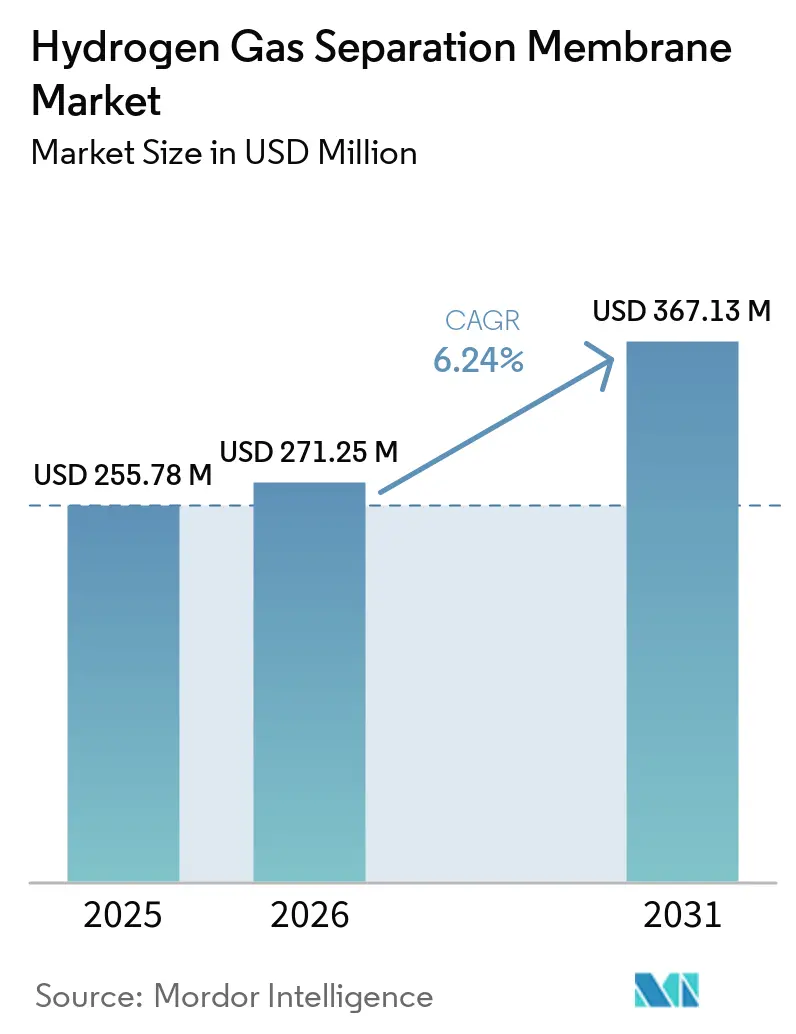
The hydrogen gas separation membrane market size was estimated at USD 255.78 million in 2025 and is estimated to grow from USD 271.25 million in 2026 to USD 367.13 million by 2031, at a CAGR of 6.24% during the forecast period (2026-2031). The hydrogen gas separation membrane market is expanding as clean hydrogen projects, refinery recovery programs, and fuel cell systems require reliable purification. Membrane units operate continuously using modular equipment without moving parts, making them suitable for distributed reformers, ammonia crackers, and on-site generation systems. Pressure swing adsorption, by contrast, uses cyclic operation and typically requires more space than membrane installations. This creates opportunities for the hydrogen gas separation membrane market in compact industrial and energy settings where continuous hydrogen recovery is required.
Key Report Takeaways
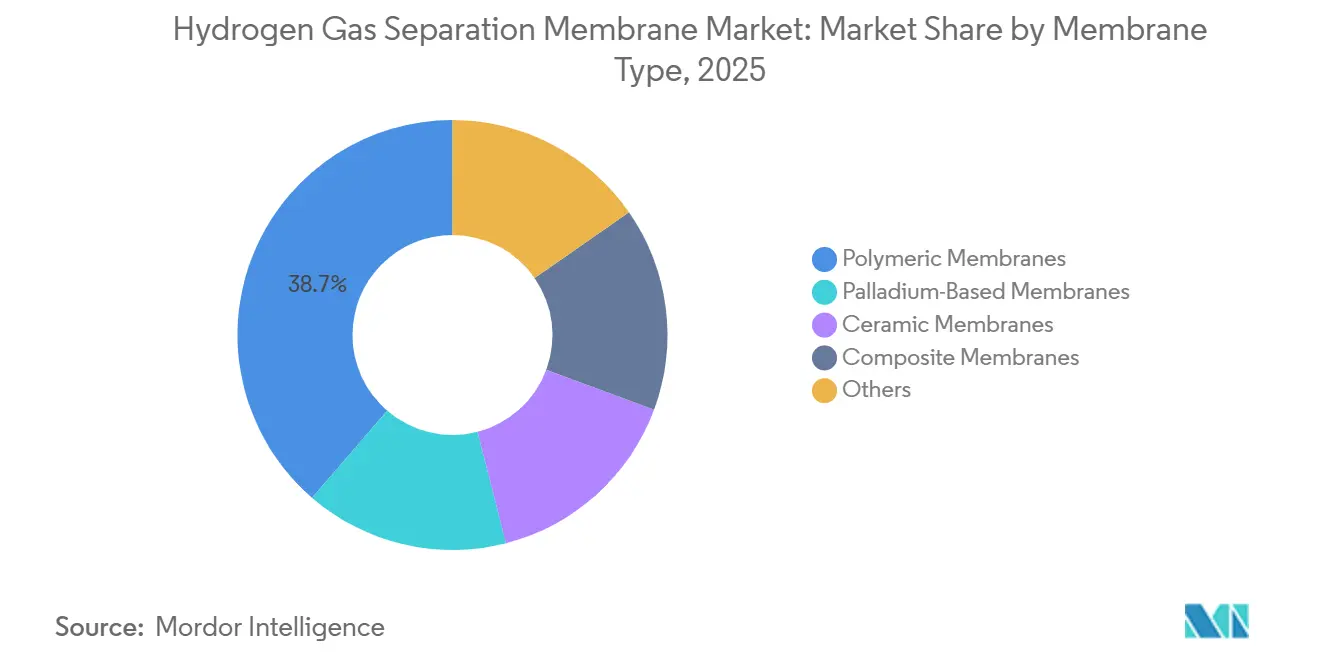
- By membrane type, polymeric membranes held 38.67% of the hydrogen gas separation membrane market share in 2025, while composite membranes are forecast to grow at a 6.83% CAGR through 2031.
- By application, hydrogen production and purification accounted for 42.56% of the hydrogen gas separation membrane market size in 2025 and are forecast to expand at a 7.66% CAGR through 2031.
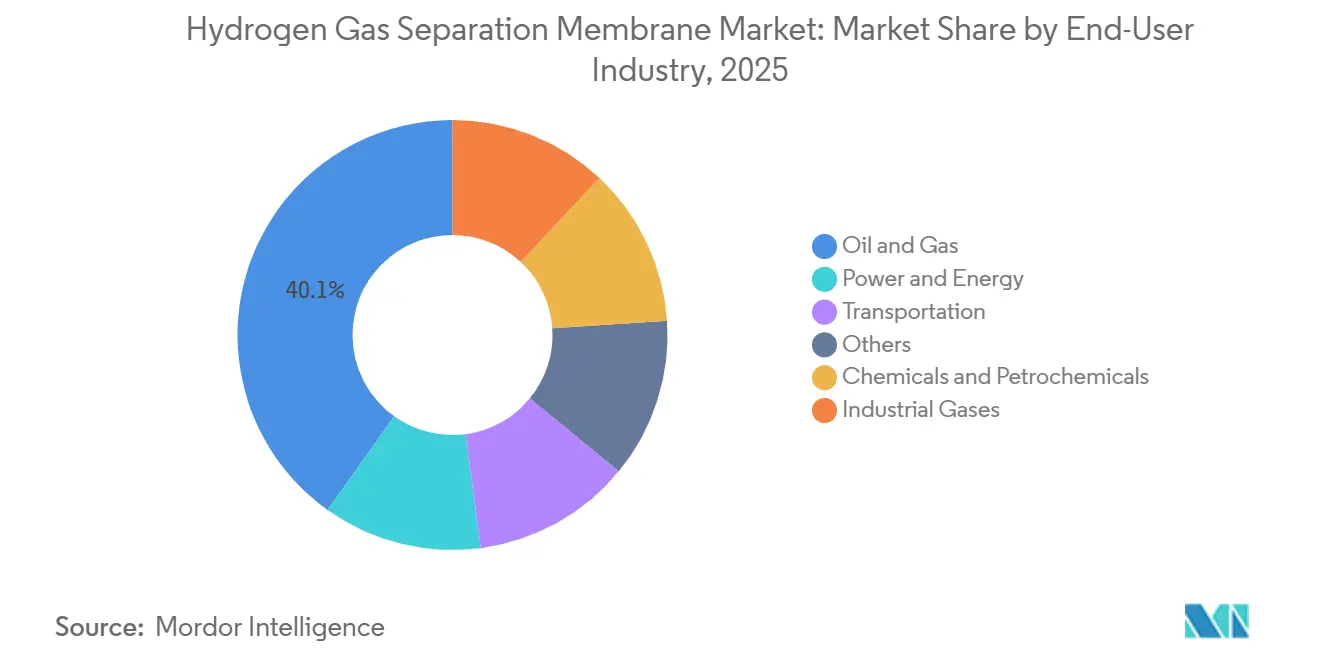
- By end-user industry, oil and gas held 40.12% of the hydrogen gas separation membrane market share in 2025, while transportation is projected to record a 7.89% CAGR through 2031.
- By geography, Asia-Pacific held 37.89% of the hydrogen gas separation membrane market share in 2025 and is projected to grow at a 7.13% CAGR through 2031.
Note: Market size and forecast figures in this report are generated using Mordor Intelligence’s proprietary estimation framework, updated with the latest available data and insights as of January 2026.
Market Trends and Insights
Drivers Impact Analysis of Hydrogen Gas Separation Membrane Market*
| Drivers | (~) % Impact on CAGR Forecast | Geographic Relevance | Impact Timeline |
|---|---|---|---|
| Hydrogen Recovery from Refinery and Petrochemical Off-Gases | +1.2% | North America, Asia-Pacific, Middle-East | Short term (≤ 2 years) |
| Decarbonization Policies and Clean Hydrogen Investment | +1.4% | Global | Medium term (2-4 years) |
| Demand for Compact, Continuous Hydrogen Purification | +0.8% | Global | Short term (≤ 2 years) |
| Fuel-Cell and Distributed Hydrogen Infrastructure Expansion | +0.9% | Asia-Pacific, North America, Europe | Medium term (2-4 years) |
| High-Temperature Integration with Reforming and Gasification | +0.6% | North America, Europe, Asia-Pacific | Medium term (2-4 years) |
| Thin-Film and Composite Membrane Performance Improvements | +0.7% | Global | Long term (≥ 4 years) |
| Source: Mordor Intelligence | |||
Hydrogen Recovery from Refinery and Petrochemical Off-Gases
Refineries and petrochemical plants produce hydrogen-rich off-gases from catalytic reformers, hydrotreaters, and steam crackers. These streams were previously directed to fuel headers, leaving recoverable hydrogen unused. The hydrogen gas separation membrane market benefits when recovered gas is reintegrated into downstream process loops. This approach can reduce purchases of fresh hydrogen and lower the carbon intensity per unit of production. In April 2025, BORSIG received a contract from a European refinery to recover and enrich process-gas hydrogen for reintegration into downstream refinery processes[1]. Regulatory carbon costs can strengthen the business case for maximizing on-site recovery from fossil-based operations. Refinery-grade hydrogen can be used at a lower purity than fuel-cell hydrogen, which supports the use of polymeric membranes in applicable recovery applications.
Decarbonization Policies and Clean Hydrogen Investment
Growing policy support for electrolyzer projects is increasing demand for downstream high-purity hydrogen separation. The hydrogen gas separation membrane market stands to benefit as these projects advance from planning to construction. In July 2025, Air Liquide committed more than EUR 500 million (~USD 578.48 million) to the 200 MW ELYgator proton exchange membrane electrolyzer in Rotterdam. The project had its first PEM electrolyzer modules installed in May 2026, with commissioning targeted for late 2027 and a projected renewable hydrogen output of 23,000 tons per year. The United Kingdom's 2025 Climate Change Levy reform exempts electricity used in hydrogen electrolysis from levy liability. The legislation took effect in spring 2026, reducing operating costs for eligible projects. Suppliers that add capacity early can pursue projects still in the permitting and feasibility stages.
Demand for Compact, Continuous Hydrogen Purification
Small steam methane reformers, ammonia crackers, and PEM electrolyzers require purification equipment capable of operating near the point of generation. This demand profile favors membrane systems over batch separation technologies. In June 2024, H2SITE demonstrated fuel-cell-grade hydrogen production from an ammonia cracker at Tyseley Energy Park. The system produced 200 kilograms per day and achieved more than 98% hydrogen recovery using palladium-alloy membranes, without requiring downstream separation units. Compact membrane equipment can reduce the complexity associated with Pressure Swing Adsorption (PSA) beds, cryogenic cold boxes, and cyclic valve trains. ISO 14687 sets fuel-cell hydrogen quality requirements, including a maximum total hydrocarbon limit of 0.2 ppm. These requirements favor high-selectivity membrane configurations that operate continuously without regeneration cycles.
Fuel-Cell and Distributed Hydrogen Infrastructure Expansion
Transportation is the fastest-growing end-use segment in the hydrogen gas separation membrane market. Commercial fuel-cell vehicles require high-purity hydrogen near the point of use. Under Society of Automotive Engineers (SAE) J2601, hydrogen refueling stations must supply hydrogen at a purity of at least 99.97%. This requirement supports the use of membrane-based compression and inline purification at dispensing sites. Distributed stations require smaller units than centralized production facilities. As fuel-cell trucks expand across logistics corridors, the hydrogen gas separation membrane market can serve both on-route and depot infrastructure. Demand may shift away from centralized, large-footprint separation systems toward modular equipment designed for continuous service in space-constrained locations.
Restraints Impact Analysis of Hydrogen Gas Separation Membrane Market*
| Restraints | (~) % Impact on CAGR Forecast | Geographic Relevance | Impact Timeline |
|---|---|---|---|
| Palladium Price Volatility and Supply Constraints | -0.8% | Global | Short term (≤ 2 years) |
| Permeability-Selectivity Trade-Off | -0.5% | Global | Long term (≥ 4 years) |
| Long-Term Durability Under Impure and Cycling Feeds | -0.4% | Industrial applications globally | Medium term (2-4 years) |
| Competition From Pressure Swing Adsorption and Cryogenic Separation | -0.6% | North America, Europe | Medium term (2-4 years) |
| Source: Mordor Intelligence | |||
Palladium Price Volatility and Supply Constraints
Palladium-based modules have substantial exposure to precious-metal input costs. Palladium represented 30%-40% of the bill of materials for a palladium-based membrane module. Composite architectures use thin palladium layers on ceramic or polymer substrates to reduce metal consumption. These layers are typically 2 to 5 micrometers thick. Composite designs can operate at 5-15 bar, compared with 50-80 bar for pure palladium alternatives. Lower operating pressure can improve the total cost of ownership for some projects. Palladium production is concentrated in South Africa and Russia, which adds supply chain risk for buyers. Palladium remains important in applications requiring hydrogen purity above 99.99%, such as pharmaceutical, semiconductor, and fuel cell applications.
Permeability-Selectivity Trade-Off
The Robeson upper bound remains a material constraint for polymeric hydrogen separation membranes. Higher hydrogen permeability can reduce H2/CO2 or H2/N2 selectivity in commercially practical polymer systems. These trade-off limits are relevant for membranes used in refinery off-gas streams with CO, CO2, H2S, and C1-C4 hydrocarbons. A 2026 Journal of Materials Chemistry A review found that mixed-matrix membranes still face this constraint in commercial deployment. Inorganic fillers can improve the reproducibility of laboratory results, but large-area manufacturing introduces defect sensitivity[2]. Defects can reduce selectivity in commercial membrane modules. Some high-purity applications consequently use hybrid membrane-PSA arrangements. ISO 14687 requirements can limit the range of standalone polymeric membranes suitable for fuel-cell-grade hydrogen at scale.
*Our forecasts treat driver/restraint impacts as directional, not additive. The impact forecasts reflect baseline growth, mix effects, and variable interactions.
Hydrogen Gas Separation Membrane Market Segment Analysis
By Membrane Type:
Composite Architectures Challenge Polymeric DominancePolymeric membranes held 38.67% of the hydrogen gas separation membrane market share in 2025. They support continuous refinery and ammonia-loop applications and can be supplied in scalable hollow-fiber modules. Their use is less sensitive to changes in palladium prices than that of metallic membrane systems. UBE Corporation supplies polyimide hydrogen separation membranes rated to 100 bar and 100°C, targeting syngas processing, refinery purge-gas recovery, and sustainable aviation fuel production. These capabilities support demand for polymeric membranes across established industrial operations. Palladium-based membranes continue to play an important role in pharmaceutical and semiconductor applications requiring very high purity, though broader adoption is limited by exposure to precious-metal costs. In continuous industrial service, tighter purity requirements are shortening some replacement cycles from 5-7 years to 3-5 years.
Composite membranes are the fastest-growing membrane type, with a forecast CAGR of 6.83% through 2031. The hydrogen gas separation membrane market size for composite systems benefits from lower palladium use and strong hydrogen flux. These designs apply thin palladium-alloy coatings to ceramic or polymer substrates, reducing precious-metal consumption while retaining the characteristics required for hydrogen permeation. TANAKA Precious Metal Technologies introduced HPM-L111 in March 2026, reporting high-purity hydrogen permeation at 100°C-200°C below the operating requirements of conventional metallic membranes. The lower operating temperature can reduce heating demand and broaden use in hydrogen sensors and fuel-cell systems. Ceramic membranes remain useful for high-temperature reformer integration, though brittleness and fabrication costs limit their wider adoption.

By Application:
Hydrogen Production Anchors Growth Across the Value ChainHydrogen production and purification accounted for 42.56% of the hydrogen gas separation membrane market in 2025 and is also the fastest-growing application, with a projected CAGR of 7.66% through 2031. This position reflects demand from green electrolyzer projects and blue hydrogen reforming investment. The European Union's HERMES project is developing palladium-based and carbon-based membrane technologies for industrial gas streams, targeting Technology Readiness Level 7 at industrial sites in Italy and Turkey. The project also targets separation energy below 3.5 kWh per kilogram and cost below EUR 1 per kilogram. These targets could improve membrane competitiveness against pressure swing adsorption (PSA) in large-scale production. Petroleum refineries use membrane units to recover hydrogen from catalytic reformer and hydrocracker purge streams, while chemical processors use membranes for syngas ratio adjustment and methanol purge-gas recovery.
Fuel cells represent the highest-purity application tier and operate under ISO 14687 quality requirements. The hydrogen gas separation membrane market is therefore exposed to both established industrial recovery uses and emerging fuel-cell purification needs. A May 2026 Nature Communications study reported a 10-nm-thick carbon membrane with hydrogen permeance above 10,000 gas permeation units (GPU) and H2/N2 mixture selectivity above 200, achieved through oxygen-modulated pyrolysis of a polymer precursor. If this performance is reproduced in commercial systems, high-purity separation could require less active membrane area, altering the surface-area economics of membrane modules. HERMES is also developing intellectual property for palladium-based and carbon membrane systems. Current industrial adoption still depends on reliable large-area fabrication and consistent performance under operating feed conditions.
By End-User Industry:
Transportation Outpaces Traditional Industrial BuyersOil and gas led end-user demand, accounting for 40.12% of the hydrogen gas separation membrane market share in 2025. Refinery hydrogen management and the installed base of hydrogen-consuming units support this position. Hydroprocessing, desulfurization, and catalytic reforming require dependable process hydrogen management. Chemicals and petrochemicals are the second-largest end-user group, with operators recovering hydrogen from ammonia synthesis and methanol production loops to reduce feedstock costs and carbon intensity per metric ton of output. Industrial gas companies also integrate membrane separation into long-term gas supply contracts, using hollow-fiber separators in continuous refinery service. Power and energy applications are at an earlier stage of commercialization but are growing alongside hydrogen co-firing and power-to-hydrogen-to-power projects.
Transportation is forecast to grow at a 7.89% CAGR through 2031, representing a higher-purity segment of the hydrogen gas separation membrane market. Bus, truck, and rail fuel-cell deployments require consistent hydrogen quality at dispersed locations, supporting demand for high-selectivity membrane configurations. Such equipment may command higher margins than bulk refinery recovery systems. This growth shifts demand toward modular equipment near refueling corridors and fleet depots, where operational requirements differ from those of centralized industrial hydrogen plants. Manufacturers able to meet purity requirements and compact installation needs are better positioned to address this demand. Transportation does not replace refinery demand but broadens the range of applications requiring membrane purification.
Geography Analysis
APAC Hydrogen Gas Separation Membrane Market
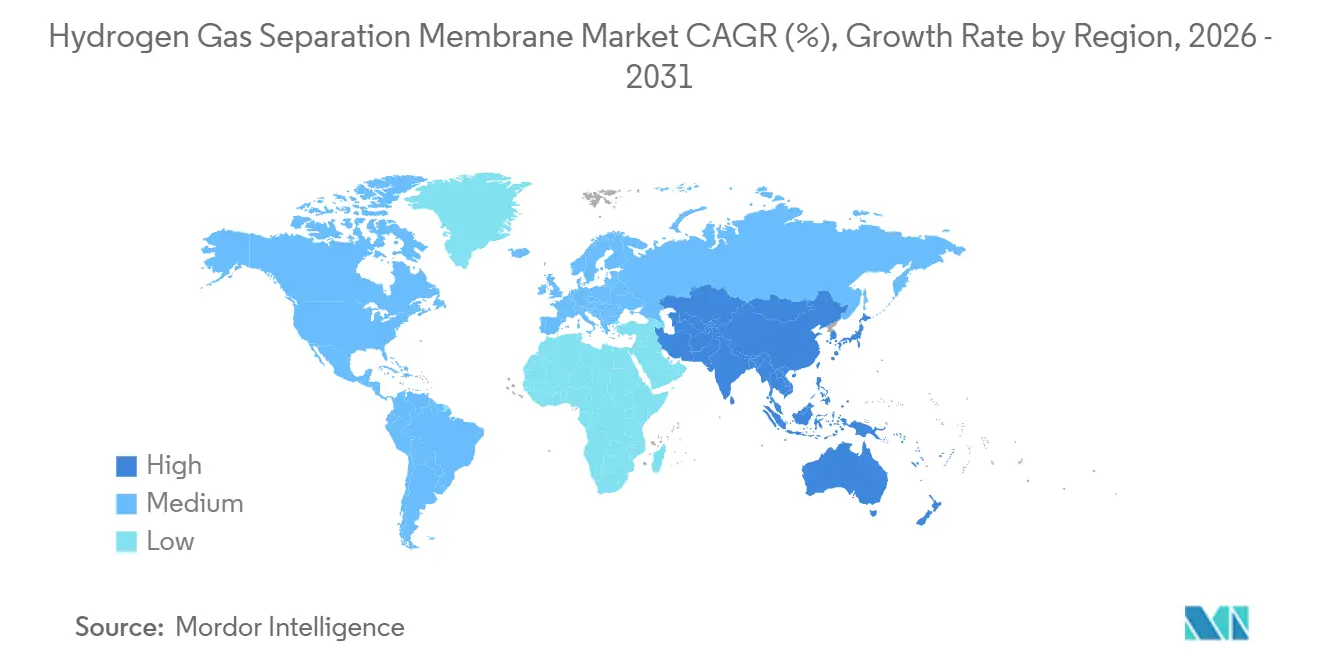
Asia-Pacific held 37.89% of the hydrogen gas separation membrane market share in 2025 and is projected to record the fastest regional CAGR of 7.13% through 2031. China supports regional demand through coal-to-chemicals processing that produces hydrogen-rich off-gases. Domestic policy also emphasizes hydrogen development and local membrane technology capability. Japan is developing a hydrogen infrastructure that gives membrane technologies a strategic role in national supply chains, including interest in proton exchange membranes for national hydrogen corridors. South Korea is building local technical capability in hydrogen purification materials and equipment. A 2026 Nature Communications paper by researchers at the Korea Advanced Institute of Science and Technology (KAIST) reported high H2/N2 selectivity in a crosslinked polymer membrane. The region is developing both demand for membrane systems and technical capability in advanced membrane materials.
North America and Europe Hydrogen Gas Separation Membrane Market
North America and Europe are the second- and third-largest regional markets covered in this research. In the United States, clean hydrogen production tax credits under the Inflation Reduction Act have tightened project timelines. Projects need to begin construction before January 1, 2028, following the July 2025 legislative changes, which can bring membrane procurement decisions forward for eligible projects. In Europe, the Renewable Energy Directive III and the European Hydrogen Bank support hydrogen uptake and project development. Germany and Nordic countries are applying membrane technology in biomethane upgrading and industrial hydrogen decarbonization. The HERMES project provides a regional example of technology development at industrial sites in Italy and Turkey. These policy environments support different but complementary routes to membrane demand.
South America and MEA Hydrogen Gas Separation Membrane Market
South America, the Middle-East, and Africa are early-stage regions in the hydrogen gas separation membrane market. Brazil's renewable gas and green hydrogen ambitions are attracting initial investment in membrane modules. Argentina's hydrogen export plans indicate future demand for large-scale separation capacity. Saudi Arabia is integrating hydrogen-related technology into its export infrastructure, with Air Products and Yara having a marketing and distribution partnership related to the NEOM renewable ammonia project. Large green hydrogen projects can require extensive purification stages before output reaches transport or end-use systems. South Africa plays a different role, as its platinum group metals sector is a major source of palladium, making it more relevant to the metallic and composite membrane supply chain than to regional demand.
Competitive Landscape
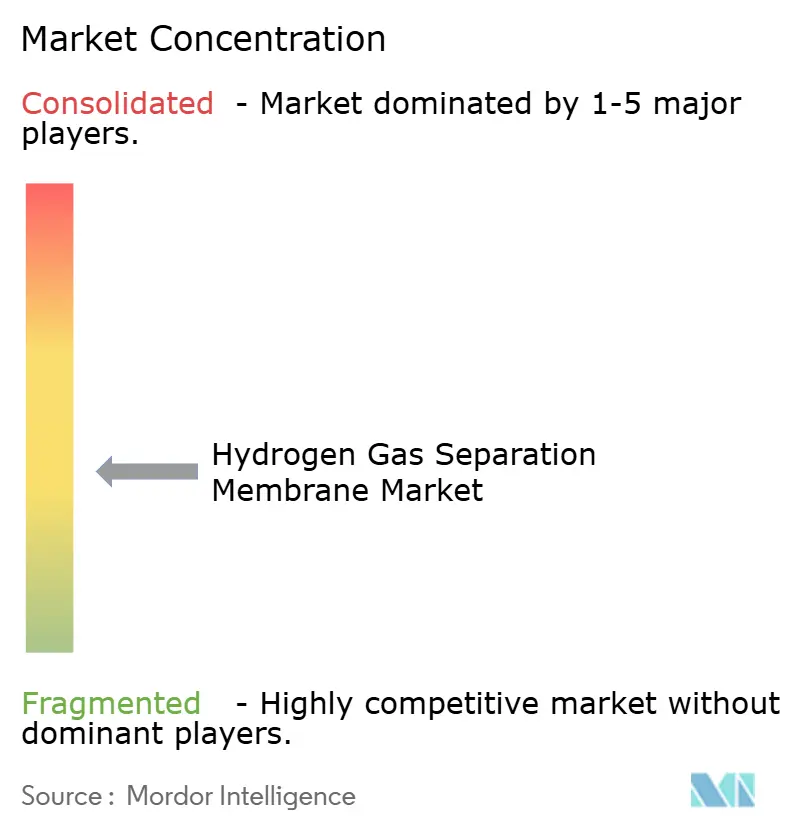
The hydrogen gas separation membrane market is moderately fragmented. Air Liquide, Air Products, and Linde have established membrane separator product lines and installed customer bases. Their systems serve refinery and ammonia-loop customers that require continuous hydrogen recovery. Membrane Technology and Research, BORSIG GmbH, H2SITE, and UBE Corporation address specialized, high-purity, and modular applications. This structure combines large industrial gas companies with smaller technology-focused suppliers. The competitive position of each company depends on installed equipment, separation performance, materials expertise, and service capability. BORSIG's April 2025 European refinery contract illustrates the continued importance of process-gas hydrogen recovery. UBE's high-pressure polyimide products demonstrate the relevance of polymeric membranes in syngas and refinery applications. The market remains open to suppliers capable of addressing both industrial recovery and new clean-hydrogen installations.
Evonik is expanding its membrane portfolio to support the green hydrogen supply chain. Its DURAION anion exchange membrane pilot facility in Marl, Germany, began production in late 2025. The company stated that its annual capacity could support 2.5 GW of electrolysis. TANAKA's HPM-L111 launch in March 2026 provides another strategic example, focusing on palladium hydrogen permeation at 100°C for hydrogen sensors, fuel cells, and vacuum equipment. These developments indicate that competition extends beyond conventional refinery separators, with suppliers also targeting low-temperature, distributed, and electrolyzer-related applications. Materials selection is becoming more important as customers seek lower palladium exposure and improved system efficiency. The market rewards technologies that meet purity requirements without adding excessive operating costs.
Competitive opportunities exist in high-temperature composite membranes for direct reformer integration above 400°C, as well as in low-temperature palladium systems for distributed fuel-cell applications. Ultra-thin carbon membranes could improve purity performance if they can be scaled reliably. A 2026 carbon-membrane study reported high hydrogen permeance and H2/N2 selectivity in a 10-nm-thick structure. Patent activity includes a Toray Industries separation-membrane filing in Japan in October 2025. ISO 14687 purity requirements influence materials choices for fuel-cell applications. Proposed European restrictions on fluorinated materials may also increase interest in non-fluorinated composites and hydrocarbon-based alternatives. Evonik's DURAION and Tosoh's hydrocarbon-based polymer electrolyte represent early commercial positions in that transition.
Hydrogen Gas Separation Membrane Industry Leaders
-
Air Products and Chemicals, Inc.
-
Air Liquide
-
UBE Corporation
-
Evonik Industries AG
-
Honeywell International Inc
- *Disclaimer: Major Players sorted in no particular order
Hydrogen Gas Separation Membrane Market Companies Covered in this Report
- Air Liquide
- Air Products and Chemicals, Inc.
- BORSIG GmbH
- Compact Membrane Systems, Inc.
- Evonik Industries AG
- GENERON
- H2SITE Industrial Company
- Honeywell International Inc
- Johnson Matthey
- Linde PLC
- Linde PLC
- Membrane Technology and Research, Inc.
- PARKER HANNIFIN CORP
- TORAY INDUSTRIES, INC.
- UBE Corporation
Recent Industry Developments in Hydrogen Gas Separation Membrane Market
- June 2026: Air Products and Chemicals, Inc. completed the USD 70 million expansion of its Membrane Solutions Manufacturing and Logistics Center in Maryland Heights, Missouri. This was the company's largest single-site investment, and the expansion added production capacity for PRISM GreenSep membrane separators for bio-LNG production and PRISM N2Sep membrane separators for nitrogen generation, driven by growing demand in biogas and hydrogen recovery applications.
- March 2026: TANAKA Precious Metal Technologies launched HPM-L111, a palladium hydrogen-permeable membrane capable of high-purity hydrogen permeation at 100°C. The membrane reduces the required heating temperature by 200°C compared to conventional metallic membranes. Sample shipments began in March 2026 at 100 units per month, targeting hydrogen sensors, fuel cells, and vacuum equipment applications.
Global Hydrogen Gas Separation Membrane Market Report Scope
A hydrogen gas separation membrane is a selective barrier that filters and purifies hydrogen from gas mixtures. It allows small hydrogen molecules to pass through while blocking larger gases such as methane, nitrogen, and carbon dioxide. This technology is used in clean energy production, fuel cells, and chemical processing.
The hydrogen gas separation membrane market is segmented by membrane type, application, end-user industry, and geography. By membrane type, the market is segmented into polymeric membranes, palladium-based membranes, ceramic membranes, composite membranes, and others. By application, the market is segmented into hydrogen production and purification, petroleum refining, chemical processing, fuel cells, and others. By end-user industry, the market is segmented into oil and gas, chemicals and petrochemicals, industrial gases, power and energy, transportation, and others. The report also covers market size and forecasts for hydrogen gas separation membranes across 15 countries in major regions. The market sizes and forecasts are provided in terms of value (USD).
Segmentation Overview
| Polymeric Membranes |
| Palladium-Based Membranes |
| Ceramic Membranes |
| Composite Membranes |
| Others |
| Hydrogen Production and Purification |
| Petroleum Refining |
| Chemical Processing |
| Fuel Cells |
| Others |
| Oil and Gas |
| Chemicals and Petrochemicals |
| Industrial Gases |
| Power and Energy |
| Transportation |
| Others |
| Asia-Pacific | China |
| India | |
| Japan | |
| South Korea | |
| ASEAN Countries | |
| Rest of Asia-Pacific | |
| North America | United States |
| Canada | |
| Mexico | |
| Europe | Germany |
| United Kingdom | |
| France | |
| Italy | |
| NORDIC Countries | |
| Rest of Europe | |
| South America | Brazil |
| Argentina | |
| Rest of South America | |
| Middle-East and Africa | Saudi Arabia |
| South Africa | |
| Rest of Middle-East and Africa |
| By Membrane Type | Polymeric Membranes | |
| Palladium-Based Membranes | ||
| Ceramic Membranes | ||
| Composite Membranes | ||
| Others | ||
| By Application | Hydrogen Production and Purification | |
| Petroleum Refining | ||
| Chemical Processing | ||
| Fuel Cells | ||
| Others | ||
| By End-User Industry | Oil and Gas | |
| Chemicals and Petrochemicals | ||
| Industrial Gases | ||
| Power and Energy | ||
| Transportation | ||
| Others | ||
| By Geography | Asia-Pacific | China |
| India | ||
| Japan | ||
| South Korea | ||
| ASEAN Countries | ||
| Rest of Asia-Pacific | ||
| North America | United States | |
| Canada | ||
| Mexico | ||
| Europe | Germany | |
| United Kingdom | ||
| France | ||
| Italy | ||
| NORDIC Countries | ||
| Rest of Europe | ||
| South America | Brazil | |
| Argentina | ||
| Rest of South America | ||
| Middle-East and Africa | Saudi Arabia | |
| South Africa | ||
| Rest of Middle-East and Africa | ||
Key Questions Answered in the Report
What is current market size of Hydrogen Gas Separation Membrane Market?
The hydrogen gas separation membrane market size was estimated at USD 255.78 million in 2025 and is estimated to grow from USD 271.25 million in 2026 to USD 367.13 million by 2031, at a CAGR of 6.24% during the forecast period (2026-2031).
Which membrane type leads to demand?
Polymeric membranes led with a 38.67% share in 2025. Their use in continuous refinery and ammonia-loop recovery, scalability via hollow fibers, and lower direct exposure to palladium costs support this position.
Which application is expanding fastest?
Hydrogen production and purification are forecast to grow at a 7.66% CAGR through 2031. It also held a 42.56% share in 2025, supported by electrolyzer projects, investment in reforming, refinery recovery, and fuel-cell purity requirements.
Which end-user group offers the strongest growth?
Transportation is projected to expand at a 7.89% CAGR through 2031. Fuel-cell buses, trucks, rail systems, and refueling stations require high-purity hydrogen at dispersed operating locations. This favors compact purification systems that can operate continuously near fleet depots and refueling corridors.