
Hydrogen Gas Generator Market Size and Share
Market Overview
| Study Period | 2021 - 2031 |
|---|---|
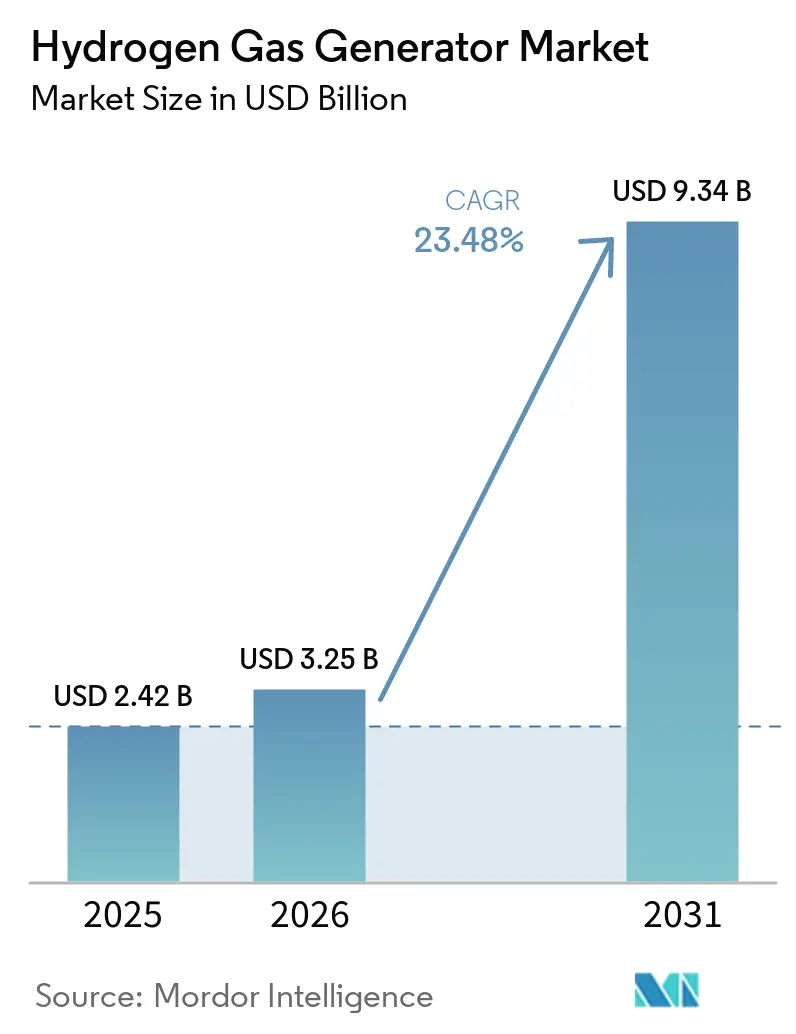
| Market Size (2026) | USD 3.25 Billion |
| Market Size (2031) | USD 9.34 Billion |
| Growth Rate (2026 - 2031) | 23.48 % |
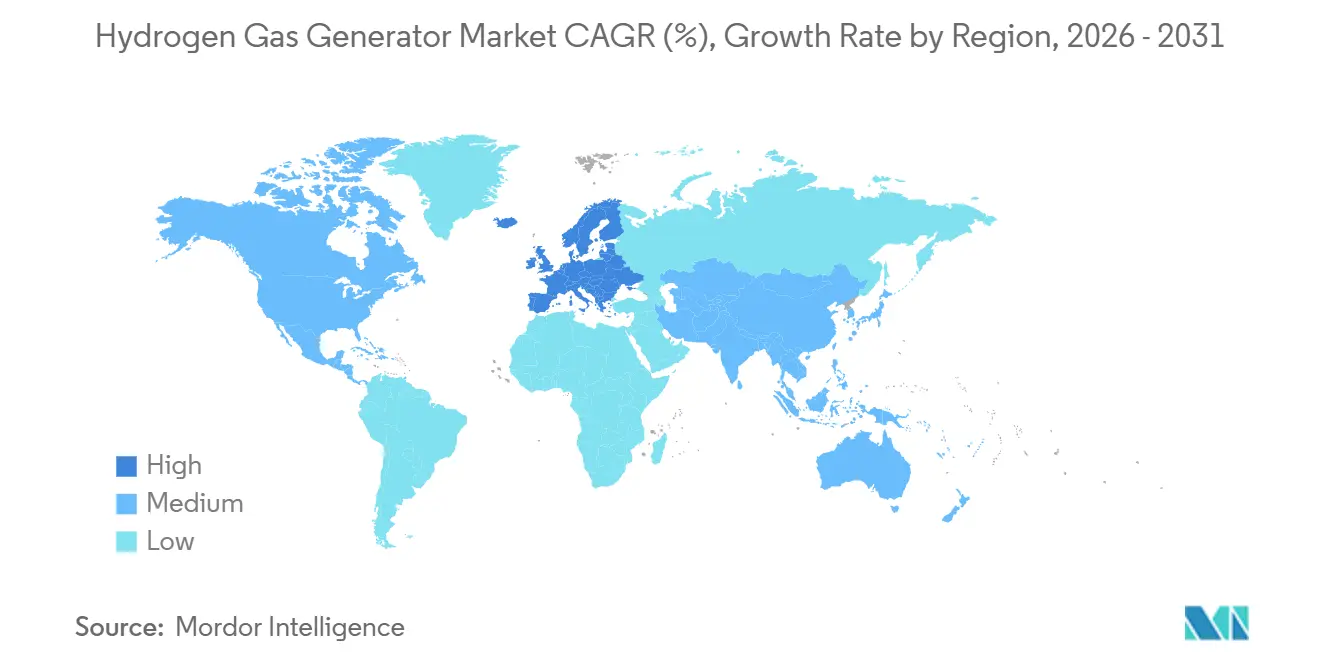
| Fastest Growing Market | Europe |
| Largest Market | Asia-Pacific |
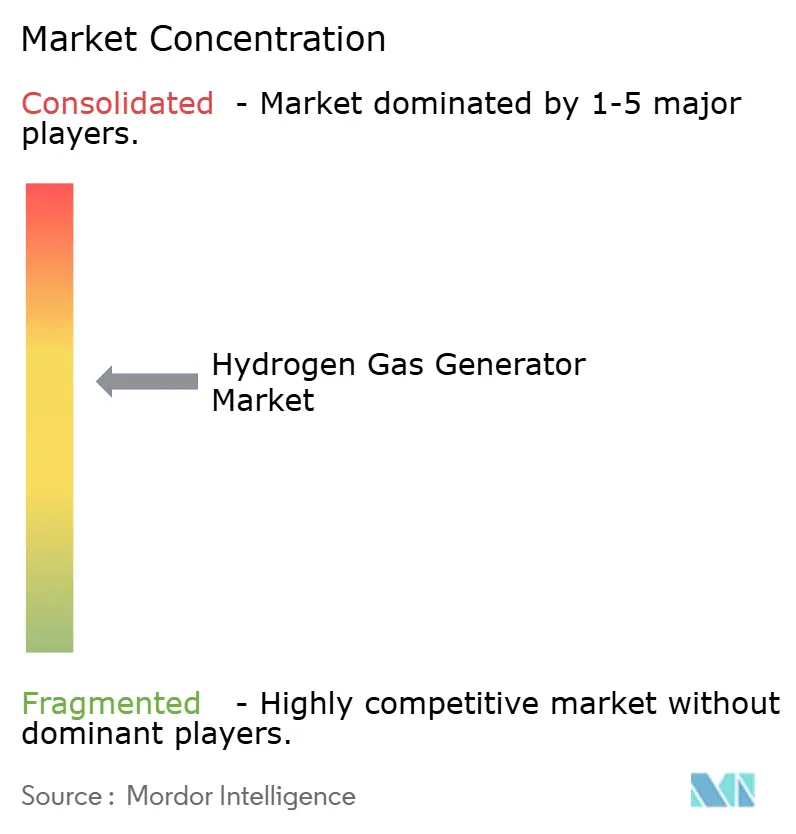
| Market Concentration | Medium |
Major Players *Disclaimer: Major Players sorted in no particular order Image © Mordor Intelligence. Reuse requires attribution under CC BY 4.0. | |
Hydrogen Gas Generator Market Analysis by Mordor Intelligence
The Hydrogen Gas Generator Market size is projected to expand from USD 2.42 billion in 2025 and USD 3.25 billion in 2026 to USD 9.34 billion by 2031, registering a CAGR of 23.48% between 2026 and 2031. Gray hydrogen remained the leading production route because steam methane reforming assets were already established at refinery and ammonia sites. Low-emissions hydrogen accounted for less than 1% of almost 100 million tonnes of global hydrogen output in 2024, showing the scale of the transition still needed[1]. Binding procurement requirements and industrial decarbonization plans are bringing forward orders for larger electrolyzer systems in Europe and Asia. On-site supply remains important because major industrial users seek tighter control over supply security, purity, and operating costs. Competition centers on service capability, system integration, stack performance, and the ability to provide long-term operating warranties across the Hydrogen gas generator market.
Key Report Takeaways
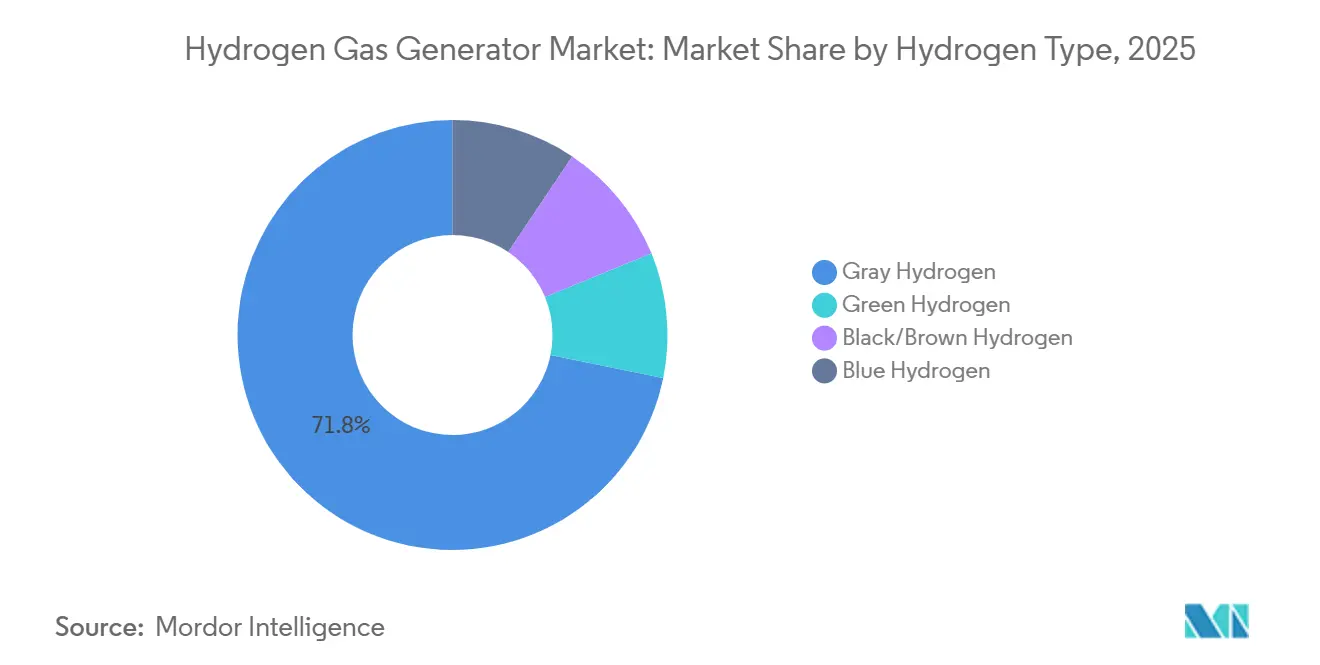
- By hydrogen type, gray hydrogen held 71.8% revenue share in 2025, while green hydrogen is forecast to grow at a 33.6% CAGR through 2031.
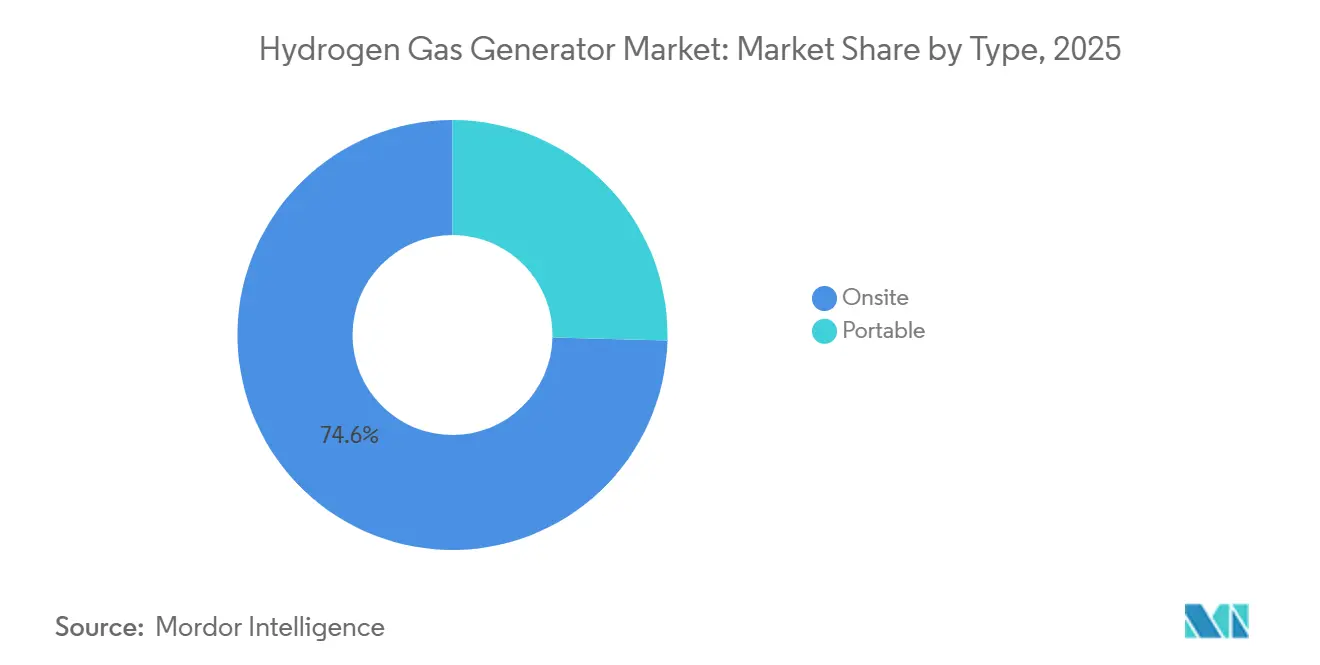
- By type, onsite systems accounted for 74.6% revenue share in 2025 and are projected to expand at a 25.8% CAGR through 2031.
- By capacity, systems above 2,000 Nm³/h represented 56.2% of the Hydrogen gas generator market size in 2025 and are forecast to grow at a 28.6% CAGR through 2031.
- By geography, Asia-Pacific held 47.1% revenue share in 2025, while Europe is forecast to expand at a 26.8% CAGR through 2031.
Note: Market size and forecast figures in this report are generated using Mordor Intelligence’s proprietary estimation framework, updated with the latest available data and insights as of January 2026.
Market Trends and Insights
Drivers Impact Analysis of Hydrogen Gas Generator Market*
| Driver | (~) % Impact on CAGR Forecast | Geographic Relevance | Impact Timeline |
|---|---|---|---|
| Industrial Decarbonization and Low-Carbon Hydrogen Procurement | +5.50% | Global, led by EU, Japan, South Korea | Medium term (2-4 years) |
| Onsite Supply for Refining, Chemicals, and Electronics | +4.80% | APAC core, spill-over to North America & EU | Short term (≤ 2 years) |
| Electrolyzer Cost and Efficiency Improvements | +4.20% | Global, strongest in China and EU | Medium term (2-4 years) |
| Hydrogen Mobility and Refueling Infrastructure | +3.50% | APAC (South Korea, Japan, China), Europe | Medium term (2-4 years) |
| Distributed Hydrogen for Grid-Resilient Power | +2.50% | North America, Australia, EU | Long term (≥ 4 years) |
| Hydrogen Purity Requirements in Semiconductor and Laboratory Applications | +2.00% | APAC (Taiwan, Japan, South Korea), North America | Short term (≤ 2 years) |
| Source: Mordor Intelligence | |||
Industrial Decarbonization and Low-Carbon Hydrogen Procurement
Industrial buyers are increasingly including carbon-intensity requirements in hydrogen supply decisions, not only price and volume. This gives the Hydrogen gas generator market a clearer demand signal where procurement rules are binding. The EU regulation on environmental sustainability requirements applies to relevant public procurement procedures launched from June 30, 2026, and includes electrolyzers among covered net-zero technologies. This changes the addressable opportunity for lower-carbon equipment in the European Hydrogen gas generator market. China’s 15th Five-Year Energy Plan set a target of 2 million tonnes of annual renewable hydrogen production by 2030 and introduced a 2026 pilot program for ammonia, methanol, and steel users[2]. These programs can shorten procurement timelines for large alkaline and PEM systems. Suppliers with manufacturing capacity and firm delivery schedules are therefore better placed to serve projects that are moving from early planning to equipment orders.
Onsite Supply for Refining, Chemicals, and Electronics
Refineries, chemical plants, and semiconductor facilities use onsite generation to reduce exposure to delivered-gas supply risks. Plug Power completed installation of 100 MW of PEM electrolyzers at Galp’s Sines Refinery in January 2026, with expected output of 15,000 tonnes of renewable hydrogen per year and annual emissions reductions of 110,000 tonnes of CO₂e. Refining applications require substantial output, while semiconductor applications require closely controlled purity and dependable uptime. This difference supports demand across the capacity range in the Hydrogen gas generator market. Large process sites favor systems that can be embedded in existing operations and supported over many years. Smaller electronics and laboratory sites favor integrated purification, monitoring, and responsive service arrangements.
Electrolyzer Cost and Efficiency Improvements
Research on electrolyzer technology projects alkaline and proton exchange membrane systems could reach EUR 300 per kW by 2030, while solid oxide systems could reach EUR 828 per kW. These estimates contrast with installed electrolyzer costs of USD 2,000 to USD 2,600 per kW outside China in 2024. The U.S. Department of Energy targets clean hydrogen production costs of USD 2 per kg by 2026 and USD 1 per kg by 2031[3]. Stack costs represented only 15% to 20% of installed project costs, so balance-of-plant design, water treatment, and service remain important cost factors. Nel launched its next-generation pressurized alkaline platform in May 2026 with a planned 1 GW annual production capacity at Herøya. The Hydrogen gas generator market, therefore, rewards suppliers that can improve complete system economics rather than stack pricing alone.
Hydrogen Mobility and Refueling Infrastructure
Hydrogen fueling networks are creating additional demand for on-site generation near logistics centers and vehicle fleets. A 2025 research report recorded 1,302 hydrogen refueling stations across 27 countries at the end of 2024, while the fuel cell vehicle fleet approached 100,000 units[4]. Heavy-duty truck deployments increased 72% from 2023, requiring higher station throughput than earlier passenger-car networks. South Korea held 36% of the global fuel cell vehicle fleet, while China accounted for 82% of fuel cell bus deployments. These fleet patterns support mid-capacity equipment at station clusters and freight routes. Manufacturers that combine equipment, power sourcing, water management, and maintenance can address the operating needs of fleet customers more effectively.
Restraints Impact Analysis of Hydrogen Gas Generator Market*
| Restraint | (~) % Impact on CAGR Forecast | Geographic Relevance | Impact Timeline |
|---|---|---|---|
| High Capital Cost and Green-Hydrogen Cost Premium | -4.50% | Global, most acute in North America and Middle East | Medium term (2-4 years) |
| Hydrogen Storage, Transport, and Safety Complexity | -3.50% | Global, with severity in emerging markets | Medium term (2-4 years) |
| Stack Degradation, Water Quality, and Balance-of-Plant Maintenance | -2.20% | Global | Short to medium term (≤ 4 years) |
| Interconnection Delays and Intermittent Renewable Power Availability | -2.00% | EU, Australia, emerging markets | Long term (≥ 4 years) |
| Source: Mordor Intelligence | |||
High Capital Cost and Green-Hydrogen Cost Premium
The cost premium for renewable hydrogen remains the main barrier to broader adoption in the Hydrogen gas generator market. ACER reported that renewable hydrogen in Europe costs 4 times more than conventional hydrogen in 2024. The gap is expected to narrow where renewable resources, carbon pricing, and imported gas costs support the business case. It is likely to remain wider where domestic gas is inexpensive and blue hydrogen has a clear cost advantage. Projects without subsidies, firm offtake contracts, or carbon pricing face more difficult financing conditions. Lenders also need confidence in long-term electrolyzer performance, which makes warranties and operating evidence important to project financing.
Hydrogen Storage, Transport, and Safety Complexity
Hydrogen requires dedicated engineering because it has low volumetric energy density, a broad flammability range, and can affect conventional steel infrastructure. Operators must address storage design, material selection, inspection requirements, and site safety procedures. These requirements add cost and can extend permitting schedules in the Hydrogen gas generator market. The availability of qualified inspectors and hydrogen-specific building rules remains limited in several emerging economies. Water quality adds another operating requirement because PEM electrolyzers need highly purified feedwater. Projects that plan water treatment and maintenance from the outset are better positioned to avoid operating disruptions. These operating requirements raise the importance of service capability in the Hydrogen gas generator market.
*Our forecasts treat driver/restraint impacts as directional, not additive. The impact forecasts reflect baseline growth, mix effects, and variable interactions.
Hydrogen Gas Generator Market Segment Analysis
By Hydrogen Type:
Gray Hydrogen Leads While Green Hydrogen Gains MomentumGray hydrogen held 71.8% of the Hydrogen gas generator market share in 2025 because steam methane reforming remained established at refinery, ammonia, and methanol facilities. Its installed base and lower current cost continue to shape purchasing decisions. Black and brown hydrogen remain concentrated in locations that rely on coal and lignite gasification. Blue hydrogen retains a near-term role in North America and the Middle East, where gas supply and carbon storage options support industrial projects. Green hydrogen is forecast to record the fastest growth at a 33.6% CAGR through 2031 as procurement commitments support larger electrolyzer orders.
The European Hydrogen Bank’s third auction awarded more than EUR 1 billion, equivalent to USD 1.09 billion, to 9 projects in 7 European Economic Area countries in February 2026. The selected projects represent 1.1 GW of electrolyzer capacity and more than 1.3 million tonnes of hydrogen in their first 10 years. India’s National Green Hydrogen Mission is targeting at least 5 million metric tonnes of annual green hydrogen production capacity by 2030. The EU target for 42% renewable hydrogen use in industry by 2030 gives developers a clearer basis for equipment commitments. These commitments strengthen the transition toward lower-emissions production pathways in the Hydrogen gas generator market.

By Type:
Onsite Systems Support Long-Term Customer RelationshipsOn-site systems accounted for 74.6% of the Hydrogen gas generator market size in 2025 and are expected to grow at a 25.8% CAGR through 2031. Once installed within refinery or chemical process infrastructure, replacement decisions are difficult, and service relationships can last 15 to 20 years. This favors suppliers that provide reliable operations, remote monitoring, and technical support. Linde’s HYDROPRIME offering supports electronics facilities with capacities from 300 to 32,000 Nm³/h and hydrogen purity of 99.999%. Air Liquide’s ULTRAL H2 unit is designed for high-grade hydrogen production for semiconductor applications.
Portable systems remain smaller in revenue terms but address emergency power and distributed infrastructure needs. Mitsubishi Heavy Industries Engine & Turbocharger announced in June 2026 that its 500 kW-class hydrogen engine generator set achieved technology readiness for commercialization after rated operation at 435 kW. Asahi Kasei began installing a containerized 1 MW alkaline electrolyzer at a commercial hydrogen refueling station in Jyväskylä, Finland, in March 2026. Semi-permanent, modular designs can connect large industrial systems with distributed mobility demand. The Hydrogen gas generator market benefits from this range of operating models because users can select equipment suited to their site conditions and planned demand.
By Capacity:
Large Systems Lead Revenue and GrowthSystems above 2,000 Nm³/h accounted for 56.2% of the Hydrogen gas generator market size in 2025 and are projected to grow at a 28.6% CAGR through 2031. Their lead reflects the spending patterns of large hydrogen projects for refining, petrochemicals, and green ammonia. thyssenkrupp nucera signed a contract in March 2026 to supply 15 standardized 20 MW alkaline units, totaling 300 MW, for Moeve’s Onuba plant in Spain. The plant is expected to produce 45,000 tonnes of green hydrogen annually. Standardized modules help developers improve construction planning and cost control at high capacity.
Systems below 5 Nm³/h serve laboratory, analytical, and semiconductor research applications where purity and reliability are the main purchasing criteria. The 100 to 2,000 Nm³/h range supports mobility stations, industrial park power applications, and mid-sized chemical plants. Containerized electrolyzer platforms allow users to add capacity as demand rises. The 5 to 15 Nm³/h and 15 to 100 Nm³/h ranges serve food processing, float glass, and metallurgical annealing. The range of use cases allows the Hydrogen gas generator market to address both large capital projects and smaller continuous-use applications.
Geography Analysis
APAC Hydrogen Gas Generator Market
Asia-Pacific held 47.1% of the Hydrogen gas generator market share in 2025, supported by China’s large electrolyzer manufacturing base and the hydrogen programs of Japan and South Korea. China’s 2026 energy plan targets 2 million tonnes of annual renewable hydrogen production by 2030 and expands use beyond fuel cell vehicles to industrial customers. Japan’s demand includes hydrogen and ammonia co-firing as well as onsite production models. India adds to regional demand through the National Green Hydrogen Mission and large green ammonia project planning. South Korea’s fuel cell vehicle deployment supports demand for station-format generation.
Europe Hydrogen Gas Generator Market
Europe is forecast to grow at a 26.8% CAGR through 2031, the highest regional rate in the Hydrogen gas generator market. The European Hydrogen Bank auction committed more than EUR 1 billion, equivalent to USD 1.09 billion, to 9 projects that total 1.1 GW of electrolyzer capacity. The Hamburg Green Hydrogen Hub selected Siemens Energy to supply a 100 MW electrolyzer for an annual output of 10,000 tonnes of green hydrogen. Spain’s Moeve project adds a 300 MW supply agreement to the regional pipeline. Regulatory requirements under RED III and the Net-Zero Industry Act improve demand visibility across European markets.
The Americas and MEA Hydrogen Gas Generator Market
North American activity is supported by federal clean-hydrogen cost goals and investment in Gulf Coast refinery applications and regional hubs. Chile has advanced export-oriented projects because the Atacama Desert has strong renewable resources. Brazil and Argentina are developing capacity under national decarbonization programs. Saudi Arabia, the UAE, Egypt, Morocco, and South Africa are developing export projects, although infrastructure and offtake agreements have progressed more slowly than early announcements.
Competitive Landscape
The Hydrogen gas generator market is moderately consolidated, with industrial gas companies and specialist electrolyzer manufacturers serving different parts of the value chain. Air Products, Air Liquide, and Linde compete through service contracts, system integration, and hydrogen logistics. Nel, ITM Power, thyssenkrupp nucera, and Enapter focus on stack performance, load-following ability, and modular delivery. Chinese manufacturers account for more than half of global electrolyzer manufacturing capacity. Local engineering, grid connections, and compliance requirements remain significant competitive factors.
John Cockerill acquired key McPhy assets in July 2025, including the Belfort gigafactory, intellectual property, and engineering capabilities. In July 2026, the company produced its first 5 MW electrolyzer stack using the combined technology base. This transaction shows how acquisitions can add manufacturing assets and shorten product-development timelines. Enapter launched the AEM Stack 250 in May 2026 for plants in the 100 MW range. The launch expands the choice of electrolyzer platforms for industrial users in steel, cement, ammonia, and aluminum.
ITM Power received a GBP 46.5 million grant and strategic investment support in April 2026 for its Chronos manufacturing line in Sheffield. Public support can improve confidence in manufacturing expansion and project financing. Asahi Kasei received approval in October 2025 for new component facilities at Kawasaki Works, with planned investment of JPY 35 billion, equivalent to USD 233 million, and potential government support of up to JPY 11.4 billion. Performance, service reach, and ability to meet local requirements will continue to shape supplier selection in the Hydrogen gas generator market.
Hydrogen Gas Generator Industry Leaders
-
Linde plc
-
L’Air Liquide S.A.
-
Air Products and Chemicals, Inc.
-
Cummins Inc.
-
Nel ASA
- *Disclaimer: Major Players sorted in no particular order
Hydrogen Gas Generator Market Companies Covered in this Report
- Air Products and Chemicals, Inc.
- Asahi Kasei Corporation
- Cummins Inc.
- Enapter AG
- EPOCH Energy Technology Corp.
- HyGear B.V.
- Idroenergy S.r.l.
- ITM Power plc
- John Cockerill S.A.
- L’Air Liquide S.A.
- Linde plc
- McPhy Energy S.A.
- MVS Engineering Pvt. Ltd.
- Nel ASA
- Peak Scientific Instruments Ltd.
- Plug Power Inc.
- Siemens Energy AG
- Teledyne Energy Systems, Inc.
- thyssenkrupp nucera AG & Co. KGaA
- Toshiba Corporation
Recent Industry Developments in Hydrogen Gas Generator Market
- July 2026: John Cockerill Hydrogen produced the first 5 MW pressurized alkaline electrolyzer stack at the former McPhy facility in Belfort, France, using a combined technology base of Cockerill and McPhy intellectual property, targeting 10-15% competitiveness improvements over current commercial platforms. Simultaneously, a 40 MW production run for a green hydrogen project in the Netherlands commenced at the Aspach plant.
- July 2026: Plug Power was awarded a 50 MW GenEco PEM electrolyzer supply contract for the Hunter Valley Hydrogen Hub in New South Wales, Australia. It is the largest green hydrogen project in Australia to reach final investment decision and the first recipient of Australia’s Hydrogen Headstart program, with AUD 432 million, equivalent to USD 272 million, in production credits. Hydrogen will replace natural gas in Orica’s low-carbon ammonia and ammonium nitrate production.
- June 2026: China published its 15th Five-Year Energy Plan, setting a national target of 2 million tonnes of annual renewable hydrogen production by 2030 and launching a pilot program to expand hydrogen applications beyond fuel cell vehicles to large industrial users of ammonia, methanol, and steel.
- May 2026: Nel ASA commercially launched its next-generation pressurized alkaline electrolyzer platform on May 6, 2026, backed by a EUR 135 million, equivalent to USD 147 million, EU Innovation Fund grant. Production capacity is ramping to 1 GW per year at Herøya, Norway, with a roadmap to 4 GW annually by 2030.
Global Hydrogen Gas Generator Market Report Scope
A hydrogen gas generator is an industrial or laboratory system that produces hydrogen gas on demand from a feedstock, rather than storing large quantities of hydrogen in cylinders. These generators typically use technologies such as water electrolysis, steam reforming, or chemical hydrogen generation, depending on the application.
The Hydrogen Gas Generator Market is segmented by hydrogen type, type, capacity, and geography. By hydrogen type, the market is segmented into green, gray, black/brown, and blue hydrogen. By type, the market is segmented into onsite and portable hydrogen gas generators. By capacity, the market is segmented into below 5 Nm³/h, 5–15 Nm³/h, 15–100 Nm³/h, 100–2,000 Nm³/h, and above 2,000 Nm³/h. The report also covers the market size and forecasts for the global hydrogen gas generator market across 26 countries in key regions. For each segment, the market sizing and forecasts have been provided on the basis of value (USD).
Segmentation Overview
| Green Hydrogen |
| Gray Hydrogen |
| Black/Brown Hydrogen |
| Blue Hydrogen |
| Onsite |
| Portable |
| Less than 5 Nm³/h |
| 5-15 Nm³/h |
| 15-100 Nm³/h |
| 100–2,000 Nm³/h |
| Greater than 2,000 Nm³/h |
| North America | United States |
| Canada | |
| Mexico | |
| Europe | Germany |
| France | |
| Italy | |
| Spain | |
| United Kingdom | |
| Poland | |
| Russia | |
| Rest of Europe | |
| Asia-Pacific | China |
| India | |
| Japan | |
| South Korea | |
| Australia | |
| Indonesia | |
| Vietnam | |
| Thailand | |
| Rest of Asia-Pacific | |
| South America | Brazil |
| Argentina | |
| Chile | |
| Rest of South America | |
| Middle East and Africa | Saudi Arabia |
| United Arab Emirates | |
| Egypt | |
| South Africa | |
| Morocco | |
| Rest of Middle East and Africa |
| By Hydrogen Type | Green Hydrogen | |
| Gray Hydrogen | ||
| Black/Brown Hydrogen | ||
| Blue Hydrogen | ||
| By Type | Onsite | |
| Portable | ||
| By Capacity | Less than 5 Nm³/h | |
| 5-15 Nm³/h | ||
| 15-100 Nm³/h | ||
| 100–2,000 Nm³/h | ||
| Greater than 2,000 Nm³/h | ||
| By Geography | North America | United States |
| Canada | ||
| Mexico | ||
| Europe | Germany | |
| France | ||
| Italy | ||
| Spain | ||
| United Kingdom | ||
| Poland | ||
| Russia | ||
| Rest of Europe | ||
| Asia-Pacific | China | |
| India | ||
| Japan | ||
| South Korea | ||
| Australia | ||
| Indonesia | ||
| Vietnam | ||
| Thailand | ||
| Rest of Asia-Pacific | ||
| South America | Brazil | |
| Argentina | ||
| Chile | ||
| Rest of South America | ||
| Middle East and Africa | Saudi Arabia | |
| United Arab Emirates | ||
| Egypt | ||
| South Africa | ||
| Morocco | ||
| Rest of Middle East and Africa | ||
Key Questions Answered in the Report
What is the projected growth of hydrogen gas generators?
The market is projected to grow at a 23.48% CAGR from 2026 to 2031, reaching USD 9.34 billion by 2031.
What is driving demand for hydrogen gas generators?
Industrial decarbonization rules, onsite supply needs, lower electrolyzer costs, and hydrogen mobility infrastructure are supporting demand.
Which hydrogen type is growing fastest?
Green hydrogen is forecast to grow at a 33.6% CAGR through 2031, while gray hydrogen held 71.8% share in 2025.
Why do industrial sites use onsite hydrogen generators?
Onsite systems provide greater control over supply, purity, logistics, and long-term operating reliability.
Which capacity range leads demand?
Systems above 2,000 Nm³/h held 56.2% share in 2025 and are forecast to grow at a 28.6% CAGR through 2031.
Which region has the strongest outlook?
Asia-Pacific led with 47.1% share in 2025, while Europe is forecast to grow fastest at a 26.8% CAGR through 2031.