
Hybrid Event Marketing Services Market Size and Share
Market Overview
| Study Period | 2020 - 2031 |
|---|---|
| Market Size (2026) | USD 1.20 Billion |
| Market Size (2031) | USD 1.82 Billion |
| Growth Rate (2026 - 2031) | 11.50 % |
| Fastest Growing Market | Asia-Pacific |
| Largest Market | North America |
| Market Concentration | Medium |
Major Players *Disclaimer: Major Players sorted in no particular order Image © Mordor Intelligence. Reuse requires attribution under CC BY 4.0. | |
Hybrid Event Marketing Services Market Analysis by Mordor Intelligence
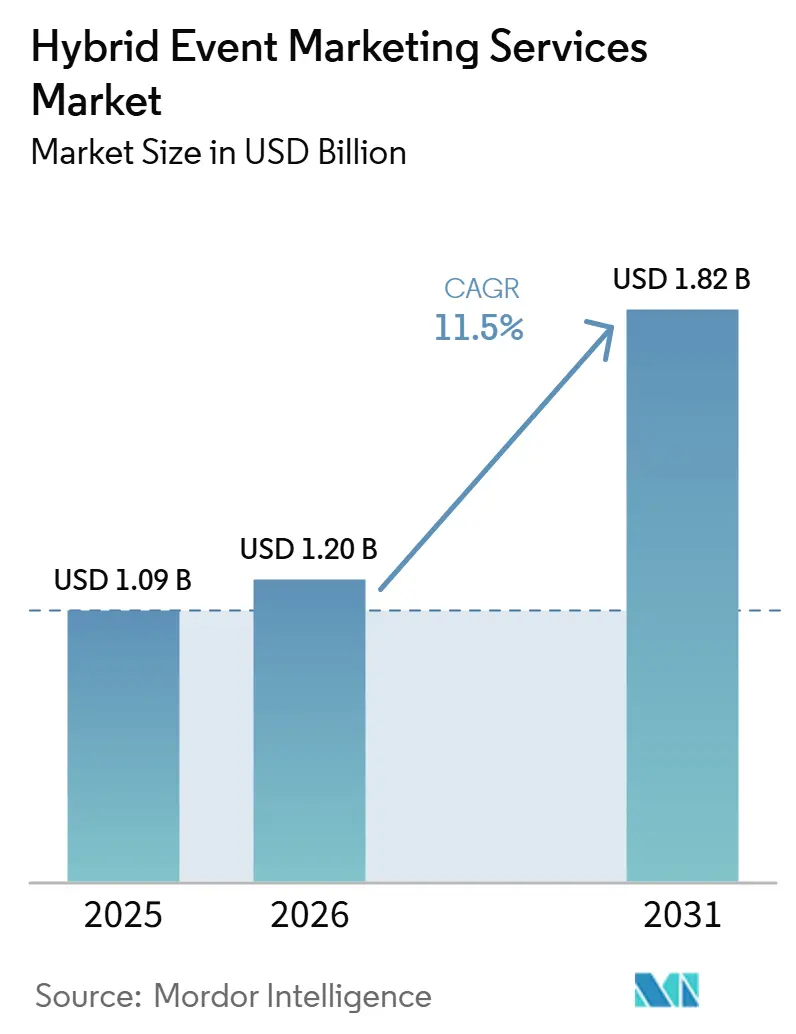
The Hybrid Event Marketing Services Market size was valued at USD 1.09 billion in 2025 and estimated to grow from USD 1.20 billion in 2026 to reach USD 1.82 billion by 2031, at a CAGR of 11.50% during the forecast period (2026-2031). The hybrid event marketing services market is moving toward a lasting operating model because it combines physical attendance with digital access and reusable content. B2B organizations use these formats to reach people who cannot travel while collecting direct engagement data from registrations, sessions, and follow-up activity. Event-led growth programs also place more weight on live and digital events as sources of qualified pipeline rather than as isolated communications activities. Competition is becoming increasingly concentrated among providers that can connect planning, delivery, content, and lead data into a single service offering. Cost inflation and data-consent requirements remain important constraints because hybrid programs combine venue costs with technology, staffing, and compliance work.
Key Report Takeaways
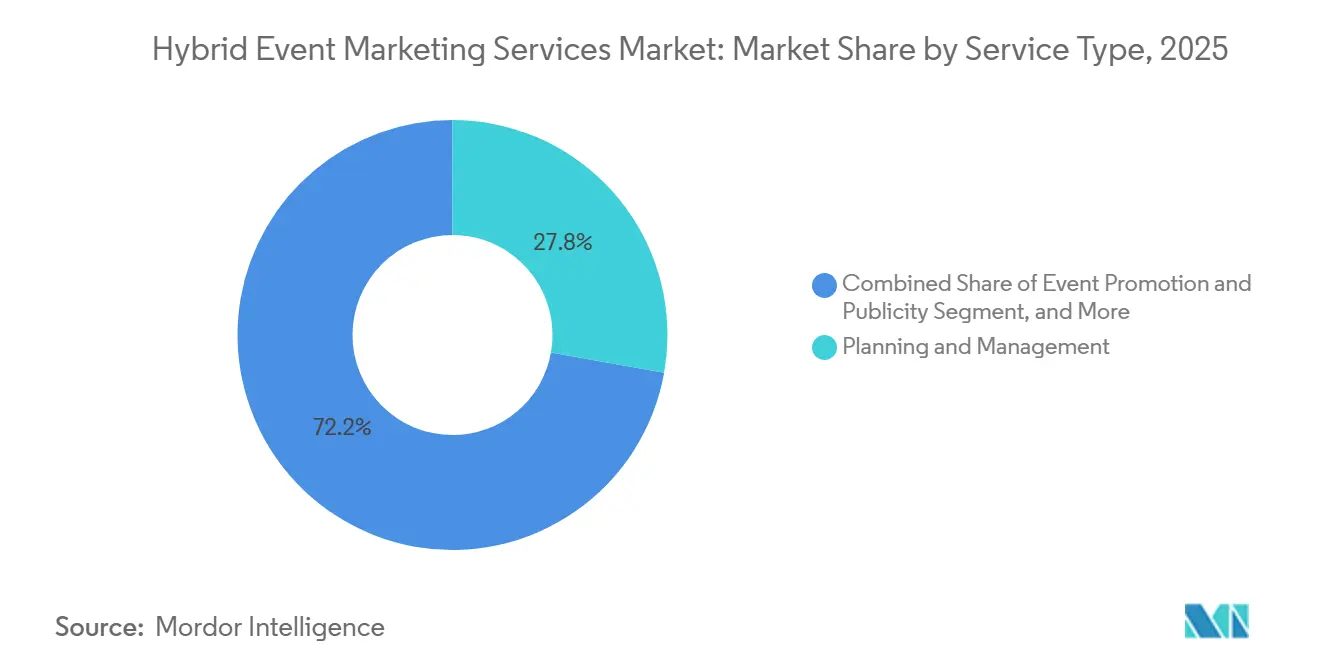
- By service type, planning and management held 27.81% of the hybrid event marketing services market share in 2025, while analytics and lead management are projected to expand at a 12.54% CAGR through 2031.
- By event type, conferences and seminars accounted for 31.73% of the hybrid event marketing services market share in 2025, while webinars and digital summits are expected to grow at a 12.63% CAGR through 2031.
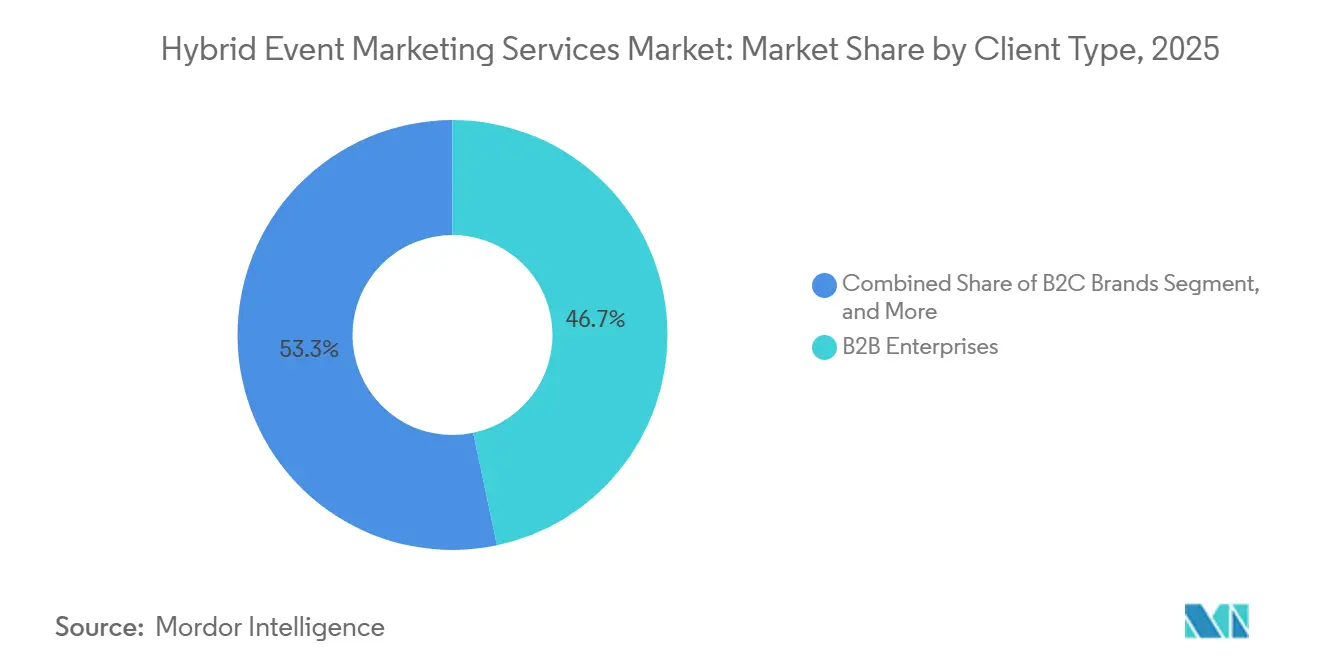
- By client type, B2B enterprises held 46.68% of the market share in 2025, while trade associations and professional bodies are projected to register a 12.56% CAGR through 2031.
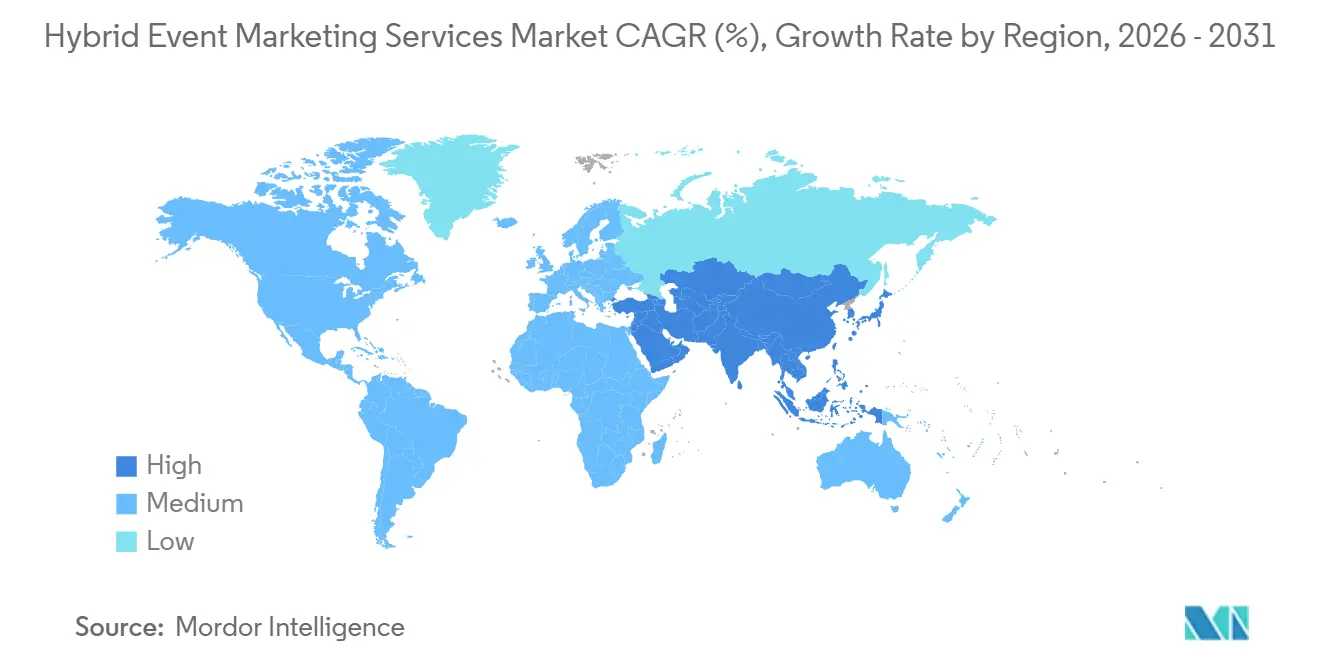
- By geography, North America accounted for 36.72% of the hybrid event marketing services market revenue in 2025, while Asia-Pacific is projected to expand at a 13.01% CAGR through 2031.
Note: Market size and forecast figures in this report are generated using Mordor Intelligence’s proprietary estimation framework, updated with the latest available data and insights as of January 2026.
Market Trends and Insights
Drivers Impact Analysis of Hybrid Event Marketing Services Market*
| Driver | (~) % Impact on CAGR Forecast | Geographic Relevance | Impact Timeline |
|---|---|---|---|
| Rising Preference for Hybrid Formats That Extend Audience Reach | +3.2% | Global | Short term (≤ 2 years) |
| Stronger Demand for Measurable Event ROI and First-Party Data | +2.5% | North America and Europe | Short term (≤ 2 years) |
| Expanding B2B Experiential Marketing and Field Events Budgets | +1.9% | North America and Asia-Pacific | Medium term (2-4 years) |
| AI-Powered Personalization, Matchmaking, and Content Repurposing | +1.6% | Global | Medium term (2-4 years) |
| Accessibility Compliance Expanding Captioning and Multilingual Event Demand | +0.6% | North America and Europe | Short term (≤ 2 years) |
| Scope 3 Travel and ESG Pressures Supporting Hybrid-First Event Mix | +0.4% | Europe and North America | Long term (≥ 4 years) |
| Source: Mordor Intelligence | |||
Rising Preference for Hybrid Formats That Extend Audience Reach
The hybrid event marketing services market benefits when organizers can increase attendance without expanding venue capacity. Virtual access lets an event offer live sessions, replay libraries, and sponsor exposure to people outside the host city. Bizzabo reported that 67% of organizers viewed hybrid as the future of event marketing, and 63% planned to hold more hybrid events to broaden audience reach.[1]Bizzabo, “2026 State of Events Benchmark Report,” Bizzabo, bizzabo.com The same format can keep generating leads after the event through recorded content and follow-up activity. ON24 states that hybrid events can generate more than twice as much behavioral data as traditional in-person events.[2]ON24, “Hybrid Events Platform,” ON24, on24.com This expanded data set supports managed analytics services and gives providers a reason to extend contracts beyond event delivery, including lead qualification, sponsor reporting, post-event content performance, and audience analysis for the next event cycle, while helping organizers compare participation across sessions, locations, formats, and audience groups without relying only on final attendance totals.
Stronger Demand for Measurable Event ROI and First-Party Data
The hybrid event marketing services market is also supported by buyer demand for clearer evidence of event returns. Registration data, badge scans, session viewing, and replay activity can be connected to customer relationship management systems. Cvent reported that 71% of organizers ranked measuring ROI as their leading operational priority. This priority reflects closer review of event budgets and stronger expectations for revenue attribution. Providers that unite in-person and virtual activity in a single lead record can reduce the need for manual data exports. That capability favors platforms with built-in marketing automation connections and helps explain the shift toward broader service suites, allowing procurement teams and sponsors to assess registration volume, session engagement, meeting requests, replay use, event-to-sales follow-up, and the audiences reached through their investment.
Expanding B2B Experiential Marketing and Field Events Budgets
B2B field-event spending supports demand for services that plan, promote, and measure multi-format programs. CEIR reported that B2B exhibitors allocated 40.8% of their annual marketing budgets to exhibitions in its 2026 Marketing Spend Decision Report. The spending base is increasingly directed toward scheduled meetings, curated content, and digital extensions rather than only toward larger booth structures. This shift gives the hybrid event marketing services market more room to deliver managed engagement and follow-up. Cvent reported that 33% of B2B marketers listed events and experiential marketing among their top 3 areas for increased spending in 2026. Providers that show pipeline results alongside event delivery are better placed to capture this spending because they can support audience targeting, event promotion, meeting coordination, content distribution, and reporting, increasing the value of service relationships when clients seek fewer handoffs between agencies, event teams, and technology suppliers.
AI-Powered Personalization, Matchmaking, and Content Repurposing
AI tools are changing the labor model for planning, matching, and content work within the hybrid event marketing services market. They can help organizers use attendee goals and professional information to support more targeted networking. Automated tools can also turn recorded sessions into additional content for later communication. Cvent's acquisition of Goldcast in December 2025 formed part of a broader move to connect webinar, content, and event capabilities. These functions can reduce repetitive production work while helping providers offer more tailored recommendations, content prompts, and engagement options. Their practical value depends on reliable event data, appropriate human oversight, and clear controls over how automated suggestions are used.
Restraints Impact Analysis of Hybrid Event Marketing Services Market*
| Restraint | (~) % Impact on CAGR Forecast | Geographic Relevance | Impact Timeline |
|---|---|---|---|
| Venue, Labor, and Production Cost Inflation | -1.8% | Global | Short term (≤ 2 years) |
| Privacy, Consent, and Cross-Border Attendee Data Compliance | -1.3% | Global, with emphasis on North America and Europe | Medium term (2-4 years) |
| Deepfake, Identity, and Cybersecurity Exposure in Digital Sessions | -0.8% | Global | Medium term (2-4 years) |
| Uneven Venue Bandwidth and AV Integration Readiness | -0.5% | Asia-Pacific core, with spillover to Middle East and Africa | Long term (≥ 4 years) |
| Source: Mordor Intelligence | |||
Venue, Labor, and Production Cost Inflation
Rising production costs can limit project margins and delay hybrid event investments. The Exhibitor Advocate found that display labor straight-time rates averaged USD 157.48 per hour in its 2025 survey of 224 trade shows across 23 US cities. The survey also recorded a 6.4% increase in that rate, while electrical overtime labor had risen 41.2% since 2022. Hybrid delivery adds streaming, encoding, and platform licensing costs to venue and production budgets. Fixed-price contracts are therefore exposed when labor or technical costs move faster than client budgets. Providers can reduce this pressure by adopting standardized technology stacks, reusable technical designs that limit last-minute work across streaming, registration, event applications, and audiovisual operations, and by providing clear, early cost reporting to clients.
Privacy, Consent, and Cross-Border Attendee Data Compliance
The hybrid event marketing services market handles data from badge scanners, mobile applications, session tracking, customer relationship systems, and on-demand viewing. Each data source can create different obligations based on an attendee's residence and the event location. Cvent notes that GDPR penalties can reach 4% of annual global turnover or EUR 20 million (USD 22.9 million), whichever is higher. Service providers must also manage data-processing agreements across registration, analytics, badging, and CRM partners. AI-based lead scoring adds further concern because consent and automated-decision requirements may apply. Buyers with multinational event programs are likely to favor vendors that can show clear privacy controls and documented consent processes, since these requirements affect platform selection, registration journeys, data retention, sponsor information, and the value of established providers with formal controls across event systems.
*Our forecasts treat driver/restraint impacts as directional, not additive. The impact forecasts reflect baseline growth, mix effects, and variable interactions.
Hybrid Event Marketing Services Market Segment Analysis
By Service Type:
Analytics and Lead Management Changes Event Program EconomicsPlanning and management held 27.81% of the hybrid event marketing services market share in 2025. The service covers coordinated requests for proposals, venue sourcing, registration, and reporting across in-person and digital channels. Large organizations use these services to reduce fragmentation across multi-event calendars. Centralizing program management also helps maintain consistent processes and data definitions. The hybrid event marketing services market size for analytics and lead management is projected to grow at a 12.54% CAGR through 2031, as buyers seek CRM-linked pipeline measurement.
Event Promotion and Publicity supports audience acquisition across physical and virtual channels, particularly when a program offers digital access beyond venue capacity. Content production and repurposing are becoming more important because recorded sessions can be converted into additional campaign materials. Virtual event technology and streaming are essential because organizers need synchronized links between cloud-delivered content and in-room audiovisual systems. Audience engagement, networking, sponsorship, and partner activation support retention and create digital inventory beyond floor space and session naming rights. Freeman reported in July 2026 that attendees ideally spend 54% of learning time outside traditional session rooms, rising to 64% at trade shows, which supports services that work across physical and digital touchpoints.



By Event Type:
Webinars Support Persistent Lead GenerationConferences and seminars accounted for 31.73% of the hybrid event marketing services market share in 2025. These recurring flagship events drive higher service revenue by combining large attendance, multiyear contracts, and sponsorship programs. Digital access can add virtual tracks and replay inventory to their established commercial model. Webinars and digital summits are projected to record a 12.63% CAGR through 2031. Their growth rests on the ability to operate as ongoing lead-generation programs rather than as one-time activities. This allows organizers to reuse sessions in follow-up communication and to measure participation over a longer period.
The hybrid event marketing services market size for webinars gains value when each live program feeds an on-demand content library. Trade shows and exhibitions remain important because exhibitors direct a large share of annual marketing funds to this channel. CEIR reported that B2B exhibitors allocated 40.8% of their annual marketing budgets to exhibitions in 2026. Their hybrid conversion remains slower because product demonstrations and floor interactions are strongly physical. Product launches, company meetings, and sales kickoffs, association and user conferences, and partner and community events use hybrid delivery to coordinate dispersed audiences, preserve selected in-person activity, and support relationship-focused programs.
By Client Type:
Enterprise Demand Anchors Spending While Associations AccelerateB2B Enterprises held 46.68% of the hybrid event marketing services market share in 2025. These organizations have the scale, marketing systems, and event-program teams needed to support specialized services. They use connected registration, CRM, and marketing automation systems to better assess event outcomes. Trade associations and professional bodies are projected to register the highest client-type CAGR at 12.56% through 2031. Their members are often geographically distributed, and hybrid access can increase participation without matching increases in venue expense.
The hybrid event marketing services market size for this client group benefits when member engagement becomes part of the value an association offers. B2C Brands use event budgets for consumer activations and product launches, extending live moments through broadcasts and social media activity. Educational institutions use these services for professional development, alum activities, and research conferences. Accessibility and captioning requirements increasingly shape their platform choices. Government and public sector organizations use hybrid delivery for consultations and stakeholder meetings, while nonprofit organizations use remote access to extend fundraising participation beyond the event location.
Geography Analysis
North America Hybrid Event Marketing Services Market
North America held 36.72% of the hybrid event marketing services market share in 2025. The region combines a large base of enterprise buyers, convention infrastructure, and established event technology providers. Cvent, Freeman, Bizzabo, and RainFocus are among the vendors that contribute to product development and service competition. The United States remains the principal regional market, while Canada and Mexico are extending hybrid activity across pharmaceutical, energy, and financial services programs. Privacy requirements, including California rules and Canada's PIPEDA, shape consent-management decisions for regional platforms.
Europe and South America Hybrid Event Marketing Services Market
Europe is the second-largest regional area, with Germany, the United Kingdom, and France showing high event density and established hybrid use. Germany recorded 395.1 million on-site event attendees in 2025, up 4.6% from 377.6 million in 2024, while the German Convention Bureau also found growth across several event-size categories above 1,000 attendees.[3]GCB German Convention Bureau, “Ergebnisse Meeting- und EventBarometer 2025/2026,” GCB German Convention Bureau, gcb.de The European Accessibility Act has been applied since June 28, 2025, increasing attention to multilingual captioning and inclusive digital participation, while South America is emerging, with Brazil leading corporate conference demand and Argentina and Chile showing earlier adoption in financial services and technology.
APAC and MEA Hybrid Event Marketing Services Market
Asia-Pacific is projected to grow at a 13.01% CAGR through 2031, the fastest regional rate in the Hybrid Event Marketing Services Market. Corporate event programs are becoming more formal across India, South Korea, Japan, and Australia, and hybrid delivery can reduce the travel and coordination burden created by long distances across the region. EventHub found that more than 60% of Japanese event marketing organizations still faced manual management and resource gaps, while 25% had reached advanced data integration. The Middle East is expanding in the UAE and Saudi Arabia through government-backed conference initiatives and Saudi Vision 2030 MICE programs. Africa remains at an earlier stage, with South Africa, Egypt, and Nigeria providing a base for mobile-first participation and connected conference activity.

Competitive Landscape
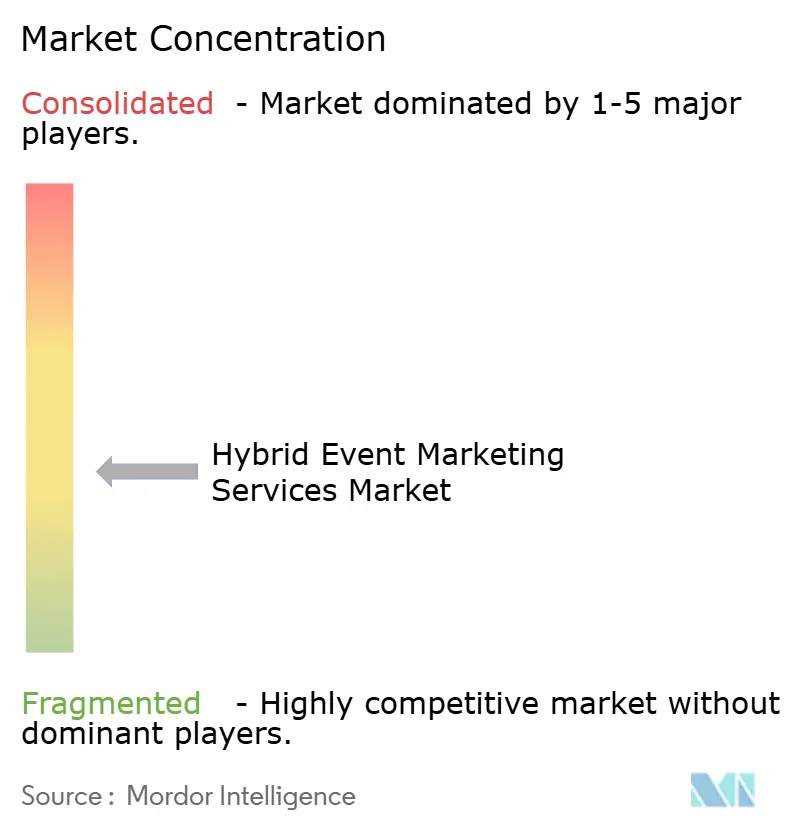
The hybrid event marketing services market is moderately fragmented, with competition spanning both technology platforms and service-led delivery models. Full-stack platform vendors, including Cvent, Bizzabo, vFairs, and RainFocus, compete primarily through the breadth of their software offerings, data integration capabilities, and ability to support event organizers across digital and in-person touchpoints. Managed-service providers, including Freeman, Maritz Holdings, MCI Group, and Encore Global Group, compete through execution capabilities, end-to-end event delivery expertise, established client relationships, and operational support. However, the distinction between these groups continues to narrow as service providers develop proprietary technology and platform vendors expand their delivery support capabilities to address broader client requirements.
The transactions connect planning, webinars, digital engagement, and content functions within a wider hybrid lifecycle offering, while competition also centers on compliance-ready design, AI-enabled analytics, and price access for the mid-market. Airmeet and Whova address narrower community and event use cases at lower price points than enterprise suites. Bizzabo was named a Visionary in the 2026 Gartner Magic Quadrant for Event Marketing and Management Platforms. vFairs introduced Smart Badge technology in 2026 to automate tracking of session attendance, booth visits, and interactions.[4]vFairs, “May Product Updates,” vFairs, vfairs.com
The hybrid event marketing services market favors companies that can support global programs across strategy, production, measurement, and engagement. Jack Morton Worldwide and Impact XM announced their merger in January 2026, creating a combined organization with more than 1,000 specialists across 20 offices. ATIV Software launched MeetingMates in April 2026 to provide AI-powered attendee matching within its EventPilot application for scientific and medical meetings. Cvent introduced hybrid check-in improvements in June 2026 that separated virtual registration from on-site check-in. No verified combined market-share figure for leading companies is available in the supplied material, which is consistent with a moderately fragmented field.
Hybrid Event Marketing Services Industry Leaders
Cvent, Inc.
Freeman Company
ON24, Inc.
Bizzabo Ltd.
Eventbrite, Inc.
- *Disclaimer: Major Players sorted in no particular order
Hybrid Event Marketing Services Market Companies Covered in this Report
- Cvent, Inc.
- Freeman Company
- Eventbrite, Inc.
- ON24, Inc.
- Bizzabo Ltd.
- Goldcast, Inc.
- EventMobi Inc.
- Kaltura, Inc.
- 6Connex, Inc.
- vFairs LLC
- Whova Inc.
- Airmeet, Inc.
- Stova Group, LLC
- RainFocus, LLC
- Encore Global Group, LLC
- Maritz Holdings Inc.
- MCI Group Holding SA
- GL events SA
- Jack Morton Worldwide, Inc.
- Informa PLC

Recent Industry Developments in Hybrid Event Marketing Services Market
- July 2026: Freeman published Unpacking XLNC - The Future of Adult Learning at Conferences and Trade Shows, Part Two, revealing that attendees ideally allocated 54% of learning time outside traditional session rooms, a figure rising to 64% at trade shows. The findings redefine how hybrid event organizers must design parallel physical and virtual engagement architectures to retain attendees who seek experiential rather than lecture-based formats.
- July 2026: Cvent released hybrid check-in improvements separating virtual registration from actual on-site check-in, enabling more accurate participation tracking for hybrid attendance reporting. The update allows organizers to check in attendees who already participated virtually, resolving a core data integrity gap in hybrid program analytics.
- May 2026: Freeman published research on non-attendees from its Trends Report series, finding 60% of non-attendees would return to conferences if events offered exclusive in-person educational content unavailable in digital formats. The data provides hybrid event service providers with an audience recapture framework grounded in content differentiation rather than registration incentives.
- April 2026: Cvent completed its acquisition of ON24, creating a connected platform spanning in-person, hybrid, virtual, and webinar formats on a single first-party data layer. The acquisition follows Cvent's December 2025 acquisition of Goldcast, with combined investment in both platforms totaling USD 700 million, backed by Blackstone's full ownership of Cvent since mid-2025.


Global Hybrid Event Marketing Services Market Report Scope
The Hybrid Event Marketing Services Market comprises companies that provide strategic, creative, technological, and operational services to plan, promote, execute, and optimize hybrid events that combine in-person and virtual participation. These services enable organizations to deliver seamless attendee experiences across physical and digital channels while maximizing audience reach, engagement, lead generation, and return on investment (ROI).
The Hybrid Event Marketing Services Market Report is Segmented by Service Type (Planning and Management, Event Promotion and Publicity, Content Production and Repurposing, Virtual Event Technology and Streaming, Audience Engagement and Networking, Analytics and Lead Management, and Sponsorship and Partner Activation), Event Type (Conferences and Seminars, Trade Shows and Exhibitions, Product Launches, Company Meetings and Sales Kickoffs, Webinars and Digital Summits, Association and User Conferences, and Partner and Community Events), Client Type (B2B Enterprises, B2C Brands, Trade Associations and Professional Bodies, Educational Institutions, Government and Public Sector, and Nonprofit Organizations), and Geography (North America, South America, Europe, Asia-Pacific, Middle East, and Africa). The Market Forecasts are Provided in Terms of Value (USD).
| Planning and Management |
| Event Promotion and Publicity |
| Content Production and Repurposing |
| Virtual Event Technology and Streaming |
| Audience Engagement and Networking |
| Analytics and Lead Management |
| Sponsorship and Partner Activation |
| Conferences and Seminars |
| Trade Shows and Exhibitions |
| Product Launches |
| Company Meetings and Sales Kickoffs |
| Webinars and Digital Summits |
| Association and User Conferences |
| Partner and Community Events |
| B2B Enterprises |
| B2C Brands |
| Trade Associations and Professional Bodies |
| Educational Institutions |
| Government and Public Sector |
| Nonprofit Organizations |
| North America | United States |
| Canada | |
| Mexico | |
| South America | Brazil |
| Argentina | |
| Chile | |
| Rest of South America | |
| Europe | Germany |
| United Kingdom | |
| France | |
| Italy | |
| Spain | |
| Rest of Europe | |
| Asia-Pacific | China |
| Japan | |
| India | |
| South Korea | |
| Australia | |
| Rest of Asia-Pacific | |
| Middle East | United Arab Emirates |
| Saudi Arabia | |
| Qatar | |
| Rest of Middle East | |
| Africa | South Africa |
| Egypt | |
| Nigeria | |
| Rest of Africa |
| By Service Type | Planning and Management | |
| Event Promotion and Publicity | ||
| Content Production and Repurposing | ||
| Virtual Event Technology and Streaming | ||
| Audience Engagement and Networking | ||
| Analytics and Lead Management | ||
| Sponsorship and Partner Activation | ||
| By Event Type | Conferences and Seminars | |
| Trade Shows and Exhibitions | ||
| Product Launches | ||
| Company Meetings and Sales Kickoffs | ||
| Webinars and Digital Summits | ||
| Association and User Conferences | ||
| Partner and Community Events | ||
| By Client Type | B2B Enterprises | |
| B2C Brands | ||
| Trade Associations and Professional Bodies | ||
| Educational Institutions | ||
| Government and Public Sector | ||
| Nonprofit Organizations | ||
| By Geography | North America | United States |
| Canada | ||
| Mexico | ||
| South America | Brazil | |
| Argentina | ||
| Chile | ||
| Rest of South America | ||
| Europe | Germany | |
| United Kingdom | ||
| France | ||
| Italy | ||
| Spain | ||
| Rest of Europe | ||
| Asia-Pacific | China | |
| Japan | ||
| India | ||
| South Korea | ||
| Australia | ||
| Rest of Asia-Pacific | ||
| Middle East | United Arab Emirates | |
| Saudi Arabia | ||
| Qatar | ||
| Rest of Middle East | ||
| Africa | South Africa | |
| Egypt | ||
| Nigeria | ||
| Rest of Africa | ||


Key Questions Answered in the Report
What is the size of the Hybrid Event Marketing Services Market?
The Hybrid Event Marketing Services Market is estimated at USD 1.20 billion in 2026 and is projected to reach USD 1.82 billion by 2031 at an 11.50% CAGR. Growth is linked to lasting use of combined physical and virtual programs, wider audience access, and the ability to collect direct engagement information across an event life cycle.
Which service is growing fastest in hybrid event marketing services?
Analytics and Lead Management is projected to grow at a 12.54% CAGR through 2031 as organizations seek CRM-linked event and pipeline measurement. The service helps event teams connect registration, attendance, session engagement, and content use with the lead follow-up processes that guide later commercial activity.
Which event format has the largest revenue share?
Conferences and Seminars held 31.73% of event-type revenue in 2025, supported by recurring events, sponsorships, and multiyear service arrangements. Their hybrid extensions can add virtual access and replay inventory to an established event model while keeping a central in-person program for priority attendees and partners.
Why are webinars and digital summits gaining use?
Webinars and Digital Summits are expected to grow at a 12.63% CAGR through 2031 because they can operate as ongoing lead-generation and content programs. Recorded sessions can remain available after a live program and give organizers an additional channel for digital follow-up and sponsor engagement.
Which region is expanding fastest for hybrid event marketing services?
Asia-Pacific is projected to grow at a 13.01% CAGR through 2031, supported by more formal corporate event programs in India, South Korea, Japan, and Australia. Hybrid delivery can help these programs reach distributed audiences while reducing the travel and coordination burden associated with fully in-person participation across long distances.
What are the main constraints on hybrid event programs?
Venue and production cost inflation, privacy and consent requirements, cybersecurity exposure, and uneven venue bandwidth can limit adoption and operating margins. These constraints affect both the planning stage and delivery stage because a hybrid event requires consistent physical, digital, data-management, and participant-access processes.
Page last updated on:





