
HVAC Insulation Market Size and Share
Market Overview
| Study Period | 2021 - 2031 |
|---|---|
| Market Size (2026) | USD 6.82 Billion |
| Market Size (2031) | USD 8.82 Billion |
| Growth Rate (2026 - 2031) | 5.28 % |
| Fastest Growing Market | Asia-Pacific |
| Largest Market | Asia-Pacific |
| Market Concentration | Low |
Major Players *Disclaimer: Major Players sorted in no particular order Image © Mordor Intelligence. Reuse requires attribution under CC BY 4.0. | |
HVAC Insulation Market Analysis by Mordor Intelligence
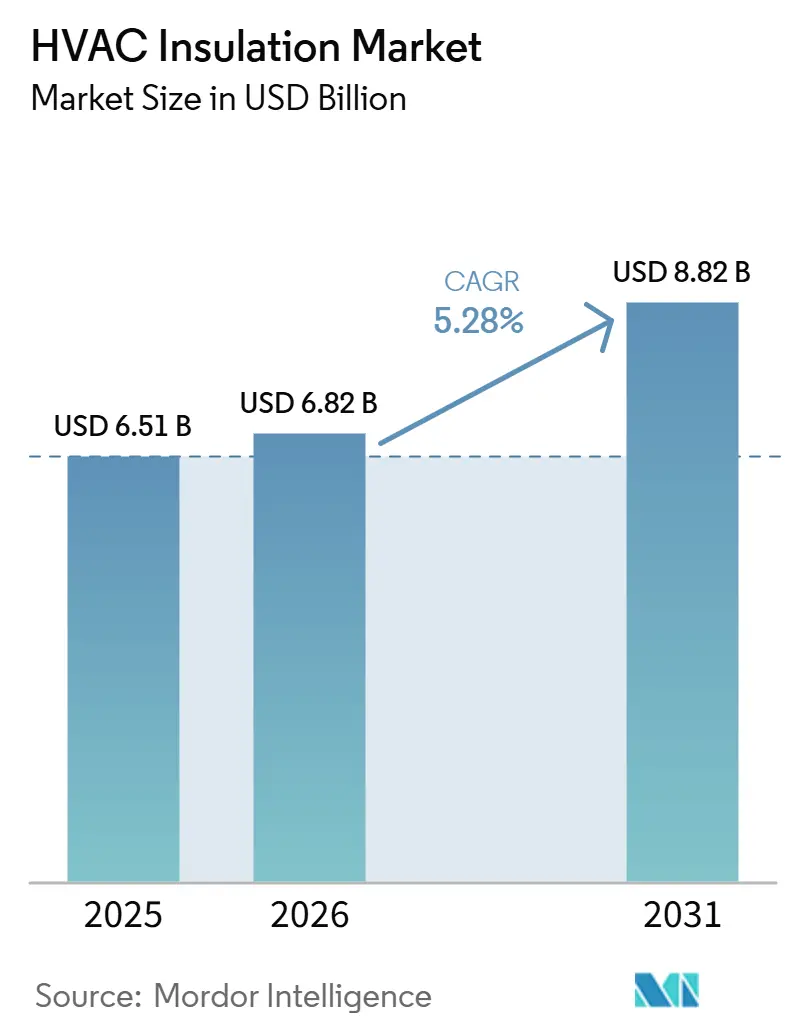
The HVAC Insulation Market size is projected to expand from USD 6.51 billion in 2025 and USD 6.82 billion in 2026 to USD 8.82 billion by 2031, and is expected to register a CAGR of 5.28% between 2026 and 2031. Mandatory energy renovation regulations in Europe and North America are raising minimum standards for duct and pipe insulation in new and existing buildings. The electrification of heating and cooling systems is increasing demand for materials that control condensation and maintain thermal performance. Commercial construction activity in Asia-Pacific is contributing to market growth, while healthcare facilities and data centers are supporting demand in segments less sensitive to conventional property cycles. Suppliers are responding by investing in capacity, narrowing product portfolios, and developing materials that meet fire, moisture, and environmental requirements. These conditions favor higher-performance insulation systems over basic alternatives in applications where lifecycle performance is a priority for building owners.
Key Report Takeaways
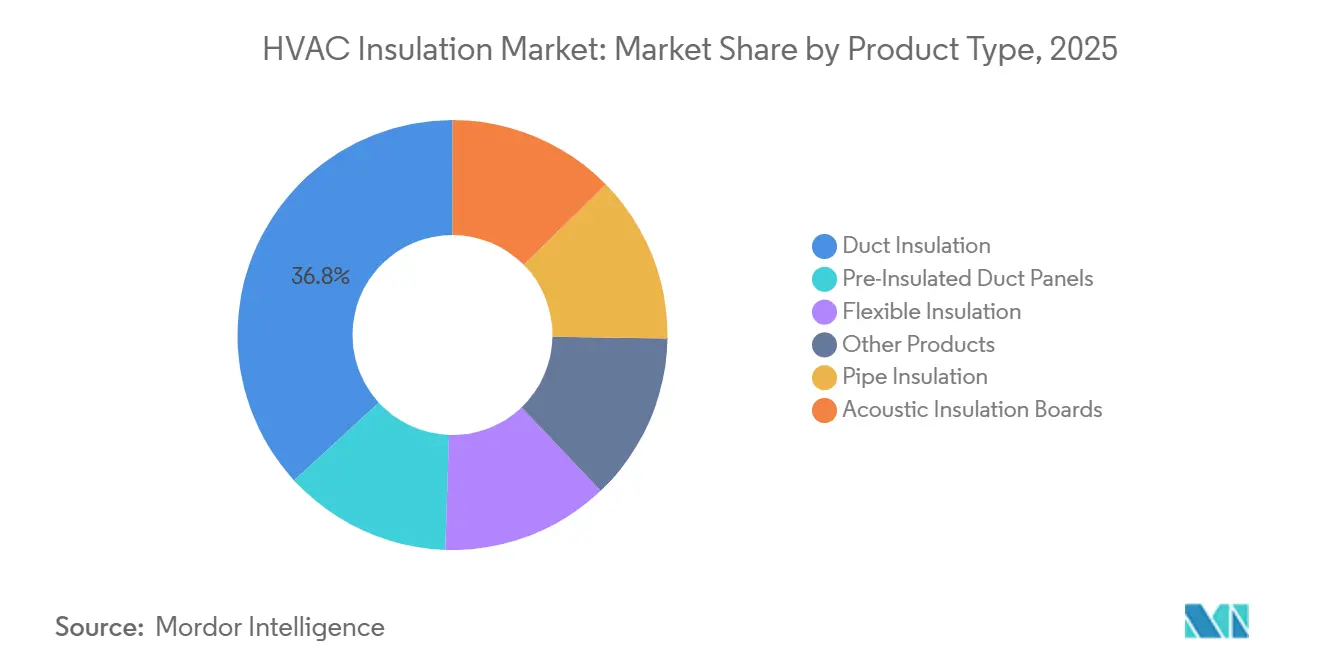
- By product type, Duct Insulation held 36.82% of the HVAC insulation market share in 2025, while Pre-Insulated Duct Panels are forecast to grow at a 6.34% CAGR through 2031.
- By material type, Glass Wool held 31.78% of the HVAC insulation market share in 2025, while Polyisocyanurate (PIR) Foam is forecast to grow at a 6.46% CAGR through 2031.
- By application, Duct Insulation accounted for 42.54% of the HVAC insulation market size in 2025, while Air Handling Unit (AHU) Insulation is forecast to grow at a 6.08% CAGR through 2031.
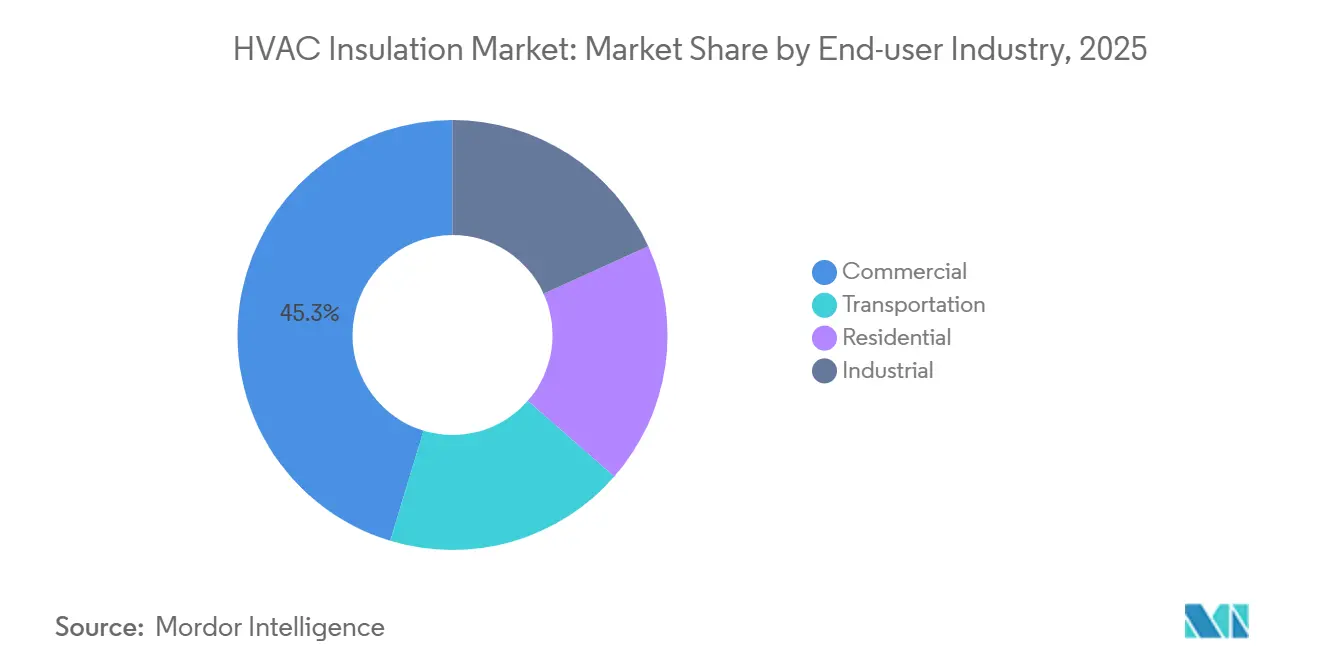
- By end-user industry, Commercial held 45.33% of the HVAC insulation market size in 2025 and is forecast to grow at a 5.84% CAGR through 2031.
- By geography, Asia-Pacific held 39.61% revenue share in 2025 and is forecast to grow at a 6.13% CAGR through 2031.
Note: Market size and forecast figures in this report are generated using Mordor Intelligence’s proprietary estimation framework, updated with the latest available data and insights as of January 2026.
Market Trends and Insights
Drivers Impact Analysis of HVAC Insulation Market*
| Drivers | (~) % Impact on CAGR Forecast | Geographic Relevance | Impact Timeline |
|---|---|---|---|
| Stricter Building Energy Efficiency Regulations | +1.2% | North America and the EU, with spillover to APAC | Medium term (2-4 years) |
| HVAC Retrofit and Renovation in Aging Buildings | +0.9% | Global, concentrated in North America and the EU | Long term (≥ 4 years) |
| Moisture-Resistant Insulation Demand in Humid Climates | +0.7% | APAC core, with spillover to MEA | Short term (≤ 2 years) |
| Electrification of Heating, Ventilation, and Air Conditioning Systems | +0.8% | North America, Europe, and early gains in APAC | Medium term (2-4 years) |
| Preference for Non-Combustible and Fire-Resistant Materials | +0.6% | Global, strongest in Europe | Short term (≤ 2 years) |
| Source: Mordor Intelligence | |||
Increasing Adoption of Stringent Building Energy Efficiency Regulations
Building codes are shifting from guidance to enforceable energy performance requirements, supporting demand in the HVAC insulation market. The recast Energy Performance of Buildings Directive requires European Union member states to renovate the 16% worst-performing non-residential buildings by 2030 and 26% by 2033[1]European Commission, “Energy Performance of Buildings Directive,” European Commission, energy.ec.europa.eu. Its supporting Delegated Regulation 2025/1511 applies from January 1, 2026, and requires member states to calculate cost-optimal performance levels for technical building systems, including heating, ventilation, and air conditioning. Article 13 also requires indoor environmental quality monitoring in non-residential buildings from May 29, 2026, raising expectations for thermal management across HVAC assemblies. California's 2025 Building Energy Efficiency Standards apply to new permit applications from January 1, 2026, and expand heat pump and ventilation requirements in new residential construction. Well-funded inspection programs are more likely to convert these rules into higher insulation specifications, while areas with weaker enforcement may adopt them more slowly.
Growing Demand for HVAC Retrofit and Renovation Projects in Aging Buildings
Existing buildings are expected to remain the primary base for renovation through 2050, creating a sustained source of HVAC insulation demand in mature markets. A 2025 peer-reviewed study identified thermal insulation and HVAC system performance as primary components of climate-sensitive renovation across building and climate types. The European Union's Renovation Passport framework supports phased deep renovation, allowing HVAC and building services upgrades to be addressed before major structural work. In North America, commercial renovation projects increasingly combine duct insulation work with broader mechanical system replacements. Retrofit projects often require better acoustic and moisture performance than basic thermal compliance. This shifts specifications toward elastomeric foam and polyisocyanurate (PIR) panel systems, where owners weigh expected operating performance and remediation exposure alongside initial material cost.
Rising Demand for High-Performance Moisture-Resistant Insulation in Humid Climates
Closed-cell elastomeric foam and polyisocyanurate (PIR) panel systems are gaining traction in humid tropical and subtropical settings, where moisture can degrade the performance of fibrous materials. Armacell published environmental product declarations for AP/ArmaFlex pipe and sheet insulation in the North American market in 2025. These declarations provide third-party environmental data that can support product selection in LEED and BREEAM projects. Moisture entering an inadequately specified insulation system can reduce thermal performance and create conditions that affect indoor air quality in healthcare and commercial buildings. This has made life cycle cost more relevant in material selection, even where glass wool retains an initial cost advantage. Southeast Asian and Gulf projects reflect this trend, as sustained humidity places greater demands on vapor control and moisture resistance.
Increasing Electrification of Heating, Ventilation, and Air Conditioning Systems
Heat pump adoption is changing insulation requirements for refrigerant pipework and air handling equipment across the HVAC insulation market. California's 2025 standards expand the role of heat pumps in new residential construction, increasing the importance of refrigerant distribution systems. ISO New England's 2025 forecast covers rising deployment of ducted and ductless heat pumps across residential and commercial buildings. Lower refrigerant saturation temperatures can extend the period during which condensation becomes a risk on pipe runs, supporting the use of closed-cell foam and vapor-resistant assemblies. Fraunhofer WKI reported Class A1 non-combustible foam components for heating system insulation in 2026, reflecting how fire protection requirements and electrification trends are influencing material development. The broader preference for non-combustible, fire-resistant products reinforces this shift, particularly where building codes and occupancy types require more stringent fire performance.
Restraints Impact Analysis of HVAC Insulation Market*
| Restraints | (~) % Impact on CAGR Forecast | Geographic Relevance | Impact Timeline |
|---|---|---|---|
| Raw Material Price and Manufacturing Cost Volatility | -0.4% | Global | Short term (≤ 2 years) |
| Dependence on Proper Installation and Workmanship | -0.3% | Global, most acute in emerging markets | Medium term (2-4 years) |
| Fire Safety, Smoke Emission, and Code Compliance Requirements | -0.3% | Europe and North America | Medium term (2-4 years) |
| Source: Mordor Intelligence | |||
Volatility in Raw Material Prices and Manufacturing Costs
HVAC insulation producers rely on silica and soda ash for glass wool, basalt and slag for stone wool, chemical inputs for polyisocyanurate (PIR) and polyurethane (PUR) foam, and natural or synthetic rubber for elastomeric products. This broad input base exposes manufacturers to simultaneous supply disruptions across multiple commodity chains. Owens Corning reported that geopolitical disruption added USD 60 million to input costs in the second quarter of 2026, driven by higher energy-linked feedstock costs. Methylene diphenyl diisocyanate (MDI), a key PIR input, remains exposed to a concentrated global supply, which is a concern given its growing specification demand. Producers with integrated glass fiber or mineral wool operations may have steadier input costs than foam-focused suppliers. Volatile costs make pricing and budgeting difficult for large commercial HVAC projects with long procurement cycles.
Performance Dependence on Proper Installation and Workmanship
Field-installed insulation depends on joint sealing, vapor barrier continuity, and support spacing to deliver expected thermal, acoustic, and moisture performance. This creates a restraint for the HVAC insulation market because work quality varies across commercial construction teams. Poor sealing in duct wrap and pipe insulation increases heat gain in humid conditions and creates condensation bridges on metal ductwork. Pre-insulated duct panels shift some work into factory-controlled production, but they require specialized fabrication and joint-assembly skills. Building owners may hesitate to pay for higher-grade materials when poor installation reduces much of the expected performance benefit. Certified installer programs and closer engagement with mechanical contractor associations can help suppliers reduce this risk and support confidence in premium specifications.
*Our forecasts treat driver/restraint impacts as directional, not additive. The impact forecasts reflect baseline growth, mix effects, and variable interactions.
HVAC Insulation Market Segment Analysis
By Product Type:
Duct Insulation Leads, Pre-Insulated Panels AccelerateDuct insulation held a 36.82% share in 2025, while pre-insulated duct panels are forecast to expand at a 6.34% CAGR through 2031. Duct insulation remains the foundation for commercial, industrial, and residential air distribution systems, with glass wool duct boards and elastomeric duct wrap continuing to serve both new construction and retrofit applications. Pipe insulation is a key segment, as chilled water, refrigerant, and hot water networks extend across large buildings and industrial facilities, where long pipe runs increase energy and condensation losses when insulation is inadequate. The HVAC insulation market continues to rely on duct and pipe systems for the majority of its installed base. Pre-insulated duct panels are growing faster because contractors value single-fix installation and factory-defined thermal performance, particularly in high-ceiling commercial spaces.
Kingspan's KoolDuct system became the first rigid phenolic foam pre-insulated ductwork product with an Underwriters Laboratories (UL) 181 Class 1 Air Duct listing in the United States. That listing supports its use in commercial and institutional specifications where performance and safety evidence are required. Acoustic insulation boards are developing a focused role in premium offices and hospitality projects, where mechanical specifications increasingly address noise control alongside thermal performance. Flexible insulation remains useful in retrofits because it can accommodate irregular duct routes and existing pipework where rigid systems are difficult to install. Other products, including high-temperature blankets, specialty wraps, and mechanical-room insulation, serve data center and pharmaceutical systems with more specific requirements. Across these product groups, higher-performance systems are gaining share from basic materials where project owners prioritize reliable installed performance. This preference is strongest where the cost of later access, moisture repair, or disruption to building operations exceeds the savings from a basic material. Product suppliers can therefore compete on documented system performance, installation guidance, and the ability to meet the requirements of complex commercial projects. The HVAC insulation market is also benefiting from solutions that reduce fieldwork without sacrificing the flexibility needed for retrofit installations.



By Material Type:
Glass Wool Leads by Share, Polyisocyanurate (PIR) Foam Sets the Thermal Performance BarGlass wool held a 31.78% share in 2025, while PIR foam is forecast to grow at a 6.46% CAGR through 2031. Glass wool maintains its position through non-combustibility, broad temperature performance, and cost efficiency in duct board, pipe insulation, and equipment wrap applications. PIR foam benefits from a closed-cell structure and compatibility with pre-insulated duct panel fabrication. Armacell's technical information specifies a service temperature range of -183°C to +148°C for its relevant insulation products, making its high-performance foam materials suitable for applications where moisture resistance and limited space are important. The HVAC insulation market size for PIR foam is supported by demand for greater thermal resistance per unit thickness. Glass wool remains central where budgets, fire performance, and established installation practices govern material selection.
Knauf Insulation's Performance+ Air Duct Board uses a bio-based binder without phenol, formaldehyde, or acrylics and holds GREENGUARD Gold certification for indoor air quality emissions. This demonstrates how glass wool suppliers are responding to more demanding indoor environment standards. Stone wool is gaining traction in commercial and industrial projects where non-combustibility is a mandatory requirement. ROCKWOOL reported a Euroclass A2 classification upgrade for Rockpanel in 2025, extending the material family's relevance in fire-sensitive building applications. Elastomeric foam is established in refrigerant pipe and air handling unit (AHU) applications in humid climates because it resists moisture and does not release fibers during installation. Polyurethane (PUR) foam supports standard pipe insulation, while phenolic foam is well-suited to thin pre-insulated duct panels in space-constrained retrofits. Polyethylene foam remains relevant in cost-sensitive residential and light commercial work where specification thresholds are lower. Material selection remains application-specific because heat exposure, moisture exposure, available installation depth, and fire requirements differ across duct, pipe, and equipment uses. Suppliers that offer multiple material types can address these trade-offs within a single project rather than requiring contractors to source multiple systems. This broad portfolio capability is important in the HVAC insulation market as building owners seek a balance between compliance, ease of installation, and long-term thermal performance.
By Application:
Duct Insulation Leads by Value, AHU Specifications Drive Premium GrowthDuct insulation accounted for a 42.54% share in 2025, while AHU insulation is forecast to grow at a 6.08% CAGR through 2031. Ductwork is present in systems ranging from residential split systems to complex variable-air-volume commercial networks. Under-insulated ductwork results in system energy loss in commercial buildings, which supports its leading application position. AHU insulation is advancing as heat pump-based equipment requires stronger condensation control and acoustic management. These applications often use multiple layers, including closed-cell foam for vapor control and mineral wool for sound attenuation, which increases the insulation value per unit compared with single-layer duct wrap. The HVAC insulation market is therefore seeing more demand tied to mechanical-system complexity rather than building area alone.
Variable-speed drive fans operate across a broader range of airside temperatures than constant-speed equipment, increasing the need to manage condensation risk in AHUs. Pipe insulation is the second-largest application because industrial HVAC and process cooling systems have long chilled water and refrigerant lines. Equipment insulation covers compressors, condensers, and expansion vessels in mechanical rooms. It is gaining attention as data centers and pharmaceutical facilities impose strict requirements for temperature stability and energy performance. Healthcare and premium office projects are also specifying both acoustic and thermal insulation, with indoor air quality and acoustic comfort forming part of building performance requirements. This combination raises specification complexity and materials cost per installed square meter across several applications. Mechanical engineers must also consider maintenance access, vapor barrier continuity, and how insulation interacts with equipment supports and joints. Those details make system design and installation quality as important as the material itself in premium applications. The HVAC insulation market gains value when contractors adopt assemblies that address thermal, acoustic, and moisture requirements within a single installation.
By End-user Industry:
Commercial Sector Commands Both Share and GrowthThe commercial segment held a 45.33% share in 2025 and is forecast to grow at a 5.84% CAGR through 2031. The segment includes offices, retail centers, healthcare facilities, hospitality sites, and data centers. This range reduces reliance on a single property category within the HVAC insulation market. Healthcare and data center projects are expanding as owners align mechanical systems with energy performance and occupant comfort requirements. Commercial capital budgets can support lifecycle costing rather than focusing solely on the lowest initial material cost. This supports upgrades from standard glass wool to PIR and elastomeric systems when operating performance justifies a higher purchase price. The segment, therefore, combines the largest demand base with the most consistent case for premium specifications.
Industrial demand is supported by pharmaceutical, food processing, and electronics facilities that require stable temperatures across ducts, pipes, and equipment systems. Residential demand benefits from energy code upgrades that require duct sealing and minimum insulation values in new buildings across North America and Europe. Residential applications generally carry lower average selling prices than commercial projects. The transportation segment includes rail, marine, climate control, and aerospace uses, and remains a smaller but growing end-user group. Rail electrification supports stronger thermal and acoustic requirements in rolling-stock HVAC systems. Armacell supplies IMO-certified ArmaFlex elastomeric products for marine newbuild and refit activity. This diversification broadens demand beyond conventional building construction and provides suppliers with more specialized application opportunities. Industrial and transportation uses can require specific fire, vibration, temperature, and moisture performance that standard building products may not provide. These requirements can support differentiated materials, although qualification cycles and specification procedures may be more demanding. The commercial segment remains the largest demand base, but specialized end users add resilience to the HVAC insulation market when conventional construction activity is uneven.
Geography Analysis
APAC HVAC Insulation Market
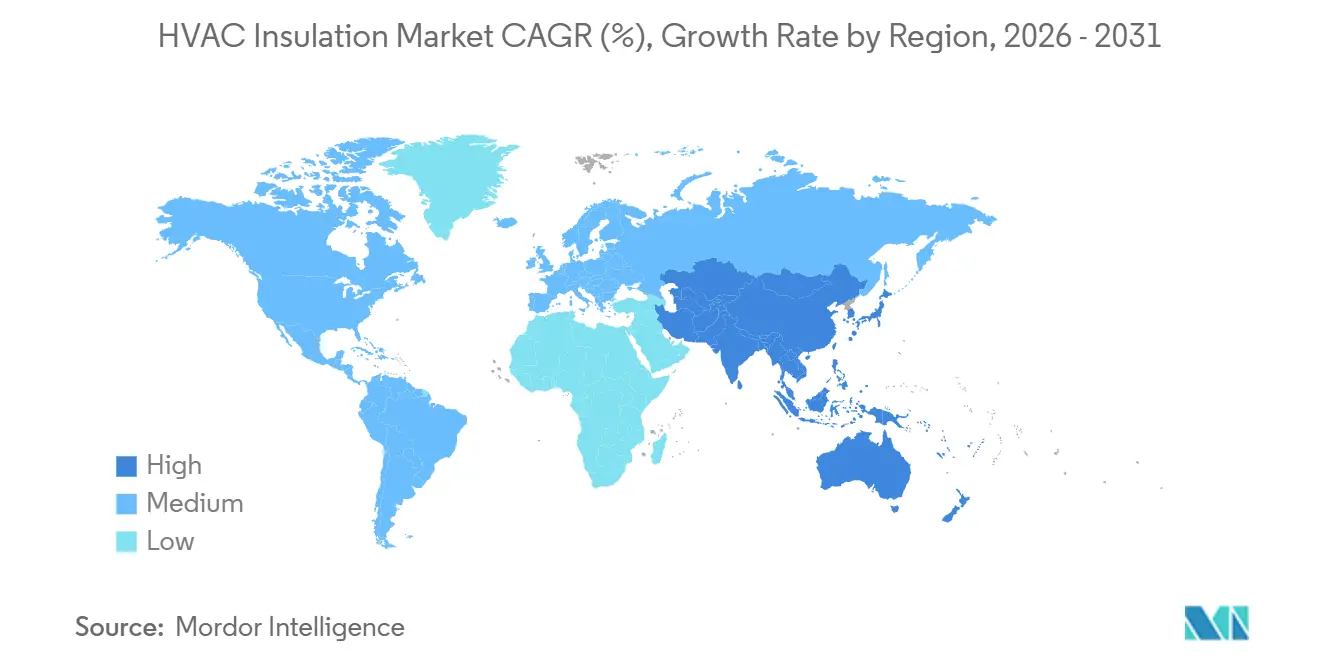
Asia-Pacific accounted for 39.61% of revenue in 2025 and is forecast to grow at a 6.13% CAGR through 2031. Regional demand in the HVAC insulation market is supported by large commercial projects in China, urban development in India and Southeast Asia, and stricter energy efficiency regulations. ROCKWOOL identified India, Malaysia, and Japan as its strongest Asia-Pacific growth markets in 2025. Its China insulation business declined at a double-digit rate during the same year, reflecting pressure in the Chinese commercial real estate market. India is raising thermal performance expectations through its Energy Conservation and Sustainable Building Code as commercial, healthcare, and information technology infrastructure expand. Kingspan is expanding its regional presence through investments in Thailand, India, and Singapore, including the acquisition of Hao Wei Singapore[2]Kingspan Group PLC, “Annual Report 2025, Insulated Building Envelopes,” Kingspan Group, annual-report.kingspan.com. South and Southeast Asia remain important areas for new manufacturing capacity and performance-oriented product specifications. Regional projects range from standard residential systems to complex commercial and data center installations, requiring suppliers to address a wide range of price and performance requirements. Greater local availability can shorten delivery times and allow manufacturers to support contractors during product selection and installation. The HVAC insulation market in this region therefore offers both broad volume potential and a growing demand for higher-value materials.
North America HVAC Insulation Market
North America is the second-largest regional market, driven by commercial renovation, data center construction, and upgrades to aging HVAC systems in the United States. ROCKWOOL reported strong double-digit U.S. revenue growth in 2025 and expects North American demand to exceed regional production capacity through at least 2028, which may require supplemental imports from Europe. Owens Corning's insulation segment generated USD 867 million in net sales in the first quarter of 2026. The company reported enterprise revenue of USD 2.6 billion to USD 2.7 billion in the second quarter of 2026 as it focuses investment on branded building products. Canada's slower housing activity is partly offset by commercial retrofits tied to net-zero goals, while Mexico presents an underdeveloped base in manufacturing and urban housing. Renovation activity, data center development, and tighter performance standards provide demand sources that do not depend solely on new residential construction. Suppliers with North American production and technical support are positioned where projects require documented compliance and dependable supply, reinforcing the region's role as a major center of demand for HVAC insulation.
Europe and South America HVAC Insulation Market
ROCKWOOL recorded revenue declines in Germany and France in 2025, while Romania, Poland, and Hungary grew, pointing to a near-term shift toward lower-cost Eastern European economies where industrial activity and building upgrades remain active. The regulatory environment continues to support longer-term demand in the HVAC insulation market across Europe. South America is the smallest listed geographic segment, with potential in Brazil's commercial construction and industrial refrigeration base. Argentina and Brazil also face commodity price and currency risks that complicate supply planning for global manufacturers. These regional differences make localized production, distribution, and product selection important for suppliers seeking to expand. European projects may place greater weight on renovation, fire performance, and regulatory compliance, while South American projects must also manage input cost and currency exposure. A uniform product and supply approach is unlikely to address these distinct conditions. The HVAC insulation market consequently favors suppliers that can adapt their material mix, sales support, and capacity planning to local building conditions.

Competitive Landscape
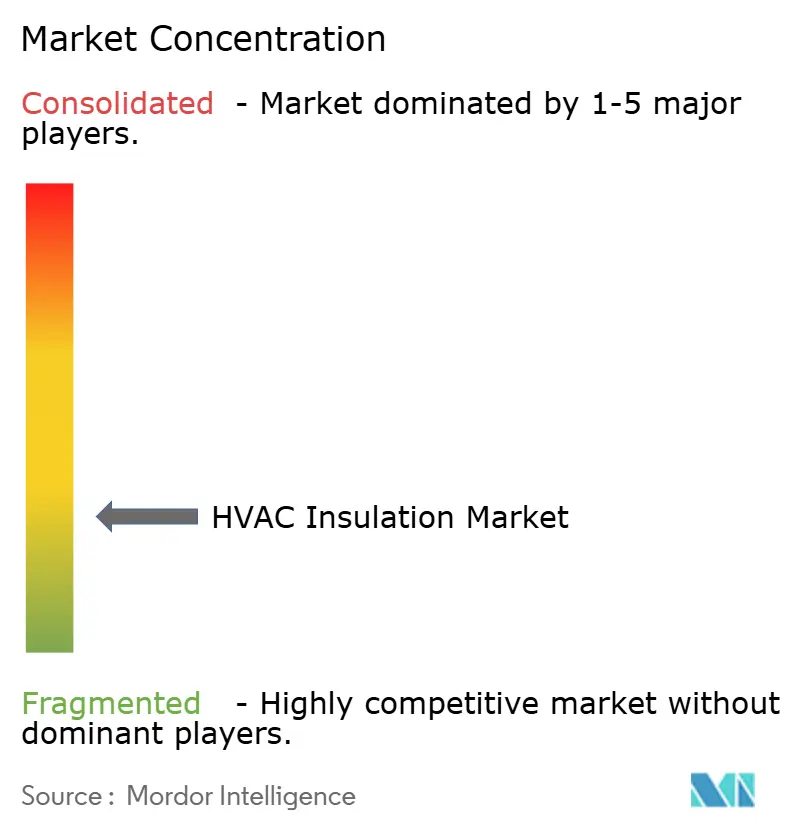
The HVAC insulation market is fragmented. Large suppliers benefit from manufacturing scale, broad product lines, and established relationships with architects and mechanical engineers. Regional specialists compete through local logistics, customer familiarity, and focused product portfolios. Kingspan reported EUR 9.2 billion (USD 10.51 billion) in group revenue in 2025, an increase of 7%, and invested EUR 547.1 million (USD 625.06 million) in Insulated Building Envelopes capacity across India, Thailand, Australia, Germany, and the United States. The company had 278 manufacturing sites globally at the end of 2025, and QuadCore represented 27% of its insulated panel revenue. Its acquisition and investment strategy builds local reach while using product differentiation to defend premium specifications. This approach gives Kingspan an advantage in projects that require thermal performance, compliance evidence, and system-level design support.
ROCKWOOL closed facilities in Yangzhou, China, in December 2025, and in Trondheim, Norway, in July 2025, while directing EUR 473 million (USD 540.40 million) of 2025 capital expenditure toward electrification-led sustainability investments. The company plans EUR 650 million (USD 742.63 million) in 2026 expansion activity across India, Romania, and the United States, excluding acquisitions. It also announced the acquisition of Ravago's stone-wool manufacturing facility in northeastern Hungary in May 2026. This combination of capacity reductions and targeted investment directs resources toward markets with stronger supply-demand conditions. Owens Corning completed the divestiture of its glass reinforcements business in April 2026, concentrating its portfolio on branded building products. This decision reflects a focus on insulation products where specification influence and brand recognition may provide more durable value than commodity inputs.
Pre-insulated duct panels remain less established in Asia-Pacific than in North America and Europe, presenting an opening for suppliers with fabrication skills and local support. This represents a meaningful opportunity for both global entrants and regional manufacturers in the HVAC insulation market. Low-global-warming-potential blowing agents for polyisocyanurate (PIR) and polyurethane (PUR) foam are becoming a key area of product development as manufacturers respond to hydrofluorocarbon (HFC) restrictions. Fraunhofer WKI's 2026 Class A1 foam development for heating-system components illustrates material innovation in fire protection. Armacell's 2025 environmental product declarations for elastomeric foam illustrate the growing role of verified lifecycle data in green building specifications. Environmental certification, fire performance, and installation support are becoming more important competitive factors alongside product price. Market concentration remains moderate, as leading groups have meaningful scale, but available information does not establish a combined market share threshold for the largest suppliers. This leaves room for regional companies that understand local codes, maintain close relationships with contractors, or serve specialized applications. Large manufacturers retain an advantage when customers require integrated systems, product testing, and consistent availability across multiple countries. Competition in the HVAC insulation market is therefore shaped by both global scale and local execution.
HVAC Insulation Industry Leaders
Owens Corning
Saint-Gobain
ROCKWOOL A/S
Johns Manville
Knauf Insulation
- *Disclaimer: Major Players sorted in no particular order
HVAC Insulation Market Companies Covered in this Report
- AFICO
- American Flexible Products
- Armacell
- Climatech
- Glassrock Insulation Co. S.A.E.
- Johns Manville
- Kingspan Holdings (IRL) Limited
- Knauf Insulation
- L'ISOLANTE K-FLEX S.p.A.
- Owens Corning
- Panasonic Corporation
- ROCKWOOL A/S
- Saint-Gobain
- Thermafiber
- Thermaflex
- Ursa Insulation S.A.

Recent Industry Developments in HVAC Insulation Market
- May 2026: ROCKWOOL announced the acquisition of Ravago's stone-wool manufacturing facility in northeastern Hungary, with the transaction expected to close in Q4 2026. The acquisition strengthens ROCKWOOL's production presence in Eastern Europe, a subregion that recorded positive single-digit revenue growth in 2025, and expands capacity ahead of an anticipated recovery in the European construction market.
- May 2026: Fraunhofer WKI, in collaboration with industrial partners, announced the development of insulation enclosures made from Class A1 non-combustible foam for heating system components, including pump groups, valves, and fittings. The development supports rapid installation and maintenance in buildings with elevated fire-protection requirements and addresses a specification gap in high-rise HVAC insulation.


Global HVAC Insulation Market Report Scope
HVAC (Heating, Ventilation, and Air Conditioning) insulation involves wrapping air ducts, refrigerant pipes, and air-handling units in specialized materials. Its primary purpose is to reduce heat transfer, keeping warm air warm and cold air cold while also preventing condensation and dampening mechanical noise.
The HVAC insulation market is segmented by product type, material type, application, end-user industry, and geography. By product type, the market is segmented into duct insulation, pipe insulation, acoustic insulation boards, pre-insulated duct panels, flexible insulation, and other products. By material type, the market is segmented into glass wool, stone wool, elastomeric foam, polyurethane (PUR) foam, polyisocyanurate (PIR) foam, phenolic foam, polyethylene foam, and other materials. By application, the market is segmented into duct insulation, pipe insulation, equipment insulation, and air handling unit (AHU) insulation. By end-user industry, the market is segmented into residential, commercial, industrial, and transportation. The report also covers market size and forecasts for HVAC insulation across 16 countries in major regions. The market sizes and forecasts are provided in terms of value (USD).
| Duct Insulation |
| Pipe Insulation |
| Acoustic Insulation Boards |
| Pre-Insulated Duct Panels |
| Flexible Insulation |
| Other Products |
| Glass Wool |
| Stone Wool |
| Elastomeric Foam |
| Polyurethane (PUR) Foam |
| Polyisocyanurate (PIR) Foam |
| Phenolic Foam |
| Polyethylene Foam |
| Other Materials |
| Duct Insulation |
| Pipe Insulation |
| Equipment Insulation |
| Air Handling Unit (AHU) Insulation |
| Residential |
| Commercial |
| Industrial |
| Transportation |
| Asia-Pacific | China |
| India | |
| Japan | |
| South Korea | |
| Rest of Asia-Pacific | |
| North America | United States |
| Canada | |
| Mexico | |
| Europe | Germany |
| United Kingdom | |
| France | |
| Italy | |
| Russia | |
| Rest of Europe | |
| South America | Brazil |
| Argentina | |
| Rest of South America | |
| Middle-East and Africa | Saudi Arabia |
| South Africa | |
| Rest of Middle-East and Africa |
| By Product Type | Duct Insulation | |
| Pipe Insulation | ||
| Acoustic Insulation Boards | ||
| Pre-Insulated Duct Panels | ||
| Flexible Insulation | ||
| Other Products | ||
| By Material Type | Glass Wool | |
| Stone Wool | ||
| Elastomeric Foam | ||
| Polyurethane (PUR) Foam | ||
| Polyisocyanurate (PIR) Foam | ||
| Phenolic Foam | ||
| Polyethylene Foam | ||
| Other Materials | ||
| By Application | Duct Insulation | |
| Pipe Insulation | ||
| Equipment Insulation | ||
| Air Handling Unit (AHU) Insulation | ||
| By End-user Industry | Residential | |
| Commercial | ||
| Industrial | ||
| Transportation | ||
| By Geography | Asia-Pacific | China |
| India | ||
| Japan | ||
| South Korea | ||
| Rest of Asia-Pacific | ||
| North America | United States | |
| Canada | ||
| Mexico | ||
| Europe | Germany | |
| United Kingdom | ||
| France | ||
| Italy | ||
| Russia | ||
| Rest of Europe | ||
| South America | Brazil | |
| Argentina | ||
| Rest of South America | ||
| Middle-East and Africa | Saudi Arabia | |
| South Africa | ||
| Rest of Middle-East and Africa | ||


Key Questions Answered in the Report
What is current market size of HVAC Insulation Market?
The HVAC Insulation Market size is projected to expand from USD 6.51 billion in 2025 and USD 6.82 billion in 2026 to USD 8.82 billion by 2031, and is expected to register a CAGR of 5.28% between 2026 and 2031.
Which product category leads HVAC insulation demand?
Duct Insulation led product demand with a 36.82% share in 2025, supported by its use across commercial, industrial, and residential air distribution systems. Pre-Insulated Duct Panels are the fastest-growing product group because they offer factory-defined performance and can reduce manual installation work.
Which insulation material is growing fastest for HVAC systems?
Polyisocyanurate (PIR) Foam is forecast to grow at a 6.46% CAGR through 2031, driven by its strong thermal performance, moisture resistance, and compatibility with pre-insulated panels.
Why are heat pumps affecting insulation specifications?
Heat pumps increase attention to refrigerant pipe insulation and condensation control, supporting closed-cell foam and vapor-resistant assemblies. Lower refrigerant temperatures can expand condensation risk, so thermal performance and vapor-barrier continuity become more important to the overall installation.
Page last updated on:





