
HVAC EPC Market Size and Share
Market Overview
| Study Period | 2021 - 2032 |
|---|---|
| Market Size (2027) | USD 11.53 Billion |
| Market Size (2032) | USD 15.61 Billion |
| Growth Rate (2027 - 2032) | 6.24 % |
| Fastest Growing Market | Asia-Pacific |
| Largest Market | Asia-Pacific |
| Market Concentration | Medium |
Major Players *Disclaimer: Major Players sorted in no particular order Image © Mordor Intelligence. Reuse requires attribution under CC BY 4.0. | |
HVAC EPC Market Analysis by Mordor Intelligence
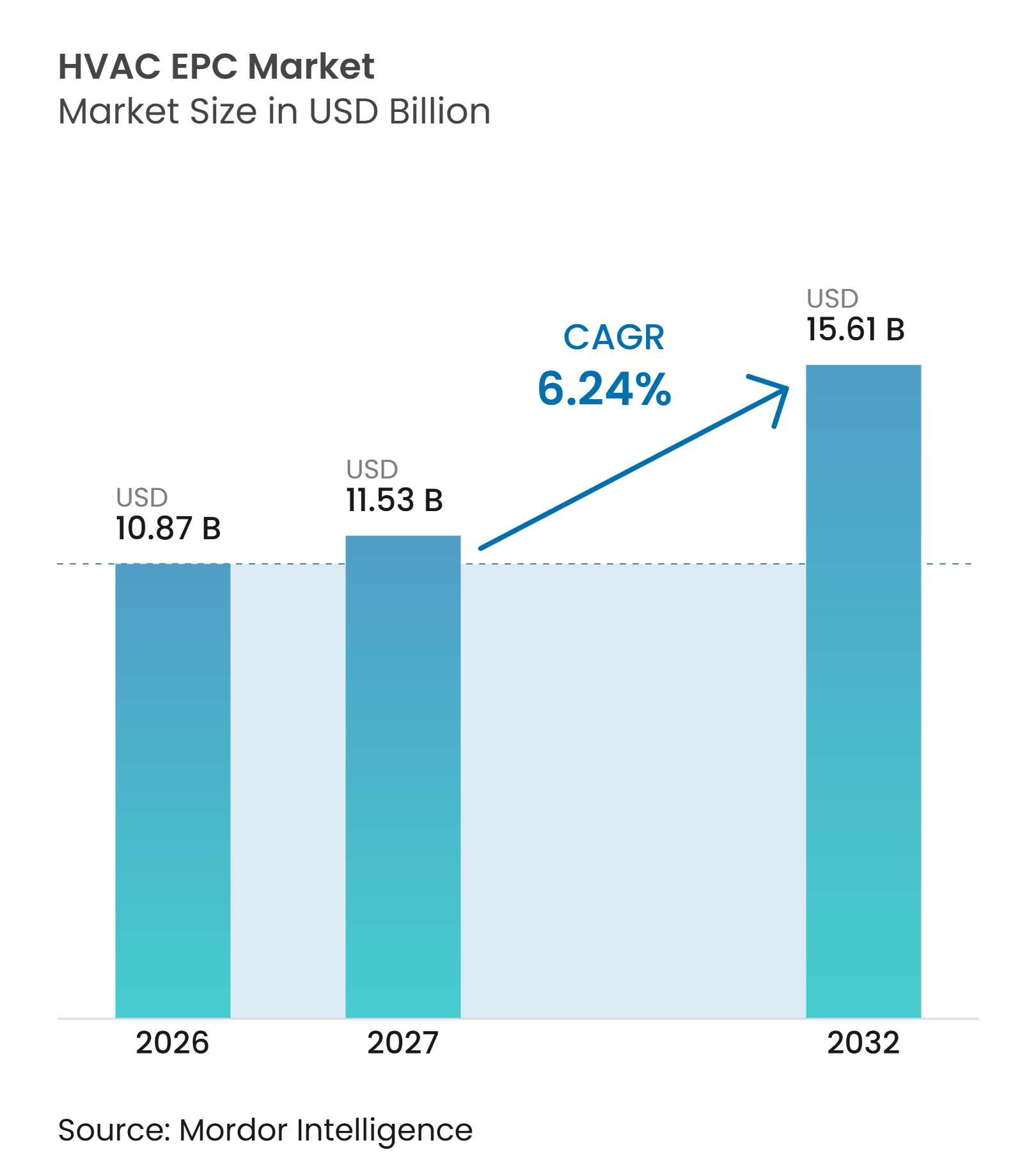
The HVAC EPC market size was valued at USD 10.87 billion in 2026 and is projected to grow from USD 11.53 billion in 2027 to USD 15.61 billion by 2032, at a CAGR of 6.24% during the forecast period (2027-2032). The HVAC EPC market is being reshaped by construction for data centers, advanced manufacturing sites, healthcare facilities, and other facilities where thermal performance is central to operations. Higher rack densities are changing project scopes because contractors must integrate central plants, liquid-cooling loops, controls, and commissioning into a single delivery program. Contractors that combine engineering capacity with fabrication and commissioning resources are better placed to meet shorter delivery schedules. The HVAC EPC market also has an expanding opportunity in retrofit programs as older commercial systems require replacement, lower-GWP refrigerants, and updated controls.
Key Report Takeaways
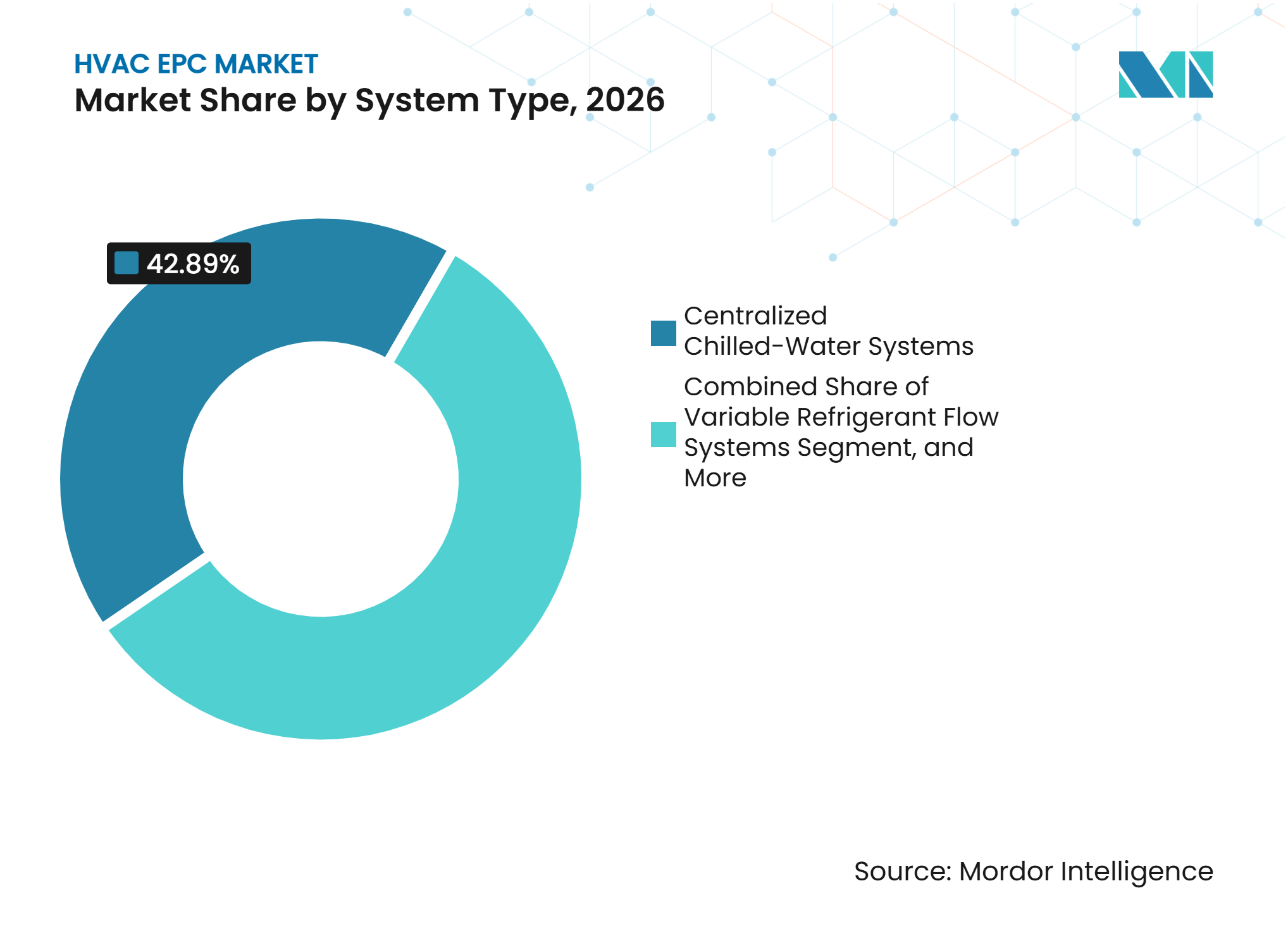
- By system type, centralized chilled-water systems held 42.89% of the HVAC EPC market share in 2026, while decentralized and packaged systems are projected to expand at a 7.34% CAGR through 2032.
- By service type, construction and installation held 46.19% of the HVAC EPC market revenue in 2026, while operations and maintenance is projected to expand at a 7.61% CAGR through 2032.
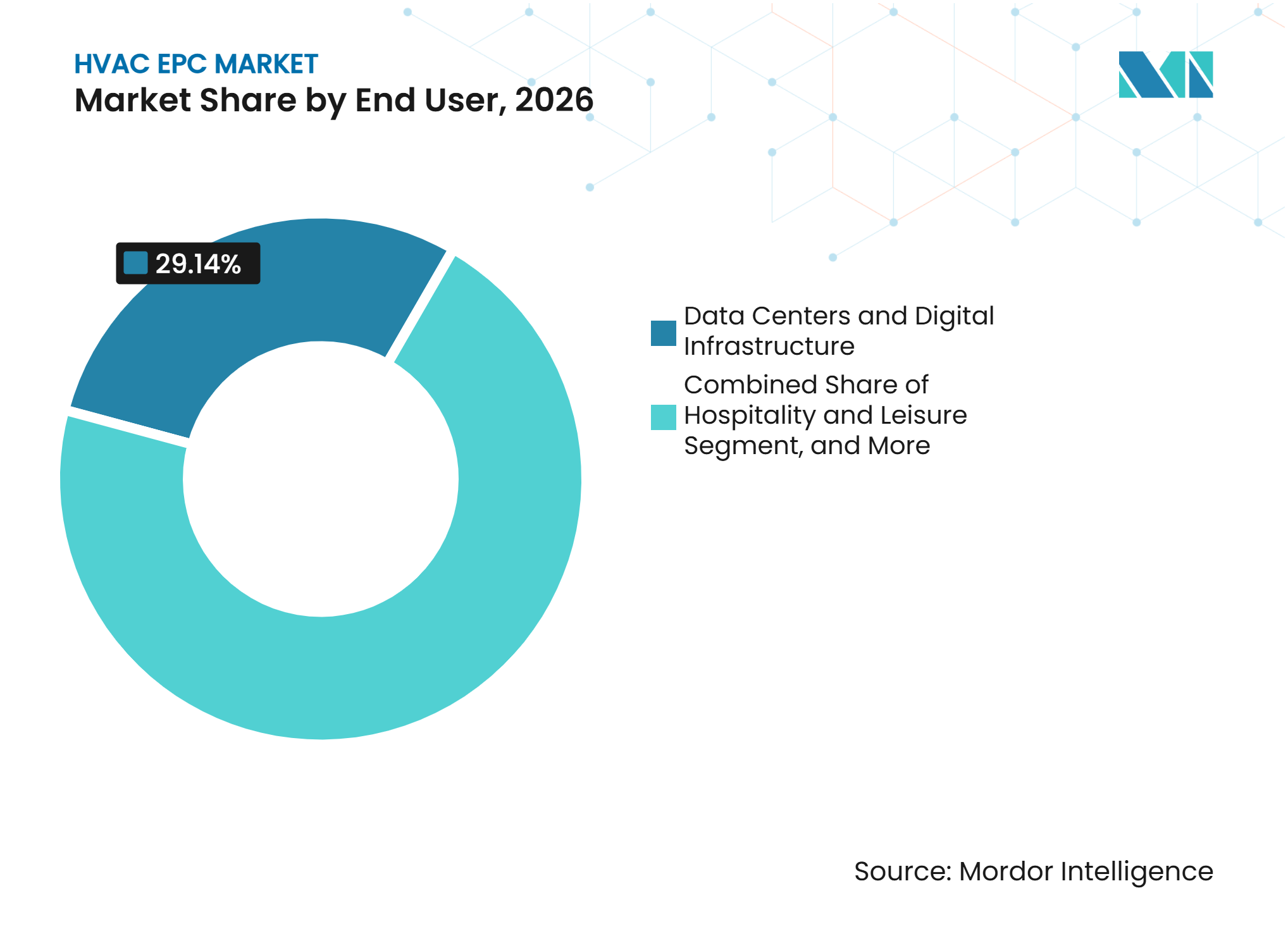
- By end user, data centers and digital infrastructure held 29.14% of the HVAC EPC market revenue in 2026, while hospitality and leisure is projected to expand at a 6.72% CAGR through 2032.
- By geography, Asia-Pacific held 35.76% of the HVAC EPC market revenue in 2026 and is projected to expand at a 7.05% CAGR through 2032.
Note: Market numbers in this report are based on Mordor Intelligence's proprietary estimation framework, which combines nine months of actuals with Q4 projections for base year 2026.
Market Trends and Insights
Drivers Impact Analysis of HVAC EPC Market*
| Driver | (~) % Impact on CAGR Forecast | Geographic Relevance | Impact Timeline |
|---|---|---|---|
| Hyperscale Data Center and High-Density Computing Build-Outs | +2.1% | Global, most acute in North America and Asia-Pacific core markets | Short term (≤ 2 years) |
| Building Energy-Efficiency and Refrigerant-Phase-Down Mandates | +1.4% | Global, with strong regulatory relevance in Europe and North America | Medium term (2-4 years) |
| Industrial and Mission-Critical Facility Expansion | +1.0% | Global, led by North America, Asia-Pacific industrial hubs, and the Middle East | Medium term (2-4 years) |
| Aging HVAC Asset Replacement and Retrofit Backlog | +0.9% | North America and Europe, with spillover into mature Asia-Pacific markets | Medium term (2-4 years) |
| Liquid Cooling and Thermal-Performance Requirements | +0.7% | Global, most pronounced in North America and Asia-Pacific data center corridors | Short term (≤ 2 years) |
| BIM-Enabled Prefabrication and Modular MEP Delivery | +0.5% | Global, with early adoption in North America, Australia, and Northern Europe | Long term (≥ 4 years) |
| Source: Mordor Intelligence | |||
Hyperscale Data Center and High-Density Computing Build-Outs
The HVAC EPC market is benefiting as AI workloads increase cooling requirements in new data centers. GPU refresh cycles can occur within 18-24 months, requiring flexible thermal designs before a facility enters service. EMCOR reported USD 8.74 billion in data center-related remaining performance obligations in the third quarter of 2026, more than double the prior-year level. This demand requires larger cooling capacity, additional controls integration, and more detailed performance testing. These conditions are increasing demand for contractors that can engineer, procure, and commission integrated cooling systems.
Building Energy-Efficiency and Refrigerant-Phase-Down Mandates
The HVAC EPC market is supported by regulations requiring lower-GWP equipment and more comprehensive documentation. The European Union F-gas Regulation introduced restrictions effective from January 2025 on specified split systems and servicing of high-GWP refrigerants. The United States AIM Act also required newly manufactured and imported VRF and commercial HVAC equipment to use low-GWP A2L refrigerants as of January 2026. These changes require contractors to update equipment specifications, safety procedures, and commissioning processes. Older building automation systems may also require upgrades to safely monitor A2L refrigerants. The resulting work covers more than just equipment replacement, as it can include controls integration and installation certification.
Industrial and Mission-Critical Facility Expansion
Semiconductor, battery, pharmaceutical, and healthcare projects create specialized work for the HVAC EPC market. Cleanroom systems can require temperature control within ±0.5°C and relative humidity control within ±2%. Air2O expanded its Phoenix manufacturing footprint to 186,000 square feet in 2025 for semiconductor and lithium-ion battery customers. Gradian opened a USD 60 million, 500,000-square-foot facility in Minnesota during October 2026 for data center, industrial, and commercial applications. Southland Industries also secured a long-term Sutter Health program across 3 facilities totaling 1.85 million square feet. Multi-site programs favor contractors with engineering teams and the ability to deliver consistent specifications across locations.
Aging HVAC Asset Replacement and Retrofit Backlog
The HVAC EPC market is gaining replacement work as equipment installed during the 1990s and early 2000s reaches the end of its normal service life. Building owners face operational and compliance risks when older systems cannot meet current energy or refrigerant requirements. Retrofitting a data center from air cooling to liquid cooling can cost 2-3 times as much per capacity unit as a greenfield design, according to Trane Technologies. Trane reported that commercial HVAC services accounted for about one-third of the company's revenue, underscoring the scale of recurring service demand. Replacement projects can provide contractors with follow-on maintenance opportunities after installation.
Restraints Impact Analysis of HVAC EPC Market*
| Restraint | (~) % Impact on CAGR Forecast | Geographic Relevance | Impact Timeline |
|---|---|---|---|
| Skilled HVAC Labor and Commissioning-Capacity Shortages | -0.8% | Global, most acute in North America and Western Europe | Short term (≤ 2 years) |
| Copper, Aluminum, Refrigerant, and Equipment Cost Volatility | -0.7% | Global, amplified in regions with high import dependence | Short term (≤ 2 years) |
| Fixed-Price EPC Exposure to Design and Procurement Rework | -0.4% | Global, most material in North America and Asia-Pacific projects | Medium term (2-4 years) |
| Legacy Controls Interoperability and Cybersecurity Risk | -0.3% | Global, with elevated risk in Europe and North America enterprise campuses | Long term (≥ 4 years) |
| Source: Mordor Intelligence | |||
Skilled HVAC Labor and Commissioning-Capacity Shortages
The HVAC EPC market faces limits from shortages of technicians, installers, and commissioning specialists. The U.S. Bureau of Labor Statistics expects 42,500 annual openings for HVAC mechanics and installers through 2033, with employment projected to expand 8% from 2024 to 2034. More than 50% of the current field workforce is above age 45. The U.S. Department of Energy reported that technicians with advanced heat pump and liquid cooling skills are retiring faster than new workers can be recruited. Labor scarcity raises labor costs and can delay commissioning, especially for complex data center projects.
Copper, Aluminum, Refrigerant, and Equipment Cost Volatility
Input cost changes place pressure on fixed-price contracts in the HVAC EPC market. U.S. producer price data showed aluminum mill shapes increased 34.1% year over year and copper and brass mill shapes increased 21.3% year over year in March 2026. Kirby increased prices for annealed copper tubes by 7% in February 2025, according to the Australian industry association. The draft also reported a USD 13,000-per-tonne copper price level and J.P. Morgan price forecasts, which are not retained because they are not from permitted source categories. The higher cost of R-454B compared with R-410A adds further pressure on large commercial installations. Contractors are increasingly seeking terms that address price changes, procurement delays, and design revisions before project awards.
*Our forecasts treat driver/restraint impacts as directional, not additive. The impact forecasts reflect baseline growth, mix effects, and variable interactions.
HVAC EPC Market Segment Analysis
By System Type:
Centralized Plants Retain Scale While Packaged Systems Gain GroundCentralized chilled-water systems accounted for 42.89% of HVAC EPC market share in 2026. Hyperscale data centers, large healthcare campuses, and high-rise commercial properties use these plants for high-capacity cooling. A centrally managed plant can support large cooling loads through shared mechanical infrastructure. This model can also support multiyear O&M agreements because one controls platform monitors the chilled-water loop. These features keep centralized systems important in large, complex facilities. The HVAC EPC market size for centralized projects benefits from the engineering scope needed for large plantrooms, piping networks, and integrated controls.
Decentralized and packaged systems are projected to expand at a 7.34% CAGR through 2032. Edge data centers, mid-rise commercial properties, and retrofit sites often lack space for a central plantroom. Factory-built modules can reduce site installation time and lower schedule uncertainty. Daikin Applied opened an expanded 191,000-square-foot modular solutions facility in Phoenix in October 2026, raising its capacity by 150%. The facility serves data center, healthcare, and industrial customers that need factory-tested systems. VRF systems are also changing mid-market designs as contractors adapt equipment selections to R-32 and A2L compliance requirements. Ventilation, indoor air quality, and other system types continue to play a role in cleanrooms, food processing sites, and educational facilities that require specialized airflow and energy recovery systems.



By Service Type:
Construction Leads Current Volume and O&M Adds Recurring WorkConstruction and installation represented 46.19% of service revenue in 2026. Greenfield data centers, healthcare projects, and industrial facilities require full mechanical installation scopes. Comfort Systems USA reported active project contract value of USD 24.17 billion across 8,427 projects at the end of the first quarter of 2026. Construction work includes equipment setting, piping, ductwork, controls, and coordination with other building trades. Its large revenue base reflects the number of facilities under development. The scale also makes delivery capacity an important selection factor for customers.
Operations and maintenance is projected to expand at a 7.61% CAGR through 2032. Asset owners are using multiyear performance contracts that link contractors to uptime and energy outcomes. Air-cooled data centers can either undergo a full retrofit or use staged component replacement while remaining under service agreements. This choice gives contractors continuing access to a facility after the initial installation. Engineering and design work is becoming more detailed as liquid-cooled facilities require specialized commissioning plans. Testing, balancing, and commissioning may require 200-400 load banks for an AI facility, compared with 40 for a conventional facility. Procurement and supply management are also shifting toward vendor-managed modules and factory-tested mechanical skids, which can improve material planning on fixed-price work.
By End User:
Digital Infrastructure Leads While Hospitality Replacement AcceleratesData centers and digital infrastructure held 29.14% of sector revenue in 2026. Hyperscale and colocation projects have created some of the highest-value mechanical contracts in the sector. EMCOR’s USD 8.74 billion data center RPO balance represented 47% of its total RPO balance in the third quarter of 2026.[1] The concentration of awards in this end-user group is changing contractors' investment priorities. Vertiv deployed direct-to-chip liquid cooling for 30 MW of AI workloads at CapitaLand India Trust’s CLDC Mumbai site in October 2026. These projects require secondary fluid networks, precise controls, and detailed performance testing.
Hospitality and leisure is projected to expand at a 6.72% CAGR through 2032. Many hotels operate mechanical systems installed in the late 1990s and early 2000s. Operators must replace systems without disrupting guest rooms and public areas. All Seasons Group replaced 40 condensers across 136 rooms at the Holiday Inn Express Royal Docks from August 2025 through February 2026. The project used a phased Daikin VRV R-32 installation and recorded a 68% GWP reduction with no guest nights lost. Healthcare, life sciences, industrial processing, and pharmaceutical manufacturing also require strict temperature, humidity, and documentation standards. Warehousing, logistics, education, and government properties support stable replacement demand across the HVAC EPC market.

Geography Analysis
Asia-Pacific
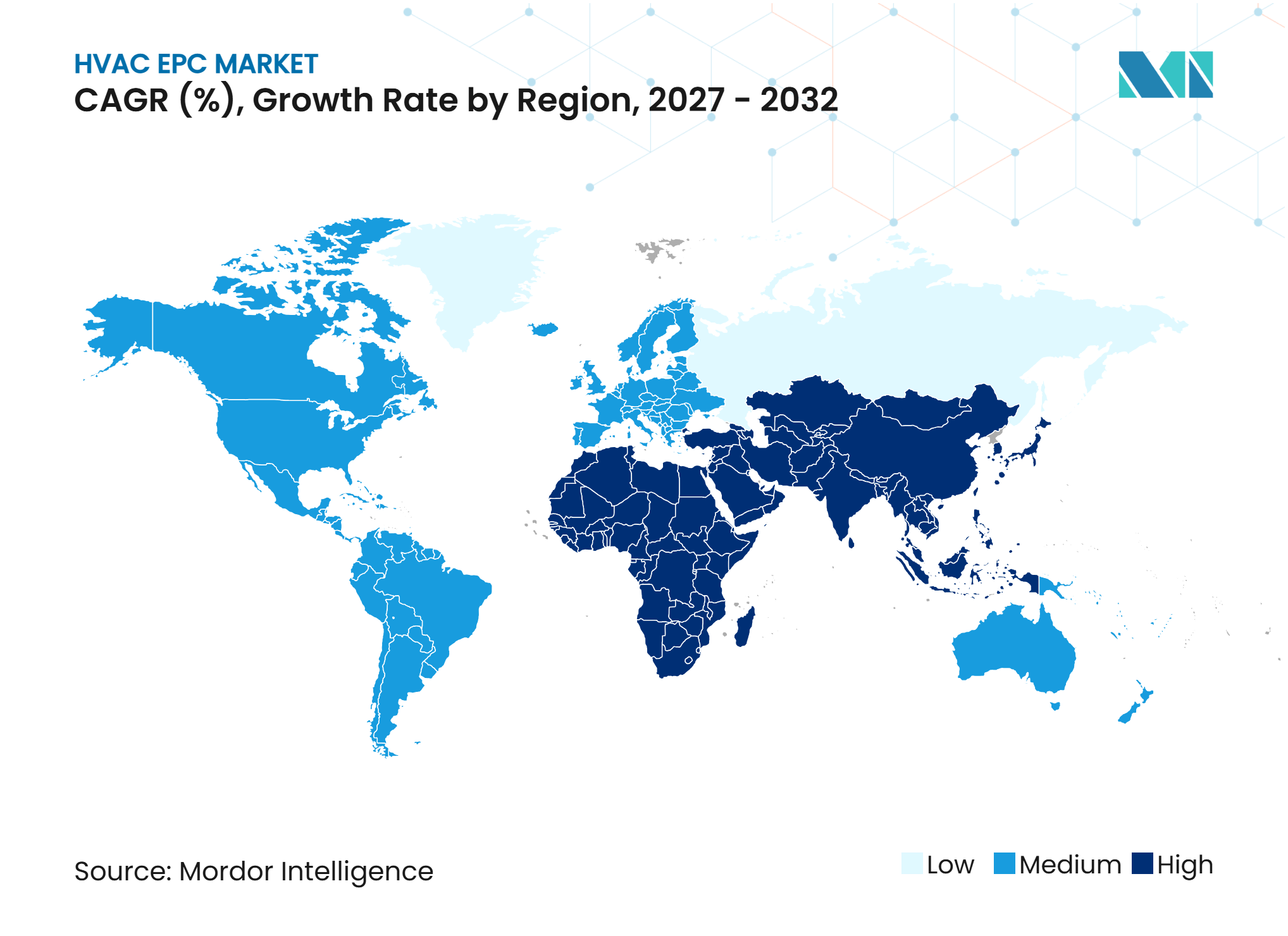
Asia-Pacific accounted for 35.76% of regional sector revenue in 2026 and is projected to grow at a 7.05% CAGR through 2032. The region combines data center construction with industrial, logistics, and urban commercial development. China is adding computing infrastructure through the East Data, West Computing initiative. India is also attracting hyperscale capacity investment in Mumbai, Hyderabad, Chennai, Delhi NCR, and Pune. Modine opened a 100,000-square-foot data center cooling facility in Chennai in August 2025. Regional demand is strengthened by local manufacturing capacity for cooling equipment. Demand is also spreading through Malaysia, Indonesia, and Vietnam as manufacturing and logistics investment increases. Contractors need regional sourcing and local engineering teams to serve these varied project requirements.
North America
North America has a large concentration of active hyperscale data center construction. Electrical grid access and land availability are directing projects toward West Texas, Ohio, Louisiana, and the Carolinas. Gradian launched a USD 60 million, 500,000-square-foot Minnesota manufacturing site in October 2026. Carrier also announced a USD 600 million Fort Worth manufacturing and engineering investment for commercial chillers and thermal management systems.[2] The U.S. AIM Act is a key regulatory influence on new HVAC equipment specifications. Healthcare construction adds demand, including Southland’s work on an 850,000-square-foot, 272-bed Sutter Health medical center. Mexico supports precision HVAC demand through nearshore manufacturing, while Canada adds retrofit demand through healthcare modernization and cold-climate heat pump adoption.
Europe, the Middle East, Africa, and South America
Europe’s HVAC EPC market is shaped by decarbonization rules, data center development, and upgrades to commercial properties. Caverion signed a EUR 80 million agreement (USD 90.4 million) for a 75 MW data center expansion in Mäntsälä, Finland, in April 2025. The project includes cooling, heat recovery, ventilation, and fire safety. The EU F-gas framework remains an important compliance factor for equipment selection and commissioning documentation. SPIE extended technical facility management at the International Business Campus in Frankfurt through 2028 for 84,000 square meters. Saudi Arabia and the UAE are building HVAC project pipelines through investments in infrastructure, hospitality, and data centers. South Africa is seeing earlier-stage demand for colocation cooling and pharmaceutical cold-chain facilities. Brazil and Argentina support South American demand through industrial construction and modernization of older commercial building stock.
Competitive Landscape
Market Concentration
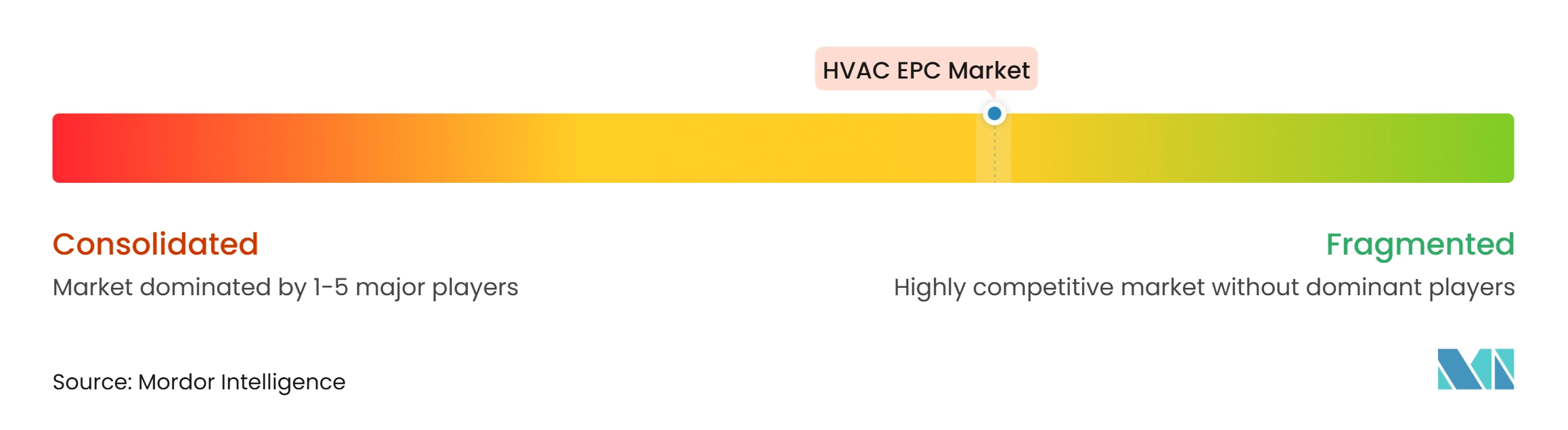
The HVAC EPC market has large integrated contractors at the top, strong regional mechanical firms in the middle, and many local service providers. Large contracts increasingly require engineering, procurement, construction, and O&M capabilities under one agreement. Data center customers are encouraging this structure because they value repeatable delivery across multiple sites. Comfort Systems USA reported a USD 12.45 billion backlog as of March 31, 2026, up 81% year over year. EMCOR reported USD 18.57 billion in RPOs in the third quarter of 2026. Trane reported USD 7.8 billion backlog at year-end 2025 and commercial HVAC bookings growth above 35% in the fourth quarter. These figures show that contractor capacity and manufacturer availability both affect project schedules.
The HVAC EPC market is moving toward prefabricated mechanical skids, multi-trade corridor racks, and factory-tested modules. These methods can reduce site labor needs and shorten commissioning periods. Daikin’s Phoenix expansion is one example of investment in modular delivery capacity.[3] Modine began commercial production of Airedale chillers at a 682,000-square-foot facility in Texas in November 2026 for hyperscale and AI applications. Carrier’s Fort Worth project is another example, focused on increasing advanced manufacturing and engineering capacity. These investments give participating firms greater control over fabrication quality, component availability, and delivery timing.
Competitive differentiation in the HVAC EPC market is shifting toward delivery reliability, specialized engineering, and commissioning resources. Firms that can manage liquid cooling, low-GWP refrigerants, and complex controls have stronger positions in mission-critical projects. Caverion’s contract in Finland shows how technical construction providers are pursuing data center work beyond conventional facilities services. Southland’s Sutter Health design-build contract shows the value of early mechanical planning in complex healthcare projects. O&M frameworks for multi-site portfolios are an important opportunity because owners need long-term performance and service coverage. Liquid cooling upgrades and heat recovery programs are also creating specialized work. The market remains fragmented below the largest contractors because local maintenance and installation work relies heavily on regional relationships.
HVAC EPC Industry Leaders
-
ACCO Engineered Systems
-
Comfort Systems USA, Inc.
-
EMCOR Group, Inc.
-
Voltas Limited
-
TDIndustries, Inc.
- *Disclaimer: Major Players sorted in no particular order
HVAC EPC Market Companies Covered in this Report
- ACCO Engineered Systems
- Comfort Systems USA, Inc.
- EMCOR Group, Inc.
- Southland Industries
- Rosendin, Inc.
- The Brandt Companies, LLC
- TDIndustries, Inc.
- A.G. Coombs, Inc.
- Harris Companies, Inc.
- Limbach Holdings, Inc.
- U.S. Engineering Company
- McKinstry Co., LLC
- M.C. Dean, Inc.
- Caverion Corporation
- SPIE SA
- Dalkia, S.A.
- Voltas Limited
- Blue Star Limited
- ETA Engineering Private Limited
- Frigomeccanica Group S.r.l.
Recent Industry Developments in HVAC EPC Market
- November 2026: Modine commenced commercial production of Airedale chillers at a new purpose-built 682,000-square-foot advanced manufacturing facility in Grand Prairie, Texas, targeting 2 MW and 3 MW chiller production for hyperscale cloud providers and AI computing environments. The facility is ramping toward 4 operational production lines with a planned 3-shift model.
- October 2026: Daikin Applied opened an expanded 191,000-square-foot Modular Solutions facility in Phoenix, Arizona, increasing production capacity for custom hydronic and electric systems by 150%. The facility serves data centers, healthcare, and industrial customers with factory-tested mechanical modules that reduce on-site installation time and schedule risk.
- October 2026: Carrier Global Corporation announced a USD 600 million investment in a new advanced manufacturing and engineering center exceeding 1 million square feet in Fort Worth, Texas. The facility is expected to begin operations in 2027 and will produce commercial chillers and thermal management systems for data centers, healthcare, and industrial markets.
- October 2026: Gradian Thermal Solutions opened a USD 60 million, 500,000-square-foot manufacturing facility in Dayton, Minnesota, expanding its total footprint to 780,000 square feet. The facility supports chiller, liquid cooling, and air handling production for data center, industrial, and commercial mission-critical customers.
Global HVAC EPC Market Report Scope
The HVAC EPC Market involves turnkey project management and contracting services for the end-to-end delivery of large-scale heating, ventilation, and air conditioning infrastructure. The service scope includes system engineering and design, load calculations, equipment procurement, installation, ductwork fabrication, insulation, piping, controls integration, testing, and commissioning. Under this model, specialized contractors assume single-point responsibility for project delivery and coordinate equipment suppliers, installation teams, and facility stakeholders. Services may also include the integration of building management system BMS platforms that monitor and control HVAC equipment, energy consumption, indoor air quality, and building operating conditions. The market primarily serves complex commercial real estate, industrial plants, hospitals, data centers, and public infrastructure projects. Increasing building complexity, stringent energy-efficiency mandates, and asset owners' preference for streamlined execution, fixed timelines, and reduced project risk drive the market.
The HVAC EPC Market Report is Segmented by System Type (Centralized Chilled-Water Systems, Decentralized and Packaged Systems, Variable Refrigerant Flow Systems, Ventilation and Indoor Air Quality Systems, and Other System Types), Service Type (Engineering and Design, Procurement and Supply Management, Construction and Installation, Testing, Balancing, and Commissioning, and Operations and Maintenance), End User (Data Centers and Digital Infrastructure, Healthcare and Life Sciences, Industrial and Process Facilities, Pharmaceutical Manufacturing, Hospitality and Leisure, Education and Government, Warehousing and Logistics, and Other End Users), and Geography (North America, South America, Europe, Asia-Pacific, Middle East, and Africa). The Market Forecasts are Provided in Terms of Value (USD).
Segmentation Overview
| Centralized Chilled-Water Systems |
| Decentralized and Packaged Systems |
| Variable Refrigerant Flow Systems |
| Ventilation and Indoor Air Quality Systems |
| Other System Types |
| Engineering and Design |
| Procurement and Supply Management |
| Construction and Installation |
| Testing, Balancing, and Commissioning |
| Operations and Maintenance |
| Data Centers and Digital Infrastructure |
| Healthcare and Life Sciences |
| Industrial and Process Facilities |
| Pharmaceutical Manufacturing |
| Hospitality and Leisure |
| Education and Government |
| Warehousing and Logistics |
| Other End Users |
| North America | United States |
| Canada | |
| Mexico | |
| South America | Brazil |
| Argentina | |
| Rest of South America | |
| Europe | Germany |
| United Kingdom | |
| France | |
| Italy | |
| Spain | |
| Rest of Europe | |
| Asia-Pacific | China |
| India | |
| Japan | |
| South Korea | |
| Rest of Asia-Pacific | |
| Middle East | Saudi Arabia |
| United Arab Emirates | |
| Rest of Middle East | |
| Africa | South Africa |
| Rest of Africa |
| By System Type | Centralized Chilled-Water Systems | |
| Decentralized and Packaged Systems | ||
| Variable Refrigerant Flow Systems | ||
| Ventilation and Indoor Air Quality Systems | ||
| Other System Types | ||
| By Service Type | Engineering and Design | |
| Procurement and Supply Management | ||
| Construction and Installation | ||
| Testing, Balancing, and Commissioning | ||
| Operations and Maintenance | ||
| By End User | Data Centers and Digital Infrastructure | |
| Healthcare and Life Sciences | ||
| Industrial and Process Facilities | ||
| Pharmaceutical Manufacturing | ||
| Hospitality and Leisure | ||
| Education and Government | ||
| Warehousing and Logistics | ||
| Other End Users | ||
| By Geography | North America | United States |
| Canada | ||
| Mexico | ||
| South America | Brazil | |
| Argentina | ||
| Rest of South America | ||
| Europe | Germany | |
| United Kingdom | ||
| France | ||
| Italy | ||
| Spain | ||
| Rest of Europe | ||
| Asia-Pacific | China | |
| India | ||
| Japan | ||
| South Korea | ||
| Rest of Asia-Pacific | ||
| Middle East | Saudi Arabia | |
| United Arab Emirates | ||
| Rest of Middle East | ||
| Africa | South Africa | |
| Rest of Africa | ||
Key Questions Answered in the Report
What is the size of the HVAC EPC market?
The sector is valued at USD 10.87 billion in 2026 and is expected to reach USD 15.61 billion by 2032 at a 6.24% CAGR.
What is driving demand for HVAC EPC services?
Data center construction, lower-GWP equipment requirements, advanced manufacturing projects, and replacement of older commercial systems are supporting demand.
Which HVAC EPC system type has the largest share?
Centralized chilled-water systems held 42.89% share in 2026 because large data centers, healthcare campuses, and high-rise properties require high-capacity cooling.
Which HVAC EPC service is expanding the fastest?
Operations and maintenance is projected to expand at a 7.61% CAGR through 2032 as owners use multiyear performance-based service agreements.
Which end user is the largest for HVAC EPC contracts?
Data centers and digital infrastructure held 29.14% share in 2026, supported by hyperscale and colocation project activity.
Which region leads HVAC EPC demand?
Asia-Pacific held 35.76% share in 2026 and is projected to expand at a 7.05% CAGR through 2032.