
Hip Resurfacing Implants Market Size and Share
Market Overview
| Study Period | 2020 - 2031 |
|---|---|
| Market Size (2026) | USD 0.88 Billion |
| Market Size (2031) | USD 1.21 Billion |
| Growth Rate (2026 - 2031) | 6.72 % |
| Fastest Growing Market | Asia-Pacific |
| Largest Market | North America |
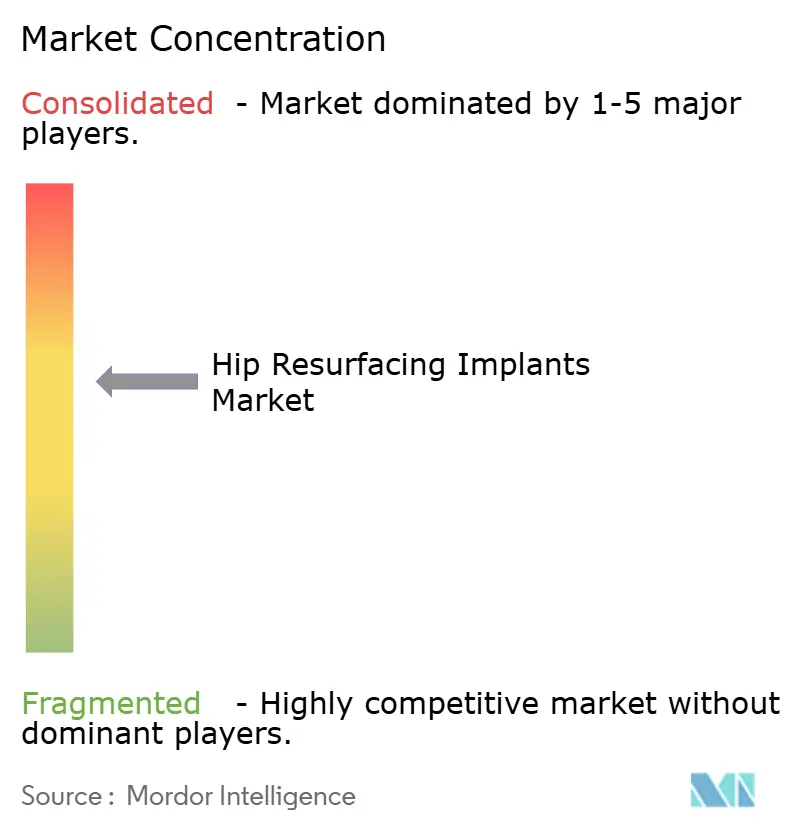
| Market Concentration | Medium |
Major Players *Disclaimer: Major Players sorted in no particular order Image © Mordor Intelligence. Reuse requires attribution under CC BY 4.0. | |
Hip Resurfacing Implants Market Analysis by Mordor Intelligence
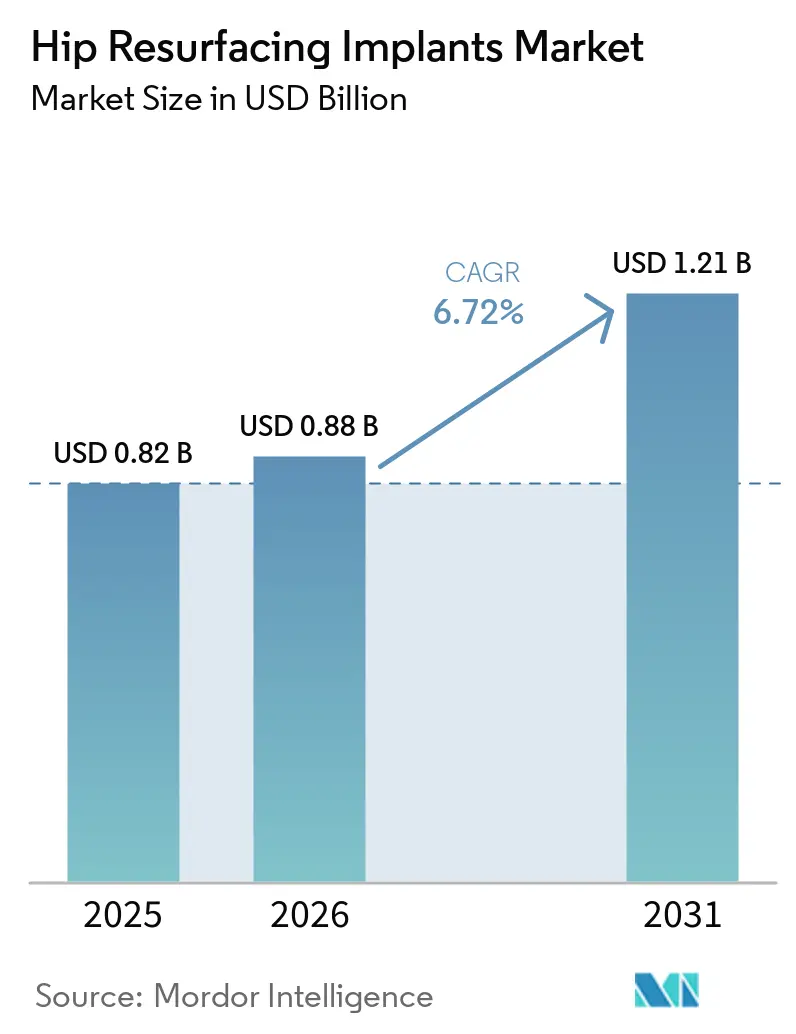
The Hip Resurfacing Implants Market size was valued at USD 0.82 billion in 2025 and is estimated to grow from USD 0.88 billion in 2026 to reach USD 1.21 billion by 2031, at a CAGR of 6.72% during the forecast period (2026-2031).
Demand is moving toward bone-conserving treatment for younger patients who expect to remain physically active after surgery. The hip resurfacing implants market is also changing as ceramic systems expand treatment options beyond the patient profiles served by metal-on-metal devices. Regulatory scrutiny of metal-on-metal implants is limiting the position of legacy products and increasing the value of long-term clinical evidence. Providers and manufacturers are responding through ceramic bearing development, surgeon education, and navigation-enabled procedures. The opportunity in the hip resurfacing implants market will depend on whether newer systems can meet safety, evidence, and reimbursement requirements in both hospital and outpatient care settings.
Key Report Takeaways
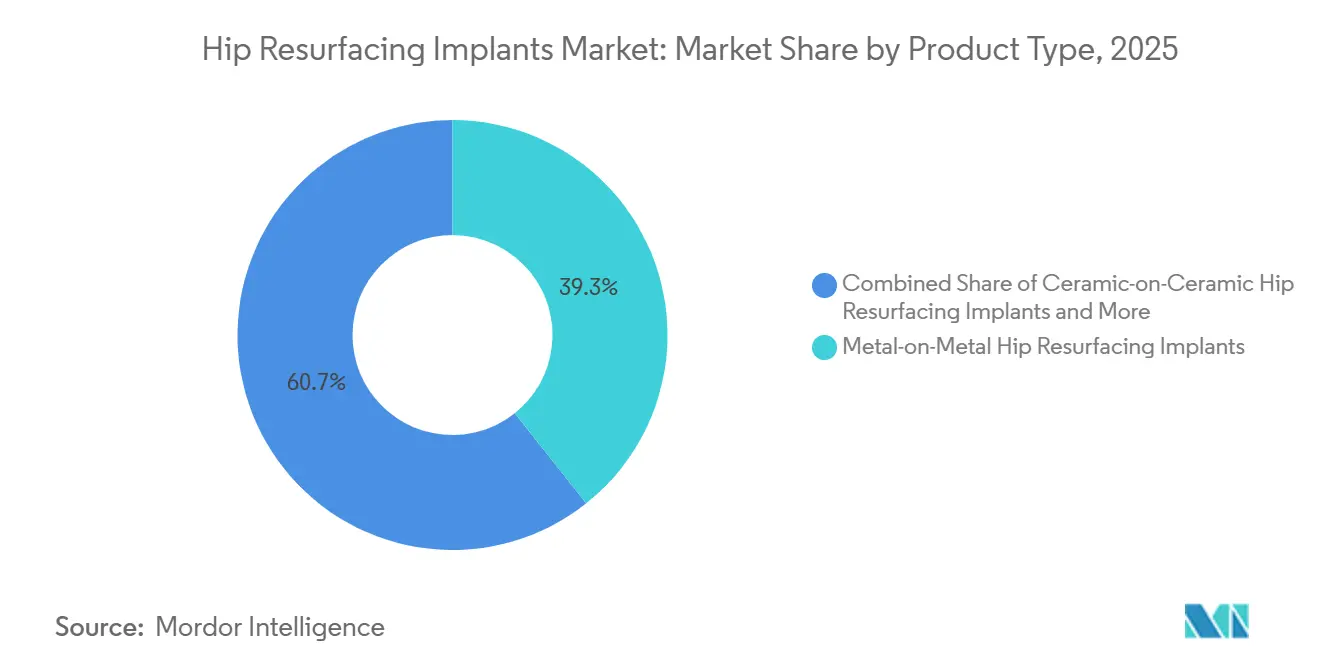
- By product type, metal-on-metal implants held 39.31% share in 2025, while ceramic-on-ceramic implants are projected to grow at a 7.85% CAGR through 2031.
- By material and bearing couple, cobalt-chromium alloy held 41.24% share in 2025, while alumina and zirconia-toughened ceramic are projected to grow at a 7.22% CAGR through 2031.
- By fixation type, cementless femoral component fixation held 44.14% share in 2025, while cementless acetabular component fixation is projected to grow at an 8.42% CAGR through 2031.
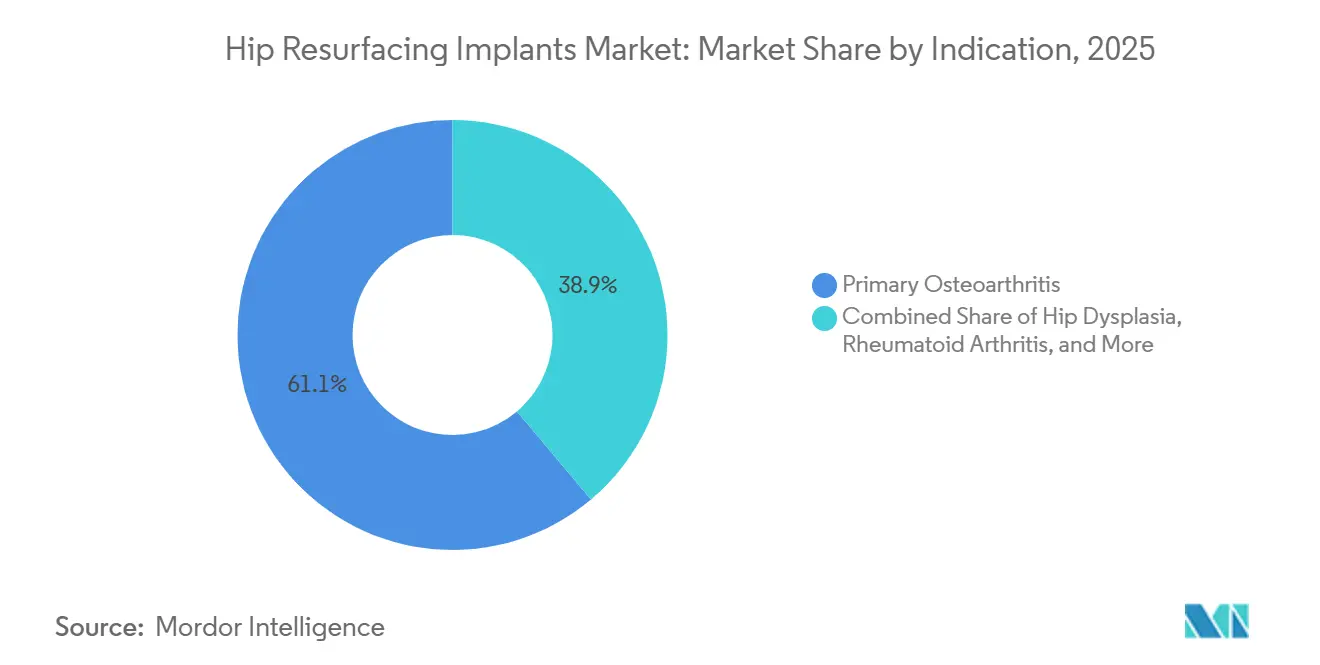
- By indication, primary osteoarthritis held 61.14% share in 2025, while hip dysplasia is projected to grow at a 7.12% CAGR through 2031.
- By end user, hospitals held 54.61% share in 2025, while ambulatory surgical centers are projected to grow at an 8.25% CAGR through 2031.
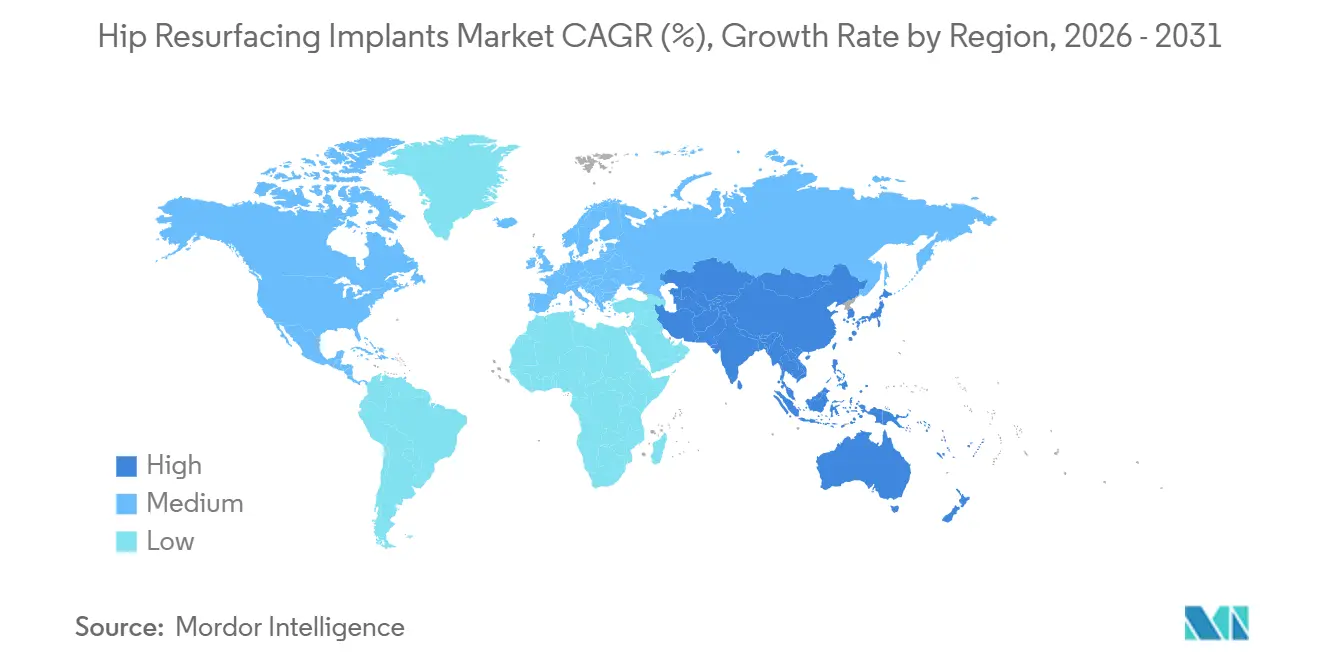
- By geography, North America held 42.41% of revenue in 2025, while Asia-Pacific is projected to have a CAGR at 8.05% through 2031.
Note: Market size and forecast figures in this report are generated using Mordor Intelligence’s proprietary estimation framework, updated with the latest available data and insights as of January 2026.
Market Trends and Insights
Drivers Impact Analysis of Hip Resurfacing Implants Market*
| Driver | (~) % Impact on CAGR Forecast | Geographic Relevance | Impact Timeline |
|---|---|---|---|
| Bone-Conserving Arthroplasty for Younger, Active Patients | +1.8% | Global, led by North America, the UK, Germany, and Australia | Long term (≥ 4 years) |
| Expanded Diagnosis and Surgical Treatment of Hip Osteoarthritis | +1.5% | Global, highest impact in high-income North America and Western Europe | Medium term (2-4 years) |
| Robotic and Computer-Assisted Component Positioning | +0.9% | North America, Western Europe, Japan, South Korea | Medium term (2-4 years) |
| Orthopedic Capacity and Private Healthcare Growth in Emerging Economies | +1.0% | APAC core, India, China, South Korea, with spillover to MEA | Long term (≥ 4 years) |
| Ceramic and Low-Wear Bearings Expanding Patient Eligibility | +0.8% | UK, EU, Australia, and Canada, following July 2026 approval | Short term (≤ 2 years) |
| Surgeon-Led Training Networks Building Procedure-Specific Demand | +0.5% | North America, UK, Western Europe, Australia | Long term (≥ 4 years) |
| Source: Mordor Intelligence | |||
Rising Preference for Bone-Conserving Arthroplasty in Younger, Active Patients
Hip resurfacing preserves more native bone than total hip arthroplasty, which is important for patients under 55 who may require revision surgery during their lifetime. A 2024 Bone & Joint study found low complication and revision rates among younger male patients with end-stage hip disease who received hip resurfacing arthroplasty. The study also reported a return to high-impact sport without lifetime activity restrictions for suitable patients treated by high-volume surgeons. This clinical profile supports referral to specialist surgeons when functional expectations are high. Ceramic systems with CE marking in 2025 reopened the procedure to women and smaller-framed patients who had been excluded from metal resurfacing for more than 10 years[1]. This broader eligibility changes the potential patient base for the hip resurfacing implants market, especially because women account for 59% of UK hip replacement patients.
Expanding Diagnosis and Surgical Treatment of Hip Osteoarthritis
Global hip osteoarthritis prevalence projected growth in South Asia and East Asia through 2050, with a DALY-rate EAPC of 0.94 in South Asia and an ASPR EAPC of 3.32 in East Asia. A Lancet Rheumatology analysis projected that the global hip osteoarthritis case burden will rise 78.6% between 2020 and 2050[2]. Population aging and obesity remain central contributors to this clinical burden. Better MRI access and greater clinical awareness can bring younger symptomatic patients to surgical assessment earlier in middle-income countries. This could add demand to the hip resurfacing implants market before it becomes fully visible in recorded procedure volumes.
Adoption of Robotic and Computer-Assisted Component Positioning
Robotic assistance accounted for 6.6% of elective primary total hip arthroplasty procedures in the United States in 2023. NHS Scotland recorded a rise in robotic joint replacements from 101 procedures in 2020 to 1,164 procedures in 2024, showing broader uptake of robotic technology. Hip resurfacing requires precise femoral component alignment, which makes CT-based planning and navigation relevant to procedure quality. Computational planning can improve component positioning compared with manual estimation when narrow alignment tolerances are required. The use of these tools also supports cementless designs that need consistent bone preparation. Their wider availability can make the hip resurfacing implants market more accessible to centers that are building specialist arthroplasty capabilities.
Ceramic and Low-Wear Bearing Innovation Expanding Patient Eligibility
Ceramic bearing systems are changing treatment access because they avoid the metal exposure concerns associated with metal-on-metal designs. The H1 ceramic-on-ceramic implant received CE marking under the EU Medical Device Regulation in July 2025 as the first non-metal hip resurfacing implant approved globally. Its cementless design is intended for women and patients with smaller femoral head anatomy. The German hip registry reported ceramic head material use in 90% of primary total hip arthroplasties in Germany, indicating established clinician familiarity with ceramic materials. EU MDR requirements for postmarket clinical follow-up and EUDAMED registration favor companies that can demonstrate validated clinical outcomes. These requirements can extend the lead of early ceramic entrants in the hip resurfacing implants market before additional regulatory submissions begin.
Restraints Impact Analysis of Hip Resurfacing Implants Market*
| Restraint | (~) % Impact on CAGR Forecast | Geographic Relevance | Impact Timeline |
|---|---|---|---|
| Metal-Ion Release, Pseudotumor, and Adverse Local Tissue Reaction Concerns | -1.5% | Global, most acute in US, UK, and EU | Long term (≥ 4 years) |
| Regulatory Scrutiny, Litigation, and Product Recall Risk | -1.0% | US, EU, Australia | Medium term (2-4 years) |
| Limited Surgeon Training Capacity and Procedure Learning Curve | -0.7% | Global, most pronounced in Asia-Pacific and Latin America | Long term (≥ 4 years) |
| Reimbursement and Hospital Procurement Friction for Specialized Systems | -0.6% | Western Europe, US public payers, and secondary APAC public hospital systems | Medium term (2-4 years) |
| Source: Mordor Intelligence | |||
Metal-Ion Release, Pseudotumor, and Adverse Local Tissue Reaction Concerns
Adverse local tissue reactions, pseudotumors, and systemic cobalt-chromium ion accumulation remain significant concerns with metal-on-metal hip resurfacing. These safety issues affect adoption volumes and pricing power for suppliers of metal-on-metal systems. The FDA continues to review postmarket surveillance and Medical Device Reports for metal-on-metal hip implants. It also maintains 522 postmarket study orders that require ongoing manufacturer safety evidence. Earlier device safety events remain influential in hospital procurement decisions, including for systems with stronger supporting evidence. This institutional caution slows referrals and leaves ceramic suppliers in the hip resurfacing implants market dependent on registry data and surgeon education to build confidence.
Regulatory Scrutiny, Litigation, and Product-Recall Risk
Regulatory scrutiny is increasing compliance costs and extending commercialization timelines, especially for smaller device innovators. The FDA recorded a Class 2 recall for Smith & Nephew’s Oxinium hip component in April 2024 because of labeling discrepancies. Zimmer Biomet voluntarily recalled its CPT Hip System Femoral Stem in July 2024 after identifying elevated periprosthetic femoral fracture risk. EU MDR requires more clinical evidence, ongoing surveillance, and EUDAMED registration than the prior European framework. For hip resurfacing, long-term survival evidence across diverse patient populations can require 5 to 10 years of registry follow-up before authorization or renewal. This raises barriers to entry in the hip resurfacing implants market and favors established companies with robust clinical datasets.
*Our forecasts treat driver/restraint impacts as directional, not additive. The impact forecasts reflect baseline growth, mix effects, and variable interactions.
Hip Resurfacing Implants Market Segment Analysis
By Product Type:
Ceramic Bearings Challenge Metal-on-Metal IncumbencyMetal-on-metal implants held 39.31% of the Hip resurfacing implants market share in 2025, supported by an installed base and surgeon familiarity with Birmingham Hip Resurfacing format procedures. Ceramic-on-ceramic implants are the fastest-growing product type and are projected to record a 7.85% CAGR from 2026 to 2031. Smith & Nephew discontinued Birmingham Hip Resurfacing manufacturing in 2024 after annual sales declined from USD 100 million to USD 9 million. The withdrawal is moving procedure volumes toward ceramic and hybrid alternatives. Metal-on-polyethylene configurations retain relevance as lower-cost options with established safety profiles in public procurement environments.
Hybrid and other configurations serve patients whose anatomy or clinical needs are not optimally addressed by full ceramic or metal-on-metal designs. The hip resurfacing implants market size for ceramic-on-ceramic products is expected to expand at a 7.85% CAGR from 2026 to 2031. ReCerf received approvals in Australia in November 2024 and the EU in July 2025, while later Canadian approval extended its commercial footprint. Its 5A* ODEP rating, awarded in May 2026, supports assessment by NHS and European hospital procurement groups. Zimmer Biomet’s exclusive H1 licensing arrangement with Embody Orthopedic adds distribution capability to the hip resurfacing implants market for ceramic resurfacing.

By Material and Bearing Couple:
CoCr Dominance Contested by Advanced CeramicsCobalt-chromium alloy held 41.24% of the material and bearing couple segment in 2025. Its position reflected the legacy base of metal-on-metal systems and continued use in hybrid fixation designs. Titanium alloy remained important in acetabular shells and cementless femoral components, where biological fixation is the design objective. Highly cross-linked polyethylene supports metal-on-polyethylene and ceramic-on-polyethylene options. Ceramic-on-metal and other niche combinations address narrower clinical requirements.
Alumina and zirconia-toughened ceramics are forecast to grow at a 7.22% CAGR from 2026 to 2031, making them the fastest-growing material category. CeramTec supplies ceramic materials to MatOrtho and Zimmer Biomet, creating a common material base for 2 advanced ceramic programs. A 2025 Lubrication Science study reported negligible wear for BIOLOX delta ceramic-on-ceramic resurfacing under walking and jogging loads. ISO 6474 governs performance standards for alumina-based implant ceramics in major markets. A concentrated supply of ceramic blanks could constrain volume scaling in the hip resurfacing implants market if demand grows faster than production capacity.
By Fixation Type:
Cementless Designs Gain Momentum Across Both ComponentsCementless femoral component fixation held 44.14% of the hip resurfacing implants market share in 2025. The share reflected interest in biological fixation for younger, active patients. Cementless acetabular component fixation is the fastest-growing approach, with an 8.42% CAGR projected from 2026 to 2031. Fully cementless systems are replacing the older hybrid model that used a cemented femoral cap and press-fit acetabular cup. Zimmer Biomet’s H1 system and MatOrtho’s ReCerf illustrate this direction[3].
The hip resurfacing implants market size for cementless acetabular fixation is projected to grow at an 8.42% CAGR through 2031. Cemented femoral and hybrid fixation remain relevant where bone quality or procedural familiarity is decisive. Cementless femoral resurfacing requires precise bone preparation and tolerance control during surgery. This requirement increases the value of navigation and robotic planning tools. Purpose-built cementless instrumentation can give manufacturers a meaningful competitive advantage.
By Indication:
Primary Osteoarthritis Anchors Volume, Hip Dysplasia Drives Emerging DemandPrimary osteoarthritis held 61.14% of the indication segment in 2025 and remained the main reason for hip resurfacing referral. The World Health Organization identifies hip and knee joints as osteoarthritis sites where surgery can be effective. Rising osteoarthritis prevalence supports stable procedural demand in North America and Europe. Rheumatoid arthritis, avascular necrosis, and post-traumatic arthritis also generate specialist demand. These cases require assessment because anatomy and disease progression differ from primary osteoarthritis.
Hip dysplasia is projected to grow at a 7.12% CAGR from 2026 to 2031. Ceramic implants with anatomically contoured designs can better accommodate dysplastic acetabular geometry than older metal systems. A 2024 Journal of Arthroplasty report on the first 200 ceramic-on-ceramic procedures found improved Oxford Hip Score, HOOS, and WOMAC results. It also documented 53% return to impact activity at 2 years and cited 96.3% survival at 8 years in follow-up cohort data. This evidence may support broader future guidance for dysplasia patients in the hip resurfacing implants market.
By End User:
Hospitals Maintain Procedural Lead, ASCs Represent the Growth VectorHospitals accounted for 54.61% of end-user revenue in 2025. Their lead reflected the need for imaging, experienced teams, and capital equipment in robotic cases. Ambulatory surgical centers are the fastest-growing end-user category, with an 8.25% CAGR forecast from 2026 to 2031. The analysis provided that 62,110 total joint procedures were performed at ambulatory surgical centers in 2023, a 70% year-over-year increase.
The hip resurfacing implants market size for ambulatory surgical centers is forecast to advance at an 8.25% CAGR through 2031. Orthopedic clinics retain a secondary specialist role in decentralized care systems. Academic medical centers and private surgical hospitals concentrate high-volume resurfacing activity in the UK, Germany, and Australia. These settings also support many surgeon training programs. Better ceramic systems and instrumentation can allow ambulatory surgical centers to capture more Hip resurfacing implant procedures while hospitals retain complex cases.
Geography Analysis
North America Hip Resurfacing Implants Market
North America held 42.41% of the global hip resurfacing implants share in 2025. The region remains the largest because of advanced orthopedic practice, reimbursement for specialist devices, and early navigation adoption. Canada gained a path for all-ceramic resurfacing when ReCerf received Health Canada approval in July 2026, while a public cost-effectiveness review will influence adoption. Mexico remains at an early stage, with procedures concentrated in private hospital groups in major cities.
Germany and Broader Europe Hip Resurfacing Implants Market
Germany maintained a large procedural base with 199,052 primary hip implantations and 19,656 revision procedures in 2024. Its mandatory EPRD registry gives new ceramic systems an established route to commercial validation. ReCerf was first implanted in Germany in September 2025. Cleveland Clinic London performed an early H1 ceramic procedure in October 2025 after MHRA approval. EU MDR requirements are increasing the importance of clinical evidence across France, Italy, and Spain.
APAC, GCC and South America Hip Resurfacing Implants Market
Asia-Pacific is the fastest-growing region in the hip resurfacing implants market, with an 8.05% CAGR projected from 2026 to 2031. Growth is supported by demographic demand, healthcare investment, and expanding private surgical infrastructure. Japan has high robotic adoption, while South Korea supports domestic and international ceramic designs through its regulatory pathways. Australia granted the first regulatory approval for an all-ceramic system in November 2024. China’s centralized purchasing policies reduce implant prices and place pressure on margins. Private tertiary hospitals in GCC countries, private insurance growth, and surgeon training in Brazil and Argentina are broadening access elsewhere.
Competitive Landscape
The hip resurfacing implants market includes broad-portfolio orthopedic companies and specialist manufacturers. Zimmer Biomet, Stryker, and Corin Group hold significant procedural influence through implant portfolios and surgeon relationships. MatOrtho, Embody Orthopedic, JointMedica, Medacta International, and LimaCorporate compete through bearing innovation and broader patient eligibility. Smith & Nephew’s discontinuation of Birmingham Hip Resurfacing manufacturing in 2024 was a major recent realignment.
Zimmer Biomet received FDA 510(k) clearance for the G7 TM Acetabular System in February 2026. The system combines Trabecular Metal Technology with an anatomically derived screw-hole pattern for complex cases. MatOrtho has advanced ReCerf through product development, multicenter research, regulatory approvals, and a 5A* ODEP rating. Corin Group uses the Cormet system and surgeon education activities in the UK and Australia. MicroPort Orthopedics and United Orthopedic Corporation are building Asia-Pacific positions through cost-competitive designs and local regulatory routes.
JointMedica’s POLYMOTION HR system is enrolled in an FDA investigational device exemption trial, with potential US clearance anticipated in mid-to-late 2028 if 2-year data meet expectations. This pipeline could introduce a polymer-based bearing configuration to the US setting for the first time in several years. EU MDR requirements and the FDA’s premarket approval approach for metal-on-metal total hip implants favor companies with long-term clinical datasets. Higher entry costs constrain undercapitalized entrants. White space remains in ambulatory surgical center programs and emerging Asia-Pacific markets where local, cost-competitive cementless offerings are limited.
Hip Resurfacing Implants Industry Leaders
-
Smith & Nephew
-
Zimmer Biomet
-
Stryker
-
Corin Group
-
Johnson & Johnson
- *Disclaimer: Major Players sorted in no particular order
Hip Resurfacing Implants Market Companies Covered in this Report
- Aesculap Implant Systems
- B. Braun
- Corin Group
- Embody Orthopaedic
- Exactech
- Johnson & Johnson
- JointMedica
- LimaCorporate
- Mathys
- MatOrtho
- Medacta International
- MicroPort Orthopedics
- OMNI Life Science
- Smiths Group
- Stryker
- United Orthopedic Corporation
- Zimmer Biomet
Recent Industry Developments in Hip Resurfacing Implants Market
- July 2026: MatOrtho's ReCerf ceramic hip resurfacing received Health Canada approval, marking the device's entry into a fourth major regulatory jurisdiction and creating a commercial pathway for all-ceramic HRA in Canada's publicly funded healthcare system.
- February 2026: Zimmer Biomet received FDA 510(k) clearance for the G7 TM Acetabular System, featuring Trabecular Metal Technology and Rim Fix Screws for improved fixation in compromised bone. Full US commercial launch was planned by the end of Q1 2026, with compatibility across Zimmer Biomet's full revision portfolio.
Global Hip Resurfacing Implants Market Report Scope
As per the scope of the report, hip resurfacing implants are a type of surgical device used in hip replacement procedures. They involve capping the damaged or diseased surface of the femoral head (the ball of the hip joint) with a metal covering, rather than removing it entirely.
The hip resurfacing implants market is segmented by product type into metal-on-metal hip resurfacing implants, ceramic-on-ceramic hip resurfacing implants, metal-on-polyethylene hip resurfacing implants, hybrid hip resurfacing implants, and other product types. By material and bearing couple, the market is segmented into cobalt-chromium alloys, titanium alloys, alumina and zirconia-toughened ceramics, highly cross-linked polyethylene, and ceramic-on-metal and other bearing couples. By fixation type, the market is segmented into cemented femoral components, cementless femoral components, cementless acetabular components, and hybrid fixation. By indication, the market is segmented into primary osteoarthritis, rheumatoid arthritis, hip dysplasia, avascular necrosis, and post-traumatic arthritis. By end user, the market is segmented into hospitals, orthopedic clinics, ambulatory surgical centers, and other end users. By geography, the market is segmented into North America, Europe, Asia-Pacific, the Middle East and Africa, and South America. The market report also covers the estimated market sizes and trends for 17 countries across major regions globally. For each segment, the market size and forecast are provided in terms of value (USD).
Segmentation Overview
| Metal-on-Metal Hip Resurfacing Implants |
| Ceramic-on-Ceramic Hip Resurfacing Implants |
| Metal-on-Polyethylene Hip Resurfacing Implants |
| Hybrid Hip Resurfacing Implants |
| Other Product Types |
| Cobalt-Chromium Alloy |
| Titanium Alloy |
| Alumina and Zirconia-Toughened Ceramic |
| Highly Cross-Linked Polyethylene |
| Ceramic-on-Metal and Other Bearing Couples |
| Cemented Femoral Component |
| Cementless Femoral Component |
| Cementless Acetabular Component |
| Hybrid Fixation |
| Primary Osteoarthritis |
| Rheumatoid Arthritis |
| Hip Dysplasia |
| Avascular Necrosis |
| Post-Traumatic Arthritis |
| Hospitals |
| Orthopedic Clinics |
| Ambulatory Surgical Centers |
| Other End Users |
| North America | United States |
| Canada | |
| Mexico | |
| Europe | Germany |
| United Kingdom | |
| France | |
| Italy | |
| Spain | |
| Rest of Europe | |
| Asia-Pacific | China |
| Japan | |
| India | |
| Australia | |
| South Korea | |
| Rest of Asia-Pacific | |
| Middle East and Africa | GCC |
| South Africa | |
| Rest of Middle East and Africa | |
| South America | Brazil |
| Argentina | |
| Rest of South America |
| By Product Type | Metal-on-Metal Hip Resurfacing Implants | |
| Ceramic-on-Ceramic Hip Resurfacing Implants | ||
| Metal-on-Polyethylene Hip Resurfacing Implants | ||
| Hybrid Hip Resurfacing Implants | ||
| Other Product Types | ||
| By Material and Bearing Couple | Cobalt-Chromium Alloy | |
| Titanium Alloy | ||
| Alumina and Zirconia-Toughened Ceramic | ||
| Highly Cross-Linked Polyethylene | ||
| Ceramic-on-Metal and Other Bearing Couples | ||
| By Fixation Type | Cemented Femoral Component | |
| Cementless Femoral Component | ||
| Cementless Acetabular Component | ||
| Hybrid Fixation | ||
| By Indication | Primary Osteoarthritis | |
| Rheumatoid Arthritis | ||
| Hip Dysplasia | ||
| Avascular Necrosis | ||
| Post-Traumatic Arthritis | ||
| By End User | Hospitals | |
| Orthopedic Clinics | ||
| Ambulatory Surgical Centers | ||
| Other End Users | ||
| By Geography | North America | United States |
| Canada | ||
| Mexico | ||
| Europe | Germany | |
| United Kingdom | ||
| France | ||
| Italy | ||
| Spain | ||
| Rest of Europe | ||
| Asia-Pacific | China | |
| Japan | ||
| India | ||
| Australia | ||
| South Korea | ||
| Rest of Asia-Pacific | ||
| Middle East and Africa | GCC | |
| South Africa | ||
| Rest of Middle East and Africa | ||
| South America | Brazil | |
| Argentina | ||
| Rest of South America | ||
Key Questions Answered in the Report
What is driving demand for hip resurfacing implants?
Demand is supported by the need to preserve bone in younger active patients who may face future revision surgery. Rising hip osteoarthritis burden creates a larger population requiring orthopedic assessment.
What is the forecast growth rate for hip resurfacing implants?
The hip resurfacing implants market is projected to grow at a 6.72% CAGR from 2026 to 2031.
Which hip resurfacing product type is growing fastest?
Ceramic-on-ceramic implants are projected to grow at a 7.85% CAGR through 2031. Their growth reflects a need for alternatives to metal-on-metal devices and a broader set of potential patient anatomies.
Which care setting is expanding most quickly for hip resurfacing?
Ambulatory surgical centers are forecast to grow at an 8.25% CAGR through 2031. Their expansion follows wider interest in outpatient orthopedic pathways, although hospitals remain necessary for complex cases that require imaging, experienced teams, and robotic equipment.
Which region will grow fastest through 2031?
Asia-Pacific is projected to expand at an 8.05% CAGR. Healthcare investment, private surgical capacity, and demographic demand support this outlook.
What is the main barrier to treatment access?
Annual list prices ranging from USD 244,000 to USD 464,000 and evidence-based reimbursement requirements remain major barriers.