
High-Speed Beverage Fill-Level Inspection Systems Market Size and Share
Market Overview
| Study Period | 2020 - 2031 |
|---|---|
| Market Size (2026) | USD 236.27 Million |
| Market Size (2031) | USD 440.14 Million |
| Growth Rate (2026 - 2031) | 13.25 % |
| Fastest Growing Market | Asia-Pacific |
| Largest Market | Asia-Pacific |
| Market Concentration | Medium |
Major Players *Disclaimer: Major Players sorted in no particular order Image © Mordor Intelligence. Reuse requires attribution under CC BY 4.0. | |
High-Speed Beverage Fill-Level Inspection Systems Market Analysis by Mordor Intelligence
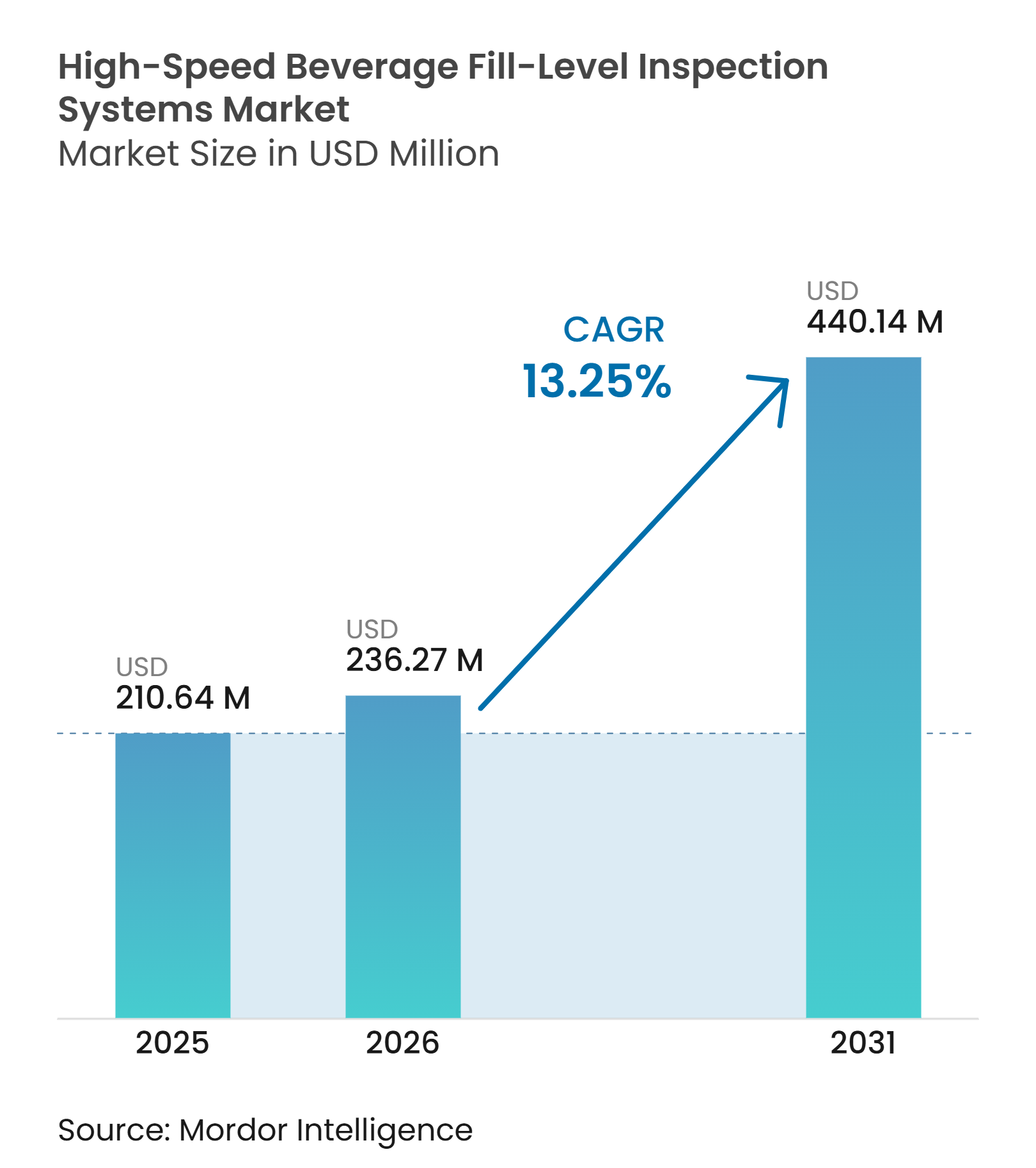
The High-Speed Beverage Fill-Level Inspection Systems Market size is expected to grow from USD 210.64 million in 2025 to USD 236.27 million in 2026, and is forecast to reach USD 440.14 million by 2031, at a 13.25% CAGR over 2026-2031. The high-speed beverage fill-level inspection systems market is supported by filling-line automation and stricter quality requirements for packaged beverages. Producers are increasingly selecting integrated systems that verify fill volume, closure integrity, and container condition in a single inline inspection pass. This approach can reduce equipment footprint and improve the operating case for modernizing quality control on high-throughput lines. Demand is strongest where new bottling capacity and more complex production formats require reliable inspection at speed. Capital cost, system integration, and the need to maintain accurate AI models across multiple SKUs remain practical limits, particularly for smaller bottlers.
Key Report Takeaways
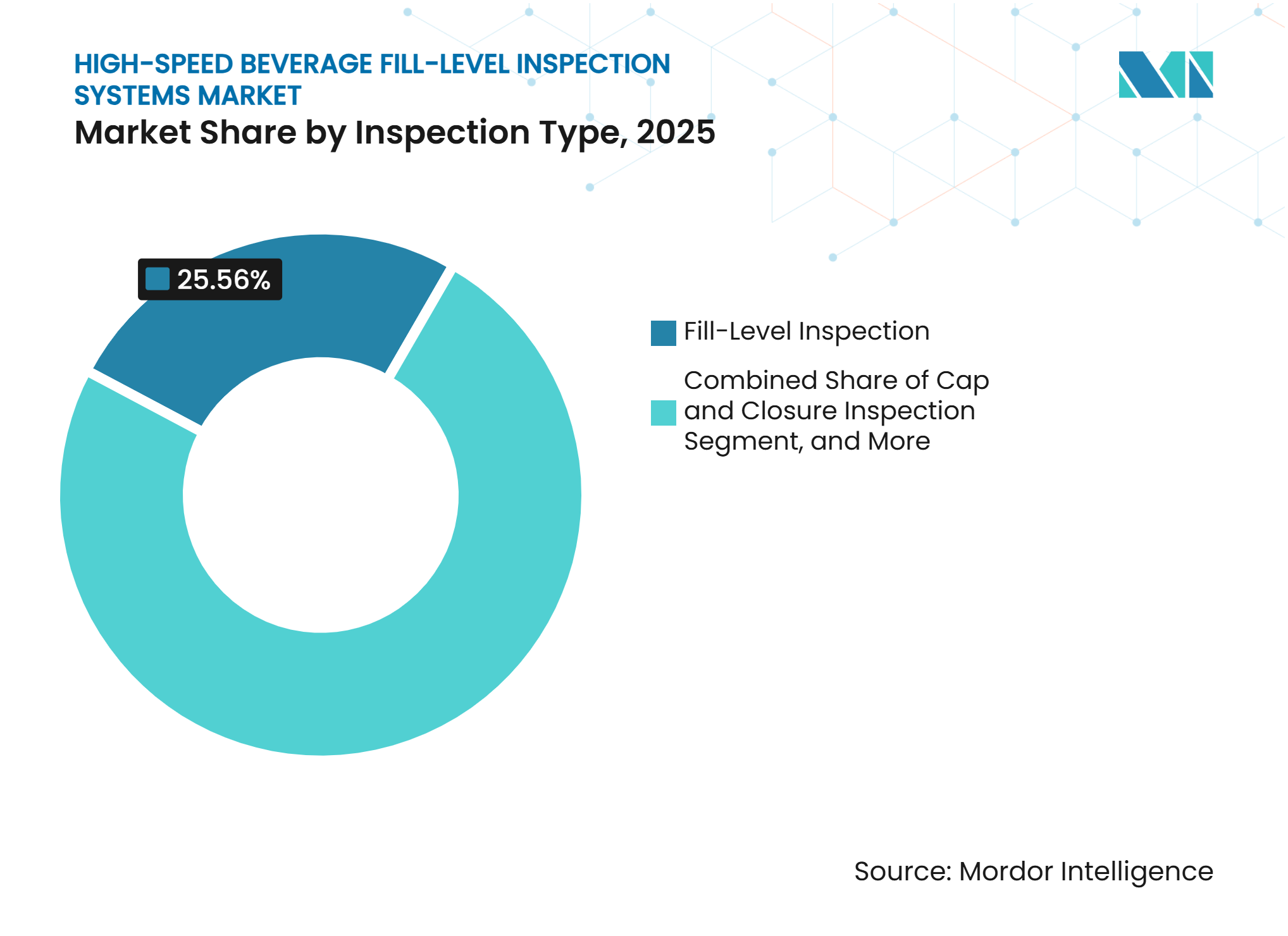
- By inspection type, Fill-Level Inspection held 25.56% of the High-speed beverage fill-level inspection systems market share in 2025, while Foreign Object and Contamination Inspection is projected to expand at an 11.32% CAGR through 2031.
- By inspection technology, 2D RGB/Color Vision accounted for 58.89% of revenue in 2025, while Multispectral and Hyperspectral Imaging is expected to expand at a 10.91% CAGR through 2031.
- By container type, PET Bottles held 43.78% of revenue in 2025, while Cartons and Aseptic Packaging are projected to expand at a 10.88% CAGR through 2031.
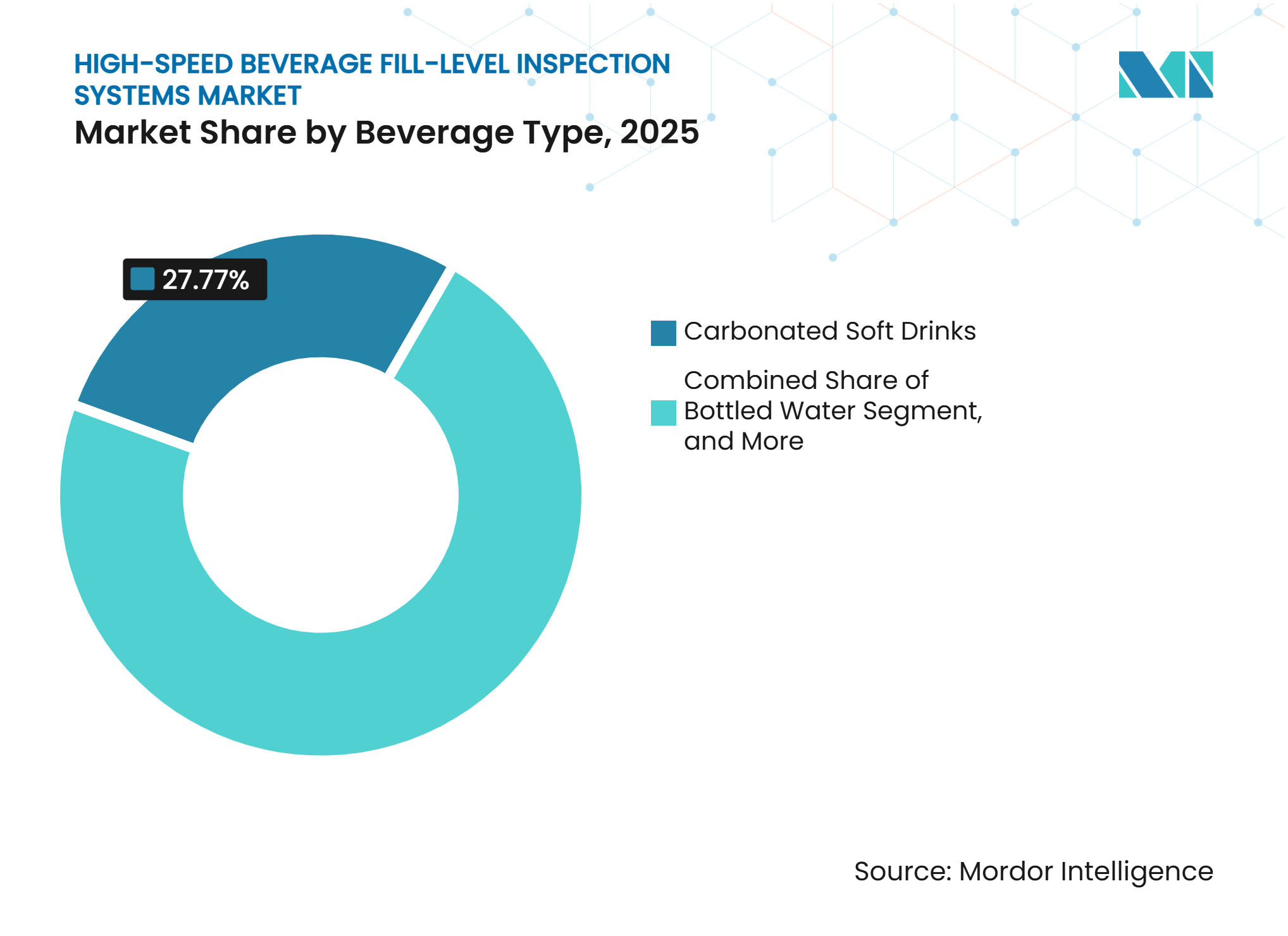
- By beverage type, Carbonated Soft Drinks held 27.77% of revenue in 2025, while Dairy and Plant-Based Beverages are expected to expand at an 11.14% CAGR through 2031.
- By customer type, Large Beverage Producers held 38.89% of revenue in 2025, while Co-Packers and Private-Label Producers are projected to expand at a 9.93% CAGR through 2031.
- By geography, Asia-Pacific held 37.67% of revenue in 2025 and is projected to expand at a 10.89% CAGR through 2031.
Note: Market size and forecast figures in this report are generated using Mordor Intelligence’s proprietary estimation framework, updated with the latest available data and insights as of January 2026.
Market Trends and Insights
Drivers Impact Analysis of High-Speed Beverage Fill-Level Inspection Systems Market*
| Driver | (~) % Impact on CAGR Forecast | Geographic Relevance | Impact Timeline |
|---|---|---|---|
| Beverage Line Automation and Zero-Defect Quality Control | +3.1% | Global | Short term (≤ 2 years) |
| Expansion of High-Speed PET and Canning Lines | +2.0% | Asia-Pacific core, spillover to North America and South America | Short term (≤ 2 years) |
| Stricter Net-Contents Compliance and Recall Avoidance | +1.6% | North America and Europe | Medium term (2-4 years) |
| Closed-Loop Filler Adjustment and Waste Reduction | +1.2% | Global, with early gains in high-volume markets | Medium term (2-4 years) |
| Tethered-Cap and Format-Change Complexity | +0.8% | Europe, United Kingdom, and growing adoption in Asia-Pacific | Short term (≤ 2 years) |
| High-Speed Digital Twin Calibration for Foamy Beverages | +0.5% | North America and Europe | Long term (≥ 4 years) |
| Source: Mordor Intelligence | |||
Beverage Line Automation and Zero-Defect Quality Control
Modern filling lines run at 1,200 to 2,400 containers per minute, leaving only 25 to 50 milliseconds for each inspection decision. Cognex launched its OneVision cloud-to-edge AI inspection platform in May 2026, following adoption by more than 100 customers of the June 2025 beta release. These systems move quality checks from periodic sampling toward verification of every container on a production line. A 2026 study found that hybrid deep-learning automated optical inspection reached 100% cap-sealing classification accuracy on mixed-SKU bottling lines, compared with 90.9% for rule-based automated optical inspection. The High-speed beverage fill-level inspection systems market, therefore, favors systems that combine inspection hardware with data management and model control. These systems can also support quicker expansion from one production line to several facilities.
Expansion of High-Speed PET and Canning Lines
New PET and aluminum can lines create direct demand because inspection equipment must match the filler's rated speed. Sidel introduced the EvoFILL PET filler in 2025 with a stated output of more than 90,000 bottles per hour for still beverages.[1] High-throughput lines require accurate inspection without slowing production or increasing false rejects. Suntory PepsiCo Vietnam opened a USD 300 million plant in Tay Ninh in July 2026, adding 1.24 billion liters of annual capacity and automated warehousing. Such projects increase the need for equipment that is tested against line-specific speeds and package formats. The High-speed beverage fill-level inspection systems market can benefit from this investment cycle even when mature markets focus more heavily on replacement equipment. The effect is especially relevant in the Asia-Pacific region, where greenfield beverage capacity is expanding.
Stricter Net-Contents Compliance and Recall Avoidance
Net-content requirements make fill-level verification a compliance task rather than only a voluntary quality measure. The 2025 edition of NIST Handbook 133 updated procedures for checking the net contents of packaged goods. The US Alcohol and Tobacco Tax and Trade Bureau added 28 authorized container-size standards for wine and distilled spirits under Treasury Decision TTB-200, effective January 10, 2025. Each authorized package size creates a fill target that producers must set and validate in their inspection recipes. Quality teams must also maintain a controlled record of those recipes as formats change. The High-speed beverage fill-level inspection systems market benefits when producers select software-based systems that can manage these format changes without extensive hardware adjustment.
Closed-Loop Filler Adjustment and Waste Reduction
Inspection systems can provide operational value when their results feed back into filler control and maintenance decisions. Peco InspX reports that its inline X-ray systems can measure fill level by individual filler valve. This visibility helps maintenance teams identify a valve that is creating repeated deviations. At 2,400 containers per minute, even a 1 ml overfill can create several thousand liters of giveaway during a shift. Integrated data can help plants intervene before deviations affect an entire production batch. It also gives condition-based maintenance programs a more detailed view of filler health. The High-speed beverage fill-level inspection systems market is consequently moving beyond a basic rejection function toward closer integration with line performance management.
Restraints Impact Analysis of High-Speed Beverage Fill-Level Inspection Systems Market*
| Restraint | (~) % Impact on CAGR Forecast | Geographic Relevance | Impact Timeline |
|---|---|---|---|
| High Capital and Integration Cost for Small Bottlers | -2.6% | Global, most pronounced in South America, Middle East and Africa, and Rest of Asia-Pacific | Medium term (2-4 years) |
| Foam, Turbulence, Labels, and Container Variability | -1.4% | Global | Short term (≤ 2 years) |
| Model Drift and False-Reject Risk in AI Vision Systems | -0.9% | Global | Medium term (2-4 years) |
| Shortage of Inspection and Controls-Engineering Skills | -0.5% | Global, most acute in Middle East and Africa and South America | Long term (≥ 4 years) |
| Source: Mordor Intelligence | |||
High Capital and Integration Cost for Small Bottlers
Advanced systems that combine X-ray or high-frequency sensing, AI vision, and data software can be difficult for smaller bottlers to justify. A regional plant operating one line at 10,000 to 30,000 containers per hour cannot spread the investment in the same way as a large multinational group. These producers may need to include inspection equipment as part of a broader line upgrade to meet internal payback requirements. Some will retain basic sensor-based systems that provide less analytical information. Others will rely on filling-line original equipment manufacturers to bundle inspection equipment at the time of purchase. This division limits recurring opportunities for dedicated vendors while smaller producers manage the rising complexity of multi-SKU operations.
Foam, Turbulence, Labels, and Container Variability
Foam, container moisture, reflective surfaces, label curvature, and frequent format changes can reduce inspection accuracy. Basic systems can interpret glass or aluminum reflections as defects and can mistake foam for low fill. AI-based vision can reduce false rejects when models are trained on the relevant container and beverage conditions. However, models require relevant training data for every container-product combination used on the line. Lines that switch SKUs more than once during a shift face a longer period before a new model reaches production-level accuracy. Operators must then accept either higher false-reject rates or a greater risk of missing defects, which slows adoption on the most complex beverage lines.
*Our forecasts treat driver/restraint impacts as directional, not additive. The impact forecasts reflect baseline growth, mix effects, and variable interactions.
High-Speed Beverage Fill-Level Inspection Systems Market Segment Analysis
By Inspection Type:
Fill-Level Detection Anchors a Diversifying PortfolioFill-Level Inspection held 25.56% of revenue in 2025, giving it the largest position within the High-speed beverage fill-level inspection systems market. Every beverage sold with a net-content declaration must meet its stated volume, making fill-level verification a standard control point across speeds, package materials, and technology generations. Cap and Closure Inspection remained a major area of spending, with producers checking cap presence, seating, tamper bands, and closure geometry. Label and Print Inspection, Container and Bottle Inspection, and Product Appearance Inspection held smaller roles but were often combined into a single inspection cell. This combined approach lets producers complete several quality checks in one pass.
Foreign Object and Contamination Inspection is projected to expand at an 11.32% CAGR through 2031, the fastest rate among inspection types in the High-speed beverage fill-level inspection systems market. The segment responds to a shift from sample-based checks toward continuous screening for foreign material. A 2025 review found that hyperspectral imaging can detect foreign matter in food matrices across wavelengths beyond those captured by conventional RGB cameras. That capability supports more demanding specifications for inline contamination control. Other Inspection Types, including weight-based and ultrasonic systems, continue to serve specialized uses.



By Inspection Technology:
2D Color Vision Leads as Spectral Imaging Scales2D RGB / Color Vision captured 58.89% of the High-speed beverage fill-level inspection systems market share in 2025. Its leading position reflects lower entry cost, broad software availability, and compatibility with PET, cans, and glass containers. It addresses common tasks such as fill-level checks, closure presence, and label registration on mainstream lines. 3D Vision is used where exact closure-height measurement or deformation detection is needed. NIR /Infrared Imaging is relevant when cameras cannot read the meniscus through opaque or multi-walled containers.
Multispectral and Hyperspectral Imaging is expected to expand at a 10.91% CAGR through 2031 within the High-speed beverage fill-level inspection systems market. A 2025 review found that machine learning applied to hyperspectral data can support defect detection and composition verification in food and beverage matrices. Principal component analysis, partial least squares regression, and support vector machines were among the methods reviewed. Compact inline systems became more available in 2024 and 2025, reducing historical barriers related to cost and equipment size. These systems are increasingly relevant for dairy aseptic lines and specialty beverages, while high-frequency electromagnetic and gamma-based systems remain necessary where cameras are less effective.
By Container Type:
PET Dominance Persists as Aseptic Formats Gain GroundPET Bottles accounted for 43.78% of the high-speed beverage fill-level inspection systems market revenue in 2025, reflecting extensive use in carbonated soft drinks, still water, and juice production. PET filling lines require inspection systems that can keep pace with high output rates. Sidel designed the EvoFILL PET filler for outputs above 90,000 bottles per hour. Equipment installed with these lines must preserve detection accuracy while matching filler speed. Glass Bottles remain important in returnable beer and premium spirits applications, where gamma and high-frequency systems can offer an advantage for opaque containers.
Cartons and aseptic packaging are projected to expand at a 10.88% CAGR through 2031, making it the fastest-growing container type in the High-speed beverage fill-level inspection systems market. This result reflects the expansion of aseptic beverage formats for dairy and plant-based products. Carton inspection is more difficult because flexible, block-shaped packages cannot be rotated into a uniform inspection aperture. Heuft developed lateral laser profile measurement systems for checking seal integrity and fill level after beverage cartons are filled and sealed. Aluminum Cans remain the highest-speed container environment, and Peco InspX states that its X-ray systems inspect cans at 2,200 containers per minute while supporting fill tracking by valve and foreign-material detection.
By Beverage Type:
Carbonated Soft Drinks Lead as Dairy and Plant-Based Formats Diversify DemandCarbonated Soft Drinks held 27.77% of revenue in 2025, the largest share among beverage types in the High-speed beverage fill-level inspection systems market. The category operates high-volume lines with strict pressure and fill-level tolerances, creating a persistent requirement for accurate package inspection. Beer is also served by fast aluminum can lines, where X-ray inspection can check fill level and seam condition. Bottled Water places greater emphasis on fill-volume accuracy because its cost structure makes overfill especially significant. Juices and Nectars require calibration for variable-viscosity products that respond differently from water in sensor apertures.\
Dairy and Plant-Based Beverages are expected to expand at an 11.14% CAGR through 2031. Aseptic and UHT formats require tighter checks of headspace, seal quality, and potential contamination. APBev entered Vietnam in June 2026 with a USD 80 million dry aseptic beverage plant in Đồng Nai, targeting an annual output of 150 million liters. Oat, almond, and soy formulations have different density profiles from dairy milk, requiring separate calibration recipes when plant-based beverages are shared on the same line as dairy products. This larger recipe library can increase demand for software-managed inspection platforms across the High-speed beverage fill-level inspection systems market.

By Customer Type:
Tier-1 Producers Set the Standard, Co-Packers Define the Next Demand WaveLarge Beverage Producers held 38.89% of revenue in 2025, placing them at the center of demand for advanced equipment in the High-speed beverage fill-level inspection systems market. Their investment helps validate equipment formats, establish original equipment manufacturer requirements, and set reference architectures for later upgrades. Regional and Craft Bottlers face more product formats but tighter capital budgets. They may choose entry-level vision configurations or inspection-as-a-service arrangements. Beverage Packaging Line OEMs are increasingly expected to include inspection modules when a customer purchases a new line.
Co-Packers and Private-Label Producers are projected to expand at a 9.93% CAGR through 2031. Proper Beverage Co. announced a 300,000-square-foot facility in Kentwood, Michigan, designed to produce 225 million cans per year and planned to begin operations in mid-2026. DrinkPAK is investing USD 350 million in a Philadelphia facility with 5 high-speed production lines. Pittston Co-Packers received support for a USD 30 million Pennsylvania investment that was expected to create 226 jobs. Multi-brand production requires rapid software-controlled changes across fill recipes, closure specifications, and label profiles, supporting platform demand in the High-speed beverage fill-level inspection systems market.
Geography Analysis
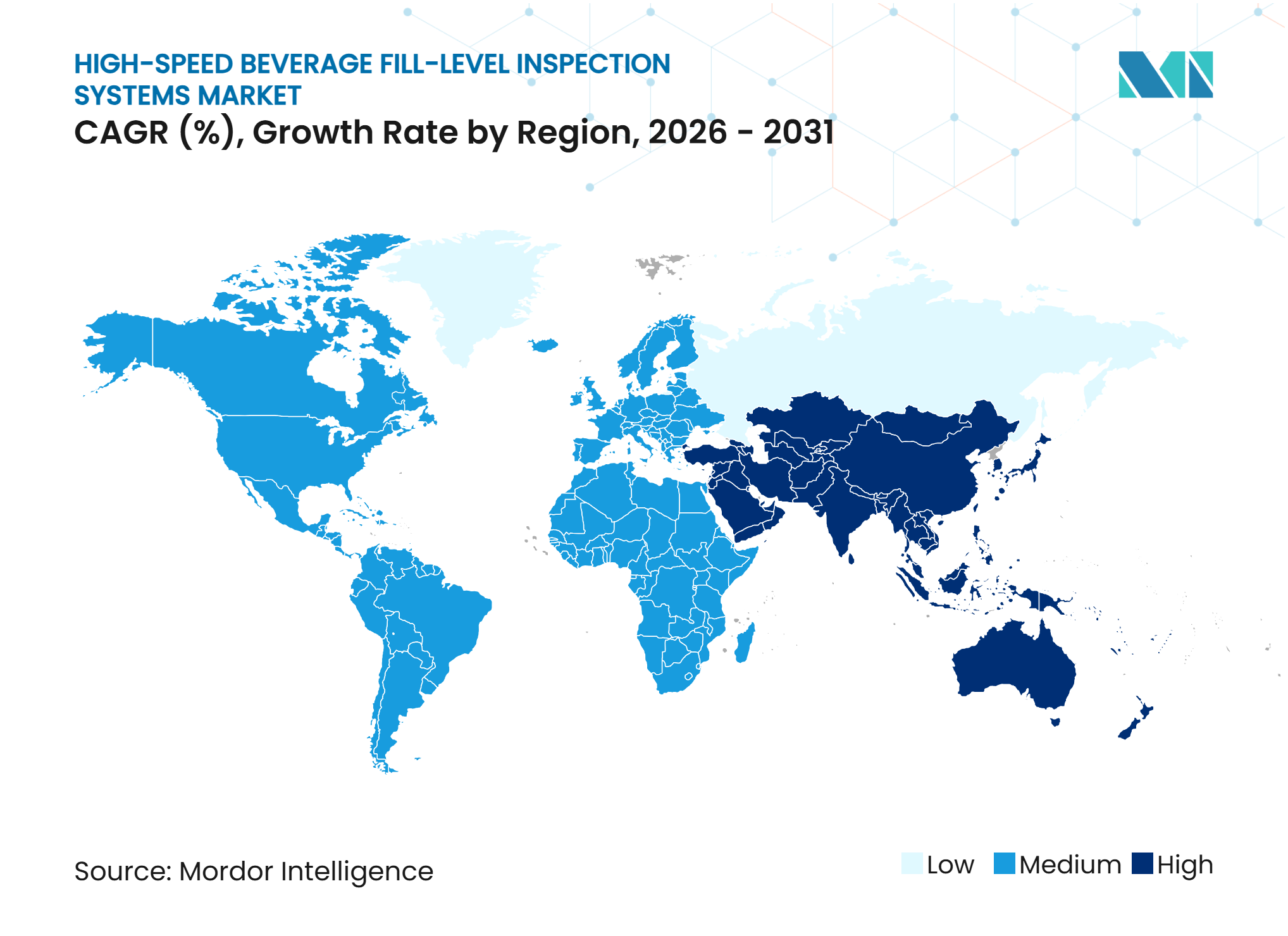
Asia-Pacific held 37.67% of revenue in 2025 and is expected to expand at a 10.89% CAGR through 2031. The High-speed beverage fill-level inspection systems market in the region is supported by new beverage manufacturing capacity and a broader move toward automated filling lines. Suntory PepsiCo Vietnam opened a USD 300 million, 20-hectare plant in Tay Ninh in July 2026, adding 1.24 billion liters of annual capacity and automated warehousing. China is the largest country market in the region due to high packaged beverage consumption and stringent packaging requirements, while Japan serves as a replacement market because of its mature automated filling base.
North America is characterized by installed-base renewal and compliance-related recalibration rather than by greenfield construction alone. DrinkPAK’s Philadelphia project is planned to add 5 high-speed lines, while the Kentwood co-packing site was expected to begin operations in mid-2026.[2] These multi-SKU facilities require systems capable of managing frequent product and package changes. Europe has a high concentration of inspection technology suppliers, including Heuft Systemtechnik, Krones, BBULL Technology, and miho Inspektionssysteme in Germany. The United Kingdom, France, Italy, and Spain remain significant renewal markets, particularly for returnable glass formats used in beer and spirits.
South America has substantial production of carbonated beverages and bottled water, particularly in Brazil, but currency exposure to imported capital equipment can slow upgrades by local bottlers. The Middle East and Africa have the smallest current installed base, although beverage infrastructure investment is increasing in Saudi Arabia, the United Arab Emirates, and Egypt. Food-production self-sufficiency programs and multinational brand requirements are supporting new capacity and the transfer of established inspection practices. South Africa remains a major African base for carbonated soft drinks and beer, while Egypt has a growing packaged beverage sector. The High-speed beverage fill-level inspection systems market is likely to progress from basic gamma-based detection toward integrated AI vision systems as new high-speed bottling lines enter service.
Competitive Landscape
Market Concentration
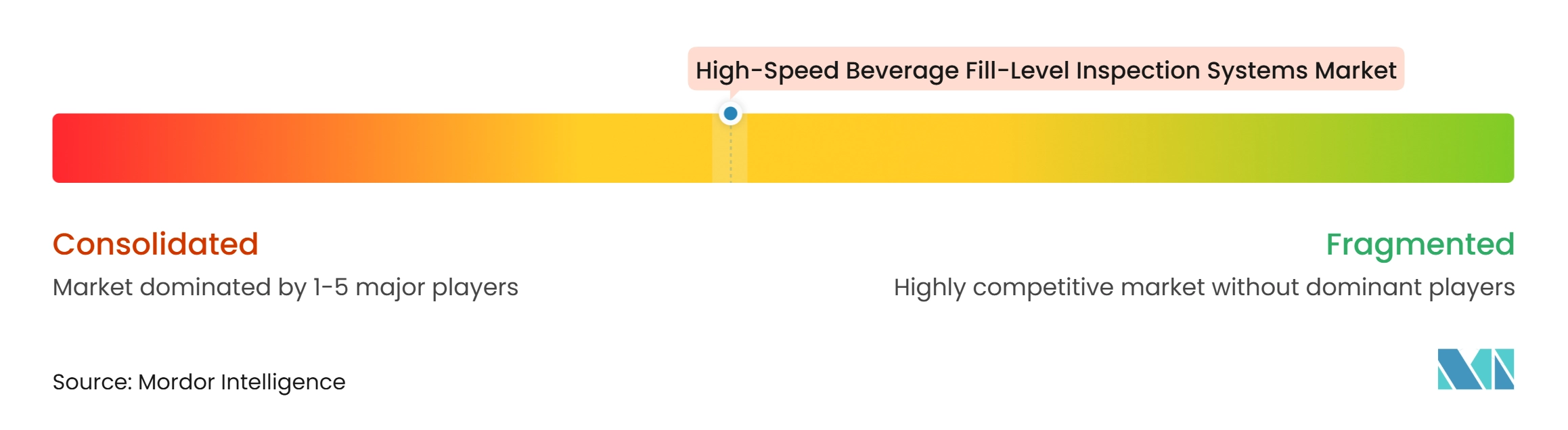
The High-speed beverage fill-level inspection systems market is moderately concentrated among established European inspection specialists. Antares Vision Group, including FT System, Heuft Systemtechnik, Krones, FILTEC, and miho Inspektionssysteme, serves global beverage producers through long-standing application experience. They compete through integrated systems, application-specific inspection methods, and data management capabilities. Krones reported a 0.3% false-reject rate for Linatronic AI, using its DART 4.0 software and deep-learning models to detect beverage container defects.[3] FILTEC introduced its High Frequency Fill Level System at Drinktec 2025 with foam compensation, dual sensor, and camera cap inspection, and no per-line license.
Peco InspX supports high-speed can lines through a single X-ray pass that combines fill-level measurement and foreign-material detection. Cognex launched OneVision in May 2026 to manage AI model training and governance in the cloud while keeping production-time inference at the edge. Mettler-Toledo introduced the X56 DXD+ dual-energy photon-counting X-ray system in May 2026 for multi-density packaged products. Antares Vision Group also introduced its ALL-IN-ONE system at Interpack 2026, combining leak detection, X-ray inspection, checkweighing, label verification, and serialization into a single machine. products show buyer interest in shorter quality-control footprints and fewer separate machines.
The High-speed beverage fill-level inspection systems market has an opportunity among mid-sized bottlers that need more capability than a basic sensor system but cannot justify a full specialist installation. Incumbents are also investing in software that reduces false rejects and supports broader defect detection. Krones has a US patent for optical inspection in beverage processing systems that combines deep learning with rule-based analysis. The Packaging and Packaging Waste Regulation, EU Regulation 2025/40, began imposing compliance obligations on August 12, 2026, making traceability and data handling more relevant in supplier selection, alongside speed and accuracy.
High-Speed Beverage Fill-Level Inspection Systems Industry Leaders
-
Heuft Systemtechnik GmbH
-
Mettler-Toledo International Inc.
-
FILTEC, Inc.
-
Antares Vision Group S.p.A.
-
Krones AG
- *Disclaimer: Major Players sorted in no particular order
High-Speed Beverage Fill-Level Inspection Systems Market Companies Covered in this Report
- Antares Vision Group S.p.A.
- Heuft Systemtechnik GmbH
- FILTEC, Inc.
- Mettler-Toledo International Inc.
- Krones AG
- Teledyne Technologies Incorporated
- Cognex Corporation
- Peco InspX, LLC
- Ishida Co., Ltd.
- Eagle Product Inspection
- miho Inspektionssysteme GmbH
- Verista, Inc.
- Keyence Corporation
- FT System S.r.l.
- BBULL TECHNOLOGY GmbH
- Jay Instruments & Systems Pvt. Ltd.
- Mapex Inspection
- Sinpack
- Hikmah Vision
- Integro Technologies, Corp.
Recent Industry Developments in High-Speed Beverage Fill-Level Inspection Systems Market
- September 2026: The European Commission issued Notice C/2026/4813 updating single-use plastic guidelines under Article 6 of Directive 2019/904, clarifying that sealed aluminum foil lids on plastic beverage containers are excluded from tethered-cap requirements, the ruling resolves a key compliance ambiguity for dairy and plant-based beverage producers operating mixed-material closure configurations, directly influencing cap-inspection module specifications at UHT and aseptic facilities across all 27 EU member states.
- August 2026: LuxTronic launched FinalCheck, an AI and machine-learning-powered end-of-line monitoring platform targeting aluminum can producers, glass bottle manufacturers, and CPG packaging operations, the system deploys 3 top-down cameras at the accumulation table, divider section, and pallet well to detect and log defects before shipment, addressing a historically uninspected production segment.
- August 2026: miho Inspektionssysteme GmbH launched the miho David 3, a redesigned empty bottle inspection system built on more than 30 years of design heritage and incorporating updated optics and software under the "evolution, not revolution" concept, the system is scheduled for first public showcase at BrauBeviale in Nuremberg in November 2026.
- July 2026: Suntory PepsiCo Vietnam Beverage inaugurated its USD 300 million, 20-hectare Tay Ninh plant, its sixth and largest facility in Vietnam, adding 1.24 billion liters of annual production capacity, incorporating fully automated warehouse technology and, since November 2025, 100% biomass-generated steam in production, the scale of the plant creates direct multi-line demand for high-speed fill-level and closure inspection equipment.
Global High-Speed Beverage Fill-Level Inspection Systems Market Report Scope
The High-Speed Beverage Fill-Level Inspection Systems Market refers to the market for automated inspection systems, equipment, and integrated machine-vision solutions used on high-speed beverage packaging lines to continuously monitor and verify the fill level and other critical quality attributes of packaged beverages. These systems use technologies such as 2D RGB/color vision, 3D vision, NIR/infrared imaging, and multispectral or hyperspectral imaging to identify underfilled or overfilled containers and detect defects related to caps and closures, labels and printing, containers, foreign objects and contamination, and overall product appearance. The market includes inspection solutions deployed across various beverage packaging formats, including PET bottles, glass bottles, aluminum cans, cartons, and aseptic packages, and covers beverages such as carbonated soft drinks, beer, bottled water, juices and nectars, dairy and plant-based beverages, and other beverage categories.
The High-Speed Beverage Fill-Level Inspection Systems Market Report is Segmented by Inspection Type (Fill-Level Inspection, Cap and Closure Inspection, Label and Print Inspection, Container / Bottle Inspection, Foreign Object and Contamination Inspection, Product Appearance Inspection, and Other Inspection Types), Inspection Technology (2D RGB / Color Vision, 3D Vision, NIR / Infrared Imaging, Multispectral / Hyperspectral Imaging, and Other Inspection Technologies), Container Type (PET Bottles, Glass Bottles, Aluminum Cans, Cartons / Aseptic Packaging, and Other Container Types), Beverage Type (Carbonated Soft Drinks, Beer, Bottled Water, Juices and Nectars, Dairy and Plant-Based Beverages, and Other Beverage Types), Customer Type (Large Beverage Producers, Regional and Craft Bottlers, Contract Beverage Manufacturers, Beverage Packaging Line OEMs, and Co-Packers and Private-Label Producers), and Geography (North America, South America, Europe, Asia-Pacific, and Middle East and Africa). The Market Forecasts are Provided in Terms of Value (USD).
Segmentation Overview
| Fill-Level Inspection |
| Cap and Closure Inspection |
| Label and Print Inspection |
| Container / Bottle Inspection |
| Foreign Object and Contamination Inspection |
| Product Appearance Inspection |
| Other Inspection Types |
| 2D RGB / Color Vision |
| 3D Vision |
| NIR / Infrared Imaging |
| Multispectral / Hyperspectral Imaging |
| Other Inspection Technologies |
| PET Bottles |
| Glass Bottles |
| Aluminum Cans |
| Cartons / Aseptic Packaging |
| Other Container Types |
| Carbonated Soft Drinks |
| Beer |
| Bottled Water |
| Juices and Nectars |
| Dairy and Plant-Based Beverages |
| Other Beverage Types |
| Large Beverage Producers |
| Regional and Craft Bottlers |
| Contract Beverage Manufacturers |
| Beverage Packaging Line OEMs |
| Co-Packers and Private-Label Producers |
| North America | United States | |
| Canada | ||
| Mexico | ||
| South America | Brazil | |
| Argentina | ||
| Rest of South America | ||
| Europe | Germany | |
| United Kingdom | ||
| France | ||
| Italy | ||
| Spain | ||
| Rest of Europe | ||
| Asia-Pacific | China | |
| Japan | ||
| India | ||
| South Korea | ||
| ASEAN | ||
| Rest of Asia-Pacific | ||
| Middle East and Africa | Middle East | Saudi Arabia |
| Turkey | ||
| United Arab Emirates | ||
| Rest of the Middle East | ||
| Africa | South Africa | |
| Egypt | ||
| Rest of Africa | ||
| By Inspection Type | Fill-Level Inspection | ||
| Cap and Closure Inspection | |||
| Label and Print Inspection | |||
| Container / Bottle Inspection | |||
| Foreign Object and Contamination Inspection | |||
| Product Appearance Inspection | |||
| Other Inspection Types | |||
| By Inspection Technology | 2D RGB / Color Vision | ||
| 3D Vision | |||
| NIR / Infrared Imaging | |||
| Multispectral / Hyperspectral Imaging | |||
| Other Inspection Technologies | |||
| By Container Type | PET Bottles | ||
| Glass Bottles | |||
| Aluminum Cans | |||
| Cartons / Aseptic Packaging | |||
| Other Container Types | |||
| By Beverage Type | Carbonated Soft Drinks | ||
| Beer | |||
| Bottled Water | |||
| Juices and Nectars | |||
| Dairy and Plant-Based Beverages | |||
| Other Beverage Types | |||
| By Customer Type | Large Beverage Producers | ||
| Regional and Craft Bottlers | |||
| Contract Beverage Manufacturers | |||
| Beverage Packaging Line OEMs | |||
| Co-Packers and Private-Label Producers | |||
| By Geography | North America | United States | |
| Canada | |||
| Mexico | |||
| South America | Brazil | ||
| Argentina | |||
| Rest of South America | |||
| Europe | Germany | ||
| United Kingdom | |||
| France | |||
| Italy | |||
| Spain | |||
| Rest of Europe | |||
| Asia-Pacific | China | ||
| Japan | |||
| India | |||
| South Korea | |||
| ASEAN | |||
| Rest of Asia-Pacific | |||
| Middle East and Africa | Middle East | Saudi Arabia | |
| Turkey | |||
| United Arab Emirates | |||
| Rest of the Middle East | |||
| Africa | South Africa | ||
| Egypt | |||
| Rest of Africa | |||
Key Questions Answered in the Report
What is the size of the high-speed beverage fill-level inspection systems market?
The High-speed beverage fill-level inspection systems market was valued at USD 210.64 million in 2025, is expected to reach USD 236.27 million in 2026, and is forecast to reach USD 440.14 million by 2031. Its 13.25% CAGR reflects investment in faster lines, integrated inspection cells, and systems that can maintain consistent settings across changing package formats.
What is driving demand for beverage fill-level inspection systems?
Faster filling lines, net-content compliance, recall avoidance, and closed-loop filler adjustment are increasing demand for inline inspection. Producers also need dependable checks for closures, container condition, labels, and product appearance without reducing line speed or increasing waste.
Which inspection type is expanding fastest?
Foreign Object and Contamination Inspection is projected to expand at an 11.32% CAGR through 2031.
Which container type has the largest demand for these systems?
PET Bottles held 43.78% of revenue in 2025, supported by high-speed carbonated soft drink, water, and juice lines.
Which region leads demand for high-speed beverage inspection equipment?
Asia-Pacific held 37.67% of revenue in 2025 and is projected to expand at a 10.89% CAGR through 2031.
Why are co-packers investing in inspection systems?
Co-packers need rapid software-controlled changeovers for different brands, fill recipes, closure specifications, and label profiles.