
High Acuity Information Systems Market Size and Share
Market Overview
| Study Period | 2020 - 2031 |
|---|---|
| Market Size (2026) | USD 11.58 Billion |
| Market Size (2031) | USD 18.76 Billion |
| Growth Rate (2026 - 2031) | 10.12 % |
| Fastest Growing Market | Asia-Pacific |
| Largest Market | North America |
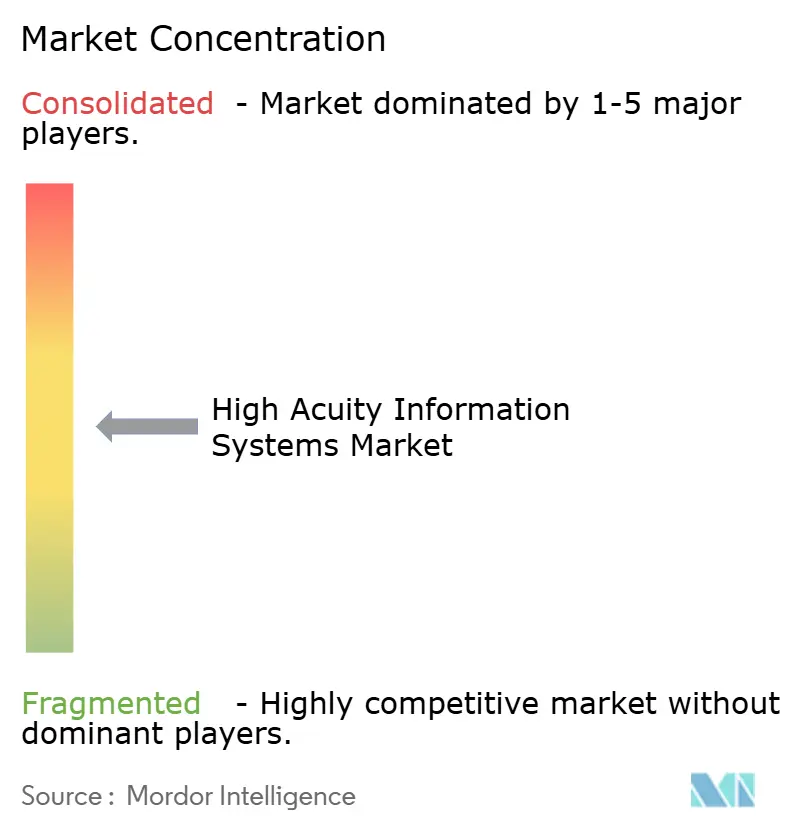
| Market Concentration | Medium |
Major Players *Disclaimer: Major Players sorted in no particular order Image © Mordor Intelligence. Reuse requires attribution under CC BY 4.0. | |
High Acuity Information Systems Market Analysis by Mordor Intelligence
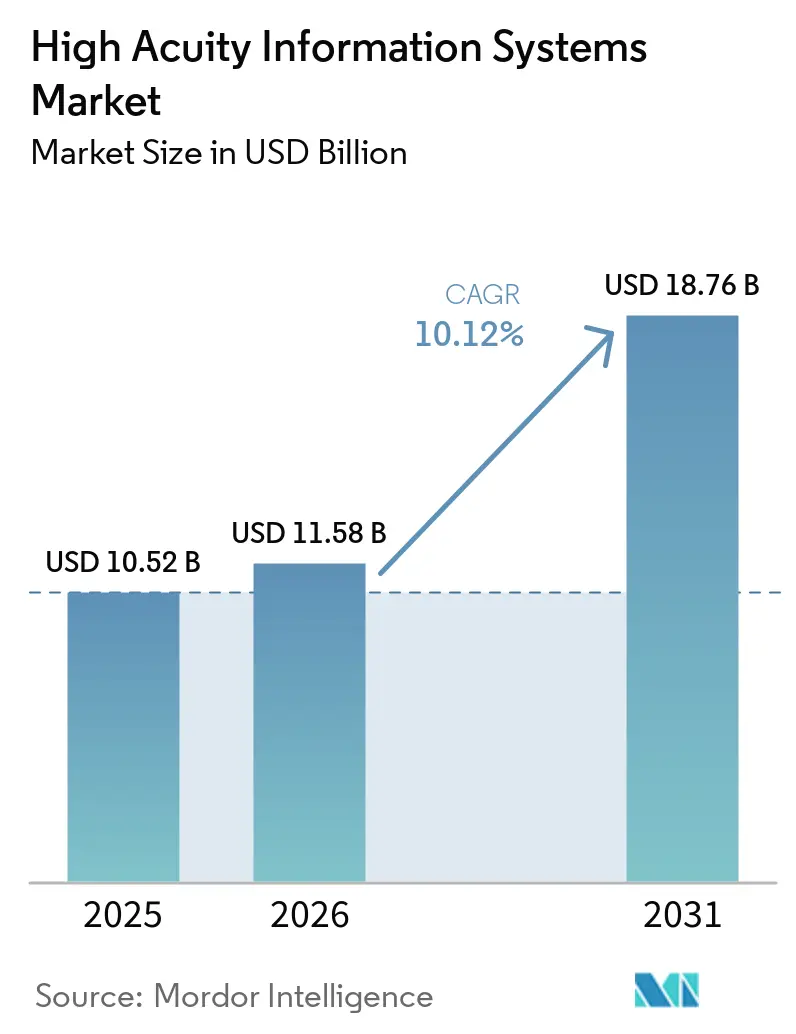
The High Acuity Information Systems Market size is projected to be USD 10.52 billion in 2025, USD 11.58 billion in 2026, and reach USD 18.76 billion by 2031, growing at a CAGR of 10.12% from 2026 to 2031.
Rising patient acuity, larger ICU caseloads, and demand for faster clinical decisions support investment in the high acuity information systems market. Health systems are prioritizing platforms that combine bedside-device data, laboratory results, medication records, and clinical workflows in real time. Interoperability has become central to purchasing decisions because providers need consistent data exchange across sites and care settings. Vendors are responding with cloud-ready platforms, edge processing, validated clinical algorithms, and multi-year service contracts. These changes create opportunities for suppliers that can reduce workflow burden while meeting security, integration, and clinical-validation requirements.
Key Report Takeaways
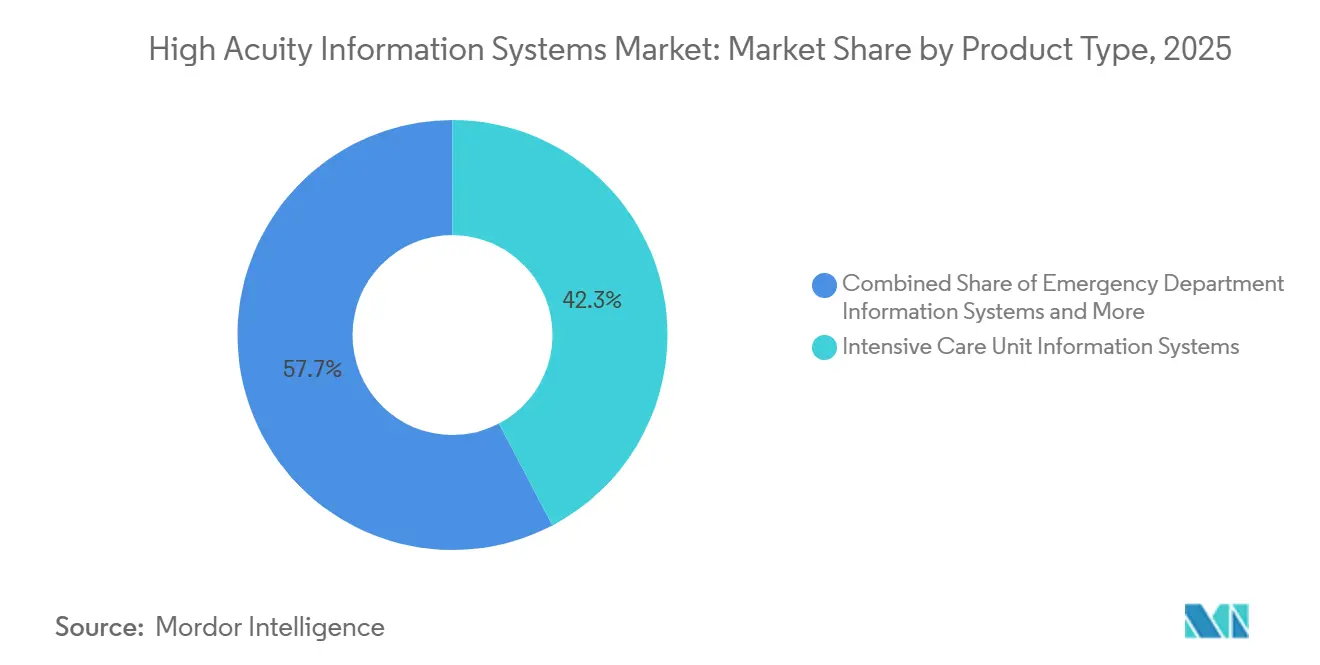
- By product type, Intensive Care Unit Information Systems held 42.31% of the high acuity information systems market share in 2025, while Emergency Department Information Systems are expected to record the highest CAGR at 13.25% through 2031.
- By component, Software and Services accounted for 60.24% of the high acuity information systems market share in 2025 and are expected to account for an 11.22% CAGR through 2031.
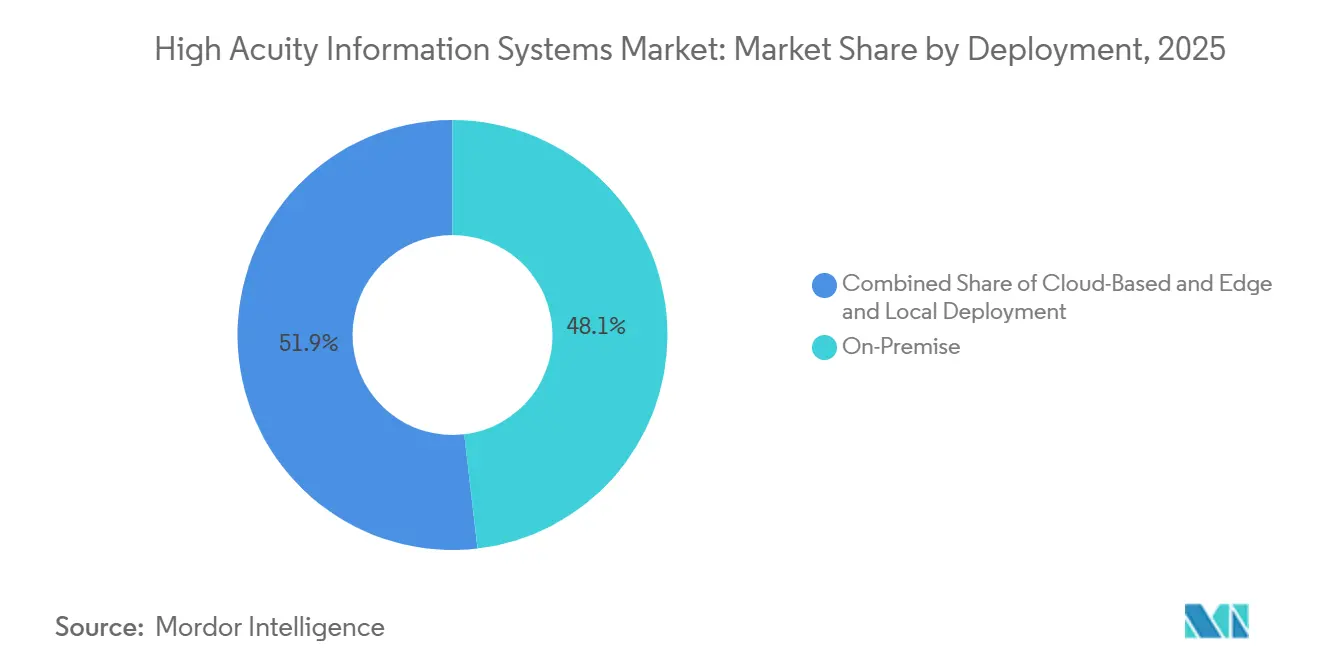
- By deployment, On-Premises deployment held 48.14% of revenue in 2025, while Cloud-Based deployment is expected to record the highest CAGR at 13.42% through 2031.
- By end user, Hospitals held 68.14% of revenue in 2025, while Ambulatory Surgical Centers are projected to have a CAGR at 13.12% through 2031.
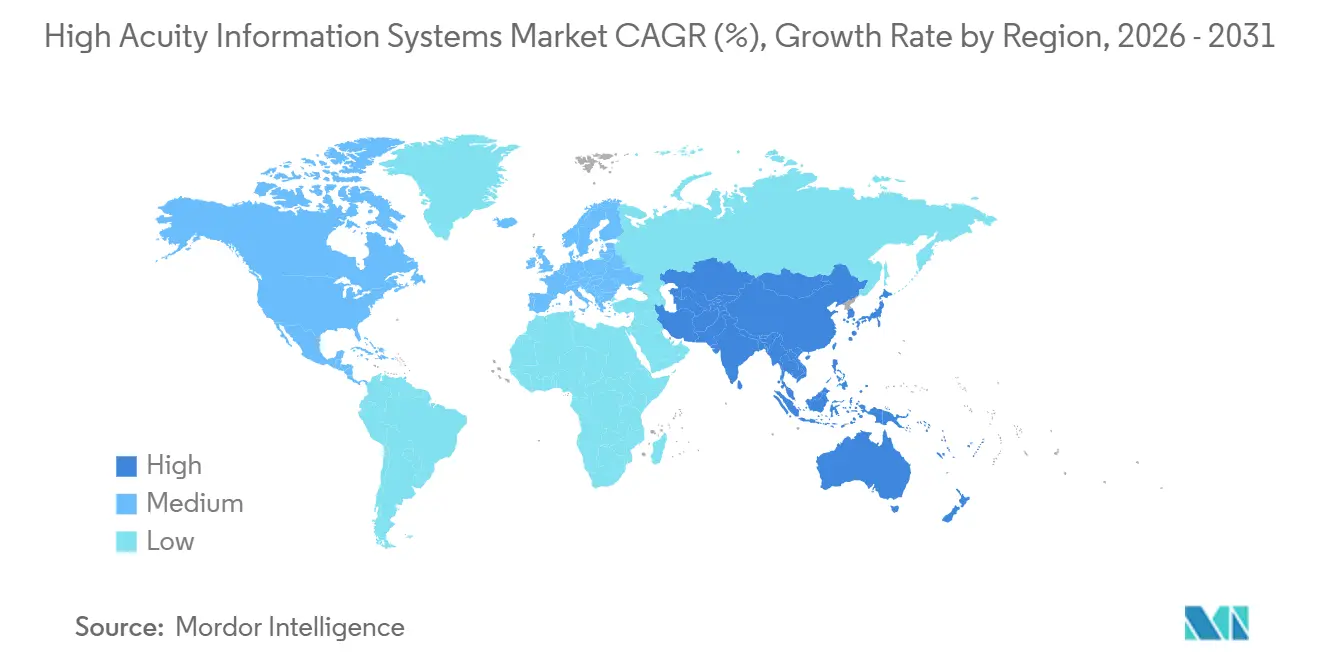
- By geography, North America held 45.61% of revenue in 2025, while Asia-Pacific is expected to record the highest CAGR at 12.25% through 2031.
Note: Market size and forecast figures in this report are generated using Mordor Intelligence’s proprietary estimation framework, updated with the latest available data and insights as of January 2026.
Market Trends and Insights
Drivers Impact Analysis of High Acuity Information Systems Market*
| Driver | (~) % Impact on CAGR Forecast | Geographic Relevance | Impact Timeline |
|---|---|---|---|
| Rising Critical-Care Admissions and Patient Acuity | +2.1% | Global; concentrated in North America, APAC, and Western Europe | Short term (≤ 2 years) |
| Expansion of Tele-ICU and Virtual-Care Models | +1.8% | North America and EU core; spill-over to GCC and Australia | Short term (≤ 2 years) |
| Demand for Predictive Deterioration and Sepsis Detection | +1.7% | Global; highest ROI in North America and Northern Europe | Medium term (2-4 years) |
| Intensivist and Critical-Care Workforce Shortages | +1.5% | North America, Western Europe; spill-over to APAC and MEA | Long term (≥ 4 years) |
| Hospital Investment in Interoperable Digital Infrastructure | +1.4% | Global; policy-driven acceleration in EU, North America, and Middle East | Medium term (2-4 years) |
| Device-Derived Data Monetization and Longitudinal Waveform Archives | +0.9% | North America and EU; early adoption in APAC | Long term (≥ 4 years) |
| Source: Mordor Intelligence | |||
Rising Critical-Care Admissions Are Redefining Platform Requirements
Critical-care demand is changing the requirements placed on the high acuity information systems market. The Society of Critical Care Medicine reports 5 million ICU admissions each year in the United States. ICU patient-days to rise 14% by 2035, compared with 5% growth in overall inpatient volume. Higher acuity requires systems that can bring together continuous waveforms, laboratory results, medication data, and bedside-device information for many patients at once. This raises the value of information systems on a per-bed basis, even where providers cannot expand physical ICU capacity. China’s T/CHIA 47-2024 smart ICU standard supports this direction by calling for multimodal data integration and real-time clinical decision support in public-hospital procurement[1].
Tele-ICU Deployment Creates An Information Systems Pull Cycle
Tele-ICU programs require a data and alerting layer that remote clinicians can use across facilities. That requirement links virtual-care growth directly to demand in the high acuity information systems market. West Tennessee Healthcare expanded its eICU program to 127 ICU beds and 17 mobile emergency department carts with Philips eCareManager and hellocare.ai in June 2026. Remote teams need access to vital signs, waveforms, laboratory data, and medication records without separate local workflows. A centralized command center also encourages health systems to standardize on one platform across affiliated sites. This can reduce vendor fragmentation within a system and make enterprise contracts more important for suppliers.
Predictive Sepsis And Deterioration Algorithms Are Setting A New Procurement Baseline
Validated sepsis and deterioration tools are becoming a core requirement for clinical information platforms. A 7-hospital study involving 6,027 patients reported an AUROC of 0.82 for sepsis prediction and 0.80 for in-hospital mortality for the Sepsis ImmunoScore. A 2026 study described a machine-learning model that achieved an AUROC of 0.92 across 47,936 ICU patients in development data. The high acuity information systems market, therefore, favors platforms that can host and validate predictive models within existing care workflows. Hospitals increasingly require evidence of clinical performance before adopting alerting tools at scale. Suppliers with the resources to support validation and regulatory review may have an advantage over smaller entrants.
Intensivist Shortages Are Accelerating Platform Adoption
Critical-care workforce pressure increases the need for tools that help clinicians oversee larger patient loads. There will be a projected shortfall of 10,300 to 35,600 critical-care physicians in the United States over the coming decade. Information systems can support clinical prioritization, automated documentation, and workflow suggestions for limited specialist teams. These functions can help hospitals make better use of available intensivist capacity. The resulting productivity case can support procurement even when capital budgets remain constrained. Workforce shortages, therefore, remain a continuing driver for the high acuity information systems market across mature hospital systems and expanding care networks.
Restraints Impact Analysis of High Acuity Information Systems Market*
| Restraint | (~) % Impact on CAGR Forecast | Geographic Relevance | Impact Timeline |
|---|---|---|---|
| Integration Complexity Across Legacy Hospital Systems | -2.1% | Global; most acute in North America and Europe with 20-30-year installed bases | Medium term (2-4 years) |
| Alert Fatigue and Declining Clinician Trust | -1.5% | Global; highest in high-density ICU markets | Medium term (2-4 years) |
| Cybersecurity, Privacy and Algorithmic-Liability Exposure | -1.2% | North America and EU; growing in GCC and APAC | Long term (≥ 4 years) |
| Uneven Budgets and Limited Local Implementation Capacity | -1.0% | Rural North America, MEA, South America, Rest of APAC | Long term (≥ 4 years) |
| Source: Mordor Intelligence | |||
Integration Complexity Suppresses Deployment Velocity
Legacy hospital architecture can slow deployment in the high acuity information systems market. Large health systems often rely on customized interfaces across laboratory, pharmacy, radiology, billing, bed management, and medical-device systems. Each connection may need rebuilding and validation during a platform migration. A 2026 hospital migration study reported a 3-month assessment of more than 20 TB of legacy Oracle data before planning began[2]. These requirements can extend implementation schedules to 1-3 years for enterprise platforms. The burden is especially difficult for community hospitals without dedicated clinical informatics teams.
Alert Fatigue Is Eroding The Business Case For AI-Driven Monitoring
High alarm volumes can weaken clinician confidence in predictive monitoring tools. Research in 30 medical ICU beds found a mean of 4,161 alerts each month, or 136 each day, and 93% of those alerts were interruptive. A 2025 study also reported that 80-99% of ICU alarms did not contain a clinically actionable signal. Buyers in the high acuity information systems market are consequently asking vendors to demonstrate fewer false positives as well as strong sensitivity. A 2026 study of COMPOSER-LLM reported a significant reduction in false alarms per patient-hour after the large language model addressed high-uncertainty predictions. Clinical evidence on alert precision can now affect the pace of enterprise procurement decisions.
*Our forecasts treat driver/restraint impacts as directional, not additive. The impact forecasts reflect baseline growth, mix effects, and variable interactions.
High Acuity Information Systems Market Segment Analysis
By Product Type:
Emergency Care Digitalization Narrows The ICU LeadIntensive Care Unit Information Systems captured 42.31% of revenue in 2025. The segment serves the hospital environment with the greatest density of waveform feeds, multi-device telemetry, and medication records. This clinical workload supports the use of systems designed for continuous data collection and coordinated decisions. A large installed base also creates longitudinal information that can support future algorithm development. That accumulated data can increase switching costs for established providers. Anesthesia Information Management Systems and Perinatal Information Systems remain mature categories with stable use in developed healthcare systems. Surgical Information Systems benefit from the movement toward minimally invasive and robot-assisted procedures. Mindray’s Ruizhi Critical Care Decision Support System, deployed in Chinese tertiary hospitals in 2026, shows the shift from documentation tools toward AI-supported clinical recommendations.
Emergency Department Information Systems are forecast to grow at a CAGR of 13.25% through 2031. This high acuity information systems market size opportunity reflects emergency department crowding and the need for faster triage and patient-flow decisions. Sepsis identification requirements under the CMS SEP-1 bundle also support demand for timely decision support. Payer pressure to avoid unnecessary admissions gives hospitals another reason to improve early clinical assessment. 76% of ambulatory surgical centers had adopted an EHR in 2025. This increases the digital readiness of settings that need effective triage and discharge processes. Other product types that bridge multiple care environments are attracting investment from vendors seeking to replace fragmented point solutions. Health systems are also moving toward fewer and deeper vendor relationships across acute-care workflows.

By Component:
Software Monetization Outpaces Hardware Refresh CyclesSoftware and Services held 60.24% of revenue in 2025, making it the leading component of the high acuity information systems market. The share reflects the move from hardware-led purchasing toward subscriptions and platform-based contracts. Software delivery can allow vendors to provide new clinical modules, regulatory patches, and algorithm updates without on-site intervention. Cloud-native formats also support access across multi-site care networks. Philips was selected by University Health in San Antonio for its Enterprise Monitoring as a Service model in June 2026. The contract combined monitoring hardware, decision support, alarm management, and lifecycle services under a multi-year subscription. Such contracts simplify vendor management for hospitals and make recurring service revenue more important for suppliers.
Hardware has a smaller relative role, but it remains necessary for bedside care and clinical connectivity. Edge AI processing can support alerts that cannot wait for a cloud query. GE HealthCare and NXP presented work on on-device AI for anesthesia and neonatal care in January 2026[3]. This approach can reduce dependence on centralized computing for latency-sensitive tasks. It also supports a new cycle of investment in intelligent bedside nodes. The hardware cycle, therefore, operates alongside software subscriptions rather than replacing them. Vendors in the high acuity information systems industry need both reliable device connectivity and scalable software delivery. Their product design must also allow hospitals to update clinical tools without disrupting established care processes.
By Deployment:
On-Premise Incumbency Versus Cloud-Native GrowthOn-Premise deployment accounted for 48.14% of revenue in 2025. This revenue position reflects a large legacy installed base within hospital governance, compliance, and staff-training structures. Academic medical centers and government-affiliated providers often retain local systems for protected health information. A complete migration can require detailed validation under internal security and quality processes. The CHU de Toulouse deployed a FHIR platform based on InterSystems IRIS for Health in 2025. The deployment illustrates a hybrid model in which local FHIR infrastructure is paired with selective cloud access. Hybrid strategies allow providers to modernize interoperability while retaining control over established systems. This preserves the importance of on-premise deployment in the high acuity information systems market.
Cloud-Based deployment is forecast to grow at a CAGR of 13.42% through 2031. New installations at ambulatory surgical centers and regional hospital networks increasingly use cloud-native architectures. More than 58% of newly deployed ASC information platforms used cloud-based or hybrid models in 2025. Providers can avoid some capital infrastructure costs and receive continuing software updates. Edge and local deployment are also becoming more relevant for real-time waveform analysis and on-device deterioration alerts. These applications need low latency and cannot always depend on a remote cloud response. The deployment mix is therefore becoming more flexible, with systems selected according to clinical urgency, data governance, and network design. Vendors that support cloud, local, and edge configurations can address different hospital risk and workflow needs.
By End User:
Hospitals Anchor Revenue While ASCs AccelerateHospitals commanded 68.14% of revenue in 2025. This leading position in the high acuity information systems market comes from the concentration of ICU, emergency, surgical, and perinatal capacity within acute-care facilities. Academic medical centers form an important hospital subgroup because they combine care delivery, teaching, referral activity, and research. Their needs include longitudinal waveform archives and real-time data streams. These records support both clinical care and sponsored research activity. Nursing care facilities remain at an earlier stage of adoption because reimbursement structures have historically limited technology investment. Shorter inpatient stays are increasing acuity in post-acute environments. That change is beginning to influence procurement needs for clinical information infrastructure.
Ambulatory Surgical Centers are forecast to grow at a CAGR of 13.12% through 2031. High-acuity procedures such as joint replacements, spinal surgery, and cardiac catheterization are moving from inpatient hospitals to outpatient centers. This shift creates demand for anesthesia information management, hemodynamic monitoring, and integrated perioperative documentation. ASC-focused platforms are adapting to provide those capabilities in smaller care settings. CMS reimbursement updates in 2026 tightened documentation requirements for Medicare-covered ASC procedures. This gives providers a compliance reason to adopt purpose-built perioperative systems. Accreditation Association for Ambulatory Health Care and Joint Commission standards also reinforce the relevance of electronic documentation and real-time decision support. The high acuity information systems market is therefore extending beyond conventional inpatient settings as procedures migrate.
Geography Analysis
North America High Acuity Information Systems Market
North America held 45.61% of revenue in 2025 and remains the largest revenue region. The United States drives regional demand through health-system consolidation and enterprise procurement. Large systems that acquire community hospitals often replace local clinical systems with a unified platform. This creates demand for interoperable information tools across many sites. The CMS Interoperability Framework enrolled its first general-availability cohort of Qualified Health Information Networks in July 2026. This milestone supports FHIR-based exchange between critical-care platforms and payers. Canada and Mexico provide additional growth through clinical information modernization. Hamilton Health Sciences integrated Philips Capsule Medical Device Integration with its Epic EMR for critical-care devices in August 2025.
Europe High Acuity Information Systems Market
Europe accounted for a significant share in 2025, with Germany holding the strongest country-level position. Hospital digitalization funding supports modernization across critical-care workflows. In France, BOW Medical reported that its Diane platform covered more than 450 healthcare institutions in 2025. The platform managed 5 million anesthesia consultations each year and supported more than 1,200 ICU beds. The United Kingdom’s June 2025 post-market surveillance reforms increased scrutiny of connected clinical systems after launch. This raises compliance expectations for suppliers seeking to operate in the region. France’s Alliance SIH is developing an open and data-centered hospital architecture to address fragmented software environments. These initiatives can strengthen interoperability requirements across clinical departments.
APAC, Middle East and South America High Acuity Information Systems Market
Asia-Pacific is forecast to grow at a CAGR of 12.25% through 2031, the fastest rate among geographic regions. China leads regional adoption through policy support, domestic technology suppliers, and hospital construction. Mindray’s Ruizhi system uses multimodal bedside data to support clinical recommendations in tertiary hospitals. Tianjin Haihe Hospital, Wining Health, and the National Supercomputing Center Tianjin launched a Ruizhi critical-care model and ICU AI innovation base in August 2026. Japan, South Korea, and Australia add demand through national and regional hospital modernization programs. India’s tertiary hospitals and private healthcare chains are also investing in purpose-built clinical information systems. Qatar launched a digital health interoperability plan in March 2026 for patient-data exchange across public and private care settings. Brazil and Colombia are developing interoperable care infrastructure, although South America remains fragmented.
Competitive Landscape
The high acuity information systems market has moderate concentration. GE HealthCare, Koninklijke Philips, Epic Systems, and Siemens Healthineers have broad installed bases and can cross-sell information platforms with hardware and diagnostic offerings. Specialty suppliers such as Picis Clinical Solutions, Etiometry, and CLEW Medical hold focused positions in perioperative systems and critical-care AI. No vendor has a dominant revenue position across ICU, anesthesia, emergency, and surgical categories. This creates meaningful competitive pressure across product types and deployment models. Larger suppliers benefit from established customer relationships and wide product portfolios. Smaller firms compete through AI-native workflows and faster product updates. The high acuity information systems market remains open to focused providers that can show clinical value and workable integration.
Platform consolidation shapes the strategies of established suppliers. Philips’ Enterprise Monitoring as a Service model combines monitoring hardware, clinical decision support, alarm management, and lifecycle services in one subscription contract. The model reduces the number of vendor relationships a hospital must manage. GE HealthCare’s January 2026 collaboration with NXP focused on edge AI for anesthesia and neonatal care. It addresses latency limits that may affect fully centralized clinical analytics. Etiometry expanded its platform beyond the ICU in July 2025 to support enterprise-wide clinical surveillance. These moves show that suppliers are competing for care-transition and enterprise workflow needs, not only individual ICU installations.
High Acuity Information Systems Industry Leaders
-
Epic Systems Corporation
-
Oracle Corporation
-
Koninklijke Philips N.V.
-
GE HealthCare Technologies Inc.
-
Siemens Healthineers AG
- *Disclaimer: Major Players sorted in no particular order
High Acuity Information Systems Market Companies Covered in this Report
- Altera Digital Health
- Baxter
- CLEW Medical Ltd.
- Dragerwerk AG and Co. KGaA
- Epic Systems
- Etiometry Inc.
- GE HealthCare Technologies Inc.
- Getinge
- Intersystems
- Koninklijke Philips
- Masimo
- Medhost
- Meditech
- Merative
- Nihon Kohden
- Oracle
- Picis Clinical Solutions, Inc.
- Siemens Healthineers
- Surgical Information Systems, LLC
- Wolters Kluwer
Recent Industry Developments in High Acuity Information Systems Market
- August 2026: zMed Healthcare launched Version 3 of its AI-driven critical care and unified hospital software suite, broadening its reach from the ICU to the wider hospital enterprise. The updated platform delivers continuous AI-based guidance for patient monitoring, integrates seamlessly with medical equipment regardless of vendor, and supports large-scale deployments across India, the Middle East, and the United States.
- August 2026: Tianjin Haihe Hospital, Wining Health, and the National Supercomputing Center Tianjin jointly launched the "Ruizhi" critical care vertical large model and AI application system, and formally established a joint ICU AI innovation base, a key milestone in China’s push to integrate sovereign AI infrastructure into critical care workflows.
Global High Acuity Information Systems Market Report Scope
As per the scope of the report, a high acuity information system is a specialized healthcare information technology platform designed to support the complex and immediate needs of high-acuity patients—those requiring intensive, continuous, and specialized medical care. It facilitates real-time data collection, monitoring, and management of critical patient information to improve clinical decision-making, enhance patient safety, and streamline workflows in settings such as intensive care units (ICUs), emergency departments, and other critical care environments.
The high acuity information systems market is segmented by product type into intensive care unit information systems, anesthesia information management systems, emergency department information systems, perinatal information systems, surgical information systems, and other product types; by component into software and services and hardware; by deployment mode into on-premises, cloud-based, and edge and local deployment; by end user into hospitals, academic medical centers, ambulatory surgical centers, nursing care facilities, and other end users; and by geography into North America, Europe, Asia-Pacific, the Middle East and Africa, and South America. The market report also covers the estimated market sizes and trends for 17 countries across major regions globally. For each segment, the market size and forecast are provided in terms of value (USD).
Segmentation Overview
| Intensive Care Unit Information Systems |
| Anesthesia Information Management Systems |
| Emergency Department Information Systems |
| Perinatal Information Systems |
| Surgical Information Systems |
| Other Product Types |
| Software and Services |
| Hardware |
| On-Premise |
| Cloud-Based |
| Edge and Local Deployment |
| Hospitals |
| Academic Medical Centers |
| Ambulatory Surgical Centers |
| Nursing Care Facilities |
| Other End Users |
| North America | United States |
| Canada | |
| Mexico | |
| Europe | Germany |
| United Kingdom | |
| France | |
| Italy | |
| Spain | |
| Rest of Europe | |
| Asia-Pacific | China |
| Japan | |
| India | |
| Australia | |
| South Korea | |
| Rest of Asia-Pacific | |
| Middle East and Africa | GCC |
| South Africa | |
| Rest of Middle East and Africa | |
| South America | Brazil |
| Argentina | |
| Rest of South America |
| By Product Type | Intensive Care Unit Information Systems | |
| Anesthesia Information Management Systems | ||
| Emergency Department Information Systems | ||
| Perinatal Information Systems | ||
| Surgical Information Systems | ||
| Other Product Types | ||
| By Component | Software and Services | |
| Hardware | ||
| By Deployment | On-Premise | |
| Cloud-Based | ||
| Edge and Local Deployment | ||
| By End User | Hospitals | |
| Academic Medical Centers | ||
| Ambulatory Surgical Centers | ||
| Nursing Care Facilities | ||
| Other End Users | ||
| By Geography | North America | United States |
| Canada | ||
| Mexico | ||
| Europe | Germany | |
| United Kingdom | ||
| France | ||
| Italy | ||
| Spain | ||
| Rest of Europe | ||
| Asia-Pacific | China | |
| Japan | ||
| India | ||
| Australia | ||
| South Korea | ||
| Rest of Asia-Pacific | ||
| Middle East and Africa | GCC | |
| South Africa | ||
| Rest of Middle East and Africa | ||
| South America | Brazil | |
| Argentina | ||
| Rest of South America | ||
Key Questions Answered in the Report
What is driving demand for high acuity information systems?
Rising ICU workloads, patient acuity, virtual care, and the need for predictive clinical support are supporting demand.
How large is the high acuity information systems sector in 2026?
The sector is valued at USD 11.58 billion in 2026 and is forecast to reach USD 18.76 billion by 2031 at a 10.12% CAGR.
Which product type is growing fastest?
Emergency Department Information Systems are forecast to expand at a 13.25% CAGR through 2031.
Why do hospitals remain the leading buyers?
Hospitals held 68.14% of revenue in 2025 because they concentrate ICU, emergency, surgical, and perinatal care infrastructure.
Which deployment model is expanding fastest?
Cloud-Based deployment is forecast to grow at a 13.42% CAGR through 2031 as providers seek scalable access and ongoing software updates.
Which region is growing fastest?
Asia-Pacific is forecast to grow at a 12.25% CAGR through 2031, supported by hospital digitalization and AI-enabled clinical workflow programs.