
Heavyweight Motorcycles Market Size and Share
Market Overview
| Study Period | 2020 - 2032 |
|---|---|
| Market Size (2027) | USD 22.67 Billion |
| Market Size (2032) | USD 28.82 Billion |
| Growth Rate (2027 - 2032) | 4.92 % |
| Fastest Growing Market | Asia-Pacific |
| Largest Market | North America |
| Market Concentration | Medium |
Major Players *Disclaimer: Major Players sorted in no particular order Image © Mordor Intelligence. Reuse requires attribution under CC BY 4.0. | |
Heavyweight Motorcycles Market Analysis by Mordor Intelligence
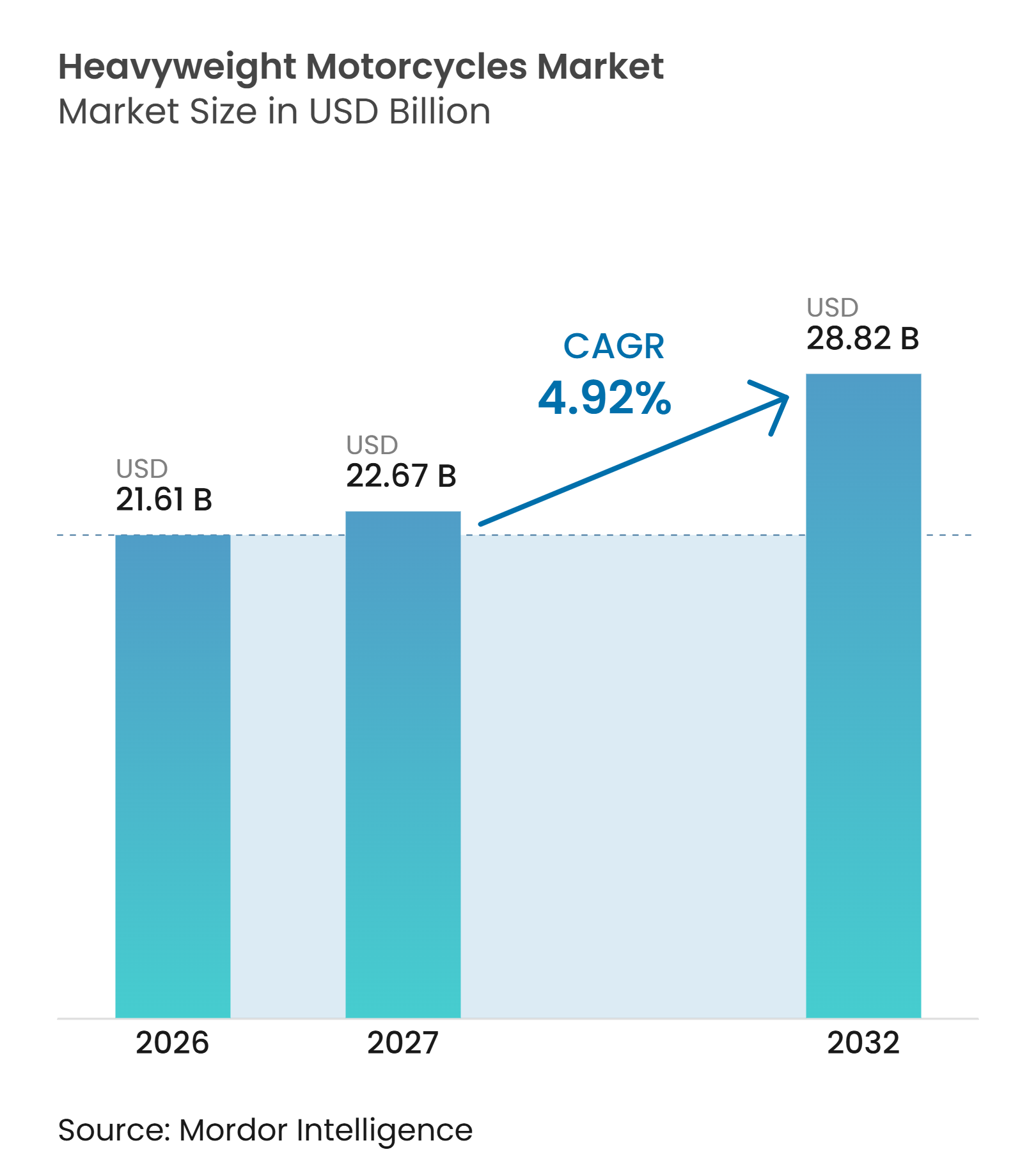
The heavyweight motorcycles market size was valued at USD 21.61 billion in 2026, is estimated at USD 22.67 billion in 2027, and is projected to reach USD 28.82 billion by 2032, growing at a CAGR of 4.92% from 2027 to 2032. The market is advancing in value as buyers choose larger motorcycles with more equipment, stronger performance, and higher transaction prices. Premium buyers also spend on luggage, protective equipment, connectivity, servicing, and branded events after buying the vehicle. North America remains the central source of heavyweight motorcycle value, although its mature buyer base makes replacement demand and customer retention more important than unit expansion. Asia-Pacific is widening the buyer pool through higher incomes, road development, and locally assembled large-displacement models. The Heavyweight motorcycles market also faces higher engineering costs from emissions and noise rules, while electric products must address battery mass and touring range before they can serve the full long-distance riding use case.
Key Report Takeaways
-
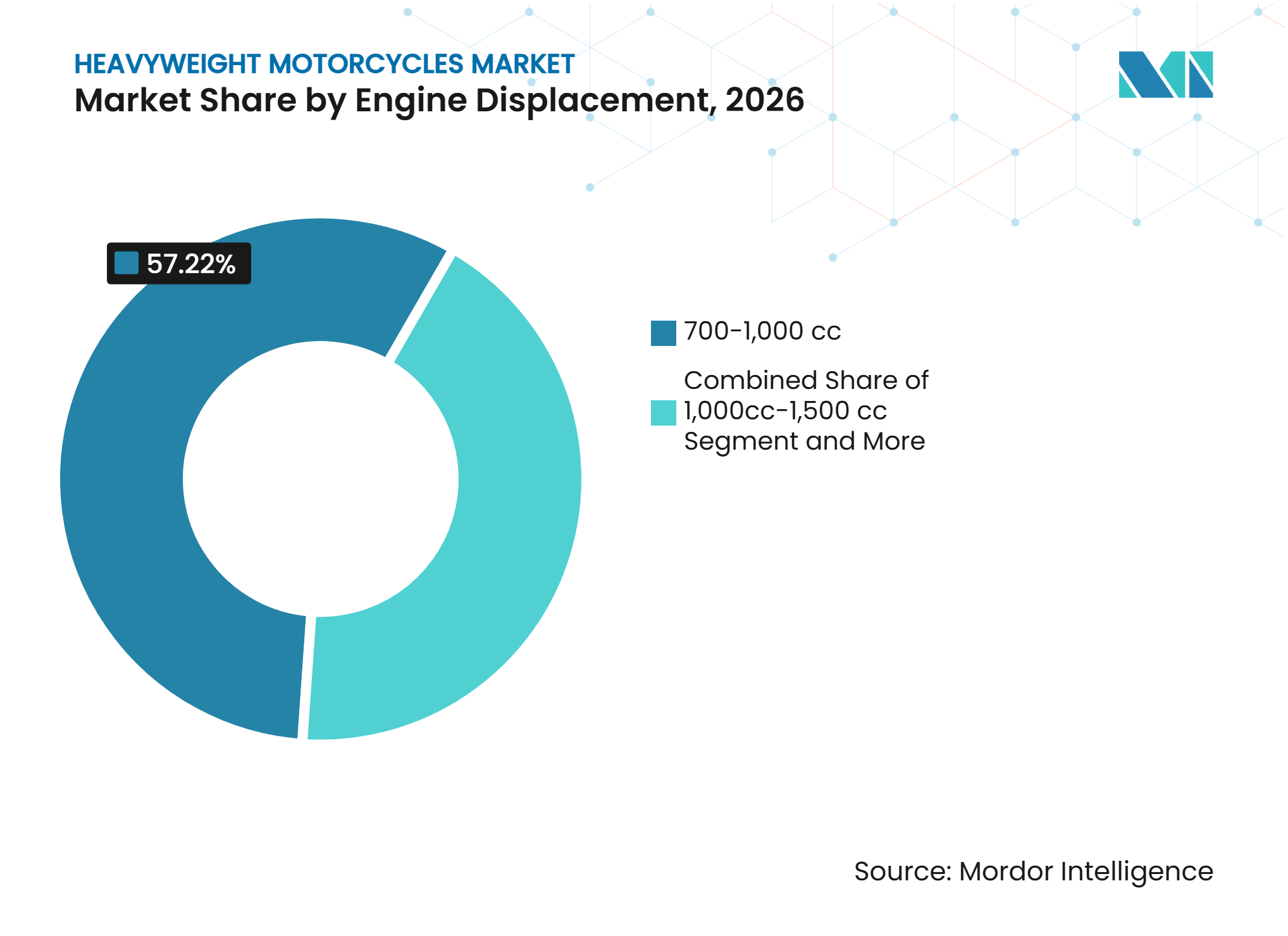
By engine displacement, the 700-1,000 cc segment held 57.22% of Heavyweight motorcycles market share in 2026, while the above 1,500 cc segment in the Heavyweight motorcycles market is forecast to grow at a 6.33% CAGR through 2032.
-
By motorcycle type, cruisers accounted for 68.29% of total 2026 value, while adventure motorcycles are projected to expand at a 6.39% CAGR through 2032.
-
By propulsion, ICE held 64.39% of the Heavyweight motorcycles market share in 2026, while electric motorcycles are forecast to grow at a 7.01% CAGR through 2032.
-
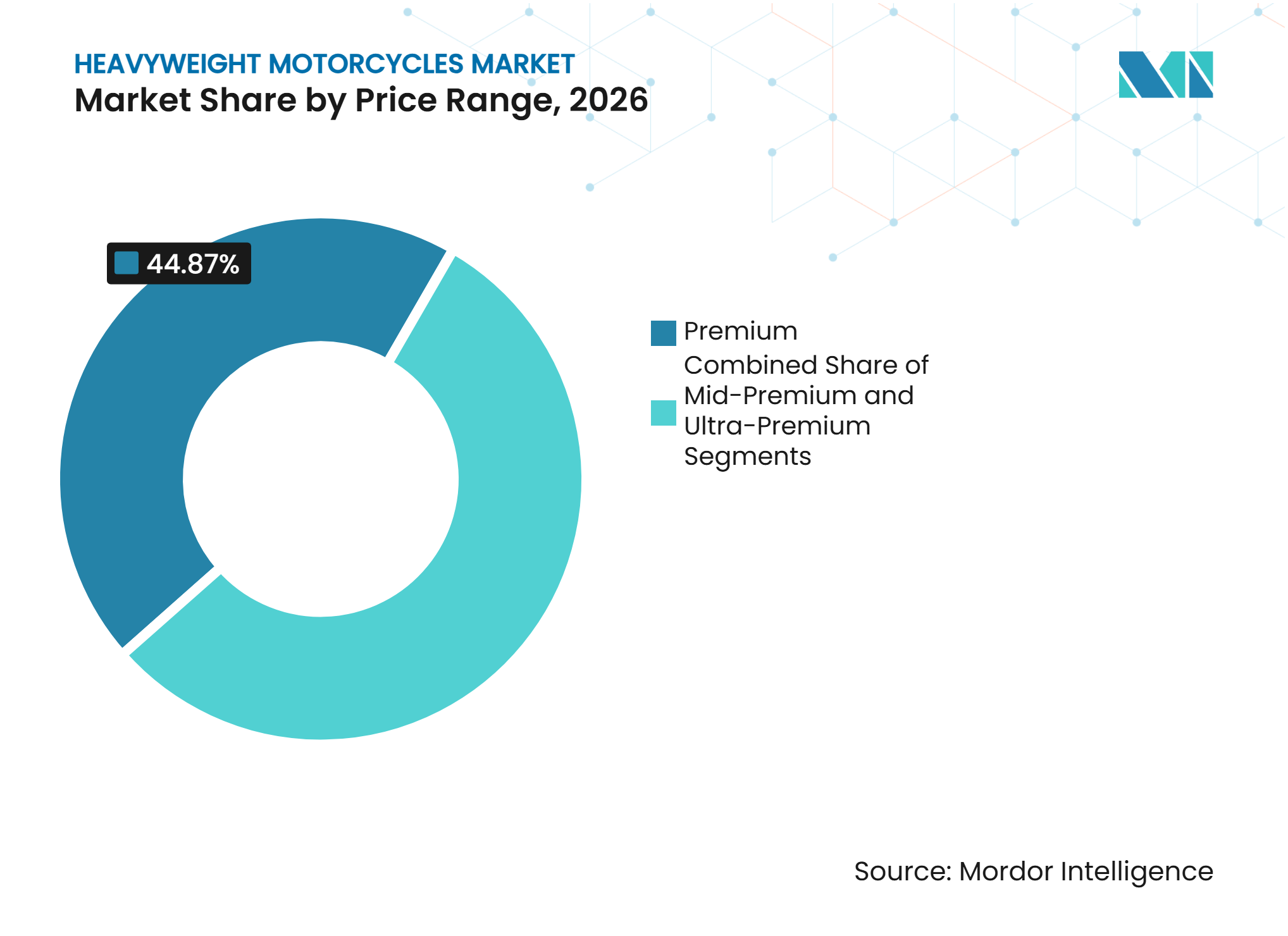
By price range, the premium segment in the Heavyweight motorcycles market accounted for 44.87% of total 2026 value, while ultra-premium motorcycles are projected to expand at a 6.89% CAGR through 2032.
-
By end user, individual buyers held 73.63% of market value in 2026, while commercial, rental, and police users are forecast to grow at a 7.22% CAGR through 2032.
-
By geography, North America in the Heavyweight motorcycles market accounted for 86.47% of market value in 2026, while Asia-Pacific is projected to expand at a 9.38% CAGR through 2032.
Note: Market numbers in this report are based on Mordor Intelligence's proprietary estimation framework, which combines nine months of actuals with Q4 projections for base year 2026.
Market Trends and Insights
Drivers Impact Analysis of Heavyweight Motorcycles Market*
| Driver | (~) % Impact on CAGR Forecast | Geographic Relevance | Impact Timeline |
|---|---|---|---|
| Growing Premiumization and Aspirational Upgrading | +1.3% | Global, with strongest pull in North America and emerging APAC markets | Long term (≥ 4 years) |
| Expansion of Adventure Touring and Motorcycle Tourism | +1.0% | Europe, North America, APAC core (India, Japan, Australia) | Medium term (2-4 years) |
| OEM Electrification and Performance EV Launches | +0.9% | North America and EU, with early gains in Japan and South Korea | Medium term (2-4 years) |
| Rising Disposable Income in Asia-Pacific Premium Segments | +0.8% | APAC core, spill-over to MEA | Long term (≥ 4 years) |
| Platform Sharing and Modular 700-1,000 cc Product Expansion | +0.7% | Global | Short term (≤ 2 years) |
| Factory-Fitted Connectivity and Software Features Increasing Ownership Value | +0.5% | North America & EU, with early gains in Japan and Australia | Medium term (2–4 years) |
| Source: Mordor Intelligence | |||
Growing Premiumization and Aspirational Upgrading
Premiumization supports the Heavyweight motorcycles market because buyers place greater weight on comfort, brand heritage, and ownership experience than on basic transport needs. This pattern shifts OEM attention toward revenue per vehicle rather than simply vehicle volume. Higher-priced motorcycles also carry larger opportunities for accessories, maintenance plans, and factory-approved customization. The original draft identifies demand from urban professionals in India, China, and Southeast Asia as a major source of this change. These buyers view a 700 cc or larger motorcycle as a leisure purchase and a personal expression. This position creates room for established manufacturers that can maintain a clear product difference and dependable dealer support.
Expansion of Adventure Touring and Motorcycle Tourism
Adventure touring expands the heavyweight motorcycle market by connecting vehicle demand with travel, guided rides, and equipment purchases. The rider often needs luggage, protective gear, navigation equipment, and riding apparel, which increases the value of each sale. Triumph launched the Tiger Sport 800 in March 2025 with cornering ABS, Bluetooth connectivity, 3 riding modes, Triumph Shift Assist, and more than 40 dedicated accessories. The product showed how a motorcycle launch can combine the vehicle with an accessory program from the first day. CFMOTO also presented the 1000MT-X at EICMA 2025 with KYB suspension, Brembo brakes, and Bosch ABS [1]. These launches show that adventure products now compete on integrated equipment and riding capability as much as engine size.
OEM Electrification and Performance EV Launches
Electrification in the heavyweight motorcycle market is currently driven more by product appeal than by routine commuting needs. Electric buyers in this category place value on torque, design, digital functions, and brand positioning. Royal Enfield announced in January 2025 that the Flying Flea FF-C6 would use Qualcomm technology for 4G, Bluetooth, Wi-Fi, voice assistance, cloud connectivity, and over-the-air updates [2]. These functions can support post-sale services and performance updates over the product life cycle. Bosch also presented connected two-wheeler safety and connectivity solutions at EICMA 2025, reflecting the growing role of electronics in motorcycle design. The opportunity is strongest for companies that can link software functions with dealer service and reliable customer support.
Rising Disposable Income in Asia-Pacific Premium Segments
Asia-Pacific is expanding the heavyweight motorcycle market as rising incomes and improved road infrastructure support leisure-oriented purchases. The region also benefits from local production and a broader range of available large-displacement models. Chongqing, an important Chinese manufacturing center, reported that motorcycle industry output increased 23.1% in the first half of 2025. The original research links this supply expansion with stronger demand for touring and premium motorcycles. Modular 700-1,000 cc platforms help manufacturers spread development costs across naked, sport-touring, and adventure models. This approach allows an OEM to adjust body style and equipment without designing a separate engine and chassis for every customer group.
Restraints Impact Analysis of Heavyweight Motorcycles Market*
| Restraint | (~) % Impact on CAGR Forecast | Geographic Relevance | Impact Timeline |
|---|---|---|---|
| High Purchase, Insurance, and Maintenance Costs | -0.9% | Global, most acute in price-sensitive APAC and South America | Long term (≥ 4 years) |
| Emission and Noise Compliance Costs | -0.6% | EU and select APAC markets (India BS VI, Japan, Taiwan) | Short term (≤ 2 years) |
| Heavy Battery Mass and Highway Range Penalty | -0.4% | North America, EU adventure and touring corridors | Medium term (2-4 years) |
| Aging Rider Base and Limited New-Rider Ergonomics | -0.3% | North America, Western Europe | Long term (≥ 4 years) |
| Source: Mordor Intelligence | |||
High Purchase, Insurance, and Maintenance Costs
Purchase prices, insurance, service work, tires, and financing can discourage potential heavyweight buyers. The pressure is greatest for riders moving up from smaller motorcycles because they face several cost increases at the same time. The original draft places premium cruisers and adventure motorcycles in a USD 10,000 to USD 25,000 price range. It also notes that younger European riders can face high insurance costs for motorcycles above 700 cc. These costs narrow the pipeline of new customers entering the Heavyweight motorcycles market. Certified pre-owned programs and subscription services can reduce some barriers, but their availability remains uneven across regions.
Emission and Noise Compliance Costs
Euro 5+ requirements have increased development and validation work for motorcycle producers. The framework requires tougher durability evidence for catalytic converters and wider noise measurement requirements. The requirements favor manufacturers with large engineering teams and established homologation capabilities. Battery weight remains a separate limit for electric heavyweight touring motorcycles because it affects handling, comfort, cargo capacity, and riding range. The European Transport Safety Council also called for mandatory ABS on all L3e-A1 motorcycles in September 2025, which could raise compliance costs in entry categories. These constraints may not stop demand, but they make entry products and long-distance electric motorcycles harder to position.
*Our forecasts treat driver/restraint impacts as directional, not additive. The impact forecasts reflect baseline growth, mix effects, and variable interactions.
Heavyweight Motorcycles Market Segment Analysis
By Engine Displacement:
Mid-Range Volume Supports the Category While Large Touring Models Grow FasterThe above 1,500 cc segment in the Heavyweight motorcycles market is forecast to expand at a 6.33% CAGR through 2032, the fastest rate within engine displacement. Buyers in this range seek long-distance comfort, integrated infotainment, strong torque, and prestige positioning. These motorcycles tend to generate high revenue per sale even when their volumes are modest. They also require specialized dealership knowledge because customers expect detailed product demonstrations and high-quality servicing. The sales case often includes seating, luggage, navigation, and comfort upgrades alongside the motorcycle itself. The original research associates the segment with ultra-premium touring and customized products across the heavyweight motorcycles industry. BMW's R 1300 GS Adventure provides a related example of continued investment in high-performance, large-capacity motorcycle platforms.
The 700-1,000 cc segment in the Heavyweight motorcycles market accounted for 57.22% of category value in 2026. It combines accessible performance, manageable weight, and a price point that reaches more riders than the largest touring motorcycles. This range can suit riders who want meaningful highway performance without moving to the physical scale of an ultra-premium tourer. It also gives manufacturers a practical step-up product for customers leaving smaller motorcycles. Manufacturers can use a common platform for a naked motorcycle, sport-tourer, and adventure derivative. This flexibility reduces engineering expense while maintaining distinct retail offers across the heavyweight motorcycles industry. The 1,000-1,500 cc range remains important for riders who want advanced electronics and touring ability. The resulting structure places high-volume demand in the middle of the displacement range and higher revenue growth at the top.



By Motorcycle Type:
Cruiser Loyalty Supports Value While Adventure Models Expand Product DemandAdventure motorcycles in the heavyweight motorcycles market are projected to grow at a 6.39% CAGR through 2032, the highest rate among motorcycle types. Their appeal comes from their ability to serve long-distance road travel, light off-road use, and daily riding. This versatility is important for buyers who do not want to own separate motorcycles for commuting and touring. It also supports dealer sales of equipment designed for weather protection, storage, navigation, and passenger comfort. Manufacturers increasingly package these models with luggage, navigation, safety equipment, and apparel. Triumph made that approach visible with the 2025 Tiger Sport 800 and its dedicated accessory range. Sport and superbike models continue to support premium pricing through performance positioning and limited editions.
Cruisers in the Heavyweight motorcycles market held 68.29% of category value in 2026. Their position rests on established rider clubs, rallies, touring habits, and strong emotional ties to heritage brands in North America. The body style remains closely tied to social riding and long-established ownership communities. This gives dealers recurring contact points through events, service visits, accessory installations, and replacement sales. Replacement cycles are long, but repeat purchases can remain brand-led. Harley-Davidson reported 132,535 global retail units in 2025, a 12% decline from the prior year, while its HDMC segment reported USD 3.58 billion in revenue. The current pressure highlights the need for established cruiser producers to refresh product appeal without losing the features that sustain buyer loyalty.
By Propulsion:
ICE Retains Touring Advantages While Electric Models Add Digital FeaturesICE in the Heavyweight motorcycles market accounted for 64.39% of category value in 2026. Existing fueling access, mature servicing networks, and dependable long-range capability keep ICE central to heavyweight touring. Riders on extended routes can refuel quickly and rely on established dealer networks when traveling across regions. This practical advantage remains significant for customers who prioritize multi-day trips or travel with passengers and luggage. Variable valve timing, ride-by-wire throttles, and advanced emissions controls continue to improve the performance and efficiency of combustion motorcycles. Euro 5+ compliance can increase cost, but it also raises the technical threshold for competing platforms. BMW reported that its motorcycles business delivered 202,563 motorcycles in 2025, with the R 1300 GS Adventure and R 1300 GS among the highest-volume models.
Electric motorcycles in the Heavyweight motorcycles market are forecast to expand at a 7.01% CAGR through 2032. Their buyer profile differs from that of the mainstream touring rider because connected functions, immediate torque, and technological credentials take greater importance. These products can give manufacturers a way to build new customer relationships through software and digital services. The technology can also help riders manage vehicle status, ride modes, and selected safety functions. Royal Enfield's Flying Flea platform uses cloud-linked functions and over-the-air update capability that are difficult to duplicate in older mechanical architectures. However, the battery mass needed for a large cruiser or touring motorcycle limits comfort and range on multi-day routes. Electric development therefore has the strongest near-term fit in shorter rides and premium urban use rather than every heavyweight application.
By Price Range:
Premium Models Form the Core While Ultra-Premium Products Raise Revenue Per SaleUltra-premium motorcycles in the Heavyweight motorcycles market are forecast to expand at a 6.89% CAGR through 2032. Buyers in this tier prioritize engineering, limited availability, personalization, and brand status. The purchase decision can include dealership experience and access to events as well as vehicle specifications. Buyers may also expect personalized delivery, tailored accessories, and continuing support after registration. Factory customization, brand events, apparel, and touring programs can extend the relationship after the vehicle purchase. The original draft identifies these services as important sources of post-sale revenue. This tier gives manufacturers an opportunity to protect margins despite modest unit volumes. It also depends on a strong dealer experience, as service quality is part of the product offering.
The premium segment in the Heavyweight motorcycles market accounted for 44.87% of category value in 2026. It faces pressure from Chinese brands offering competitive equipment at lower entry prices. Buyers in this range are likely to compare standard technology and component brands closely before choosing a model. The segment therefore rewards manufacturers that can present clear value without reducing the quality of the ownership experience. CFMOTO's 1000MT-X uses KYB suspension, Brembo brakes, and Bosch ABS, placing recognized component brands on a product aimed at the premium adventure category. The entry-premium range remains important because it introduces new riders to heavier motorcycles before later trade-ups. OEMs need to defend value through design, dealer coverage, and service support rather than competing only on price.

By End User:
Individual Buyers Form the Base While Institutional Fleets Expand FasterCommercial, rental, and police users in the Heavyweight motorcycles market are forecast to grow at a 7.22% CAGR through 2032. These buyers create demand through fleet leasing, guided-tour operations, rental programs, and municipal procurement. Their purchasing processes differ from individual retail sales because vehicle uptime, equipment consistency, and service access are central requirements. Fleet operators can also influence which motorcycle models new riders encounter during travel or professional use. A standardized police fleet can provide recurring service and replacement work for the manufacturer and local dealer. Springfield, Massachusetts sought 2 Harley-Davidson FLHTP Electra Glide police motorcycles in a 2025 procurement process. Coral Gables approved a lease agreement for 11 Harley-Davidson motorcycles in 2025, while Orlando documented a lease agreement for 17 Electra Glide motorcycles.
Individual buyers in the Heavyweight motorcycles market accounted for 73.63% of category value in 2026. They treat the motorcycle as a leisure asset and often buy accessories, parts, servicing, and branded apparel over the ownership period. Many customers evaluate the vehicle as part of a riding lifestyle rather than only as a method of transport. This makes comfort, design, sound, technology, and the availability of local service meaningful elements of the purchase decision. The original research notes replacement cycles of 4-7 years for many heavyweight customers. That pattern makes customer retention and dealer service important commercial factors. Adventure rental operators also add larger adventure motorcycles to serve guided travel and multi-day riding packages. These fleet purchases complement, rather than replace, the individual lifestyle buyer who remains the core of the category.
Geography Analysis
North America: Established Retail Systems Support Premium Motorcycle Value
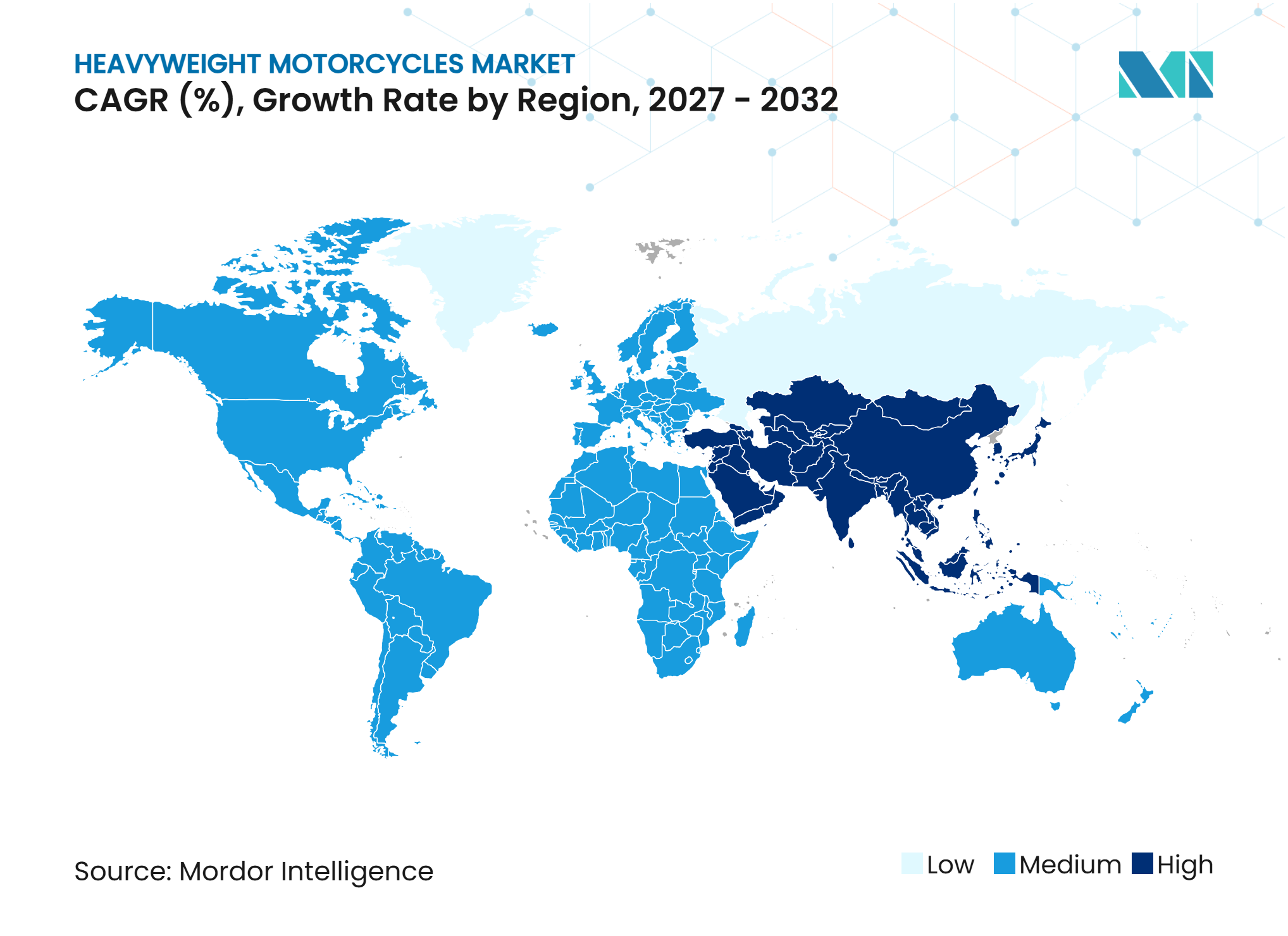
North America accounted for 86.47% of the global heavyweight motorcycles market value in 2026. The region has an established network of specialist dealers, financing programs, insurance options, used-motorcycle programs, clubs, and police fleet channels. These systems help manufacturers retain customers after the initial purchase through service, accessories, and replacement motorcycles. Harley-Davidson reported North American retail sales of 89,132 motorcycles in 2025. It also reduced dealer inventory by 17% during the year, a move intended to align wholesale supply more closely with retail demand. Police procurement provides a separate institutional channel, as shown by the 2025 municipal actions in Springfield, Coral Gables, and Orlando. The region remains important for high-price cruisers and tourers because its service infrastructure supports large, accessory-rich motorcycles.
Asia-Pacific: Income Growth and Local Manufacturing Expand the Buyer Base
Asia-Pacific is forecast to grow at a 9.38% CAGR through 2032. The region benefits from rising disposable incomes, expanding road networks, local manufacturing capabilities, and a growing segment of riders moving beyond basic transportation motorcycles. Chongqing reported 23.1% growth in motorcycle industry output during the first half of 2025. China's manufacturing base supports lower entry prices and faster product development for larger motorcycles. Japan, South Korea, Thailand, Indonesia, India, and China each present distinct buyer segments with established relationships with Japanese or domestic brands. Digital features and connected safety systems are particularly relevant as local manufacturers look to improve product offerings. Growth in the Asia-Pacific market is further supported by the gradual shift from smaller motorcycles to premium and touring-oriented products.
Europe, South America, and the Middle East and Africa: Different Demand Conditions Shape Product Opportunity
Europe remains important for premium touring, adventure, and performance motorcycles, although Euro 5+ compliance factors affect product cost and timing. ACEM reported that registrations in the 5 largest European markets fell 12.9% in 2025 to 1,002,848 units, while registrations remained 14.7% above the 2019 level. BMW delivered 118,814 motorcycles in Europe in 2025, and Italy, Spain, Portugal, and the Netherlands recorded their best BMW Motorrad results. South America has a younger heavyweight opportunity because broader motorcycle demand and road development can spur progression to larger models. The Middle East and Africa contain smaller but important pockets of ultra-premium demand, especially among high-income buyers in the GCC. Turkey and Morocco can also support adventure riding as tourism routes and motorcycle travel services develop. These mixed markets need product ranges and retail strategies that reflect local affordability, road use, and compliance conditions.
Competitive Landscape
Market Concentration
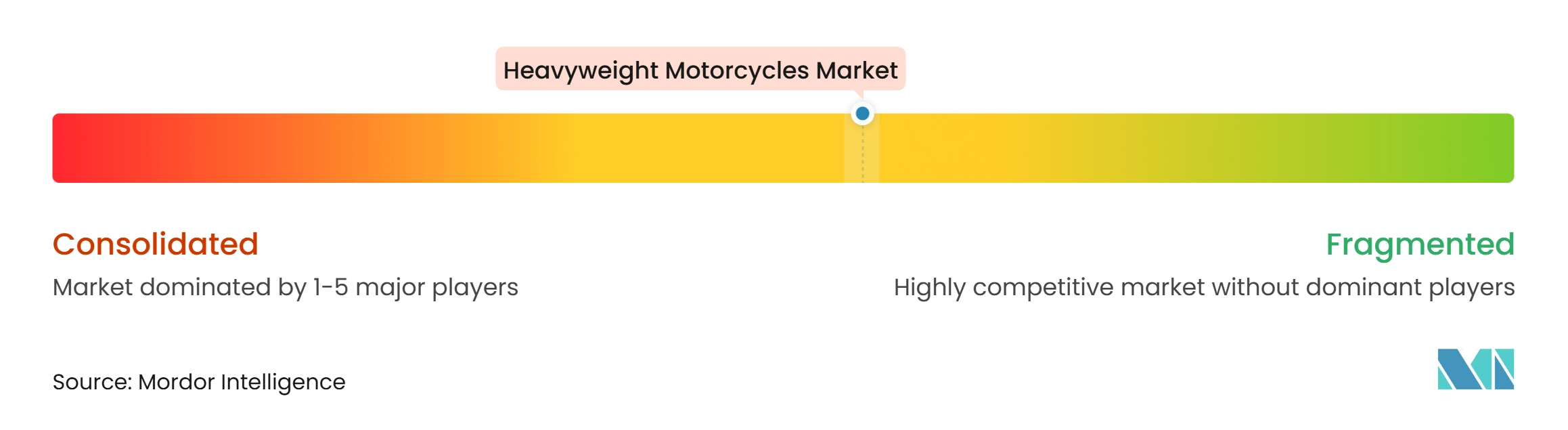
The heavyweight motorcycles market is moderately concentrated in its premium tiers. BMW Motorrad, Harley-Davidson, Honda, Kawasaki, and Triumph have established brand recognition, dealer reach, and experience in high-price motorcycles. Their positions are supported by complete product portfolios, after-sales support, and the ability to meet complex safety and emissions requirements. BMW delivered 202,563 motorcycles worldwide in 2025, marking its fourth consecutive year above 200,000 units. The R 1300 GS Adventure accounted for 33,570 units, and BMW reported a 4.1 percentage point gain in Germany's over-500 cc segment in 2025. Established brands can use their dealer networks to provide test rides, accessories, and technical support that add value beyond the original transaction.
Harley-Davidson illustrates both the strengths and pressures facing legacy heavyweight brands. The company reported an HDMC operating loss of USD 29 million in 2025, with revenue of USD 3.58 billion and retail unit sales down 12% to 132,535 units. It reduced dealer inventory by 17%, prioritizing demand-led supply over inventory growth. Triumph strengthened its adventure offering in November 2025 with the Tiger Sport 800 Tour, following the March 2025 launch of the Tiger Sport 800. For cruiser-focused manufacturers, the priority is to preserve recognizable design while improving relevance for younger customers. For adventure-focused manufacturers, the priority is broader equipment options and versatile road performance. Product planning must link new models with dealer training and a credible parts supply.
Chinese manufacturers present the most direct pricing challenge in the entry-premium and upper-mid ranges. CFMOTO's 1000MT-X combines a 946.2 cc parallel-twin engine with KYB suspension, Brembo brakes, and Bosch ABS, demonstrating how technology from recognized suppliers can be assembled into a competitively priced heavyweight platform. Euro 5+ and UNECE R41.05 requirements increase the importance of engineering scale and homologation capacity, meaning the competitive gap will depend on product quality, dealer support, software capability, and compliance execution, not on vehicle price alone. Larger incumbents retain an advantage where regulation requires extensive testing across multiple markets. Newer manufacturers must demonstrate that their retail and service support matches the visible quality of the motorcycle. Distribution quality remains a central competitive issue in the entry-premium range. Combined company market shares are not available, so a company-specific market share ranking cannot be substantiated.
Heavyweight Motorcycles Industry Leaders
-
Harley-Davidson, Inc.
-
BMW AG
-
Honda Motor Co., Ltd.
-
Yamaha Motor Co., Ltd.
-
Kawasaki Heavy Industries, Ltd.
- *Disclaimer: Major Players sorted in no particular order
Heavyweight Motorcycles Market Companies Covered in this Report
- Harley-Davidson, Inc.
- BMW AG
- Triumph Motorcycles Limited
- Honda Motor Co., Ltd.
- Kawasaki Heavy Industries, Ltd.
- Yamaha Motor Co., Ltd.
- Suzuki Motor Corporation
- Bajaj Auto Limited
- Indian Motorcycle (standalone business, majority-owned by Carolwood LP)
- Piaggio & C. S.p.A.
- MV Agusta Motor S.p.A.
- Eicher Motors Limited
- Qianjiang Motorcycle Group Co., Ltd.
- Zhejiang CFMOTO Power Co., Ltd.
- Zero Motorcycles, Inc.
- Energica Motor Company S.p.A.
- TVS Motor Company Limited
- Loncin Motor Co., Ltd.
- Zhongneng Vehicle Group Co., Ltd.
Recent Industry Developments in Heavyweight Motorcycles Market
- November 2026: Moto Honda da Amazônia in Brazil has announced an investment plan totaling approximately 3.3 billion BRL. The plan includes the expansion of production lines at its plant in Manaus, Amazonas, with the new lines scheduled to become operational by 2029.
- October 2026: Triumph launched the Tiger 1200 in India in two variants: GT Pro and Rally Explorer. The motorcycle is expected to be available from March 2027, with pricing to be announced closer to the booking date. The updated 1,160cc three-cylinder engine produces 158 PS at 9,250 rpm and 130 Nm at 6,750 rpm. It uses a six-speed gearbox and shaft drive.
- October 2026: Triumph launched the updated Tiger 1200 with a 1200 triple engine producing 158 PS, SHOWA semi-active suspension that lowers the seat by 30 mm at standstill, a 7-inch touchscreen with smartphone mirroring, and Bosch radar-based rider-assistance systems.
- January 2026: Harley-Davidson revealed 13 new 2026 models, including updated Street Glide and Road Glide touring motorcycles with the Milwaukee-Eight VVT 117 engine, a new Pan America 1250 adventure model, and five CVO models.
Global Heavyweight Motorcycles Market Report Scope
The Heavyweight Motorcycles Market is Segmented by Engine Displacement (700–999 cc, 1,000–1,500 cc, and Above 1,500 cc), Motorcycle Type (Cruiser, Touring, Sports/Superbike, Adventure, Naked/Standard, and Other), Propulsion (ICE and Electric), Price Range (Mid-Premium, Premium, and Ultra-Premium), End User (Individual, Commercial, and Rental and Police), and Geography (North America, Europe, Asia-Pacific, South America, and Middle East and Africa). The Market Forecasts are Provided in Terms of Value (USD) and Volume (Units).
Segmentation Overview
| 700-1,000 cc |
| 1,000-1,500 cc |
| Above 1,500 cc |
| Cruiser |
| Touring |
| Sports/Superbike |
| Adventure |
| Naked/Standard |
| Other Motorcycle Types |
| ICE |
| Electric |
| Mid-Premium |
| Premium |
| Ultra-Premium |
| Individual |
| Commercial, Rental and Police |
| North America | United States |
| Canada | |
| Mexico | |
| Europe | Germany |
| France | |
| Italy | |
| Spain | |
| United Kingdom | |
| Russia | |
| Rest of Europe | |
| Asia-Pacific | China |
| Japan | |
| India | |
| South Korea | |
| Thailand | |
| Indonesia | |
| Rest of Asia-Pacific | |
| South America | Brazil |
| Argentina | |
| Colombia | |
| Rest of South America | |
| Middle East and Africa | Saudi Arabia |
| United Arab Emirates | |
| Turkey | |
| South Africa | |
| Egypt | |
| Morocco | |
| Rest of Middle East and Africa |
| By Engine Displacement | 700-1,000 cc | |
| 1,000-1,500 cc | ||
| Above 1,500 cc | ||
| By Motorcycle Type | Cruiser | |
| Touring | ||
| Sports/Superbike | ||
| Adventure | ||
| Naked/Standard | ||
| Other Motorcycle Types | ||
| By Propulsion | ICE | |
| Electric | ||
| By Price Range | Mid-Premium | |
| Premium | ||
| Ultra-Premium | ||
| By End User | Individual | |
| Commercial, Rental and Police | ||
| By Geography | North America | United States |
| Canada | ||
| Mexico | ||
| Europe | Germany | |
| France | ||
| Italy | ||
| Spain | ||
| United Kingdom | ||
| Russia | ||
| Rest of Europe | ||
| Asia-Pacific | China | |
| Japan | ||
| India | ||
| South Korea | ||
| Thailand | ||
| Indonesia | ||
| Rest of Asia-Pacific | ||
| South America | Brazil | |
| Argentina | ||
| Colombia | ||
| Rest of South America | ||
| Middle East and Africa | Saudi Arabia | |
| United Arab Emirates | ||
| Turkey | ||
| South Africa | ||
| Egypt | ||
| Morocco | ||
| Rest of Middle East and Africa | ||
Key Questions Answered in the Report
What is the projected value of the heavyweight motorcycles category by 2032?
The category is projected to reach USD 28.82 billion by 2032, growing at a 4.92% CAGR from 2027.
Which motorcycle type is expanding fastest?
Adventure motorcycles in the Heavyweight motorcycles market are projected to expand at a 6.39% CAGR through 2032, supported by demand for touring capability and factory accessory packages.
Why do cruisers remain important in heavyweight motorcycles?
Cruisers in the Heavyweight motorcycles market held 68.29% of 2026 value because established rider communities, heritage brands, and long replacement cycles support repeat demand.
Which region has the strongest growth outlook for heavyweight motorcycles?
Asia-Pacific is forecast to grow at a 9.38% CAGR through 2032 as incomes, road infrastructure, and local manufacturing develop.
What limits adoption of heavyweight electric touring motorcycles?
Battery mass and range remain important barriers for long-distance touring because they affect vehicle weight, comfort, and charging needs.