
Heavy Metal Removal Agent Market Size and Share
Market Overview
| Study Period | 2021 - 2031 |
|---|---|
| Market Size (2026) | USD 3.47 Billion |
| Market Size (2031) | USD 4.81 Billion |
| Growth Rate (2026 - 2031) | 6.77 % |
| Fastest Growing Market | Asia-Pacific |
| Largest Market | Asia-Pacific |
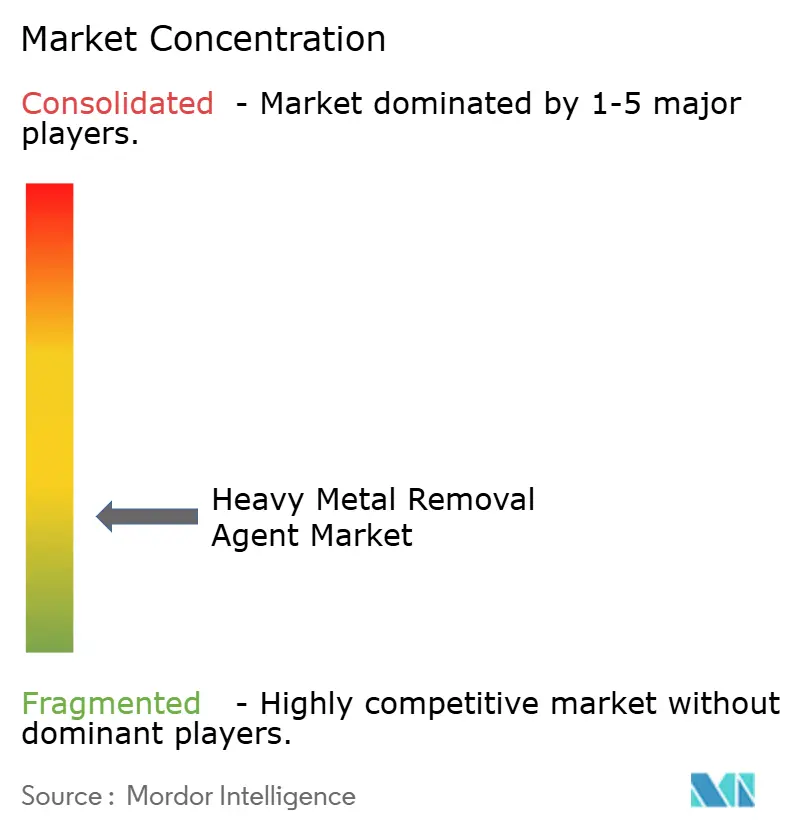
| Market Concentration | Low |
Major Players *Disclaimer: Major Players sorted in no particular order Image © Mordor Intelligence. Reuse requires attribution under CC BY 4.0. | |
Heavy Metal Removal Agent Market Analysis by Mordor Intelligence
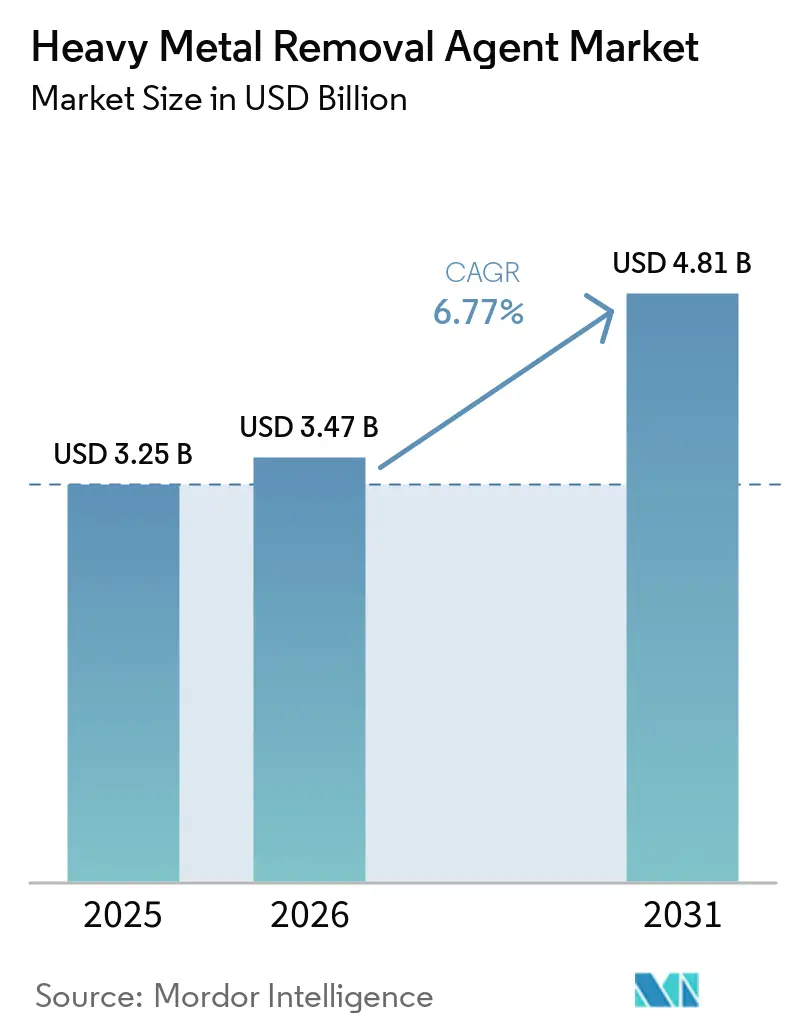
The Heavy Metal Removal Agent Market size was valued at USD 3.25 billion in 2025 and is estimated to grow from USD 3.47 billion in 2026 to reach USD 4.81 billion by 2031, at a CAGR of 6.77% during the forecast period (2026-2031). The heavy metal removal agent market is supported by tighter discharge standards, investment in battery materials production, and wider use of zero liquid discharge systems, which require operators to control metal concentrations before water can be discharged, recycled, or returned to a production process. These factors increase the number of treatment steps and raise the need for chelants, precipitants, adsorbents, and ion exchange media, particularly where a primary treatment stage does not achieve the required discharge limit or where wastewater composition changes during production. Requirements affecting drinking water are also raising demand for treatment systems that can address lead, arsenic, and other contaminants together, rather than relying on a material designed for a single contaminant and a narrowly defined influent stream. Suppliers are responding through renewable-carbon formulations, selective recovery technologies, and integrated treatment design tools, reflecting customer demand for products that can fit existing plants, meet sustainability criteria, and support complex treatment trains. Higher operating costs, persistent conventional chelants, and mixed industrial effluents remain important limits on adoption in the heavy metal removal agent market, because they raise the cost of compliance, complicate treatment performance, and can delay investment until regulation or customer requirements become more urgent.
Key Report Takeaways
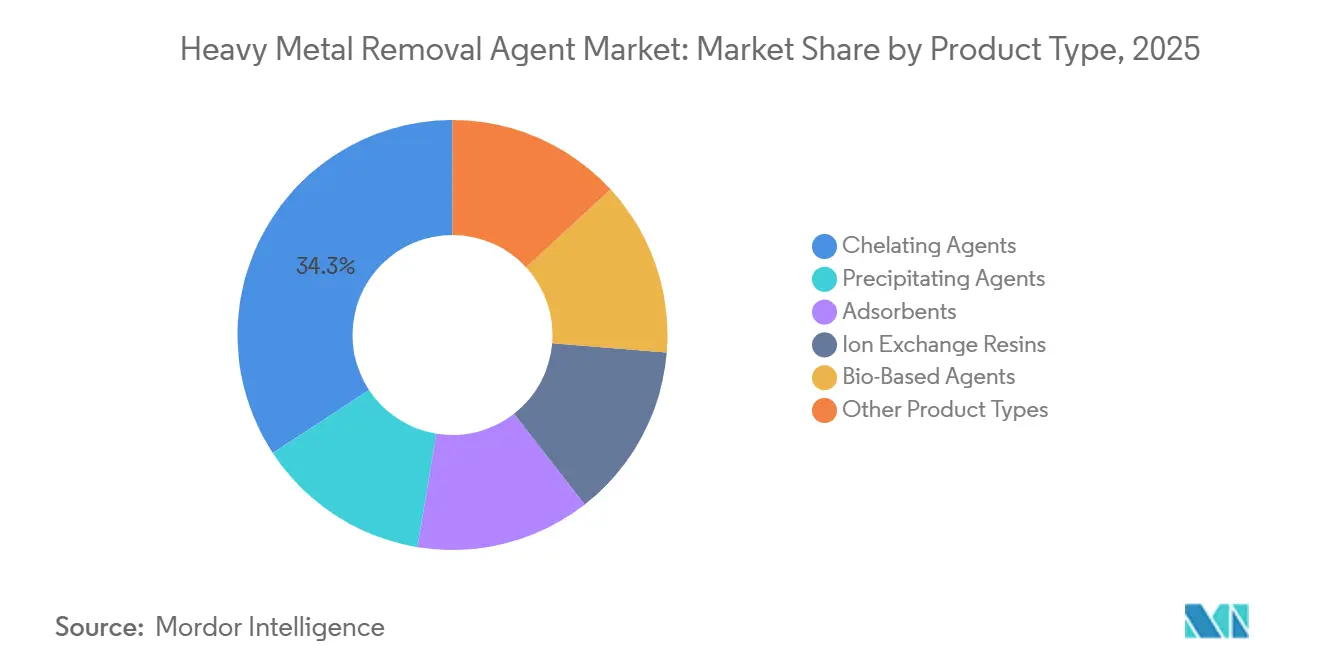
- By product type, chelating agents held 34.25% of the heavy metal removal agent market share in 2025, while bio-based agents are projected to advance at a 7.23% CAGR through 2031.
- By application, industrial wastewater treatment held 46.17% of the heavy metal removal agent market share in 2025, while soil and groundwater remediation is projected to advance at a 7.71% CAGR through 2031.
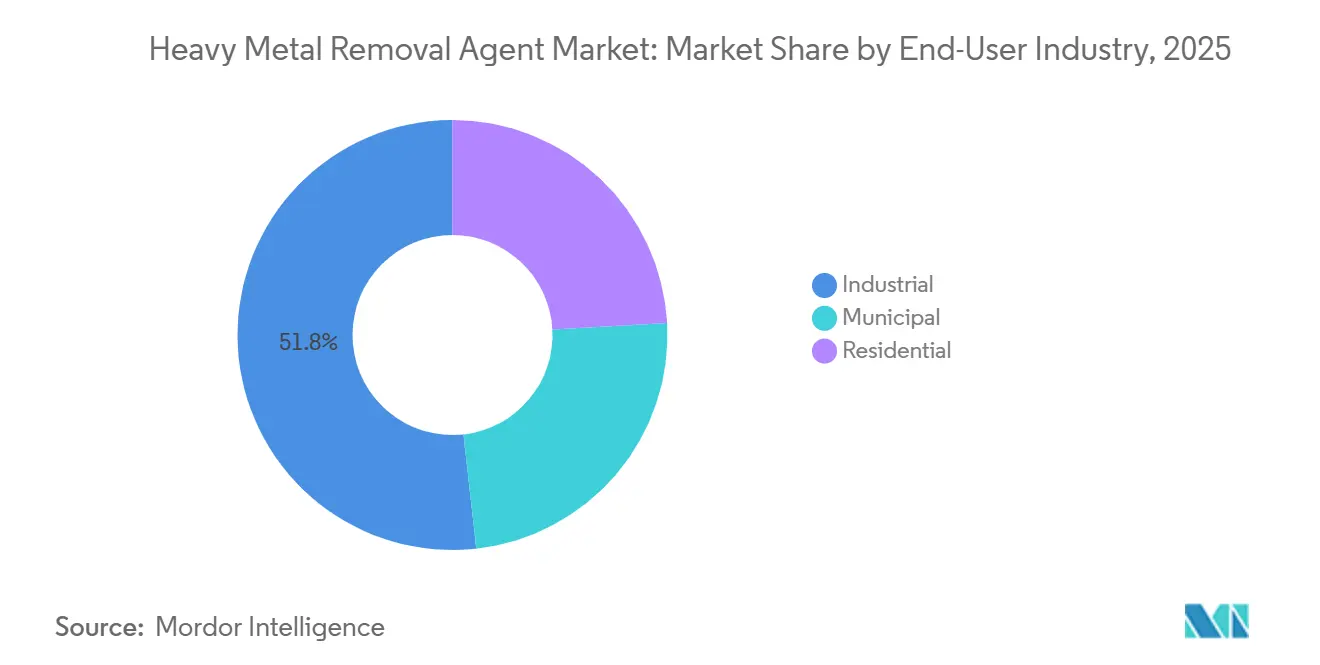
- By end-user industry, industrial held 51.76% of the heavy metal removal agent market share in 2025, while residential is projected to advance at a 7.80% CAGR through 2031.
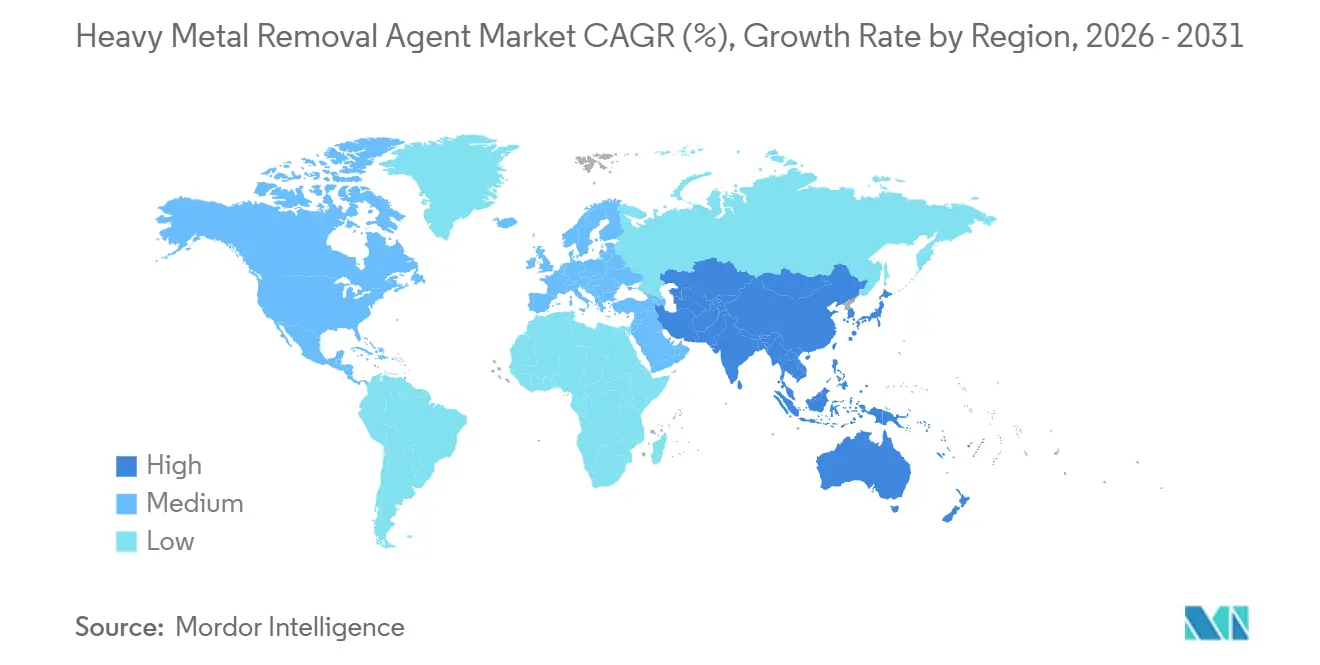
- By geography, Asia-Pacific held 37.53% of the heavy metal removal agent market share in 2025 and is projected to advance at a 7.44% CAGR through 2031.
Note: Market size and forecast figures in this report are generated using Mordor Intelligence’s proprietary estimation framework, updated with the latest available data and insights as of January 2026.
Market Trends and Insights
Drivers Impact Analysis of Heavy Metal Removal Agent Market*
| Driver | (~) % Impact on CAGR Forecast | Geographic Relevance | Impact Timeline |
|---|---|---|---|
| Tightening Heavy-Metal Discharge and Drinking-Water Standards | +2.1% | Global | Short term (≤ 2 years) |
| Industrial Expansion in Mining, Electronics and Battery Manufacturing | +1.8% | APAC core, spillover to North America & Europe | Medium term (2–4 years) |
| Water Scarcity, Industrial Reuse and Zero-Liquid-Discharge Programs | +1.4% | Global, strongest in APAC & MEA | Medium term (2–4 years) |
| Public-Health Response to Lead, Arsenic, Mercury and Chromium Exposure | +0.9% | North America, Europe, APAC | Short term (≤ 2 years) |
| Selective Metal Recovery Creating a By-Product Revenue Stream | +0.5% | Global, early gains in North America & Europe | Long term (≥ 4 years) |
| Source: Mordor Intelligence | |||
Tightening Heavy-Metal Discharge and Drinking-Water Standards
The heavy metal removal agent market is responding to a stricter compliance baseline across industrial discharge and drinking water systems, where treatment decisions increasingly depend on both the final contaminant limit and the ability to document consistent results through formal sampling programs. The U.S. Environmental Protection Agency finalized the Lead and Copper Rule Improvements in October 2024 and reduced the lead action level from 0.015 mg/L to 0.010 mg/L. The rule also tightened sampling requirements at schools and childcare facilities[1]. The 2026 recast of the European Union Industrial Emissions Directive introduces Best Available Techniques-associated emission levels for industrial wastewater and increases the need for multi-stage treatment at new installations.
Industrial Expansion in Mining, Electronics and Battery Manufacturing
Battery cathode production is expanding the heavy metal removal agent market because its wastewater contains nickel, cobalt, manganese, lithium, and fluoride. Standard hydroxide precipitation cannot reduce these contaminants to the required discharge levels in a single treatment stage. Facilities therefore use precipitation, selective ion exchange, membrane polishing, and, in some cases, electrochemical recovery. A 2026 review of battery manufacturing and recycling wastewater found that integrated membrane and electrochemical approaches can support high metal recovery and industrial water reuse. A 2025 review found that reverse osmosis achieved removal efficiencies of up to 99.9%, although high-salinity battery effluents increased fouling risk and required effective upstream treatment. LANXESS presented metal ore purification solutions for battery electrode production at Aquatech 2025, showing the link between ion exchange materials and battery supply chains. Selective metal recovery is also becoming relevant because recovered metals can create value alongside compliance benefits.
Water Scarcity, Industrial Reuse and Zero-Liquid-Discharge Programs
Water scarcity and industrial reuse requirements are increasing chemical demand in the heavy metal removal agent market. Zero Liquid Discharge (ZLD) systems require metals to reach very low concentrations before water can be recycled. This configuration uses higher chemical doses than partial-discharge systems and creates concentrated streams that require further treatment before crystallization, which extends chemical use beyond the initial removal stage and increases the importance of reliable polishing chemistry. A 2026 study of a chemical enterprise found that treatment chemical selection was among the operational factors affecting ZLD system efficiency. As ZLD deployment expands, the heavy metal removal agent market benefits from recurring demand for chelants and other polishing agents in high-recovery treatment trains.
Public-Health Response to Lead, Arsenic, Mercury and Chromium Exposure
Public health concerns are supporting broader adoption of multi-contaminant treatment in the heavy metal removal agent market. The U.S. lead rule created stronger incentives for systems that remove lead from drinking water. This evidence supports interest in materials that bind lead, arsenic, and hexavalent chromium instead of targeting only one metal. In March 2025, South Korea’s National Nakdong River Biological Resources Institute announced a Dechloromonas microorganism that absorbed cadmium and lead ions while reducing chlorinated compounds by more than 80%. Drinking water requirements for arsenic continue to increase the performance expectations placed on treatment systems serving sensitive catchments.
Restraints Impact Analysis of Heavy Metal Removal Agent Market*
| Restraint | (~) % Impact on CAGR Forecast | Geographic Relevance | Impact Timeline |
|---|---|---|---|
| High Total Cost of Ownership for Advanced Media and Resin Systems | -1.8% | Global | Short term (≤ 2 years) |
| Persistence and Remobilization Risk of Conventional Chelants | -1.2% | Europe, North America | Medium term (2–4 years) |
| Treatment Performance Volatility from Complexed Metals and Mixed Effluents | -0.7% | Global | Medium term (2–4 years) |
| Source: Mordor Intelligence | |||
High Total Cost of Ownership for Advanced Media and Resin Systems
The cost of advanced polishing systems limits adoption in the heavy metal removal agent market, especially among mid-sized industrial operators that must compare compliance investments against simpler precipitation systems and may lack the scale to absorb recurring regeneration and disposal costs. For high-concentration mixed-metal streams above 50 mg/L total metals, hydroxide or sulfide precipitation provides a lower-cost primary treatment route. Treatment to limits below 0.1 mg/L requires ion exchange or selective adsorption media, regeneration chemicals, and spent-media disposal. Complexed metals, including metal-ethylenediaminetetraacetic acid (EDTA) complexes, also make treatment performance less stable because they can pass through primary precipitation and require additional processing.
Persistence and Remobilization Risk of Conventional Chelants
Conventional chelants create a sustainability constraint for the heavy metal removal agent market. EDTA was widely used in industrial formulations, but it is not readily biodegradable. In receiving water bodies, persistent EDTA can mobilize metals that had previously settled in sediments. This effect can reduce the environmental benefit of upstream treatment and raise liability concerns for remediation projects. European regulatory requirements and ecolabel criteria are increasing the demand for biodegradable alternatives. Ethylenediamine-N, N′-disuccinic acid (EDDS) is a biodegradable alternative, but its higher cost can slow substitution in price-sensitive applications.
*Our forecasts treat driver/restraint impacts as directional, not additive. The impact forecasts reflect baseline growth, mix effects, and variable interactions.
Heavy Metal Removal Agent Market Segment Analysis
By Product Type:
Chelating Agents Lead Demand, While Bio-Based Agents AdvanceChelating agents held 34.25% of the heavy metal removal agent market size in 2025. They complex metal ions across a pH range of 2 to 12 and remain important in the polishing stage of multi-step treatment trains. Nouryon’s Dissolvine GL Premium contains 55% active L-glutamic acid, N,N-diacetic acid (GLDA). The product was used in industrial cleaning formulations and gained traction in water treatment because it is compatible with downstream membrane filtration. Precipitating agents serve as primary treatment, while adsorbents are relevant where per- and polyfluoroalkyl substances (PFAS) must also be removed. Ion exchange resins retain a role in polishing and selective recovery of lead, cadmium, copper, and nickel at concentrations below 10 mg/L.
Bio-based agents are projected to advance at a 7.23% CAGR through 2031 in the heavy metal removal agent market. Their adoption reflects a continuing shift within the heavy metal removal agent market and obligations under the European Union Registration, Evaluation, Authorisation and Restriction of Chemicals Regulation (REACH), the European Union Ecolabel, and the U.S. Environmental Protection Agency Safer Choice Program. Nouryon launched the Dissolvine MAX range in October 2025 with 100% renewable carbon content and International Sustainability and Carbon Certification PLUS (ISCC PLUS). A 2026 review reported that biosorption accounted for 54.4% of the biological removal approaches reviewed for battery-industry effluents. Metal-organic framework (MOF) sorbents have tunable pore structures and high adsorption capacity, but they remain at the pre-commercial stage within the forecast period.

By Application:
Industrial Wastewater Treatment Leads, Soil and Groundwater Remediation Grows FastestIndustrial wastewater treatment held 46.17% of the heavy metal removal agent market size in 2025, giving the heavy metal removal agent market a large installed base of continuous-treatment users. Metal finishing, mining, battery manufacturing, and semiconductor fabrication require continuous treatment to comply with discharge requirements. Multi-barrier treatment trains combine primary precipitation with ion exchange polishing and provide more reliable performance under changing inlet conditions. Municipal water treatment uses coagulants and flocculants to remove particulate and dissolved metals during drinking water clarification. Industrial waste management also uses chelating agents to limit metal remobilization from process liquors, filter cakes, and landfill leachate. SNF Group’s METALSORB illustrates the shift toward application-specific chelating products for mine water and pyrometallurgical cooling circuits.
Soil and groundwater remediation is projected to advance at a 7.71% CAGR through 2031. Stricter environmental quality standards and site-closure liability requirements are extending remediation depth and duration. These conditions increase the consumption cycle for chelants used in pump-and-treat and in-situ chemical treatment configurations. The U.S. Environmental Protection Agency proposed the Sixth Unregulated Contaminant Monitoring Rule (UCMR 6) on July 1, 2026. It would begin monitoring additional heavy-metal co-contaminants from 2028 and could support later regulatory determinations. A 2026 Nature Sustainability paper described sulfur-mediated electrochemical copper recovery from industrial wastewater at 2.02 kg per m² over 250 hours of continuous operation, with net electricity generation.
By End-User Industry:
Industrial Leads, While Residential Gains MomentumIndustrial held 51.76% of the heavy metal removal agent market size in 2025. Continuous operations in metal processing, mining, battery cathode manufacturing, and semiconductor production create substantial effluent treatment needs. Nickel, cobalt, and manganese removal from cathode production wastewater is a new source of industrial demand. A 2026 review found that combined membrane and electrochemical treatment can recover metals and enable water reuse from battery manufacturing effluents. Kurita Water Industries Ltd.’s Kuriflock line is designed for the precipitation of heavy metals from metallurgical, refinery, and incineration effluents. Application-engineered products retain value where wastewater composition changes frequently.
The residential segment is projected to advance at a 7.80% CAGR through 2031. The 2024 Lead and Copper Rule Improvements strengthened the case for point-of-use (POU) filters containing chelating or ion exchange media. These filters can support household responses to lead and arsenic concerns. Multi-contaminant drinking water treatment remains important where systems must address more than one regulated contaminant. Municipal users continue to purchase coagulants, flocculants, and selective polishing agents for urban drinking water and wastewater plants. Infrastructure upgrades in Europe and North America support this demand across the heavy metal removal agent market.
Geography Analysis
APAC Heavy Metal Removal Agent Market
Asia-Pacific held 37.53% of the market share in 2025 and is projected to advance at a 7.44% CAGR through 2031. China’s 15th Five-Year Plan for 2026 to 2030 carries forward ZLD compliance mandates across chemical and pharmaceutical hubs. It also extends environmental enforcement to battery cathode material producers. India’s Central Pollution Control Board requires monitoring of heavy metals in industrial discharges and enforces ZLD requirements for textile, tannery, and pharmaceutical clusters. These measures support multi-stage treatment systems using chelating agents and ion exchange resins, especially at sites where production effluents contain several metals and require reliable polishing before reuse or discharge.
North America Heavy Metal Removal Agent Market
North America remained a major regional participant in 2025, supported by drinking water compliance and industrial pretreatment investment. The 2024 U.S. lead rule reduced the action level to 0.010 mg/L and required service-line inventory submissions. The U.S. Environmental Protection Agency plans a July 2026 notice of proposed rulemaking for metal-finishing effluent guidelines that addresses PFAS discharges in chromium electroplating wastewater. Canada’s battery manufacturing plans are also stimulating industrial wastewater investment, where new material capacity can create demand for integrated water infrastructure rather than stand-alone removal equipment.
EMEA and South America Heavy Metal Removal Agent Market
Europe is shaped by German chemical industry discharge requirements and the Industrial Emissions Directive recast. Kemira Oyj’s KemConnect DEX treated the Seine during 2 successive Olympic summer seasons, and its agreement with the Greater Paris Sanitation Authority extends into 2026[2]. South America, and the Middle East and Africa are smaller but important areas for mining, petrochemicals, and water reuse. Brazil’s mining activity has drawn attention to mercury and arsenic contamination, while Argentina’s lithium operations require selective separation agents. Veolia signed a USD 500 million agreement with Saudi Aramco Total Refining and Petrochemical Company (SATORP) in September 2025 to build and operate an industrial wastewater reuse plant in Jubail Industrial City with a capacity of 8.8 million m³ annually under a 30-year contract beginning in 2028. Water scarcity in the Gulf Cooperation Council (GCC) supports ZLD-based reuse, while South African mine drainage requires neutralization, precipitation, and chelant polishing.
Competitive Landscape
The heavy metal removal agent market is highly fragmented, with the top five players including Veolia, Ecolab Inc., Kurita Water Industries Ltd., LANXESS, and Kemira Oyj. Nouryon, LANXESS, Dow, DuPont, Ecolab Inc., Kemira Oyj, and Veolia compete through product breadth, supply reliability, sustainability credentials, and treatment expertise. Regional specialists such as Accepta Water Treatment, Aries Chemical, Inc., Kurita Water Industries Ltd., Thermax Limited, Paques, and SNF Group compete through application engineering and local regulatory knowledge. Product certifications, including ISCC PLUS, and sustainability ratings, including EcoVadis, support supplier differentiation and are increasingly relevant in procurement decisions. In September 2025, Kemira Oyj acquired Water Engineering, Inc. for USD 150 million to expand industrial water treatment services in North America.
Ecolab Inc. closed its acquisition of Ovivo’s Electronics ultrapure water business in December 2025 for CAD 2.4 billion (approximately USD 1.8 billion). The transaction more than doubled Ecolab Inc.’s exposure to high-tech water treatment for semiconductor manufacturing and artificial intelligence data centers. LANXESS presented Lewatit products for short-chain PFAS and heavy metal removal at Aquatech 2025. These moves combine selective separation materials with high-purity water and electronics capabilities in the heavy metal removal agent market. Paques uses anaerobic sulfate-reducing bioprocesses to precipitate heavy metals as metal sulfides, which can reduce chemical costs and sludge volumes in mining and refinery applications.
The heavy metal removal agent market is also attracting activity in electrochemistry and circular metal recovery, because recovered metals can offset a portion of treatment costs and make wastewater management more closely connected to material supply and resource efficiency objectives. A 2026 Nature Sustainability paper showed that sulfur-mediated electrochemical treatment could recover copper from real industrial wastewater while generating net electricity. Syensqo received the 2026 American Chemistry Council Sustainability Leadership Award for CYANEX 936P, which recovered more than 90% of battery-grade lithium hydroxide from electric vehicle battery black mass. DuPont launched the WAVE PRO multi-technology water treatment design platform in July 2026, integrating ultrafiltration, ion exchange, reverse osmosis, and nanofiltration in one design environment.
Heavy Metal Removal Agent Industry Leaders
-
Veolia
-
Ecolab Inc.
-
Kurita Water Industries Ltd.
-
LANXESS
-
Kemira Oyj
- *Disclaimer: Major Players sorted in no particular order
Heavy Metal Removal Agent Market Companies Covered in this Report
- Accepta Water Treatment
- Aries Chemical, Inc.
- Dow
- DuPont
- Ecolab Inc.
- Kemira Oyj
- Kurita Water Industries Ltd.
- LANXESS
- Mitsubishi Chemical Corporation
- Nouryon
- Paques
- SNF Group
- Syensqo
- Thermax Limited
- Veolia
- Xylem
Recent Industry Developments in Heavy Metal Removal Agent Market
- July 2026: DuPont launched an enhanced WAVE PRO platform integrating ultrafiltration, ion exchange resins, reverse osmosis, and nanofiltration into a single water treatment design environment. The platform supports more efficient design of industrial wastewater and water treatment systems, including technologies capable of removing metal ions and other dissolved contaminants, supporting the deployment of solutions for heavy metal removal.
- September 2025: Kemira Oyj agreed to acquire Water Engineering, Inc. for approximately USD 150 million, expanding its industrial wastewater treatment capabilities across North America, including manufacturing, food & beverage, and healthcare sectors. The expansion strengthens Kemira Oyj’s water treatment portfolio and service capabilities, supporting greater deployment of chemical solutions used to remove heavy metals and other contaminants from industrial wastewater.
Global Heavy Metal Removal Agent Market Report Scope
Heavy metal removal agents are treatment chemicals and materials used to capture, immobilize, separate, or remove toxic metal contaminants from water, wastewater, soil, and other contaminated streams. They help reduce the concentration and mobility of metals such as lead, mercury, cadmium, chromium, and arsenic, supporting environmental protection and compliance with treatment requirements.
The Heavy Metal Removal Agent Market is segmented by product type, application, end-user industry, and geography. By product type, the market is segmented into chelating agents, precipitating agents, adsorbents, ion exchange resins, bio-based agents, and other product types. By application, the market is segmented into industrial wastewater treatment, municipal water treatment, soil and groundwater remediation, industrial waste management, and other applications. By end-user industry, the market is segmented into industrial, municipal, and residential. The report also covers the market size and forecasts for heavy metal removal agents in 15 countries across major regions. For each segment, the market sizing and forecasts have been done on the basis of value (USD).
Segmentation Overview
| Chelating Agents |
| Precipitating Agents |
| Adsorbents |
| Ion Exchange Resins |
| Bio-Based Agents |
| Other Product Types |
| Industrial Wastewater Treatment |
| Municipal Water Treatment |
| Soil and Groundwater Remediation |
| Industrial Waste Management |
| Other Applications |
| Industrial |
| Municipal |
| Residential |
| Asia-Pacific | China |
| India | |
| Japan | |
| South Korea | |
| Rest of Asia-Pacific | |
| North America | United States |
| Canada | |
| Mexico | |
| Europe | Germany |
| United Kingdom | |
| France | |
| Italy | |
| Rest of Europe | |
| South America | Brazil |
| Argentina | |
| Rest of South America | |
| Middle East and Africa | Saudi Arabia |
| South Africa | |
| Rest of Middle East and Africa |
| By Product Type | Chelating Agents | |
| Precipitating Agents | ||
| Adsorbents | ||
| Ion Exchange Resins | ||
| Bio-Based Agents | ||
| Other Product Types | ||
| By Application | Industrial Wastewater Treatment | |
| Municipal Water Treatment | ||
| Soil and Groundwater Remediation | ||
| Industrial Waste Management | ||
| Other Applications | ||
| By End-User Industry | Industrial | |
| Municipal | ||
| Residential | ||
| By Geography | Asia-Pacific | China |
| India | ||
| Japan | ||
| South Korea | ||
| Rest of Asia-Pacific | ||
| North America | United States | |
| Canada | ||
| Mexico | ||
| Europe | Germany | |
| United Kingdom | ||
| France | ||
| Italy | ||
| Rest of Europe | ||
| South America | Brazil | |
| Argentina | ||
| Rest of South America | ||
| Middle East and Africa | Saudi Arabia | |
| South Africa | ||
| Rest of Middle East and Africa | ||
Key Questions Answered in the Report
What is the size of the heavy metal removal agent market?
The heavy metal removal agent market stands at USD 3.47 billion in 2026 and is projected to reach USD 4.81 billion by 2031.
What is driving demand for heavy metal removal agents?
Tighter discharge rules, battery manufacturing, industrial water reuse, and ZLD requirements are increasing demand for multi-stage treatment chemicals.
Which product type led revenue in 2025?
Chelating agents held 34.25% of revenue in 2025 because they selectively bind metal ions across a broad pH range.
Which application is projected to grow fastest through 2031?
Soil and groundwater remediation is projected to advance at a 7.71% CAGR through 2031, supported by tighter remediation and site-closure requirements.