
Heavy Machinery Insurance Market Size and Share
Market Overview
| Study Period | 2021 - 2032 |
|---|---|
| Market Size (2027) | USD 14.20 Billion |
| Market Size (2032) | USD 18.80 Billion |
| Growth Rate (2027 - 2032) | 5.80 % |
| Fastest Growing Market | Asia-Pacific |
| Largest Market | North America |
| Market Concentration | Low |
Major Players *Disclaimer: Major Players sorted in no particular order Image © Mordor Intelligence. Reuse requires attribution under CC BY 4.0. | |
Heavy Machinery Insurance Market Analysis by Mordor Intelligence
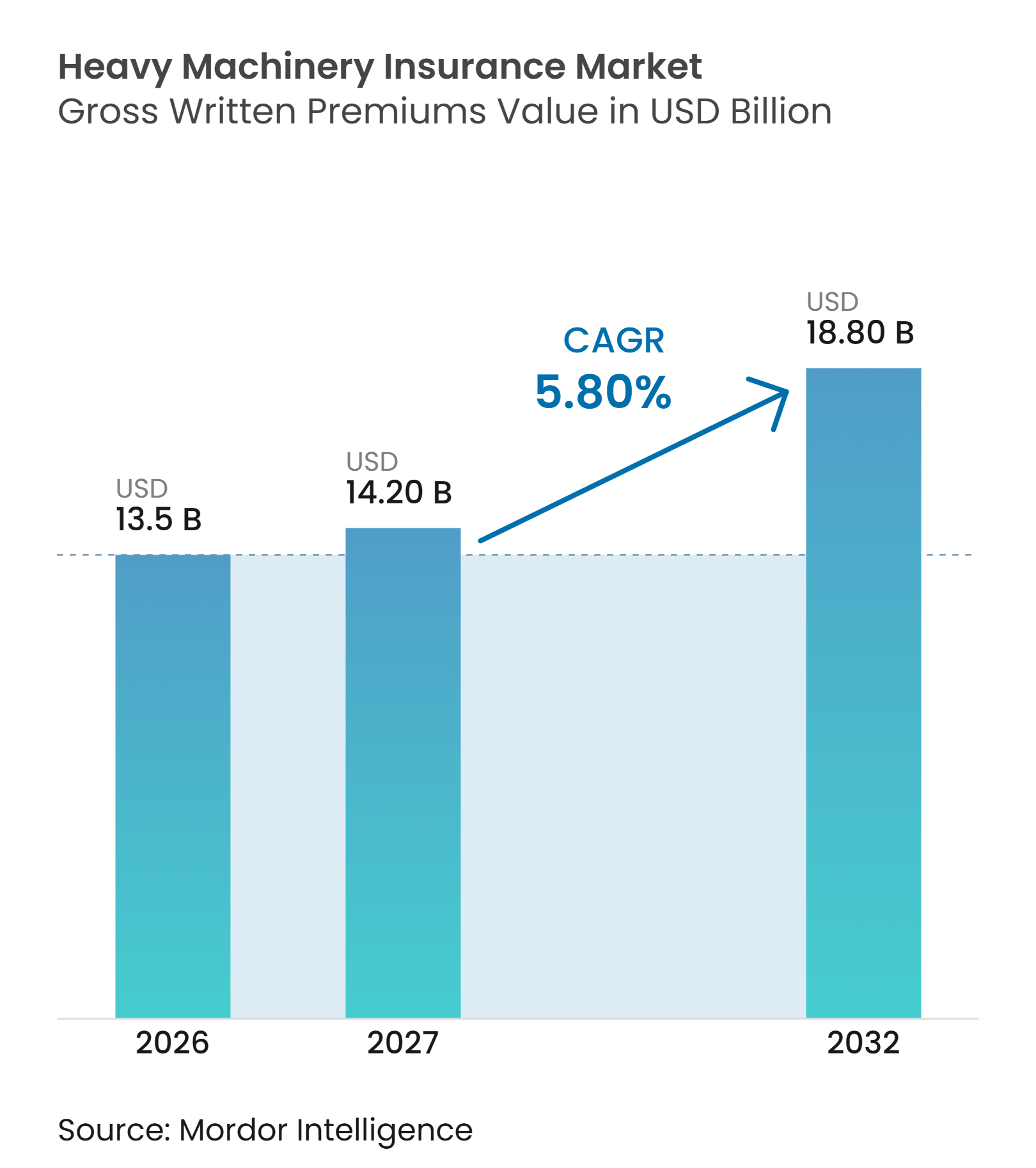
The Heavy Machinery Insurance Market size in terms of gross written premiums value is projected to be USD 13.5 billion in 2026, USD 14.20 billion in 2027, and reach USD 18.80 billion by 2032, growing at a CAGR of 5.80% from 2027 to 2032.
The growing size and complexity of heavy equipment fleets are increasing demand for comprehensive insurance coverage, particularly for assets operating across multiple sites, projects, and ownership arrangements. Rising replacement costs are making accurate equipment valuation and insured limits increasingly important. Rental, leasing, and embedded insurance models are expanding coverage access while creating a greater need to clarify responsibilities among owners, operators, lenders, and contractors. Meanwhile, connected machinery, automation, and software-driven systems are introducing new risks involving operational interruptions and equipment failures. These developments favor insurers offering flexible coverage that addresses physical damage, business interruption, equipment relocation, maintenance, contractual liabilities, and replacement costs.
Key Report Takeaways
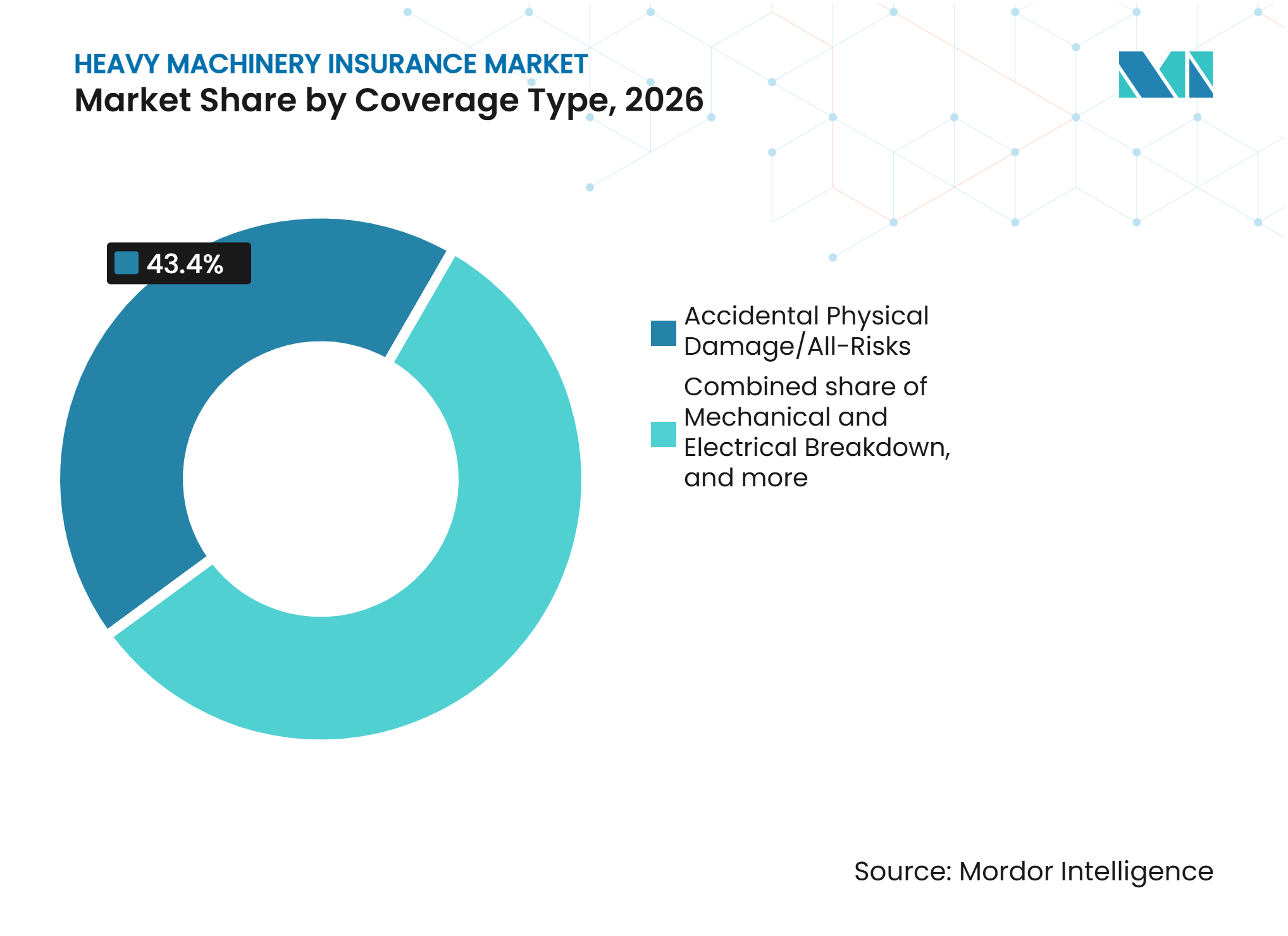
- By coverage type, Accidental physical damage and all-risks policies captured 43.4% of the heavy machinery insurance market share in 2026, while mechanical and electrical breakdown coverage is projected to grow at 7.2% CAGR through 2032.
- By equipment type, construction and earthmoving equipment captured 45.8% of the heavy machinery insurance market share in 2026, while specialized industrial, energy and utility equipment is projected to grow at 7.5% CAGR through 2032.
- By end-user, construction and civil infrastructure contractors captured 32.3% of the heavy machinery insurance market share in 2026, while energy and utility companies are projected to grow at 7.6% CAGR through 2032.
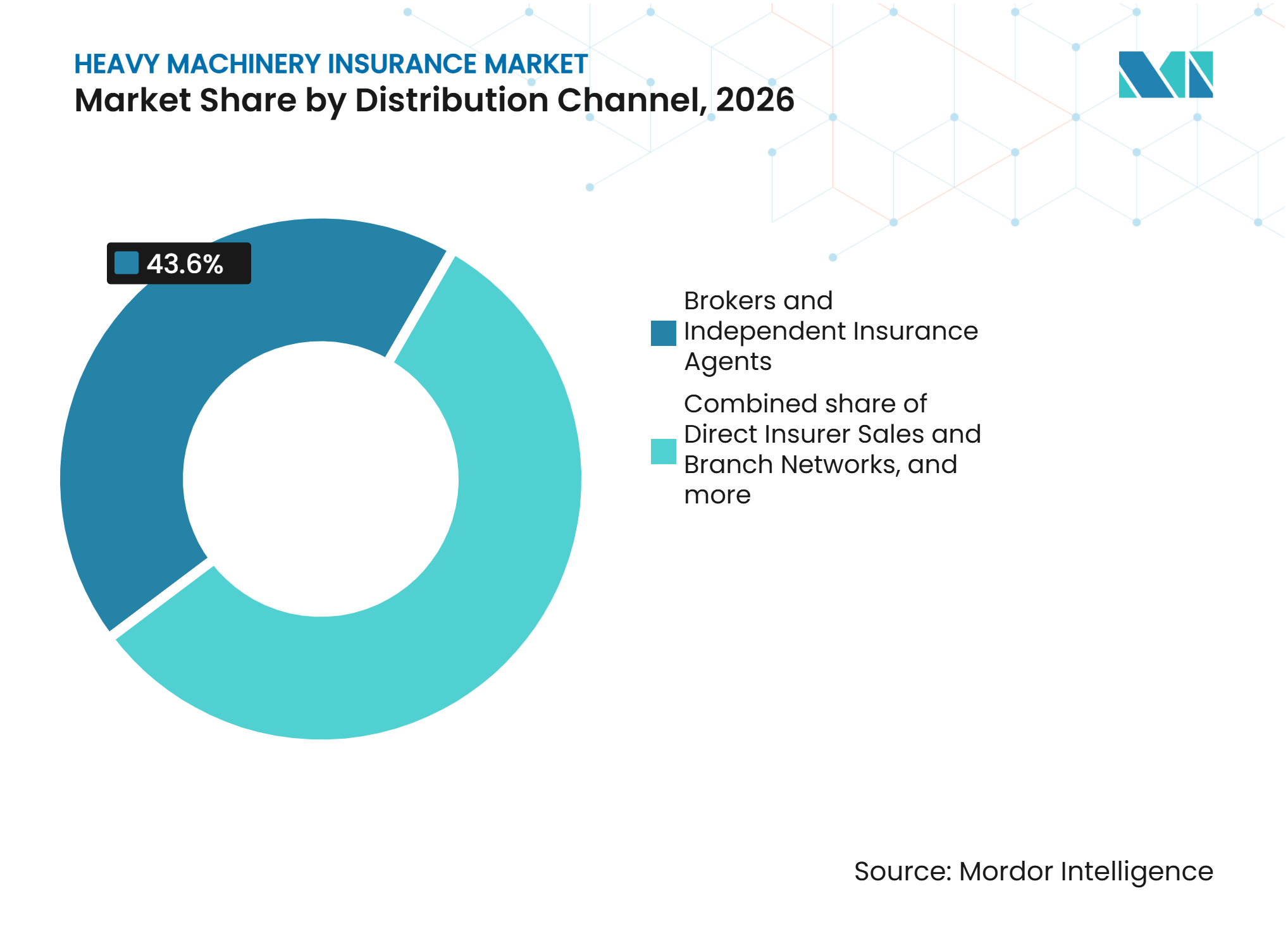
- By distribution channel, brokers and independent insurance agents captured 43.6% of the heavy machinery insurance market share in 2026, while digital platforms and online insurance channels are projected to grow at 8.6% CAGR through 2032.
- By equipment ownership, owned equipment captured 53.5% of the heavy machinery insurance market share in 2026, while hired and rented equipment is projected to grow at 7.8% CAGR through 2032.
-
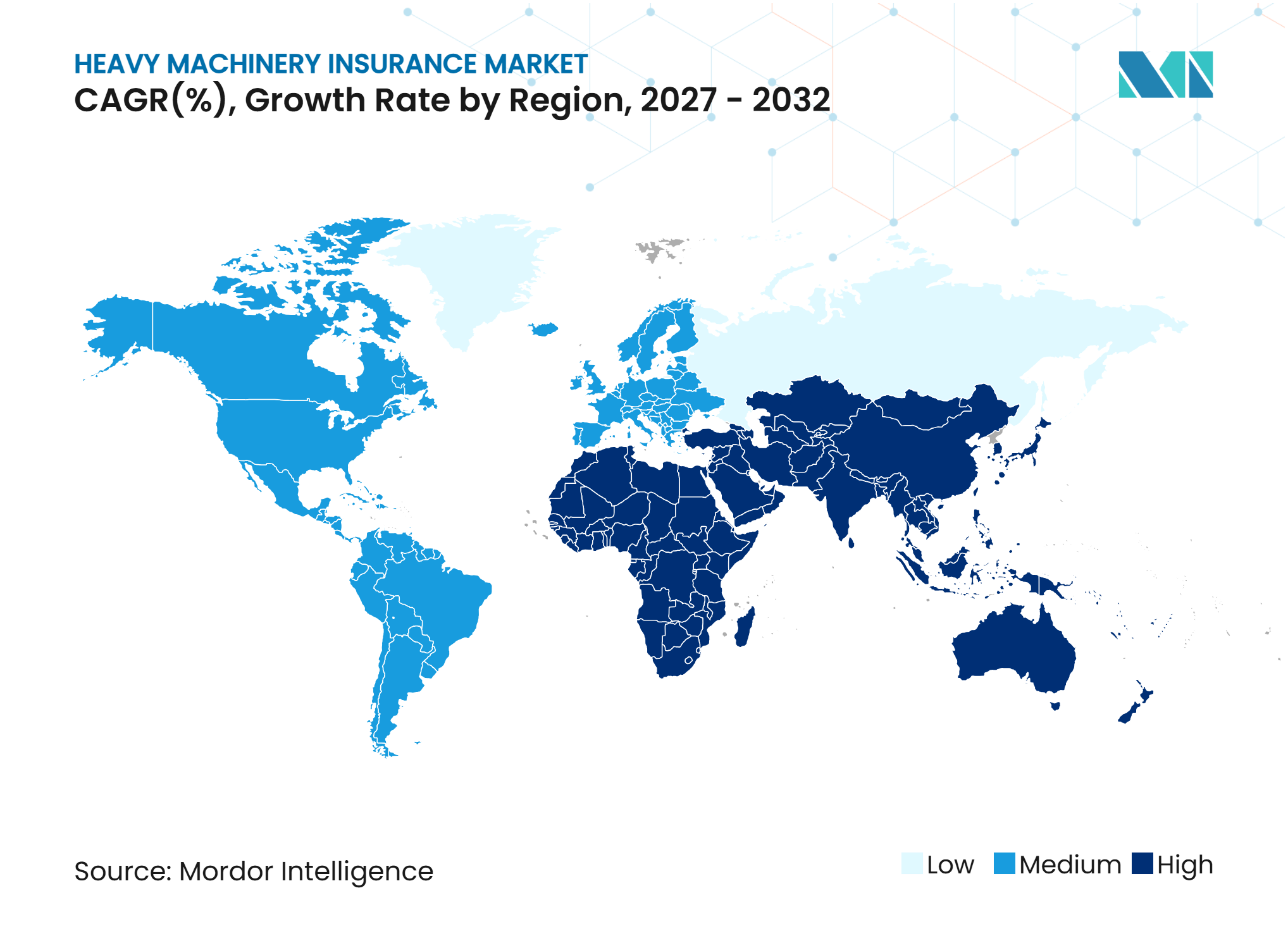
By geography, North America captured 34.1% of the heavy machinery insurance market share in 2026, while Asia-Pacific is projected to grow at 7.4% CAGR through 2032.
Note: Market numbers in this report are based on Mordor Intelligence's proprietary estimation framework, which combines nine months of actuals with Q4 projections for base year 2026.
Market Trends and Insights
Drivers Impact Analysis of Heavy Machinery Insurance Market*
| Driver | (~) % Impact on CAGR Forecast | Geographic Relevance | Impact Timeline |
|---|---|---|---|
| Expansion of Construction, Mining and Infrastructure Equipment Fleets | +1.5% | Global, with early gains in Asia-Pacific and Middle East and Africa | Long term (≥ 4 years) |
| Increasing Equipment Values and Capital Exposure | +1.0% | Global, concentrated in North America and Europe | Medium term (2-4 years) |
| Contractual, Financing and Project-Owner Insurance Requirements | +0.8% | North America and Europe, extending to Asia-Pacific and Middle East and Africa | Medium term (2-4 years) |
| Growth of Heavy Equipment Leasing and Rental Fleets | +0.9% | Global, with early gains in North America and Southeast Asia | Short term (≤ 2 years) |
| Rising Equipment Mobility and Multi-Site Project Operations | +0.5% | Asia-Pacific, extending to Middle East and Africa and South America | Long term (≥ 4 years) |
| Telematics-Enabled Risk Management and Data-Driven Underwriting | +0.4% | North America and Europe, expanding to Asia-Pacific | Short term (≤ 2 years) |
| Source: Mordor Intelligence | |||
Expansion of Construction, Mining and Infrastructure Equipment Fleets
Rising global investment in infrastructure, mining, energy, and industrial development is expanding the deployment of heavy machinery across multiple regions. According to PwC's 2026 Global Infrastructure Outlook, annual global infrastructure spending is projected to increase from USD 4.4 trillion in 2024 to USD 6.9 trillion by 2050[1]. The International Energy Agency (IEA) also estimates that USD 500 billion in new mining capital investment will be required between 2025 and 2040 under its Stated Policies Scenario. Expanding equipment fleets increases exposure to accidental damage, theft, fire, transit losses, and operational downtime. This creates opportunities for insurers to offer fleet-wide policies, project-specific endorsements, and coverage for machinery operating across multiple locations.
Increasing Equipment Values and Capital Exposure
Rising manufacturing, component, transportation, and repair costs are increasing the financial exposure associated with heavy machinery damage and replacement. Caterpillar reported USD 2.148 billion in unfavorable manufacturing cost impacts in 2025, largely reflecting higher tariffs[2]. Supply-chain disruptions, raw material price volatility, and specialized component requirements can further increase equipment replacement expenses. Consequently, businesses are placing greater importance on accurate equipment valuations, replacement-cost coverage, and periodic policy reviews to avoid underinsurance. The heavy machinery insurance market can benefit from valuation-based underwriting, agreed-value provisions, and coverage that accounts for transportation and installation expenses.
Contractual, Financing and Project-Owner Insurance Requirements
Construction contracts, equipment financing agreements, and project-owner requirements are strengthening the need for machinery insurance across international markets. Equipment owners and lenders require financial protection against physical damage, while contractors must address liabilities arising from machinery operations at construction and infrastructure sites. For example, Zurich's Contractors' Plant Insurance provides all-risks protection for owned equipment and can cover legal liabilities associated with hired-in machinery and continuing hire charges following damage[3]. Such requirements create opportunities for insurers to offer project-specific coverage, hired-in plant protection, lender interests, and standardized insurance documentation.
Growth of Heavy Equipment Leasing and Rental Fleets
The expansion of equipment rental and leasing models is increasing the number of stakeholders exposed to machinery-related risks, including owners, dealers, lenders, renters, and contractors. United Rentals reported a rental fleet of approximately 1.095 million units, with an original equipment cost of USD 22.48 billion across its international operations as of December 2025[4]. This demonstrates the significant value of equipment held within large rental fleets and the need for continuous insurance protection. Rental and leasing models create demand for flexible coverage addressing equipment ownership, hired-in machinery, transit, accidental damage, and liability during rental periods. Insurers can also leverage digital insurance verification and embedded distribution to improve coverage compliance at the point of equipment rental.
Restraints Impact Analysis of Heavy Machinery Insurance Market*
| Restraint | (~) % Impact on CAGR Forecast | Geographic Relevance | Impact Timeline |
|---|---|---|---|
| High Premiums and Deductibles for High-Risk Equipment | -0.6% | Global, most acute in North America and Europe | Short term (≤ 2 years) |
| Underinsurance and Equipment Valuation Discrepancies | -0.5% | Global, concentrated in Europe and emerging markets | Medium term (2-4 years) |
| High Claims Severity from Theft, Accidents and Equipment Damage | -0.4% | North America, Europe, and South Africa | Short term (≤ 2 years) |
| Coverage Limitations and Mechanical Breakdown Exclusions | -0.3% | Global, most acute in markets with high electrification and automation | Long term (≥ 4 years) |
| Source: Mordor Intelligence | |||
High Premiums and Deductibles for High-Risk Equipment
High premiums and deductibles can limit coverage uptake among smaller contractors and operators. A high deductible shifts more of the first loss back to the insured, which can discourage claims reporting or lead to lower limits. Contractors with poor loss records can face greater renewal pressure than peers with established safety programs. This creates a gap for products that align cost more closely with equipment use and loss experience. The heavy machinery insurance market can address this issue through shorter policy periods, usage-sensitive rating, or risk-improvement support. These approaches must still preserve adequate premium for theft, accidental damage, and liability exposure.
Underinsurance and Equipment Valuation Discrepancies
Underinsurance is increasing financial exposure for machinery owners when declared asset values fail to reflect actual replacement or reinstatement costs. Charterfields' 2026 Insurance Gap Report found that 83% of 95 surveyed United Kingdom locations had underinsured contents, plant and equipment, while 48% had declared values below 50% of reinstatement costs. These findings highlight valuation challenges associated with outdated asset registers, reliance on depreciated values, and rising equipment, component, and labour costs. In the event of partial losses, average clauses may proportionately reduce claim settlements when assets are underinsured. The global heavy machinery insurance market therefore presents opportunities for insurers to strengthen valuation practices through regular equipment assessments, updated asset schedules, and replacement-cost-based coverage.
*Our forecasts treat driver/restraint impacts as directional, not additive. The impact forecasts reflect baseline growth, mix effects, and variable interactions.
Heavy Machinery Insurance Market Segment Analysis
By Coverage Type:
Physical Damage Leads While Breakdown Cover Broadens ProtectionAccidental physical damage and all-risks policies accounted for 43.4% of the global heavy machinery insurance market in 2026. Contractors and equipment owners require protection against accidental damage, collision, fire, flooding, theft, and other external risks affecting mobile machinery. Swiss Re's Contractors' Plant and Equipment insurance guidance distinguishes external damage protection from machinery breakdown coverage, highlighting the importance of selecting appropriate policy wording for different equipment exposures. Loss of hire, rental reimbursement, and business interruption extensions also support businesses facing equipment downtime and project delays. Regulatory requirements further influence underwriting: WorkSafe Western Australia introduced high-risk work licensing requirements from August 2025 for operating earthmoving machinery as a crane above three tonnes' safe working load. These developments reinforce demand for coverage supported by operator competency and risk-management controls.
Mechanical and electrical breakdown is forecast to grow at a 7.2% CAGR through 2032. Increasing equipment complexity, automation, electronic controls, and integrated operating systems are expanding the range of potential machinery failures. Allianz Commercial's 2026 analysis of 7,888 business interruption claims identified machinery breakdown as the third-largest cause by claim value, demonstrating its importance to operational continuity. The growing dependence on specialized components and technical maintenance also increases the potential duration and financial impact of equipment failures. Insurers can address these exposures through machinery breakdown, business interruption, and equipment-specific engineering coverage, supported by clear maintenance and inspection requirements.


By Equipment Type:
Construction Equipment Leads While Energy Assets Expand FasterConstruction and earthmoving equipment accounted for 45.8% of the global heavy machinery insurance market in 2026. Excavators, bulldozers, graders, loaders, and cranes remain essential to infrastructure development, commercial construction, mining support, and public works. Their frequent movement between sites and exposure to demanding operating conditions sustain demand for physical damage, theft, transit, and third-party liability protection. Mining and quarrying equipment requires additional underwriting attention because of remote operating locations, heavy utilization, and specialized maintenance requirements. Agricultural, lifting, material-handling, and forestry equipment also contribute to demand for equipment-specific insurance solutions. Bradesco Seguros' agricultural equipment insurance offering illustrates the importance of specialized protection for mechanized farming assets.
Specialized industrial, energy and utility equipment is projected to grow at a 7.5% CAGR between 2027 and 2032. Investments in power generation, renewable energy, battery storage, and utility infrastructure are increasing demand for specialized equipment protection during construction and operations. Such assets can involve high replacement costs, complex electrical systems, and extended repair timelines. In February 2026, Skyward Specialty launched a dedicated power generation insurance solution covering power plants, municipal utilities, battery energy storage systems, and related contractors. Kinsale Insurance also offers energy property coverage for fixed property and mobile equipment used in oil and gas, solar, wind, and power-generation activities. These developments demonstrate insurers' growing focus on specialized energy-related equipment risks and tailored property protection.
By End-user:
Contractors Lead While Utilities Add Premium OpportunitiesConstruction and civil infrastructure contractors held 32.3% of the global heavy machinery insurance market in 2026. Contractors operate equipment across infrastructure, commercial construction, industrial development, and public-sector projects, creating demand for coverage that accommodates changing project locations and operating conditions. Their insurance requirements often include physical damage, third-party liability, hired-in equipment, and protection against project-related equipment downtime. Mining companies require specialized coverage reflecting remote operations, high-value machinery, and demanding working environments, while industrial and manufacturing companies prioritize machinery protection and production continuity. Equipment rental and leasing businesses also require policies that clearly allocate responsibility between equipment owners and users. Insurers can address these requirements through fleet-wide programs, project-specific policies, and equipment-specific extensions.
Energy and utility companies are forecast to grow at a 7.6% CAGR from 2027 to 2032. Expanding power generation, renewable energy, electricity transmission, and battery storage infrastructure is increasing the need to insure specialized construction and operating equipment. Machinery may require different coverage during installation, testing, commissioning, and commercial operation. In February 2026, Skyward Specialty introduced a dedicated power generation insurance solution for power producers, municipal utilities, battery energy storage systems, and related contractors. Kinsale's energy property offering also covers mobile equipment and fixed property across conventional and renewable energy activities. These specialized insurance solutions create opportunities for carriers to address equipment damage, machinery breakdown, and operational interruption across energy infrastructure projects.
By Distribution Channel:
Brokers Lead While Digital Distribution ExpandsBrokers and independent insurance agents accounted for 43.6% of the global heavy machinery insurance market in 2026. Their role remains important because large equipment fleets involve complex valuations, multiple operating locations, ownership arrangements, financing conditions, and specialized coverage requirements. Brokers help contractors and equipment owners assess policy limits, compare coverage terms, and identify gaps involving hired machinery, liability, and business interruption. Direct insurer distribution remains relevant for standardized equipment policies, while embedded insurance is expanding through equipment manufacturers, dealers, finance providers, and rental businesses. In March 2025, Great American Insurance Group partnered with TRNSACT to integrate equipment physical damage insurance quotations into a commercial equipment dealer and finance platform, enabling customers to obtain coverage during the equipment purchasing process.
Digital platforms and online insurance channels are forecast to grow at an 8.6% CAGR through 2032. Digital insurance platforms are simplifying policy quotations, equipment registration, insurance verification, and coverage enrolment, particularly for smaller fleets and standardized equipment risks. Great American Insurance Group offers online self-service enrolment, automated insurance programs, and insurance tracking for equipment finance, leasing, and rental portfolios. Its partnership with TRNSACT further demonstrates how insurance distribution can be integrated into equipment sales and financing workflows. These developments can reduce administrative delays, improve coverage compliance, and expand access to equipment insurance. However, high-value and technically complex machinery fleets will continue to require specialist underwriting and broker involvement.

By Equipment Ownership:
Owned Fleets Lead While Rental Exposure RisesOwned equipment accounted for 53.5% of the global heavy machinery insurance market in 2026. Construction contractors, mining operators, and industrial businesses maintain substantial equipment portfolios that require continuous physical damage and liability protection. Large owned fleets often benefit from scheduled or blanket insurance programs, supported by periodic equipment valuations and risk-engineering assessments. However, rising acquisition and replacement costs can create underinsurance risks if declared values are not regularly updated. United Rentals reported an original equipment cost of USD 22.48 billion across its rental fleet at year-end 2025, illustrating the substantial capital value associated with large equipment portfolios. Insurers can address these exposures through updated asset schedules, replacement-cost assessments, and fleet-wide coverage arrangements.
Hired and rented equipment is projected to grow at a 7.8% CAGR from 2027 to 2032. Equipment rental and leasing models are expanding access to machinery without requiring contractors to make substantial upfront capital investments. However, responsibility for physical damage and replacement costs can shift between equipment owners, rental companies, and contractors during the hire period. United Rentals reported approximately 1.095 million rental equipment units and USD 22.48 billion in original equipment cost at the end of 2025, highlighting the scale of its rental operations. Great American Insurance Group provides rental loss damage waiver protection, equipment insurance tracking, and programs for leasing and rental portfolios. These solutions can help reduce uninsured exposures and clarify insurance responsibilities during equipment delivery, use, and return.
Geography Analysis
North America
North America accounted for 34.1% of the global heavy machinery insurance market in 2026. The region benefits from an established construction equipment rental industry, large contractor fleets, and insurance requirements associated with infrastructure and industrial projects. In the United States, construction spending reached an annualized USD 2.19 trillion in September 2026, demonstrating the scale of construction activity despite a 2.7% year-on-year decline. United Rentals' extensive equipment rental fleet also illustrates the importance of rental-related equipment protection. Demand is supported by physical damage, third-party liability, hired equipment, and project-specific coverage requirements. Telematics, equipment tracking, and risk-engineering assessments are increasingly relevant to fleet underwriting, while worker-safety regulations and contractual insurance obligations influence coverage conditions.
Asia-Pacific
Asia-Pacific is forecast to grow at a 7.4% CAGR from 2027 to 2032. Infrastructure development, urbanization, renewable energy investments, and transportation projects across India, Indonesia, Thailand, Malaysia, and Vietnam are supporting demand for construction and industrial equipment. The Asian Development Bank estimates that Southeast Asia will require USD 7.1 trillion in infrastructure investment between 2026 and 2040, with electricity and transport accounting for 85% of the requirement. AXA XL has highlighted the increasing complexity of regional engineering projects, including airports, transmission infrastructure, data centre's, and renewable energy developments, which require specialized equipment such as tunnel-boring machines and marine cranes. These developments create opportunities for insurers offering contractors' plant and machinery, construction all-risks, machinery breakdown, and delay-related coverage. Local underwriting expertise and claims capabilities remain important because regulatory frameworks, project conditions, and equipment requirements vary across regional markets.
Europe, Middle East and Africa, and South America
Europe, the Middle East, Africa, and South America present varied growth opportunities driven by infrastructure investment, industrial development, energy projects, and equipment modernization. In the United Kingdom, Marsh launched its Machina plant and equipment insurance facility in October 2026, offering pre-agreed pricing and coverage for standalone equipment placements and annual contractor programs. In Germany, ERGO introduced a revised technical insurance tariff in July 2026, combining machinery, mobile equipment, electronics, photovoltaic, and construction insurance for SMEs. Across the Middle East and Africa, transport, energy, mining, and infrastructure development support demand for contractors' plant and machinery and construction-related insurance. The OECD highlights substantial African infrastructure requirements across roads, railways, energy, and digital infrastructure. In South America, Brazil's engineering insurance premiums reached BRL 840 million (USD 147 million) during January–July 2025, according to industry reporting citing SUSEP data. These developments create opportunities for insurers to provide specialized equipment protection, machinery breakdown, and project-specific coverage.
Competitive Landscape
Market Concentration
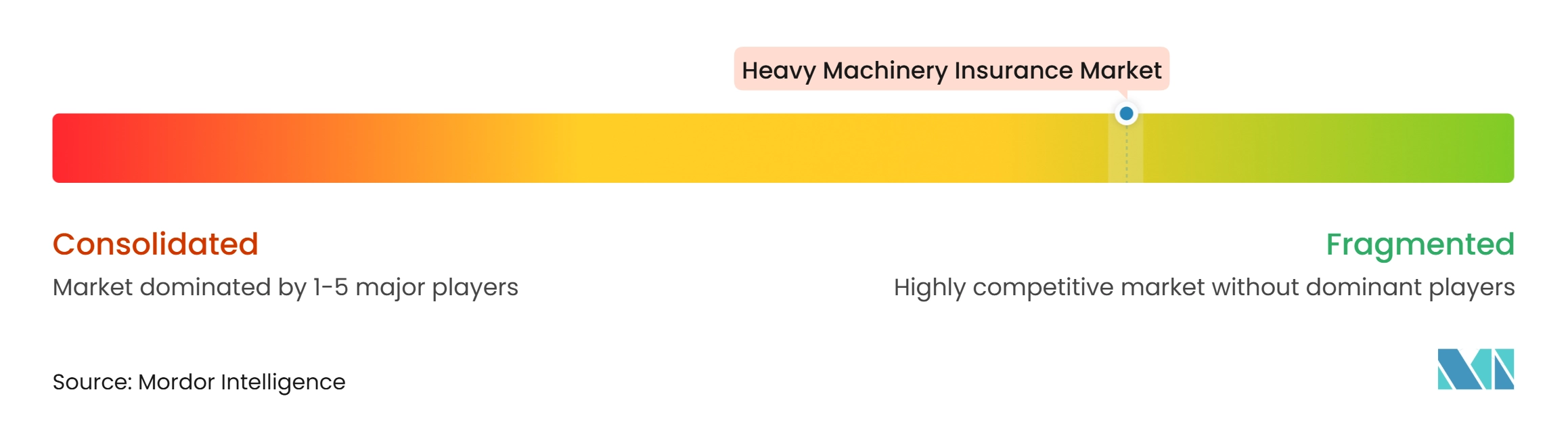
The heavy machinery insurance market is fragmented, comprising multinational insurance carriers, specialist engineering insurers, managing general agents (MGAs), and regional insurance providers. Large insurers compete through underwriting capacity, global claims networks, risk-engineering expertise, and comprehensive construction and industrial insurance portfolios. Specialist providers differentiate themselves through flexible coverage, sector-specific underwriting, and tailored solutions for construction, mining, transportation, and industrial equipment. This diverse competitive structure allows insurers to serve different equipment categories, customer segments, and regional markets.
Competition is increasingly driven by specialized product development and digital distribution capabilities. In March 2025, Great American Insurance Group partnered with TRNSACT to integrate equipment physical damage insurance quotations into dealer and equipment-financing platforms, enabling customers to obtain coverage during equipment purchases. In November 2025, Markel launched its global construction and engineering practice, offering construction all risks (CAR) and erection all risks (EAR) products. These developments highlight insurers' focus on improving distribution efficiency, expanding specialist underwriting capabilities, and strengthening access to equipment-related insurance.
Insurers are also strengthening their technical underwriting and risk-engineering capabilities to address increasingly complex machinery exposures. In September 2024, HDI Global established a dedicated United States inland marine unit focused on construction and transportation risks. In June 2026, it appointed Dan Feige as head of engineering, construction and inland marine underwriting in the United States, reinforcing its specialist underwriting capabilities. Increasing equipment automation, electrification, telematics, and software integration are further encouraging insurers to develop coverage addressing machinery breakdown, operational interruption, and emerging equipment risks.
Heavy Machinery Insurance Industry Leaders
-
Allianz SE
-
AXA XL
-
Zurich Insurance Group AG
-
Chubb Limited
-
American International Group, Inc.
- *Disclaimer: Major Players sorted in no particular order
Heavy Machinery Insurance Market Companies Covered in this Report
- Allianz SE
- AXA XL
- Zurich Insurance Group AG
- Chubb Limited
- American International Group, Inc.
- The Travelers Companies, Inc.
- Liberty Mutual Insurance
- Tokio Marine HCC
- Sompo International Holdings Ltd.
- HDI Global SE
- QBE Insurance Group Limited
- Berkshire Hathaway Specialty Insurance
- CNA Financial Corporation
- Markel Group Inc.
- The Hartford Financial Services Group, Inc.
- Generali Group
- MAPFRE S.A.
- Arch Insurance
- Great American Insurance Group
- FM Global
Recent Industry Developments in Heavy Machinery Insurance Market
- October 2026: Marsh launched the Machina plant and equipment insurance facility in the United Kingdom, offering contractors standalone placements and annual plant and equipment programmes through a pre-agreed rating structure. The facility is underwritten by Allianz and is designed to provide dedicated coverage for contractors’ plant and equipment risks.
- October 2026: Eirion Risk Underwriters launched a United States inland marine program backed by MS Transverse, covering contractors’ equipment, installation floaters, riggers’ liability, and equipment sales and rental exposures. The programme offers limits of up to USD 25 million and targets civil, utility, road, grading and selected mining contractors.
- August 2026: Munich Re Specialty Syndicate launched a construction rescue insurance program at Lloyd’s for major tunnelling and underground infrastructure projects. The programme covers emergency response costs, specialist rescue equipment, personnel and logistical coordination following major incidents, extending specialist risk protection for equipment-intensive construction projects.
- June 2026: ARTes Specialty partnered with Mobius Insurance to launch an integrated crane insurance solution in Australia. The offering provides material damage coverage of up to AUD 15 million (USD 9.8 million), alongside business interruption, on-hook, transportation, and liability protection for crane, rigging, and specialized heavy machinery operators.
Global Heavy Machinery Insurance Market Report Scope
Segmentation Overview
| Accidental Physical Damage / All-Risks |
| Mechanical and Electrical Breakdown |
| Loss of Hire / Rental Reimbursement / Business Interruption |
| Plant-Specific Third-Party Liability Extensions |
| Construction and Earthmoving Equipment |
| Mining and Quarrying Equipment |
| Agricultural Equipment |
| Lifting and Material Handling Equipment |
| Forestry Equipment |
| Specialized Industrial, Energy and Utility Equipment |
| Construction and Civil Infrastructure Contractors |
| Mining and Quarrying Companies |
| Agricultural and Forestry Enterprises |
| Equipment Rental and Leasing Companies |
| Industrial and Manufacturing Companies |
| Energy and Utility Companies |
| Logistics, Warehousing and Material Handling Operators |
| Government and Public-Sector Organizations |
| Brokers and Independent Insurance Agents |
| Direct Insurer Sales and Branch Networks |
| Digital Platforms and Online Insurance Channels |
| Embedded OEM, Dealer, Lessor and Rental Channels |
| Owned Equipment |
| Leased and Financed Equipment |
| Hired and Rented Equipment |
| North America | United States |
| Canada | |
| Mexico | |
| South America | Brazil |
| Argentina | |
| Rest of South America | |
| Europe | United Kingdom |
| Germany | |
| France | |
| Italy | |
| Spain | |
| Rest of Europe | |
| Asia-Pacific | China |
| Japan | |
| India | |
| South Korea | |
| Australia | |
| Indonesia | |
| Thailand | |
| Malaysia | |
| Singapore | |
| Vietnam | |
| Rest of Asia-Pacific | |
| Middle East and Africa | Saudi Arabia |
| United Arab Emirates | |
| Turkey | |
| South Africa | |
| Egypt | |
| Rest of Middle East and Africa |
| By Coverage Type | Accidental Physical Damage / All-Risks | |
| Mechanical and Electrical Breakdown | ||
| Loss of Hire / Rental Reimbursement / Business Interruption | ||
| Plant-Specific Third-Party Liability Extensions | ||
| By Equipment Type | Construction and Earthmoving Equipment | |
| Mining and Quarrying Equipment | ||
| Agricultural Equipment | ||
| Lifting and Material Handling Equipment | ||
| Forestry Equipment | ||
| Specialized Industrial, Energy and Utility Equipment | ||
| By End-user | Construction and Civil Infrastructure Contractors | |
| Mining and Quarrying Companies | ||
| Agricultural and Forestry Enterprises | ||
| Equipment Rental and Leasing Companies | ||
| Industrial and Manufacturing Companies | ||
| Energy and Utility Companies | ||
| Logistics, Warehousing and Material Handling Operators | ||
| Government and Public-Sector Organizations | ||
| By Distribution Channel | Brokers and Independent Insurance Agents | |
| Direct Insurer Sales and Branch Networks | ||
| Digital Platforms and Online Insurance Channels | ||
| Embedded OEM, Dealer, Lessor and Rental Channels | ||
| By Equipment Ownership | Owned Equipment | |
| Leased and Financed Equipment | ||
| Hired and Rented Equipment | ||
| By Geography | North America | United States |
| Canada | ||
| Mexico | ||
| South America | Brazil | |
| Argentina | ||
| Rest of South America | ||
| Europe | United Kingdom | |
| Germany | ||
| France | ||
| Italy | ||
| Spain | ||
| Rest of Europe | ||
| Asia-Pacific | China | |
| Japan | ||
| India | ||
| South Korea | ||
| Australia | ||
| Indonesia | ||
| Thailand | ||
| Malaysia | ||
| Singapore | ||
| Vietnam | ||
| Rest of Asia-Pacific | ||
| Middle East and Africa | Saudi Arabia | |
| United Arab Emirates | ||
| Turkey | ||
| South Africa | ||
| Egypt | ||
| Rest of Middle East and Africa | ||
Key Questions Answered in the Report
What is the forecast growth rate for heavy machinery insurance?
The sector is forecast to grow at a 5.8% CAGR from 2027 to 2032 and reach USD 18.8 billion by 2032.
Which coverage type leads heavy machinery insurance?
Accidental Physical Damage and All-Risks policies lead with a 43.4% share in 2026. Mechanical and Electrical Breakdown is the fastest-growing coverage type at a 7.2% CAGR because newer machines contain more software-dependent systems, sensors, and remote-operation functions.
Why is equipment valuation important for contractors?
Replacement costs can exceed scheduled values after tariff, parts, or labor increases, leaving contractors underinsured after a loss. Routine asset reviews help make sure insured amounts reflect current replacement cost rather than older purchase prices or accounting depreciation.
Which end users create the strongest demand for machinery protection?
Construction and Civil Infrastructure Contractors lead with a 32.3% share in 2026, while Energy and Utility Companies are expected to grow at a 7.6% CAGR. Contractors need cover across several projects, while energy users need protection through construction, testing, commissioning, and operations.
How are digital tools changing equipment insurance placement?
Digital platforms support faster quotes, certificate checks, and embedded coverage at dealer and rental touchpoints. Telematics can also provide information on location, operation, maintenance, and safety practices, helping insurers align risk engineering and underwriting with current fleet conditions.
Which region is expanding fastest?
Asia-Pacific is forecast to grow at a 7.4% CAGR through 2032, supported by infrastructure, energy, transport, and urban development activity. Coverage demand is also influenced by varied local compliance requirements, larger project values, and the need to protect specialized equipment across long construction cycles.