
Heavy and Bulky Two-Person White-Glove Last-Mile Delivery Market Size and Share
Market Overview
| Study Period | 2021 - 2032 |
|---|---|
| Market Size (2027) | USD 27.96 Billion |
| Market Size (2032) | USD 41.70 Billion |
| Growth Rate (2027 - 2032) | 8.32 % |
| Fastest Growing Market | Asia-Pacific |
| Largest Market | North America |
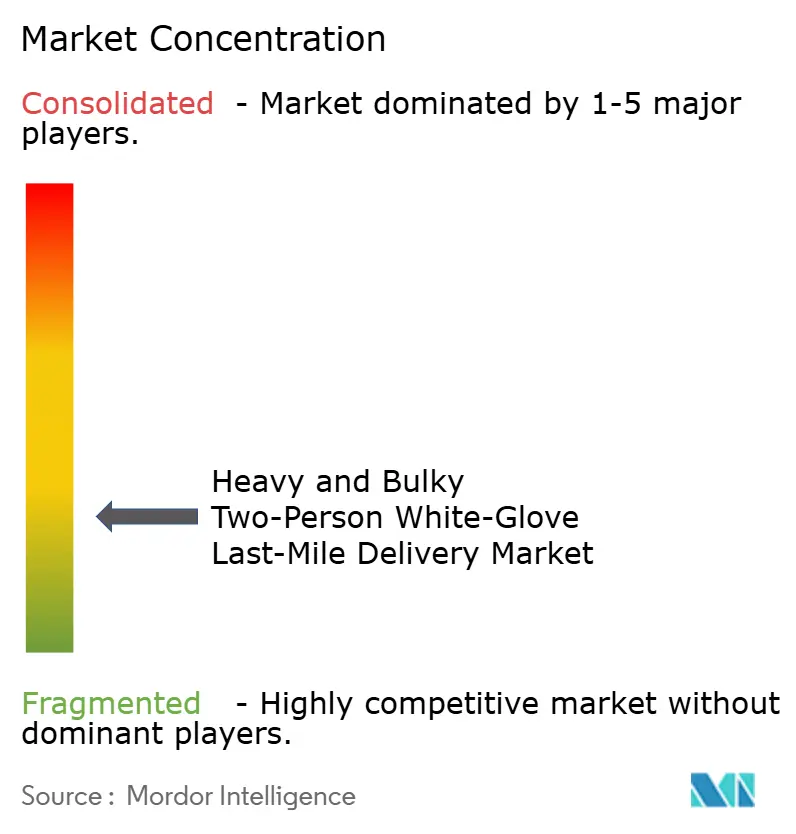
| Market Concentration | Low |
Major Players *Disclaimer: Major Players sorted in no particular order Image © Mordor Intelligence. Reuse requires attribution under CC BY 4.0. | |
Heavy and Bulky Two-Person White-Glove Last-Mile Delivery Market Analysis by Mordor Intelligence
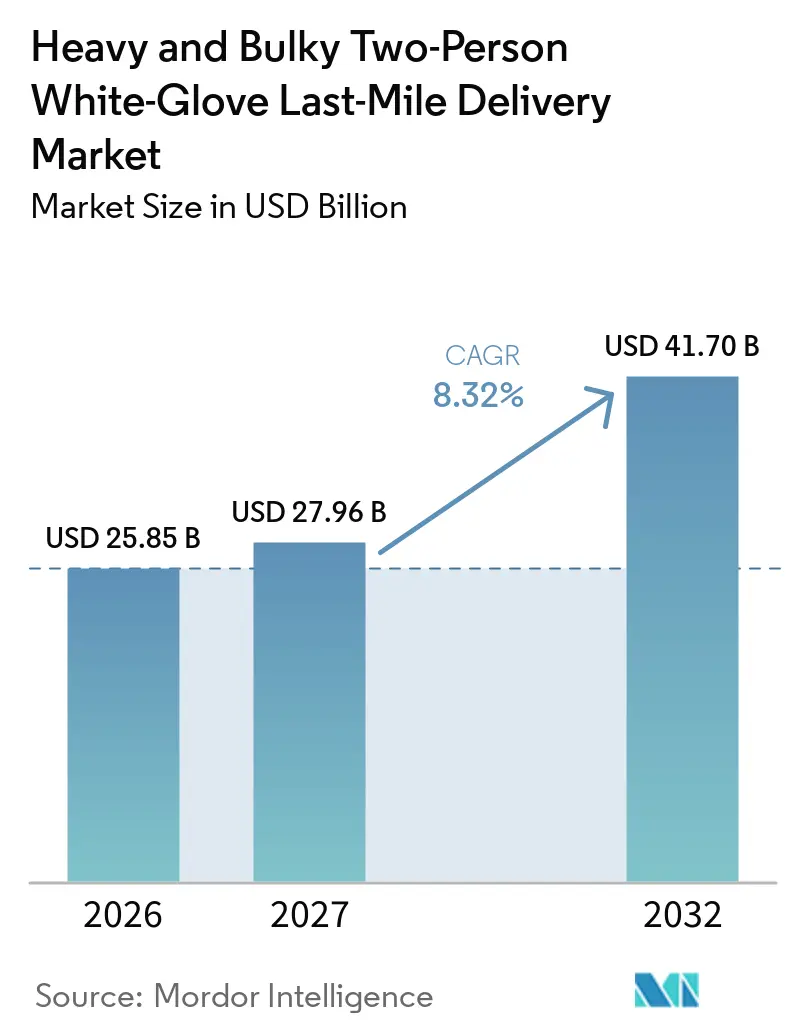
The heavy and bulky two-person white-glove last-mile delivery market size is valued at USD 25.85 billion in 2026 and is estimated to reach USD 27.96 billion in 2027 and USD 41.70 billion by 2032, registering a CAGR of 8.32% from 2027 to 2032.
This service layer uses trained 2-person crews to deliver, position, assemble, and configure oversized or high-weight items in the room selected by the customer. It meets needs that parcel and less-than-truckload networks do not cover. Large appliance and furniture retailers face a conversion risk when room-of-choice delivery is unavailable, as 50% of large appliance buyers and 42% of furniture buyers said they would switch retailers in that situation. The heavy and bulky two-person white-glove last-mile delivery market benefits from e-commerce demand, home-based care, and retailer outsourcing, while crew availability, urban access, and low United States housing turnover limit near-term growth. National carriers, regional specialists, and marketplace platforms are competing for the same retail accounts through broader networks, service consistency, and delivery technology.
Key Report Takeaways
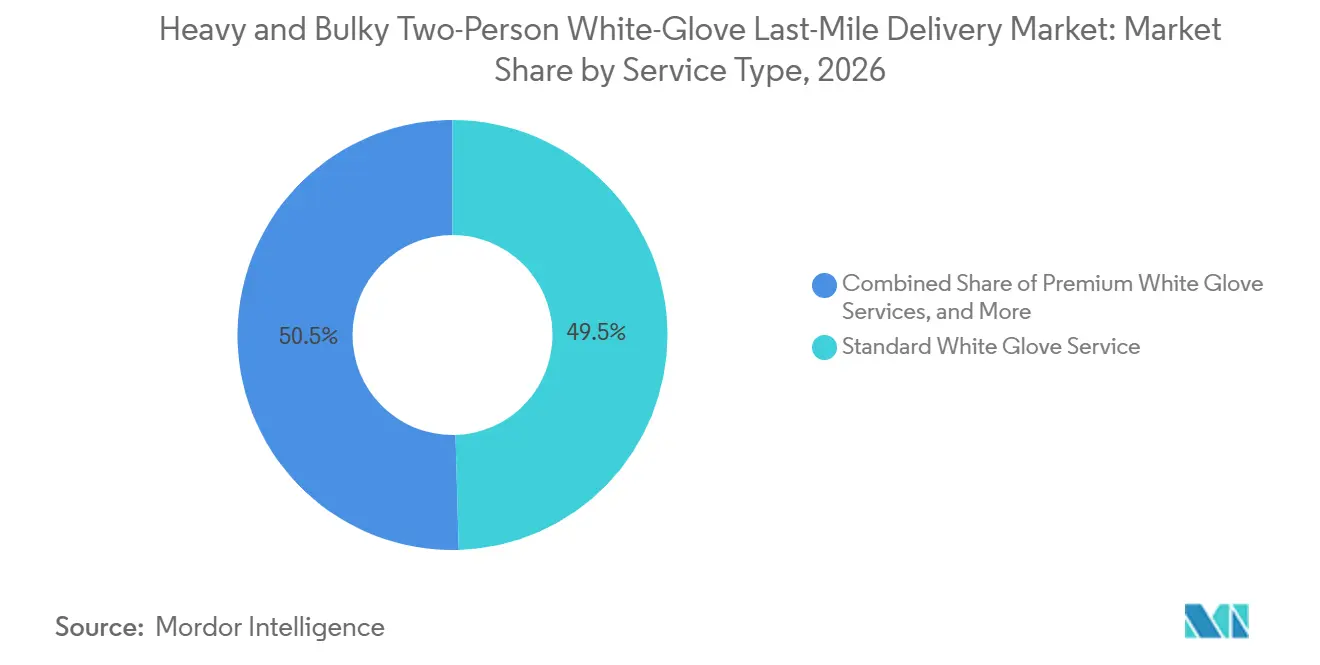
- By service, standard white-glove service held 49.53% of the heavy and bulky two-person white-glove last-mile delivery market size in 2026, while specialized white-glove solutions registered a 10.15% CAGR through 2032.
- By product type, furniture and home goods held 38.46% of the heavy and bulky two-person white-glove last-mile delivery market share in 2026, while healthcare and medical equipment registered a 10.37% CAGR through 2032.
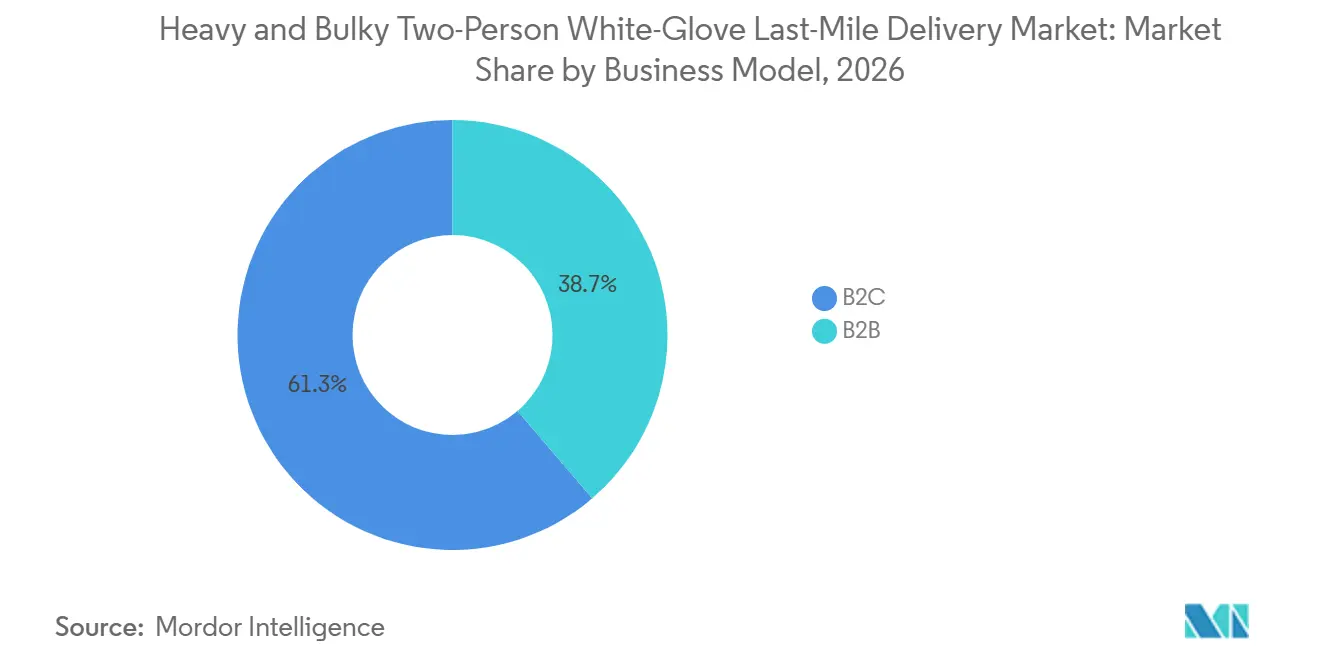
- By business model, B2C held 61.27% of the heavy and bulky two-person white-glove last-mile delivery market share in 2026, while B2B registered an 8.84% CAGR through 2032.
- By delivery destination, residential households held 62.77% of the heavy and bulky two-person white-glove last-mile delivery market size in 2026, while healthcare facilities registered a 10.11% CAGR through 2032.
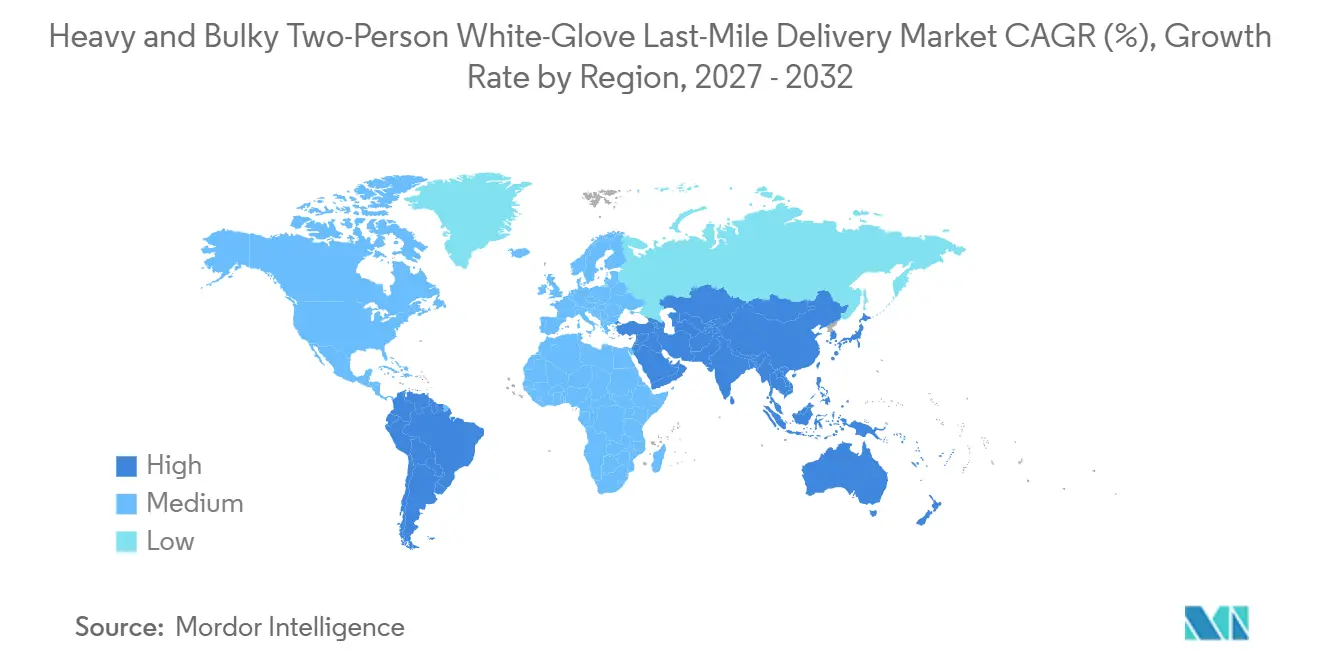
- By geography, North America held 36.13% of the heavy and bulky two-person white-glove last-mile delivery market share in 2026, while Asia-Pacific registered a 9.62% CAGR through 2032.
Note: Market numbers in this report are based on Mordor Intelligence's proprietary estimation framework, which combines nine months of actuals with Q4 projections for base year 2026.
Market Trends and Insights
Drivers Impact Analysis of Heavy and Bulky Two-Person White-Glove Last-Mile Delivery Market*
| Driver | (~) % Impact on CAGR Forecast | Geographic Relevance | Impact Timeline |
|---|---|---|---|
| E-Commerce Expansion for Furniture, Appliances and Large Electronics | +2.0% | Global, concentrated in North America and Asia-Pacific | Medium term (2-4 years) |
| Outsourcing of Two-Person Delivery by Omnichannel Retailers | +1.4% | North America and Europe | Medium term (2-4 years) |
| Growth of Healthcare-at-Home Equipment Delivery | +1.2% | North America, expanding to Europe and Asia-Pacific | Long term (≥ 4 years) |
| Rising Expectations for Scheduled, Visible and Installation-Ready Delivery | +1.0% | Global | Medium term (2-4 years) |
| Exception Data as a Retail Conversion and Retention Signal | +0.6% | North America and Europe | Short term (≤ 2 years) |
| Urban Access-Constraint Pricing and Crew-Mix Optimization | +0.4% | Global urban centers, Asia-Pacific spill-over | Long term (≥ 4 years) |
| Source: Mordor Intelligence | |||
E-Commerce Expansion for Furniture, Appliances and Large Electronics
Online retail continues to take a larger share of durable goods spending. The United States Census Bureau reported continued e-commerce activity across retail in 2025, supporting digital purchasing for high-ticket goods.[1] Brands that relied on store pickup are moving toward direct delivery to consumers. Products above 50 lbs often need 2-person crews, room-of-choice placement, and packaging removal. A 2025 study found that 43% of buyers did not know curbside delivery required them to carry items inside themselves. Each retailer that places white-glove delivery at checkout can add outsourced volume beyond changes in consumer demand alone.
Outsourcing of Two-Person Delivery by Omnichannel Retailers
Omnichannel retailers are reducing self-operated delivery because fleets, trained crews, and returns workflows are difficult to adjust during seasonal shifts. Ryder reported that e-commerce and last-mile services represented 18% of its supply chain solutions revenue in 2025. J.B. Hunt reported USD 824 million in 2025 revenue from final-mile services in its SEC disclosure.[2] These figures show the scale at which established operators handle retailer delivery programs. Furniture, appliances, and fitness equipment remain important outsourcing categories because a failed delivery can harm a retailer's reputation. Specialist providers can apply repeatable operating procedures across delivery, installation, and returns.
Growth of Healthcare-at-Home Equipment Delivery
The shift from institutional settings to home-based care supports demand for 2-person delivery of durable medical equipment. The Health Industry Distributors Association projected the United States home care market demand to grow by 22% by 2034. Hospital-grade beds, power wheelchairs, CPAP systems, and patient lifts need stair navigation, calibration, and patient education. These tasks do not fit standard parcel service. Cardinal Health at-Home Solutions ships more than 80,000 medical supply packages each day and has invested in robotic fulfillment and automated packing for residential deliveries. The heavy and bulky two-person white-glove last-mile delivery market gains from the need to join physical handling with reliable home delivery.
Rising Expectations for Scheduled, Visible and Installation-Ready Delivery
Scheduled 2-to-4-hour delivery windows, live crew tracking, and installation confirmation are becoming normal service requirements. Ryder stated that its RyderView 2.0 platform supported consumer scheduling and live tracking, with on-time delivery above 97% and customer satisfaction of 4.68 out of 5 in documented deployments. Hermes Einrichtungs Service recorded a 4.7 out of 5 satisfaction score for delivery to the place of use, compared with 3.0 for curbside furniture delivery. These service elements affect repeat purchase behavior and retailer reviews. Self-scheduling at checkout removes the need for post-purchase calls. It also makes delivery part of the retailer's customer experience rather than a separate operating step.
Restraints Impact Analysis of Heavy and Bulky Two-Person White-Glove Last-Mile Delivery Market*
| Restraint | (~) % Impact on CAGR Forecast | Geographic Relevance | Impact Timeline |
|---|---|---|---|
| Specialized Labor Recruitment and Retention Challenges | -0.7% | Global, acute in North America and Europe | Short term (≤ 2 years) |
| High Cost-to-Serve and Damage Exposure | -0.6% | Global | Medium term (2-4 years) |
| Building-Access Variance and Failed-Attempt Cascades | -0.4% | Urban markets globally | Medium term (2-4 years) |
| Installer Credential Fragmentation for Connected Appliances | -0.3% | North America and Europe | Long term (≥ 4 years) |
| Source: Mordor Intelligence | |||
Specialized Labor Recruitment and Retention Challenges
White-glove crews need physical capability, product-handling skill, and professional conduct in a customer's home. This combination narrows the available labor pool compared with standard driver recruitment. The United States Bureau of Labor Statistics identifies freight and material-moving occupations as having high turnover. Stair navigation, careful handling, and direct customer contact add to staffing pressures. Federal Motor Carrier Safety Administration compliance requirements create an additional credential need for contractor-based networks.[3] The heavy and bulky two-person white-glove last-mile delivery market, therefore, depends on operators that can recruit, train, and retain specialized teams.
High Cost-to-Serve and Damage Exposure
Two-person wages, lift-gate vehicles, appointment coordination, and damage liability create a cost structure that does not decline easily in low-density routes. Forward Air identified damage claims and reverse logistics as especially intensive parts of white-glove operations in its 2025 Form 10-K. Staircase navigation and on-site assembly create several product contact points. Ryder reported 98% damage-free deliveries and a 4.8-star customer satisfaction rating in its Ernesta deployment during volume growth above 200%.[4] Standardized crew procedures can reduce damage, but they require continued investment. Rate-led competition can, therefore, create costs that offset any initial price advantage for a provider and expose retail clients to brand risk.
*Our forecasts treat driver/restraint impacts as directional, not additive. The impact forecasts reflect baseline growth, mix effects, and variable interactions.
Heavy and Bulky Two-Person White-Glove Last-Mile Delivery Market Segment Analysis
By Service:
Tier Differentiation Driven by Complexity GrowthStandard white-glove service held 49.53% of the heavy and bulky two-person white-glove last-mile delivery market share in 2026. Its broad fit across furniture, appliances, and consumer electronics makes it suitable for checkout programs without customized delivery design. Premium white-glove service serves luxury goods buyers and healthcare organizations that need dedicated crews and protected inventory.
Specialized white-glove solutions registered a 10.15% CAGR from 2027 to 2032. SEKO Logistics expanded capacity in Cincinnati, Houston, and several Midwest locations in July 2026. The company strengthened white-glove last-mile and specialized freight capabilities for medical and high-tech verticals. Connected appliances, including smart refrigerators and networked HVAC units, need device pairing and software configuration during delivery. The heavy and bulky two-person white-glove last-mile delivery market, therefore, needs wider crew capability as product complexity rises.

By Product Type:
Healthcare Equipment Reconfigures the Growth CurveFurniture and home goods accounted for 38.46% of the heavy and bulky two-person white-glove last-mile delivery market size in 2026. The category created the volume base and many retailer outsourcing relationships. These deliveries include hospital-grade beds, power wheelchairs, CPAP systems, and diagnostic imaging units.
Healthcare and medical equipment registered a 10.37% CAGR from 2027 to 2032. Healthcare logistics providers need protocols for custody, handling, and delivery records. Cardinal Health has invested in robotic fulfillment to support next-day delivery to nearly all Americans. This infrastructure supports the heavy and bulky two-person white-glove last-mile delivery market as residential medical delivery expands. Specialized teams can combine careful equipment placement with the service process required in a patient's home.
By Business Model:
B2B Contract Growth Reshapes Route EconomicsB2C accounted for 61.27% of the heavy and bulky two-person white-glove last-mile delivery market share in 2026. E-commerce retailers delivering furniture, appliances, and home fitness products to residences drive most of this volume. Corporate buyers need professional delivery and installation service-level agreements for office furniture, clinical equipment, and industrial electronics.
B2B registered an 8.84% CAGR from 2027 to 2032. Commercial accounts can offer predictable order patterns and higher contract values per delivery. Forward Air and Omni Logistics won a July 2025 contract with a global athletics brand. Omni provides daily white-glove store replenishment to 18 retail locations in 4 states, while Forward Air provides full truckload service on several nationwide lanes. The heavy and bulky two-person white-glove last-mile delivery industry can use route-dense programs to improve utilization.
By Delivery Destination:
Healthcare Facilities Signal the Next FrontierResidential households accounted for 62.77% of delivery destination volumes in the heavy and bulky two-person white-glove last-mile delivery market size in 2026. Online retail-to-home flows support this position. Hospitals are outsourcing imaging-system delivery, surgical equipment installation, and inpatient furniture placement.
Healthcare facilities registered a 10.11% CAGR from 2027 to 2032. GXO expanded its United States agreement with Siemens Healthineers through dedicated mega-depot locations in the Forward Stocking Network. Equipment manufacturers are placing logistics programs within their distribution strategies from the outset. The heavy and bulky two-person white-glove last-mile delivery market serves healthcare facilities and residences through different crew skills and operating processes. Facility requirements support specialist demand, while residential destinations retain their volume role.
Geography Analysis
North America held 36.13% of revenue in 2026. The United States e-commerce furniture and appliance sales, established 3PL outsourcing, and residential medical equipment delivery support the region. Ryder added last-mile hubs in Milwaukee with 75,000 ft² and Philadelphia with 108,000 ft² in January 2026. This local capacity supports the heavy and bulky two-person white-glove last-mile delivery market in underserved metro areas.
Europe is the second-largest geographic share, led by the United Kingdom, Germany, and France. The United Kingdom's online share of retail sales reached 28.2% in early 2026. South America has moderate growth from e-commerce in Brazil and Mexico, while the Middle East and Africa are emerging areas for specialist delivery.
Asia-Pacific registered a 9.62% CAGR from 2027 to 2032. China is expanding white-glove networks with online furniture and appliance retail. India's National Logistics Policy supports multimodal corridors and more efficient interstate logistics. These changes can extend premium delivery services into tier-2 and tier-3 cities. The heavy and bulky two-person white-glove last-mile delivery market benefits from urban growth and premium e-commerce adoption in the region.
Competitive Landscape
The heavy and bulky two-person white-glove last-mile delivery market is fragmented at the national level. SEKO, RXO, Ryder, and J.B. Hunt compete through technology platforms, hub networks, and multi-year carrier relationships. RXO launched Middle Mile Solutions in February 2026, combining first-mile, middle-mile, and last-mile activities within a dock-to-door network that includes commercial white-glove and big-and-bulky home delivery.
RXO reported service in more than 159 United States metro markets through over 10,000 contracted carriers and approximately 10 million annual last-mile deliveries. GXO announced a 10-year, USD 2.5 billion NHS Supply Chain contract in May 2025, covering 8 distribution centers and a dedicated fleet of more than 300 vehicles in England. These operators are competing for healthcare programs and retail accounts. The heavy and bulky two-person white-glove last-mile delivery market remains open to providers that can prove consistent execution. Scale can limit entry for smaller providers.
FragilePAK, Diakon Logistics, Metropolitan Warehouse and Delivery, and Last Mile Home focus on accounts needing low damage rates and installation capability. Diakon opened a flex warehouse in Richmond, Virginia, in April 2026 and extended white-glove coverage to 15 states. GoShare expanded to more than 100 United States markets in 2025 and reported a 0.004% damage claim rate. The heavy and bulky two-person white-glove last-mile delivery market also includes regional and marketplace providers that compete on specialized operations.
Heavy and Bulky Two-Person White-Glove Last-Mile Delivery Industry Leaders
-
Ryder System, Inc.
-
J.B. Hunt Transport Services, Inc.
-
United Parcel Service of America, Inc. (UPS)
-
GXO Logistics, Inc.
-
SEKO Logistics
- *Disclaimer: Major Players sorted in no particular order
Heavy and Bulky Two-Person White-Glove Last-Mile Delivery Market Companies Covered in this Report
- Ryder System, Inc.
- J.B. Hunt Transport Services, Inc.
- GXO Logistics, Inc.
- United Parcel Service of America, Inc. (UPS)
- FedEx
- Werner Enterprises, Inc.
- SEKO Logistics
- DSV A/S
- Pilot Freight Services
- Fidelitone
- Metropolitan Warehouse & Delivery
- GoShare
- Diakon Logistics
- Hilldrup
- FragilePAK
- Schneider National, Inc.
- Forward Air Corporation
- McCollister's Transportation Group
- AIT Worldwide Logistics
- RXO, Inc.
Recent Industry Developments in Heavy and Bulky Two-Person White-Glove Last-Mile Delivery Market
- July 2026: SEKO opened facilities in Elmhurst, Mount Prospect, and Elk Grove Village, Illinois; Cincinnati, Ohio (350,000 ft²); Houston, Texas (35,000 ft²); and El Paso, Texas (24,000 ft²), extending white-glove last-mile, contract logistics, and specialized freight capabilities. The build-out extends SEKO's United States footprint to 64 locations, with white-glove services available at all new stations.
- May 2026: FIDELITONE opened a fulfillment center in Bridgeport, New Jersey, enabling 2-day ground delivery to 98% of the United States population when combined with its Reno, Chicago, and Nashville facilities, supporting direct-to-consumer and omnichannel fulfillment across the Eastern Seaboard.
- April 2026: Diakon Logistics opened a flex warehouse in Richmond, Virginia, extending its white-glove last-mile delivery to 15 states as part of its 35th anniversary expansion, offering assembly, repairs, and reverse logistics for large-item retailers.
- April 2026: J.B. Hunt Transport Services and Pinnacle Fulfillment entered a partnership to provide premium white-glove home delivery across the Cincinnati Tri-State region, expanding J.B. Hunt's Final Mile Services carrier network with a specialist in-home delivery provider.
Global Heavy and Bulky Two-Person White-Glove Last-Mile Delivery Market Report Scope
Segmentation Overview
| Standard White Glove Service |
| Premium White Glove Service |
| Specialized White Glove Solutions |
| Furniture & Home Goods |
| Electronics and Appliances |
| Healthcare and Medical Equipment |
| Luxury Goods |
| E-commerce and Retail |
| Others |
| B2B (Business-to-Business) |
| B2C (Business-to-Consumer) |
| Residential Households |
| Commercial Offices |
| Healthcare Facility |
| Hospitality Operators |
| Retail Store and Branded Outlets |
| Other Application |
| North America | United States |
| Canada | |
| Mexico | |
| South America | Brazil |
| Argentina | |
| Peru | |
| Chile | |
| Rest of South America | |
| Europe | Germany |
| United Kingdom | |
| France | |
| Italy | |
| Spain | |
| Russia | |
| Nordics (Denmark, Finland, Iceland, Norway, and Sweden) | |
| Rest of Europe | |
| Asia-Pacific | China |
| India | |
| Japan | |
| South Korea | |
| Australia | |
| Southeast Asia (ASEAN) | |
| Rest of Asia-Pacific | |
| Middle East and Africa | Saudi Arabia |
| United Arab Emirates | |
| Qatar | |
| South Africa | |
| Nigeria | |
| Egypt | |
| Rest of Middle East and Africa |
| By Service | Standard White Glove Service | |
| Premium White Glove Service | ||
| Specialized White Glove Solutions | ||
| By Product Type | Furniture & Home Goods | |
| Electronics and Appliances | ||
| Healthcare and Medical Equipment | ||
| Luxury Goods | ||
| E-commerce and Retail | ||
| Others | ||
| By Business Model | B2B (Business-to-Business) | |
| B2C (Business-to-Consumer) | ||
| By Delivery Destination | Residential Households | |
| Commercial Offices | ||
| Healthcare Facility | ||
| Hospitality Operators | ||
| Retail Store and Branded Outlets | ||
| Other Application | ||
| By Geography | North America | United States |
| Canada | ||
| Mexico | ||
| South America | Brazil | |
| Argentina | ||
| Peru | ||
| Chile | ||
| Rest of South America | ||
| Europe | Germany | |
| United Kingdom | ||
| France | ||
| Italy | ||
| Spain | ||
| Russia | ||
| Nordics (Denmark, Finland, Iceland, Norway, and Sweden) | ||
| Rest of Europe | ||
| Asia-Pacific | China | |
| India | ||
| Japan | ||
| South Korea | ||
| Australia | ||
| Southeast Asia (ASEAN) | ||
| Rest of Asia-Pacific | ||
| Middle East and Africa | Saudi Arabia | |
| United Arab Emirates | ||
| Qatar | ||
| South Africa | ||
| Nigeria | ||
| Egypt | ||
| Rest of Middle East and Africa | ||
Key Questions Answered in the Report
What is the heavy and bulky two-person white-glove last-mile delivery market value in 2026?
The heavy and bulky two-person white-glove last-mile delivery market is valued at USD 25.85 billion in 2026 and is projected to reach USD 41.7 billion by 2032, at an 8.32% CAGR from 2027 to 2032.
Which service type leads the heavy and bulky two-person white-glove last-mile delivery market?
Standard white glove service leads the heavy and bulky two-person white-glove last-mile delivery market with 49.53% of revenue in 2026.
Which product category is growing fastest in the heavy and bulky two-person white-glove last-mile delivery market?
Healthcare and medical equipment registered a 10.37% CAGR through 2032.
Why do retailers outsource activity in the heavy and bulky two-person white-glove last-mile delivery market?
The heavy and bulky two-person white-glove last-mile delivery market gives retailers access to specialized crews, vehicle networks, appointment management, installation, and returns support.
Which region is expanding fastest in the heavy and bulky two-person white-glove last-mile delivery market?
Asia-Pacific registered a 9.62% CAGR from 2027 to 2032.
What are the main barriers in the heavy and bulky two-person white-glove last-mile delivery market?
Recruiting specialized crews, managing damage exposure, urban access constraints, and installer credential needs are key operating barriers.