
HDPE Pipes Market Size and Share
Market Overview
| Study Period | 2021 - 2031 |
|---|---|
| Market Size (2026) | USD 23.69 Billion |
| Market Size (2031) | USD 31.68 Billion |
| Growth Rate (2026 - 2031) | 5.98 % |
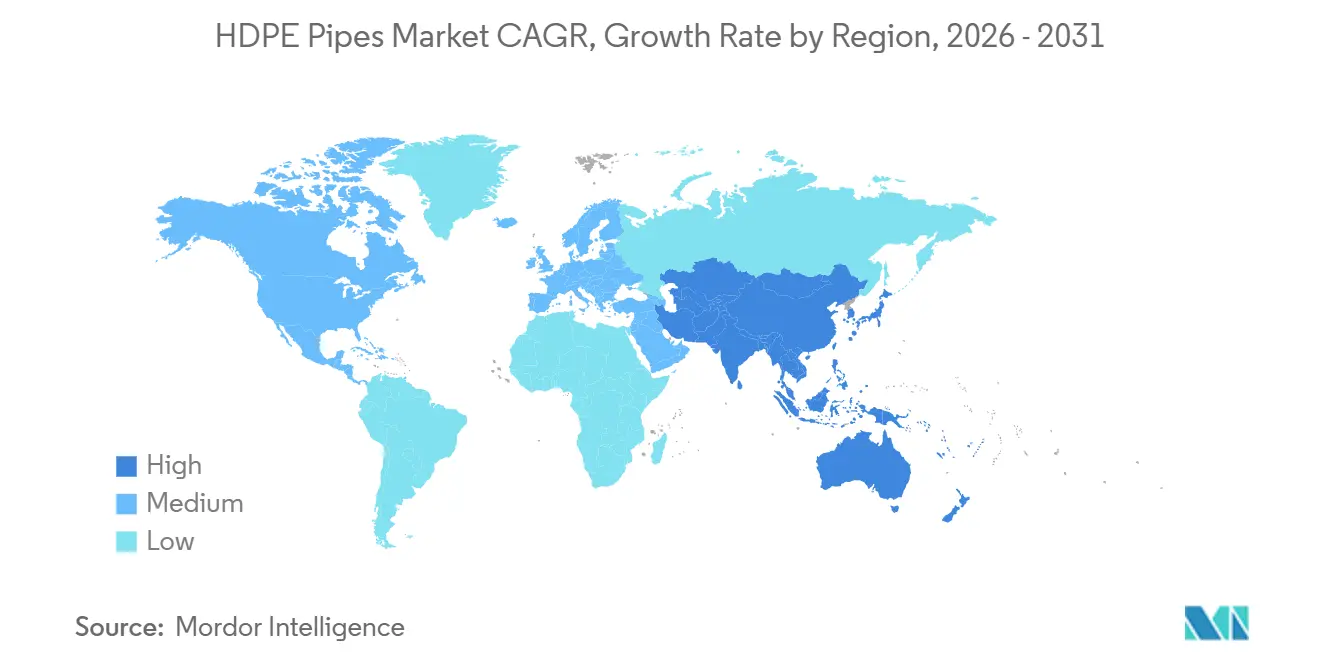
| Fastest Growing Market | Asia-Pacific |
| Largest Market | Asia-Pacific |
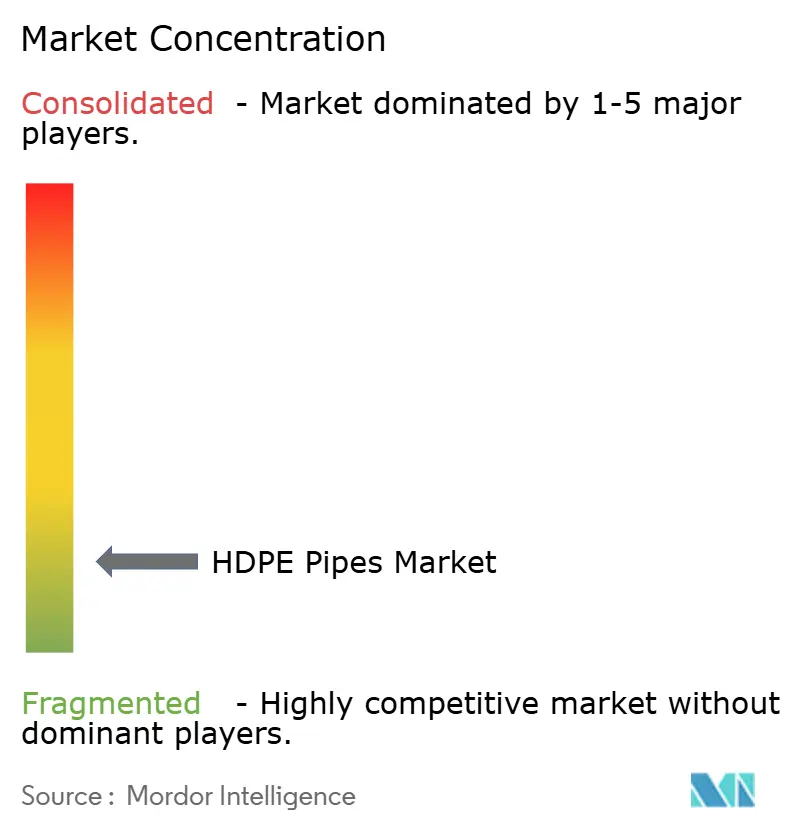
| Market Concentration | Low |
Major Players *Disclaimer: Major Players sorted in no particular order Image © Mordor Intelligence. Reuse requires attribution under CC BY 4.0. | |
HDPE Pipes Market Analysis by Mordor Intelligence
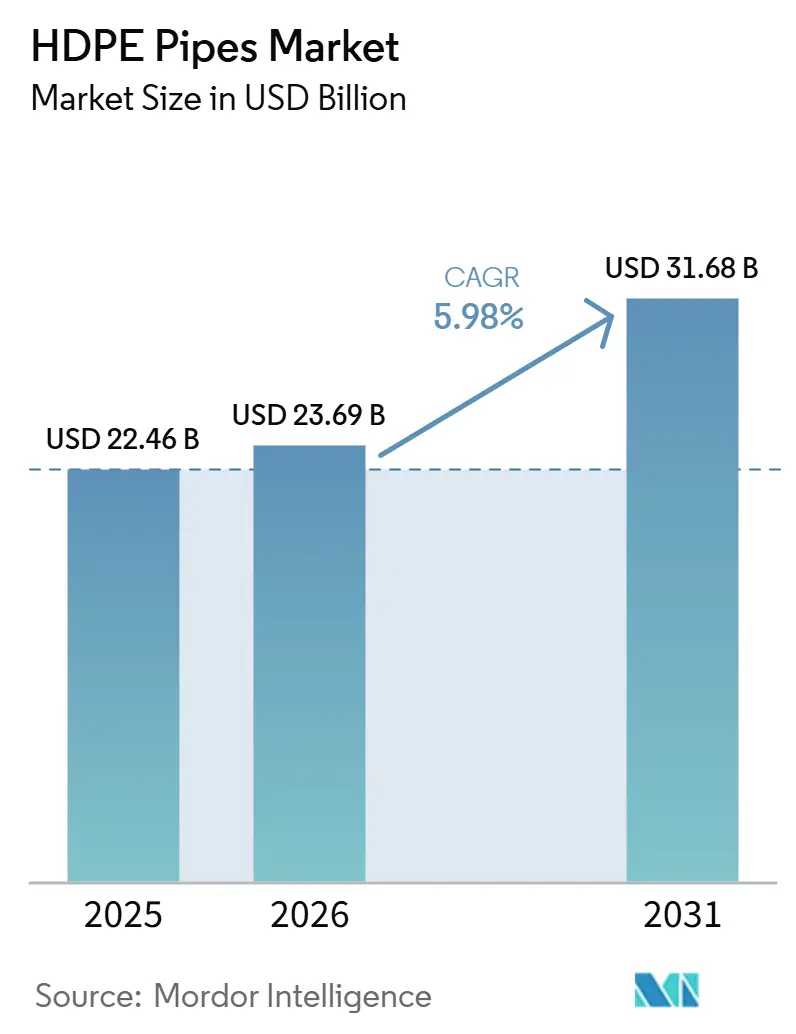
The HDPE pipes market size was valued at USD 22.46 billion in 2025 and estimated to grow from USD 23.69 billion in 2026 to reach USD 31.68 billion by 2031, at a CAGR of 5.98% during the forecast period (2026-2031). Municipal water investment and pipeline replacement support demand because utilities must address aging, corroded, and leaking networks. Rapid urban pipeline construction in emerging economies adds to this base of public infrastructure work. HDPE pipes are selected for corrosion resistance, fusion-jointed connections, and long service life in pressure applications. Renewable energy, broadband, and power-grid projects are creating demand that is separate from municipal water budgets. Within the HDPE pipes market, competition remains strong in standard diameters, while large-diameter and high-performance applications favor manufacturers with technical capability and project experience.
Key Report Takeaways
- By grade, PE 100 held 66.32% of the HDPE pipes market share in 2025 and is forecast to grow at a 6.61% CAGR through 2031.
- By diameter, the 110–500 mm range accounted for 47.24% of the HDPE pipes market share in 2025, while pipes above 500 mm are projected to grow at a 6.84% CAGR through 2031.
- By application, water supply and distribution held 30.68% of the HDPE pipes market share in 2025, while telecom and power ducting is expected to expand at a 7.33% CAGR through 2031.
- By end-use industry, municipal and public utilities accounted for 36.11% of the HDPE pipes market share in 2025, while renewable energy is forecast to grow at a 7.19% CAGR through 2031.
- By geography, Asia-Pacific held 44.92% of the HDPE pipes market share in 2025 and is projected to grow at a 6.75% CAGR through 2031.
Note: Market size and forecast figures in this report are generated using Mordor Intelligence’s proprietary estimation framework, updated with the latest available data and insights as of January 2026.
Market Trends and Insights
Drivers Impact Analysis of HDPE Pipes Market*
| Driver | (~) % Impact on CAGR Forecast | Geographic Relevance | Impact Timeline |
|---|---|---|---|
| Expansion of Municipal Water Supply and Wastewater Infrastructure | +2.0% | Global, concentrated in APAC, North America, and MEA | Long term (≥ 4 years) |
| Replacement of Aging and Corrosion-Prone Pipeline Infrastructure | +1.2% | North America, Europe, Australia | Medium term (2–4 years) |
| Increasing Adoption of HDPE Pipes for Water-Efficient Irrigation Systems | +0.8% | APAC, MEA, South America | Long term (≥ 4 years) |
| Growing Demand for High-Performance PE100 Pipes in High-Pressure Applications | +0.7% | Global | Medium term (2–4 years) |
| Increasing Adoption of Trenchless Pipeline Rehabilitation and Fusion-Jointed HDPE Systems | +0.6% | North America, Europe | Medium term (2–4 years) |
| Source: Mordor Intelligence | |||
Expansion of Municipal Water Supply and Wastewater Infrastructure
Municipal water and wastewater investment provides the largest demand base for the HDPE pipes market. The U.S. Environmental Protection Agency identified USD 422.9 billion in distribution and transmission rehabilitation needs over 20 years in its 2025 survey[1]U.S. Environmental Protection Agency, “2025 Update to the 7th Drinking Water Infrastructure Needs Survey and Assessment,” EPA, epa.gov.. The Infrastructure Investment and Jobs Act appropriated USD 31 billion through the Drinking Water State Revolving Fund to support drinking water investment and lead service line replacement. India’s Jal Jeevan Mission specifies PE 100 Standard Dimension Ratio (SDR) 17, Nominal Pressure (PN) 10 pipe for rural water distribution mains. These public programs turn regulatory, public-health, and climate-resilience requirements into committed procurement. The resulting work reduces the HDPE pipes market’s exposure to private construction cycles.
Replacement of Aging and Corrosion-Prone Pipeline Infrastructure
Replacement of cast iron, asbestos cement, and corroding ductile iron pipelines supports the HDPE pipes market demand in mature economies. The American Society of Civil Engineers reported in 2025 that nearly 20% of installed U.S. water mains had exceeded their useful service lives. Its assessment also cited more than 33.3 trillion gallons of annual water loss and more than USD 187 billion in lost utility revenue from failing networks. EYDAP began a EUR 500 million pipeline replacement program for 600–700 km of network in Athens during 2025. United Utilities signed a GBP 3 billion agreement in 2025 to refurbish the 150 km Haweswater Aqueduct, with construction beginning in 2026. Repeated corrosion failures increase water losses and strengthen the life-cycle case for HDPE replacement.
Increasing Adoption of HDPE Pipes for Water-Efficient Irrigation Systems
Agricultural water stress is shaping the HDPE pipes market demand in Asia, the Middle-East, and South America. HDPE drip irrigation systems made to ISO 4427 requirements support more controlled water delivery than traditional flood irrigation. The Saudi Water Authority described the 587 km Jubail-to-Buraydah independent water transmission pipeline as a 35-year Build-Own-Operate-Transfer project that will supply 650,000 cubic meters per day. Such projects show how water scarcity can support large and long-duration pipe procurement. PE 80 and PE 63 retain demand in cost-sensitive agricultural applications and low-pressure service lines. This broadens the grade mix available to producers that also serve municipal PE 100 projects.
Growing Demand for High-Performance PE 100 Pipes and Fusion-Jointed Systems
PE 100 is gaining use across the HDPE pipes market in high-pressure municipal, gas distribution, and industrial specifications. Its Minimum Required Strength is 10 MPa under ISO 4427, supporting thinner wall sections at equivalent pressure ratings. Modern PE4710 and bimodal PE 100 compounds have documented design-life projections above 100 years under pressure conditions. The European Plastic Pipes and Fittings Association (TEPPFA) stated that PE 100-RC represented 25% of PE 100 use in European trenchless applications. A 2025 peer-reviewed study examined the qualification of thick-wall PE 100 butt fusion joints for desalination, power, and industrial pipelines. As procurement specifications require PE 100 more often, fusion monitoring and joint-integrity documentation become important sources of differentiation in the HDPE pipes industry.
Restraints Impact Analysis of HDPE Pipes Market*
| Restraint | (~) % Impact on CAGR Forecast | Geographic Relevance | Impact Timeline |
|---|---|---|---|
| Volatility in Polyethylene Resin Prices Affecting Production Costs | -0.8% | Global | Short term (≤ 2 years) |
| Competition from PVC, Ductile Iron, Steel and Concrete Pipes | -0.5% | North America, Europe, Asia-Pacific | Medium term (2–4 years) |
| Thermal Expansion and Temperature-Service Limitations | -0.3% | Global (above-grade industrial applications) | Long term (≥ 4 years) |
| Source: Mordor Intelligence | |||
Thermal Expansion and Temperature-Service Limitations
Resin price volatility remains an immediate operational challenge for the HDPE pipes market. Long-term public infrastructure contracts can limit the ability of manufacturers to recover feedstock cost increases. This exposure is more acute for producers without forward-purchase or other price-management arrangements. Naphtha-dependent cracker economics in Asia remain sensitive to disruptions affecting Middle-East shipping routes. HDPE also has thermal performance limits in above-grade, high-temperature industrial applications. These limits preserve a role for alternative materials in process conditions that exceed HDPE service requirements.
Competition from PVC, Ductile Iron, Steel, and Concrete Pipes
The HDPE pipes market competes with other materials across diameters and applications. PVC remains relevant in smaller-diameter residential and suburban distribution systems where its initial material cost and handling are favorable. Ductile iron continues to be specified for some high-pressure, large-diameter trunk mains with traffic or soil loading requirements. Steel retains use in long-distance, high-pressure gas transmission and oil-gathering systems. HDPE becomes more competitive as the diameter rises because its thinner wall, lower joining cost, and fusion-sealed connections can offset material costs. This relationship supports HDPE participation in mid-range and large-diameter replacement bids.
*Our forecasts treat driver/restraint impacts as directional, not additive. The impact forecasts reflect baseline growth, mix effects, and variable interactions.
HDPE Pipes Market Segment Analysis
By Grade:
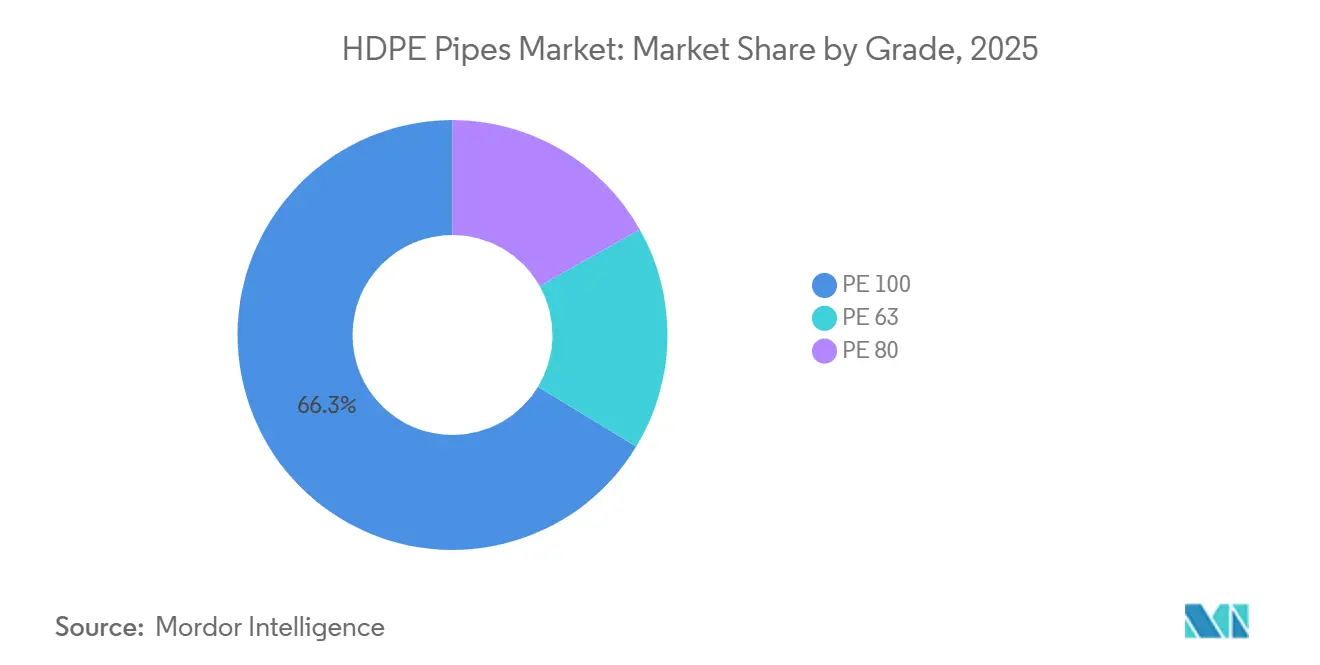
PE 100 Leads Across Pressure and Durability SpecificationsPE 100 accounted for 66.32% of global value in 2025 and is projected to expand at a 6.61% CAGR through 2031. PE 100 benefits from its 10 MPa Minimum Required Strength (MRS) rating under ISO 4427. That rating permits thinner wall sections at comparable pressure levels than lower grades. Modern bimodal PE 100 compounds address slow crack growth and oxidative aging over a 100-year design horizon. Public procurement frameworks in Europe and North America increasingly specify PE 100 for new pressure-rated water infrastructure.
PE 80, with an MRS of 8 MPa, continues to serve gas distribution and low-to-medium-pressure water systems. PE 63 is losing ground in pressure applications but remains relevant in agricultural laterals and low-pressure domestic supply lines. A 2025 review found that butt fusion advancements for thick-wall PE 100 are extending its use in desalination, thermal power, and nuclear pipeline applications. This supports wider adoption of PE 100, where lower grades were previously used. The HDPE pipes market is therefore shifting toward higher-performance grades as designers gain confidence in joint quality.



By Diameter:
110–500 mm Range Anchor Revenue While Above 500 mm Drive GrowthThe 110–500 mm range held 47.24% of the global value in 2025. This range anchors the HDPE pipes market revenue in municipal water distribution, wastewater collection, and agricultural irrigation mains across regions. Pipes above 500 mm are forecast to grow at a 6.84% CAGR through 2031. Large water transmission lines and offshore energy cable protection support this growth. Pipes below 110 mm are used in service connections, small-bore irrigation laterals, and telecom microduct systems.
Large-diameter demand also reflects investment in offshore energy infrastructure. Polenergia and Equinor transported 4 HDPE pipes, each 1.5 km long and weighing more than 200 metric tons, for the Bałtyk 2 and Bałtyk 3 offshore wind farms in Poland. The combined project has 1,440 MW capacity and is expected to supply electricity to more than 2 million Polish households at commercial start-up in 2028. A 3.5-meter-diameter HDPE submarine intake pipe was installed for the Jizan Industrial City seawater cooling project in Saudi Arabia during 2025. These applications provide a separate demand source for the HDPE pipes market.
By Application:
Water Supply and Distribution Anchors Revenue as Digital Networks Accelerate GrowthWater supply and distribution held 30.68% of the global value in 2025. Its position reflects the use of HDPE in pressurized municipal systems across the HDPE pipes market. Telecom and power ducting is forecast to grow at a 7.33% CAGR through 2031. Fiber-to-the-home deployments and 5G rollouts require HDPE microduct bundles at urban and rural scales. Wastewater, sewage and drainage application demand is supported by sanitation expansion in APAC and MEA and replacement work in European cities.
Irrigation, oil and gas, industrial process piping, chemical processing, and stormwater management make up the remaining application mix. SIMONA Peak Pipe Systems supplied ClearDuct C1+ ENA TS 12-24 cable ducting for the 525 kV Eastern Green Link 2 route in Yorkshire during 2025. The work covered 18.3 km of onshore horizontal directional drilling (HDD) activity across 49 locations. Dogger Bank used more than 165 km of approved HDPE ducting. These power-grid projects can generate HDPE pipes market demand at a scale comparable to traditional water contracts.
By End-Use Industry:
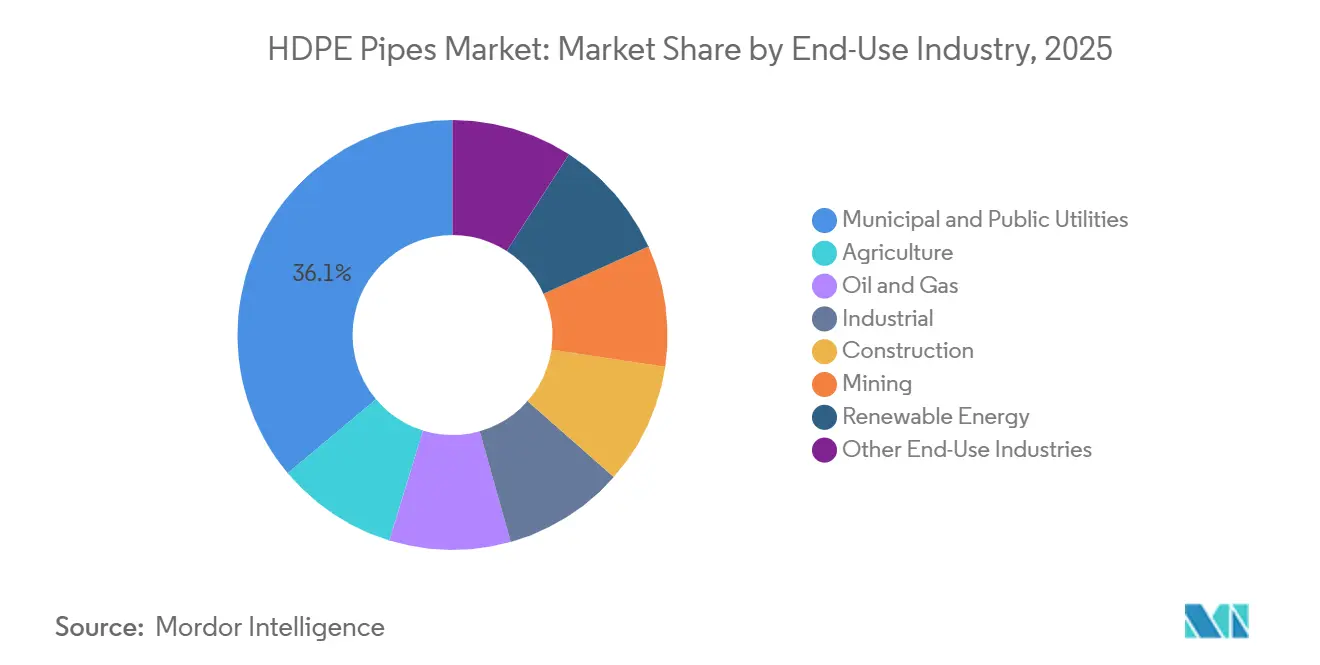
Renewable Energy Leads Growth While Municipal and Public Utilities Anchor RevenueMunicipal and public utilities held 36.11% of the global value in 2025. This end-use industry segment is the primary buyer for water supply, wastewater, and stormwater systems in the HDPE pipes market. Renewable energy is forecast to grow at a 7.19% CAGR through 2031. Renewable energy demand includes underground solar wiring, offshore wind export cable ducts, and geothermal fluid transport piping.
Supreme Industries reported 14% year-on-year plastic piping volume growth in its Q4 FY26 results, and management guided for 15–17% piping volume growth in FY27 while citing renewable energy infrastructure. Manufacturers are repositioning product lines toward renewable energy projects to address faster growth in the HDPE pipes market. Construction and mining face challenges because of weaker global construction activity and commodity-cycle pressures. This supports the relative value of municipal and renewable-energy exposure in the HDPE pipes industry.
Geography Analysis
APAC HDPE Pipes Market
Asia-Pacific accounted for 44.92% of global value in 2025 and is forecast to grow at 6.75% CAGR through 2031. China is pursuing urban pipeline modernization and industrial-park utility expansion. India’s Jal Jeevan Mission directs rural distribution procurement toward PE 100 SDR 17 pipe, while the PM Krishi Sinchayee Yojana supports agricultural irrigation pipe demand. Japan and South Korea focus on earthquake-resilience upgrades and replacement of aging metallic networks.
North America and Europe HDPE Pipes Market
North America is an important part of the HDPE pipes market because of policy-linked water infrastructure spending. The EPA’s 2025 update identified USD 625 billion in 20-year drinking-water investment needs, a 30% increase from its 2018 assessment. The USD 31 billion Drinking Water State Revolving Fund (DWSRF) appropriation supports drinking-water distribution and lead service line work. Europe is driven by the replacement of 20th-century networks and Drinking Water Directive compliance, while the European Commission allocated EUR 392 billion (approximately USD 446.12 billion) under 2021–2027 Cohesion Policy programs for water access and sustainable water management[2]European Commission, “Cohesion Policy Programmes 2021–2027,” European Commission, commission.europa.eu..
MEA and South America HDPE Pipes Market
South America, led by Brazil, combines agribusiness irrigation demand with municipal modernization, while Middle-East and Africa have a stronger project-led opportunity through water supply, district cooling ducting, and fiber infrastructure. Saudi Arabia’s National Water Company awarded a USD 220 million water infrastructure contract in 2025 that included 97.66 km of HDPE water lines in 110–400 mm diameters. In July 2026, Alwasail Industrial Co. signed a SAR 12.82 million contract, equivalent to USD 3.4 million, to supply HDPE pipes for King Abdullah Economic City infrastructure phases. Saudi Vision 2030 projects, including NEOM, Red Sea, and Qiddiya, provide a multi-year HDPE procurement pipeline for water supply, district cooling ducting, and fiber infrastructure. Sub-Saharan piped-water programs and GCC desalination extensions support demand where saline and arid conditions challenge metallic pipe systems.

Competitive Landscape
The HDPE pipes market is highly fragmented, with the top five players including JM Eagle, Inc., Aliaxis Holdings SA, WL Plastics, POLYPLASTIC Group, and Chevron Phillips Chemical Company LLC. Global producers compete in premium and large-diameter applications, while regional producers maintain price competition in standard mid-range diameters. Leading strategies in the HDPE pipes market include geographic expansion, acquisition, technology licensing, and recycled-content production.
GF Industry and Infrastructure Flow Solutions uses its ELGEF Plus PE 100 electrofusion system to support a quality-based position in fusion applications. The system has been commercially deployed for more than 25 years. Large-diameter pipes for offshore energy and seawater cooling are a specialized opportunity in the HDPE pipes market. Telecom microduct bundles for rural broadband are another opportunity where public digital-access programs support demand. Chinese resin-to-pipe producers represent competitive pressure for non-integrated manufacturers because their expanding domestic resin availability can support more competitive volume bids.
Mergers and acquisitions show the importance of scale and technology access in the HDPE pipes market. In April 2026, Infra Pipes completed the acquisition of Atkore’s HDPE pipe and conduit business, which serves the U.S. telecommunications sector and includes 5 manufacturing facilities. Infra Pipes capitalized the combined entity with USD 28 million, while Atkore retained a 10% equity stake. Supreme Industries completed its USD 30 million acquisition of Orbia Wavin’s India pipes and fittings business in July 2025, including a long-term technology license for India and South Asian Association for Regional Cooperation (SAARC) countries.
HDPE Pipes Industry Leaders
JM EAGLE, INC.
Aliaxis Holdings SA
WL Plastics
POLYPLASTIC Group
Chevron Phillips Chemical Company LLC
- *Disclaimer: Major Players sorted in no particular order
HDPE Pipes Market Companies Covered in this Report
- Aliaxis Holdings SA
- Astral Limited
- Chevron Phillips Chemical Company LLC
- China Lesso
- Finolex Industries Limited
- GF Industry and Infrastructure Flow Solutions
- JM EAGLE, INC.
- KWH Pipe Oy
- Orbia
- Pipelife International GmbH
- POLYPLASTIC Group
- Prinsco, Inc.
- Radius Systems
- Supreme Industries Limited
- WL Plastics

Recent Industry Developments in HDPE Pipes Market
- July 2026: Alwasail Industrial Co. signed a SAR 12.82 million (approximately USD 3.4 million) contract with Nesma & Partners Contracting Co. to supply HDPE pipes in various sizes and technical specifications for infrastructure works at King Abdullah Economic City (KAEC) phases 2.2 and 2.3. The agreement supported the development of roads, utilities, and services for the King Salman Automotive Cluster and the KAEC Special Economic Zone.
- July 2026: Infra Pipes acquired Atkore Inc.’s HDPE pipe and conduit business, strengthening its presence in the United States telecommunications market. The acquired business included five manufacturing facilities across Texas, Oregon, South Carolina, New Mexico, and Missouri.


Global HDPE Pipes Market Report Scope
High-density polyethylene (HDPE) pipes are durable thermoplastic piping systems known for their high strength-to-density ratio, corrosion resistance, flexibility, and long service life. They are widely used for the safe transportation of water, wastewater, chemicals, hydrocarbons, and other fluids across municipal, industrial, agricultural, and infrastructure applications due to their leak-proof joints and low maintenance requirements.
The HDPE Pipes Market is segmented by grade, diameter, application, end-use industry, and geography. By grade, the market is segmented into PE 100, PE 63, and PE 80. By diameter, the market is segmented into less than 110 mm, 110–500 mm, and above 500 mm. By application, the market is segmented into water supply and distribution, wastewater, sewage and drainage, irrigation, oil and gas, industrial process piping, chemical processing, stormwater management, telecom and power ducting, and other applications. By end-use industry, the market is segmented into municipal and public utilities, agriculture, oil and gas, industrial, construction, mining, renewable energy, and other end-use industries. The report also covers the market size and forecasts for HDPE pipes in 16 countries across major regions. For each segment, the market sizing and forecasts have been done on the basis of value (USD).
| PE 100 |
| PE 63 |
| PE 80 |
| Less Than 110 mm |
| 110-500 mm |
| Above 500 mm |
| Water Supply and Distribution |
| Wastewater, Sewage and Drainage |
| Irrigation |
| Oil and Gas |
| Industrial Process Piping |
| Chemical Processing |
| Stormwater Management |
| Telecom and Power Ducting |
| Other Applications |
| Municipal and Public Utilities |
| Agriculture |
| Oil and Gas |
| Industrial |
| Construction |
| Mining |
| Renewable Energy |
| Other End-Use Industries |
| Asia-Pacific | China |
| India | |
| Japan | |
| South Korea | |
| Rest of Asia-Pacific | |
| North America | United States |
| Canada | |
| Mexico | |
| Europe | Germany |
| United Kingdom | |
| France | |
| Italy | |
| Russia | |
| Rest of Europe | |
| South America | Brazil |
| Argentina | |
| Rest of South America | |
| Middle-East and Africa | Saudi Arabia |
| South Africa | |
| Rest of Middle-East and Africa |
| By Grade | PE 100 | |
| PE 63 | ||
| PE 80 | ||
| By Diameter | Less Than 110 mm | |
| 110-500 mm | ||
| Above 500 mm | ||
| By Application | Water Supply and Distribution | |
| Wastewater, Sewage and Drainage | ||
| Irrigation | ||
| Oil and Gas | ||
| Industrial Process Piping | ||
| Chemical Processing | ||
| Stormwater Management | ||
| Telecom and Power Ducting | ||
| Other Applications | ||
| By End-Use Industry | Municipal and Public Utilities | |
| Agriculture | ||
| Oil and Gas | ||
| Industrial | ||
| Construction | ||
| Mining | ||
| Renewable Energy | ||
| Other End-Use Industries | ||
| By Geography | Asia-Pacific | China |
| India | ||
| Japan | ||
| South Korea | ||
| Rest of Asia-Pacific | ||
| North America | United States | |
| Canada | ||
| Mexico | ||
| Europe | Germany | |
| United Kingdom | ||
| France | ||
| Italy | ||
| Russia | ||
| Rest of Europe | ||
| South America | Brazil | |
| Argentina | ||
| Rest of South America | ||
| Middle-East and Africa | Saudi Arabia | |
| South Africa | ||
| Rest of Middle-East and Africa | ||


Key Questions Answered in the Report
What is the size of the HDPE pipes market?
The HDPE pipes market stands at USD 23.69 billion in 2026 and is forecast to reach USD 31.68 billion by 2031.
Which HDPE pipe grade leads global demand?
PE 100 led with a 66.32% share in 2025 and is forecast to grow at a 6.61% CAGR through 2031.
Which pipe diameter is projected to grow fastest through 2031?
Pipes above 500 mm are projected to grow at a 6.84% CAGR through 2031, supported by transmission and offshore energy projects.
What application is projected to grow fastest through 2031?
Telecom and power ducting is projected to grow at a 7.33% CAGR through 2031.
Page last updated on:





