
Haptic Feedback and Sensorial Simulation For XR Market Size and Share
Market Overview
| Study Period | 2020 - 2031 |
|---|---|
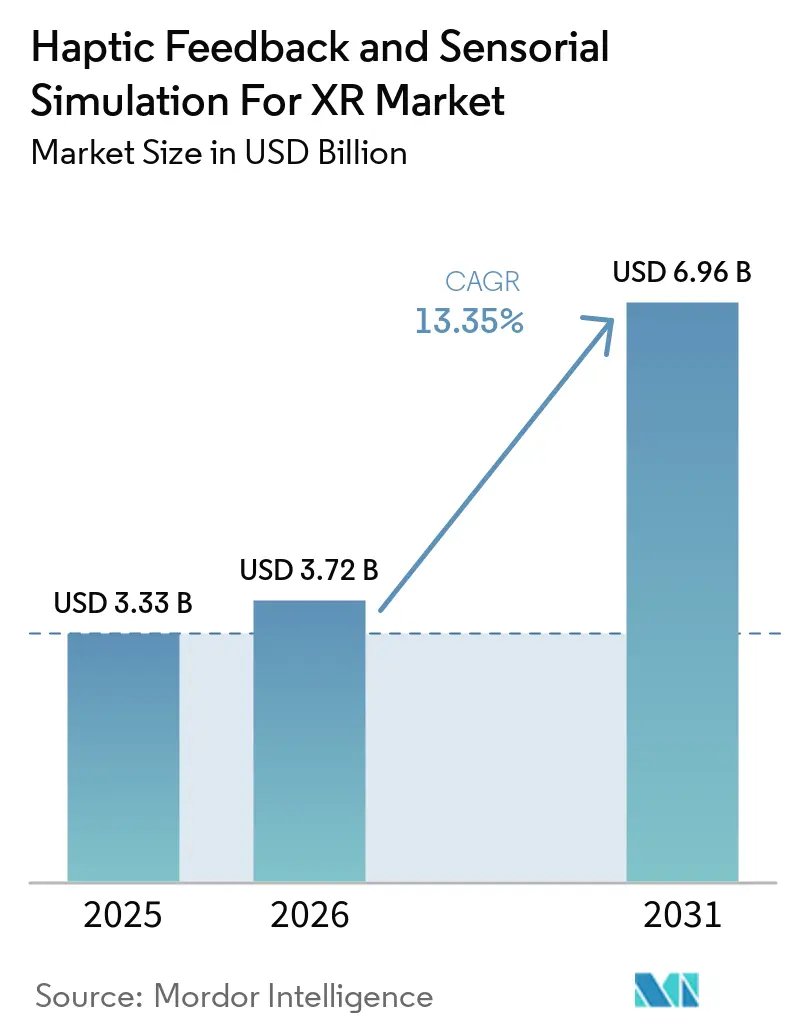
| Market Size (2026) | USD 3.72 Billion |
| Market Size (2031) | USD 6.96 Billion |
| Growth Rate (2026 - 2031) | 13.35 % |
| Fastest Growing Market | Asia-Pacific |
| Largest Market | North America |
| Market Concentration | Medium |
Major Players *Disclaimer: Major Players sorted in no particular order Image © Mordor Intelligence. Reuse requires attribution under CC BY 4.0. | |
Haptic Feedback and Sensorial Simulation For XR Market Analysis by Mordor Intelligence
The haptic feedback and sensorial simulation for XR market size is projected to expand from USD 3.33 billion in 2025 and USD 3.72 billion in 2026 to USD 6.96 billion by 2031, registering a CAGR of 13.35% between 2026 to 2031. Lower headset costs are widening the installed base for controllers, gloves, vests, and other tactile peripherals. Enterprise buyers are also moving toward training systems that can measure performance during complex physical tasks. This combination supports demand across consumer, healthcare, industrial, and defense settings. Vendors are responding by combining hardware with software tools, content libraries, and integration services. haptic feedback and sensorial simulation for XR market therefore depends on both wider XR adoption and the availability of practical content that works across devices.
Key Report Takeaways
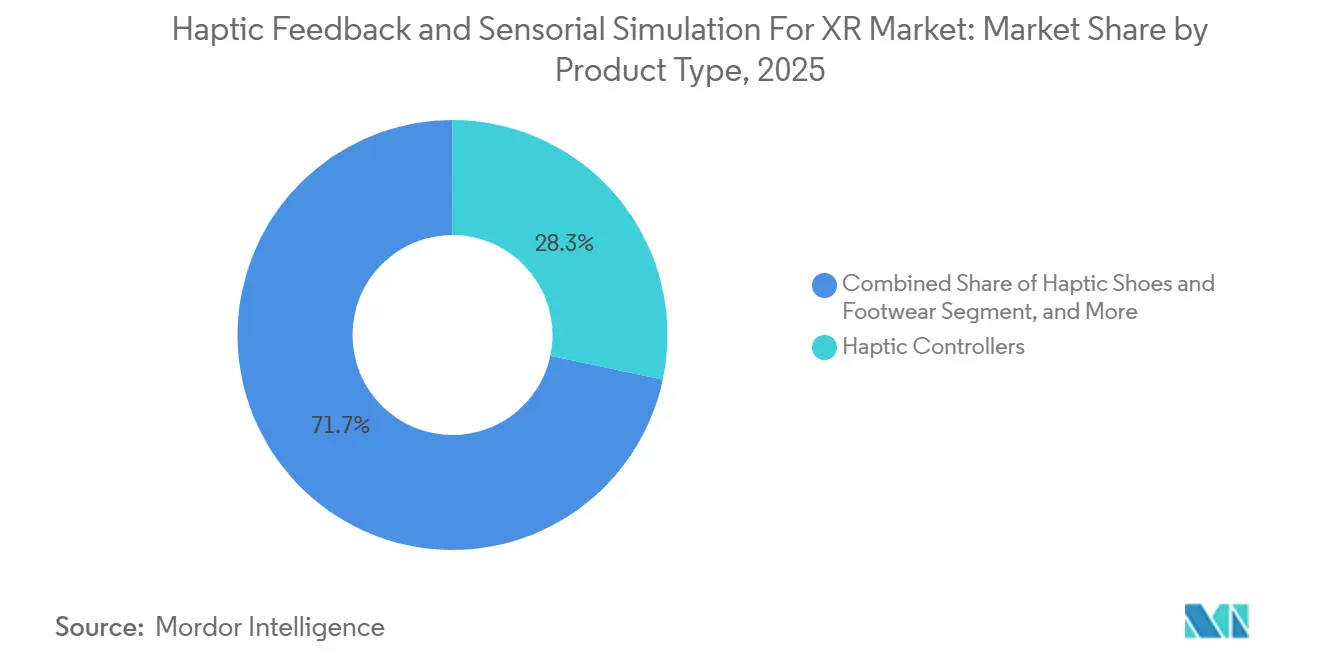
- By product type, Haptic Controllers held 28.32% of the haptic feedback and sensorial simulation market share in 2025, while Mid-Air Haptic Systems are the fastest-growing product category, with a CAGR of 13.56% through 2031.
- By feedback modality, Vibrotactile Feedback led revenue with a share of 38.42% in 2025, while Multimodal Feedback is projected to expand at a 13.68% CAGR through 2031 in the haptic feedback and sensorial simulation for the XR market.
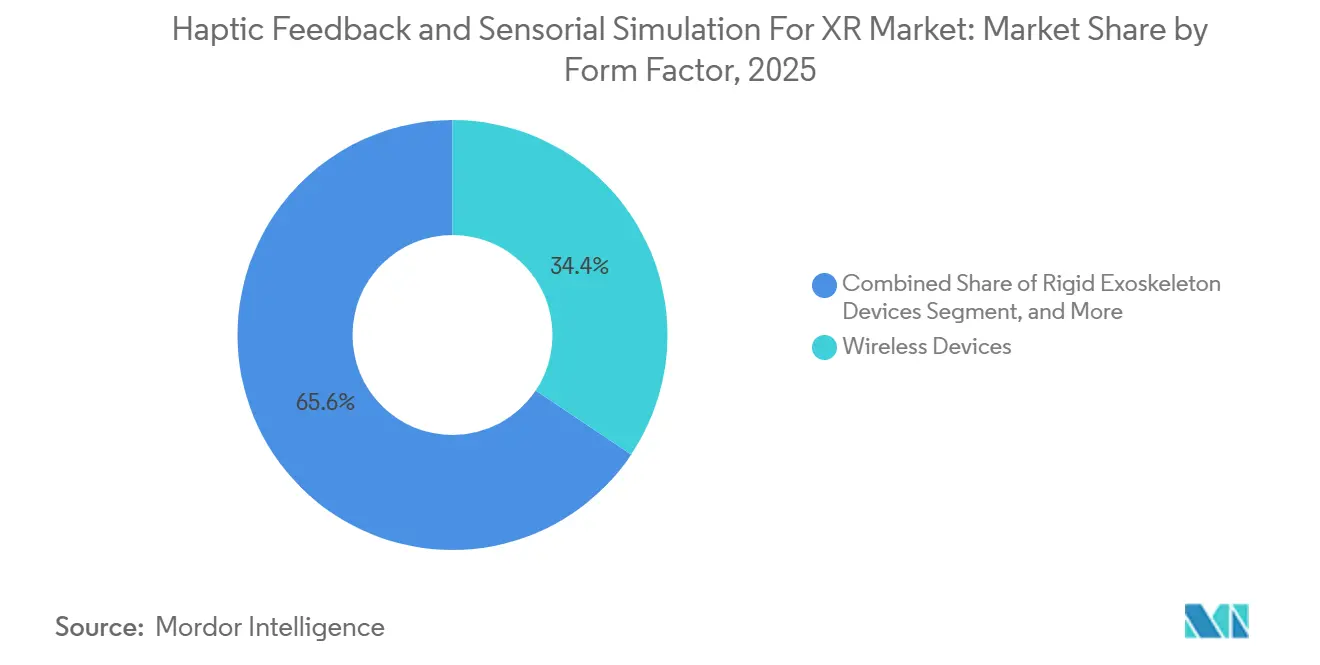
- By form factor, Wireless Devices accounted for 34.38% of revenue in 2025, while Soft Wearable Devices are the fastest-growing form factor with a CAGR of 13.89% through 2031 in the haptic feedback and sensorial simulation market for XR.
- By application, Gaming and Entertainment led revenue with a share of 32.36% in 2025, while Industrial Training and Simulation is projected to expand at a 13.97% CAGR through 2031.
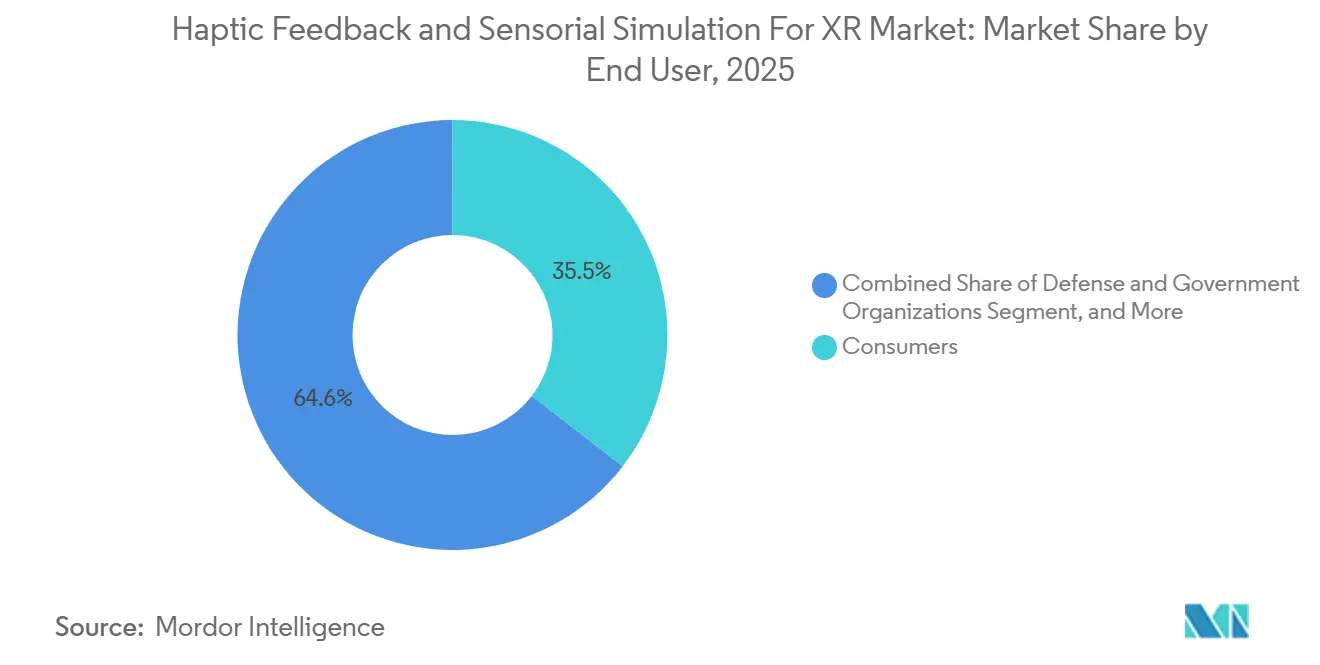
- By end user, Consumers accounted for 35.45% of revenue in 2025, while Enterprise and Commercial Organizations are the fastest-growing end-user group, with a CAGR of 14.05% through 2031.
- By distribution channel, Direct Sales held the largest revenue share of 32.36% in 2025, while Subscription and Haptic-Software Bundles are projected to expand at a 14.11% CAGR through 2031.
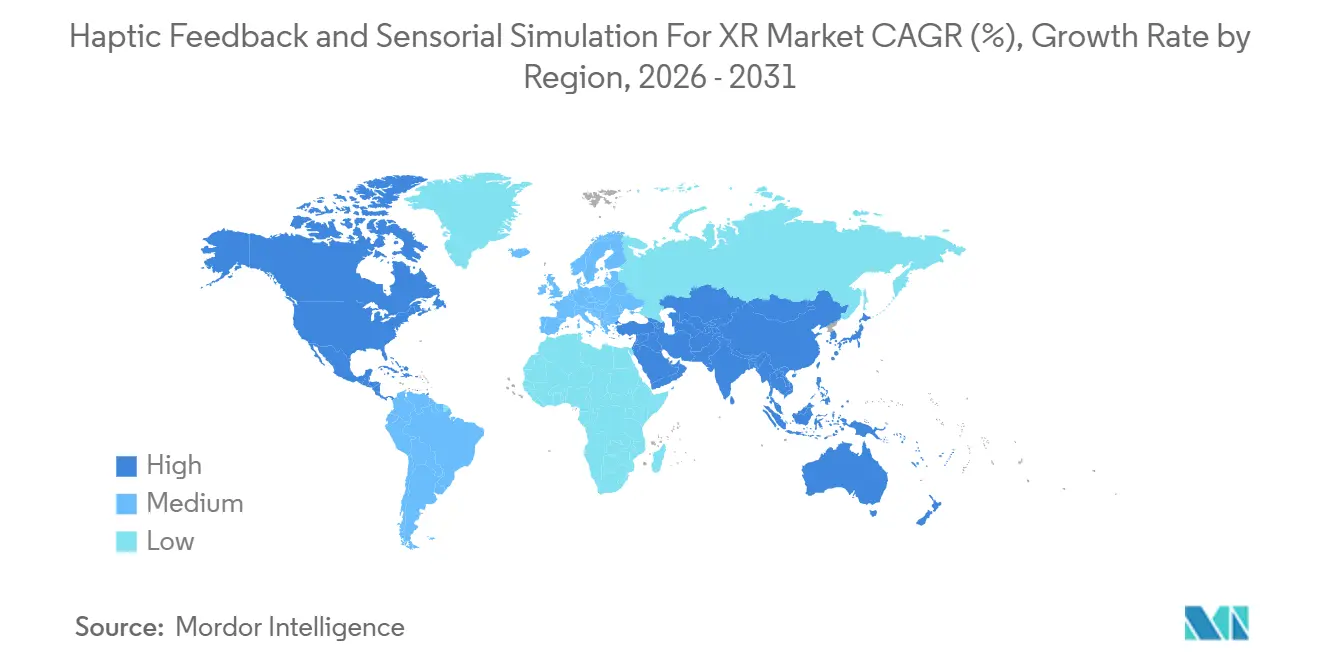
- By geography, North America held 36.40% of revenue in 2025, while Asia-Pacific is projected to expand at a 14.19% CAGR through 2031.
Note: Market size and forecast figures in this report are generated using Mordor Intelligence’s proprietary estimation framework, updated with the latest available data and insights as of January 2026.
Market Trends and Insights
Drivers Impact Analysis of Haptic Feedback and Sensorial Simulation For XR Market*
| Driver | (~) % Impact on CAGR Forecast | Geographic Relevance | Impact Timeline |
|---|---|---|---|
| XR Hardware Proliferation and Spatial Computing Adoption | +3.8% | Global, concentrated in North America and Asia-Pacific | Medium term (2-4 years) |
| Enterprise Demand for High-Fidelity Simulation and Training | +2.9% | North America and Europe, with an expanding Asia-Pacific footprint | Medium term (2-4 years) |
| Rising Use of Haptic Wearables in Gaming and Fitness | +2.1% | Global, with high adoption in North America, South Korea, and Japan | Short term (≤ 2 years) |
| Expansion of Force Feedback in Remote Robotics and Teleoperation | +1.5% | Japan, South Korea, Germany, and the United States | Long term (≥ 4 years) |
| AI-Enabled Adaptive and Multisensory Haptic Rendering | +1.2% | Global, with early commercial deployment in North America and Europe | Long term (≥ 4 years) |
| Regional XR Investment Programs in Asia-Pacific and the Middle East | +0.8% | Asia-Pacific, with spillover to the Middle East and North Africa | Medium term (2-4 years) |
| Source: Mordor Intelligence | |||
XR Hardware Proliferation and Spatial Computing Adoption
Qualcomm’s Snapdragon XR2+ Gen 2 supports high-resolution mixed-reality devices and provides the processing base for new headset designs.[1] Lower-cost and higher-volume headsets widen the potential customer base for compatible controllers, gloves, and vests. Samsung’s joint mixed-reality work with Google and Qualcomm, aimed at consumer channels in 2026, also supports higher headset volumes. The haptic feedback and sensorial simulation for XR market gains when headset users can add tactile accessories without a specialized setup. A larger installed base also gives software developers a reason to include dedicated haptic functions in new XR titles. Qualcomm introduced Snapdragon Reality Elite and its Scalable Turnkey AI-Ready Toolkit in June 2026, adding development tools that haptic solution providers can use when building AR hardware.
Enterprise Demand for High-Fidelity Simulation and Training
Enterprise buyers use haptic systems when visual simulation alone cannot reproduce physical resistance, texture, or contact. Surgical training, aircraft maintenance, explosive ordnance disposal, and complex manufacturing all require workers to practice detailed procedures. The HEART Project, launched under the EU-funded MasterXR framework in March 2025, combined SenseGlove’s Rembrandt force-feedback gloves with Aeon Robotics’ HandEffector robotic system.[2] The project aimed to let untrained operators teach complex robot tasks within 1 hour through a VR and force-feedback interface. This model shifts buyer attention from device specifications toward onboarding time, incident reduction, and training outcomes. It also favors suppliers that can provide SDKs, content libraries, and system support with the hardware.
Rising Use of Haptic Wearables in Gaming and Fitness
Gaming gives haptic device suppliers consumer-scale volumes that support ongoing product development. At CES 2026, bHaptics presented applications in music, fitness, and everyday digital interaction alongside its gaming products.[3] The company began shipping the TactGlove DK3 in June 2026 at USD 385, adding palm-base haptic motors to complement fingertip feedback. Its TactSuit Pro and TactSuit Air were priced at USD 565 and USD 320, respectively, for gaming and fitness users. Fitness products place greater emphasis on washable materials, low device weight, ventilation, and battery duration. Those requirements can carry into medical rehabilitation devices, where comfort during repeated sessions is equally important.
Expansion of Force Feedback in Remote Robotics and Teleoperation
Teleoperation requires force feedback when a remote operator must judge resistance, grip, or movement in real time. In February 2026, NTT DOCOMO and Keio University Haptics Research Center demonstrated robot teleoperation through a commercial 5G network using low-latency slicing and Real Haptics technology. The demonstration increased force-feedback reproduction by 40% and reduced Dimensionless Jerk Cost by 59% compared with standard 5G operation. This result reduces the need for dedicated private networks in some deployments. SenseGlove also demonstrated its R1 active force-feedback exoskeleton with Haption’s Virtuose 6D HF TAO manipulator at European Robotics Forum 2026. Such multi-vendor configurations can support industrial teleoperation and humanoid robot training, while producing motion and force data that can later inform autonomous control systems.
Restraints Impact Analysis of Haptic Feedback and Sensorial Simulation For XR Market*
| Restraint | (~) % Impact on CAGR Forecast | Geographic Relevance | Impact Timeline |
|---|---|---|---|
| High System Cost and Complex Integration Requirements | -1.5% | Global, most acute in price-sensitive emerging markets | Medium term (2-4 years) |
| Limited Cross-Platform Haptic Interoperability | -1.1% | Global, with influence from ISO/IEC 23090-31:2025 and IEEE 1918.1-2024 frameworks | Short term (≤ 2 years) |
| Power, Weight, Thermal, and Wearability Constraints | -0.7% | Global, most acute in consumer and fitness applications | Long term (≥ 4 years) |
| Difficulty Translating Real-World Texture and Force Into Portable Devices | -0.4% | Global, concentrated in high-fidelity enterprise and medical applications | Long term (≥ 4 years) |
| Source: Mordor Intelligence | |||
High System Cost and Complex Integration Requirements
Full-body haptic systems with biometric sensing remain costly for small training operators and educational institutions. Teslasuit launched the XR5 at CES 2026 with an MSRP of USD 9,900 for professional and research settings. These systems can require links to learning-management platforms, game engines, and enterprise software. The resulting integration work increases total ownership costs beyond the listed device price. High prices also limit the volume of interaction data available for improving AI-driven haptic rendering. Wireless consumer gloves priced below USD 400 are reducing expectations for entry-level devices, but regulated simulation environments will continue to require premium multi-sensor systems.
Limited Cross-Platform Haptic Interoperability
Content created for one haptic device often needs manual revision before it can work on another platform. This limits catalog depth, raises production costs, and slows the haptic feedback and sensorial simulation for XR market in applications that depend on third-party content. ISO/IEC 23090-31:2025 established haptics coding for vibrotactile and kinesthetic signals in human-readable JSON and compressed binary formats. IEEE 1918.1-2024 also covers tactile and kinesthetic signal handling for the Tactile Internet and teleoperation. Both standards provide a basis for compatibility, but adoption remains voluntary. Many commercial SDKs have not yet incorporated the formats, leaving vendors with proprietary tools and customers with higher integration costs.
*Our forecasts treat driver/restraint impacts as directional, not additive. The impact forecasts reflect baseline growth, mix effects, and variable interactions.
Haptic Feedback and Sensorial Simulation For XR Market Segment Analysis
By Product Type:
Controllers Lead While Mid-Air Systems Expand Natural InteractionHaptic Controllers accounted for 28.32% of global revenue in 2025 because they remain the primary haptic interface bundled with major XR headsets. The haptic feedback and sensorial simulation for the XR market rely on their broad game engine support and large title library. Haptic Gloves are used for enterprise training, surgical simulation, and teleoperation, with HaptX, SenseGlove, and Manus VR employing different force-feedback designs. Haptic Vests and Belts primarily serve gaming and location-based entertainment, while Haptic Suits have high unit values in enterprise and defense use. Haptic Shoes and Footwear, and Haptic Headsets and Head-Mounted Devices remain smaller categories that extend tactile coverage across the body.
Mid-Air Haptic Systems are the fastest-growing product category, with a CAGR of 13.56% through 2031, as they enable interaction without a handheld accessory. SIM IP acquired Ultraleap’s haptics and XR patent portfolio in 2025, covering more than 500 assets and supporting a commercial licensing strategy. The haptic feedback XR market can benefit if those assets support broader commercial development of controller-free interaction. Research presented at CVPR 2026 described Haptic Neural Fields, which link scene geometry, user actions, and tactile responses in 3D scenes. The method can reduce manual authoring work for material-specific effects and improve the practicality of mid-air systems outside niche installations, where touchless interaction can also reduce the cleaning and maintenance requirements associated with worn controllers.

By Feedback Modality:
Vibrotactile Feedback Leads While Multimodal Systems AdvanceVibrotactile Feedback led revenue with a share of 38.42% in 2025 because it uses mature, lower-cost actuators and works with a broad range of gaming hardware. Haptics reported more than 39,000 dynamic patterns compatible with over 100 game titles. This content base helps the haptic-feedback XR market maintain vibrotactile feedback as its most accessible modality. Force and Kinesthetic Feedback follows, where resistance and directional cues are essential. Skin-Stretch Feedback, Electro-Tactile Feedback, and Thermal Feedback serve smaller, specialized uses, including rehabilitation settings where temperature variation can support treatment and assessment.
Multimodal Feedback is projected to expand at a 13.68% CAGR through 2031 because combined cues can better represent physical contact. The haptic feedback and sensorial simulation for the XR market size for this modality is supported by systems that combine vibration, force, and thermal signals. HAPhy used language models and visual inputs to generate multimodal haptic parameters from object descriptions and 3D images. Users in its blinded study rated the generated experiences comparably to manually authored stimuli. Safety assessment and CE marking requirements for electro-tactile and thermal devices may slow consumer launches and raise barriers for suppliers without compliance capabilities, particularly when products are intended for prolonged body contact or for use in supervised care environments.
By Form Factor:
Wireless Devices Lead While Soft Wearables Gain GroundWireless Devices held 34.38% of the form-factor segment in 2025, reflecting demand for mobility in gaming, fitness, and commercial XR. Improved low-power chipsets and higher battery energy density have enabled longer operating sessions. The haptic feedback and sensory simulation for the XR market benefit from wireless products that can support training sessions beyond 2 hours. Wired Devices remain relevant in surgical simulation, industrial inspection, and defense training, where lower latency and signal quality take priority. Rigid Exoskeleton Devices, Modular Devices, Full-Body Systems, and Partial-Body Systems address applications requiring force feedback or configurable coverage, including industrial tasks in which a device must be adjusted for a specific user, tool, or body area.
Soft Wearable Devices are the fastest-growing form factor, with a CAGR of 13.89%, because actuator arrays can increasingly be integrated into fabric-based products. FundamentalXR launched Fundamental Touch as a device-agnostic platform for wireless haptics beyond healthcare. The haptic feedback and sensorial simulation in the XR industry improve when soft products conform to movement without restricting the user. The platform targets industrial training and search-and-rescue settings through a client-server architecture designed for sub-100 ms latency. If soft devices achieve comparable force resolution to rigid systems, cost and comfort will become more important purchasing criteria, especially for operators who need to wear a system through repeated instruction, evaluation, and practical assessment sessions.
By Application:
Gaming Supports Scale While Industrial Training Leads ExpansionGaming and Entertainment was the largest application segment in 2025 with a share of 32.36%, based on the broad installed base of XR-compatible devices and the deepest haptic content library. Consumer gaming lets manufacturers spread tooling and R&D costs across more products. The haptic feedback and sensorial simulation for the XR market use this volume base to support the development of smaller professional applications. Healthcare and Rehabilitation was the third-largest application, while Defense and Public-Safety Training and Remote Robotics and Teleoperation are moving toward longer procurement programs. Education and Research, Fitness and Sports Training, and Design, Engineering, and Prototyping broaden the use case beyond entertainment, allowing suppliers to serve users who need product review, physical familiarization, or repeatable task practice.
Industrial Training and Simulation is projected to expand at a 13.97% CAGR through 2031. Buyers use haptic simulation when they can link it to faster task learning, lower equipment incidents, and better knowledge retention. South Korea’s Ministry of Science and ICT opened a 2026 program allocating KRW 4.2 billion (USD 3.04 million) to support overseas expansion by XR and AI digital content companies. The haptic feedback XR market may benefit from institutional support for industrial XR suppliers that use tactile platforms. Training deployments also create records of virtual operator interaction that could support autonomous-system training, linking the immediate training case with future uses in process planning and robotic task development.
By End User:
Consumers Lead Revenue While Enterprises Build Premium DemandConsumers accounted for 35.45% of revenue in 2025, reflecting the broad potential base of gaming and fitness users. Falling hardware prices and a wider library of haptic-enabled titles support adoption in this group. bHaptics offered the TactSuit Pro at USD 565 and the TactSuit Air at USD 320 for mainstream VR users. Healthcare Providers use surgical simulation and rehabilitation tools, while Defense and Government Organizations contribute smaller but high-value demand through multiyear service arrangements. Academic and Research Institutions and XR Content and Platform Developers remain important users for testing and early capability development, because they evaluate device performance before wider commercial software and hardware releases.
Enterprise and Commercial Organizations are the fastest-growing end-user segment with a CAGR of 14.05% through 2031. These buyers focus on productivity, onboarding time, and risk reduction where physical practice is difficult or expensive. Teslasuit’s XR5 combines full-body haptics, motion capture, and biometric analytics for defense, medical simulation, and research settings. The haptic feedback and sensorial simulation for XR market rewards vendors that translate this hardware into usable training programs and measurable operating results. Enterprise deployments also favor suppliers that can provide data governance, privacy controls, integration, and ongoing support, since biometric and motion information can be sensitive in regulated training and workplace environments.
By Distribution Channel:
Direct Sales Lead While Software Bundles Change Revenue ModelsDirect Sales held the largest distribution-channel share of 32.36% in 2025 because enterprise haptic systems often need consultation and custom deployment. Buyers may require demonstrations, compatibility assessments, and SDK modifications before purchase. The haptic feedback XR market, therefore, retains a meaningful role for direct vendor relationships. System Integrators and Resellers support mid-market buyers that lack technical teams, while Online Channels and Specialty Retail serve consumers and prosumers. Subscription and Haptic-Software Bundles had the smallest current revenue share but represented the fastest-growing channel, showing that buyers increasingly value access to current content and deployment tools alongside device ownership.
Subscription and Haptic-Software Bundles are projected to expand at a 14.11% CAGR through 2031. Bundled offers combine devices with content libraries, authoring tools, and outcome dashboards, raising revenue per device beyond a one-time sale. FundamentalXR’s device-agnostic architecture supports deployment across Apple Vision Pro, Meta Quest, and robotics platforms through a single software layer. The haptic feedback and sensorial simulation for the XR market can benefit from this model, as it offers buyers hardware flexibility while maintaining an ongoing supplier relationship. Vendors with proprietary content libraries or durable SDK ecosystems are best positioned to benefit from associated switching costs, as changing suppliers may require transferring, revising, and validating existing haptic content.
Geography Analysis
North America and Europe Haptic Feedback and Sensorial Simulation for XR Market
North America held 36.40% of global revenue in 2025, supported by XR developers, enterprise training buyers, and investment in haptic companies. The haptic feedback and sensorial simulation for XR market benefits from regional demand in healthcare, defense, aviation, and advanced manufacturing. The United States remains an important destination for high-fidelity enterprise systems, while HaptX demonstrated glove-based teleoperation of dexterous robot hands at European Robotics Forum 2026. Europe also has a significant revenue position through cross-border projects, industrial robotics, and specialized simulation activity. The EU-funded MasterXR framework supports haptic research and development, while Germany and the United Kingdom contribute industrial robotics, medical simulation, and defense demand.
APAC Haptic Feedback and Sensorial Simulation for XR Market
Asia-Pacific is projected to expand at a 14.19% CAGR through 2031. The haptic feedback and sensorial simulation for XR market share of the region is supported by hardware manufacturing capacity, national XR programs, and a growing gaming base. Japan’s NTT DOCOMO and Keio University demonstration showed that commercial 5G can support high-fidelity haptic teleoperation. South Korea’s 2026 support program provides a route for XR and AI content companies seeking overseas expansion, while China’s actuator ecosystem can reduce hardware unit costs. India and Australia remain underpenetrated markets for consumer and industrial haptic devices.
MEA Haptic Feedback and Sensorial Simulation for XR Market
The Middle East is emerging as a high-growth subregion because public XR programs support economic diversification. Qatar’s Ministry of Communications and Information Technology launched AI and XR Sandboxes at Web Summit Qatar in February 2025. Saudi Arabia’s Vision 2030 framework supports VR medical and defense simulators. Africa remains an early-stage opportunity centered on South Africa, Egypt, and Nigeria, where selected university centers and premium gaming facilities may lead initial commercial adoption.
Competitive Landscape
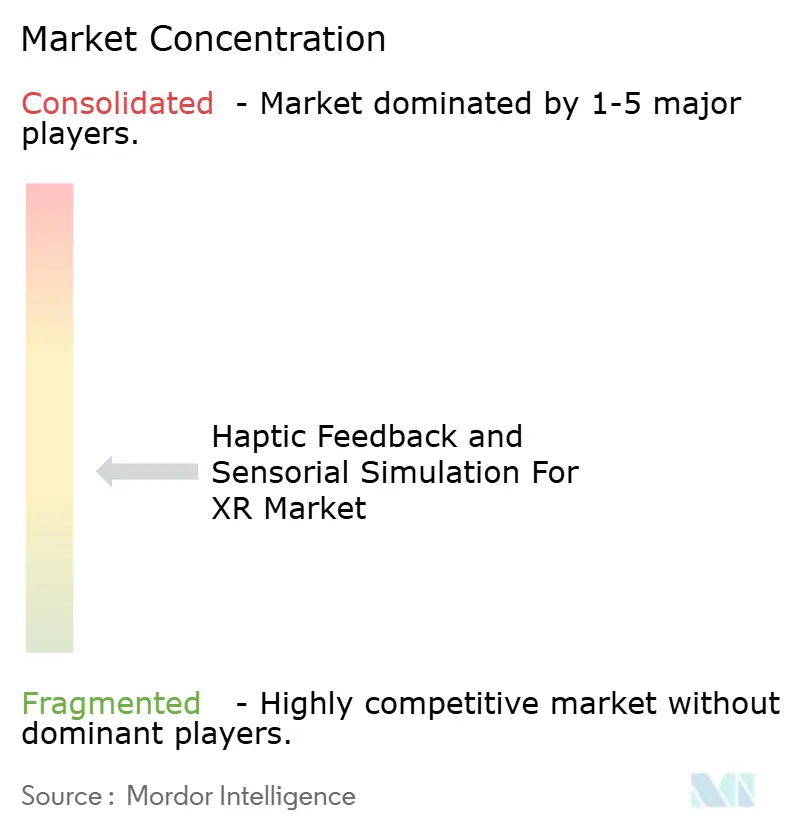
The haptic feedback and sensorial simulation for XR market is fragmented, with more than 20 profiled vendors serving distinct device types, feedback methods, and customer groups. HaptX focuses on enterprise force-feedback gloves for teleoperation and surgical simulation, while bHaptics focuses on consumer vibrotactile wearables and content. Teslasuit provides full-body systems that combine biometrics, motion capture, and haptics for defense and medical customers. The haptic feedback XR market is also becoming more competitive at the software layer, where Unity 6.0 and Unreal Engine 5.1 compatibility can support developer retention. Manus VR’s Metagloves Pro Haptic extends motion-capture capabilities into embodied AI and humanoid teleoperation.
SIM IP acquired Ultraleap’s haptics and XR patent portfolio in 2025 and began commercial licensing activities. The portfolio contains more than 500 assets covering touchless haptics and hand tracking, and licensing may increase entry barriers for mid-air haptic suppliers. FundamentalXR launched Fundamental Touch to extend wireless haptics beyond healthcare. In the haptic feedback and sensorial simulation for XR market, Teslasuit launched the XR5 in January 2026 for professional and research deployments. SenseGlove and Haption demonstrated integrated force-feedback systems for industrial teleoperation and robot imitation learning.
Open areas include device-agnostic software platforms, soft wearables for medical rehabilitation, and authoring tools for smaller studios. Scene2Hap generates scene-wide vibrotactile designs from VR scene context with multimodal language models. It can also allow hardware suppliers to reach smaller studios that could not previously justify specialized design resources. Data protection requirements for physiological training information favor established vendors with mature governance practices.
Haptic Feedback and Sensorial Simulation For XR Industry Leaders
-
HaptX Inc.
-
bHaptics Inc.
-
SenseGlove B.V.
-
Manus VR B.V.
-
Teslasuit Inc.
- *Disclaimer: Major Players sorted in no particular order
Haptic Feedback and Sensorial Simulation For XR Market Companies Covered in this Report
- HaptX Inc.
- Manus VR B.V.
- SenseGlove B.V.
- CyberGlove Systems LLC
- VRgluv Inc.
- Dexta Robotics Inc.
- BeBop Sensors Inc.
- Contact CI
- NeuroDigital Technologies S.L.
- Noitom Ltd.
- Teslasuit Inc.
- bHaptics Inc.
- Virtuix Inc.
- Straythink
- ExoGeniX
- GestureTek Inc.
- Tactai Inc.
- AxonVR Inc.
- Actronika SAS
- Woojer Ltd.
- SUBPAC Inc.
- FundamentalVR
Recent Industry Developments in Haptic Feedback and Sensorial Simulation For XR Market
- June 2026: bHaptics began shipping the TactGlove DK3 at USD 385 following preorder announcements at AWE 2026. The DK3 adds haptic motors at the palm base to address user feedback that prior versions concentrated sensation only at the fingertips, while maintaining full SDK and Unity and Unreal Engine compatibility.
- April 2026: Magicgate and Teslasuit announced a strategic collaboration to support the US market expansion of the Teslasuit XR5. Magicgate is responsible for US business development, system integration, pilot programs, and early-stage deployments with enterprise, academic, and government organizations across defense, aviation, public safety, and healthcare, translating the XR5’s hardware capabilities into outcome-driven enterprise programs and moving customers from standalone technology to deployed, measurable-ROI systems.
- February 2026: NTT DOCOMO and Keio University Haptics Research Center demonstrated the world’s first practical robot teleoperation over a commercial 5G network using Configured Grant low-latency slicing combined with Keio’s Real Haptics® technology. Force-feedback reproduction rate increased by 40%, 24 percentage points, and Dimensionless Jerk Cost decreased by 59% relative to standard 5G operation, validating commercial 5G as a viable transport layer for production-grade haptic teleoperation.
- January 2026: Teslasuit launched the XR5 at CES 2026, its 2026 flagship full-body haptic system for professional and research applications. The XR5 integrates full-body haptics, motion capture, and biometric analytics, supports Unity 6.0 and Unreal Engine 5.1, carries an MSRP of USD 9,900, and is designed and manufactured in the European Union for defense, medical simulation, and research verticals.
Global Haptic Feedback and Sensorial Simulation For XR Market Report Scope
The Global Haptic Feedback and Sensorial Simulation for XR Market comprises technologies, components, software, and integrated solutions designed to recreate tactile, force, motion, temperature, vibration, and other sensory stimuli within extended reality (XR) environments, including virtual reality (VR), augmented reality (AR), and mixed reality (MR).
The Haptic Feedback and Sensorial Simulation for XR Market Report is Segmented by Product Type (Haptic Controllers, Haptic Gloves, Haptic Vests and Belts, Haptic Suits, Haptic Shoes and Footwear, Haptic Headsets and Head-Mounted Devices, Mid-Air Haptic Systems, and Other Product Types), Feedback Modality (Vibrotactile Feedback, Force and Kinesthetic Feedback, Skin-Stretch Feedback, Electro-Tactile Feedback, Thermal Feedback, and Multimodal Feedback), Form Factor (Wired Devices, Wireless Devices, Soft Wearable Devices, Rigid Exoskeleton Devices, Modular Devices, Full-Body Systems, and Partial-Body Systems), Application (Gaming and Entertainment, Industrial Training and Simulation, Healthcare and Rehabilitation, Defense and Public-Safety Training, Remote Robotics and Teleoperation, Education and Research, Fitness and Sports Training, and Design, Engineering, and Prototyping), End User (Consumers, Enterprise and Commercial Organizations, Healthcare Providers, Defense and Government Organizations, Academic and Research Institutions, and XR Content and Platform Developers), Distribution Channel (Direct Sales, System Integrators and Resellers, Online Channels, Specialty Retail, and Subscription and Haptic-Software Bundles), and Geography (North America, South America, Europe, Asia-Pacific, Middle East, and Africa). The Market Forecasts are Provided in Terms of Value (USD).
Segmentation Overview
| Haptic Controllers |
| Haptic Gloves |
| Haptic Vests and Belts |
| Haptic Suits |
| Haptic Shoes and Footwear |
| Haptic Headsets and Head-Mounted Devices |
| Mid-Air Haptic Systems |
| Other Product Types |
| Vibrotactile Feedback |
| Force and Kinesthetic Feedback |
| Skin-Stretch Feedback |
| Electro-Tactile Feedback |
| Thermal Feedback |
| Multimodal Feedback |
| Wired Devices |
| Wireless Devices |
| Soft Wearable Devices |
| Rigid Exoskeleton Devices |
| Modular Devices |
| Full-Body Systems |
| Partial-Body Systems |
| Gaming and Entertainment |
| Industrial Training and Simulation |
| Healthcare and Rehabilitation |
| Defense and Public-Safety Training |
| Remote Robotics and Teleoperation |
| Education and Research |
| Fitness and Sports Training |
| Design, Engineering, and Prototyping |
| Consumers |
| Enterprise and Commercial Organizations |
| Healthcare Providers |
| Defense and Government Organizations |
| Academic and Research Institutions |
| XR Content and Platform Developers |
| Direct Sales |
| System Integrators and Resellers |
| Online Channels |
| Specialty Retail |
| Subscription and Haptic-Software Bundles |
| North America | United States |
| Canada | |
| Mexico | |
| South America | Brazil |
| Argentina | |
| Colombia | |
| Rest of South America | |
| Europe | Germany |
| United Kingdom | |
| France | |
| Italy | |
| Russia | |
| Rest of Europe | |
| Asia-Pacific | China |
| Japan | |
| South Korea | |
| India | |
| Taiwan | |
| Australia | |
| Rest of Asia-Pacific | |
| Middle East | Saudi Arabia |
| United Arab Emirates | |
| Israel | |
| Qatar | |
| Turkey | |
| Rest of Middle East | |
| Africa | South Africa |
| Egypt | |
| Nigeria | |
| Rest of Africa |
| By Product Type | Haptic Controllers | |
| Haptic Gloves | ||
| Haptic Vests and Belts | ||
| Haptic Suits | ||
| Haptic Shoes and Footwear | ||
| Haptic Headsets and Head-Mounted Devices | ||
| Mid-Air Haptic Systems | ||
| Other Product Types | ||
| By Feedback Modality | Vibrotactile Feedback | |
| Force and Kinesthetic Feedback | ||
| Skin-Stretch Feedback | ||
| Electro-Tactile Feedback | ||
| Thermal Feedback | ||
| Multimodal Feedback | ||
| By Form Factor | Wired Devices | |
| Wireless Devices | ||
| Soft Wearable Devices | ||
| Rigid Exoskeleton Devices | ||
| Modular Devices | ||
| Full-Body Systems | ||
| Partial-Body Systems | ||
| By Application | Gaming and Entertainment | |
| Industrial Training and Simulation | ||
| Healthcare and Rehabilitation | ||
| Defense and Public-Safety Training | ||
| Remote Robotics and Teleoperation | ||
| Education and Research | ||
| Fitness and Sports Training | ||
| Design, Engineering, and Prototyping | ||
| By End User | Consumers | |
| Enterprise and Commercial Organizations | ||
| Healthcare Providers | ||
| Defense and Government Organizations | ||
| Academic and Research Institutions | ||
| XR Content and Platform Developers | ||
| By Distribution Channel | Direct Sales | |
| System Integrators and Resellers | ||
| Online Channels | ||
| Specialty Retail | ||
| Subscription and Haptic-Software Bundles | ||
| By Geography | North America | United States |
| Canada | ||
| Mexico | ||
| South America | Brazil | |
| Argentina | ||
| Colombia | ||
| Rest of South America | ||
| Europe | Germany | |
| United Kingdom | ||
| France | ||
| Italy | ||
| Russia | ||
| Rest of Europe | ||
| Asia-Pacific | China | |
| Japan | ||
| South Korea | ||
| India | ||
| Taiwan | ||
| Australia | ||
| Rest of Asia-Pacific | ||
| Middle East | Saudi Arabia | |
| United Arab Emirates | ||
| Israel | ||
| Qatar | ||
| Turkey | ||
| Rest of Middle East | ||
| Africa | South Africa | |
| Egypt | ||
| Nigeria | ||
| Rest of Africa | ||
Key Questions Answered in the Report
What is the 2026 size of the haptic feedback XR market?
The haptic feedback XR market was estimated at USD 3.72 billion in 2026 and is forecast to reach USD 6.96 billion by 2031 at a 13.35% CAGR.
Which product category leads haptic feedback XR revenue?
Haptic Controllers led with 28.32% of revenue in 2025, supported by their use with major XR headsets and game-engine integration.
Which haptic feedback application is expanding fastest?
Industrial Training and Simulation is projected to expand at a 13.97% CAGR through 2031 as employers seek measurable training and safety outcomes.
Why are enterprises adopting haptic XR systems?
Enterprises use tactile systems to support hands-on simulation, improve onboarding, and reduce risk in complex tasks such as maintenance and teleoperation.
Which region is projected to expand fastest for haptic feedback XR?
Asia-Pacific is projected to expand at a 14.19% CAGR through 2031, supported by manufacturing capacity, XR programs, and gaming demand.
What limits wider use of haptic feedback devices?
High enterprise-system costs and limited cross-platform content interoperability continue to increase deployment and integration requirements.