
Hand Geometry Biometrics Market Size and Share
Market Overview
| Study Period | 2021 - 2032 |
|---|---|
| Market Size (2027) | USD 0.79 Billion |
| Market Size (2032) | USD 1.21 Billion |
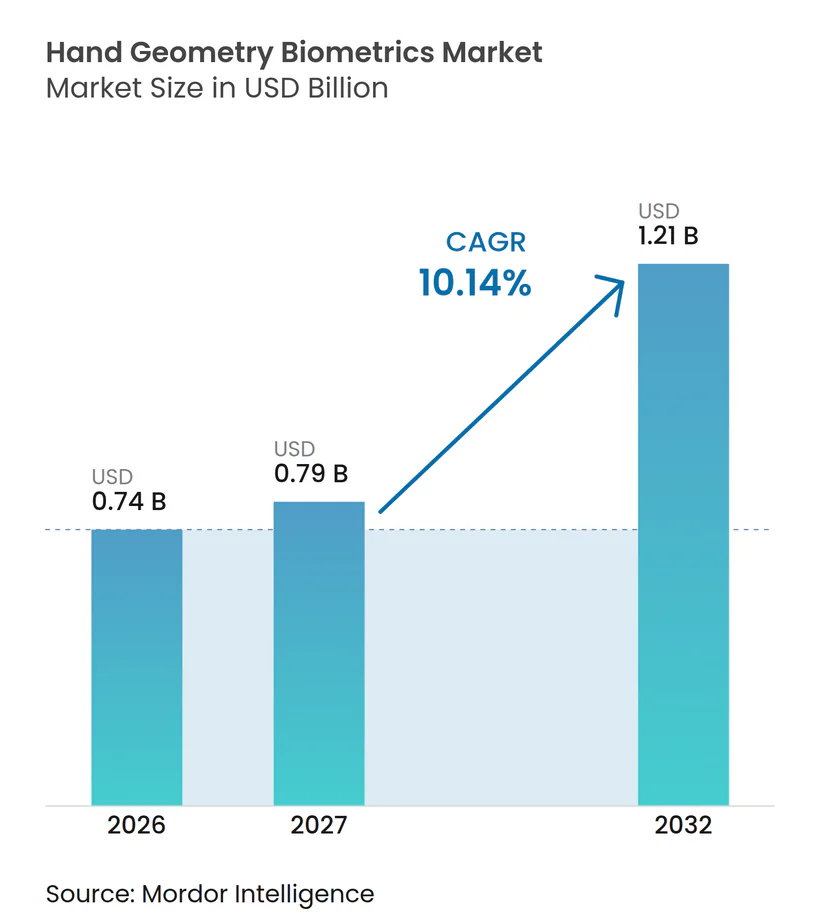
| Growth Rate (2027 - 2032) | 10.14 % |
| Fastest Growing Market | Asia-Pacific |
| Largest Market | North America |
| Market Concentration | Medium |
Major Players *Disclaimer: Major Players sorted in no particular order Image © Mordor Intelligence. Reuse requires attribution under CC BY 4.0. | |
Hand Geometry Biometrics Market Analysis by Mordor Intelligence
The hand geometry biometrics market size is expected to increase from USD 0.74 billion in 2026 to USD 0.82 billion in 2027 and reach USD 1.21 billion by 2032, expanding at a CAGR of 10.14% over 2027-2032. Across the hand geometry biometrics market, demand is shifting from device purchases toward identity platforms that coordinate enrollment, template storage, matching, access administration, and reporting across several sites with different operating requirements and separate local access policies. Hardware remains the main revenue contributor because each controlled entry point requires sensors, optics, protective enclosures, installation work, continued operational support, and dependable performance in the physical environment where access is controlled throughout daily operating hours, including peak entry periods. Government and critical-infrastructure contracts provide steady demand because they often follow multiyear procurement, credentialing, and compliance programs. Buyers increasingly favor providers that can connect physical access, digital identity, mobile credentials, visitor processes, and access governance systems through usable interfaces that do not require a full replacement of installed access infrastructure. The hand geometry biometrics market also faces pressure from palm-vein and 3D facial systems, although its lower potential for covert surveillance can support use where biometric consent, limited data use, and practical access workflows are a concern.
Key Report Takeaways
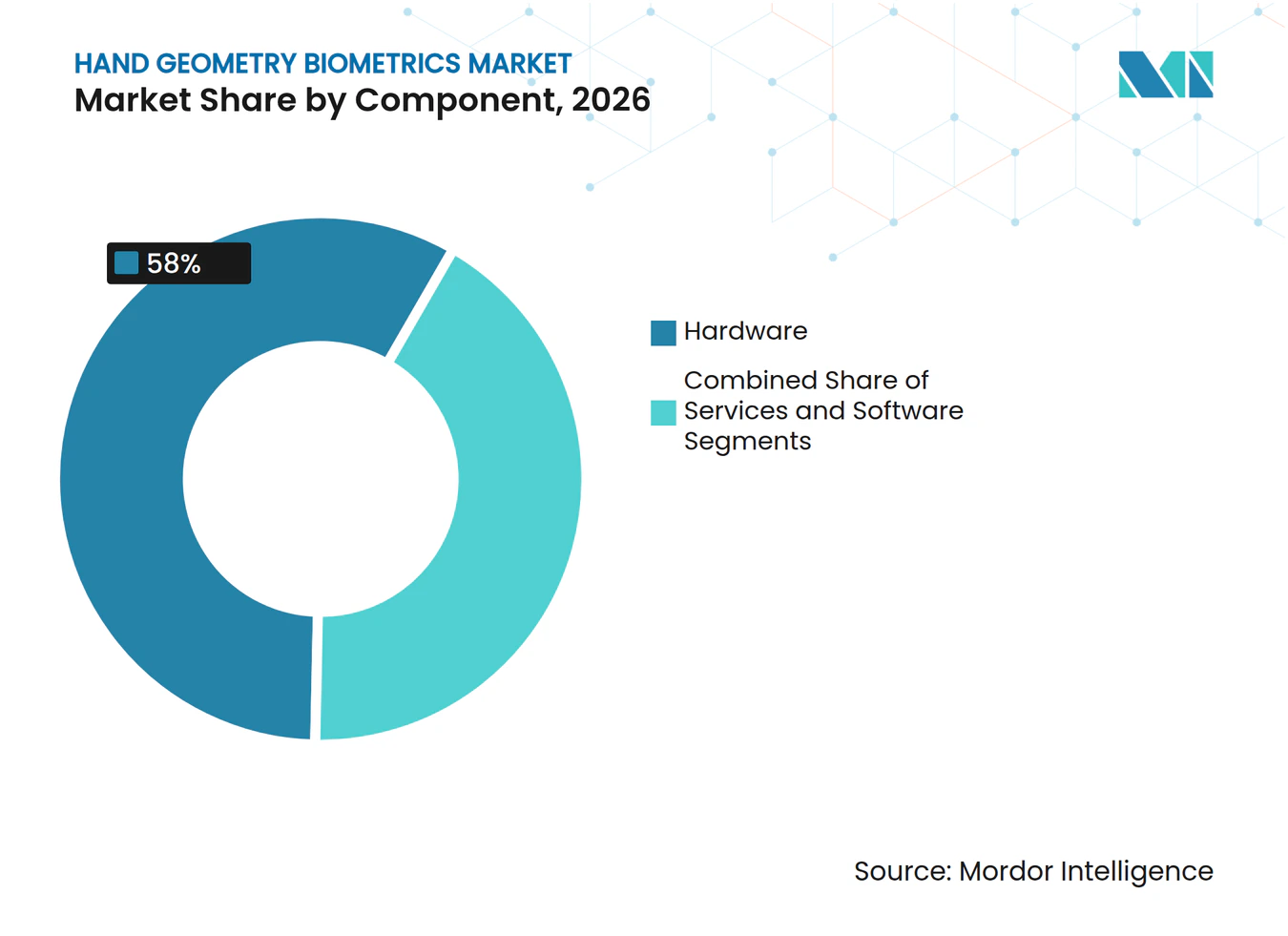
- By component, hardware held 58.00% of the revenue share in 2026, while software is projected to expand at an 11.25% CAGR through 2032.
- By technology type, 2D Optical Hand Geometry Systems accounted for 46.00% of revenue in 2026, while 3D Structured-Light and Time-of-Flight Hand Geometry Systems are projected to expand at an 11.56% CAGR through 2032.
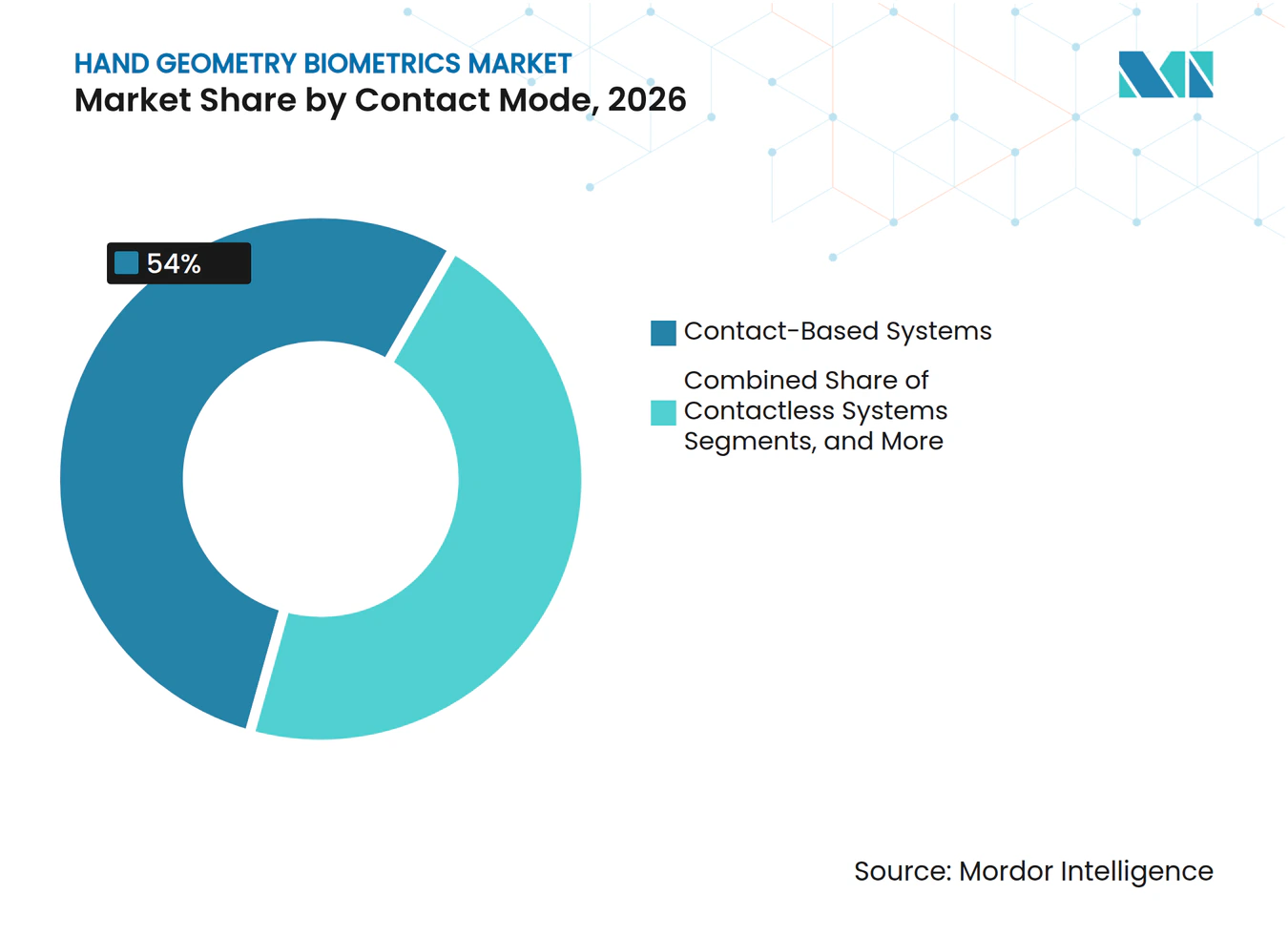
- By contact mode, Contact-Based Systems held 54.00% of revenue in 2026, while Contactless Systems are projected to expand at an 11.67% CAGR through 2032.
- By end user, Government and Defense held 28.00% of revenue in 2026, while Healthcare is projected to expand at an 11.85% CAGR through 2032.
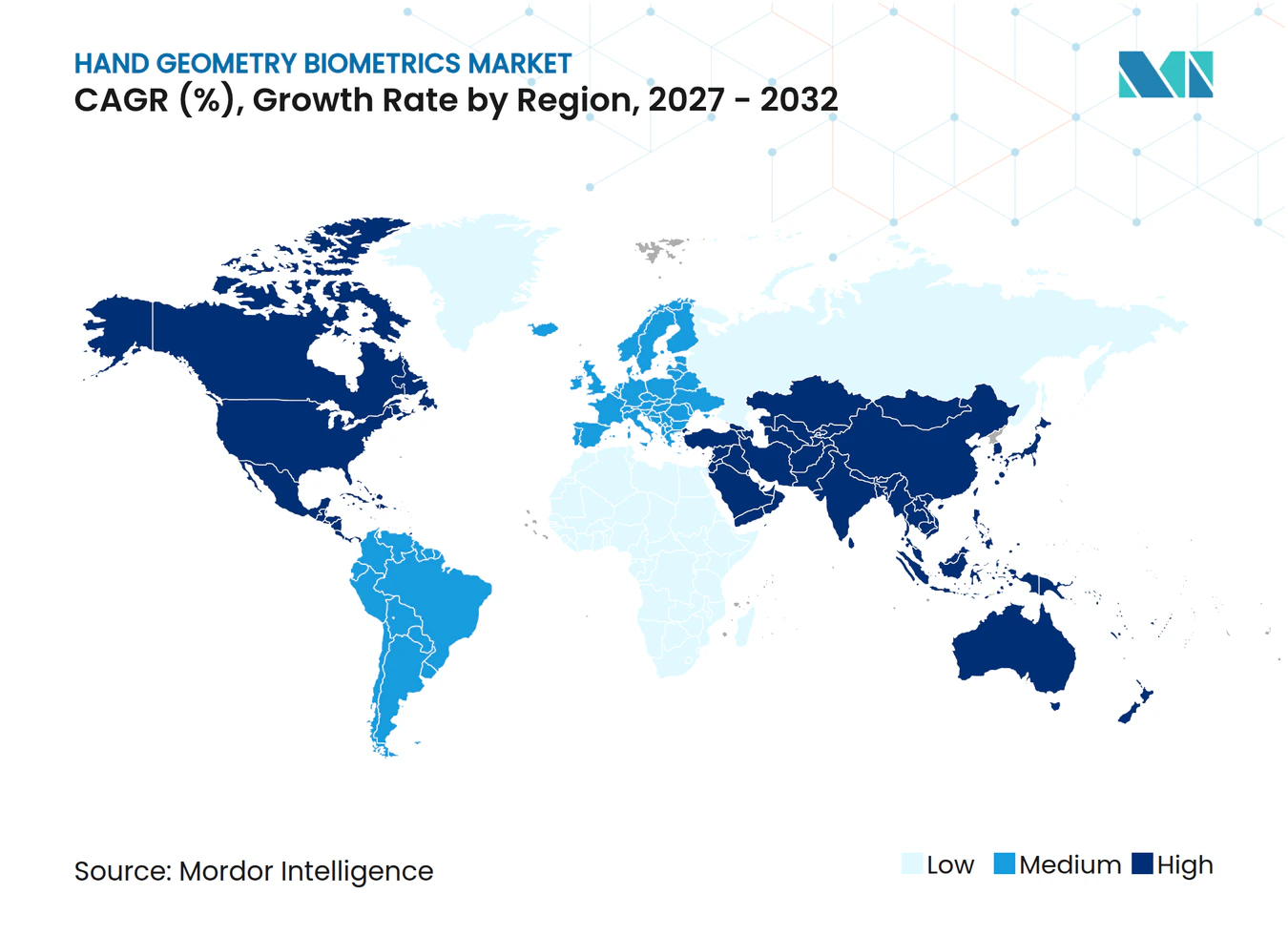
- By geography, North America held 32.00% of revenue in 2026, while Asia-Pacific is projected to expand at an 11.82% CAGR through 2032.
Note: Market numbers in this report are based on Mordor Intelligence's proprietary estimation framework, which combines nine months of actuals with Q4 projections for base year 2026.
Market Trends and Insights
Drivers Impact Analysis of Hand Geometry Biometrics Market*
| Driver | (~) % Impact on CAGR Forecast | Geographic Relevance | Impact Timeline |
|---|---|---|---|
| Government and Critical-Infrastructure Access Modernization | +2.8% | Global, with early gains in North America and Western Europe | Medium term (2-4 years) |
| Contactless Authentication at High-Throughput Worksites | +2.2% | Global, with focus on Asia-Pacific industrial centers, the Middle East, and North America | Short term (≤ 2 years) |
| Replacement of Fingerprint Readers in Harsh and Hygiene-Sensitive Environments | +1.8% | Global, especially North America and Europe in pharmaceuticals and food processing, and Asia-Pacific manufacturing | Short term (≤ 2 years) |
| Integrated Physical and Logical Access Control | +1.4% | North America and Europe, with selected deployments in Asia-Pacific financial hubs | Medium term (2-4 years) |
| Multimodal Hand-Based Authentication | +1.1% | Global, with early adoption in Japan, South Korea, and Gulf Cooperation Council states | Medium term (2-4 years) |
| Smart-Campus, Healthcare, and Industrial Identity Workflows | +0.9% | North America, Western Europe, and East Asia | Long term (≥ 4 years) |
| Source: Mordor Intelligence | |||
Expansion of Government and Critical-Infrastructure Access Modernization
Government agencies remain a durable source of demand for the hand geometry biometrics market because procurement programs are often multiyear and compliance-led. In January 2025, IDEMIA received a 10-year Blanket Purchase Agreement worth up to USD 194.5 million from the U.S. General Services Administration for Login.gov identity proofing.[1] Identity credential programs create opportunities for reader upgrades at physical access points when agencies renew related access systems, templates, and credentialing processes. Federal Identity, Credential, and Access Management requirements support demand for systems that work with existing cards, access panels, and facility operating procedures. Government buyers also value hand geometry systems where dependable verification, documented access events, and operational continuity are more important than consumer-style convenience. This pattern gives suppliers a route into hand geometry biometrics market projects where certification, service capability, interoperability, and long-term support influence purchasing decisions.
Growth in Contactless Authentication for High-Throughput Worksites
Contactless hand authentication helps address throughput challenges at worksites where workers use gloves or protective equipment. Food processing, chemical manufacturing, and pharmaceutical packaging sites may need identity checks without requiring repeated contact with a reader during a shift. A 2025 study described a contactless platform that captured wrist, palm, and finger-vein data at the same time and reported a 0.057% finger-vein recognition half-total error rate.[2] The result supports the use of contactless hand-based systems where sanitation, access speed, and repeatable operation across changing work teams matter together. ZKTeco presented terminals combining contactless palm, facial, and vein recognition for industrial entry at its September 2025 conference in Seoul. The hand geometry biometrics market can benefit when organizations refresh older contact-based readers while retaining the network, enrollment records, and access-control investments already in place.
Replacement of Fingerprint Readers in Harsh and Hygiene-Sensitive Environments
Harsh operating conditions can make fingerprint readers less suitable for some controlled access points. Workers in pharmaceutical and food-and-beverage facilities may wear gloves, handle cleaning materials, or move through sites with strict hygiene practices and frequent shift changes. These conditions can make reliable placement on a contact reader more difficult and can increase cleaning requirements between users. Hand geometry can use measurements such as finger length, palm width, and hand curvature for verification at defined entry locations. This approach can serve as a primary or supplemental layer where an organization needs a practical method that fits its existing workflow, staffing pattern, and access-control process. The hand geometry biometrics market therefore has a role in facilities that prioritize consistent access checks under demanding conditions and need a credible path away from touch-dependent readers.
Increasing Demand for Integrated Physical and Logical Access Control
Organizations increasingly seek identity systems that connect building entry with digital access. This need favors hand geometry providers that support physical access hardware, logical authentication interfaces, and the exchange of verification information across connected systems. HID introduced an integrated visitor identity kiosk in August 2026 that combined document authentication, facial recognition, and CloudGate visitor management software.[3] Such integrated designs reduce the number of separate products that organizations must coordinate for visitor management, identity confirmation, and access processes. Hand geometry retains a role as a secondary method in locations where smart cards and other credentials need a dependable backup. The hand geometry biometrics market is better positioned when suppliers can connect readers to broader identity and access systems without making customers replace all existing equipment at once.
Restraints Impact Analysis of Hand Geometry Biometrics Market*
| Restraint | (~) % Impact on CAGR Forecast | Geographic Relevance | Impact Timeline |
|---|---|---|---|
| Lower Distinctiveness Than Fingerprint, Iris, and Palm-Vein Modalities | -1.5% | Global, most acute in high-security and forensic identification applications | Long term (≥ 4 years) |
| Legacy Protocol Integration and Middleware Complexity | -1.2% | North America, Europe, and established Asia-Pacific markets with large legacy installed bases | Medium term (2-4 years) |
| Biometric Privacy, Consent, and Cross-Border Data-Transfer Requirements | -0.9% | North America and the European Union | Short term (≤ 2 years) |
| Sensor Performance Constraints From Gloves, Swelling, Low Light, and Fixed Capture Geometry | -0.6% | Developing markets with variable infrastructure and outdoor deployments globally | Medium term (2-4 years) |
| Source: Mordor Intelligence | |||
Lower Distinctiveness Than Fingerprint, Iris, and Palm-Vein Modalities
Lower distinctiveness remains a structural limit for hand geometry in high-assurance identification programs. The technology is better suited to one-to-one verification when a credential supplies the claimed identity and the system confirms a specific person rather than searches a large population. It is less suited to large one-to-many searches used in national identity or forensic repositories, where competing modalities can offer stronger differentiation. Organizations with several thousand enrolled people may need additional controls when using hand geometry alone, particularly when the risk of a false acceptance has material consequences. Many deployments therefore pair the modality with a smart card, face, or vein-based method so that the physical access process has more than one assurance element. This design improves assurance but can increase hardware costs and narrow the use cases that fit the hand geometry biometrics market.
Legacy Protocol Integration and Middleware Complexity
Older Wiegand, RS-485, and early OSDP infrastructure can make reader replacement more complex. Organizations may need middleware to connect new contactless sensors with existing access-control panels, credential databases, and established building workflows. Integration work can extend project schedules and raise ownership costs, especially for smaller enterprises that do not have dedicated technical teams. ZKTeco stated that its Armatura One platform supports HID Mobile Access, a feature that can reduce device-level integration work. Suppliers that offer tested bridging, configuration support, and backward compatibility can remove a practical barrier for customers planning upgrades across several sites. Suppliers without that capability may lose hand geometry biometrics market projects where a buyer needs old and new systems to operate together without disrupting access.
*Our forecasts treat driver/restraint impacts as directional, not additive. The impact forecasts reflect baseline growth, mix effects, and variable interactions.
Hand Geometry Biometrics Market Segment Analysis
By Component:
Hardware Anchors the Base While Software Leads GrowthHardware held 58.00% of the hand geometry biometrics market share in 2026 because every controlled entry point needs a sensor, optics, and a protective enclosure. Near-infrared sensor arrays, precision light guides, and ruggedized cases contribute to hardware value at industrial and outdoor locations. These requirements keep hardware important when buyers pursue lower-cost deployment models, since the reader remains the physical point of verification. Services cover installation, system integration, maintenance, and managed-service work that help a customer keep the system operating after deployment. Government and critical-infrastructure customers often bundle these services with equipment under multiyear operating agreements.
Software is projected to expand at an 11.25% CAGR through 2032, the highest rate among components in the hand geometry biometrics industry. The hand geometry biometrics market is moving from local template management toward identity platforms that coordinate verification, mobile credentials, document authentication, and site-level access rules. A 2025 IEEE study on 3D contactless fingerprint recognition examined robust feature extraction and graph embedding methods, showing the software work being applied to contactless hand-based matching. Matching software can help organizations manage templates and verification records across several facilities without treating each location as a separate system. Providers that offer certified REST API connections to identity governance platforms can compete on integration, administration, and device performance.



By Technology Type:
2D Optical Retains the Installed Base While 3D Systems Shape New Deployments2D Optical Hand Geometry Systems accounted for 46.00% of the hand geometry biometrics market in 2026. Their position reflects deployments in government lobbies, manufacturing shift stations, and campuses over several decades. Many sites continue to use these systems because their original investment remains functional and staff already understand the enrollment process. New buyers now compare 2D optical tools with structured-light and time-of-flight alternatives as they review reader replacement plans. That comparison places greater value on contactless capture, liveness detection, and the ability to work within a modern identity architecture.
3D Structured-Light and Time-of-Flight Hand Geometry Systems are projected to expand at an 11.56% CAGR through 2032. The hand geometry biometrics market is using depth-aware capture to support new enterprise installations where buyers prefer contactless operation. A 2025 patent record describes a structured-light camera-projector configuration for real-time 3D hand-position detection without additional distance sensors. Hybrid systems can combine contact and contactless methods where an entry point cannot tolerate a single-mode failure or interruption during a transition. Electrical, capacitive, and pressure-based variants remain relevant for specialized measurement settings where optical installation is limited by space or site conditions.
By Contact Mode:
Contact-Based Systems Retain the Base While Contactless Systems Change New ProcurementContact-Based Systems held 54.00% of revenue in 2026, supported by the legacy government and manufacturing installed base. Platen-based readers were widely specified under earlier procurement programs and many are now approaching replacement cycles. These systems can remain useful in outdoor kiosks where changing ambient light affects contactless optical capture and operating conditions are difficult to standardize. They can also suit low-traffic secure sites where deliberate hand placement is acceptable and the added step does not affect workforce movement. The installed base keeps contact systems important to the hand geometry biometrics market even as procurement patterns change.
The hand geometry biometrics market size for Contactless Systems is projected to expand at an 11.67% CAGR through 2032, the highest rate among contact modes. Healthcare, pharmaceutical, and food-processing facilities are adopting them in new locations that do not have legacy reader constraints. A 2025 study showed that dynamic registration can reduce the effect of palm-position variation during touchless sensing. Better position handling can narrow a historical performance gap between contactless and contact-based capture, which can make deployment planning more straightforward. Hybrid systems provide a transition route for organizations that want phased enrollment and continued operation while replacing equipment.

By End User:
Government and Defense Lead Revenue While Healthcare Leads GrowthGovernment and Defense held 28.00% of revenue in 2026. These facilities use the hand geometry biometrics market for perimeter security, military installations, border locations, and intelligence environments. The segment values reliable verification and the ability to use the technology within wider credentialing programs that have defined access procedures. BFSI represents the second-largest end-user tier because branches and data centers need employee authentication and auditable access records for privileged areas. Manufacturing, industrial users, commercial enterprises, and education sites also use hand geometry for attendance integrity, controlled access, and verification at designated entry points.
Healthcare is projected to expand at an 11.85% CAGR through 2032, the highest rate among end users. Hospitals are evaluating contactless hand authentication for medication rooms and surgical-suite entry, where speed, glove tolerance, and auditability matter. A September 2025 medical IoT study reported 99.72% accuracy and a 0.0037 equal error rate for sEMG-based hand-gesture authentication. The research supports the wider development of hand-based authentication for clinical settings where staff need access without interrupting care procedures. Healthcare opportunities in the hand geometry biometrics industry depend on systems that fit clinical workflows, identity-control requirements, and facility access practices.
Geography Analysis
North America Hand Geometry Biometrics Market
North America held 32.00% of the hand geometry biometrics market share in 2026, the largest regional position. The hand geometry biometrics market benefits in the region from federal identity requirements and an established network of system integrators. Government procurement cycles can sustain reader refresh projects over several years and allow contractors to plan around formal renewal processes. Canada is developing its digital identity environment. Mexico benefits from manufacturing activity in the Bajío and northern border corridors, where automotive and aerospace suppliers need attendance and access tracking.
APAC Hand Geometry Biometrics Market
Asia-Pacific is projected to expand at an 11.82% CAGR through 2032, making it the fastest-growing regional area. The hand geometry biometrics market is supported in India by workforce attendance digitization in manufacturing and public infrastructure. South Korea is upgrading security systems at semiconductor and electronics facilities. In December 2025, IDEMIA Public Security and Tsuzuki Denki signed a memorandum to develop and deploy access-management solutions in Japan. Chinese manufacturers such as ZKTeco use manufacturing scale to serve mid-market deployments in Southeast Asia and the Middle East.
EMEA and South America Hand Geometry Biometrics Market
Europe has meaningful revenue from Germany, the United Kingdom, and France, where government and financial-services applications are important. Biometric data governance increases the value of on-device template storage and deletion-on-demand features. IDEMIA Public Security and Sopra Steria completed the eu-LISA shared Biometric Matching System go-live in August 2025 for fingerprint and facial-image comparison across the Schengen Area. The Middle East has greenfield demand linked to critical-infrastructure development, while Africa and South America remain early-stage areas focused on government and extractive-industry identity programs.
Competitive Landscape
Market Concentration
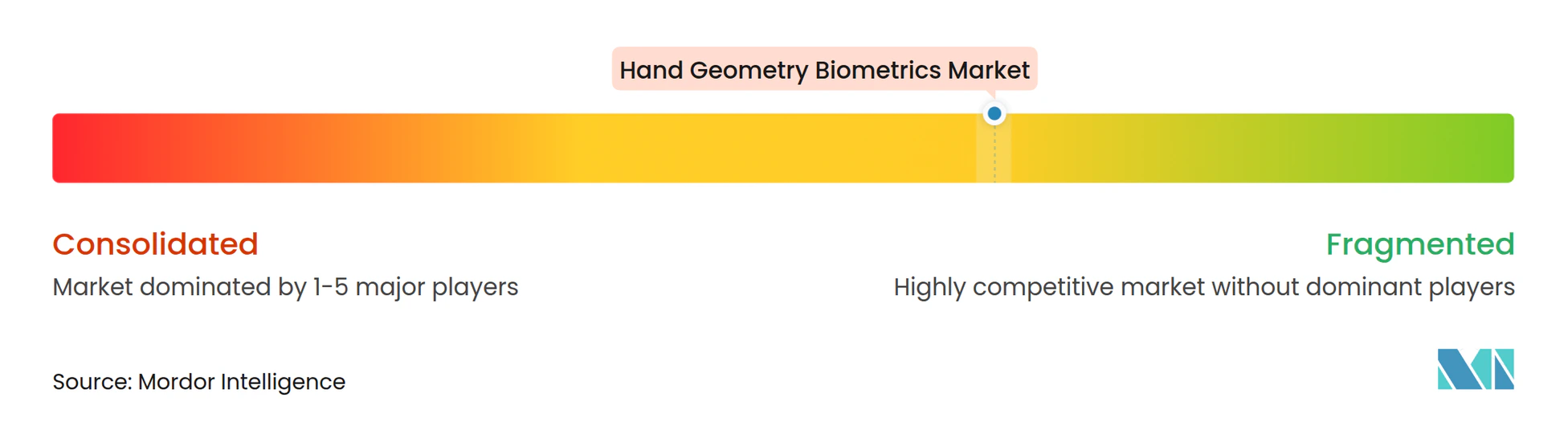
The hand geometry biometrics market has moderate concentration at the revenue level. Fujitsu Limited, IDEMIA Group, NEC Corporation, and HID Global Corporation have long relationships with government and critical-infrastructure customers. Those relationships can provide an advantage in projects with long contracts, formal procurement requirements, and demanding integration needs. A wider group of original equipment manufacturers and software-focused providers serves enterprise and mid-market buyers.
ZKTeco and Suprema compete through product development speed and channel relationships. In October 2025, AMAG Technology named Suprema its preferred biometric reader provider, connecting Suprema's portfolio with the Symmetry access-control platform. In January 2026, ZKTeco presented Armatura One with HID Mobile Access compatibility and support for employee badges in Apple Wallet. In August 2026, HID introduced a visitor identity kiosk that combined document authentication, facial recognition, and CloudGate visitor-management software. These moves reflect demand for connected access systems rather than a standalone reader.
Bio-Key International, Inc. and M2SYS Technology focus on middleware that can connect legacy hand geometry equipment to current identity platforms. This approach addresses integration problems that can delay hardware refresh projects across the hand geometry biometrics market. Providers are also developing intellectual property around contactless capture designs. A 2025 patent record covers a contactless 3D fingerprint and handprint method using time-of-flight and structured-light cameras. Compliance, audit logging, consent management, and explainable matching can further separate providers in regulated deployments. Healthcare remains an open area because no leading hand geometry provider is described here as holding regulatory clearance for patient identification as a clinical device.
Hand Geometry Biometrics Industry Leaders
-
Fujitsu Limited
-
HID Global Corporation
-
IDEMIA Group
-
Recognition Systems, Inc.
-
Suprema Inc.
- *Disclaimer: Major Players sorted in no particular order
Hand Geometry Biometrics Market Companies Covered in this Report
- Recognition Systems, Inc.
- BioSec Group Ltd.
- IdentyTech Solutions Ltd.
- BioEnable Technologies Private Limited
- M2SYS Technology
- Suprema Inc.
- ZKTeco Co., Ltd.
- Mantra Softech (India) Private Limited
- Anviz Global Inc.
- Fujitsu Limited
- HID Global Corporation
- IDEMIA Group
- NEC Corporation
- 3M Company
- Crossmatch Technologies, Inc.
- Fulcrum Biometrics, LLC
- SecuGen Corporation
- Bio-Key International, Inc.
- Precise Biometrics AB
- Recogtech B.V.
- Integrated Biometrics, LLC
- ValidSoft UK Limited
- Facebanx, Inc.
- Amano Corporation
Recent Industry Developments in Hand Geometry Biometrics Market
- October 2026: AMAG Technology completed one year of formalizing a strategic partnership with Suprema, naming Suprema its preferred biometric reader provider, aligning product roadmaps between the Symmetry access control platform and Suprema's biometric reader portfolio for enterprise clients across global geographies.
- September 2026: Zeva Inc. celebrated one year after it was awarded a USD 4.7 million biometric authentication pilot contract by the U.S. Department of Veterans Affairs to deploy face and iris recognition for clinical staff authentication at VA medical centers, designed with an architecture scalable to enterprise-wide VA deployment.
- August 2026: HID Global, Soloinsight, and CTS launched an integrated self-service visitor identity check-in kiosk for critical infrastructure and global enterprises, combining HID document authentication and facial recognition with Soloinsight's CloudGate visitor management system into a converged identity-assurance platform.
- January 2026: ZKTeco unveiled the SpeedPalm-V5L palm biometric device and its Armatura One unified web-based security platform at Intersec 2026 in Dubai, including HID Mobile Access compatibility and support for employee badges in Apple Wallet, targeting enterprise accounts transitioning to mobile-first access architectures.
Global Hand Geometry Biometrics Market Report Scope
The Hand Geometry Biometrics Market refers to the industry focused on the development, deployment, and management of biometric authentication systems that identify or verify individuals based on the unique geometric characteristics of the human hand, including finger length, finger width, palm size, hand shape, and joint positioning. These systems utilize specialized scanners, imaging sensors, software algorithms, and access control platforms to capture and analyze hand measurements for secure identity verification and physical access management.
The Hand Geometry Biometrics Market Report is Segmented by Component (Hardware, Software, and Services), Technology Type (2D Hand Geometry Systems, 3D Hand Geometry Systems, Hybrid Hand Geometry Systems, Optical Hand Geometry, Electrical Hand Geometry, Capacitive and Pressure-Based Hand Geometry, and Time-of-Flight and Structured-Light Hand Geometry), Contact Mode (Contact-Based Systems, Contactless Systems, and Hybrid Contact and Contactless Systems), End User (Government and Defense, Banking, Financial Services, and Insurance, Healthcare, Manufacturing and Industrial, Commercial Enterprises, Education, and Other End Users), and Geography (North America [United States, Canada, and Mexico], South America [Brazil, Argentina, Chile, and Rest of South America], Europe [United Kingdom, Germany, France, Italy, Spain, and Rest of Europe], Asia-Pacific [China, Japan, India, South Korea, Australia, Singapore, and Rest of Asia-Pacific], Middle East [United Arab Emirates, Saudi Arabia, Turkey, Israel, and Rest of Middle East], and Africa [South Africa, Nigeria, Egypt, and Rest of Africa]). The Market Forecasts are Provided in Terms of Value (USD).
Segmentation Overview
| Hardware |
| Services |
| Software |
| 2D Hand Geometry Systems |
| 3D Hand Geometry Systems |
| Hybrid Hand Geometry Systems |
| Optical Hand Geometry |
| Electrical Hand Geometry |
| Capacitive and Pressure-Based Hand Geometry |
| Time-of-Flight and Structured-Light Hand Geometry |
| Contact-Based Systems |
| Contactless Systems |
| Hybrid Contact and Contactless Systems |
| Government and Defense |
| Banking, Financial Services, and Insurance |
| Healthcare |
| Manufacturing and Industrial |
| Commercial Enterprises |
| Education |
| Other End Users |
| North America | United States |
| Canada | |
| Mexico | |
| South America | Brazil |
| Argentina | |
| Chile | |
| Rest of South America | |
| Europe | United Kingdom |
| Germany | |
| France | |
| Italy | |
| Spain | |
| Rest of Europe | |
| Asia-Pacific | China |
| Japan | |
| India | |
| South Korea | |
| Australia | |
| Singapore | |
| Rest of Asia-Pacific | |
| Middle East | United Arab Emirates |
| Saudi Arabia | |
| Turkey | |
| Israel | |
| Rest of Middle East | |
| Africa | South Africa |
| Nigeria | |
| Egypt | |
| Rest of Africa |
| By Component | Hardware | |
| Services | ||
| Software | ||
| By Technology Type | 2D Hand Geometry Systems | |
| 3D Hand Geometry Systems | ||
| Hybrid Hand Geometry Systems | ||
| Optical Hand Geometry | ||
| Electrical Hand Geometry | ||
| Capacitive and Pressure-Based Hand Geometry | ||
| Time-of-Flight and Structured-Light Hand Geometry | ||
| By Contact Mode | Contact-Based Systems | |
| Contactless Systems | ||
| Hybrid Contact and Contactless Systems | ||
| By End User | Government and Defense | |
| Banking, Financial Services, and Insurance | ||
| Healthcare | ||
| Manufacturing and Industrial | ||
| Commercial Enterprises | ||
| Education | ||
| Other End Users | ||
| By Geography | North America | United States |
| Canada | ||
| Mexico | ||
| South America | Brazil | |
| Argentina | ||
| Chile | ||
| Rest of South America | ||
| Europe | United Kingdom | |
| Germany | ||
| France | ||
| Italy | ||
| Spain | ||
| Rest of Europe | ||
| Asia-Pacific | China | |
| Japan | ||
| India | ||
| South Korea | ||
| Australia | ||
| Singapore | ||
| Rest of Asia-Pacific | ||
| Middle East | United Arab Emirates | |
| Saudi Arabia | ||
| Turkey | ||
| Israel | ||
| Rest of Middle East | ||
| Africa | South Africa | |
| Nigeria | ||
| Egypt | ||
| Rest of Africa | ||
Key Questions Answered in the Report
What is the projected size of the hand geometry biometrics market by 2032?
The market is projected to reach USD 1.21 billion by 2032, from USD 0.82 billion in 2027, at a 10.14% CAGR.
Which component is expanding fastest in hand geometry biometrics?
Software is projected to expand at an 11.25% CAGR through 2032 as organizations use identity platforms across distributed sites.
Which hand geometry technology is leading new deployments?
3D Structured-Light and Time-of-Flight systems are projected to expand at an 11.56% CAGR through 2032, while 2D Optical systems held 46.00% revenue share in 2026.
Why are contactless hand authentication systems being adopted?
They support hygienic, touch-free, and high-throughput access verification in healthcare, food processing, pharmaceutical, and industrial environments.
Which end-user sector has the highest projected demand?
Healthcare is projected to expand at an 11.85% CAGR through 2032, supported by applications such as medication-room access control and surgical-suite security.
Which region is expanding fastest for hand geometry biometrics?
Asia-Pacific is projected to expand at an 11.82% CAGR through 2032, supported by workforce digitization and enterprise security modernization initiatives.