
GTP Firewall Software Market Size and Share
Market Overview
| Study Period | 2020 - 2031 |
|---|---|
| Market Size (2026) | USD 191.21 Million |
| Market Size (2031) | USD 331.21 Million |
| Growth Rate (2026 - 2031) | 11.61 % |
| Fastest Growing Market | Asia-Pacific |
| Largest Market | Europe |
| Market Concentration | Medium |
Major Players *Disclaimer: Major Players sorted in no particular order Image © Mordor Intelligence. Reuse requires attribution under CC BY 4.0. | |
GTP Firewall Software Market Analysis by Mordor Intelligence
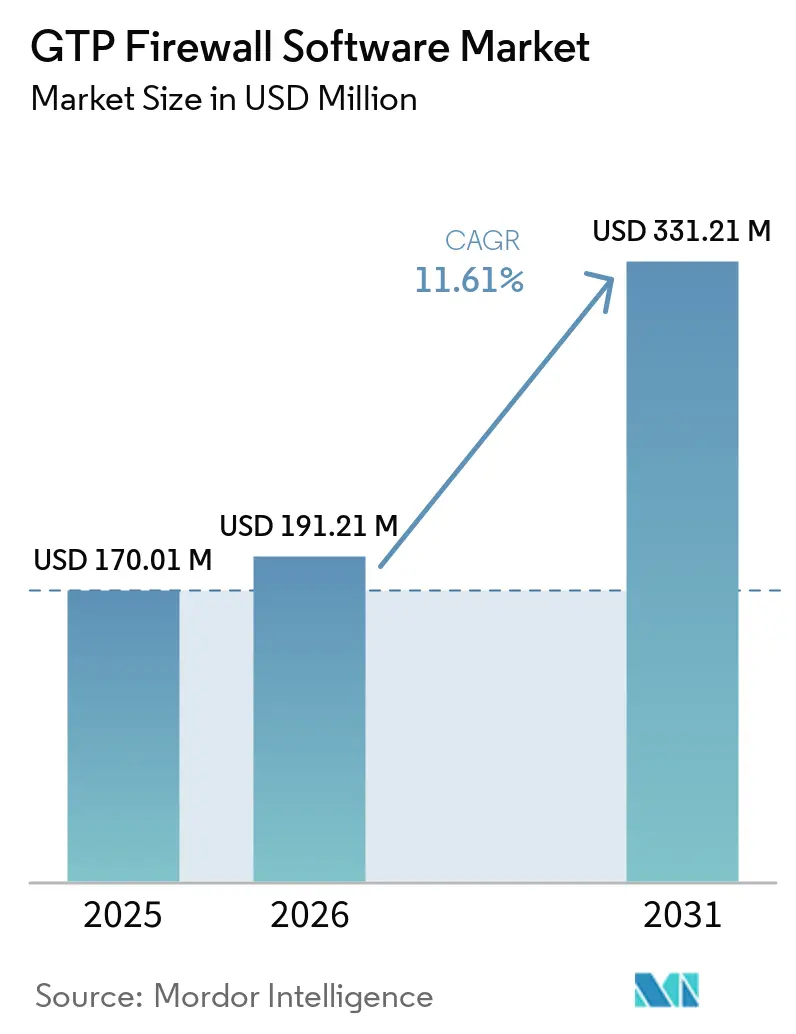
The GTP firewall software market size is expected to increase from USD 170.01 million in 2025 to USD 191.21 million in 2026 and reach USD 331.21 million by 2031, expanding at a CAGR of 11.61% over 2026-2031. The market is supported by the continued use of GTP across 4G, 5G non-standalone, and 5G standalone networks, in which the protocol carries subscriber session traffic without native source authentication or message integrity verification. IEEE researchers documented 749,000 valid GTP hosts reachable from the public internet across 1,176 providers in 162 countries, underscoring that exposure in mobile core environments requires tighter operational controls. 5G standalone roaming expands the number of user-plane interfaces that operators must protect, while cloud-based core designs increase the need for security controls that can operate with distributed workloads. Regulatory requirements, fraud-prevention needs, and higher mobile traffic volumes are driving procurement toward platforms that inspect GTP-C and GTP-U traffic together. The GTP firewall software market also favors suppliers that combine protocol knowledge, compliant deployments, and cloud-native delivery models.
Key Report Takeaways
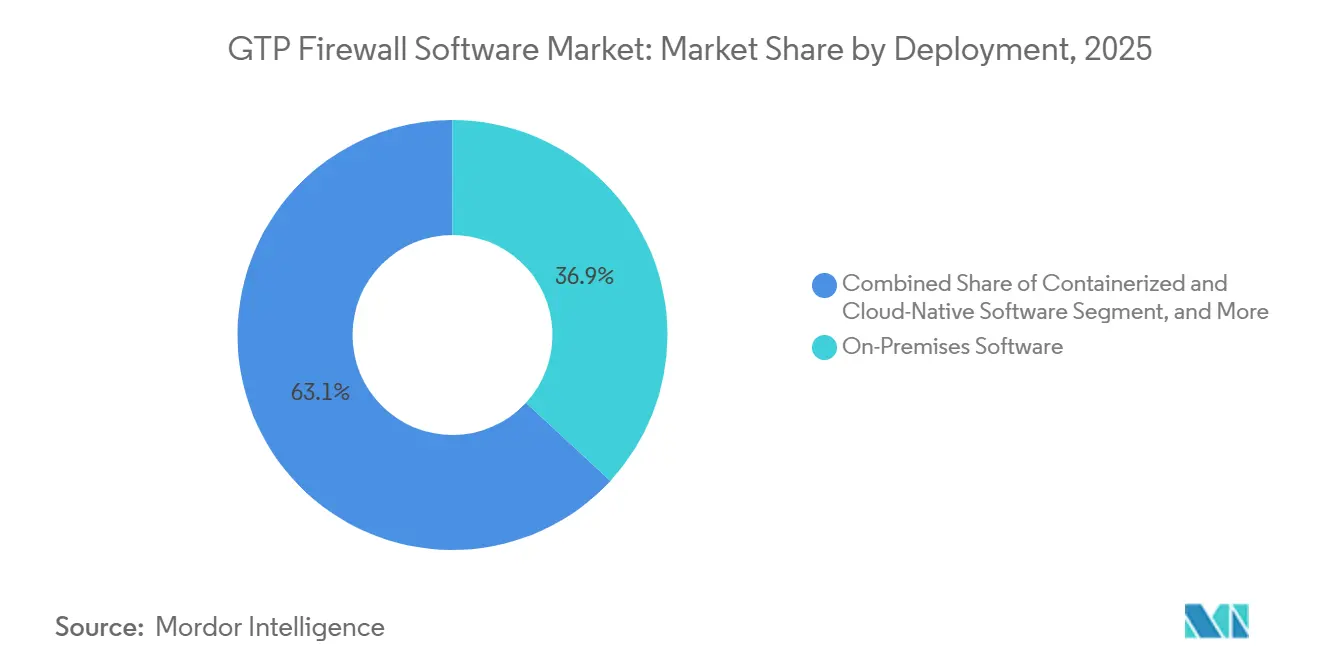
- By deployment, on-premises software held 36.87% of revenue in 2025, while containerized and cloud-native software is projected to expand at a 12.45% CAGR through 2031.
- By network generation, 4G accounted for 40.02% of 2025 revenue, while 5G is projected to expand at a 13.22% CAGR through 2031 in the GTP firewall software market.
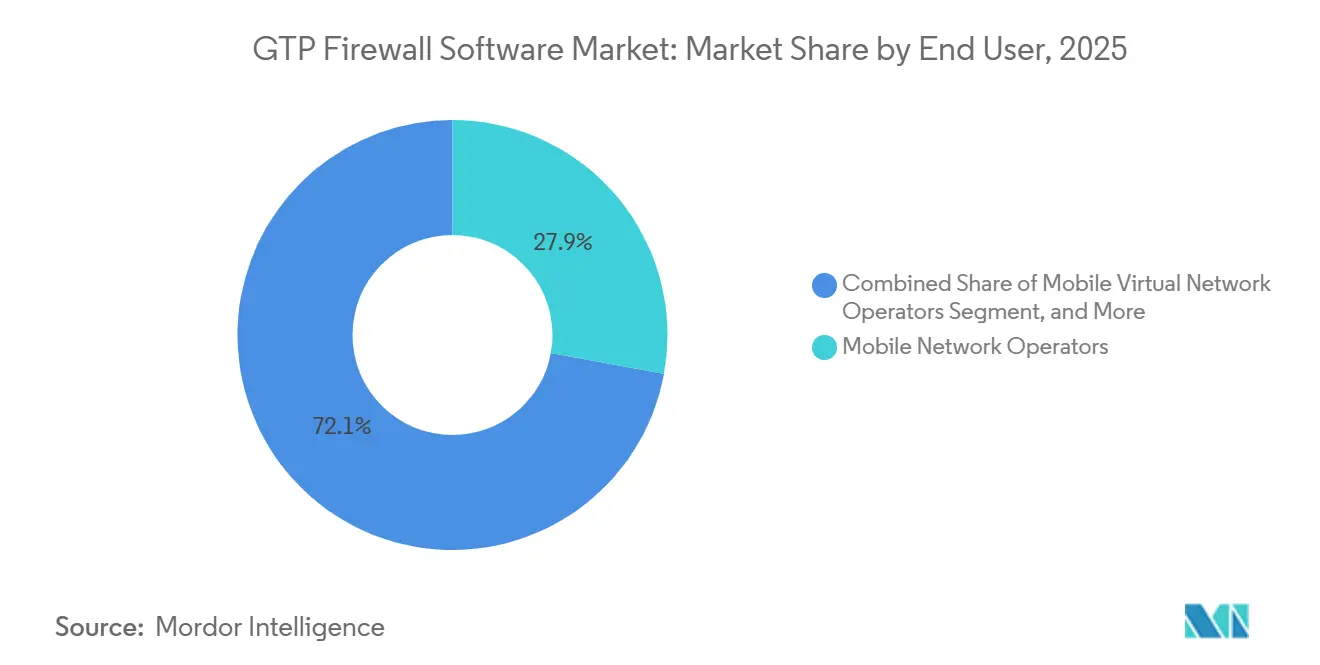
- By end user, mobile network operators held 27.88% of the GTP firewall software market revenue in 2025, while private 5G and industrial network operators are expected to expand at a 12.57% CAGR through 2031.
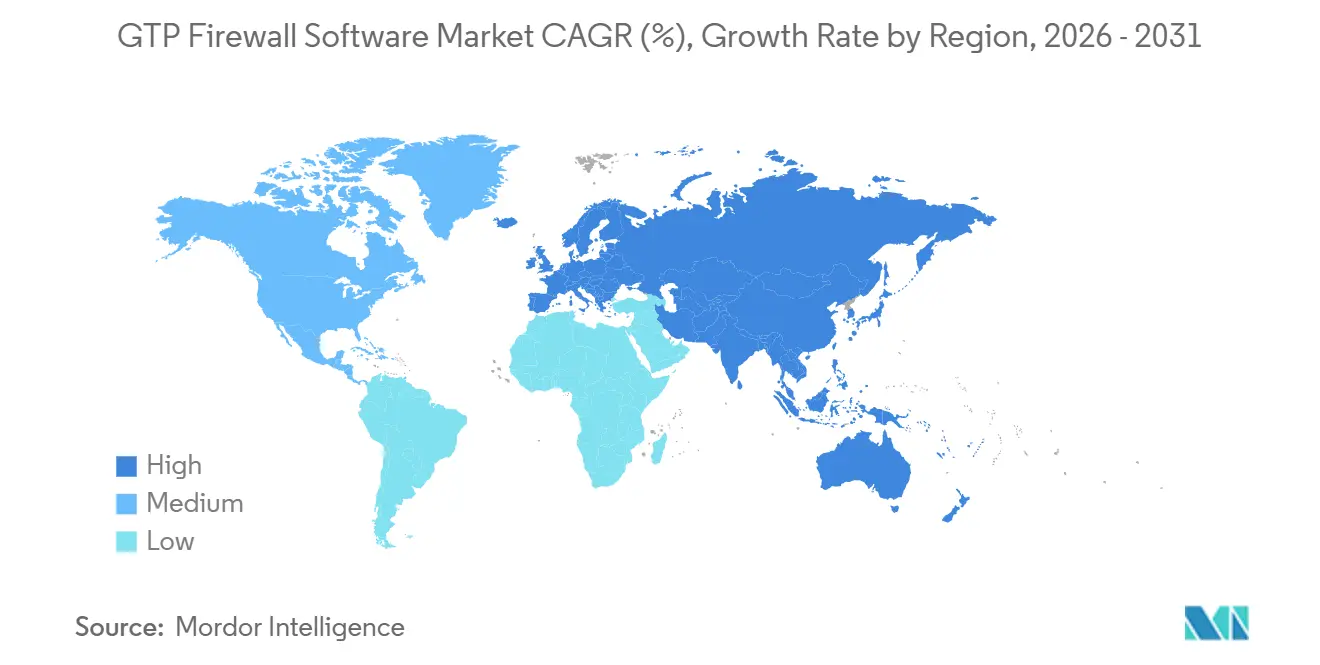
- By geography, Europe held 27.66% of revenue in 2025, while Asia-Pacific is projected to expand at a 13.54% CAGR through 2031 in the GTP firewall software market.
Note: Market size and forecast figures in this report are generated using Mordor Intelligence’s proprietary estimation framework, updated with the latest available data and insights as of January 2026.
Market Trends and Insights
Drivers Impact Analysis of GTP Firewall Software Market*
| DRIVER | (~) % IMPACT ON CAGR FORECAST | GEOGRAPHIC RELEVANCE | IMPACT TIMELINE |
|---|---|---|---|
| 5G Standalone and Roaming Security Expansion | +3.2% | Global | Medium term (2-4 years) |
| Rising GTP-Based Signaling Attacks and Telecom Fraud | +2.5% | Global | Short term (≤ 2 years) |
| Regulatory and GSMA Security Compliance Requirements | +1.8% | North America and Europe, with early adoption in the Asia-Pacific | Medium term (2-4 years) |
| Growth of Mobile Data Traffic and Cellular IoT | +1.4% | Global, concentrated in Asia-Pacific and North America | Medium term (2-4 years) |
| Persistent Exposure of Hybrid 4G and 5G Core Networks | +1.0% | Asia-Pacific, Middle East and Africa, South America | Medium term (2-4 years) |
| GTP-U Inspection Requirements Across N3 and N9 Interfaces | +0.7% | Global | Long term (≥ 4 years) |
| Source: Mordor Intelligence | |||
5G Standalone and Roaming Security Expansion
5G standalone deployments place the GTP firewall software market at an important point in inter-operator security design. GSMA NG.113 v14.0 requires inter-PLMN user-plane security and GTP-U message filtering for roaming partners, including traffic on the N9 interface.[1] This requirement extends protection beyond the N32 control interface, where the Security Edge Protection Proxy operates. The Global Mobile Suppliers Association recorded public 5G standalone services from at least 89 operators in 73 countries by December 2025, while 181 operators were investing in the technology.[2] BICS and Syniverse integrated their 5G Signaling Hub solutions and created peering arrangements in March 2026, bringing roaming coordination into a more active commercial stage. GTP firewall software remains relevant because 5G standalone roaming changes the path and scale of GTP-U traffic rather than removing the protocol from user-plane operations.
Rising GTP-Based Signaling Attacks and Telecom Fraud
Demand in the GTP firewall software market is driven by the exposure of mobile core protocols to denial-of-service attacks, session hijacking, and billing abuse. The 2025 IEEE study identified 38 GTP message types that can be misused and found publicly accessible hosts across a broad range of service providers. These findings indicate that protection cannot rely solely on the assumption that the mobile core is isolated from external access. Signaling attacks can affect session establishment, routing, and charging processes, which raises the operational importance of validating messages before they reach core functions. GTP firewall software can support policy enforcement by checking message fields, session state, and source behavior across the signaling path. Suppliers that can correlate GTP activity with related signaling protocols are better positioned to address attacks that move between protocol layers.
Regulatory and GSMA Security Compliance Requirements
Compliance requirements create a recurring reason for operators to maintain and update GTP firewall software in the GTP firewall software market. The NIS2 Directive applies to essential entities in electronic communications and requires risk-management measures for relevant cybersecurity risks.[3] ENISA's 2025 threat landscape reviewed 4,875 incidents from July 2024 through June 2025, and 53.7% of the affected organizations fell within the essential-entity classification used by NIS2.[4] GSMA documents FS.11, FS.21, and FS.34 provide security references that shape interconnect and roaming practices. Compliance, therefore, affects both the initial selection of a GTP firewall and later recertification, testing, and upgrade work. The Cyber Security Agency of Singapore issued private 5G security recommendations in December 2025, incorporating input from the GSMA and Singtel, extending relevant security considerations to enterprise networks.
Growth of Mobile Data Traffic and Cellular IoT
Higher traffic volumes increase the processing demands placed on GTP firewall software across the GTP firewall software market. Ericsson reported global mobile data traffic of 146 EB per month at the end of 2025 and forecasts it will reach 328 EB per month by 2031. More user-plane traffic increases the volume of GTP-U packets that security platforms must inspect at interfaces such as N3 and N9. Ericsson also expects cellular IoT connections to approach 7.8 billion by 2031, after reaching 4.7 billion in 2025.[5] Each connected device can add session-establishment and bearer-management events that require policy checks. The GTP firewall software market benefits when platforms can maintain reliable control-plane and user-plane performance as both mobile broadband and IoT connections increase.
Restraints Impact Analysis of GTP Firewall Software Market*
| RESTRAINT | (~) % IMPACT ON CAGR FORECAST | GEOGRAPHIC RELEVANCE | IMPACT TIMELINE |
|---|---|---|---|
| High Integration Costs Across Legacy and Cloud-Native Cores | -2.1% | Global | Medium term (2-4 years) |
| Shortage of Specialized Telecom Security Skills | -1.5% | Global, most acute in the Middle East, Africa and South America | Medium term (2-4 years) |
| Encrypted and Distributed Traffic Visibility Challenges in Cloud-Native Cores | -1.0% | North America and Asia-Pacific core networks | Long term (≥ 4 years) |
| Throughput, Latency, and False-Positive Tradeoffs in Deep GTP Inspection | -0.7% | Global | Long term (≥ 4 years) |
| Source: Mordor Intelligence | |||
High Integration Costs Across Legacy and Cloud-Native Cores
High integration costs can slow the adoption of GTP firewall software in hybrid mobile core environments. Operators often need to support GTPv1 for earlier roaming environments and GTPv2 for 4G and 5G non-standalone networks, which requires coordinated policies and testing. The transition also involves physical, virtual, and containerized network functions, each with different operating models. Security rules must be validated against production traffic because inaccurate classification can interrupt valid sessions or roaming activity. GSMA-aligned qualification and security-assurance processes can add testing and deployment work before a change reaches a live network. Smaller MNOs and mobile virtual network operators may defer projects or opt for managed services when they lack the staff and budget to manage this integration internally.
Shortage of Specialized Telecom Security Skills
A shortage of specialized skills can limit the effective operation of GTP firewall software across the GTP firewall software market. Teams need familiarity with 3GPP signaling protocols, mobile core topology, roaming exchanges, and threat detection practices. This combination is less common than general cybersecurity skills, particularly among smaller operators and organizations in emerging markets. SecurityGen has published research focused on GTP vulnerabilities and provides a supervised 5G cybersecurity lab for security testing and training. The operational challenge is not limited to deployment because policies need ongoing adjustment as traffic patterns and roaming relationships change. Automated policy tuning and managed services can reduce this burden, but the GTP firewall software market still relies on users to distinguish suspicious traffic from legitimate network behavior.
*Our forecasts treat driver/restraint impacts as directional, not additive. The impact forecasts reflect baseline growth, mix effects, and variable interactions.
GTP Firewall Software Market Segment Analysis
By Deployment:
On-Premises Incumbency and Cloud-Native MomentumOn-premises software is projected to account for 36.87% of the GTP firewall software market in 2025, making it the largest deployment category. This position reflects the installed base of appliances and bare-metal systems across mature 4G core networks in Europe, North America, and established Asia-Pacific operator environments. These systems often operate within long-standing supplier relationships, allowing operators to renew them rather than replace them. This installed base provides suppliers with ongoing maintenance, support, and upgrade revenue. Virtual network function software offers an intermediate option for carriers that have adopted network function virtualization but have not fully transitioned to Kubernetes-based operating models.
Managed GTP firewall software serves mobile virtual network operators, GRX and IPX providers, and smaller carriers that do not maintain in-house security stacks. Providers can deliver these solutions as cloud-managed or outsourced services, aligning with operating-expenditure purchasing preferences. Containerized and cloud-native software is projected to grow at a 12.45% CAGR through 2031, the highest rate among deployment formats. This growth reflects operators' migration toward 5G standalone cores built around cloud-native network functions. Containerized solutions can operate within the orchestration environments used for functions such as the AMF, SMF, and UPF. CISA guidance on securing 5G cloud infrastructure supports implementing security controls at the granular workload level. A 2026 scientific paper is expected to identify lateral movement risks associated with shared-kernel architectures in eBPF-enabled, containerized 5G cores. These conditions support subscription licensing models and reduce dependence on dedicated hardware in the GTP firewall software market.

By Network Generation:
4G Security Demand and a 5G-Led ShiftThe 4G segment is projected to hold 40.02% of market revenue in 2025, supported by the global scale of LTE core infrastructure. LTE networks have a documented history of GTP-based threats affecting the S5-Gn and S8-Gp roaming interfaces. The large 4G footprint generates recurring demand for message validation, session monitoring, and policy enforcement. It also makes support for established GTP-C use cases essential for vendors seeking to serve existing operator networks. The 3G segment continues to generate residual demand in parts of the Middle East, Africa, and South America, where GTPv1-C supports GPRS roaming and machine-to-machine traffic.
The 5G segment is projected to grow at a CAGR of 13.22% through 2031 in the GTP firewall software market, making it the fastest-growing network-generation category. New GTP-U interfaces include N3, which connects the gNB and UPF, and N9, which connects UPFs in inter-PLMN roaming. Trend Micro reported that GTP-U tunnels between base stations and the UPF lack encryption and authentication by default and identified a packet-reflection vulnerability affecting internal 5G components. 3GPP TS 33.501 and GSMA roaming guidance provide technical and operational references for protecting 5G user-plane traffic. Consequently, the GTP firewall software industry is shifting toward stateful inspection capabilities that cover both signaling messages and GTP-U payload paths.
By End User:
MNO Demand and Industrial Network AdoptionMobile network operators are projected to account for 27.88% of market revenue in 2025, reflecting their central role in operating 4G EPC and 5G standalone core infrastructure. Their security investments often align with broader core-network transformation programs spanning several years. MNOs often prefer platforms that cover SS7, Diameter, and GTP through a single vendor relationship. This approach can reduce the need to operate separate point products for each protocol. Mobile virtual network operators typically rely on host MNO infrastructure and primarily procure security through managed roaming-security arrangements and IoT-focused services.
GRX, IPX, and roaming providers operate exchange infrastructure for cross-border GTP traffic, giving them a concentrated role in inter-operator security. Their GTP-C filtering capabilities can affect traffic paths across multiple roaming relationships. Private 5G and industrial network operators are projected to grow at a 12.57% CAGR through 2031, making them the fastest-growing end-user group. The Wireless Broadband Alliance is expected to publish an enterprise private 5G security framework in January 2026 based on a zero-trust model and open standards. This framework extends the relevance of protocol-level controls to manufacturing, logistics, campus, and other enterprise deployments. Government and critical-communications networks also represent an emerging procurement channel, with Enea expected to report a growing pipeline of government security contracts in its July 2026 results. These developments broaden the addressable user base for the GTP firewall software market.
Geography Analysis
Europe GTP Firewall Software Market
Europe held 27.66% of the 2025 GTP firewall software market share, making it the largest regional contributor. The region combines regulatory requirements, active 5G standalone activity, and established operator security programs. The NIS2 Directive places risk-management obligations on essential electronic communications entities. The United Kingdom, Germany, France, and Italy are major procurement markets because their operators are implementing 5G standalone capabilities and related user-plane protections. Smaller European markets are also affected by the direction of EU-wide cybersecurity rules. These conditions make security upgrades a more regular part of core-network planning.
APAC GTP Firewall Software Market
Asia-Pacific is expected to expand at a 13.54% CAGR through 2031, the highest regional rate in the GTP firewall software market. China, South Korea, Japan, and India are important demand centers because of their large cellular networks, 5G programs, and enterprise connectivity activity. South Korea established an early reference point for 5G deployment, and A10 Networks reports the use of GTP firewalls in production 4G and 5G mobile networks. India's expanding 5G coverage can increase the need for N3 user-plane inspection as networks reach more cities. Japan and Australia add private 5G demand from manufacturing and logistics use cases. Vendors need to support multiple GTP versions because the region includes both advanced standalone networks and hybrid 4G and 5G environments.
The Americas and MEA GTP Firewall Software Market
North America remains an important GTP firewall software market because Tier-1 MNO programs and 5G cloud-security guidance sustain investment. CISA guidance emphasizes secure cloud business applications and related security practices for organizations moving workloads into cloud environments. South America is developing as LTE density increases and operators address signaling and security exposure. The Middle East includes Gulf Cooperation Council operators with advanced 5G standalone programs and security requirements influenced by government policy. Africa remains at an earlier stage of specialized GTP firewall adoption. Mobile-money use cases and signaling-related fraud exposure can support demand for managed services that do not require extensive in-house protocol expertise.
Competitive Landscape
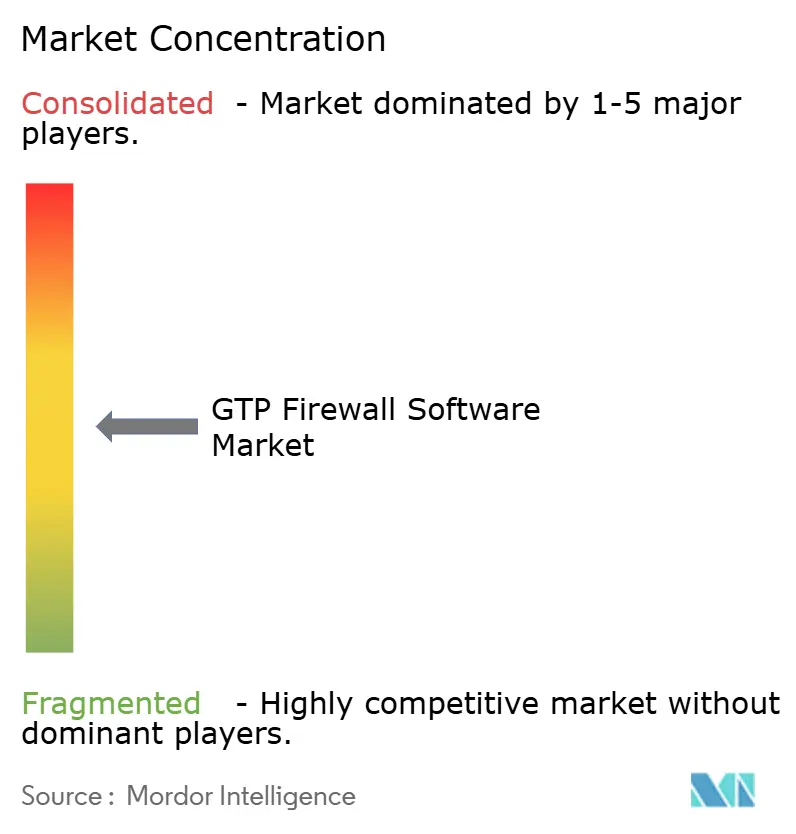
The GTP firewall software market is moderately concentrated around purpose-built telecommunications security suppliers. Enea AB, Mobileum Inc., SecurityGen, and Cellusys Limited hold differentiated positions in the MNO-facing segment, while larger networking and cybersecurity suppliers offer adjacent capabilities. Operators increasingly seek unified coverage across SS7, Diameter, GTP-C, GTP-U, and HTTP/2. This requirement reflects the risk that attackers can move across protocol layers rather than remain within a single signaling path. GSMA FS.11 and related security requirements favor suppliers that have demonstrated telecom-specific compliance and operational experience. These qualification requirements narrow the practical vendor pool for live roaming environments.
Enea reported a growing pipeline of government security contracts in July 2026, indicating that national infrastructure requirements are becoming a relevant sales channel. BICS and Syniverse integrated their 5G Signaling Hub solutions in March 2026, a step that can increase the commercial relevance of N9 GTP-U security for hub-connected operators. A10 Networks and BroadForward provide carrier-grade enforcement approaches designed for high-throughput mobile core environments. Palo Alto Networks has positioned its CN-Series container firewall for cloud-native deployments, illustrating enterprise cybersecurity suppliers' interest in 5G core use cases. Vendors that depend only on isolated GTP-C controls may face pressure as operators consolidate their security tools. The GTP firewall software market increasingly rewards suppliers that can deliver protocol coverage without materially increasing latency on production traffic.
AI-supported anomaly detection is becoming an important capability in competitive evaluations. Telecom-specific models can account for the stateful nature of GTP sessions and may help reduce false alarms when policies are tuned correctly. Mobileum has pursued cross-protocol correlation for SS7, Diameter, GTP, and HTTP/2, demonstrating the importance vendors place on multi-layer detection architecture. Private 5G creates an opportunity because enterprise users may not have access to the same tools and skills used by national MNOs. Managed service offerings can package GTP security with private 5G network services for these users. The GTP firewall software industry is also shifting toward Kubernetes-compatible options as MNOs replace older infrastructure in the GTP firewall software market.
GTP Firewall Software Industry Leaders
-
Enea AB
-
Mobileum Inc.
-
Nokia Corporation
-
Cisco Systems, Inc.
-
Huawei Technologies Co., Ltd.
- *Disclaimer: Major Players sorted in no particular order
GTP Firewall Software Market Companies Covered in this Report
- A10 Networks, Inc.
- Enea AB
- Mobileum Inc.
- Fortinet, Inc.
- Palo Alto Networks, Inc.
- Cellusys Limited
- SecurityGen
- BroadForward B.V.
- Nokia Corporation
- Mavenir Systems, Inc.
- Check Point Software Technologies Ltd.
- Huawei Technologies Co., Ltd.
- Juniper Networks, Inc.
- Cisco Systems, Inc.
- Oracle Corporation
- Tata Communications Limited
- BICS SA
- Enghouse Networks Ltd.
- PROTEI Ltd.
- Trend Micro Incorporated
- AdaptiveMobile Security Limited
Recent Industry Developments in GTP Firewall Software Market
- July 2026: Enea's Q2 2026 results confirmed that its Threat Intelligence team observed an increase in signaling and messaging attacks, with the company signing more security contracts in the government sector and describing rising geopolitical tensions as accelerating security investment across its firewall and traffic management portfolios.
- March 2026: BICS, a Proximus Global company, and Syniverse announced a strategic partnership to integrate their respective 5G Signaling Hub solutions and establish peering arrangements to accelerate global adoption of standalone 5G roaming. The collaboration directly expands the number of MNOs for which N9 GTP-U security requirements become commercially active, broadening the addressable market for GTP-U firewall software.
- January 2026: The Wireless Broadband Alliance published "Enterprise Security for Private 5G Networks," a unified security framework introducing a converged Zero-Trust model built on open standards. The report formalizes GTP-level security control requirements for enterprise private 5G deployments, expanding the addressable market for GTP firewall software beyond public MNO networks to industrial and enterprise operators globally.
- December 2025: The Cyber Security Agency of Singapore published recommendations to mitigate security threats to private 5G infrastructure, developed jointly with GSMA and Singtel. The publication extended GTP-related security recommendations to enterprise private 5G deployments globally, creating a compliance reference cited by enterprise network operators across multiple markets.
Global GTP Firewall Software Market Report Scope
The GTP Firewall Software Market Report is Segmented by Deployment (On-Premises Software, Virtual Network Function Software, Containerized and Cloud-Native Software, and Managed GTP Firewall Software), Network Generation (3G, 4G, and 5G), End User (Mobile Network Operators, Mobile Virtual Network Operators, GRX, IPX, and Roaming Providers, Government and Critical Communications Networks, and Other End Users), and Geography (North America, South America, Europe, Asia-Pacific, and Middle East and Africa). The Market Forecasts are Provided in Terms of Value (USD).
Segmentation Overview
| On-Premises Software |
| Virtual Network Function Software |
| Containerized and Cloud-Native Software |
| Managed GTP Firewall Software |
| 3G |
| 4G |
| 5G |
| Mobile Network Operators |
| Mobile Virtual Network Operators |
| GRX, IPX, and Roaming Providers |
| Private 5G and Industrial Network Operators |
| Government and Critical Communications Networks |
| Other End User |
| North America | United States |
| Canada | |
| Mexico | |
| South America | Brazil |
| Argentina | |
| Rest of South America | |
| Europe | United Kingdom |
| Germany | |
| France | |
| Italy | |
| Rest of Europe | |
| Asia-Pacific | China |
| India | |
| Japan | |
| South Korea | |
| Rest of Asia-Pacific | |
| Middle East | Saudi Arabia |
| United Arab Emirates | |
| Rest of Middle East | |
| Africa | South Africa |
| Nigeria | |
| Rest of Africa |
| By Deployment | On-Premises Software | |
| Virtual Network Function Software | ||
| Containerized and Cloud-Native Software | ||
| Managed GTP Firewall Software | ||
| By Network Generation | 3G | |
| 4G | ||
| 5G | ||
| By End User | Mobile Network Operators | |
| Mobile Virtual Network Operators | ||
| GRX, IPX, and Roaming Providers | ||
| Private 5G and Industrial Network Operators | ||
| Government and Critical Communications Networks | ||
| Other End User | ||
| By Geography | North America | United States |
| Canada | ||
| Mexico | ||
| South America | Brazil | |
| Argentina | ||
| Rest of South America | ||
| Europe | United Kingdom | |
| Germany | ||
| France | ||
| Italy | ||
| Rest of Europe | ||
| Asia-Pacific | China | |
| India | ||
| Japan | ||
| South Korea | ||
| Rest of Asia-Pacific | ||
| Middle East | Saudi Arabia | |
| United Arab Emirates | ||
| Rest of Middle East | ||
| Africa | South Africa | |
| Nigeria | ||
| Rest of Africa | ||
Key Questions Answered in the Report
What is the size of the GTP firewall software market?
The GTP firewall software market size is expected to increase from USD 170.01 million in 2025 to USD 191.21 million in 2026 and reach USD 331.21 million by 2031, at an 11.61% CAGR over 2026-2031.
Which deployment format drives adoption of GTP firewall software?
On-premises software led with 36.87% of 2025 revenue, while containerized and cloud-native software is expected to expand at a 12.45% CAGR through 2031 as 5G core architectures become more cloud-native.
Which deployment format leads GTP firewall software adoption?
On-premises software led with 36.87% of 2025 revenue, while containerized and cloud-native software is expected to expand at a 12.45% CAGR through 2031.
Why is 5G important for GTP security?
5G adds N3 and N9 GTP-U interfaces that require stateful inspection, particularly as standalone deployments and inter-PLMN roaming increase.
Which users are expanding their spending on GTP protection?
Private 5G and industrial network operators are expected to expand at a 12.57% CAGR through 2031, supported by enterprise and operational-network security requirements.
Which region has the strongest GTP firewall software demand?
Europe held 27.66% of 2025 revenue, while Asia-Pacific is expected to expand at a 13.54% CAGR through 2031.