
Ground-Source Heat Pump Systems Market Size and Share
Market Overview
| Study Period | 2021 - 2032 |
|---|---|
| Market Size (2027) | USD 12.11 Billion |
| Market Size (2032) | USD 21.51 Billion |
| Growth Rate (2027 - 2032) | 12.17 % |
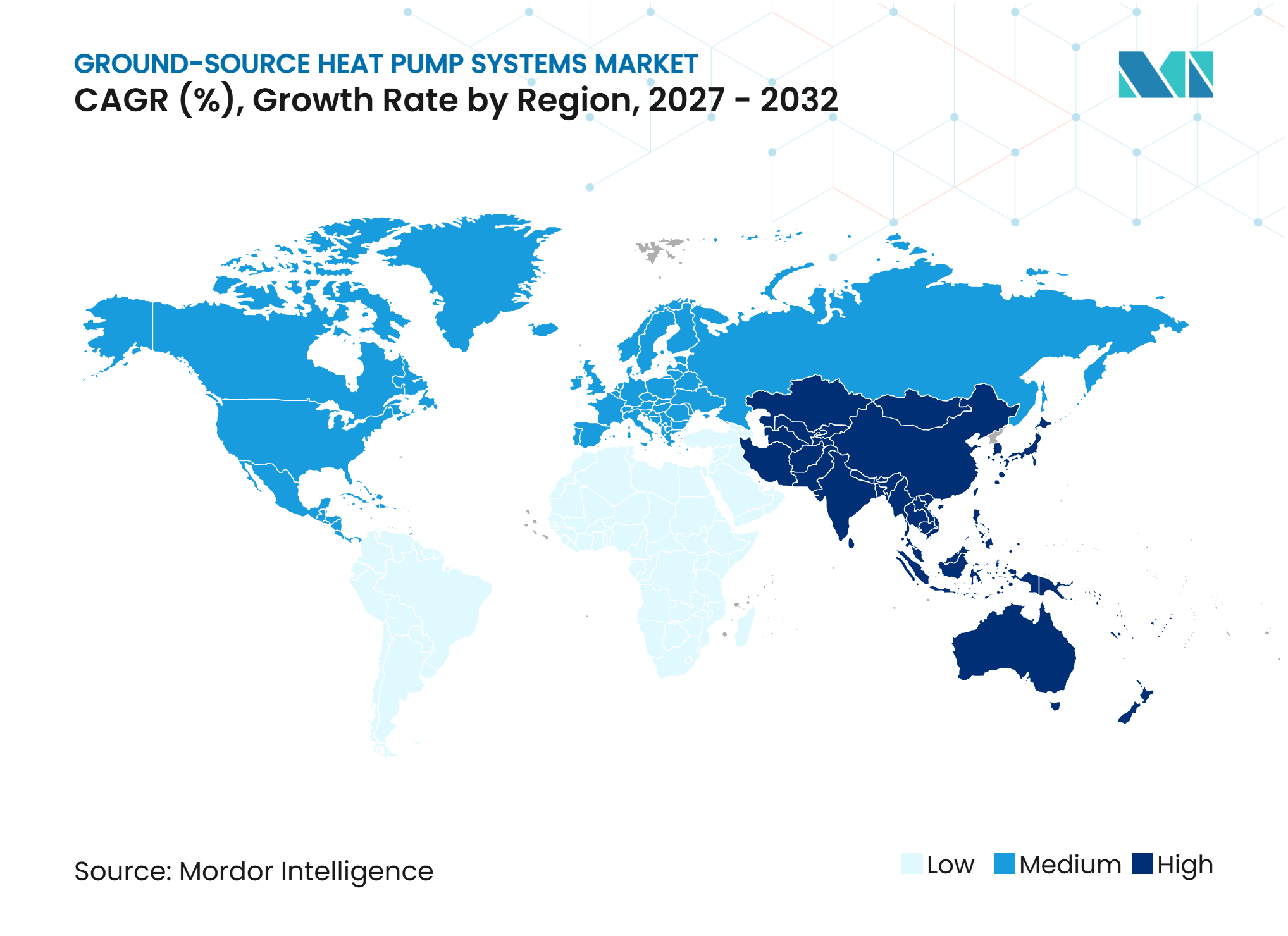
| Fastest Growing Market | Asia-Pacific |
| Largest Market | Europe |
| Market Concentration | Medium |
Major Players *Disclaimer: Major Players sorted in no particular order Image © Mordor Intelligence. Reuse requires attribution under CC BY 4.0. | |
Ground-Source Heat Pump Systems Market Analysis by Mordor Intelligence
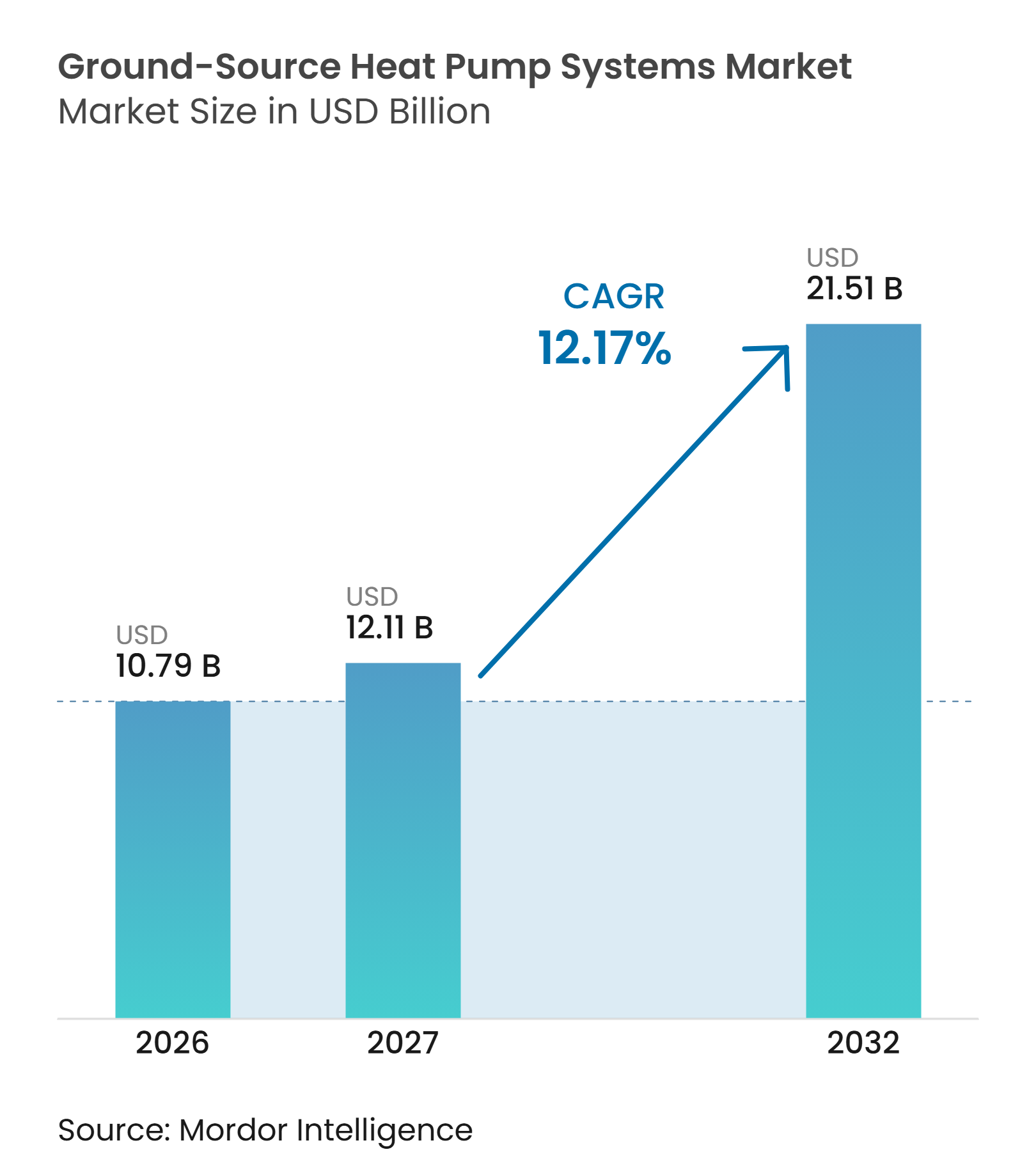
The Ground-source heat pump systems market size is expected to increase from USD 10.79 billion in 2026 to USD 12.11 billion in 2027 and reach USD 21.51 billion by 2032, expanding at a CAGR of 12.17% over 2027-2032. The market is supported by building electrification policies, renewable-heating targets, and the need to reduce operating emissions from buildings. Installations are moving from single-building projects toward shared ground loops and district-scale systems, which changes how infrastructure is financed and delivered. Manufacturers are competing through compact monobloc designs, natural refrigerants, inverter controls, and connected monitoring systems. The opportunity is strongest where retrofit programs, capable drilling contractors, and stable policy support are present at the same time. High drilling costs, long approval processes, and shortages of qualified specialists continue to limit adoption in residential retrofit projects.
Key Report Takeaways
- By system configuration, Monobloc Systems held 57.13% of the ground-source heat pump systems market share in 2026, while Hybrid Heat Pumps are projected to expand at a 12.77% CAGR through 2032.
- By capacity, Up to 10 kW held a 46.98% share in 2026, while Above 20 kW is projected to expand at a 12.79% CAGR through 2032.
- By application, Space Heating and Cooling held a 65.71% share of the ground-source heat pump systems market in 2026, while District Heating is projected to expand at a 12.96% CAGR through 2032.
- By end user, Residential held a 52.86% share in 2026, while Commercial is projected to expand at a 12.92% CAGR through 2032.
- By geography, Europe held a 36.17% share of the ground-source heat pump systems market in 2026, while Asia-Pacific is projected to expand at a 13.14% CAGR through 2032.
Note: Market numbers in this report are based on Mordor Intelligence's proprietary estimation framework, which combines nine months of actuals with Q4 projections for base year 2026.
Market Trends and Insights
Drivers Impact Analysis of Ground-Source Heat Pump Systems Market*
| Driver | (~) % Impact on CAGR Forecast | Geographic Relevance | Impact Timeline |
|---|---|---|---|
| Building Decarbonization and Heat Electrification Targets | +3.5% | Global, led by Europe and North America | Medium term (2-4 years) |
| Superior Cold Climate Efficiency and Stable Seasonal Performance | +2.0% | Northern Europe, Canada, Northern and Central China | Long term (≥ 4 years) |
| Low-Carbon New Construction and Deep Retrofits | +1.8% | Europe, North America, Asia-Pacific | Medium term (2-4 years) |
| District and Networked Ground-Loop Heating Expansion | +1.5% | Europe, with expansion into North America | Long term (≥ 4 years) |
| Borefield Thermal Energy Storage and Multi-Service Integration | +1.2% | Europe and North America | Long term (≥ 4 years) |
| Digital Monitoring, Inverter Controls, and Predictive Commissioning | +0.9% | Global, led by Northern Europe | Short term (≤ 2 years) |
| Source: Mordor Intelligence | |||
Building Decarbonization and Heat Electrification Targets
Building decarbonization requirements are a major force behind the Ground-source heat pump systems market. The revised Renewable Energy Directive requires European Union member states to raise the share of renewable heating and cooling by at least 1.1 percentage points per year from 2026 through 2030, which supports efficient electric heating choices. China issued an April 2025 action plan that explicitly includes ground-source and water-source heat pumps across residential, commercial, and industrial uses.[1] A 2025 review found that ground-source systems can use 25% less electricity and produce 13-43% lower greenhouse gas emissions than air-source systems in suitable applications. These policy and performance factors make the technology more relevant for dense multi-family buildings and commercial retrofits where electric load and operating emissions must both be managed.
Superior Cold Climate Efficiency and Stable Seasonal Performance
Cold climates support the Ground-source heat pump systems market because subsurface temperatures remain more stable than outdoor air temperatures. Systems can draw from ground temperatures of 10-15°C at 100 m depth in temperate and cold locations, helping them maintain a seasonal coefficient of performance of 3.5-5.4. A 2025 study found that hybrid air-ground systems can use the ground loop as a thermal buffer during the coldest periods, reducing peak borehole load and supporting longer system life. This performance is important in northern Europe, Canada, and China, where winter heating demand is high and air-source performance can weaken. Stable seasonal output also gives institutional owners a clearer basis for predicting operating costs over the life of a building asset.
Low-Carbon New Construction and Deep Retrofits
Low-carbon construction and deep retrofit activity continue to create demand for the Ground-source heat pump systems market. Installing ground-loop infrastructure during building design can spread drilling costs across a defined heating and cooling load and avoid later disruption to occupied buildings. Enertech Global was selected in April 2025 to support Dandelion Energy on more than 1,500 homes across 14 Lennar communities in Colorado, with projected homeowner savings of USD 30 million over 20 years relative to air-source systems. A Swedish study of a low-temperature district network found that shared boreholes reduced active energy use by 14% and cut heating emissions to 7% of the previous district heating benchmark. The Energy Performance of Buildings Directive further supports high-efficiency heating choices as building owners improve the energy performance of existing properties.
District and Networked Ground-Loop Heating Expansion
Shared ground loops are extending the Ground-source heat pump systems market beyond individual installations. BGE proposed a networked geothermal pilot in Maryland in August 2025 for multi-family housing and university facilities, with each location expected to reduce carbon dioxide-equivalent emissions by 100,000-110,000 lb annually versus air-source electrification. Kensa Group and Octopus Energy Generation began work in August 2025 on an investor-funded network for 114 new homes at Parc Eirin in South Wales. These models treat the ground loop as shared infrastructure rather than a cost borne only by the homeowner. That structure can reduce the entry barrier for households and can give investors a longer-lived contracted asset. It also creates a larger role for utilities, developers, and financing partners in project delivery.
Restraints Impact Analysis of Ground-Source Heat Pump Systems Market*
| Restraint | (~) % Impact on CAGR Forecast | Geographic Relevance | Impact Timeline |
|---|---|---|---|
| High Upfront Drilling and Installation Cost | -2.8% | Global, most acute in residential retrofit markets | Short term (≤ 2 years) |
| Permitting, Ground Risk, and Contractor Capacity Constraints | -2.2% | Europe and North America | Medium term (2-4 years) |
| Site-Specific Thermal Imbalance and Borefield Underperformance Risk | -1.4% | Northern China, Canada, and cold heating-dominated regions | Long term (≥ 4 years) |
| Limited Skilled Design, Drilling, and Commissioning Specialists | -1.3% | Global, particularly Asia-Pacific and emerging deployment markets | Short term (≤ 2 years) |
| Source: Mordor Intelligence | |||
High Upfront Drilling and Installation Cost
High installation cost remains the most immediate restraint on the Ground-source heat pump systems market. A typical United States residential vertical closed-loop installation costs USD 20,000-50,000, while hard-rock conditions can raise the cost to USD 80,000. The ground loop accounts for 30-55% of the project cost, and drilling is the most variable part of the installation. A survey of residential contractors and facility managers identified drilling conditions, installation complexity, and labor as the leading concerns in project economics. The result is uneven adoption, with developers and large asset owners better able to absorb upfront costs than mid-market residential customers. Leasing, shared infrastructure, and utility-led models can address this barrier, but they are not yet broadly available.
Permitting, Ground Risk, and Contractor Capacity Constraints
Administrative and supply constraints can delay the Ground-source heat pump systems market even where demand and funding are available. EGEC reported that lengthy procedures, inconsistent rules, and shortages of skilled professionals continue to slow deployment across European Union member states.[2] RED III caps permit-granting timelines at 3 months for ground-source heat pump installations below 50 MW and requires member states to establish Renewables Acceleration Areas. Implementation remains uneven, and local drilling conditions can still create uncertainty in schedule and fixed-price quotations. Geological differences between expected and actual borehole conditions add contingency costs and complicate construction planning. Capacity shortages in drilling, design, and commissioning therefore remain a practical constraint alongside formal regulation.
*Our forecasts treat driver/restraint impacts as directional, not additive. The impact forecasts reflect baseline growth, mix effects, and variable interactions.
Ground-Source Heat Pump Systems Market Segment Analysis
By System Configuration:
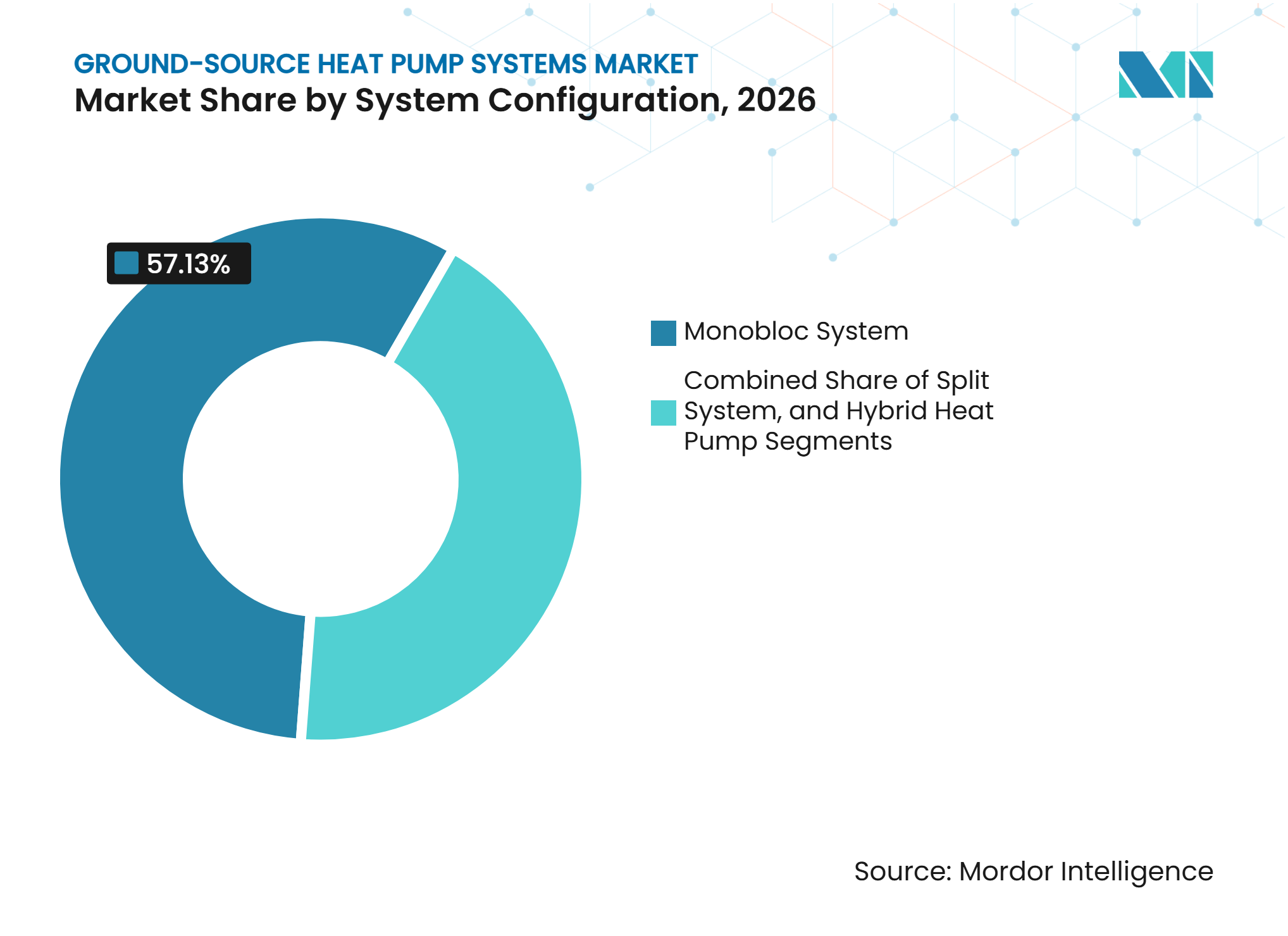
Monobloc Architecture Leads While Hybrid Systems Gain GroundMonobloc Systems held 57.13% of the Ground-source heat pump systems market share in 2026. Their compact design places the refrigerant circuit in one indoor unit, which can simplify installation and reduce refrigerant volume crossing the building envelope. This architecture suits residential retrofits and multi-family construction where indoor space and installation time matter. It also gives suppliers a practical platform for natural refrigerants, variable-speed compressors, and connected controls. The Ground-source heat pump systems market uses this configuration to meet demand for compact equipment without removing the thermal benefits of a ground loop.
OCHSNER launched its GEO FOX monobloc unit in June 2026 with R290 refrigerant, a seasonal coefficient of performance of 5.2-5.4, and an A+++ energy efficiency class.[3] The unit and hot-water storage fit within 0.5 m² of floor area, which supports use in constrained retrofit settings. Split Systems remain relevant where larger commercial projects require separation of components and refrigerant piping can be managed. Hybrid Heat Pumps are projected to expand at a 12.77% CAGR through 2032 because they can combine existing hydronic systems with ground loops and reduce the required borehole field size. Their role is strongest where owners need dependable output during cold periods while retaining existing heating infrastructure.



By Capacity:
Residential Units Lead While Larger Systems Support Project ScaleThe Ground-source heat pump systems market retained broad residential demand, and the up to 10 kW category held a 46.98% share in 2026, reflecting the large installed base of single-family systems. Northern and Central Europe account for much of this demand, supported by retrofit activity in Germany, Sweden, and the Netherlands. Germany's ground-source unit sales rose 7% to 13,500 units in 2025, with smaller systems leading volume. This capacity range is well suited to individual homes with predictable heating loads. It also benefits from installers that have experience with standardized residential layouts.
The 10-20 kW category serves large homes, multi-unit residential buildings, and small commercial sites. Above 20 kW is projected to expand at a 12.79% CAGR through 2032 as commercial, public, and district projects require higher output. EGEC identifies systems above 500 kW as an important growth area for larger buildings and heating and cooling networks. Larger equipment faces more demanding test and certification requirements under ISO 13256 and EN 14511. Those requirements can favor suppliers with established engineering, testing, and field-service capacity.
By Application:
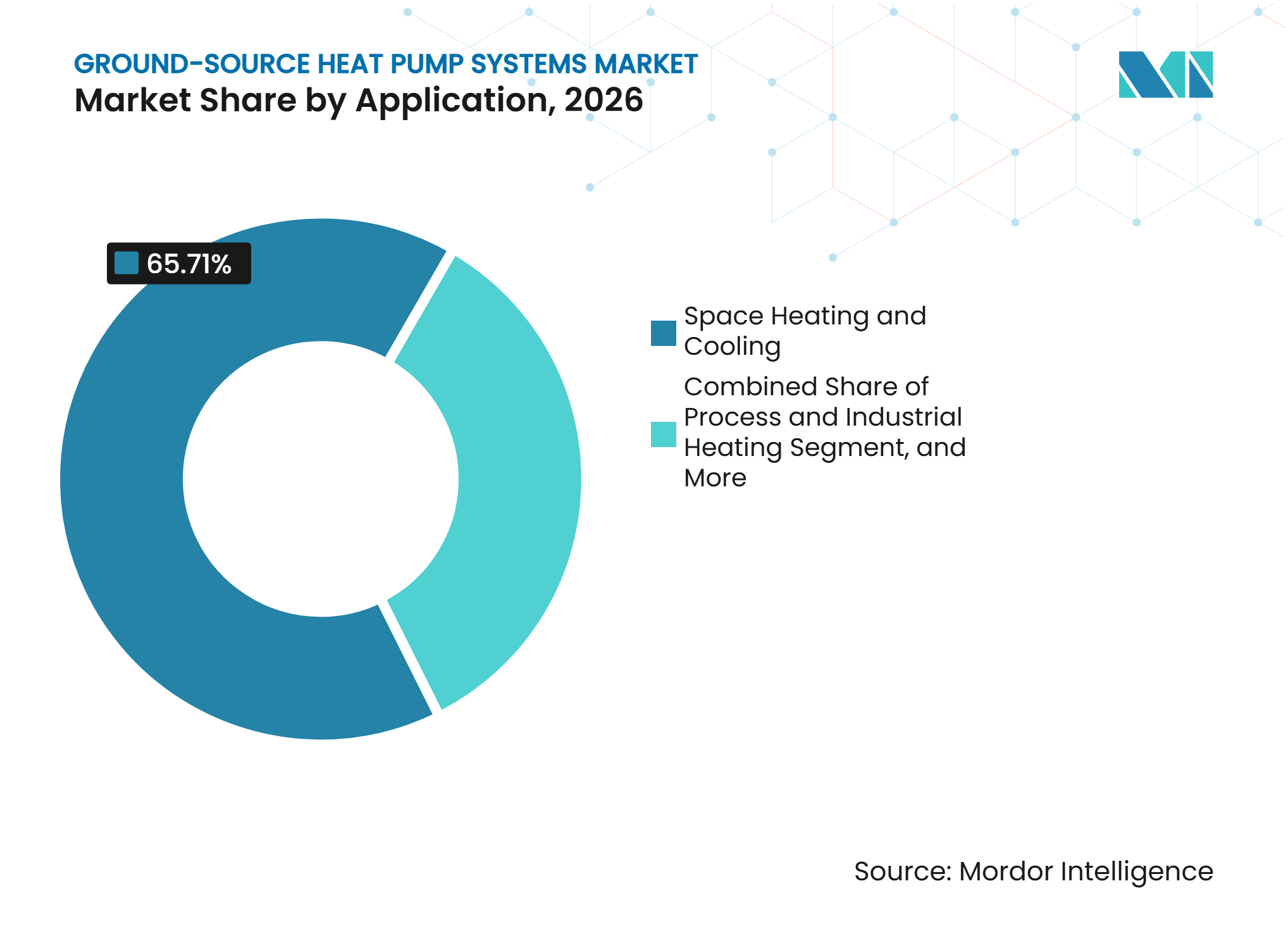
Space Heating and Cooling Remains Central While District Heating ExpandsSpace Heating and Cooling held a 65.71% share in 2026, making it the largest application in the Ground-source heat pump systems market. The same borehole field can provide heating during winter and cooling during warmer periods. This dual capability can reduce summer grid demand and can help recharge the borehole thermally. A Swedish analysis found that combining a ground-source heat pump with borehole thermal energy storage increased annual heat extraction by 27%, reduced heating costs by 29%, and reduced carbon dioxide emissions by more than 90% against the prior district heating setup. These operating characteristics make space conditioning relevant across building types and climate zones.
Within the Ground-source heat pump systems market, Water Heating remains a supporting application because desuperheaters can recover heat from the compression cycle for domestic hot water. Process and Industrial Heating is smaller, but China's 2025 policy plan identified petrochemicals, textiles, food processing, and pharmaceuticals as target uses for heat pumps. District Heating is projected to expand at a 12.96% CAGR through 2032 as fifth-generation networks operate at ambient loop temperatures. These networks avoid the efficiency losses associated with conventional high-temperature distribution. They can also enable energy exchange between buildings with different heating and cooling needs.

By End User:
Residential Demand Is Established While Commercial Procurement AcceleratesResidential users held a 52.86% share in 2026, supported by established installations in Scandinavia and increasing retrofit activity in Germany, the Netherlands, and the United Kingdom. Older European homes often have high heating demand, which makes lifetime operating cost an important consideration. New R290 monobloc designs can deliver supply temperatures of 55-70°C, allowing systems to serve some radiator-heated buildings without a full hydronic replacement. The Ground-source heat pump systems market therefore has a strong retrofit opportunity in existing housing stock. Adoption still depends heavily on the local availability of drilling, incentives, and financing.
Commercial users within the Ground-source heat pump systems market are projected to expand at a 12.92% CAGR through 2032. Corporate sustainability commitments, net-zero building codes, and green building frameworks such as LEED and BREEAM support high-efficiency heating and cooling choices. ClimateMaster was selected for a USD 63 million modernization involving more than 1,700 military homes at Fort Sill in August 2026. Hospitals, universities, and public facilities increasingly assess ground-source systems as long-lived infrastructure assets with 30-50-year service lives. This perspective can change procurement from a short-term equipment purchase to a capital investment decision.
Geography Analysis
Europe
Europe held 36.17% of the Ground-source heat pump systems market share in 2026. The region has mature installation networks, established financing channels, and renewable-heating policy support. Sweden, the Netherlands, and Germany recorded 26,785, 22,148, and 19,125 ground-source heat pump units, respectively, in 2025.[4] Germany's ground-source unit sales rose 7% to 13,500 in 2025, while heat pumps became the country's best-selling heating technology. RED III, national implementation, product investment, and contractor capacity will determine how quickly projects advance.
Asia-Pacific
Asia-Pacific is projected to expand at a 13.14% CAGR through 2032. China's geothermal heating and cooling coverage reached 1.65 billion m² by the end of 2025. The National Energy Administration began a 2026 pilot program for shallow ground-source systems in rural areas and cluster-scale urban projects. In Hebei, a split-type system was reported at CNY 10,000 (USD 1,375) installed per household, reducing winter heating expenditure from CNY 2,000-3,000 to under CNY 1,000. Japan and South Korea add demand through public incentives and building decarbonization measures, while standards and contractor capability will shape the pace of adoption.
North America, South America, Middle East, and Africa
North America has a meaningful position in the Ground-source heat pump systems market because of its cold climates, institutional sites, and established suppliers. The U.S. Department of Energy reported that broad geothermal heat pump deployment could avoid 24,500 miles of new transmission lines and produce USD 4 billion in annual grid-system savings. The removal of residential installation tax credits in early 2026 increased interest in financing, including Enertech Global's November 2026 lease with Palmetto. Canada offers retrofit potential through common hydronic systems and deep-cold performance, while South America, the Middle East, and Africa remain earlier-stage markets focused on commercial and institutional projects.
Competitive Landscape
Market Concentration
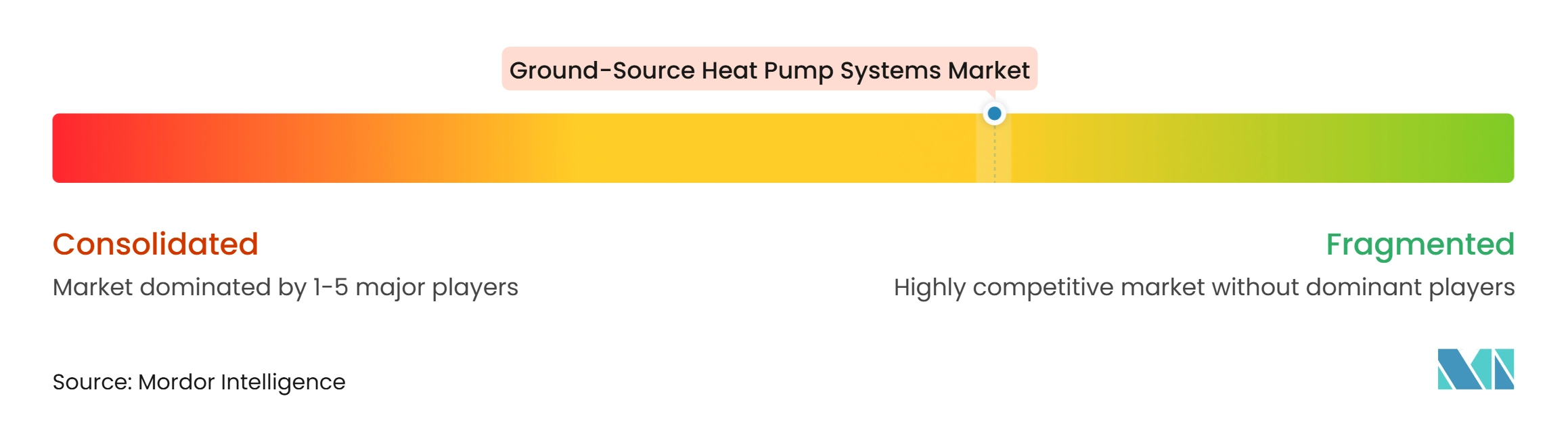
The Ground-source heat pump systems market has a moderately fragmented global supplier base. NIBE Industrier AB and STIEBEL ELTRON have broad European coverage, while WaterFurnace International and ClimateMaster have established North American positions through installer relationships and regional product adaptation. NIBE reported Climate Solutions revenue of SEK 7,326 million (USD 695 million) in the second quarter of 2026, up 7.3% year over year, while operating profit rose 20%. The Ground-source heat pump systems market rewards companies that can fund product development and sustain installer and after-sales support.
Product strategy increasingly centers on R290 refrigerants, inverter-driven compressors, digital monitoring, and predictive borefield controls. OCHSNER's June 2026 GEO FOX launch illustrates the focus on compact R290 equipment with high seasonal performance. Kensa Group and Octopus Energy Generation adopted an investor-funded shared-loop approach for 114 homes in Wales. WaterFurnace expanded its Fort Wayne headquarters by USD 14 million in 2025 to support geothermal demand. These actions show competition across equipment, financing, manufacturing capacity, and project delivery.
Smaller European suppliers, including Heliotherm, Ecoforest Geotermia, and WATERKOTTE, compete through specialized R290 products and regional channels. Chinese producers may create pricing pressure in Asia-Pacific as domestic manufacturing and geothermal construction expand. White space remains in commercial retrofits, shared-loop networks, and rural residential projects using lower-cost systems. A 2025 U.S. patent publication covering real-time borefield calibration and thermal prediction demonstrates the interest in digital control methods
Ground-Source Heat Pump Systems Industry Leaders
-
NIBE Industrier AB
-
Thermia AB
-
Kensa Group Limited
-
STIEBEL ELTRON GmbH & Co. KG
-
Kensa Group Limited
- *Disclaimer: Major Players sorted in no particular order
Ground-Source Heat Pump Systems Market Companies Covered in this Report
- NIBE Industrier AB
- WaterFurnace International, Inc.
- ClimateMaster, Inc.
- Enertech Global, LLC
- STIEBEL ELTRON GmbH & Co. KG
- Kensa Group Limited
- OCHSNER Wärmepumpen GmbH
- Thermia AB
- Heliotherm Wärmepumpentechnik GmbH
- Ecoforest Geotermia S.L.
- Gebwell Oy
- Oilon Oy
- Kronoterm d.o.o.
- alpha innotec GmbH
- ait-deutschland GmbH
- iDM Energiesysteme GmbH
- WATERKOTTE GmbH
- CTA AG
- Novelan GmbH
- TermoPlus d.o.o.
Recent Industry Developments in Ground-Source Heat Pump Systems Market
- November 2026: Viessmann Climate Solutions, part of Carrier Global Corporation, launched Vitocal 300-G, a new ground-source propane (R290) heat pump. The product line offers 6 to 16kW (1.7 to 4.5TR) of heating capacity, with up to four units able to operate in cascade. It uses Viessmann’s new One Base Intelligence control platform to connect system components, including third-party products.
- August 2026: ClimateMaster geothermal systems were selected to drive a USD 63 million energy modernization project across more than 1,700 military homes at Fort Sill, Oklahoma, the third military housing geothermal project executed with Ameresco and Corvias, confirming sustained federal institutional procurement for ground-source systems despite changes in residential incentive policy.
- June 2026: China's National Energy Administration issued its "Notice on Organizing High-Quality Development and Utilization Pilots for Geothermal Energy," prioritizing shallow ground-source cluster deployments in rural and urban districts and setting a two-year pilot implementation window. Provincial energy authorities were directed to submit implementation plans by July 31, 2026.
- June 2026: OCHSNER Wärmepumpen launched the GEO FOX ground-source heat pump series using natural refrigerant R290, achieving SCOP values of 5.2-5.4, an A+++ efficiency class, and supply temperatures up to 70°C. The entire unit and 200-liter hot-water storage fit within 0.5 m² of floor space, targeting single-family and multi-family retrofit applications.
Global Ground-Source Heat Pump Systems Market Report Scope
Ground-source heat pump systems, also known as geothermal heat pumps, are renewable heating, cooling, and water-heating systems that transfer thermal energy between a building and the earth. As underground soil and groundwater maintain a nearly constant temperature year-round, these systems operate at very high efficiency.
The Ground-Source Heat Pump Systems Market Report is Segmented by System Configuration (Split System, Monobloc System, and Hybrid Heat Pump), Capacity (Up to 10 kW, 10-20 kW, and Above 20 kW), Application (Space Heating and Cooling, Water Heating, District Heating, and Process and Industrial Heating), End User (Residential, Commercial, Institutional, and Industrial), and Geography (North America, South America, Europe, Asia-Pacific, Middle East, and Africa). The Market Forecasts are Provided in Terms of Value (USD).
Segmentation Overview
| Split System |
| Monobloc System |
| Hybrid Heat Pump |
| Up to 10 kW |
| 10-20 kW |
| Above 20 kW |
| Space Heating and Cooling |
| Water Heating |
| District Heatging |
| Process and Industrial Heating |
| Residential |
| Commercial |
| Institutional |
| Industrial |
| North America | United States |
| Canada | |
| Mexico | |
| South America | Brazil |
| Argentina | |
| Rest of South America | |
| Europe | Germany |
| France | |
| Italy | |
| United Kingdom | |
| Russia | |
| Rest of Europe | |
| Asia-Pacific | China |
| Japan | |
| South Korea | |
| India | |
| ASEAN | |
| Rest of Asia-Pacific | |
| Middle East | Saudi Arabia |
| United Arab Emirates | |
| Turkey | |
| Rest of Middle East | |
| Africa | South Africa |
| Nigeria | |
| Rest of Africa |
| By System Configuration | Split System | |
| Monobloc System | ||
| Hybrid Heat Pump | ||
| By Capacity | Up to 10 kW | |
| 10-20 kW | ||
| Above 20 kW | ||
| By Application | Space Heating and Cooling | |
| Water Heating | ||
| District Heatging | ||
| Process and Industrial Heating | ||
| By End User | Residential | |
| Commercial | ||
| Institutional | ||
| Industrial | ||
| By Geography | North America | United States |
| Canada | ||
| Mexico | ||
| South America | Brazil | |
| Argentina | ||
| Rest of South America | ||
| Europe | Germany | |
| France | ||
| Italy | ||
| United Kingdom | ||
| Russia | ||
| Rest of Europe | ||
| Asia-Pacific | China | |
| Japan | ||
| South Korea | ||
| India | ||
| ASEAN | ||
| Rest of Asia-Pacific | ||
| Middle East | Saudi Arabia | |
| United Arab Emirates | ||
| Turkey | ||
| Rest of Middle East | ||
| Africa | South Africa | |
| Nigeria | ||
| Rest of Africa | ||
Key Questions Answered in the Report
What is the ground-source heat pump systems market size?
The Ground-source heat pump systems market is expected to increase from USD 10.79 billion in 2026 to USD 21.51 billion by 2032, at a 12.17% CAGR from 2027 to 2032.
What is driving demand for ground-source heat pump systems?
Renewable-heating requirements, building electrification, cold-climate performance, and shared-loop project models are supporting adoption.
Which system configuration leads ground-source heat pump adoption?
Monobloc Systems held 57.13% share in 2026 because their compact design can simplify installation in residential and multi-family buildings.
Which application is expanding fastest for ground-source heat pumps?
District Heating is projected to expand at a 12.96% CAGR through 2032 as ambient-loop networks support energy exchange between buildings.
Which region is projected to expand fastest?
Asia-Pacific is projected to expand at a 13.14% CAGR through 2032, supported primarily by China's policy-led geothermal deployment.
What limits ground-source heat pump adoption?
High drilling costs, permitting delays, geological uncertainty, and a shortage of qualified drillers and commissioning specialists remain key constraints.