
Greece Kiwi Market Size and Share
Greece Kiwi Market Analysis by Mordor Intelligence
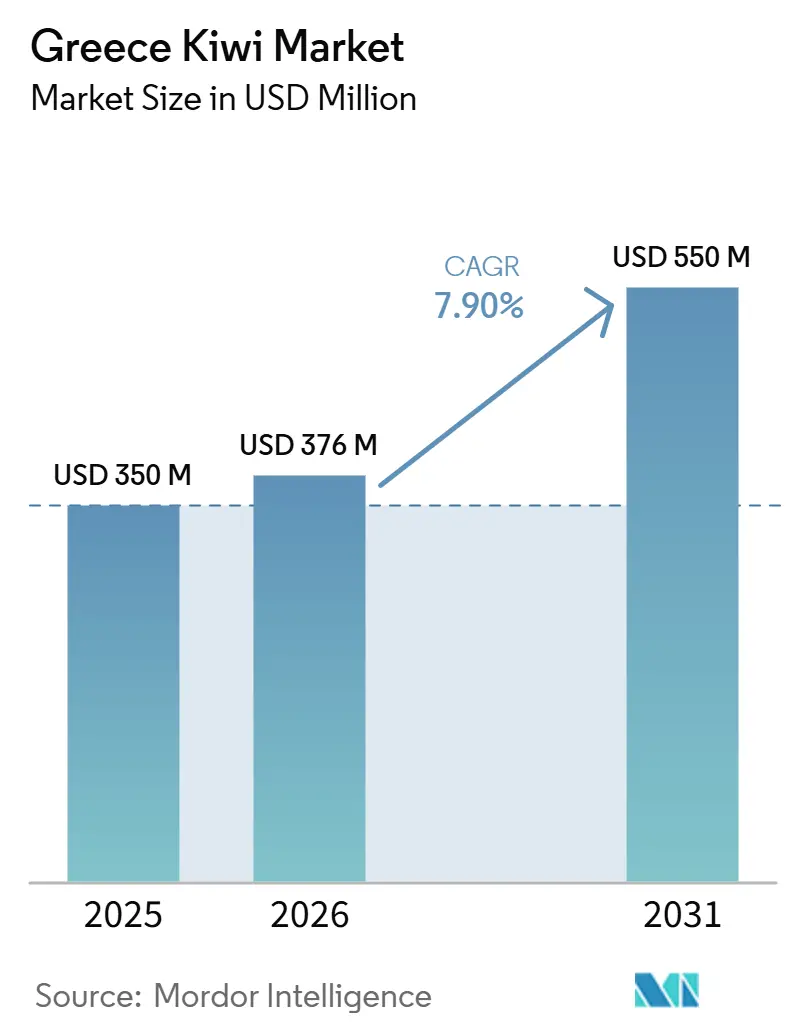
The Greece kiwi market size is projected to increase from USD 350.00 million in 2025 to USD 376.00 million in 2026 and reach USD 550.00 million by 2031, growing at a CAGR of 7.90% over 2026-2031. The Greece kiwi market is shaped by an export-led structure, where commercial value depends more on overseas demand, shipment discipline, and buyer specifications than on domestic retail demand. Greece ranked third globally in kiwi export value in 2024, underscoring the country’s strong position in international trade and offering exporters a broader set of destination options across premium channels[1]. Production strength also supports this outlook, with Greece’s kiwifruit output reaching 341,998 metric tons in 2024, according to the official Rural Development and Food Ministry, which provides the physical base required for sustained export activity[2]. The Greek kiwi market is also benefiting from improved cold storage, traceability, and packing standards, which help exporters extend the selling season and protect fruit quality in longer-haul trade. Competitive advantage is shifting toward operators that can combine certified-grower networks, careful harvest control, and organized logistics, while weather exposure and labor tightness continue to limit consistency in some parts of the value chain.
Key Report Takeaways
- By production, domestic kiwi output increased from 171,719 tons in 2014 to 341,998 tons in 2024.
Note: Market size and forecast figures in this report are generated using Mordor Intelligence’s proprietary estimation framework, updated with the latest available data and insights as of January 2026.
Greece Kiwi Market Trends and Insights
Drivers Impact Analysis*
| Driver | (~) % Impact on CAGR Forecast | Geographic Relevance | Impact Timeline |
|---|---|---|---|
| Strong export orientation toward premium fresh kiwi destinations | +1.8% | Greece national, with export production concentrated in Central Macedonia, Epirus, and Eastern Macedonia and Thrace | Medium term (2-4 years) |
| Expansion of certified orchard production under export specifications | +1.5% | Greece national, European Union and non-European Union export markets | Medium term (2-4 years) |
| Improved post-harvest handling and cold-chain discipline | +1.2% | Greece national, with highest impact in Northern Greece packing and storage hubs | Short term (≤ 2 years) |
| Rising demand for high-brix, uniform-sized fresh kiwi in trade channels | +1% | Global, with highest relevance for Greek exporters targeting Europe, North America, and Asia | Long term (≥ 4 years) |
| Orchard replanting with higher-yield, better-storing vine material | +0.9% | Greece national, led by Central Macedonia and Epirus | Long term (≥ 4 years) |
| Greater coordination between growers, packers, and exporters | +0.7% | Greece national | Medium term (2-4 years) |
| Source: Mordor Intelligence | |||
Strong Export Orientation Toward Premium Fresh Kiwi Destinations
The Greece kiwi market is structurally tied to export demand, which shapes the commercial decisions of growers, packers, and exporters. Greece ranked third globally in kiwi export value in 2024, which shows that the country holds a visible and durable place in world trade rather than acting as a marginal seasonal supplier. This position matters because premium buyers usually favor suppliers that can combine scale, consistency, and reliable documentation across multiple shipments. The Greece kiwi market, therefore gains strength when exporters can spread sales across a wider range of destinations rather than relying on a narrow set of nearby buyers. This outward focus also supports firmer pricing discipline, as exporters have greater flexibility in matching fruit to timing, quality, and destination requirements. Over time, that export orientation reinforces investment in orchard management, grading systems, and shipment planning, all of which raise the commercial ceiling for the Greece kiwi market.
Expansion of Certified Orchard Production Under Export Specifications
Certification has become a practical requirement in the Greece kiwi market, especially for fruit moving into formal retail programs and high-value import channels. Global Good Agricultural Practices (GlobalG.A.P.) has strengthened the role of traceability, documentation, and audited production systems in securing export access. This raises the operating standard for smaller growers and increases the value of producer groups and exporters that can coordinate compliance across many farms. Zeus Kiwi SA states that it works with more than 300 growers and uses a cloud-based traceability and farm management system, which shows how certification and operating scale now work together in commercial practice. AC Episkopi’s Version 6.0 certification also aligns with this direction, with a group-based model that supports disciplined supply for demanding buyers. As this structure expands, the Greece kiwi market becomes more organized and better aligned with premium trade channels.
Improved Post-Harvest Handling and Cold-Chain Discipline
Post-harvest performance is a central value driver in the Greece kiwi market because fruit quality must be protected long after harvest is complete. Zeus Kiwi SA reports 15,000 square meters of packhouse and cold storage space, along with modern sorting equipment and at least 80 quality control checks each day, which indicates that scale in handling and storage is now part of market competition. Kiwi Hellas also states that it operates refrigeration units and a sorting and grading line close to the main production area in Pieria, which reduces handling stress before export. These capabilities matter because the Greece kiwi market depends on fruit condition during shipment just as much as on orchard output at harvest. Better storage discipline helps exporters extend the selling season and approach late-window sales with stronger confidence in firmness and appearance. This improves commercial returns and shifts competition toward operators that can preserve quality over time rather than simply move fruit quickly.
Rising Demand for High-Brix, Uniform-Sized Fresh Kiwi in Trade Channels
The Greece kiwi market is increasingly shaped by buyer demand for fruit that is consistent in size, sweetness, and visual quality. Formal retail programs and organized importers rarely reward mixed lots, and this raises the premium on disciplined orchard practices and accurate grading. Kiwi Hellas notes that it monitors sugar levels and field conditions during harvest, reflecting how quality control now begins before the fruit reaches the packing line. In the Greece kiwi market, fruit that meets these tighter specifications is more likely to secure repeat placement in export channels where purchasing decisions depend on consistency across seasons. This creates a clear split between exporters that can supply a uniform product and operators that remain more exposed to variable outcomes at harvest. As a result, demand for high-Brix and uniform-sized fruit is not only a quality preference, it is also a force that pushes the market toward stronger process control.
Restraints Impact Analysis*
| Restraint | (~) % Impact on CAGR Forecast | Geographic Relevance | Impact Timeline |
|---|---|---|---|
| High sensitivity of fresh kiwi quality to rain, frost, and harvest timing | -1.90% | Greece national, with highest impact in Northern Greece producing regions | Short term (≤ 2 years) |
| Labor-intensive orchard and harvest operations | -1.50% | Greece national | Short term (≤ 2 years) |
| Limited storage and packing capacity in peak harvest windows | -1.30% | Greece national, especially in smaller producing areas | Short term (≤ 2 years) |
| Fruit rejection risk from residue, size, or maturity non-compliance | -0.90% | Greece export channels across Europe, North America, and Asia | Medium term (2-4 years) |
| Source: Mordor Intelligence | |||
High Sensitivity of Fresh Kiwi Quality to Rain, Frost, and Harvest Timing
The Greece kiwi market remains highly sensitive to weather conditions because export value depends on a narrow quality range rather than on harvest volume alone. Even when national production remains solid, local frost, poorly timed rain, or harvest delays can reduce the share of fruit that meets export standards. This matters because buyers in premium channels evaluate firmness, appearance, and maturity with little tolerance for variation. The Greece kiwi market, therefore, carries a risk that a single weather event can affect both the usable volume and the average realized value within one season. Production data from the Food and Agriculture Organization of the United Nations confirm that Greece operates at meaningful output scale, yet scale alone does not eliminate quality-related weather exposure. As long as fruit quality remains closely tied to orchard conditions during a short seasonal window, weather will stay one of the main limits on consistency.
Labor-Intensive Orchard and Harvest Operations
The Greece kiwi market depends heavily on seasonal labor because harvest timing cannot be stretched without affecting fruit quality. Orchard work and picking need to take place within a narrow window, and labor gaps can quickly translate into grading losses or weaker shipping conditions. The European Commission’s seasonal worker framework for Greece shows how formal labor access is governed through quotas, employer applications, and time-bound contracts. This indicates that labor is not just a cost issue in the Greece kiwi market, it is also a structural operating constraint. Export fruit that misses the optimal picking window can lose value before it even enters cold storage. For that reason, labor availability remains one of the most direct operational restraints on the Greece kiwi market.
*Our forecasts treat driver/restraint impacts as directional, not additive. The impact forecasts reflect baseline growth, mix effects, and variable interactions.
Geography Analysis
Central Macedonia largest geographic contributor to the Greece kiwi market, according to the International Society for Horticultural Science. The region’s strength rests on an established production base, a dense concentration of packing activity, and close logistical links to export channels. This makes it the most important operating center for the country’s commercial kiwi trade. The Greece kiwi market relies heavily on this northern base because it brings scale and infrastructure together in the same production corridor. That concentration supports faster movement from the orchard to the cooling and from the cooling to the shipment.
Epirus, Eastern Macedonia, and Thrace form the next layer of support within national supply. Their role is smaller than Central Macedonia’s, but they still matter because they broaden the production footprint and reduce dependence on a single district. The Greece kiwi market becomes more resilient when production is spread across several northern zones with different local growing conditions. This diversification helps exporters manage seasonal variation with more flexibility. It also improves the market's ability to sustain export programs when one region faces temporary pressure.
Greece’s output reached 342,330 metric tons in 2024, which confirms the scale of domestic supply behind export activity. Greece also ranked third globally in kiwi export value in 2024, which shows that the country’s trade position is supported by both production and market access. The Greece kiwi market is therefore shaped by a domestic base that is large enough to support international placement at meaningful scale. Imports remain limited compared with domestic production and mainly serve small seasonal gaps rather than structural shortages. This net exporter profile gives the Greece kiwi market a commercial identity that is centered on overseas value capture and trade execution.
Competitive Landscape
The Greece kiwi market is fragmented at the grower level, but it is more structured at the packing and export tier, where scale and compliance matter most. Hundreds of farms contribute supply, while a smaller group of organized operators shape how that supply is graded, stored, certified, and sold abroad. This means the Greece kiwi market does not show single-company dominance at the farm level, yet competitive influence is clearly stronger among exporters with infrastructure and audit-readiness. Zeus Kiwi SA is one of the most established examples, stating that it was founded in 1991, operates with more than 300 growers, and has developed traceability, storage, and advanced sorting capabilities over time. That kind of operating scale helps exporters meet the needs of demanding buyers more consistently across seasons.
Kiwi Hellas represents another organized model in the Greece kiwi market, with refrigeration units, grading systems, and export activity to more than 30 countries. Its location near Katerini and close to the port of Thessaloniki supports shorter internal transport routes and smoother outbound shipment planning. The Greece kiwi market increasingly rewards this type of integrated setup because fruit quality can weaken quickly if field handling and post-harvest logistics are not closely aligned. AC Episkopi adds a cooperative-led model, where group certification creates a formal bridge between fragmented production and export compliance. These models show that competition is moving toward better organization rather than simply larger grower numbers.
Logistics capability is also becoming more important in the Greece kiwi market because long-distance fruit trade depends on temperature control and timing discipline[3]. DS Freight Forwarding presents itself as a Greece-based logistics provider for perishables with temperature-controlled transport, export shipments across Europe, and digital logistics support. This matters because exporters need more than orchard supply if they want to compete in premium markets that judge fruit by arrival condition as much as by origin reputation. The Greece kiwi market is therefore becoming more selective in terms of which operators can reliably serve longer-haul destinations with stable quality. Over time, this favors exporters and producer groups that can combine certified supply, cold-chain control, and organized shipment execution. The visible result is a market that still looks fragmented on the surface, but where real competitive power is gradually concentrating among better-prepared operators.
Recent Industry Developments
- June 2026: According to the European Commission's Migration and Home Affairs portal, Greece has begun implementing its agreement with Egypt to recruit seasonal agricultural workers, including for kiwi harvesting in Northern Greece. The initiative is expected to improve labor availability during the harvest season, supporting production efficiency and strengthening the Greece kiwi market.
- December 2025: AC Episkopi received GLOBALG.A.P. Integrated Farm Assurance Version 6.0 certification, covering around 250 member-growers across 3,700 hectares of kiwifruit. The certification enhances export market access and strengthens the competitiveness of the Greece kiwi market by meeting stringent European Union buyer requirements.
- June 2025: ZEUS KIWI SA established a logistics partnership with DS Freight Forwarding for temperature-controlled reefer container transport coordination to international markets, as disclosed in DS Freight Forwarding's official company communications. The collaboration supports ZEUS KIWI SA's cold chain integrity requirements from packing house to destination port, a critical operational need for maintaining fruit quality in long-haul shipments to non-EU markets.
Greece Kiwi Market Report Scope
Kiwi, also known as kiwifruit, is a nutrient-rich edible berry with green, gold, or red flesh and a fuzzy or smooth skin, cultivated commercially for fresh consumption and food processing applications. The Greece kiwi market report includes production analysis (volume, area harvested, and yield), consumption analysis (value and volume), import analysis (value and volume), export analysis (value and volume), wholesale price trend analysis and forecast, regulatory framework, logistics and infrastructure, and seasonality analysis. The market forecasts are provided in terms of value (USD) and volume (metric tons).
| Production Analysis | Production Volume | |
| Area Harvested and Yield | ||
| Consumption Analysis (Value and Volume) | ||
| Trade Analysis (Value and Volume) | Import Market Analysis | Import Value and Volume |
| Key Supplying Markets | ||
| Export Market Analysis | Export Value and Volume | |
| Key Destinations Markets | ||
| Wholesale Price Trend Analysis and Forecast | ||
| Regulatory Framework | ||
| Logistics and Infrastructure | ||
| Seasonality Analysis | ||
| Mexico | Production Analysis | Production Volume | |
| Area Harvested and Yield | |||
| Consumption Analysis (Value and Volume) | |||
| Trade Analysis (Value and Volume) | Import Market Analysis | Import Value and Volume | |
| Key Supplying Markets | |||
| Export Market Analysis | Export Value and Volume | ||
| Key Destinations Markets | |||
| Wholesale Price Trend Analysis and Forecast | |||
| Regulatory Framework | |||
| Logistics and Infrastructure | |||
| Seasonality Analysis | |||
Key Questions Answered in the Report
What is the projected value of the Greece kiwi market by 2031?
The Greece kiwi market is forecast to reach USD 550.00 million by 2031, up from USD 376.00 million in 2026, at a CAGR of 7.90% over 2026-2031.
Why is Greece important in global kiwi trade?
Greece ranked third globally in kiwi export value in 2024, which shows that it is one of the leading suppliers in international kiwi trade.
Which region leads kiwi production in Greece?
Central Macedonia is the leading region in the country.
What is driving growth in this sector?
Export orientation, certified production, stronger cold-chain systems, and better coordination between growers and exporters are the main growth drivers.