
Graphene Reinforced Polymer Composites Market Size and Share
Market Overview
| Study Period | 2021 - 2031 |
|---|---|
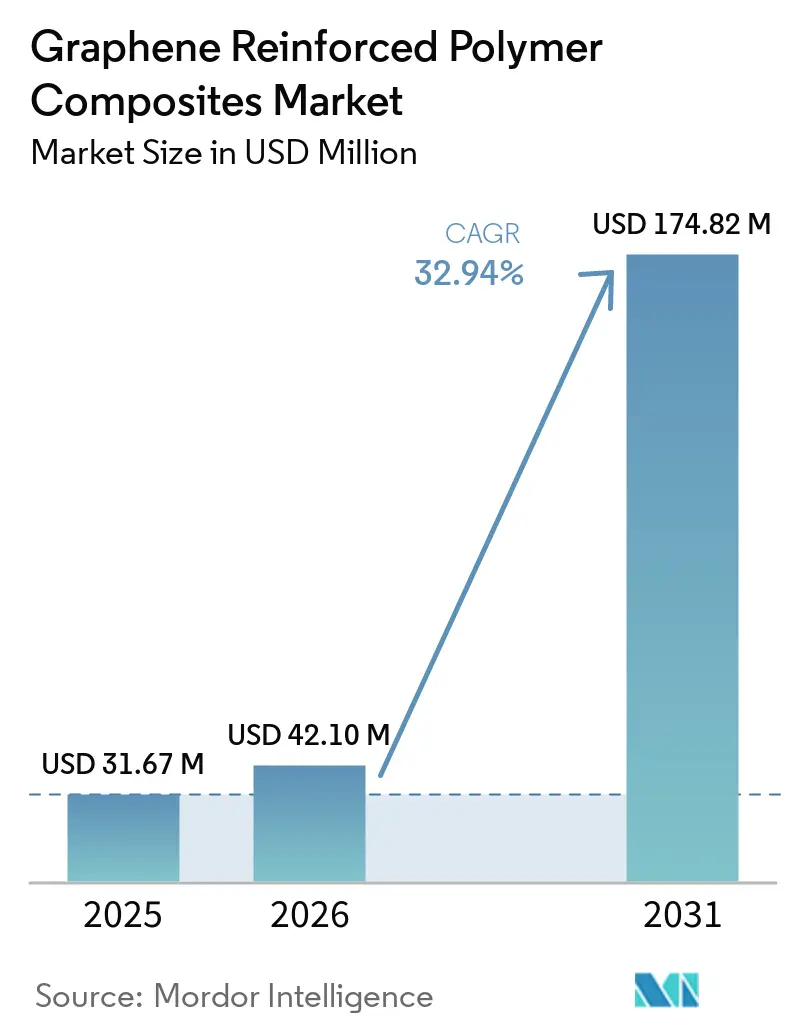
| Market Size (2026) | USD 42.10 Million |
| Market Size (2031) | USD 174.82 Million |
| Growth Rate (2026 - 2031) | 32.94 % |
| Fastest Growing Market | Asia-Pacific |
| Largest Market | Asia-Pacific |
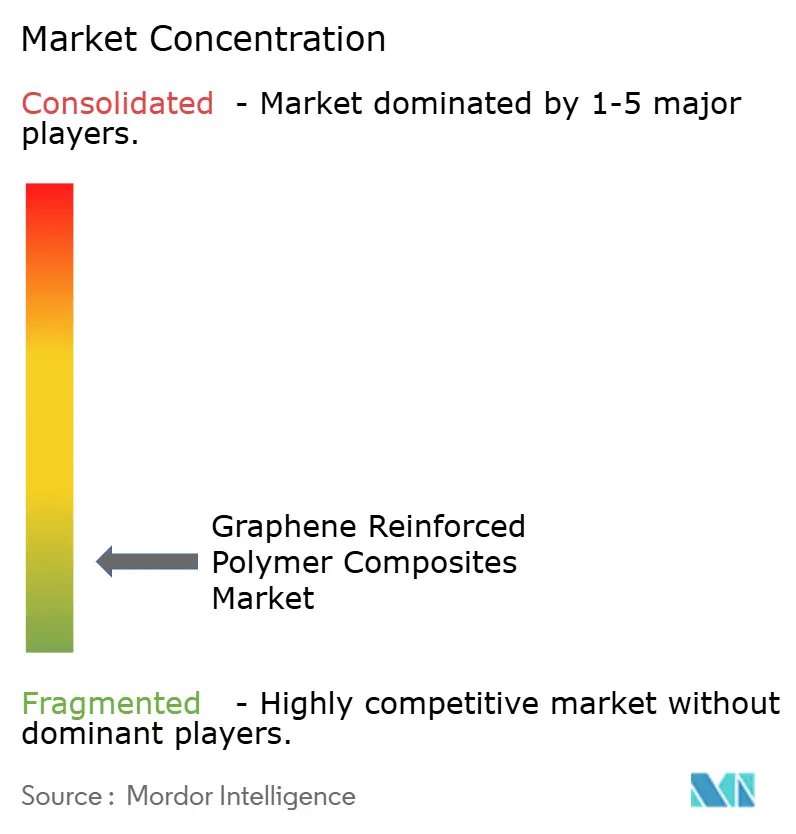
| Market Concentration | Low |
Major Players *Disclaimer: Major Players sorted in no particular order Image © Mordor Intelligence. Reuse requires attribution under CC BY 4.0. | |
Graphene Reinforced Polymer Composites Market Analysis by Mordor Intelligence
The Graphene Reinforced Polymer Composites Market size was valued at USD 31.67 million in 2025 and is estimated to grow from USD 42.10 million in 2026 to reach USD 174.82 million by 2031, at a CAGR of 32.94% during the forecast period (2026-2031). The graphene reinforced polymer composites market is expanding as transportation electrification, battery safety requirements, and electronics thermal management needs converge. This positions the graphene reinforced polymer composites market around applications where lightweight structures, heat transfer, and electrical behavior are considered together. Processing-ready masterbatches are making graphene additions workable on standard extrusion and injection molding lines, which lowers the need for factory retooling. Suppliers with documented and consistent material grades are becoming more relevant to original equipment manufacturer procurement teams because qualification depends on repeatable material behavior. Asia-Pacific combines graphene supply, battery manufacturing, electronics production, and electric vehicle assembly, which gives the region a strong operating base. The graphene reinforced polymer composites market also faces long validation cycles and variable input quality, which can delay commercial demand even where laboratory performance is strong.
Key Report Takeaways
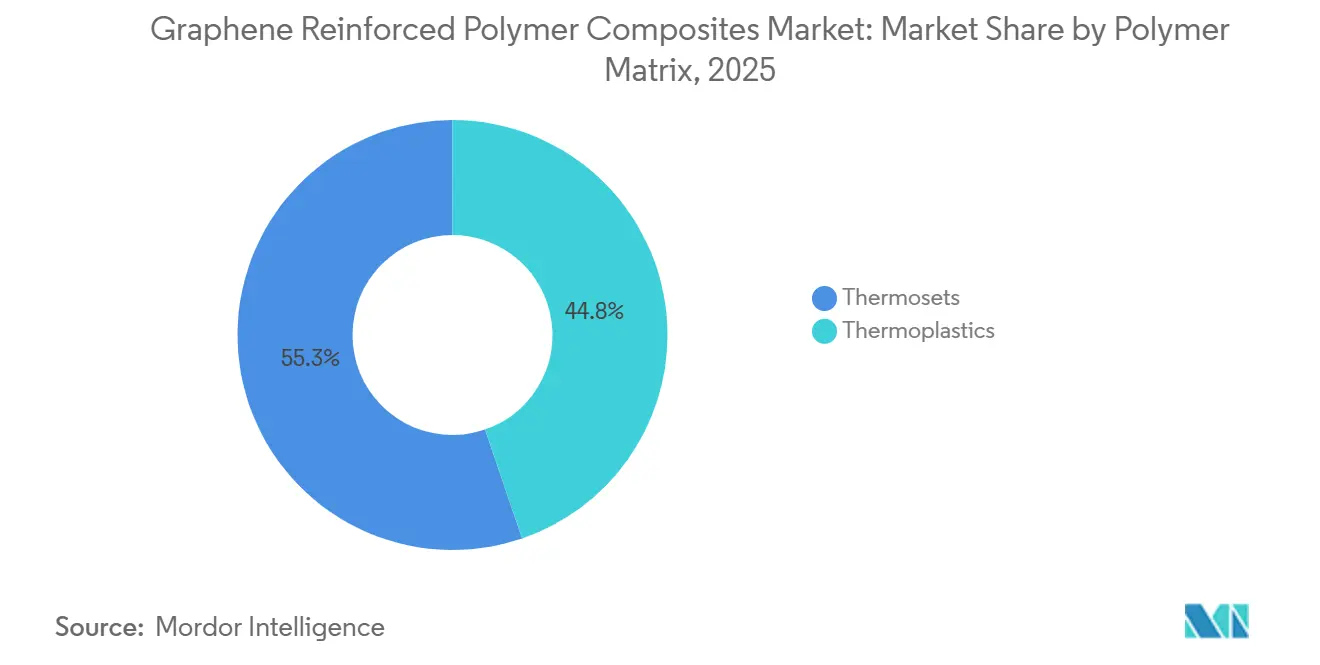
- By polymer matrix, thermoplastics held 44.75% of the graphene reinforced polymer composites market share in 2025 and are projected to advance at a 34.34% CAGR through 2031.
- By reinforcement material, graphene oxide held 35.13% of the graphene reinforced polymer composites market share in 2025, while reduced graphene oxide is projected to advance at a 34.70% CAGR through 2031.
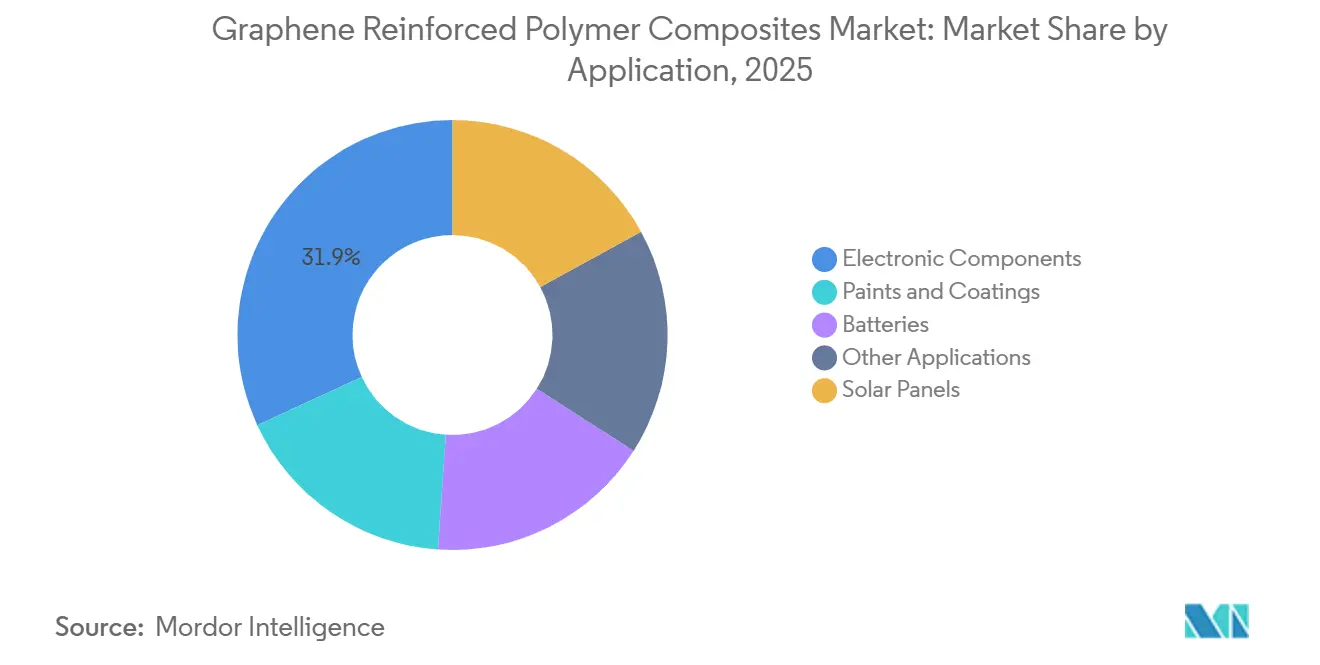
- By application, electronic components held 31.89% of the graphene reinforced polymer composites market share in 2025, while batteries are projected to advance at a 35.67% CAGR through 2031.
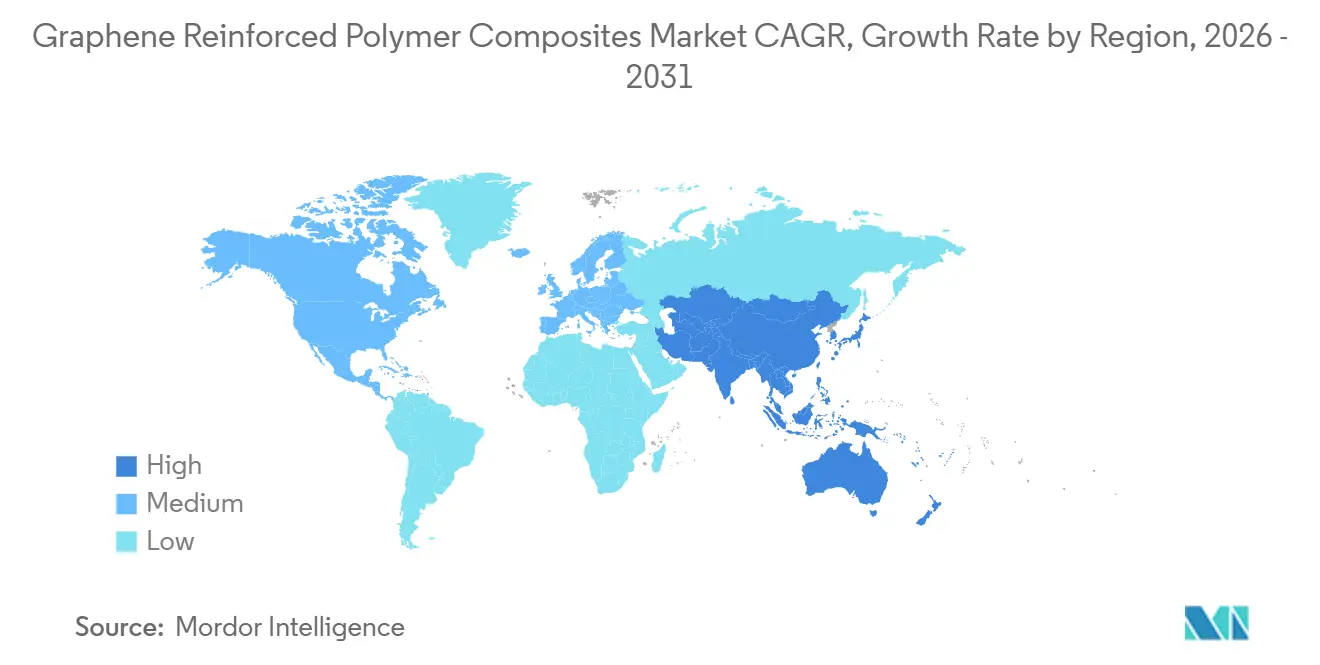
- By geography, Asia-Pacific held 32.56% of the graphene reinforced polymer composites market share in 2025 and is projected to advance at a 35.16% CAGR through 2031.
Note: Market size and forecast figures in this report are generated using Mordor Intelligence’s proprietary estimation framework, updated with the latest available data and insights as of January 2026.
Global Graphene Reinforced Polymer Composites Market Trends and Insights
Drivers Impact Analysis*
| Driver | (~) % Impact on CAGR Forecast | Geographic Relevance | Impact Timeline |
|---|---|---|---|
| Electrification and Thermal Management in Vehicles and Energy Storage | +8.5% | Global, concentrated in Asia-Pacific and Europe | Medium term (2-4 years) |
| Lightweighting and Multifunctional Performance Requirements | +7.2% | Global | Long term (≥ 4 years) |
| Demand for Conductive, Anti-Corrosion and EMI-Shielding Coatings | +6.8% | Asia-Pacific, North America, and Europe | Medium term (2-4 years) |
| Expansion of Flexible Electronics, Wearables and Printed Components | +5.4% | Asia-Pacific core, spillover to North America | Short term (≤ 2 years) |
| Low-Loading Graphene Dispersion and Masterbatch Commercialization | +4.1% | Global, with early gains in Canada and UK | Short term (≤ 2 years) |
| Source: Mordor Intelligence | |||
Electrification and Thermal Management in Vehicles and Energy Storage
Thermal runaway mitigation has become an important materials issue for electric vehicle manufacturers. Graphene reinforced polymer composites can support lighter battery enclosures, thermally switchable separators, and conductive coatings that help manage temperature across cell arrays. A 2026 study reported a graphene-based flame-retardant material that changed from thermally conductive at 1.23 W m⁻¹ K⁻¹ to insulating at 0.11 W m⁻¹ K⁻¹ within 20 seconds near 140 °C. The result reduced heat diffusion and limited thermal runaway propagation in nickel-manganese lithium-ion battery modules. NANOXPLORE launched xGnP D500-HP in May 2026 for energy storage, conductive composites, and advanced electronics, with commercial validation from an Asian customer secured at launch[1]NANOXPLORE, “NANOXPLORE Launches xGnP D500-HP, High-Purity Graphene to Replace Conventional Conductive Additives,” NANOXPLORE, nanoxplore.ca. In stationary storage, tighter temperature limits and limited maintenance access strengthen the case for materials that deliver several functions in one component.
Lightweighting and Multifunctional Performance Requirements
Weight reduction is a design requirement in automotive, aerospace, and portable electronics applications. At low loading levels, graphene can improve strength, barrier performance, and processing behavior without a comparable increase in density. A 2026 review found measurable gains in tensile strength and Young's modulus in graphene reinforced carbon fiber composites used for automotive and aerospace components. The review also identified flash Joule heating as a potential route for converting waste composites into turbostratic graphene. Research on ultrahigh molecular weight polyethylene nanocomposites recorded a 61% rise in tensile modulus and a 72% rise in storage modulus at 10 wt% graphene nanoplatelet content. The graphene reinforced polymer composites market can therefore benefit as components first validated for secondary structures move into applications with more demanding structural requirements.
Demand for Conductive, Anti-Corrosion and EMI-Shielding Coatings
Electromagnetic interference shielding is increasingly a specification requirement as 5G infrastructure places more high-frequency components in smaller spaces. The graphene reinforced polymer composites market can address this need with thin, lightweight, and mechanically durable coatings. A 2025 study reported that a reduced graphene oxide film achieved an average shielding effectiveness of 53.5 dB across the X-band from 8.2 GHz to 12.4 GHz. The film also showed higher tensile strength than films made through conventional high-temperature reduction and retained stability under varied conditions. A graphene-filled epoxy coating may combine protection against chloride ingress with shielding of control electronics in offshore energy and subsea systems.
Low-Loading Graphene Dispersion and Masterbatch Commercialization
The graphene reinforced polymer composites market is moving from powder graphene, which can require specialized dispersion equipment, toward pelletized masterbatches for existing production lines. NANOXPLORE and Techmer PM launched GrapheneBlack xGnP Masterbatch in June 2026 for high-performance plastic films. The companies reported more than 70% improvement in mechanical strength and up to 20% film-thickness reduction while maintaining tensile, tear, and puncture performance. Black Swan Graphene completed a United Kingdom capacity expansion in March 2026 for its Graphene Enhanced Masterbatch product range. The platform has included 7 commercial grades since 2024 and uses processing technology developed by Thomas Swan & Co. Ltd. Consistent masterbatch loading and detailed certificates for layer count, conductivity, and lateral flake size can shorten procurement review and improve supplier selection.
Restraints Impact Analysis*
| Restraint | (~) % Impact on CAGR Forecast | Geographic Relevance | Impact Timeline |
|---|---|---|---|
| High Cost and Inconsistent Quality of Functionalized Graphene Inputs | -4.5% | Global | Short term (≤ 2 years) |
| Dispersion, Interfacial Bonding and Scale-Up Complexity | -3.2% | Global | Medium term (2-4 years) |
| Qualification Cycles and Limited Long-Term Field Data | -2.8% | North America and Europe | Long term (≥ 4 years) |
| Source: Mordor Intelligence | |||
High Cost and Inconsistent Quality of Functionalized Graphene Inputs
Functionalized graphene is surface-modified for compatibility with specific polymer systems and carries a premium of 10x to 100x over conventional conductive fillers such as carbon black. This difference remains even as dry-exfoliation capacity expands. U.S. Patent 12,454,459 describes existing production methods as multistep processes that can require toxic chemicals and may not provide repeatable mechanical gains at commercially relevant concentrations[2]United States Patent and Trademark Office, “Use of Graphene-Polymer Composites to Improve Barrier Properties,” United States Patent 12,378,385, patents.us. Differences in oxidation state, flake size, layer count, and surface functional groups can cause a qualified composite to behave differently when a later production lot is used. Original equipment manufacturers require certificates of analysis aligned with International Organization for Standardization specifications for each input lot. The graphene reinforced polymer composites market is consequently affected by approval delays when suppliers cannot demonstrate reliable quality controls.
Dispersion, Interfacial Bonding and Scale-Up Complexity
Uniform dispersion of graphene in a polymer matrix remains difficult under industrial melt-processing conditions. Shear rate, temperature, and residence time in twin-screw extrusion can promote aggregation that reduces reinforcing and conductive performance. A 2026 review found that pi-pi stacking and van der Waals attractions cause graphene and graphene oxide sheets to reagglomerate in polymer matrices. Weak bonding at the filler-matrix interface also limits stress transfer and can prevent commercial materials from matching laboratory results. Solution-blending methods do not directly translate to production-scale melt processing. Each polymer, graphene grade, and application combination requires separate optimization, which extends development time and raises qualification costs.
*Our forecasts treat driver/restraint impacts as directional, not additive. The impact forecasts reflect baseline growth, mix effects, and variable interactions.
Segment Analysis
By Polymer Matrix: Thermoplastics Anchor Revenue, Thermosets Hold Structural Positions
Thermoplastics held 44.75% of the polymer matrix segment in 2025, reflecting compatibility with standard manufacturing equipment. Thermoplastics are projected to advance at a 34.34% CAGR through 2031. Pelletized masterbatches allow manufacturers to add graphene to established production lines without capital-intensive retooling. A 2026 study of segmented thermoplastic polyurethane nanocomposites found that 0.5 wt% graphene oxide achieved tensile strength of 30.4 MPa and elongation at break of 800%.
Thermoplastics support applications in consumer packaging, automotive interiors, cable jacketing, and flexible electronics substrates. Their recyclability also supports procurement requirements that give greater weight to product lifecycle considerations. Thermosets retain a role in aerospace structures, corrosion-resistant industrial coatings, and electronics encapsulants. These materials provide dimensional stability under sustained load and elevated temperatures, although their cure cycles are longer. The graphene reinforced polymer composites industry benefits from both material classes because they serve different processing and performance requirements.


By Reinforcement Material: Graphene Oxide Leads Revenue, Reduced Graphene Oxide Accelerates Fastest
Graphene oxide held 35.13% of the reinforcement material segment in 2025. Its aqueous processability and compatibility with polar matrices such as epoxy and polyamide support broad formulation use. At 1 wt% loading in thermoplastic polyurethane, graphene oxide reduced oxygen permeability by 71%. This performance supports gas-barrier packaging and protective coatings as well as mechanical reinforcement. The graphene reinforced polymer composites market size for reduced graphene oxide is projected to expand at a 34.70% CAGR between 2026 and 2031.
Reduction restores the sp² carbon network and improves conductivity relative to oxygen-disrupted graphene oxide. This property supports electromagnetic interference shielding, battery electrodes, and conductive coatings. Registration, Evaluation, Authorisation and Restriction of Chemicals (REACH) requirements govern graphene nanomaterial commercialization in European Union member states. Suppliers that complete substance identity, safety, and environmental data registration can enter regulated European applications with fewer barriers. Pristine graphene serves defense electronics, precision thermal spreaders, and advanced energy uses where high conductivity supports a premium price.
By Application: Electronics Components Anchor Revenue, Batteries Define Future Potential
Electronic components held 31.89% of the application segment in 2025. High production of consumer and industrial electronics in Asia-Pacific drives demand for lightweight materials that manage heat and electromagnetic interference. A graphene, carbon fiber, and polyimide composite achieved shielding effectiveness of 95 dB and thermal conductivity of 3.38 W m⁻¹ K⁻¹ in a 2025 study. That thermal conductivity represented a 1,151% improvement over pure polyimide. These results show why thermal and shielding functions are frequently considered together in electronic packaging.
Batteries are projected to advance at a 35.67% CAGR through 2031. Graphene reinforced separators and enclosure materials are moving through qualification for lithium-ion systems and evaluation for solid-state battery designs. A 2024 study found that graphene in poly(lactic acid) battery casings improved thermal conductivity, heat dissipation, and gas-barrier behavior. Paints and coatings serve conductive, anti-corrosion, and shielding needs in offshore energy, industrial automation, and 5G infrastructure. Solar panels remain an emerging use for electrode interfaces and encapsulants in perovskite devices. A 2025 Science study reported degradation of 0.0065% per hour over 2,000 hours for graphene-polymer-reinforced perovskite lattices.

Geography Analysis
Asia-Pacific held 32.56% of the graphene reinforced polymer composites market size in 2025 and is projected to advance at a 35.16% CAGR through 2031. The region integrates graphene production, composite compounding, and end-product manufacturing in closely connected clusters. China has production activity in the Yangtze River Delta, Pearl River Delta, and Sichuan-Chongqing industrial zones. A March 2025 Xinhua report stated that graphene-copper composites reached industrial deployment in electrical contacts, electric vehicle charging guns, transformers, and wire and cable systems. South Korea supports demand from organic light-emitting diode components, semiconductor packaging, and power electronics, while Japan is evaluating graphene reinforced thermoplastics for robotics and analytical instruments.
North America held a significant share of the graphene reinforced polymer composites market in 2025 through aerospace, defense, and automotive qualification programs in the United States and Canada. NANOXPLORE and VoltaXplore qualified in September 2026 under Canada’s Defence Drone Initiative Marketplace for graphene-enhanced composite components and lithium-ion 21700 battery cells. NANOXPLORE’s dry-exfoliation platform was designed for an annual output of 500 to 1,000 metric tons, depending on grade. The platform supports Canada’s role as a supply base for powder and masterbatch products. Mexico adds demand because automotive production uses specifications developed by original equipment manufacturer research centers in Germany and Japan.
Europe is supported by research networks, regulated end-use sectors, and industrial programs for lightweighting and coatings. The European Commission’s GIANCE project is developing 11 graphene-based multifunctional composite and coating products for automotive, aerospace, energy, and water treatment applications. Recyclability and lifecycle sustainability are built into its development requirements. South America and Middle East and Africa remain at an early stage, with Brazil, Argentina, Saudi Arabia, and South Africa providing demand foundations through manufacturing, research, and advanced materials programs.

Competitive Landscape
The graphene reinforced polymer composites market is highly fragmented, with the top five players including HAYDALE PLC, NANOXPLORE, Directa Plus S.p.A., First Graphene, and Grupo Graphenano. Competition centers on application-specific grades, dependable supply, technical documentation, and engineering support needed for material qualification. This structure supports differentiated offerings rather than competition based only on material price in the graphene reinforced polymer composites market.
NANOXPLORE has developed a platform that includes graphene powder, masterbatch, composite components, and battery cells through VoltaXplore. NANOXPLORE reported 38% year-over-year revenue growth for the first 9 months of fiscal 2026 and stated that its dry-exfoliation module was installed on time and within budget. Black Swan Graphene acquired Falpaco Rubber & Plastics, a Quebec injection molding specialist, for CAD 12.6 million in March 2026. The acquisition added downstream manufacturing capability and can reduce the time from masterbatch validation to commercial component production. These moves show how companies are building application support and production capability alongside material supply.
Patent portfolios are becoming more important as suppliers seek protection for application-specific products. NANOXPLORE filed a provisional patent for GrapheneBlack xGnP Masterbatch in May 2026, while U.S. Patent 12,378,385 covers graphene-polymer composites used to improve barrier properties. Opportunities remain in fire-retardant polyurethane systems for mining, thermally switchable materials for stationary storage, and coatings for offshore equipment. Dry-exfoliation specialists and formulation developers using machine learning can compete through production economics and faster dispersion optimization.
Graphene Reinforced Polymer Composites Industry Leaders
HAYDALE PLC
NANOXPLORE
Directa Plus S.p.A.
First Graphene
Grupo Graphenano
- *Disclaimer: Major Players sorted in no particular order

Recent Industry Developments
- June 2026: NanoXplore and Techmer PM commercially launched GrapheneBlack xGnP Masterbatch for high-performance plastic film applications, delivering more than 70% improvement in mechanical strength and enabling film thickness reductions of up to 20%. The development supports the graphene reinforced polymer composites market by expanding commercial use of graphene-enhanced polymer materials in lightweight, high-strength plastic film applications.
- June 2026: First Graphene agreed to acquire MITO Material Solutions, adding functionalized graphene, graphene oxide, thermoplastic and thermoset composite technologies to its portfolio. The acquisition strengthens capabilities for developing graphene-enhanced polymer composites for aerospace, defense, automotive, coatings, and other high-performance applications.


Global Graphene Reinforced Polymer Composites Market Report Scope
Graphene reinforced polymer composites are polymer-based materials enhanced with graphene or graphene-derived materials to improve mechanical, electrical, thermal, and barrier properties. They combine the processing characteristics of polymer matrices with the functional properties of graphene-based reinforcements.
The Graphene Reinforced Polymer Composites Market is segmented by polymer matrix, reinforcement material, application, and geography. By polymer matrix, the market is segmented into thermoplastics and thermosets. By reinforcement material, the market is segmented into graphene oxide, reduced graphene oxide, pristine graphene, and other reinforcement materials. By application, the market is segmented into electronic components, paints and coatings, batteries, solar panels, and other applications. The report also covers the market size and forecasts for graphene reinforced polymer composites in 15 countries across major regions. For each segment, the market sizing and forecasts have been done on the basis of value (USD).
| Thermoplastics |
| Thermosets |
| Graphene Oxide |
| Reduced Graphene Oxide |
| Pristine Graphene |
| Other Reinforcement Materials |
| Electronic Components |
| Paints and Coatings |
| Batteries |
| Solar Panels |
| Other Applications |
| Asia-Pacific | China |
| India | |
| Japan | |
| South Korea | |
| ASEAN Countries | |
| Rest of Asia-Pacific | |
| North America | United States |
| Canada | |
| Mexico | |
| Europe | Germany |
| United Kingdom | |
| France | |
| Italy | |
| NORDIC Countries | |
| Rest of Europe | |
| South America | Brazil |
| Argentina | |
| Rest of South America | |
| Middle East and Africa | Saudi Arabia |
| South Africa | |
| Rest of Middle East and Africa |
| By Polymer Matrix | Thermoplastics | |
| Thermosets | ||
| By Reinforcement Material | Graphene Oxide | |
| Reduced Graphene Oxide | ||
| Pristine Graphene | ||
| Other Reinforcement Materials | ||
| By Application | Electronic Components | |
| Paints and Coatings | ||
| Batteries | ||
| Solar Panels | ||
| Other Applications | ||
| By Geography | Asia-Pacific | China |
| India | ||
| Japan | ||
| South Korea | ||
| ASEAN Countries | ||
| Rest of Asia-Pacific | ||
| North America | United States | |
| Canada | ||
| Mexico | ||
| Europe | Germany | |
| United Kingdom | ||
| France | ||
| Italy | ||
| NORDIC Countries | ||
| Rest of Europe | ||
| South America | Brazil | |
| Argentina | ||
| Rest of South America | ||
| Middle East and Africa | Saudi Arabia | |
| South Africa | ||
| Rest of Middle East and Africa | ||


Key Questions Answered in the Report
What is the size of the graphene reinforced polymer composites market?
The graphene reinforced polymer composites market stands at USD 42.10 million in 2026 and is projected to reach USD 174.82 million by 2031.
What is driving demand for graphene reinforced polymer composites?
Electrification, battery thermal management, electromagnetic interference shielding, lightweighting, and masterbatch processing are supporting demand in the graphene reinforced polymer composites market.
Which polymer matrix held the largest market share in 2025?
Thermoplastics held a 44.75% share in 2025.
Which reinforcement material is projected to advance fastest through 2031?
Reduced graphene oxide is projected to advance at a 34.70% CAGR through 2031 because its conductivity supports shielding, battery, and coating uses.
Page last updated on:


 Your data is secure and never sold or shared.


