
Granite Market Size and Share
Market Overview
| Study Period | 2020 - 2031 |
|---|---|
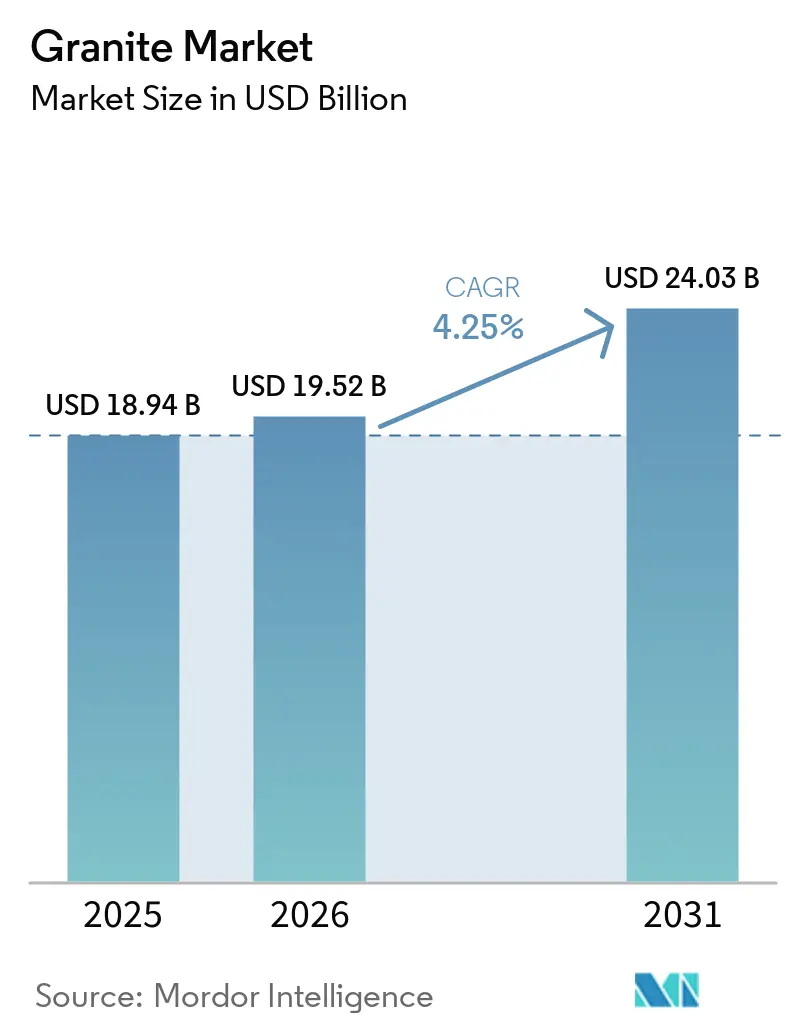
| Market Size (2026) | USD 19.52 Billion |
| Market Size (2031) | USD 24.03 Billion |
| Growth Rate (2026 - 2031) | 4.25 % |
| Fastest Growing Market | Middle East and Africa |
| Largest Market | Asia-Pacific |
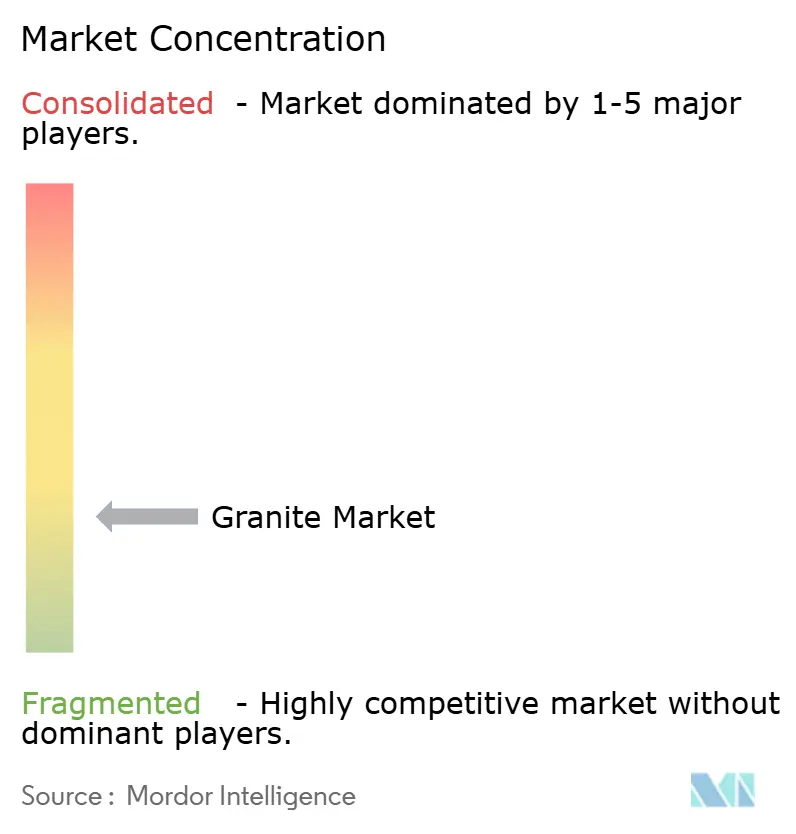
| Market Concentration | Low |
Major Players *Disclaimer: Major Players sorted in no particular order Image © Mordor Intelligence. Reuse requires attribution under CC BY 4.0. | |
Granite Market Analysis by Mordor Intelligence
The global granite market size is expected to grow from USD 18.94 billion in 2025 to USD 19.52 billion in 2026 and is forecast to reach USD 24.03 billion by 2031 at a 4.25% CAGR during 2026-2031. The granite market is supported by demand for durable architectural surfaces in residential, commercial, infrastructure, and monumental work, where selection decisions can reflect both technical requirements and the desired character of the completed space. Product differentiation is increasingly tied to fabrication quality, surface protection, traceability, reliable supply, carefully finished materials, and the ability to meet project-specific requirements rather than block volume alone. Integrated processors can serve demanding specifications and better protect margins, while suppliers of standard rough blocks face greater price pressure when buyers can compare broadly similar alternatives. Trade barriers and rising delivered costs are changing sourcing decisions, especially for processors that depend on imports and for customers that need dependable delivery schedules. Granite retains a clear role for demanding projects where heat resistance, ultraviolet stability, natural variation, long service life, and the visual distinction of a geological material are important to the project brief.
Key Report Takeaways
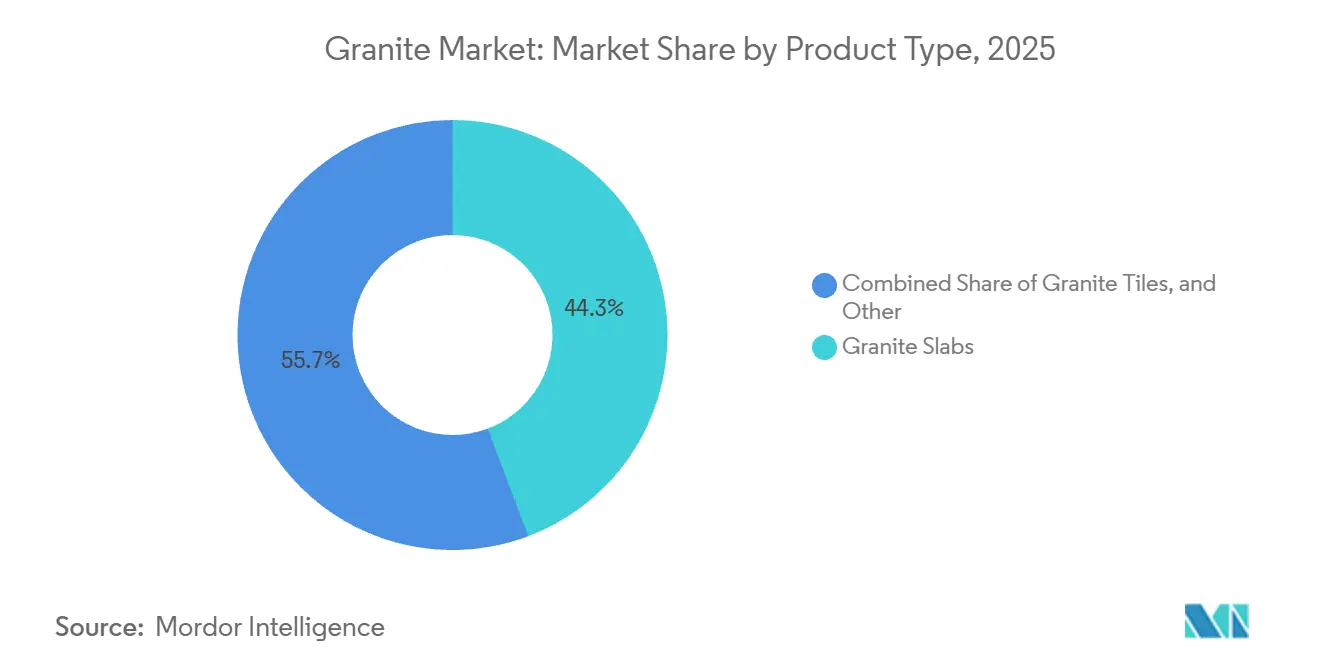
- By product type, slabs held a 44.3% revenue share in 2025, while tiles are projected to grow at a 5.61% CAGR through 2031.
- By application, countertops accounted for 35.6% of the granite market share in 2025, while wall cladding and facades are forecast to advance at a 4.88% CAGR through 2031.
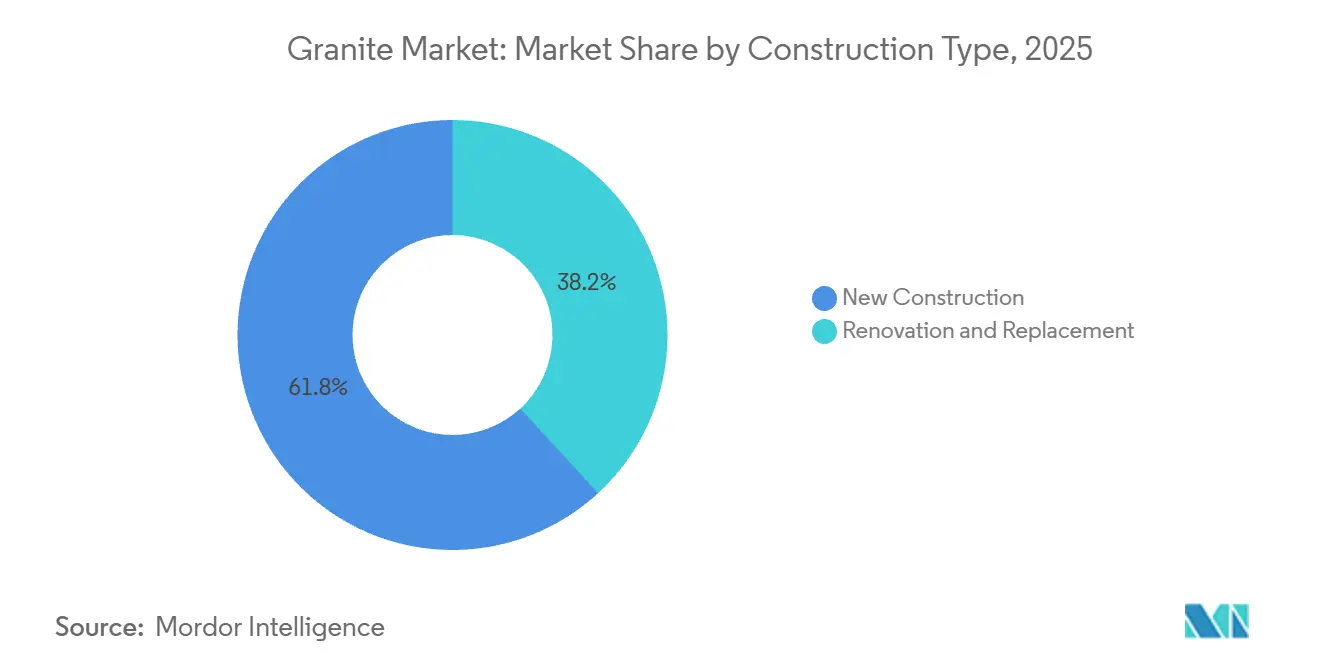
- By construction type, new construction held a 61.8% revenue share in 2025, while renovation and replacement are forecast to grow at a 4.64% CAGR through 2031.
- By end user, commercial users held a 54.9% revenue share in 2025 and are forecast to grow at a 5.12% CAGR through 2031.
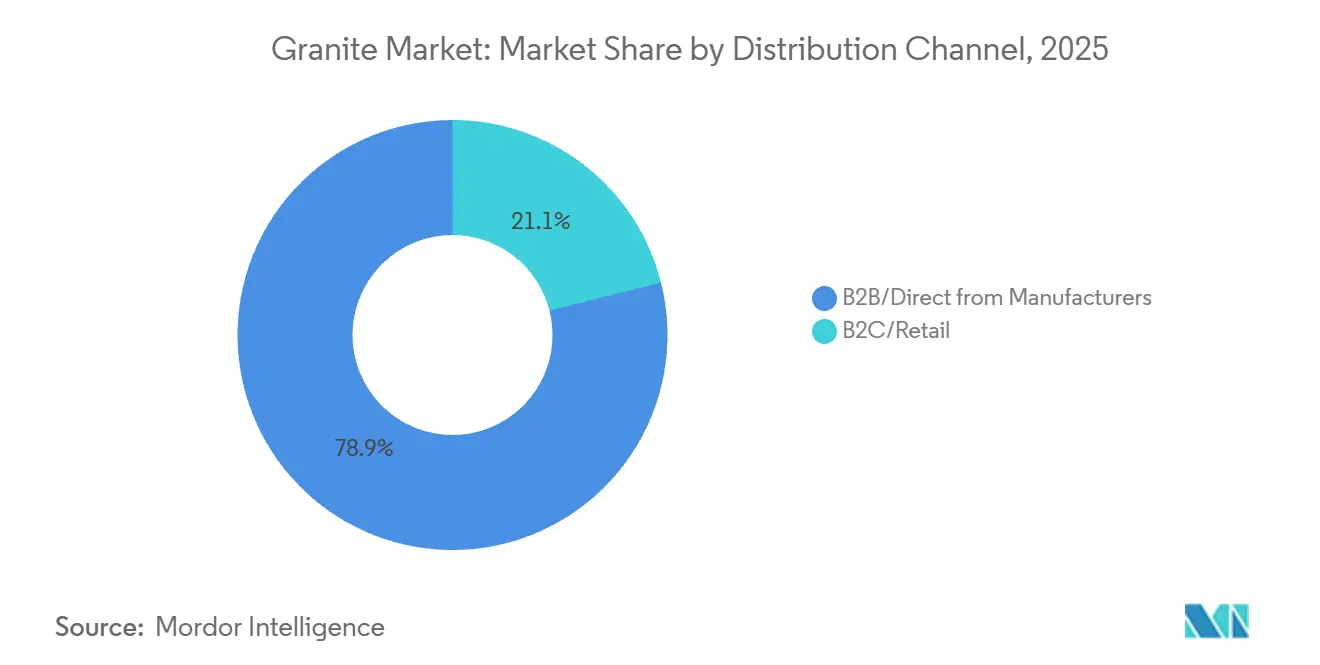
- By distribution channel, B2B direct sales held a 78.9% revenue share in 2025, while B2C retail is forecast to grow at a 4.46% CAGR through 2031.
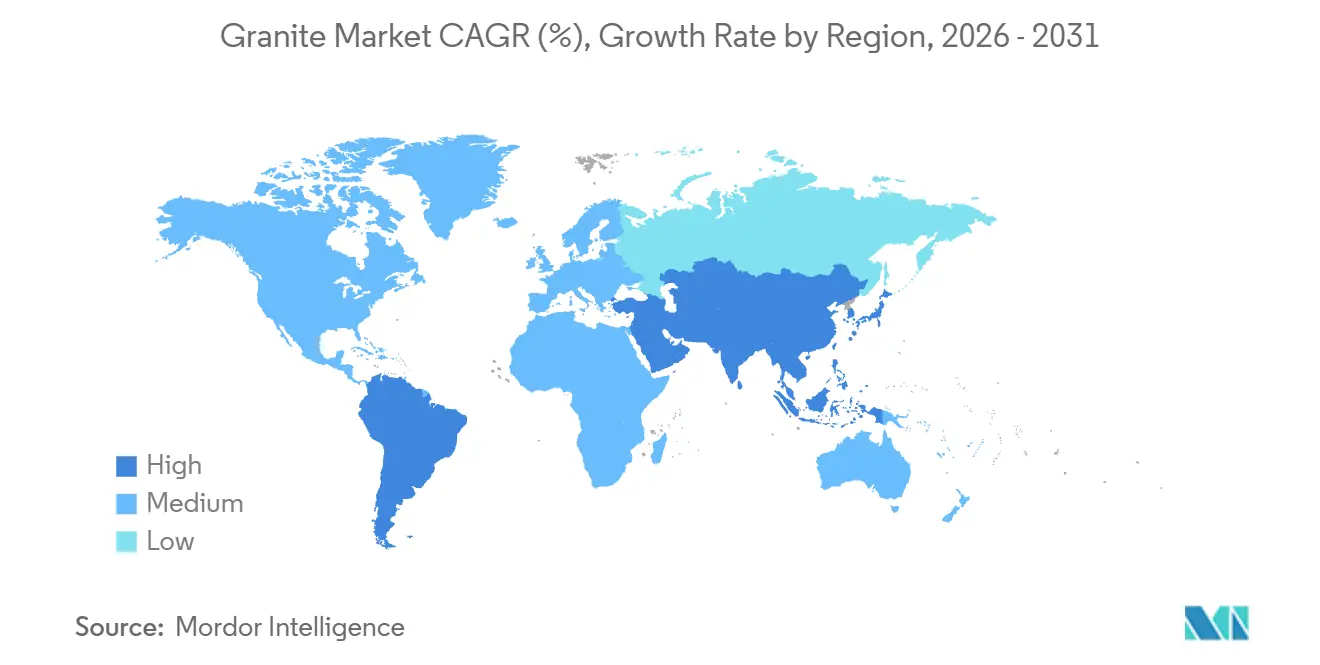
- By geography, Asia-Pacific held a 48.7% revenue share in 2025, while the Middle East and Africa are forecast to grow at a 5.47% CAGR through 2031.
Note: Market size and forecast figures in this report are generated using Mordor Intelligence’s proprietary estimation framework, updated with the latest available data and insights as of January 2026.
Market Trends and Insights
Drivers Impact Analysis of Granite Market*
| Driver | (~) % Impact on CAGR Forecast | Geographic Relevance | Impact Timeline |
|---|---|---|---|
| Residential Renovation and Premium Kitchen Remodeling | +1.2% | North America, Europe, Asia-Pacific urban centers | Medium term (2-4 years) |
| Infrastructure and Commercial Construction Investment | +1.0% | Global, concentrated in Asia-Pacific and Middle East and Africa | Long term (≥ 4 years) |
| Hospitality, Tourism, and Luxury Real Estate Development | +0.8% | Middle East and Africa, Southeast Asia, South America | Medium term (2-4 years) |
| Demand for Durable, Low-Maintenance Natural Surfaces | +0.7% | Global | Long term (≥ 4 years) |
| Export-Led Quarry-to-Slab Integration in India and Brazil | +0.5% | Global supply, with primary consumption in North America and Europe | Short term (≤ 2 years) |
| Digital Fabrication and Large-Format Processing Capability | +0.4% | North America, Europe, Asia-Pacific | Medium term (2-4 years) |
| Source: Mordor Intelligence | |||
Residential Renovation and Premium Kitchen Remodeling
The granite market benefits when renovation projects prioritize durable work surfaces, visible material quality, and a finish that can continue to perform after daily household use. Statistics Canada’s Residential Renovation Price Index rose 0.3% in Q1 2025 and 0.9% in Q2 2025[1]. This movement indicates sustained spending pressure across renovation inputs in a major North American market, including materials, labor, transport, and project preparation. Granite is relevant to projects where buyers seek a long-lived countertop, flooring, bathroom surface, or outdoor kitchen finish that remains part of the property after the work is completed. Its heat tolerance and resistance to ultraviolet exposure support use in outdoor and high-sunlight settings, where homeowners may place greater weight on material behavior over time. The granite market can therefore draw demand from renovation projects that need a material with performance characteristics beyond a uniform indoor finish and a standard short replacement cycle.
Infrastructure and Commercial Construction Investment
The granite market is supported by construction work that values service life, reliable appearance, and resistance to heavy use over a long operating period. Granite can be used in flooring, cladding, paving, entrances, public buildings, transport locations, and commercial interiors where replacement cycles carry operational costs for the property owner. India’s stone trade moved substantial export value through major ports in 2025, including USD 303.4 million through Chennai SEZ between January and July[2]. This export activity shows the importance of organized processing, port access, shipping coordination, quality checks, and logistics planning in supplying global building projects. Long procurement cycles give processors time to plan blocks, finishes, matching requirements, packing, delivery timing, and installation support around the needs of a specific site. The granite market benefits when project specifications require a proven natural material for high-traffic areas and when procurement teams can place material performance ahead of the lowest initial quote.
Hospitality, Tourism, and Luxury Real Estate Development
The granite market gains from hospitality and luxury real estate projects that treat surfaces as a visible part of a property’s identity and guest experience. These projects often require color consistency within a project, book-matched material, dependable supply over several installation phases, and close coordination between designers, fabricators, and site teams. Brazil’s natural stone exports (granite, marble, and quartzite) to the Middle East reached USD 20.7 million between January and October 2025, of which the United Arab Emirates received USD 13.5 million. In November 2025, Brazil’s natural stone association Centrorochas signed an MoU with Abu Dhabi Ports Company to establish a regional stocking hub aimed at cutting delivery times to Gulf buyers[3]. The trade pattern points to demand for distinctive Brazilian varieties in projects that use premium natural stone as part of an overall design language. Hospitality developers may value rare color bodies and documented quarry origin because these details help create interiors that cannot be reproduced easily with a standard manufactured surface. The granite market is well positioned for such work when suppliers can match design intent with fabrication precision, quality assurance, and delivery discipline from the first sample through final installation.
Demand for Durable, Low-Maintenance Natural Surfaces
The granite market serves buyers who need hard-wearing surfaces with a long useful life in settings exposed to moisture, heat, cleaning, and regular foot traffic. Granite’s dense structure and low water absorption support applications in which owners need a material that can remain serviceable without frequent replacement. India issued guidelines in September 2025 for using slurry from marble and granite processing units[4]. The guidance places more attention on processing waste, storage, transport, recovery practices, site controls, and the evidence needed to support compliance during operating approvals. Australia prohibited the manufacture, supply, processing, and installation of engineered stone from 1 July 2024 and banned its import from 1 January 2025, following rising silicosis cases among fabrication workers. Regulatory pressure on high-silica engineered surfaces is shifting attention toward alternatives, including natural stone and porcelain. Because granite also contains crystalline silica, fabricators that use wet-cutting and automated processing are better placed to capture this demand.This compliance requirement favors processors that can document responsible material handling, use suitable containment, and invest in waste-management systems as part of normal operations. The granite market can benefit where buyers evaluate natural stone alongside durability, low-maintenance use, indoor-material considerations, and the handling of processing by-products.
Restraints Impact Analysis of Granite Market*
| Restraint | (~) % Impact on CAGR Forecast | Geographic Relevance | Impact Timeline |
|---|---|---|---|
| High Quarrying, Freight and Installation Costs | -0.8% | Global | Short term (≤ 2 years) |
| Competition from Engineered Quartz, Porcelain and Ceramic Surfaces | -0.6% | North America, Europe | Medium term (2–4 years) |
| Quarry Permitting, Land Rehabilitation and Water-Use Constraints | -0.4% | India, Brazil, Europe | Medium term (2–4 years) |
| Commodity-Grade Oversupply and Rough-Block Margin Compression | -0.3% | Global, particularly Asia-Pacific | Short term (≤ 2 years) |
| Source: Mordor Intelligence | |||
High Quarrying, Freight, and Installation Costs
The granite market carries costs from extraction, primary cutting, finishing, packing, transport, duties, local delivery, site handling, and skilled installation. These costs can rise by more than 1 point in the supply chain before a finished surface reaches the customer, particularly when a project needs imported stone or specialized fabrication. Brazil’s natural stone exports depend heavily on international buyers, which makes freight conditions and trade measures important to supplier economics. Higher delivered costs can affect standard grades first because buyers have more material alternatives at that price level and may delay nonessential renovation work. Smaller fabricators may find it harder to absorb cost movements, maintain a wide inventory, or carry stock for long periods while customers compare alternatives. The granite market remains more resilient in projects where performance, appearance, longevity, and a carefully defined natural-stone requirement outweigh the first cost of the installed surface.
Competition from Engineered Quartz, Porcelain, and Ceramic Surfaces
The granite market competes with engineered and ceramic surfaces in interior applications where uniform appearance, regular dimensions, routine maintenance, and predictable availability are important purchase criteria. Alternative materials can be lighter, easier to transport, or simpler to standardize across large projects, particularly when a customer does not require natural variation. Granite remains differentiated by natural pattern variation, heat resistance, outdoor performance, geological origin, and the ability to create a distinct visual result from each selected slab. These features matter most where designers and owners identify them as stated project requirements rather than as optional upgrades that can be removed from the design. Competition is more pronounced in price-sensitive projects that can accept a replicated appearance, shorter material life, or a less specialized surface. The granite market can defend value by focusing on applications where technical performance, authenticity, visual depth, and long-term durability are central to the design brief.
*Our forecasts treat driver/restraint impacts as directional, not additive. The impact forecasts reflect baseline growth, mix effects, and variable interactions.
Granite Market Segment Analysis
By Product Type:
Slabs Lead Through Large-Surface Applications, While Tiles Expand in Value-Focused ProjectsSlabs held a 44.3% revenue share in 2025, making them the leading product format in the granite market and a central input for the highest-visibility natural-stone applications. Their position reflects use in countertops, large flooring areas, monumental work, and projects where uninterrupted visual flow is necessary across an island, reception desk, feature wall, floor area, or memorial piece. A slab preserves a natural pattern across a broad surface. It allows fabricators to create finished elements with fewer joints, which can be especially important when a designer has selected a particular color range or veining direction. Custom edging, cutouts, tailored dimensions, careful pattern placement, safe handling, and detailed installation planning further increase the importance of accurate cutting, finishing, and breakage control. Slab demand depends on processors that maintain quality from block selection through final installation and give customers confidence in the appearance of the approved material.
Tiles are forecast to grow at a 5.61% CAGR through 2031, and are projected to be the fastest-growing product type in the granite market and a format that can broaden access to natural stone in projects with controlled spend. They provide a durable option for renovation work that needs smaller-format handling, manageable installation, and a finish suited to defined project budgets without requiring oversized pieces or extensive on-site handling. Corridors, hospitality spaces, education facilities, and other high-use areas can use tile formats where full slabs are not required. In contrast, external paving can use formats selected for local weather conditions and site design. Regular dimensions, reliable finishing, available inventory, packaging, and practical installation support are important to distributors serving this category because they help contractors plan quantities and reduce avoidable project delays. Granules, paving stones, and monumental blanks are used in specialized construction, external landscaping, memorial requirements, and local projects that call for a robust natural-stone element rather than a decorative indoor surface alone.

By Application:
Countertops Anchor Demand, While Wall Cladding and Facades Add GrowthCountertops accounted for 35.6% of the granite market size in 2025, making them the leading application and a major point of contact between the material, the fabricator, and the final user. They support demand from kitchens, service counters, hospitality projects, and premium residential renovation, where buyers value a natural appearance, heat tolerance, durable use, and a surface that fits the wider design of the room. Countertop projects require templating, cutouts, edging, transport, installation, and aftercare, which allows fabricators to provide a more complete service rather than sell only a raw slab. The finished value depends on how accurately a slab is converted into a fitted system that meets the room layout, appliance positions, plumbing needs, edge preferences, and user requirements. This application keeps the granite market closely linked to local fabrication skill, customer service, and the ability to complete work cleanly within the timeline of a renovation or construction project.
Wall cladding and facades are forecast to grow at a 4.88% CAGR through 2031, supported by use in buildings that need a durable external surface and a material presence that complements the overall architectural design. Granite provides a robust finish for exposed hotel entries, commercial buildings, civic structures, and other projects where façade material contributes to a building’s quality, identity, and perceived permanence. Low water absorption and resistance to weathering can support use where designers require long-term surface stability in demanding conditions, including changes in temperature, rain exposure, and high daily use around entrances. Appropriate anchoring, engineering, material thickness, joint design, and installation quality remain important to the outcome of each façade project and can influence the reliability of the finished surface. Flooring, monuments, and other uses give the granite market a broader demand base beyond interior countertops, which helps suppliers serve several project types and balance their exposure to a single application.
By Construction Type:
New Construction Holds the Largest Value Share, While Renovation Builds Faster DemandNew construction held a 61.8% revenue share in 2025. This share reflects residential, commercial, and public projects that consume stone through planned packages for lobbies, floors, facades, bathrooms, counters, public spaces, external paving, and other areas that require a durable finished surface. These orders often require coordinated delivery schedules, clear quality checks, substantial finishing capacity, careful management of site requirements, and an understanding of how the material will be installed in different areas of the building. They favor suppliers that can arrange material availability while giving contractors dependable documentation, packing, delivery coordination, and project support from the initial material selection to final handover. The granite market benefits when integrated producers and fabricators can handle volume without losing finish consistency, especially where a project requires matching material across several locations or construction stages.
Renovation and replacement are forecast to grow at a 4.64% CAGR through 2031, reflecting demand created when older homes and buildings need updated countertops, flooring, bathroom, or entry surfaces. Aging housing stock and building upgrades create demand for replacing existing finishes with a durable natural material that can be selected to suit the design of the property and the practical needs of its users. Renovation orders are smaller than major construction packages, but they often need fast turnaround, accurate measurement, and precise fabrication around existing walls, cabinets, plumbing, and appliances. Digital measurement and CNC cutting can reduce installation errors, while clear material choices, accurate samples, and timely communication help homeowners, designers, and contractors make decisions without delaying the project schedule. The granite market gains from this segment when suppliers combine dependable lead times, fitting support, and finishes that suit a wide range of existing interiors from traditional kitchens to contemporary commercial refurbishments.
By End User:
Commercial Projects Lead, While Residential Buyers Support Higher-Value SpecificationsCommercial users held a 54.9% revenue share in 2025. This group includes hospitality, retail, offices, health care, education, infrastructure, and public buildings that can require flooring, counters, feature walls, paving, external cladding, and other surfaces exposed to regular use by visitors and staff. Commercial work often calls for technical information, consistent delivery, material performance, and coordination with several contractors across different stages of the project. Granite can be attractive in high-traffic settings because it is durable, can be refinished as a surface ages, and presents a natural appearance that may suit formal public interiors. The granite market benefits where specifications assess material life, cleaning needs, replacement risk, and the visual quality expected from the finished building alongside the original installed cost.
Commercial user is forecast to grow at a 5.12% CAGR through 2031, projected to be the fastest-growing commercial subsegment and an important source of demand for visible, high-quality interior finishes. Hotels and premium retail spaces use natural stone to create settings that are distinctive to guests and customers. At the same time, designers may prioritize color, finish quality, continuity between areas, and a surface that can remain presentable under regular use. Residential buyers can also value visible variation and quarry origin, especially when the material is a focal point of the room and forms part of a broader renovation decision. Their individual orders tend to be smaller, but the finished value can be meaningful for specialized fabricators that provide selection advice, precise installation, and practical aftercare guidance. The granite market serves both groups when technical reliability is paired with a clear presentation of available stone varieties, the expected finish, and the choices that will affect the appearance of the completed space.
By Distribution Channel:
B2B Direct Sales Remain Dominant, While B2C Retail Uses Digital AccessB2B direct sales held a 78.9% revenue share in 2025. Developers, contractors, architects, and fabricators use direct purchasing for orders that need specific dimensions, finishes, delivery plans, documentation, and coordination with a project schedule that may change across several construction phases. Direct contracts can include committed volumes, technical reviews, site support, custom fabrication, material approvals, and delivery sequencing that a standard retail shelf model cannot easily deliver. This channel lets suppliers plan production around known requirements and lets buyers work directly with the people responsible for material selection, fabrication details, packing, and delivery. The granite market continues to rely on these relationships for large commercial and construction orders because reliable communication can be as important to project delivery as the quality of the selected stone.
B2C retail is forecast to grow at a 4.46% CAGR through 2031, supported by a customer journey that increasingly begins with online research but still depends on physical evaluation before a final stone choice is made. Digital catalogs and visualization tools allow homeowners to compare stone finishes before a showroom visit or a discussion with a fabricator, which can help them narrow choices according to color, application, and budget. Retail channels can make maintenance, variation, pricing, templating, installation, expected lead time, and the difference between product formats easier to understand for smaller renovation buyers. A physical slab review still matters because natural patterns cannot be fully represented online and customers may want to approve their selected pieces, veining, and finish before fabrication starts. Specialty stores and fabricator showrooms remain important points of contact as the granite market serves more household projects and as customers seek direct answers about material suitability for their home.
Geography Analysis
APAC Granite Market
Asia-Pacific held a 48.7% revenue share in 2025. India is a major source of processed stone exports, while China remains a large consumer of building stone for residential, commercial, and infrastructure uses. FIGSI recorded USD 303.4 million in stone exports through Chennai SEZ during January to July 2025, followed by USD 83.1 million through Mundra, USD 71.7 million through Ennore, and USD 52.5 million through Tuticorin. These flows show the importance of port-linked processing clusters, dependable container access, export documentation, and proximity to quarrying areas in the granite market. Indian producers also face stronger environmental expectations after the 2025 slurry-management guidance from the Central Pollution Control Board. Compliance can influence processor costs, plant planning, material recovery, and the ability to meet customer requirements for responsible supply practices.
Europe Granite Market
Europe remains important for high-specification renovation, heritage work, processing, distribution, and the supply of finished stone to design-focused customers. European processors can add value through precise cutting, finishing, selection, detailed sampling, and the ability to supply materials that meet a project’s specific visual requirements. The region’s environmental assessment, material traceability, and sustainable procurement requirements can increase the importance of documented supply chains and organized supplier records. These conditions favor suppliers that can maintain consistent information from quarry selection through finished surface delivery, rather than relying only on spot availability.
The Americas and MEA Granite Market
The Middle East and Africa are forecast to grow at a 5.47% CAGR through 2031, the fastest regional rate in the granite market. Demand is tied to hospitality, luxury real estate, commercial buildings, public-realm projects, and other construction where natural stone may form part of the property’s visible architectural character. Brazil’s January to October 2025 stone exports to the Middle East reached USD 20.7 million, including USD 13.5 million to the United Arab Emirates. North America remains a major destination for fabricated stone and has a large renovation base that supports local fabricator networks, showrooms, and direct contractor relationships. Supply decisions in that region are sensitive to trade costs, logistics, lead times, material availability, and the availability of qualified local installers. South American demand outside Brazil is supported by urban construction and tourism-related projects.
Competitive Landscape
The granite market is fragmented in quarrying and primary processing, while value-added processing and branded distribution are more concentrated within regional customer networks. Levantina y Asociados de Minerales, Polycor Inc., Antolini Luigi & C., Pokarna Limited, Coldspring, and Margraf S.p.A. are among the leading participants in the granite market. Their competitive positions reflect product selection, fabrication capability, geographic reach, customer relationships, and their ability to provide materials that meet specialized project requirements. Suppliers do not compete only on extracted volume because clients may need rare colors, exact finishes, certified quality, reliable project service, and dependable communication between selection and delivery. This encourages processors to develop differentiated collections, proprietary finishing capabilities, quality-control processes, and sales support that helps customers understand the properties of each stone. The granite market therefore rewards companies that pair stone access with dependable downstream execution and a clear route to commercial, residential, and specification-led customers.
Levantina signed a strategic cooperation agreement with Maser and Veegoo Technology in October 2025 for intelligent resin and natural stone polishing production lines. The agreement is designed to expand production capacity and improve automated quality standards in premium stone processing, where repeatable polishing and surface treatment can influence the final customer experience. Antolini has continued to emphasize surface treatment and design-led stone collections. These examples show why producers are investing in finishing and automation rather than relying only on raw material supply and manual processing capacity. Such capabilities can support repeatable quality for projects that require natural variation within defined technical limits, accurate finishing, careful selection, and assurance that supplied material will match approved samples.
Sims-Lohman acquired a 65,000 sq ft facility in Crestview, Florida, in September 2025 for its Gulf Coast headquarters. The company stated that the addition took its footprint to 38 showrooms, 18 distribution centers, and 7 granite and quartz manufacturing plants across 12 U.S. states. Pokarna reported FY25 revenue of INR 930.1 crore with net profit of INR 187.5 crore, while noting strong quartz surface exports under its Quantra brand. These actions illustrate different competitive priorities, including local fabrication reach, distribution capacity, processing quality, and investment in higher-value surface offerings. Suppliers can improve their position by making material selection and project delivery easier for architects, contractors, retail partners, and household buyers.
Granite Industry Leaders
-
Levantina y Asociados de Minerales S.A.
-
Polycor Inc.
-
Coldspring
-
Antolini Luigi & C. S.p.A.
-
Pokarna Limited
- *Disclaimer: Major Players sorted in no particular order
Granite Market Companies Covered in this Report
- Levantina y Asociados de Minerales S.A.
- Polycor Inc.
- Coldspring
- Antolini Luigi & C. S.p.A.
- Pokarna Limited
- Aro Granite Industries Ltd.
- Margraf S.p.A.
- Dakota Granite Company
- Swenson Granite Company
- Kangli Stone Group
- R.E.D. Graniti S.p.A.
- Mumal Marbles Pvt. Ltd.
- Xiamen Xinze Stone
- Asian Granito India Ltd.
- Dimpomar, Rochas Portuguesas, Lda
- Marcolini Marmi S.p.A.
- Varmora Granito
- Aracem Granites
- Margo Granite
- Sims-Lohman, Inc.
Recent Industry Developments in Granite Market
- September 2025: Sims-Lohman, the United States provider of granite and quartz countertops to building professionals, acquired a 65,000 sq ft facility in Crestview, Florida, as its Gulf Coast headquarters, bringing its footprint to 38 showrooms, 18 distribution centers, and 7 granite and quartz manufacturing plants across 12 US states.
- September 2025: The Central Pollution Control Board (CPCB) notified comprehensive guidelines for marble and granite processing-unit slurry utilization, requiring all units to submit a slurry-utilization plan as a precondition for Consent-to-Operate renewal. The guidelines mandate HDPE-lined containment and GPS-tracked transport vehicles, raising the compliance baseline across India's stone processing industry.
Global Granite Market Report Scope
Segmentation Overview
| Granite Slabs |
| Granite Tiles |
| Other |
| Flooring |
| Countertops |
| Wall Cladding and Facades |
| Monuments and Memorials |
| Other Granite Applications (sculptures and decorative items, paving and hardscaping, etc.) |
| New Construction |
| Renovation and Replacement |
| Residential | |
| Commercial | Hospitality |
| Retail and Offices | |
| Healthcare and Education | |
| Institutional and Infrastructure | |
| Other Commercial End Users |
| B2B/Direct Sales from Manufacturers to Real Estate Developers or Contractors | |
| B2C/Indirect through Retailers and Distributors | Modern Retail (home centers, specialty flooring stores, online, etc.) |
| Traditional Retail |
| North America | Canada |
| United States | |
| Mexico | |
| South America | Brazil |
| Peru | |
| Chile | |
| Argentina | |
| Rest of South America | |
| Europe | United Kingdom |
| Germany | |
| France | |
| Spain | |
| Italy | |
| BENELUX (Belgium, Netherlands, Luxembourg) | |
| NORDICS (Denmark, Finland, Iceland, Norway, Sweden) | |
| Rest of Europe | |
| Asia-Pacific | India |
| China | |
| Japan | |
| Australia | |
| South Korea | |
| Southeast Asia | |
| Rest of Asia-Pacific | |
| Middle East and Africa | United Arab Emirates |
| Saudi Arabia | |
| South Africa | |
| Nigeria | |
| Rest of Middle East & Africa |
| By Product Type | Granite Slabs | |
| Granite Tiles | ||
| Other | ||
| By Application | Flooring | |
| Countertops | ||
| Wall Cladding and Facades | ||
| Monuments and Memorials | ||
| Other Granite Applications (sculptures and decorative items, paving and hardscaping, etc.) | ||
| By Construction Type | New Construction | |
| Renovation and Replacement | ||
| By End User | Residential | |
| Commercial | Hospitality | |
| Retail and Offices | ||
| Healthcare and Education | ||
| Institutional and Infrastructure | ||
| Other Commercial End Users | ||
| By Distribution Channel | B2B/Direct Sales from Manufacturers to Real Estate Developers or Contractors | |
| B2C/Indirect through Retailers and Distributors | Modern Retail (home centers, specialty flooring stores, online, etc.) | |
| Traditional Retail | ||
| By Geography | North America | Canada |
| United States | ||
| Mexico | ||
| South America | Brazil | |
| Peru | ||
| Chile | ||
| Argentina | ||
| Rest of South America | ||
| Europe | United Kingdom | |
| Germany | ||
| France | ||
| Spain | ||
| Italy | ||
| BENELUX (Belgium, Netherlands, Luxembourg) | ||
| NORDICS (Denmark, Finland, Iceland, Norway, Sweden) | ||
| Rest of Europe | ||
| Asia-Pacific | India | |
| China | ||
| Japan | ||
| Australia | ||
| South Korea | ||
| Southeast Asia | ||
| Rest of Asia-Pacific | ||
| Middle East and Africa | United Arab Emirates | |
| Saudi Arabia | ||
| South Africa | ||
| Nigeria | ||
| Rest of Middle East & Africa | ||
Key Questions Answered in the Report
What is the projected value of the global granite sector by 2031?
The global granite market is projected to reach USD 24.03 billion by 2031, growing at a 4.25% CAGR from 2026 to 2031. Demand is supported by building, renovation, hospitality, and public-space applications that need long-lasting architectural surfaces and carefully finished materials over the life of a property.
Which granite product format has the largest share?
Slabs lead with a 44.3% share in 2025 because they serve countertops, large flooring projects, feature walls, and monumental applications. Their broad surface area enables fabricators to create finished pieces with fewer visible joins and closer continuity of natural pattern in prominent spaces.
Which application accounts for the largest demand for granite?
Countertops account for a 35.6% share in 2025 and remain important to renovation and premium residential projects. The application also relies on local templating, custom fabrication, edge finishing, transport planning, installation, and aftercare services that shape the final customer experience and the visible fit of each stone piece.
Why is granite used in commercial projects?
Granite offers durability, heat tolerance, low water absorption, and a natural appearance for floors, counters, cladding, and high-traffic spaces. These properties can be relevant where a project considers both installed appearance, cleaning requirements, replacement risk, and long-term surface performance across guest, visitor, or staff areas.