
Government Enterprise Content Management (ECM) Market Size and Share
Market Overview
| Study Period | 2020 - 2031 |
|---|---|
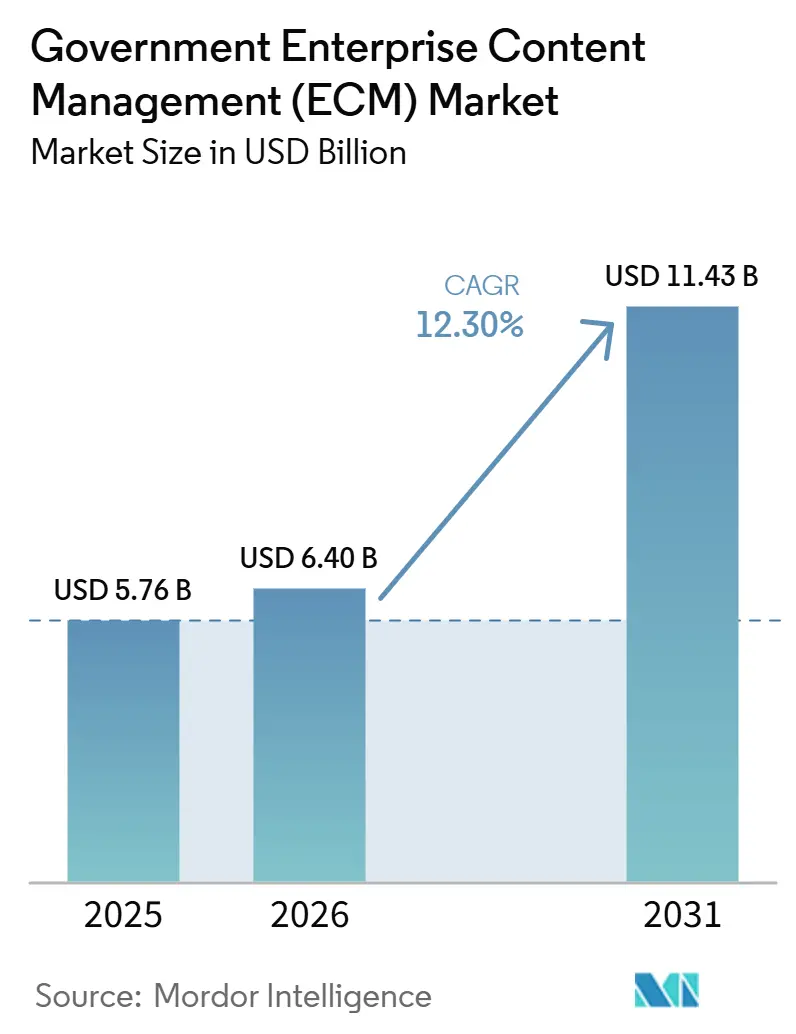
| Market Size (2026) | USD 6.40 Billion |
| Market Size (2031) | USD 11.43 Billion |
| Growth Rate (2026 - 2031) | 12.30 % |
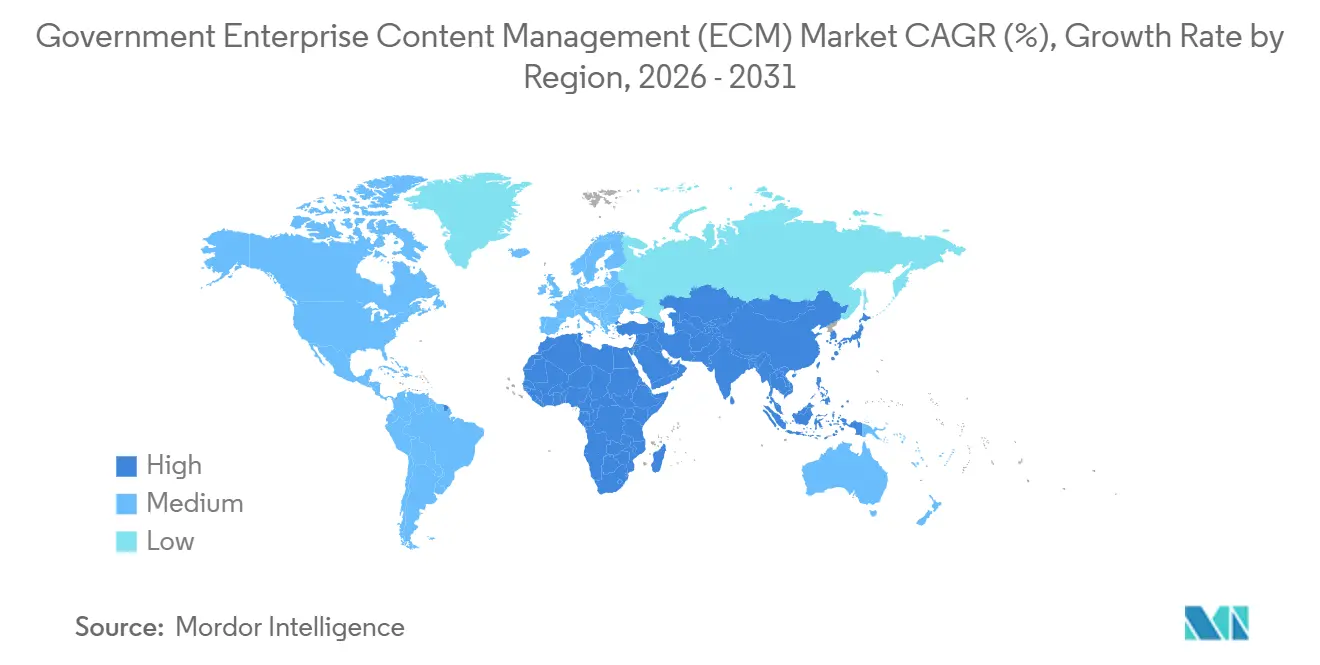
| Fastest Growing Market | Middle East |
| Largest Market | North America |
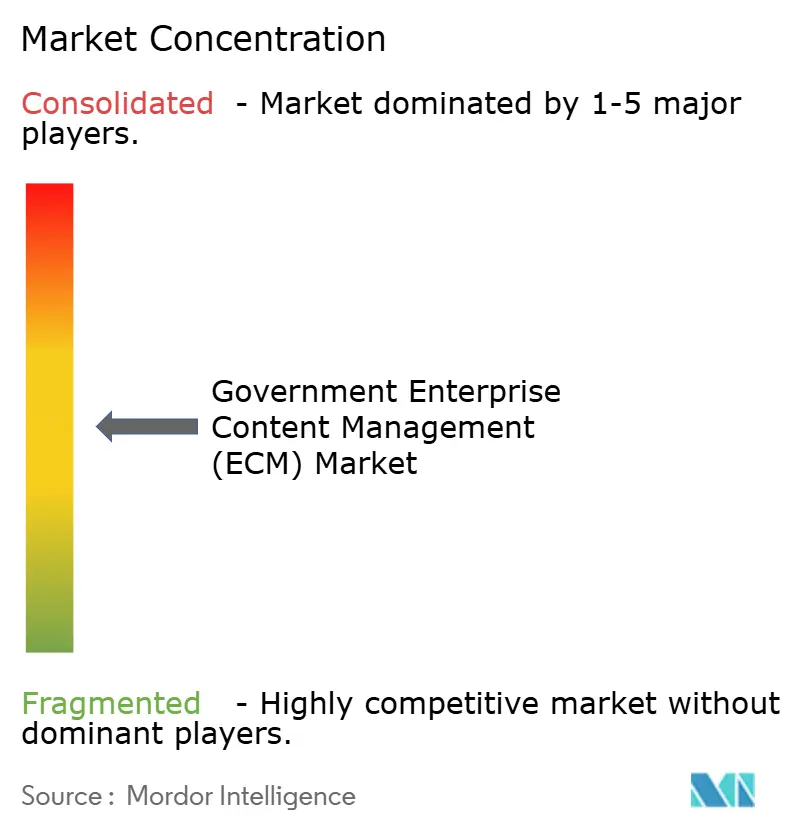
| Market Concentration | Medium |
Major Players *Disclaimer: Major Players sorted in no particular order Image © Mordor Intelligence. Reuse requires attribution under CC BY 4.0. | |
Government Enterprise Content Management (ECM) Market Analysis by Mordor Intelligence
The Government Enterprise Content Management (ECM) market size was valued at USD 5.76 billion in 2025 and is forecast to reach USD 11.43 billion by 2031 at a CAGR of 12.30% from 2026 to 2031. The Government Enterprise Content Management (ECM) market is expanding as agencies move away from paper-heavy processes and bring records, documents, and workflow controls into shared digital environments. Mandatory electronic records rules, rising volumes of unstructured data, and cloud-first procurement policies are pushing content governance higher on agency spending agendas. In the Government Enterprise Content Management (ECM) market, buying decisions are increasingly shaped by agency leadership because records control, service continuity, and audit readiness have become operational issues rather than narrow IT tasks. Vendors have room to grow as cloud adoption, case-centric digital services, and AI-linked workflow modernization spread from large federal bodies to smaller regional entities. The Government Enterprise Content Management (ECM) market still faces delays due to legacy migration complexity, data sovereignty rules, and tight public budgets, which keep cost control and implementation speed central to competition.
Key Report Takeaways
- By solution type, records management led the Government Enterprise Content Management (ECM) market with 26.44% share in 2025, while case management is projected to expand at a 12.67% CAGR through 2031.
- By deployment mode, cloud held 68.21% of the Government Enterprise Content Management (ECM) market share in 2025 and is expected to post the fastest growth at 13.32% CAGR through 2031.
- By enterprise size, large enterprises accounted for 69.12% of the Government Enterprise Content Management (ECM) market in 2025, while small and medium enterprises are projected to record the highest CAGR at 13.71% through 2031.
- By geography, North America held 40.28% of the Government Enterprise Content Management (ECM) market share in 2025, while the Middle East is projected to expand at a 12.96% CAGR through 2031.
Note: Market size and forecast figures in this report are generated using Mordor Intelligence’s proprietary estimation framework, updated with the latest available data and insights as of January 2026.
Market Trends and Insights
Drivers Impact Analysis of Government Enterprise Content Management (ECM) Market*
| Driver | (~) % Impact on CAGR Forecast | Geographic Relevance | Impact Timeline |
|---|---|---|---|
| Regulatory Compliance Mandates for Content Lifecycle Governance | +2.8% | Global, concentrated in North America and Europe | Short term (≤ 2 years) |
| Growth in Government Unstructured Data Volumes | +2.2% | Global, with highest intensity in North America and Asia Pacific | Medium term (2-4 years) |
| Shift to Cloud-Native ECM Deployments | +1.8% | North America, Europe, Asia Pacific | Short term (≤ 2 years) |
| AI-Driven Content Intelligence and Hyper-Automation | +1.5% | North America and Europe, expanding to Middle East | Medium term (2-4 years) |
| Citizen-Service Workflow Standardization across Agencies | +1.0% | Global, especially emerging markets in Middle East and South America | Medium term (2-4 years) |
| Zero-Trust Content Security and Auditability Requirements | +0.8% | North America, Europe, early-stage in Asia Pacific | Short term (≤ 2 years) |
| Source: Mordor Intelligence | |||
Regulatory Compliance Mandates Redefine Content Governance Standards
Regulatory obligations remain the most durable demand driver in the Government Enterprise Content Management (ECM) market because they turn records control into a recurring operating need rather than a one-time software project. NARA opened the 2026 federal reporting cycle and required agencies to submit the Records Management Self-Assessment, the Federal Electronic Records and Email Management Report, and the Senior Agency Official for Records Management Annual Report in the same cycle. NARA's 2024 federal records report also showed that 44% of agencies held less than 5 terabytes of permanent email and electronic records, while 5 agencies held more than 100 petabytes, which highlights the scale differences that content platforms must manage. These obligations make compliant repositories harder to postpone because agencies without them face audit findings, legal exposure, and transfer backlogs that are costly to correct. The same pattern is evident in Europe, where electronic identification and trust service requirements keep government bodies focused on systems capable of processing authenticated records and legally recognized digital signatures.
Growth in Government Unstructured Data Volumes Strains Legacy Architectures
The Government Enterprise Content Management (ECM) market is also benefiting from the volume and complexity of unstructured government data, which now extends well beyond scanned documents to email, video, chat, and case records. U.S. agency officials said in 2026 that digital records workloads are rising rapidly, with the State Department expecting its cable declassification workload to grow fivefold in the coming years, and the FDIC describing a massive rise in unstructured content that requires automated categorization and lifecycle control. A 2025 benchmark covering more than 240 agencies found that the average file size tied to public records requests had grown 438% since 2018, and that video files alone were up 173%. The pressure is not evenly spread because agencies with active AI programs are also creating training corpora, inference logs, and audit trails that add new layers of governed content. The United Kingdom's AI insights framework described unstructured data management as vital to effective operations and accountability, indicating that the same governance need extends beyond the United States.
Shift to Cloud-Native ECM Deployments Unlocks Operational Scale
Cloud adoption is expanding the Government Enterprise Content Management (ECM) market, as public agencies now treat compliant, hosted deployment as a workable operating model rather than a future option. OpenText obtained full FedRAMP authorization for its Cloud for Government offering in June 2024, providing federal agencies with an approved cloud path for ECM and workflow services. Tungsten Automation received FedRAMP High authority to operate in March 2026 for TotalAgility Cloud, opening a migration path for more than 350 existing government customers who had been using on-premises or hybrid environments. In the Government Enterprise Content Management (ECM) market, this shift is being driven by integration needs as much as by hosting preferences, as agencies seek content layers that connect more easily with permitting, finance, GIS, and ERP systems. The result is a larger opportunity for vendors that can combine compliant cloud delivery, faster deployment, and less custom middleware in public sector projects.
AI-Driven Content Intelligence and Hyper-Automation Redefine Workflow Efficiency
AI-led automation is reshaping the Government Enterprise Content Management (ECM) market, as agencies increasingly need content systems that can classify, route, and retrieve records within live workflows. The 2025 federal AI use case inventory listed 3,611 individual use cases across 56 agencies, which showed how quickly AI has moved into day-to-day agency operations. In 2026, Washington Headquarters Services at the U.S. Department of Defense tested AI personas tied to disposition schedules to enable records to be identified, categorized, classified, and filed with less manual tagging. Japan's Digital Agency selected TOPPAN, NTT Data, and FPSC in July 2026 to build an AI-ready dataset of approximately 18 million government document pages for the Government AI Genai platform, with the common data infrastructure set to be completed by March 2027. As AI use expands, agencies become more dependent on governed permissions, metadata, and audit trails, which keep content infrastructure central to legally defensible automation.
Restraints Impact Analysis of Government Enterprise Content Management (ECM) Market*
| Restraint | (~) % Impact on CAGR Forecast | Geographic Relevance | Impact Timeline |
|---|---|---|---|
| Security and Privacy Concerns in Cloud and Mobile ECM | -1.5% | Global, concentrated in North America and Europe | Short term (≤ 2 years) |
| Legacy Repository Modernization Complexity in Public Agencies | -1.2% | North America, Europe | Medium term (2-4 years) |
| Cross-Border Data Residency and Sovereignty Constraints | -0.9% | EU, Asia Pacific, Middle East | Medium term (2-4 years) |
| Procurement Friction from Multi-Agency Integration and Validation Cycles | -0.7% | Global | Long term (≥ 4 years) |
| Source: Mordor Intelligence | |||
Security and Privacy Concerns Complicate Cloud ECM Adoption
Security and privacy concerns continue to slow the Government Enterprise Content Management (ECM) market, even as agencies support cloud modernization in principle. A 2025 audit by NARA's Office of Inspector General found that ERA 2.0 lacked the technical capability to ingest large datasets and that 71 terabytes of accessioned unclassified records were stored outside the system due to file-size and security configuration limits. CISA's zero-trust architecture guidance, issued in January 2025, also framed content governance as an enterprise security issue that requires identity-based access controls, continuous validation, and tamper-evident audit logs for every transaction.[1] Mobile access adds another compliance layer for field staff and remote workers, so agencies often need additional controls before they can extend ECM beyond fixed office environments. When agencies do not map these security requirements early, procurement takes longer, and post-deployment remediation becomes more expensive.
Legacy Repository Modernization Complexity Lengthens Procurement and Deployment Cycles
Legacy modernization remains a major brake on the Government Enterprise Content Management (ECM) market because many agencies still run deeply embedded repositories linked to other mission systems. GAO reported in July 2025 that only 3 of the 10 most critical legacy federal IT systems identified 6 years earlier had completed modernization projects. In many public bodies, content repositories are tied to ERP, HR, and finance platforms through proprietary middleware, so migration cannot be handled as a standalone content project. A 2025 House proposal would require agency CIOs to inventory legacy systems within 1 year and to prepare information resource management plans within 2 years, indicating the issue has moved into formal policy debate. Even after evaluation begins, multi-agency validation cycles can stretch over 18-36 months, delaying deployment and reducing near-term growth conversion.
*Our forecasts treat driver/restraint impacts as directional, not additive. The impact forecasts reflect baseline growth, mix effects, and variable interactions.
Government Enterprise Content Management (ECM) Market Segment Analysis
By Solution Type:
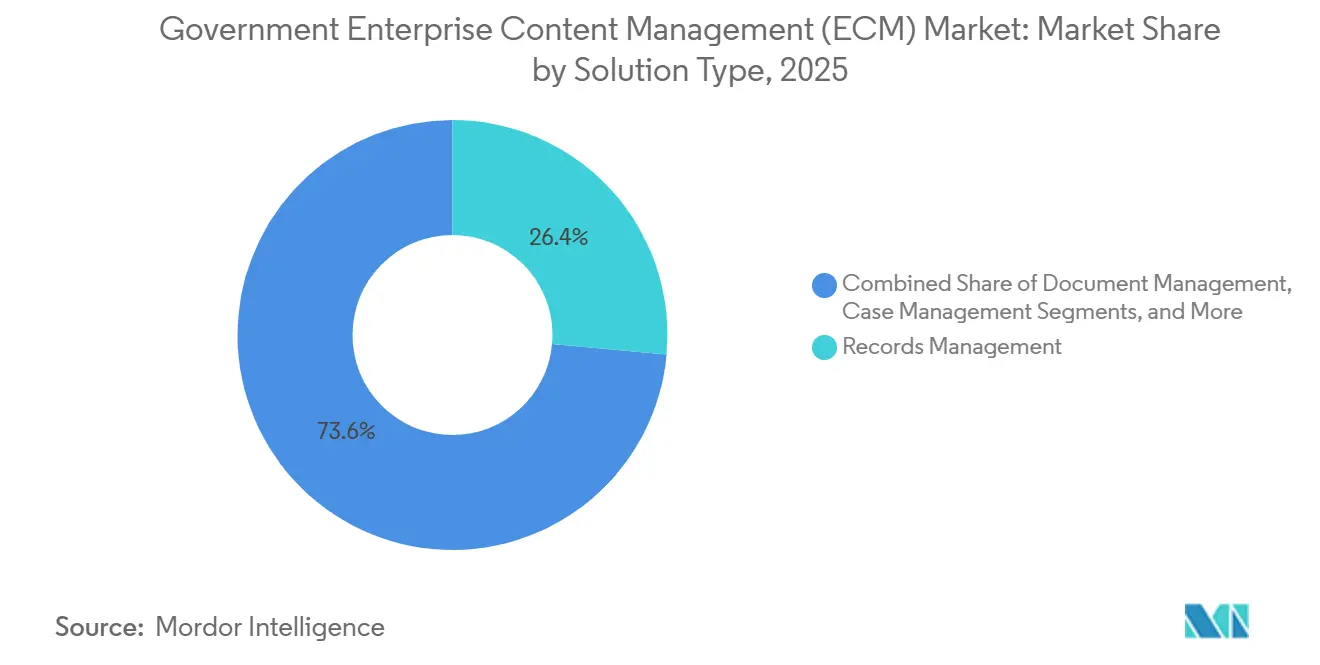
Compliance Keeps Records Management in Front While Case Management AcceleratesRecords management held 26.44% of the Government Enterprise Content Management (ECM) market share in 2025, making it the largest solution type in the category. The segment stayed in front because records retention, FOIA response, litigation hold, and audit trail requirements remain basic operating needs for federal, state, and local agencies. That compliance weight makes records management harder to delay than adjacent tools, even when agencies are under budget pressure. Document management, workflow, and business process management continue to capture meaningful spending because digitized permitting, grants, contracting, and service delivery all depend on structured routing tied to controlled storage.
Case management is projected to grow at a 12.67% CAGR through 2031, making it the fastest-growing solution area in the Government Enterprise Content Management (ECM) market. Demand is expanding because agencies need more structured handling of benefits, enforcement, permit processing, and judicial workflows across citizen-facing operations. The ECOWAS Community Court of Justice launched an electronic case management system in June 2026, which showed how public bodies are moving toward secure digital filing, document handling, and virtual hearings at scale. Web content management, digital asset management, and other specialized tools remain smaller, yet they are increasingly being pulled closer to core ECM as agencies consolidate platforms and connect AI-enabled workflows to governed records.

By Deployment Mode:
Cloud Becomes the Default Operating ModelCloud deployment accounted for 68.21% of the Government Enterprise Content Management (ECM) market in 2025 and is expected to expand at a 13.32% CAGR through 2031. The Government Enterprise Content Management (ECM) industry is moving in this direction because cloud-first policies, compliant hosting, and subscription pricing reduce the burden of large upfront infrastructure decisions. OpenText's June 2024 FedRAMP authorization provided agencies with an approved path to cloud-based ECM and process automation.[2] Hyland's Alfresco Digital Business Platform achieved FedRAMP authorization within the Armedia Content Cloud in March 2026, which broadened the set of compliant content services available to public sector buyers.
On-premises deployment still holds an important place in defense and other classified environments where hosting restrictions remain firm. Hybrid models are also gaining attention because they allow agencies to separate unclassified and sensitive records while maintaining governance under a single operating framework. In the Government Enterprise Content Management (ECM) market, deployment choice is now largely filtered through FedRAMP, StateRAMP, or comparable national security frameworks rather than through simple cost comparisons. Vendors without those approvals face a narrower addressable base, especially in federal and high-security workloads where procurement teams screen for compliance first.
By Enterprise Size:
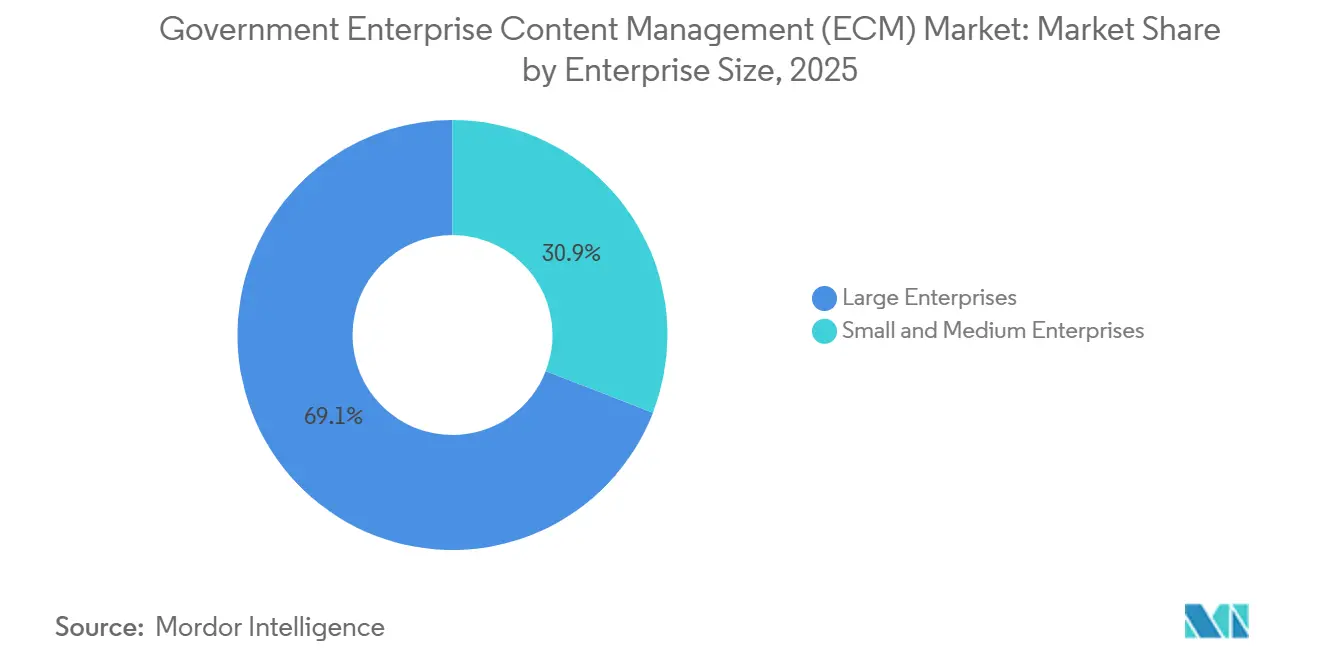
Large Agencies Lead While Smaller Public Bodies Gain SpeedLarge enterprises accounted for 69.12% of revenue in 2025, reflecting the dominance of large central agencies, defense bodies, and national ministries in the Government Enterprise Content Management (ECM) market. These organizations manage the largest volumes of sensitive content and often require enterprise-scale, robust role-based access controls, as well as deep integration with ERP and finance systems. Their procurement patterns also favor multi-year contracts and broad platform standardization, which supports premium pricing for established vendors. This part of the market tends to move more slowly, but contract values are larger because each implementation spans more departments, rules, and repositories.
Small and medium enterprises are projected to grow at a 13.71% CAGR through 2031, making them the fastest-growing segment in the Government Enterprise Content Management (ECM) market. The Government Enterprise Content Management (ECM) industry is expanding here because SaaS delivery lowers the infrastructure barrier that has kept many municipalities and regional bodies from enterprise-grade deployments. Smaller agencies still face heavier unit implementation burdens because they often need outside help for configuration, training, and change management. Vendors that package managed services with compliant cloud platforms are therefore well placed to win sub-national and regional public sector accounts over the forecast period.
Geography Analysis
North America Government Enterprise Content Management (ECM) Market
North America held 40.28% of the the Government Enterprise Content Management (ECM) market share in 2025, making it the largest regional cluster. The region's lead comes from the scale of U.S. federal records obligations, the size of its agency base, and the growing bench of vendors with approved cloud and AI offerings. The 2025 federal AI use case inventory covered 56 agencies and showed how widely agencies are already applying AI tools that depend on governed content layers. California expanded its Poppy generative AI platform statewide in June 2026 after a pilot that involved more than 70 departments and more than 2,700 employees, which points to broader state-level demand for secure content controls.[3] Oracle also launched its AI Data Platform for U.S. federal agencies in March 2026, reinforcing North America as the most active zone for premium, security-led content platform spending.
Europe Government Enterprise Content Management (ECM) Market
Europe ranked as the second-largest region in the Government Enterprise Content Management (ECM) market and remains shaped by strict digital identity and citizen data requirements. Public bodies across the region continue to tie content management decisions to authenticated records handling, privacy control, and the push for sovereign digital infrastructure. France's shared web content management approach across ministries shows how multi-ministry consolidation can create large public sector ECM opportunities. Germany, the United Kingdom, and France continue to lead regional procurement, while Eastern European member states are advancing digitization in line with broader EU digital service goals.
MEA, APAC and South America Government Enterprise Content Management (ECM) Market
The Middle East segment of the Government Enterprise Content Management (ECM) market size is projected to grow at 12.96% CAGR through 2031, which makes it the fastest-growing regional market. The UAE's first batch of agentic AI tools entered government use in May 2026 across tax audits, procurement, customer service, and technical support, which creates steady demand for governed content and audit trails. Asia Pacific is also building momentum through programs such as Japan's renewed electronic administrative document management system and its AI-ready content data buildout for government use. South America and Africa remain smaller positions in the Government Enterprise Content Management (ECM) market, yet digital government strategies show that adoption is widening beyond the most mature regions.
Competitive Landscape
The Government Enterprise Content Management (ECM) market has a moderately consolidated top tier, where Microsoft, OpenText, IBM, Oracle, and Hyland maintain strong positions through contract access, integration depth, and compliance credentials. Microsoft benefits from its large Microsoft 365 presence inside public agencies, which gives it a natural route into collaboration, records, and AI-assisted document workflows. The 2025 federal AI inventory listed 102 use cases for Microsoft Copilot products, underscoring how deeply the Microsoft stack already sits in agency operations. Hyland strengthened its platform alignment in June 2026 by partnering with Microsoft to bring the Content Innovation Cloud to Azure. OpenText also holds an important position because its FedRAMP authorization provides a compliant cloud option for agencies seeking modernization without stepping outside approved security baselines.
Another layer of the Government Enterprise Content Management (ECM) market sits between the largest enterprise suites and the lighter cloud tools aimed at smaller buyers. Vendors such as Newgen Software, SER Group, Fabasoft, and Laserfiche are well placed in this middle tier because many regional authorities need strong governance without the full complexity of tier-one deployments. This creates room for providers to package compliance, easier configuration, and public-sector procurement support into a single offer. Compliance authorizations still act as both a moat and a ceiling, protecting access to high-security workloads while keeping non-certified vendors out of some of the fastest-moving opportunities.
Strategic moves in 2025 and 2026 show that the Government Enterprise Content Management (ECM) market is shifting toward AI-ready content services rather than stand-alone repositories. IBM previewed the Core Content Services MCP Server for FileNet Content Manager in November 2025, enabling AI models to interact with enterprise content under controlled governance rules.[4] Oracle launched an AI Data Platform for U.S. federal agencies in March 2026, and Hyland followed with its Azure partnership in June 2026, which showed how leading vendors are tying content platforms to broader data and automation ecosystems. Buyers are therefore judging vendors less on storage alone and more on secure integration, auditability, and the speed at which content services can support live agency workflows.
Government Enterprise Content Management (ECM) Industry Leaders
-
Microsoft Corporation
-
OpenText Corporation
-
IBM Corporation
-
Oracle Corporation
-
Hyland Software, Inc.
- *Disclaimer: Major Players sorted in no particular order
Government Enterprise Content Management (ECM) Market Companies Covered in this Report
- Microsoft Corporation
- OpenText Corporation
- IBM Corporation
- Oracle Corporation
- Hyland Software, Inc.
- Adobe Inc.
- Box, Inc.
- M-Files Corporation
- Laserfiche, Inc.
- DocuWare GmbH
- SAP SE
- Xerox Corporation
- Newgen Software Technologies Limited
- SER Group GmbH
- Fabasoft AG
- Alfresco Software, Inc.
- KnowledgeLake, Inc.
- iManage LLC
- Egnyte, Inc.
- Everteam Global Services
Recent Industry Developments in Government Enterprise Content Management (ECM) Market
- July 2026: Japan's Digital Agency selected TOPPAN, NTT Data, and FPSC to build a large-scale, AI-ready dataset comprising approximately 18 million pages of government documents for the Government AI Genai platform. The common government data infrastructure is scheduled for completion by March 2027 and will support approximately 180,000 government employees across all ministries.
- June 2026: Hyland and Microsoft announced a strategic partnership to bring the Hyland Content Innovation Cloud to Microsoft Azure. The partnership includes joint go-to-market and co-sell motions, integration with Microsoft 365, and availability through the Microsoft Marketplace, targeting regulated industries including government, healthcare, and financial services.
- June 2026: California launched the Poppy generative AI platform statewide, making the state-built, in-house GenAI platform available to all departments following a pilot period involving 70+ departments and 2,700+ employees. The platform includes centralized security, automatic PII detection, and a no-model-training policy, establishing a governed AI content interface at the state government scale.
- May 2026: The UAE launched its first wave of agentic AI tools targeting tax audits, procurement, customer service, and technical support across government. Half of all government services are targeted for agentic AI delivery within 2 years, creating a sustained demand pipeline for ECM infrastructure to govern AI-interacted content.
Global Government Enterprise Content Management (ECM) Market Report Scope
The Government Enterprise Content Management (ECM) Market includes software platforms and associated services that help government agencies, public sector organizations, municipalities, regulatory bodies, defense institutions, and public administrations capture, manage, store, secure, organize, access, and archive enterprise content, records, and documents throughout their lifecycle. These solutions support document management, records management, workflow automation, case management, digital asset management, web content management, citizen service processes, regulatory compliance, transparency initiatives, and secure information governance. Increasing digital government initiatives, growing demand for paperless administration, rising compliance and records-retention requirements, and the need to improve operational efficiency, citizen service delivery, information accessibility, and security across government organizations drive the market.
The Government Enterprise Content Management (ECM) Market Report is Segmented by Solution Type (Document Management, Records Management, Workflow and Business Process Management, Case Management, Digital Asset Management, Web Content Management, and Other Solutions), Deployment Mode (On-Premises, Cloud, and Hybrid), Enterprise Size (Small and Medium Enterprises, and Large Enterprises), and Geography (North America, South America, Europe, Asia Pacific, Middle East, and Africa). The Market Forecasts are Provided in Terms of Value (USD).
Segmentation Overview
| Document Management |
| Records Management |
| Workflow and Business Process Management |
| Case Management |
| Digital Asset Management |
| Web Content Management |
| Other Solutions |
| On-Premises |
| Cloud |
| Hybrid |
| Small and Medium Enterprises |
| Large Enterprises |
| North America | United States |
| Canada | |
| Mexico | |
| South America | Brazil |
| Argentina | |
| Rest of South America | |
| Europe | United Kingdom |
| Germany | |
| France | |
| Rest of Europe | |
| Asia Pacific | China |
| Japan | |
| India | |
| South Korea | |
| Australia | |
| Rest of Asia Pacific | |
| Middle East | United Arab Emirates |
| Saudi Arabia | |
| Rest of Middle East | |
| Africa | South Africa |
| Kenya | |
| Rest of Africa |
| By Solution Type | Document Management | |
| Records Management | ||
| Workflow and Business Process Management | ||
| Case Management | ||
| Digital Asset Management | ||
| Web Content Management | ||
| Other Solutions | ||
| By Deployment Mode | On-Premises | |
| Cloud | ||
| Hybrid | ||
| By Enterprise Size | Small and Medium Enterprises | |
| Large Enterprises | ||
| By Geography | North America | United States |
| Canada | ||
| Mexico | ||
| South America | Brazil | |
| Argentina | ||
| Rest of South America | ||
| Europe | United Kingdom | |
| Germany | ||
| France | ||
| Rest of Europe | ||
| Asia Pacific | China | |
| Japan | ||
| India | ||
| South Korea | ||
| Australia | ||
| Rest of Asia Pacific | ||
| Middle East | United Arab Emirates | |
| Saudi Arabia | ||
| Rest of Middle East | ||
| Africa | South Africa | |
| Kenya | ||
| Rest of Africa | ||
Key Questions Answered in the Report
What is the current and forecast value of the Government Enterprise Content Management (ECM) space?
It was valued at USD 5.76 billion in 2025 and is forecast to reach USD 11.43 billion by 2031 at a CAGR of 12.30% from 2026 to 2031.
Which solution area leads spending in government content platforms?
Records management led in 2025 with a 26.44% share because retention, FOIA response, litigation hold, and audit requirements remain core agency needs.
Why is cloud deployment gaining traction across public agencies?
Cloud-based ECM held 68.21% share in 2025 and is projected to grow at 13.32% CAGR, supported by cloud-first policy, FedRAMP approvals, and easier integration with agency systems.
Which region currently leads demand for government ECM platforms?
North America led with 40.28% share in 2025, supported by federal records mandates, strong agency demand, and a large base of approved cloud and AI vendors.
Why is the Middle East expanding faster than other regions?
The Middle East is projected to grow at 12.96% CAGR through 2031, helped by national AI and digital government programs that require stronger control of records and workflow content.
How are AI programs changing content management requirements in government?
AI programs are raising demand for governed metadata, permissions, audit trails, and case-level content control, which makes ECM more central to compliant automation and service delivery.