
Gold Analyzer Testing Solutions Market Size and Share
Market Overview
| Study Period | 2021 - 2032 |
|---|---|
| Market Size (2027) | USD 470.29 Million |
| Market Size (2032) | USD 633.11 Million |
| Growth Rate (2027 - 2032) | 6.13 % |
| Fastest Growing Market | Asia-Pacific |
| Largest Market | Asia-Pacific |
| Market Concentration | Medium |
Major Players *Disclaimer: Major Players sorted in no particular order Image © Mordor Intelligence. Reuse requires attribution under CC BY 4.0. | |
Gold Analyzer Testing Solutions Market Analysis by Mordor Intelligence
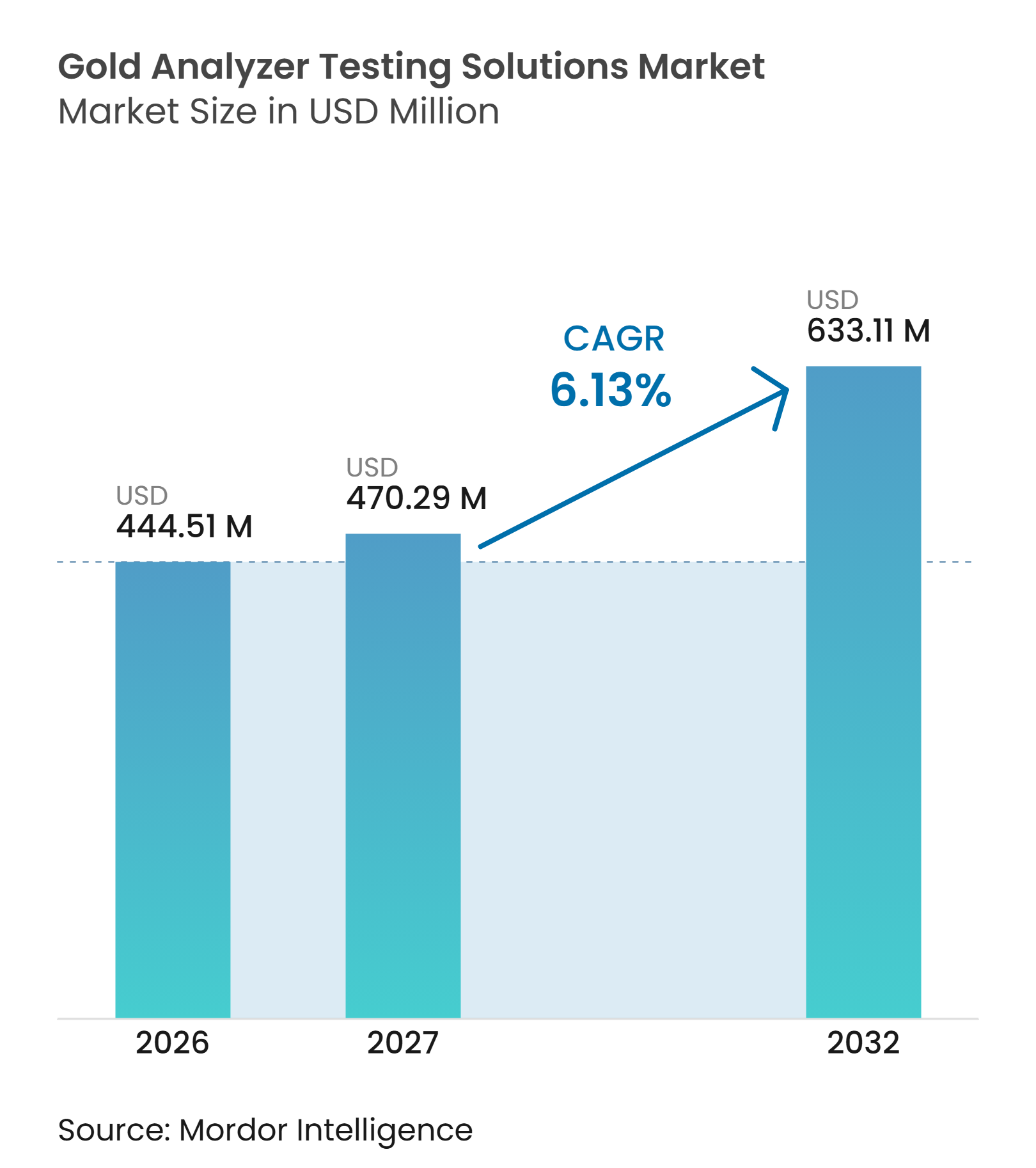
The Gold Analyzer Testing Solutions Market size was valued at USD 444.51 million in 2026 and is estimated to expand from USD 470.29 million in 2027 to reach USD 633.11 million by 2032, at a CAGR of 6.13% during the forecast period (2027-2032). Mandatory hallmarking, collateral-lending rules, and gold-trade standards are moving testing equipment from a discretionary purchase toward a compliance requirement in several markets. India’s expansion of hallmarking coverage and the addition of 9-carat gold create further demand for calibration updates, software, and instruments used by Assaying and Hallmarking Centres. Higher gold prices also increase the commercial cost of an incorrect purity reading, which supports replacement of acid and conductivity methods with more precise workflows. Premium suppliers compete on detector performance, anti-plating functions, software, and service, while lower-cost Asian suppliers are increasing price pressure in mid-tier procurement. Capital costs and XRF surface-bias limitations still make complementary testing methods relevant, especially where plated or heterogeneous articles are common.
Key Report Takeaways
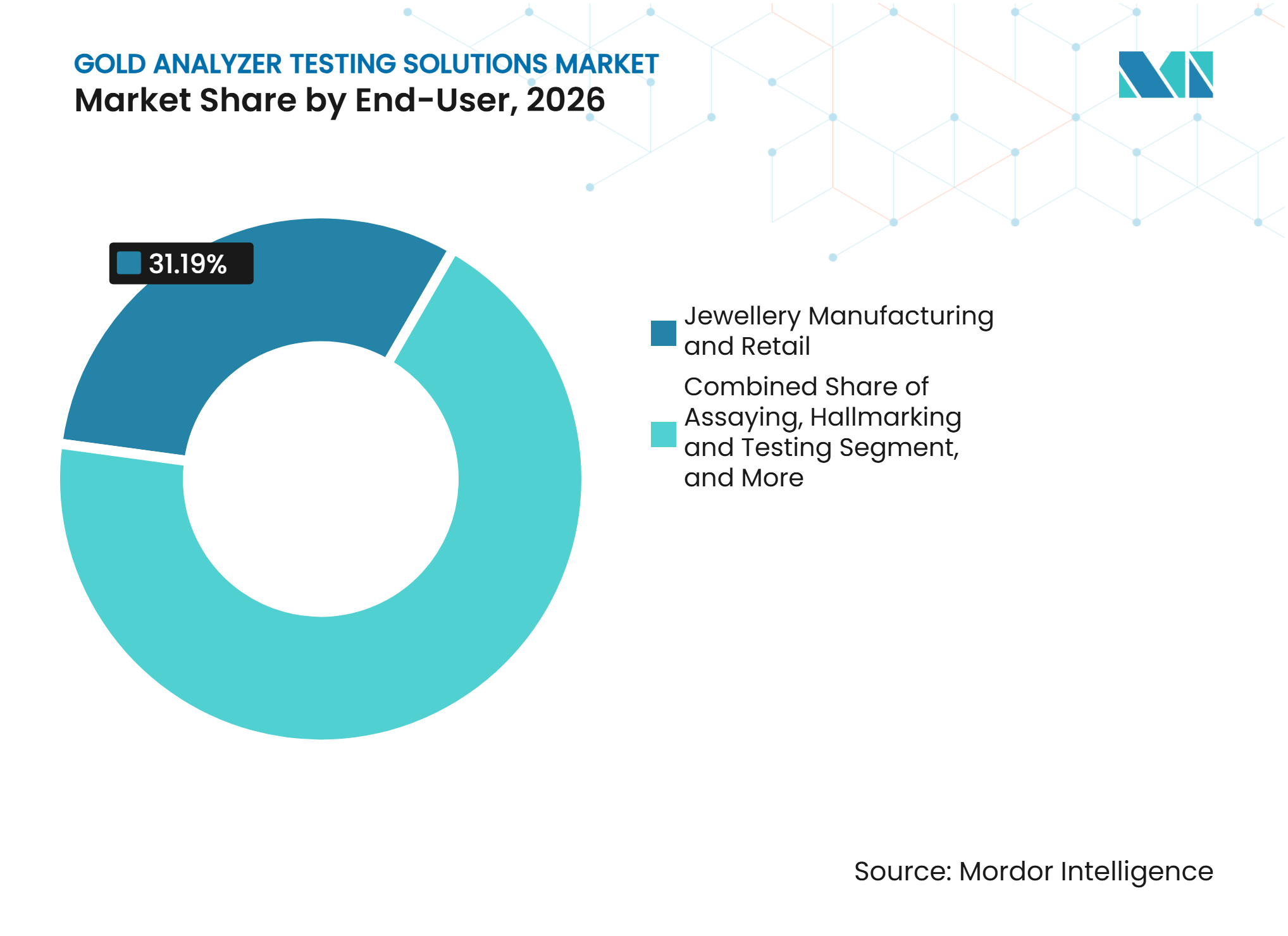
- By end-user segment, jewelry manufacturing and retail held 31.19% of the Gold Analyzer Testing Solutions Market share in 2026, while assaying, hallmarking, and testing is projected to expand at a 7.11% CAGR through 2032.
- By technology, X-Ray Fluorescence held 62.14% of market share in 2026 and is projected to expand at a 6.82% CAGR through 2032.
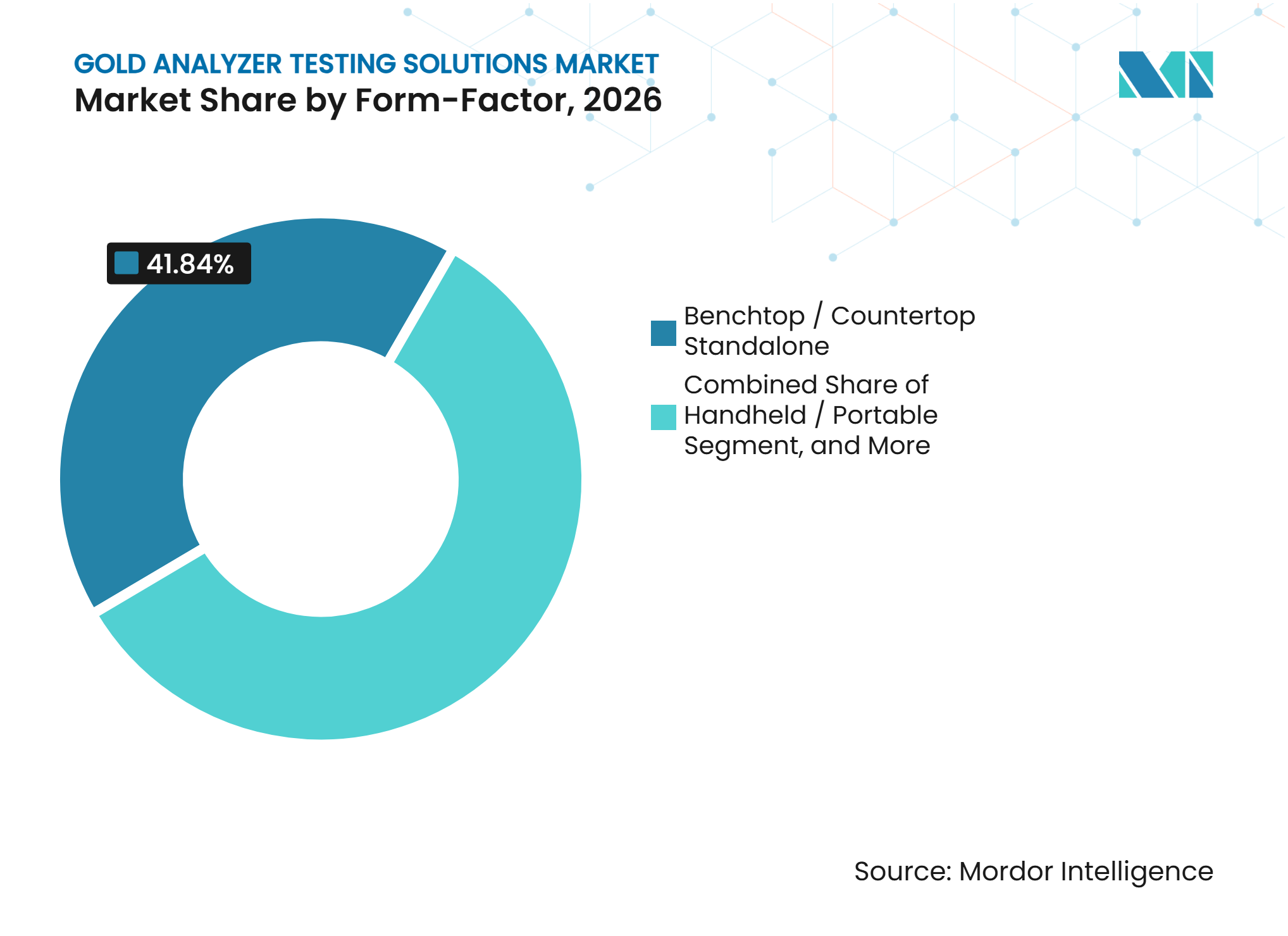
- By form factor, benchtop and countertop standalone instruments held 41.84% of market share in 2026, while handheld and portable devices are projected to expand at a 7.18% CAGR through 2032.
- By geography, Asia-Pacific held 38.26% of market share in 2026 and is projected to expand at a 7.11% CAGR through 2032.
Note: Market numbers in this report are based on Mordor Intelligence's proprietary estimation framework, which combines nine months of actuals with Q4 projections for base year 2026.
Market Trends and Insights
Drivers Impact Analysis of Gold Analyzer Testing Solutions Market*
| Driver | (~) % Impact on CAGR Forecast | Geographic Relevance | Impact Timeline |
|---|---|---|---|
| Mandatory Gold Hallmarking and Purity Certification Regulations | +1.8% | Asia-Pacific, including India, Indonesia, and Southeast Asia, with spillover to the Middle East and Africa | Short term (≤ 2 years) |
| Growth in Gold Trading, Collateral Lending, and Financial Transactions | +1.4% | Global, with high intensity in South Asia, Southeast Asia, and the Middle East | Medium term (2-4 years) |
| Demand for Non-Destructive and Rapid Gold Purity Verification | +1.2% | Global | Short term (≤ 2 years) |
| Expansion of Gold Recycling, Refining, and Secondary Processing | +1.0% | Global, concentrated in Europe and Asia-Pacific | Medium term (2-4 years) |
| Gold Supply Chain Formalization and Traceability Requirements | +0.8% | Global, most acute in West Africa, South America, and the UAE gold corridor | Long term (≥ 4 years) |
| Technological Advancements in XRF Analyzers and Automated Testing | +0.7% | Global | Medium term (2-4 years) |
| Source: Mordor Intelligence | |||
Mandatory Gold Hallmarking and Purity Certification Regulations
National hallmarking requirements are a major source of demand for the Gold Analyzer Testing Solutions Market. India expanded mandatory hallmarking to 392 districts across 26 states and union territories by August 2026, which broadens the addressable base for certified testing facilities. BIS also brought 9-carat gold into mandatory hallmarking from July 2025, requiring instrument libraries to accommodate a 375 parts-per-thousand fineness matrix. The change can create upgrade and software demand where existing XRF systems need revised calibrations. Indonesia’s SNI 8880:2025 sets purity requirements for gold articles from 6-carat to 24-carat, adding another formal testing standard in Southeast Asia.[1] BIS certification and ISO-aligned practices give these purchases a compliance basis rather than relying only on normal replacement cycles.
Growth in Gold Trading, Collateral Lending, and Financial Transactions
Gold-backed lending is creating a more structured need for documented purity testing. The Reserve Bank of India finalized its directions on lending against gold and silver collateral in June 2025, requiring regulated entities to use standardized assaying procedures across branches.[2] These procedures cover purity in carats, gross and net weight, and deductions for stones or alloys. They also require borrowers to be present during the assaying process, which favors repeatable and documented workflows. The Shanghai Futures Exchange revised its gold-futures rules from July 2025 and requires delivery gold to meet purity and weight checks certified by registered inspection bodies. These requirements make verified XRF and conductivity equipment more important to lenders, bullion traders, and inspection providers in the Gold Analyzer Testing Solutions Market.
Demand for Non-Destructive and Rapid Gold Purity Verification
High gold values make speed and accuracy more important at each purity checkpoint. A small purity error on a 1-kilogram gold bar can create meaningful financial exposure, particularly for pawn businesses, bullion traders, and collateral lenders. Intertek commissioned a high-energy X-ray analysis unit at Pantoro Gold’s Norseman Gold Project in September 2025, where the system produced results from 500-gram samples in under 2 minutes.[3] The installation also eliminated 3 tonnes of hazardous lead flux waste per 10,000 samples and avoided 4.6 tonnes of CO₂ emissions. Thermo Fisher’s AuDIT function screens for plated articles by comparing expected karat values with elemental readings, addressing a recurring retail and pawn concern. Dubai Central Laboratory and the Dubai Gold and Jewellery Group also presented an automated XRF testing kiosk in October 2025, indicating a shift toward rapid, lower-touch retail verification.
Expansion of Gold Recycling, Refining, and Secondary Processing
Recycling and refining operations need fast purity analysis across jewelry scrap, electronic waste, and cash-for-gold feedstocks. These inputs can be heterogeneous, so operators need equipment that can support throughput without weakening auditability. China’s State Administration for Market Regulation approved construction of a National Gold and Jewelry Industry Metrology Testing Center in 2025, targeting measurement gaps that include sub-ppm trace-element reference materials. The China Gold Association also published a trade-in service standard in December 2025 that calls for full-process monitoring, documented consent for destructive testing, and certificates showing gold content, weight, and deductions. ISO 10713:2025 identifies ICP-OES, XRF, and SEM/EDS among methods for verifying fineness in gold-alloy coatings. This setting supports demand for calibrated fleets, recurring service, and complementary laboratory workflows in the Gold Analyzer Testing Solutions Market.
Restraints Impact Analysis of Gold Analyzer Testing Solutions Market*
| Restraint | (~) % Impact on CAGR Forecast | Geographic Relevance | Impact Timeline |
|---|---|---|---|
| High Equipment Costs and Maintenance Requirements | -1.0% | Global, most acute in price-sensitive emerging markets | Medium term (2-4 years) |
| XRF Surface-Bias and Sample-Heterogeneity Limitations | -0.5% | Global | Long term (≥ 4 years) |
| Shortage of Qualified Assay and Radiation-Safety Personnel | -0.4% | Global, most acute in developing markets | Medium term (2-4 years) |
| Fragmented Testing Standards and Low-Cost Equipment Competition | -0.3% | Asia-Pacific, the Middle East, and Africa | Medium term (2-4 years) |
| Source: Mordor Intelligence | |||
High Equipment Costs and Maintenance Requirements
Capital expenditure limits first-time purchases by smaller testing operators. Laboratory-grade benchtop XRF analyzers can be costly, depending on the configuration. Maintenance contracts, calibration, software licensing, lead shielding, dosimetry, and periodic X-ray tube inspections contribute to ownership costs. India increased its hallmarking fee per article, which shows the constrained fee base available to Assaying and Hallmarking Centers. This economics can favor conductivity testers and acid kits, even though their accuracy is lower. The challenge is most pronounced in sub-Saharan Africa, South and Southeast Asia, and South America, where instruments must fit smaller operating budgets.
XRF Surface-Bias and Sample-Heterogeneity Limitations
XRF can measure surface composition without reliably representing the full bulk composition of a complex item. Measurement depth is typically 10 to 500 micrometers, depending on the element and matrix. In 2025, market-surveillance authorities in Shenzhen and Guangzhou required gold-wrapped silver vendors to label products correctly after a National Jewelry Quality Inspection Center study found that 14 of 17 tested samples contained less gold than declared. Thick plating, layered construction, and heterogeneous alloys can therefore require density checks, fire assay, or other bulk-analysis methods alongside XRF. This is important for collateral lending because lenders need documented purity verification under the RBI’s 2025 rules. Improved beam collimation and plating-detection software can reduce some errors, but they cannot remove the physical measurement-depth limitation.
*Our forecasts treat driver/restraint impacts as directional, not additive. The impact forecasts reflect baseline growth, mix effects, and variable interactions.
Gold Analyzer Testing Solutions Market Segment Analysis
By End-User:
Hallmarking Compliance Anchors Instrument DemandJewelry manufacturing and retail held 31.19% of the Gold Analyzer Testing Solutions Market share in 2026. The segment spans purity checks at casting, production quality control, and point-of-sale verification for high-value purchases. Its scale reflects the number of transaction points in the jewelry value chain. Helmut Fischer introduced the Goldscope SD 300 compact XRF instrument at IIJS Premiere 2025 in Mumbai for showroom and retail-counter use. The product’s positioning recognizes the need for compact systems that fit customer-facing settings. In retail, non-destructive testing can support confidence without damaging the article. Compliance rules in India add a further reason for jewelry businesses to use standardized testing workflows.
Assaying, hallmarking, and testing is projected to expand at a 7.11% CAGR through 2032. The category follows the expansion of Assaying and Hallmarking Centre networks in India and similar certification programs in Indonesia and Vietnam. These facilities need calibrated systems that can document results and meet required procedures. Gold refining, recycling, and processing operators need high throughput and commonly use automated or laboratory-grade XRF configurations. Those configurations have higher instrument values and can generate calibration and service revenue. Gold buyers, pawn businesses, and cash-for-gold operators favor rugged portable devices because purchasing is often mobile. Bullion trading and financial institutions are also becoming a clearer procurement channel as standardized assaying becomes a branch-level compliance requirement.



By Technology:
XRF Dominance Faces Incremental DiversificationX-Ray Fluorescence held 62.14% of the Gold Analyzer Testing Solutions Market share in 2026 and is projected to expand at a 6.82% CAGR through 2032. XRF supports multi-element analysis in one scan without destroying the sample. Typical scan times range from 3 to 60 seconds, which fits retail, workshop, and laboratory workflows. Thermo Fisher announced the Niton XL5e Handheld XRF Analyzer in January 2026 with enhanced light-element sensitivity and wireless connectivity. Bruker presented its TITAN Handheld XRF at Analytica Munich in March 2026 with matrix-matched precious-metal calibrations. These launches show continued investment in portable XRF applications. The technology remains the leading option where speed, convenience, and non-destructive analysis are required together.
Electrical, conductivity, and resistivity testing remain lower-cost complements to XRF in retail and pawn settings. Density and specific-gravity testing also serve as initial screening methods for bullion and coin authentication. Fire assay remains relevant where reference-grade accuracy is required and destructive testing is acceptable. Other methods, including photon assay, are used in mining and laboratory environments where bulk-sample measurement has particular value. SGS expanded PhotonAssay capability to Orange, New South Wales, in late 2024, extending non-destructive bulk analysis at the 500-gram sample scale. These alternatives address cases where the surface-bias or cost profile of XRF is not suitable. The result is a layered technology environment rather than a single-method testing model.
By Form Factor:
Portable Devices Redefine In-Field TestingBenchtop and countertop standalone instruments held 41.84% of the Gold Analyzer Testing Solutions Market share in 2026. Their larger analytical chambers and controlled operating conditions suit Assaying and Hallmarking Centres, refinery laboratories, and manufacturing facilities. These instruments are designed for repeatable high-volume work and shielded measurement. Helmut Fischer launched its FISCHERSCOPE XDAL and XDV benchtop XRF systems in September 2025 with FISIQ X software. The company reported autofocus in under 2 seconds and material-analysis calculations up to 13 times faster than in earlier models. AMETEK/SPECTRO’s SPECTROSCOUT kt uses a silicon drift detector and measures 25 elements in 30 to 90 seconds. Such systems increase competitive pressure on older detector platforms in the Gold Analyzer Testing Solutions Market.
Handheld and portable devices are projected to expand at a 7.18% CAGR through 2032. They suit on-site buying, field assaying, estate valuation, and mobile pawn operations that lack permanent laboratory infrastructure. Demand depends on systems that can provide credible results with limited operator training. Handheld devices also support inspection at the point of purchase, which can shorten transaction times. Automated and integrated laboratory or inline systems serve refineries and mineral-processing plants with continuous workflows. Gekko Systems and CSIRO launched the OLGA Mk3 online gold analyzer with a reported detection limit as low as 0.02 ppm gold in solution. Its multi-stream monitoring function addresses plant settings where delayed manual sampling can affect recovery decisions.

Geography Analysis
Asia-Pacific
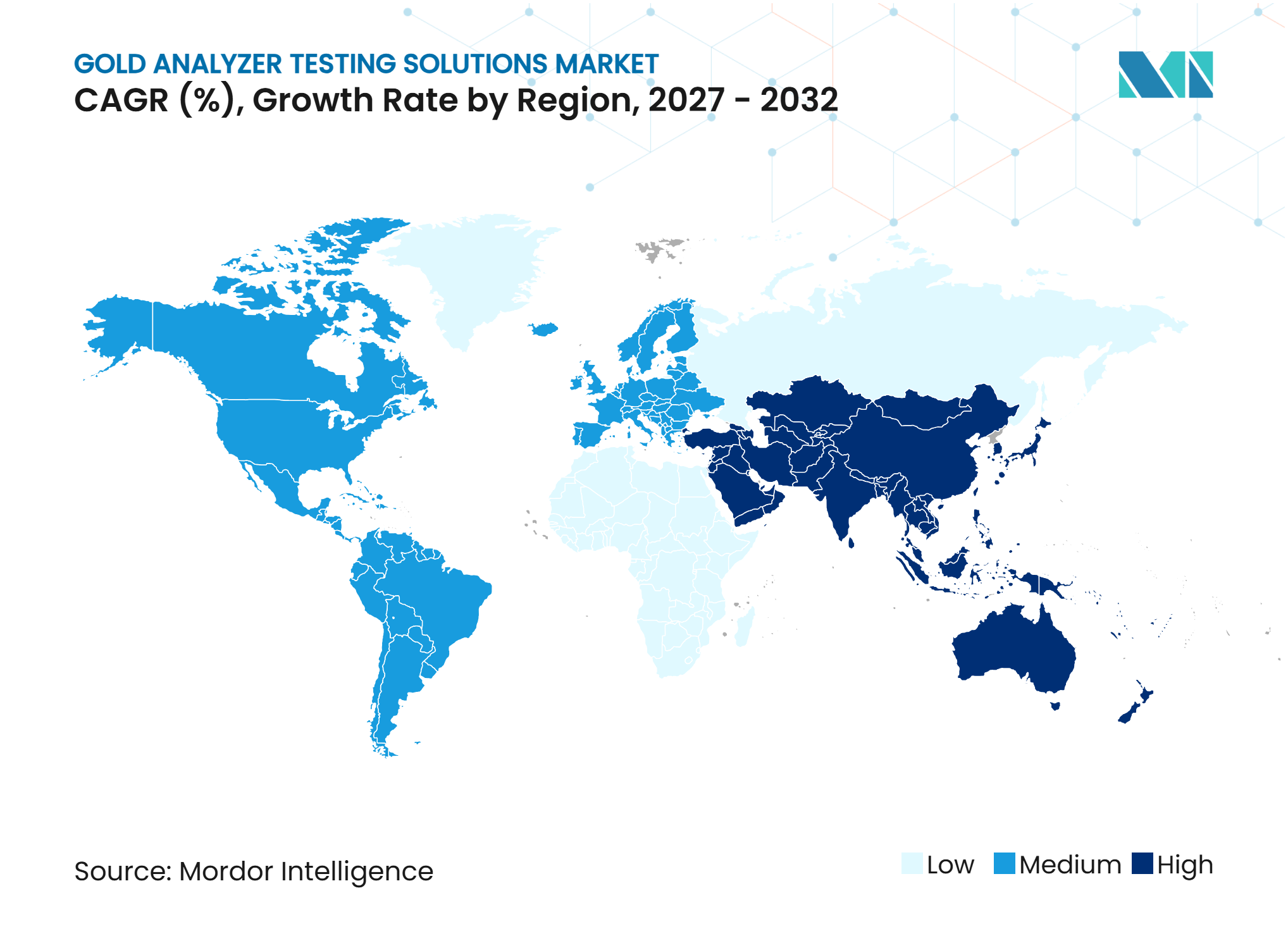
Asia-Pacific held 38.26% of the Gold Analyzer Testing Solutions Market share in 2026 and is projected to expand at a 7.11% CAGR through 2032. India is the region’s central demand driver because BIS hallmarking now covers 392 districts across 26 states and union territories. The July 2025 addition of 9-carat gold broadened the range of articles that require suitable testing and calibration. India also proposed 1 mg precision balances for high-value gold transactions under the Draft Indian Standard Time Rules, 2025. In China, SAMR approved a National Gold and Jewelry Industry Metrology Testing Center in 2025 to address measurement gaps. The Shanghai Futures Exchange’s revised rules require certified checks for delivery gold, strengthening demand from financial trading activity. Indonesia’s SNI 8880:2025 provides purity requirements for gold articles from 6-carat through 24-carat. These overlapping compliance factors favor instruments with updated libraries, documented workflows, and local service support.
Europe
Europe is a mature, technically demanding part of the Gold Analyzer Testing Solutions Market. Germany, Switzerland, Italy, and the United Kingdom have dense networks of refiners, laboratories, and precision-instrument users. Germany also hosts Helmut Fischer and Bruker, supporting regional expertise in high-end analytical equipment. Bruker launched its S8 TIGER Series 3 WDXRF spectrometer in May 2025 with HighSense XE solid-state detectors. ISO 10713:2025 and ISO 11426 provide a compliance basis for fineness verification and laboratory accreditation. In November 2025, TRACE and BRGM Invest launched Lyncée Traçabilité, which uses geochemical isotope analysis and blockchain notarization for mineral-origin verification. The development points to an additional demand layer for origin-linked analytical services at the refinery tier. European buyers are therefore likely to value traceability features alongside measurement accuracy and service quality.
North America, the Middle East, Africa, and South America
North America has an established base of pawnbroker chains, secondary precious-metal dealers, and commercial assay laboratories using XRF workflows. Canada’s gold-mining activity supports demand for inline and automated solutions. VRAY introduced its XRF Gold Analyzer at JCK Las Vegas in June 2025 for jewelry and estate valuation applications. The Middle East, Africa, and South America are at earlier stages of supply-chain formalization. Ghana established GoldBod in April 2025 as the sole legal aggregator, assayer, and exporter for artisanal and small-scale mining gold. GoldBod plans a blockchain-based track-and-trace system by the end of 2026, which requires certified testing at multiple purchasing points. Brazil launched the Forum for Responsible Gold in September 2025 with its National Mining Agency and the World Gold Council, adding pressure for verified origin and testing at source. These changes favor portable equipment, verification records, and local operator training across dispersed supply chains.
Competitive Landscape
Market Concentration
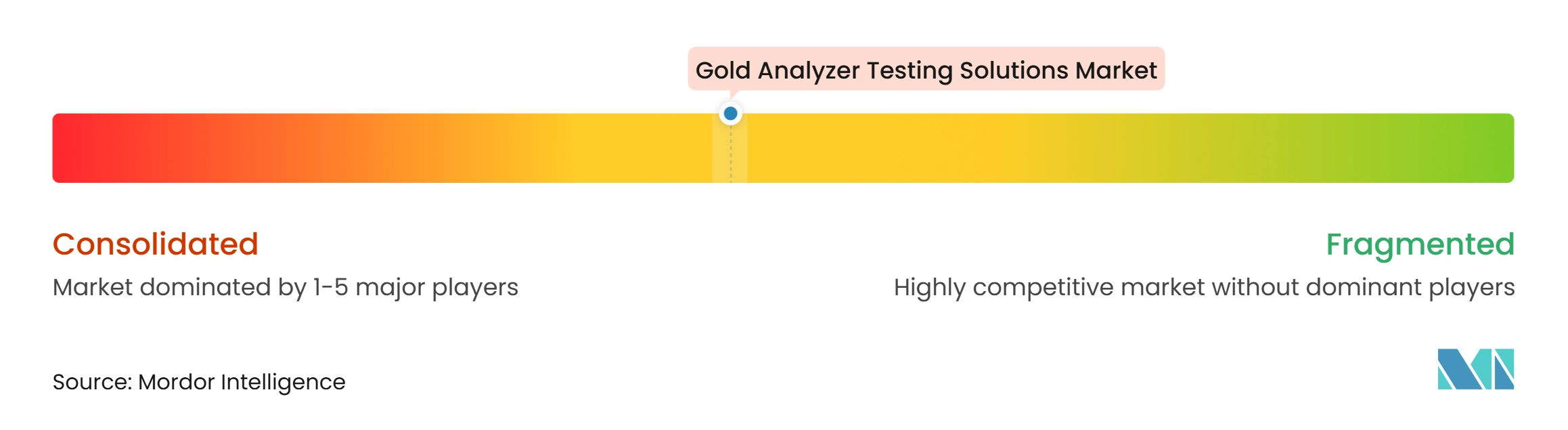
The Gold Analyzer Testing Solutions Market is moderately concentrated in the premium analytical tier. Thermo Fisher Scientific, Bruker Corporation, Hitachi High-Tech Analytical Science, Helmut Fischer GmbH, Evident Scientific, and AMETEK/SPECTRO have strong positions in North America, Europe, and higher-income Asia-Pacific markets. Their installed-base value is supported by proprietary detectors, calibration libraries, and application software. Thermo Fisher differentiates its Niton range with the AuDIT plating-detection algorithm. Helmut Fischer differentiates through FISIQ X software and systems designed for compact retail and laboratory use. IEC-compliant radiation-safety features can also matter in regulated Assaying and Hallmarking Centre tenders. These strengths support recurring revenue from service, calibration, and software.
Price competition is stronger in the mid-tier. Chinese suppliers, including Jiangsu Skyray Instrument and Guangdong Hongtuo Instrument Technology Co., Ltd., address price-sensitive procurement in South and Southeast Asia. Their presence can reduce average selling prices for benchtop systems. Regional suppliers also compete with local service networks and familiarity with national requirements. Arihant Maxsell Technologies is positioned around price points, BIS familiarity, and local service for India’s Assaying and Hallmarking Centre segment. This approach can be difficult for multinational suppliers to match across dispersed local facilities. The competitive outcome depends on whether buyers prioritize acquisition cost, documented compliance, instrument accuracy, or service response.
Companies are also competing on improved spectral analysis, connectivity, and portable usability. Bruker presented its TITAN Handheld XRF at Analytica Munich in March 2026 with a next-generation detection engine and matrix-matched precious-metal calibrations. Thermo Fisher announced the Niton XL5e in January 2026 with IP54 protection, enhanced light-element sensitivity, Bluetooth, and Wi-Fi connectivity. Helmut Fischer’s September 2025 launch combined benchtop hardware with AI-supported analysis software, aiming to improve speed and ease of use. The premium tier remains differentiated, but lower-cost competitors limit pricing power where specifications are less demanding.
Gold Analyzer Testing Solutions Industry Leaders
-
Thermo Fisher Scientific Inc.
-
Bruker Corporation
-
Evident Corporation
-
Hitachi High-Tech Corporation
-
AMETEK, Inc.
- *Disclaimer: Major Players sorted in no particular order
Gold Analyzer Testing Solutions Market Companies Covered in this Report
- Thermo Fisher Scientific / Niton
- Hitachi High-Tech Analytical Science
- Helmut Fischer GmbH
- Bruker Corporation
- Evident Scientific (formerly Olympus)
- AMETEK / SPECTRO
- Arihant Maxsell Technologies / Maxsell
- Microanalytik Instruments
- Omio Technologies
- Neo Instrument Co.
- Jiangsu Skyray Instrument
- Guangdong Hongtuo Instrument Technology Co., Ltd.
Recent Industry Developments in Gold Analyzer Testing Solutions Market
- October 2026: India’s BIS revised gold hallmarking charges to INR 75 per article (USD 0.90) under the BIS (Hallmarking) Amendment Regulations, 2026, effective September 2026, a 67% increase. The revision signals pressure on Assaying and Hallmarking Center business models and is likely to accelerate consolidation toward higher-throughput instrument configurations.
- August 2026: India’s Ministry of Consumer Affairs notified the Hallmarking of Gold Jewellery and Gold Artefacts (Third Amendment) Order, 2026, expanding mandatory hallmarking from 380 to 392 districts across 26 states and union territories, adding 12 districts across 9 states.
- March 2026: Bruker Corporation unveiled the TITAN Handheld XRF analyzer at Analytica Munich, featuring a next-generation detection engine, matrix-matched calibrations for precious metals and alloys, and an operator-oriented touchscreen interface, positioning it as a direct competitor to Thermo Fisher’s Niton handheld platform in the gold testing segment.
- January 2026: Thermo Fisher Scientific announced the Niton XL5e Handheld XRF Analyzer with IP54-rated field protection, Light Metal Quick Sort capability, enhanced light-element sensitivity, and Bluetooth and Wi-Fi connectivity, targeting scrap-metal recycling, mining, and metal-recovery applications.
Global Gold Analyzer Testing Solutions Market Report Scope
The Gold Analyzer Testing Solutions Market comprises instruments, analytical systems, and related services for verifying the purity, composition, and authenticity of gold and other precious metals. These solutions support accurate testing, valuation, quality assurance, certification, and fraud detection across the gold ecosystem. Market growth is driven by increasing demand for reliable precious metal verification, rising gold trading and recycling activities, stricter quality standards, and technological advancements that enhance testing accuracy, speed, and operational efficiency.
The Gold Analyzer Testing Solutions Market is Segmented by End-User (Jewellery Manufacturing and Retail, Assaying, Hallmarking and Testing, Gold Refining, Recycling and Processing, Gold Buying, Pawn and Cash-for-Gold, and Bullion Trading and Financial Institutions (NBFCs and Banks)), Technology (X-Ray Fluorescence (XRF), Density / Specific Gravity Testing, Electrical / Conductivity / Resistivity Testing, and Other Technologies), Form Factor (Benchtop/Countertop Standalone, Handheld/Portable, and Automated / Integrated Laboratory or Inline Systems), and Geography (North America, South America, Europe, Asia-Pacific, Middle East, Africa). The Market Forecasts are Provided in Terms of Value (USD).
Segmentation Overview
| Jewellery Manufacturing and Retail |
| Assaying, Hallmarking andTesting |
| Gold Refining, Recycling and Processing |
| Gold Buying, Pawn and Cash-for-Gold |
| Bullion Trading and Financial Institutions (NBFCs and Banks) |
| X-Ray Fluorescence (XRF) |
| Density / Specific Gravity Testing |
| Electrical / Conductivity / Resistivity Testing |
| Other Technologies |
| Benchtop / Countertop Standalone |
| Handheld / Portable |
| Automated / Integrated Laboratory or Inline Systems |
| North America | United States |
| Canada | |
| Mexico | |
| Europe | Germany |
| United Kingdom | |
| France | |
| Italy | |
| Rest of Europe | |
| Asia-Pacific | China |
| Japan | |
| South Korea | |
| Taiwan | |
| India | |
| Rest of Asia-Pacific | |
| Rest of the World |
| By End-User | Jewellery Manufacturing and Retail | |
| Assaying, Hallmarking andTesting | ||
| Gold Refining, Recycling and Processing | ||
| Gold Buying, Pawn and Cash-for-Gold | ||
| Bullion Trading and Financial Institutions (NBFCs and Banks) | ||
| By Technology | X-Ray Fluorescence (XRF) | |
| Density / Specific Gravity Testing | ||
| Electrical / Conductivity / Resistivity Testing | ||
| Other Technologies | ||
| By Form Factor | Benchtop / Countertop Standalone | |
| Handheld / Portable | ||
| Automated / Integrated Laboratory or Inline Systems | ||
| By Geography | North America | United States |
| Canada | ||
| Mexico | ||
| Europe | Germany | |
| United Kingdom | ||
| France | ||
| Italy | ||
| Rest of Europe | ||
| Asia-Pacific | China | |
| Japan | ||
| South Korea | ||
| Taiwan | ||
| India | ||
| Rest of Asia-Pacific | ||
| Rest of the World | ||
Key Questions Answered in the Report
What is the Gold Analyzer Testing Solutions Market size?
The Gold Analyzer Testing Solutions Market is valued at USD 444.51 million in 2026 and is projected to reach USD 633.11 million by 2032 at a 6.13% CAGR.
What is driving demand for gold testing equipment?
Mandatory hallmarking, standardized collateral-lending procedures, recycling activity, and demand for rapid non-destructive verification are key demand factors.
Which technology leads gold purity testing?
X-Ray Fluorescence leads with a 62.14% share in 2026 and is projected to expand at a 6.82% CAGR through 2032.
Why are handheld analyzers gaining adoption?
Handheld units support on-site gold buying, field assaying, estate valuation, and mobile pawn operations without permanent laboratory infrastructure.
Which region has the strongest position in gold analyzer testing?
Asia-Pacific leads with a 38.26% share in 2026 and is projected to expand at a 7.11% CAGR through 2032, supported by formalizing testing requirements.
What limits wider adoption of XRF systems?
Equipment costs, ongoing maintenance, radiation-safety requirements, and XRF surface-bias limitations can require complementary testing methods.