
Goat Milk Ingredients Market Size and Share
Market Overview
| Study Period | 2021 - 2031 |
|---|---|
| Market Size (2026) | USD 137.69 Million |
| Market Size (2031) | USD 178.19 Million |
| Growth Rate (2026 - 2031) | 5.29 % |
| Fastest Growing Market | Middle East and Africa |
| Largest Market | Europe |
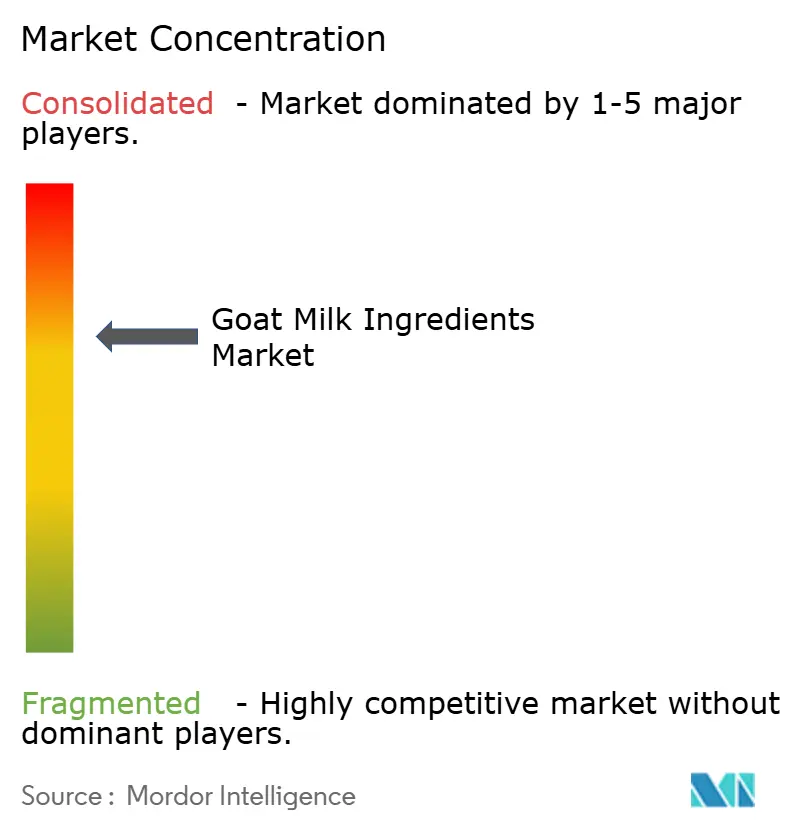
| Market Concentration | Medium |
Major Players *Disclaimer: Major Players sorted in no particular order Image © Mordor Intelligence. Reuse requires attribution under CC BY 4.0. | |
Goat Milk Ingredients Market Analysis by Mordor Intelligence
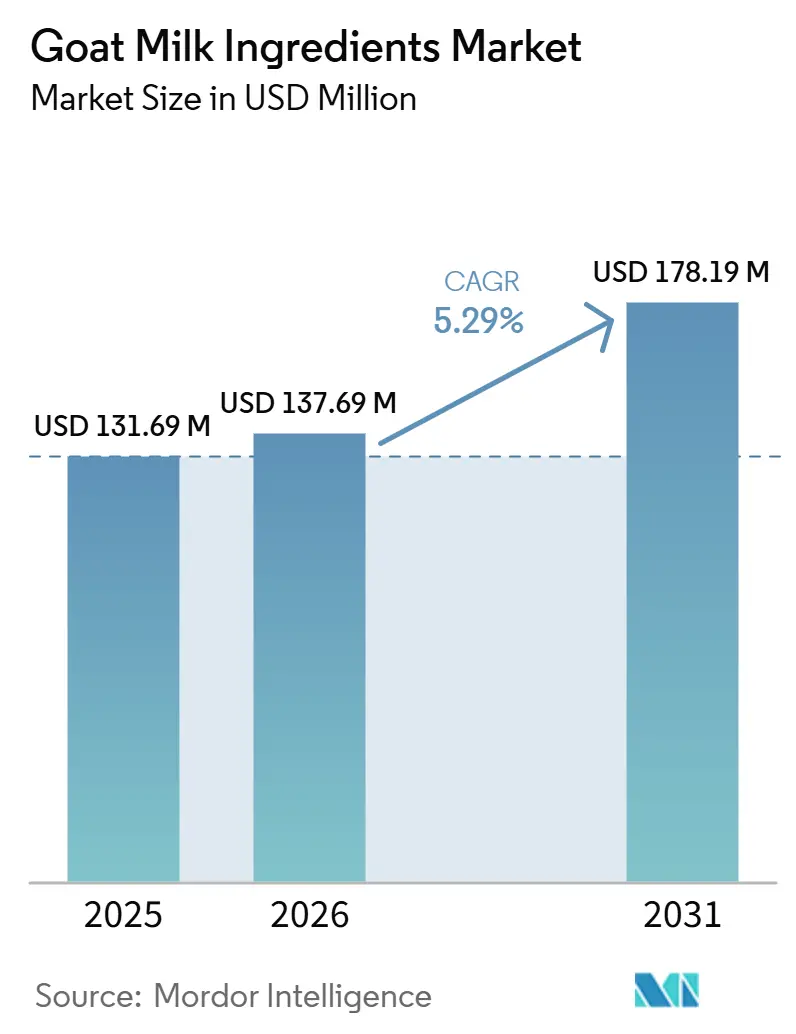
The goat milk ingredients market size is expected to increase from USD 131.7 million in 2025 to USD 137.7 million in 2026 and reach USD 178.2 million by 2031, growing at a CAGR of 5.3% over 2026-2031. Market demand is increasingly driven by the need for differentiated, high-value ingredients across infant nutrition, functional foods, and premium clinical nutrition applications. Goat-derived whey fractions are gaining commercial traction as manufacturers seek alternatives to conventional bovine proteins, supported by perceived digestibility advantages, traceability, and specialized formulation requirements. Global processing capacity remains concentrated in the Netherlands, New Zealand, and Austria, making long-term supply partnerships and qualified sourcing capabilities critical competitive differentiators. Europe continues to dominate the value chain through its mature milk collection and advanced processing infrastructure, while the Middle East & Africa is projected to be the fastest-growing regional market, expanding at a CAGR of 7.3% through 2031. The competitive landscape is moderately concentrated, with leading processors reinforcing market positions through certified production systems, identity-preserved supply chains, clinically validated ingredient portfolios, and expansion into premium protein fractions with higher value realization.
Key Report Takeaways
- By product type, Whey Protein Concentrate held 72.5% of value in 2025 and is forecast to grow at a 6.0% CAGR through 2031.
- By application, infant nutrition accounted for 43.3% of the goat milk ingredients market size in 2025 and is projected to expand at a 6.7% CAGR through 2031.
- By geography, Europe led with 46.9% of the goat milk ingredients market share in 2025, while the Middle East and Africa are forecast to grow at a 7.3% CAGR through 2031.
Note: Market size and forecast figures in this report are generated using Mordor Intelligence’s proprietary estimation framework, updated with the latest available data and insights as of January 2026.
Market Trends and Insights
Drivers Impact Analysis of Goat Milk Ingredients Market*
| Driver | (~) % Impact on CAGR Forecast | Geographic Relevance | Impact Timeline |
|---|---|---|---|
| Growing Demand for Goat Milk Ingredients in Infant Nutrition | +1.8% | Global, with concentrated pull from Europe, China, and North America | Medium term (2-4 years) |
| Increasing Consumer Preference for Easily Digestible Dairy | +1.2% | Global, with highest relevance in Europe, North America, and Australia | Long term (≥ 4 years) |
| Growing Prevalence of High-Protein Food and Beverages | +0.7% | North America, Europe, and core Asia-Pacific markets | Medium term (2-4 years) |
| Expansion of Goat Farming and Goat Milk Production | +0.5% | Europe, Oceania, and the Middle East and Africa | Long term (≥ 4 years) |
| Escalating Use in Bakery, Confectionery, and Dairy Processing | +0.4% | Europe and North America, with expansion into the GCC | Medium term (2-4 years) |
| Rising Demand for Clean Label and Natural Ingredients | +0.6% | North America and the European Union, with early gains in Australia and Japan | Long term (≥ 4 years) |
| Source: Mordor Intelligence | |||
Growing Demand for Goat Milk Ingredients in Infant Nutrition
Infant nutrition remains the largest value-generating application for goat whey ingredients, with demand shifting from conventional dairy powders toward highly specialized functional proteins. Regulatory acceptance of goat milk-based infant formula by the U.S. Food and Drug Administration during the 2022 infant formula shortage expanded commercial opportunities for goat-derived ingredients and accelerated product innovation in premium infant nutrition [1]Source: U.S. Food and Drug Administration, “Infant Formula Act,” U.S. Food and Drug Administration, fda.gov. Growing clinical validation has further strengthened market confidence. Large-scale clinical studies evaluating goat milk-based infant formula have demonstrated its suitability for infant nutrition, providing manufacturers with stronger scientific evidence to support product formulation, regulatory approvals, and premium product positioning. Similarly, ingredient manufacturers are expanding their portfolios beyond conventional whey powders. Companies are increasingly commercializing high-value ingredients such as goat whey protein hydrolysates, goat casein hydrolysates, lactoferrin, colostrum powders, and other bioactive milk fractions, enabling infant formula producers to develop differentiated products targeting digestibility, immune support, and premium nutritional claims. As a result, competitive advantage in the goat whey ingredients market is increasingly determined by advanced processing capabilities, clinical substantiation, and the ability to manufacture specialized, high-value functional ingredients, rather than the supply of standard dairy powders alone.
Consumer Preference for Digestible Dairy and High-Protein Nutrition
Growing consumer preference for functional, clean-label, and easily digestible protein ingredients is expanding the application scope of goat whey beyond infant nutrition into sports nutrition, medical nutrition, and functional beverages. The naturally lower αs1-casein content and smaller fat globule structure of goat milk are increasingly leveraged by manufacturers to position goat-derived proteins as differentiated dairy ingredients for consumers seeking alternatives to conventional bovine proteins. Recent scientific research has reinforced this positioning, highlighting goat milk's potential across life-stage nutrition, including products formulated for older adults, active consumers, and specialized nutritional requirements. Studies evaluating goat whey protein in fortified beverages also demonstrate its suitability for sports recovery and high-protein functional beverage formulations, supporting wider commercialization across performance nutrition categories. As consumers increasingly prioritize high-quality protein, clean-label ingredients, and premium nutritional formulations, food and beverage manufacturers are incorporating specialized goat whey ingredients into value-added product portfolios. Consequently, market growth is being driven not only by expanding end-use applications but also by the industry's ability to deliver differentiated protein solutions supported by scientific validation and premium positioning.
Expansion of Goat Farming and Milk Production
Sustained growth in infant nutrition and specialized dairy ingredients is increasing the need for a broader and more resilient goat milk supply base. France continues to lead the European goat dairy industry, supported by its large commercial herd and well-established milk collection infrastructure, while industry initiatives aimed at expanding production capacity through new farm installations are expected to strengthen long-term raw milk availability. According to the OECD-FAO Agricultural Outlook 2025–2034, global small-ruminant production is projected to continue expanding over the forecast period, supported by rising demand across emerging economies and increasing commercialization of goat and sheep farming [2]Source: Organisation for Economic Co-operation and Development and Food and Agriculture Organization, “OECD-FAO Agricultural Outlook 2025-2034,” OECD, oecd.org. This outlook reinforces the long-term availability of raw materials required to support the production of value-added goat whey ingredients. Similarly, investments in breeding programs, herd productivity, and fodder infrastructure across the Middle East and Africa are expected to gradually increase export-eligible goat milk supplies, diversifying global sourcing beyond traditional Northern European production hubs.
Use in Bakery, Confectionery, Dairy Processing, and Clean-Label Products
While infant nutrition remains the primary demand driver, expanding applications across premium bakery, confectionery, dairy, and functional food categories are improving value realization for goat milk ingredients. Manufacturers are increasingly incorporating goat lactose, whole milk powder, cream fat, and other milk solids into premium formulations to differentiate products through unique sensory characteristics, ingredient provenance, and clean-label positioning. Goat-derived lactose continues to play an important role as a carbohydrate source in infant formula while also serving functional purposes in bakery and confectionery products, including bulking, texture enhancement, and formulation stability. Meanwhile, fresh dairy products, specialty cheeses, and fermented dairy continue to represent significant volume outlets, particularly across Europe's established artisan dairy sector. Growing consumer preference for natural, minimally processed, and traceable ingredients is further strengthening demand for goat-derived dairy ingredients beyond traditional infant nutrition applications.
Restraints Impact Analysis of Goat Milk Ingredients Market*
| Restraint | (~) % Impact on CAGR Forecast | Geographic Relevance | Impact Timeline |
|---|---|---|---|
| High Ingredient Prices Compared with Cow Milk Ingredients | -0.8% | Global, most acute in North America and emerging Asia-Pacific markets | Short term (≤ 2 years) |
| Limited Consumer Awareness in Mainstream Markets | -0.5% | Emerging Asia-Pacific markets, the Middle East and Africa, and Latin America | Medium term (2-4 years) |
| Competition from Cow Milk Ingredients | -0.6% | Global, strongest in commodity bakery and beverages | Short term (≤ 2 years) |
| Supply Chain Constraints and Regulatory Complexity | -0.5% | Global, with a concentration in China and emerging markets | Medium term (2-4 years) |
| Source: Mordor Intelligence | |||
High Prices, Bovine Competition, and Limited Consumer Awareness
The commercial adoption of goat whey ingredients remains constrained by their premium cost structure relative to conventional bovine dairy proteins. Lower milk yields per animal, limited economies of scale, dedicated processing and segregation requirements, and comparatively smaller production volumes result in significantly higher manufacturing costs, positioning goat whey protein concentrates and related ingredients within premium value segments. Consequently, price sensitivity limits penetration into high-volume applications such as mainstream dairy beverages, standard bakery products, and other cost-driven food categories, where manufacturers prioritize ingredient affordability and margin optimization. In addition, bovine A2 protein ingredients present a relatively lower-cost alternative in markets where consumers seek digestibility-focused dairy solutions. Market expansion is further challenged by limited consumer awareness and low category penetration across several emerging regions, including Southeast Asia and Sub-Saharan Africa, where premium goat-derived dairy ingredients remain at an early stage of commercialization. As a result, sustained market growth will depend on continued consumer education, clinical validation, and targeted expansion into premium nutrition, infant formula, medical nutrition, and functional food applications, rather than widespread substitution of conventional dairy ingredients.
Supply Chain Constraints and Regulatory Complexity
The global goat whey ingredients market is characterized by a highly concentrated export supply base, with the Netherlands, New Zealand, and Austria accounting for a significant share of processing capacity. This concentration increases supply chain exposure and sourcing risk for manufacturers, particularly in highly regulated applications such as infant nutrition, where uninterrupted availability and qualified supplier networks are critical. Regulatory compliance further elevates market entry barriers. EU Regulation 2016/127, which establishes compositional and nutritional requirements for infant and follow-on formula, imposes stringent ingredient specifications, traceability requirements, and validated segregation of goat and bovine milk processing streams [3]Source: European Commission, “Commission Delegated Regulation (EU) 2016/127,” EUR-Lex, eur-lex.europa.eu. Compliance with these standards is essential for suppliers serving regulated infant nutrition markets. Emerging sourcing regions across the Middle East, Africa, and South Asia also face challenges related to fragmented milk collection systems, variable raw milk composition, and microbiological quality consistency, making it difficult to achieve export-grade standards. Consequently, the market continues to favor established processors with advanced quality assurance systems, certified production infrastructure, and proven regulatory compliance capabilities, creating significant barriers for new entrants while reinforcing the competitive advantage of incumbent suppliers.
*Our forecasts treat driver/restraint impacts as directional, not additive. The impact forecasts reflect baseline growth, mix effects, and variable interactions.
Goat Milk Ingredients Market Segment Analysis
By Product Type:
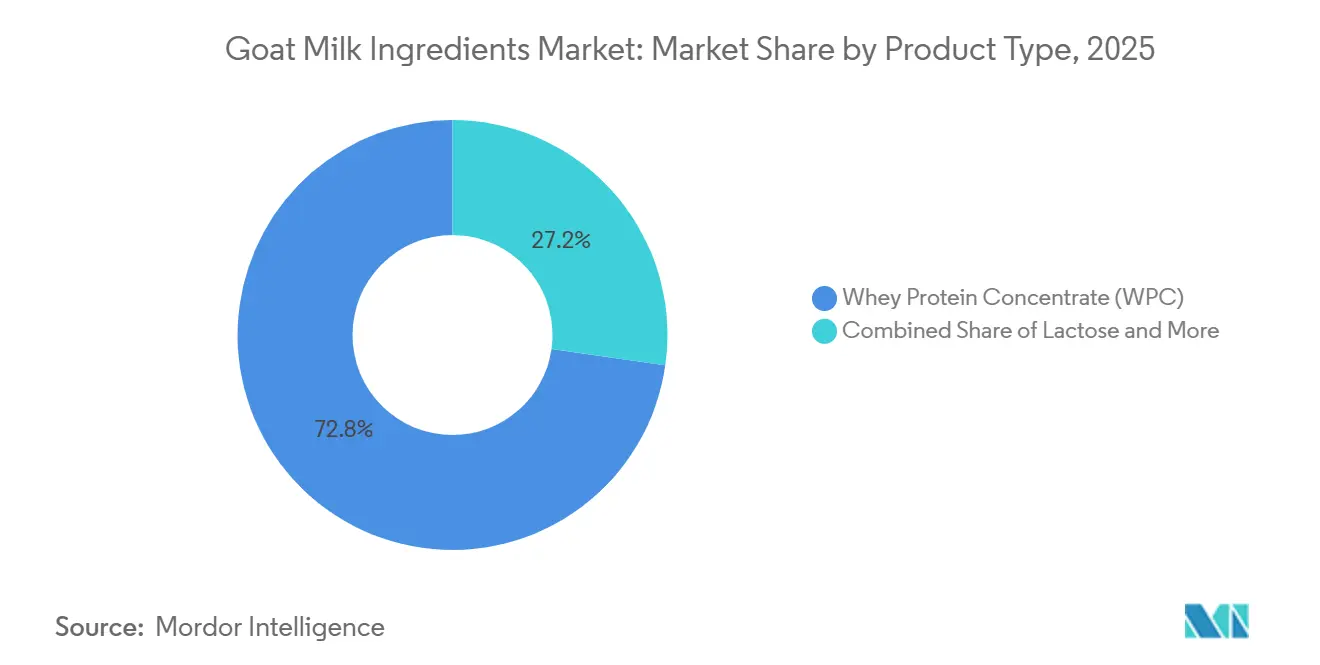
Whey Protein Concentrate Leads Ingredient RevenueWhey Protein Concentrate held 72.5% of the goat milk ingredients market size in 2025 and is projected to grow at a 6.0% CAGR through 2031. Whey Protein Concentrates (WPC) represent the largest value segment in the goat whey ingredients market, driven by strong demand from infant formula and sports nutrition. Different protein grades enable manufacturers to optimize formulation performance, nutritional claims, and cost across end-use applications. WPC 55 is widely used in follow-on and growing-up formulas, WPC 80 is preferred in high-protein sports nutrition products, while WPC 50 serves blended dairy and lower-protein formulations. Recent commercialization of goat whey protein hydrolysates has further expanded the premium protein portfolio, strengthening the segment's value proposition through specialized functional ingredients.
Although smaller in market value than WPC, Demineralized Whey Powder D90 remains a critical ingredient for infant formula due to its highly reduced mineral content, which supports formulations designed to more closely match human milk composition. Its specialized application, stringent quality requirements, and limited supplier base encourage long-term procurement agreements, providing qualified processors with stable demand and enhanced supply visibility.
Goat-derived lactose serves primarily as a carbohydrate source in infant formula while also providing bulking and stability functions in bakery and confectionery applications. Although demand growth is slower than for protein ingredients, lactose improves overall milk utilization and offers a premium alternative where manufacturers prioritize species-specific origin, traceability, and clean-label positioning.



By Application:
Infant Nutrition Anchors Demand While Other Uses ExpandInfant nutrition accounted for 43.3% of the goat milk ingredients market size in 2025 and is forecast to expand at a 6.7% CAGR through 2031. Infant formula is the primary demand driver for goat whey ingredients, supported by stringent formulation requirements, premium product positioning, and recurring consumption. Goat Whey Protein Concentrates (WPC) and Demineralized Whey Powder (D90) are critical ingredients in goat milk-based formulas, where manufacturers require consistent composition, validated species segregation, and compliance with infant nutrition regulations. These technical and regulatory barriers support premium pricing and long-term supplier relationships.
Fresh dairy products, specialty cheeses, and fermented dairy represent the second-largest application for goat milk ingredients. Whole goat milk powder and cream are widely utilized in premium dairy products where flavor differentiation, artisanal positioning, and product origin enhance consumer appeal. This segment provides processors with a stable outlet for whole milk streams while complementing higher-value ingredient production.
Beyond infant nutrition, goat whey ingredients are gaining traction across sports nutrition, premium bakery and confectionery, and functional pet nutrition. Whey protein concentrates are increasingly incorporated into sports recovery products targeting consumers seeking alternative dairy proteins, while goat lactose and cream fat are used in premium bakery and confectionery formulations to enhance ingredient provenance and sensory differentiation.
Geography Analysis
Europe Goat Milk Ingredients Market
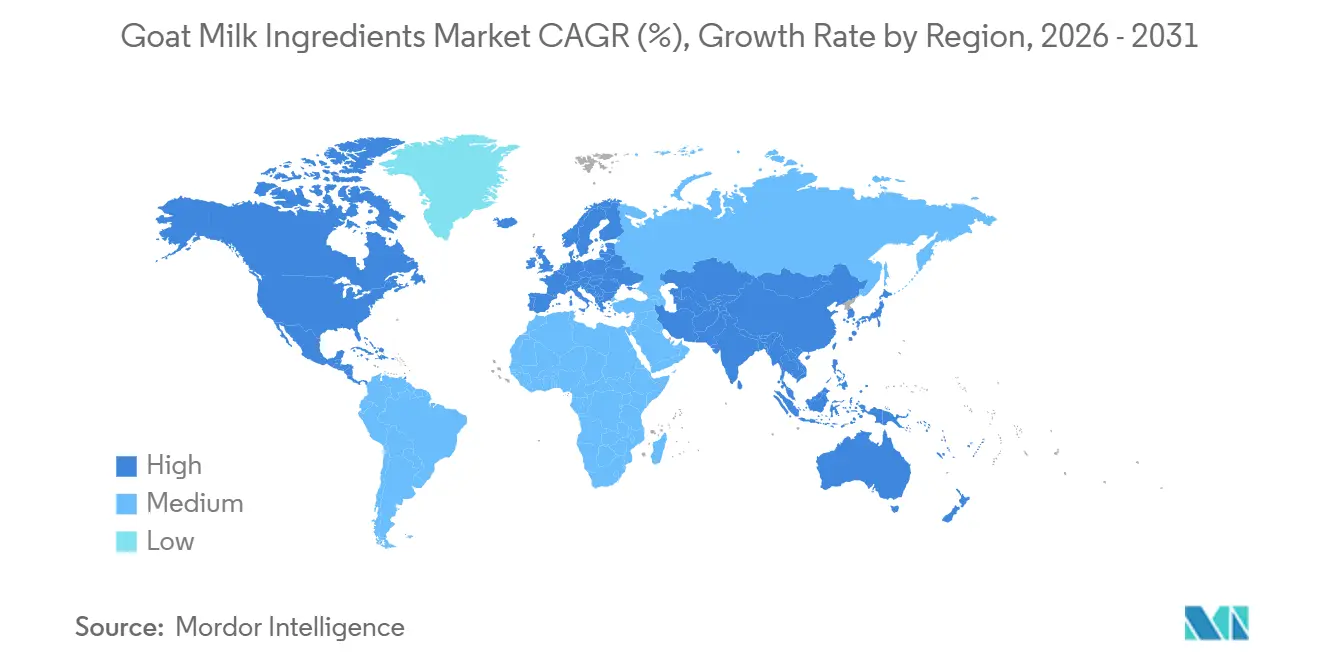
Europe held 46.9% of the goat milk ingredients market share in 2025, supported by processing infrastructure in the Netherlands, France, and Austria. Certified farms, collection systems, and export-oriented processors create integrated supply chains across the region. France further strengthens regional supply through initiatives aimed at expanding domestic goat milk production over the coming decade, while European infant formula regulations continue to set high product and quality standards that shape ingredient specifications across the value chain. These structural advantages create significant barriers to entry and sustain Europe's leadership in premium goat whey ingredients.
North America and APAC Goat Milk Ingredients Market
Asia-Pacific and North America represent the most attractive growth markets for qualified goat whey ingredient suppliers. North America's expanding acceptance of goat milk-based infant formula has broadened commercial opportunities for premium ingredients, while rising disposable incomes and increasing demand for premium nutrition products continue to support growth across Asia-Pacific. Emerging markets such as India, Indonesia, and other Southeast Asian countries offer long-term potential, although broader adoption will depend on consumer awareness, affordability, and education regarding the nutritional benefits of goat-derived ingredients.
MEA Goat Milk Ingredients Market
The Middle East & Africa is projected to register the fastest market growth, expanding at a 7.3% CAGR through 2031. Rising demand for premium infant nutrition, halal-certified dairy ingredients, and functional food products, coupled with increasing urbanization and higher disposable incomes, is supporting market expansion across countries such as Saudi Arabia and the UAE.
South America Goat Milk Ingredients Market
Meanwhile, South America is gradually strengthening its role within the global supply chain. Investments in goat milk processing capacity, particularly in Brazil's cooperative dairy sector, alongside emerging sourcing opportunities in Argentina, are expected to diversify global raw material availability over the long term as production standards, quality systems, and export-oriented processing capabilities continue to improve.

Competitive Landscape
The goat milk ingredients market is moderately concentrated, with a limited number of specialized processors controlling a significant share of global export-grade Whey Protein Concentrate (WPC) and Demineralized Whey Powder (D90) production. Competitive advantage is built on access to certified goat milk supply, integrated collection networks, dedicated caprine processing lines, stringent species segregation, and the technical capabilities required to manufacture infant-grade ingredients. As a result, barriers to entry are substantially higher than those for conventional dairy ingredients, particularly in regulated nutrition applications.
Leading processors are strengthening their competitive positions through continuous investment in specialized manufacturing infrastructure and value-added ingredient innovation. Recent investments in dedicated goat milk processing facilities and the commercialization of advanced ingredients, including goat milk protein concentrates (MPC), whey protein hydrolysates, casein hydrolysates, lactoferrin, and colostrum powders, reflect the industry's strategic shift toward higher-margin, science-backed nutrition solutions serving infant formula, clinical nutrition, and functional foods.
Beyond infant nutrition, emerging applications in sports nutrition, clinical recovery, and functional pet nutrition are creating additional opportunities for differentiated ingredient portfolios. Companies are increasingly investing in clinical research, proprietary processing technologies, and application development to strengthen product differentiation and support premium positioning rather than competing primarily on price.
Goat Milk Ingredients Industry Leaders
Dairy Goat Co-operative (DGC)
Ausnutria Dairy Corporation
Prolactal GmbH
AVH Dairy Trade B.V.
Eurial Ingredients
- *Disclaimer: Major Players sorted in no particular order
Goat Milk Ingredients Market Companies Covered in this Report
- Yili Group
- Dairy Goat Co-operative (DGC)
- Emmi Group
- FIT SA Group
- Goat Specialty Ingredients
- Valfoo
- TMW International, Inc.
- Idaho Milk Products
- Prolactal GmbH
- ABCO India
- Goat Partners International Inc.
- Royer Groupe Laitier
- Eurial Ingredients
- Chemcopia Ingredients Pvt Ltd
- Mt. Capra Products
- St Helen's Farm Limited
- Xi'an Baiyue Goat Milk Group
- Pure Goat Company B.V.
- Kabrita USA
- AVH Dairy Trade B.V.

Recent Industry Developments in Goat Milk Ingredients Market
- May 2025: Ausnutria Dairy Corporation expanded its premium goat milk ingredients portfolio by launching goat milk casein hydrolysate, goat whey protein hydrolysate, goat milk lactoferrin, and goat colostrum powder. The launch strengthens the company's presence in high-value bioactive ingredients, diversifies its product portfolio beyond conventional milk powders and WPC, and enhances its competitive position in premium infant nutrition and clinical nutrition markets.
- May 2025: Dairy Goat Co-operative launched a NZD 40 million capital raise targeting new investors to fund its strategic growth plan, which includes expanding infant formula production capacity, growing ingredient sales to Korea and China through sports nutrition and pet food channels, and pursuing third-party contract manufacturing to improve plant utilization
- March 2024: Ausnutria Dairy Ingredients BV partnered with NXT Group to establish its presence in the Indian market, leveraging NXT's Multi-Market Distribution platform for regulatory compliance, import management, sales, and distribution of goat milk ingredients to major food manufacturers. The collaboration supports Ausnutria's long-term market expansion strategy by combining local market expertise with an on-ground commercial go-to-market approach.


Global Goat Milk Ingredients Market Report Scope
Goat milk ingredients are value-added dairy ingredients derived from goat milk through processing techniques such as separation, concentration, filtration, drying, hydrolysis, and demineralization. The goat milk ingredients market is segmented by product type, including Demineralized Whey Powder, Whey Protein Concentrate, and Lactose. It is also segmented by application, including dairy, bakery and confectionery, beverages, sports and performance nutrition, infant nutrition, pet food, and other applications. Geographic coverage includes North America, Europe, Asia-Pacific, South America, and the Middle East and Africa. The available forecasts are presented in value and volume terms.
| Demineralised Whey Powder (D90) | |
| Whey Protein Concentrate (WPC) | WPC 50 |
| WPC 80 | |
| WPC 55 | |
| Lactose |
| Dairy |
| Bakery and Confectionery |
| Beverages |
| Sports and Performance Nutrition |
| Infant Nutrition |
| Pet Food |
| Other Applications |
| North America | United States |
| Canada | |
| Mexico | |
| Rest of North America | |
| Europe | Germany |
| United Kingdom | |
| Italy | |
| France | |
| Spain | |
| Netherlands | |
| Poland | |
| Belgium | |
| Sweden | |
| Rest of Europe | |
| Asia-Pacific | China |
| India | |
| Japan | |
| Australia | |
| Indonesia | |
| South Korea | |
| Thailand | |
| Singapore | |
| Rest of Asia-Pacific | |
| South America | Brazil |
| Argentina | |
| Colombia | |
| Chile | |
| Peru | |
| Rest of South America | |
| Middle East and Africa | South Africa |
| Saudi Arabia | |
| United Arab Emirates | |
| Nigeria | |
| Egypt | |
| Morocco | |
| Turkey | |
| Rest of Middle East and Africa |
| By Product Type | Demineralised Whey Powder (D90) | |
| Whey Protein Concentrate (WPC) | WPC 50 | |
| WPC 80 | ||
| WPC 55 | ||
| Lactose | ||
| By Application | Dairy | |
| Bakery and Confectionery | ||
| Beverages | ||
| Sports and Performance Nutrition | ||
| Infant Nutrition | ||
| Pet Food | ||
| Other Applications | ||
| By Geography | North America | United States |
| Canada | ||
| Mexico | ||
| Rest of North America | ||
| Europe | Germany | |
| United Kingdom | ||
| Italy | ||
| France | ||
| Spain | ||
| Netherlands | ||
| Poland | ||
| Belgium | ||
| Sweden | ||
| Rest of Europe | ||
| Asia-Pacific | China | |
| India | ||
| Japan | ||
| Australia | ||
| Indonesia | ||
| South Korea | ||
| Thailand | ||
| Singapore | ||
| Rest of Asia-Pacific | ||
| South America | Brazil | |
| Argentina | ||
| Colombia | ||
| Chile | ||
| Peru | ||
| Rest of South America | ||
| Middle East and Africa | South Africa | |
| Saudi Arabia | ||
| United Arab Emirates | ||
| Nigeria | ||
| Egypt | ||
| Morocco | ||
| Turkey | ||
| Rest of Middle East and Africa | ||


Key Questions Answered in the Report
What is driving demand for goat milk ingredients?
Infant nutrition is the main demand source, supported by interest in digestible dairy proteins, functional foods, and premium product positioning. Supply expansion, specialized WPC grades, and clean-label product development provide further support.
How large is the goat milk ingredients market in 2026?
Its value is USD 137.7 million in 2026 and is forecast to reach USD 178.2 million by 2031. The forecast reflects a 5.3% CAGR over 2026-2031 and continued demand for qualified caprine ingredients.
Which product type leads goat milk ingredient sales?
Whey Protein Concentrate led with 72.5% share in 2025 and is expected to grow at a 6.0% CAGR through 2031. WPC 55, WPC 80, and WPC 50 serve different infant formula, blended dairy, and performance nutrition needs.
Why is infant nutrition important for goat milk ingredients?
Infant nutrition accounted for 43.3% of value in 2025 and has the highest projected application CAGR at 6.7% through 2031. The application requires consistent, qualified inputs and can support the premium pricing of goat-derived fractions.
Page last updated on:





