
Wedding Planner Market Size and Share
Market Overview
| Study Period | 2022 - 2032 |
|---|---|
| Market Size (2027) | USD 320.73 Billion |
| Market Size (2032) | USD 462.70 Billion |
| Growth Rate (2027 - 2032) | 7.60 % |
| Fastest Growing Market | Middle East and Africa |
| Largest Market | Asia-Pacific |
| Market Concentration | Medium |
Major Players *Disclaimer: Major Players sorted in no particular order Image © Mordor Intelligence. Reuse requires attribution under CC BY 4.0. | |
Wedding Planner Market Analysis by Mordor Intelligence
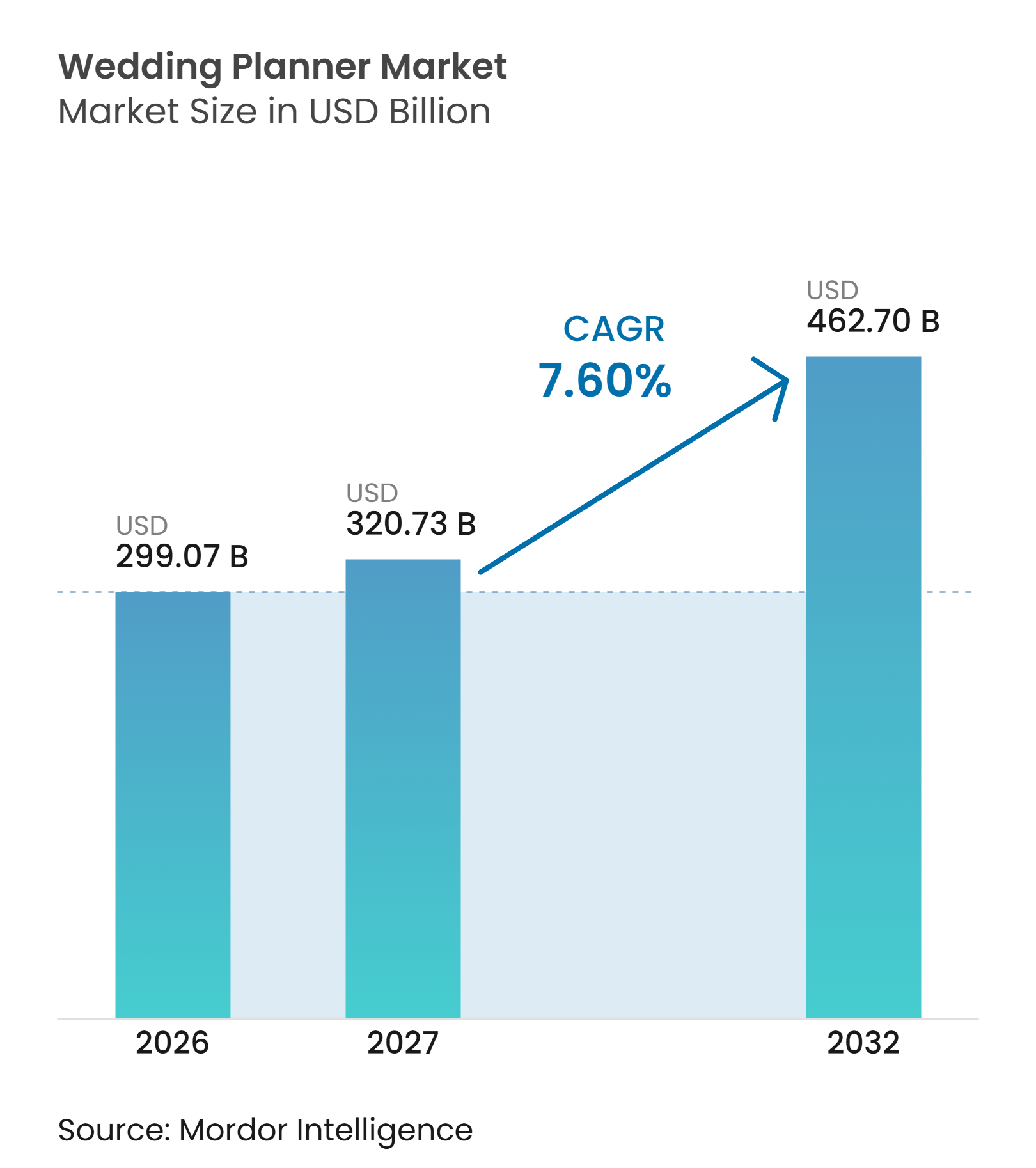
The global wedding planner market size was valued at USD 299.07 billion in 2026 and is estimated to grow from USD 320.73 billion in 2027 to reach USD 462.7 billion by 2032, at a CAGR of 7.60% during the forecast period (2027-2032). The global wedding planner market is supported by ceremonies requiring multiple vendors, extended schedules, and complex coordination. Couples increasingly use professional services to coordinate vendors, manage budgets, schedule venues, and organize guest logistics. Digital discovery tools improve vendor searches, but personal trust remains important in planner selection. Destination weddings and multi-day celebrations create strong opportunities for planners with local networks and reliable execution capabilities.
Key Report Takeaways
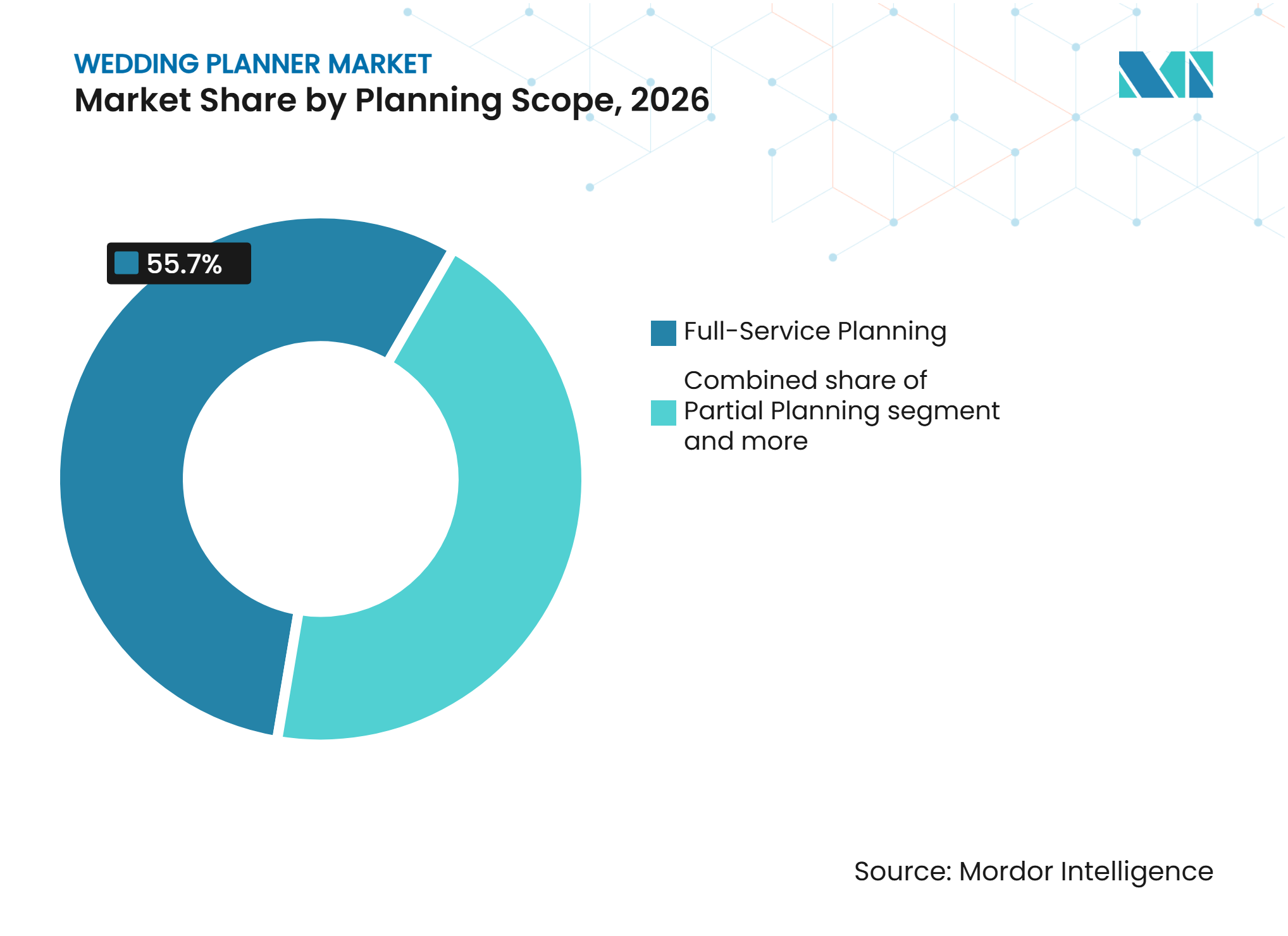
- By planning scope, full-service planning accounted for 55.70% of the global wedding planning services market share in 2026 and is projected to grow at an 8.30% CAGR through 2032.
- By budget tier, mid-range weddings accounted for 36.60% of the global wedding planning services market share in 2026, while Luxury Weddings are projected to grow at an 8.10% CAGR through 2032.
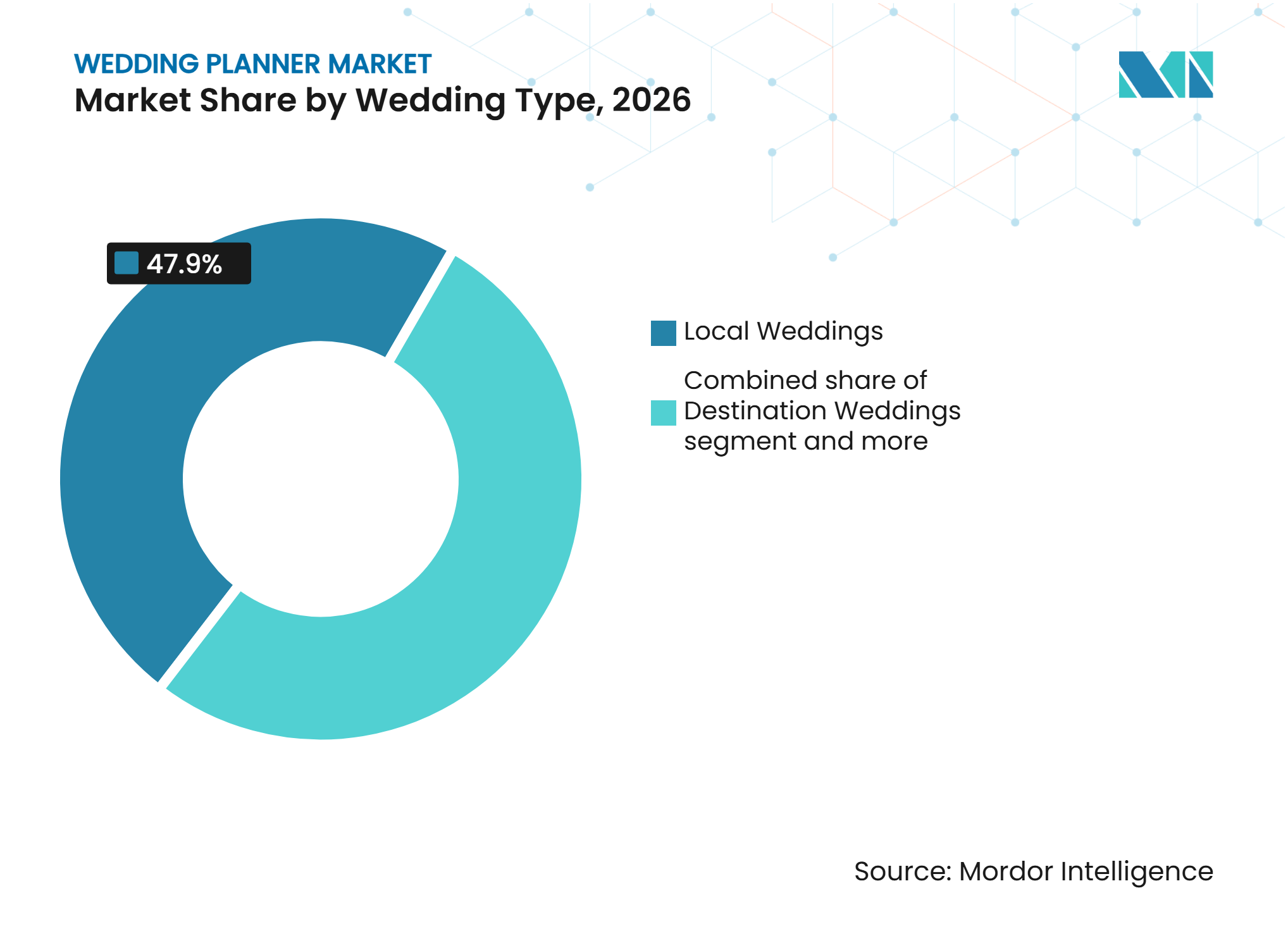
- By wedding type, Local Weddings accounted for 47.90% of the global wedding planning services market share in 2026, while Multi-Day and Wedding-Week Celebrations are projected to grow at an 8.20% CAGR through 2032.
- By booking channel, Offline Booking accounted for 43.00% of the global wedding planning services market share in 2026 and is projected to grow at a 8.4% CAGR through 2032.
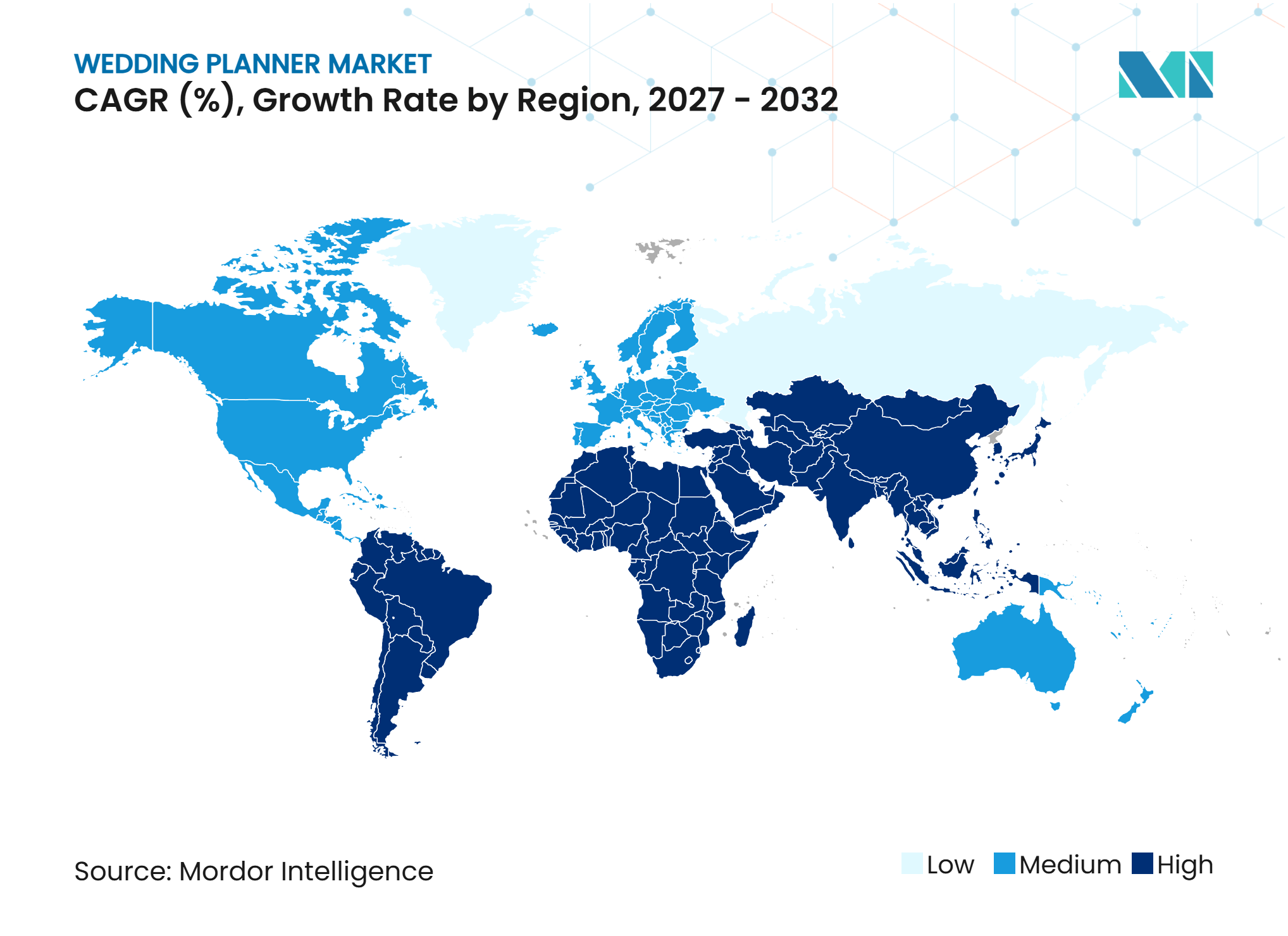
- By geography, Asia-Pacific accounted for 44.60% of the global wedding planning services market share in 2026, while the Middle East and Africa are projected to grow at a 10.70% CAGR through 2032.
Note: Market numbers in this report are based on Mordor Intelligence's proprietary estimation framework, which combines nine months of actuals with Q4 projections for base year 2026.
Market Trends and Insights
Drivers Impact Analysis of Wedding Planner Market*
| Driver | (~) % Impact on CAGR Forecast | Geographic Relevance | Impact Timeline |
|---|---|---|---|
| Personalized and Experience-Led Celebrations | +1.8% | Global, concentrated in North America and Europe | Medium term (2-4 years) |
| Destination and Multi-Day Weddings | +1.4% | Global, strong uptake in Asia-Pacific, the Middle East and Africa, and Europe | Long term (≥ 4 years) |
| Digital Discovery and Booking Platforms | +1.2% | Global, with Asia-Pacific and North America leading adoption | Medium term (2-4 years) |
| Professional Execution Certainty | +1.0% | Global | Short term (≤ 2 years) |
| AI-Assisted Vendor Matching and Planning Productivity | +0.8% | Global, with North America and Europe as early adopters | Short term (≤ 2 years) |
| Hospitality and Travel Partnerships | +0.6% | The Middle East and Africa, Europe, and Asia-Pacific | Long term (≥ 4 years) |
| Source: Mordor Intelligence | |||
Demand for Personalized and Experience-Led Celebrations
The global wedding planner market benefits as couples increasingly prioritize personalized ceremonies. The Knot Worldwide reported that 61% of surveyed couples wrote their own vows in 2025. The study also found that 32% incorporated religious, ethnic, or cultural elements, while 28% selected eco-friendly options, increasing demand for specialized vendor networks. These preferences favor planners who understand family expectations, cultural requirements, and sustainable options. WedMeGood reported that destination weddings accounted for one in four Indian weddings in 2025-2026. Couples choosing destination weddings spent INR 58 lakh (USD 0.064 million), compared with INR 39.5 lakh (USD 0.044 million) for local celebrations[1]. This difference reflects additional accommodation, transportation, venue, and guest-management requirements. The market benefits when providers organize personalized, multi-event wedding programs beyond décor or venue commissions.
Growth of Destination and Multi-Day Weddings
Destination and multi-day celebrations increase the operational decisions couples must manage, benefiting the global wedding planner market through greater vendor coordination and tighter scheduling. Italy hosted 15,100 foreign wedding ceremonies in 2024. The number rose to 16,700 in 2025, generating more than EUR 1.1 billion (USD 1.29 billion) in revenue and over 3 million overnight stays, linking planners to tourism demand[2]. India provides a large domestic base, as celebrations often span multiple days. CAIT estimated that 460,000 weddings took place during the 45-day November-December 2025 season, generating INR 6.5 trillion (USD 72.34 billion) in spending. Destination couples spend more than local couples, increasing demand for logistics support. Multi-day weddings require planners to coordinate room blocks, arrivals, ceremony schedules, supplier briefings, and contingency arrangements.
Adoption of Digital Discovery and Booking Platforms
Digital platforms help couples compare planners, venues, and specialist suppliers efficiently. The Knot Worldwide states that its platforms have supported 25 million couples and connected them with 200,000 local wedding professionals globally. These networks help planners generate leads, showcase portfolios, and collect reviews. However, the global wedding planner market still relies on personal validation, as wedding services are high-trust purchases. Couples increasingly use a hybrid approach, beginning with digital discovery and completing decisions through direct evaluation. Vendor discussions and contract decisions often continue through in-person meetings or video calls. This model allows couples to assess cultural fit, communication quality, and supplier credibility before committing. The global wedding planner market can expand its digital reach while maintaining the relationship-driven nature of wedding planning services.
Rising Need for Professional Execution Certainty
Professional coordination becomes more valuable when weddings involve multiple vendors and linked events. The Knot Worldwide reported that couples married in 2025 used an average of 13 vendors, and 71% of weddings lasted 2-3 days. These arrangements require schedule management, supplier communication, and rapid decisions during events. The global wedding planner market benefits when couples view planning as a way to reduce execution risk. Cross-border celebrations add compliance requirements to standard logistics. Travel Industry Council of Ontario (TICO) states that Ontario planners packaging travel and accommodation must register as travel agents or work with registered agencies. This requirement highlights the need for defined roles between planners and travel providers. Planners serving overseas guests face similar needs related to travel, accommodation, documentation, and local supplier management. The global wedding planner market benefits when firms establish destination-specific support and compliant partner relationships.
Restraints Impact Analysis of Wedding Planner Market*
| Restraint | (~) % Impact on CAGR Forecast | Geographic Relevance | Impact Timeline |
|---|---|---|---|
| Wedding Budget Inflation and Affordability Pressure | -1.2% | Global, most acute in North America and Europe | Medium term (2-4 years) |
| Free Digital Tools and Social Content Commoditizing Basic Planning | -0.9% | North America, Europe, and Asia-Pacific | Medium term (2-4 years) |
| Seasonal Demand Concentration and Weather Disruption | -0.8% | Global | Long term (≥ 4 years) |
| Cultural Localization and Cross-Border Compliance Complexity | -0.5% | The Middle East and Africa, Asia-Pacific, and Europe | Long term (≥ 4 years) |
| Source: Mordor Intelligence | |||
Wedding Budget Inflation and Affordability Pressure
Affordability limits the number of couples that can use comprehensive professional wedding planning services. The Knot Worldwide reported that the average cost of a United States wedding was USD 34,000 in 2025. Per-guest spending reached USD 292, an increase of USD 8 from 2024[3]. The study found that 85% of couples said economic conditions affected their planning decisions. Cost-sensitive couples may reduce the scope of planning services or manage some wedding elements independently. This pressure does not eliminate demand but affects the services couples consider. WeddingWire lists starting fees of USD 800 for day-of coordination and USD 3,000 for full-service planning. Modular offerings can improve access to professional support for couples unable to fund full-service planning. Planners can serve price-sensitive clients by separating essential coordination from optional design services while maintaining execution standards.
Free Digital Tools and Social Content Commoditizing Basic Planning
Free digital tools can reduce demand for basic checklists, inspiration boards, and vendor searches. The Knot’s product launch showed that technology could recommend vendors based on a couple’s saved images, simplifying planning for low-complexity ceremonies. Social media also provides a steady flow of visual ideas and venue references. However, these tools offer limited value when couples require personal accountability for execution. Professional planners remain relevant for weddings involving coordinated decisions across multiple functions. The Knot Worldwide reported that 50% of surveyed couples considered a planner’s personality important when booking, while 52% identified responsiveness as critical. These findings show that couples do not choose planners solely for supplier recommendations.
*Our forecasts treat driver/restraint impacts as directional, not additive. The impact forecasts reflect baseline growth, mix effects, and variable interactions.
Consumer Preferences & Spending Patterns
Couples increasingly seek personalized celebrations that reflect cultural identities and practical priorities. The Knot Worldwide’s 2026 Real Weddings Study reported that 61% of surveyed couples wrote their own vows in 2025, while 32% included religious, ethnic, or cultural elements and 28% selected eco-friendly options. These preferences increase demand for planners offering relevant vendor networks, sustainable suppliers, and flexible event designs. WedMeGood’s 2025-2026 industry report indicated that one in four Indian weddings was a destination wedding, with 90% held domestically. This trend favors planners with destination-specific hotel, transportation, and venue partnerships. Wedding spending remained substantial, although economic pressures increased the need for transparent pricing and flexible packages. The Knot Worldwide reported an average United States wedding cost of USD 34,000 in 2025 and per-guest spending of USD 292; 85% of surveyed couples said economic conditions affected planning.
Service Market Performance Intelligence
Wedding planning fees vary by service scope and complexity, creating opportunities across budget and higher-end segments. WeddingWire lists United States day-of coordination services from USD 800, full-service planning from USD 3,000, and fees above USD 12,000 for higher-end services. Destination weddings provide a larger spending base. Italian National Tourist Board (ENIT) reported 16,700 international weddings in Italy in 2025, generating more than EUR 1.1 billion (USD 1.29 billion) in revenue and averaging EUR 67,000 (USD 78,812.8) per wedding.
Customer acquisition combines digital discovery with personal trust. The Knot Worldwide’s 2026 Real Weddings Study found that 50% of surveyed couples considered planner personality important, while 52% valued responsiveness. Its AI-powered planning tools aim to streamline vendor matching and help couples move from shortlisting to booking more efficiently. Although not a market-wide benchmark, this result highlights the potential for improved vendor matching and follow-ups. Planners can strengthen conversion through updated portfolios, transparent packages, prompt communication, and personalized consultations.
Wedding Planner Market Segment Analysis
By Planning Scope:
Full-Service Planning Retains Scale and GrowthFull-service planning accounted for 55.70% of the global planning services share in 2026 and is projected to grow at an 8.30% CAGR through 2032. It includes vendor selection, budget support, scheduling, design coordination, guest logistics, and event-day management. In 2025, couples used an average of 13 vendors, and 71% of weddings lasted 2 to 3 days. These needs support demand for end-to-end planning. Partial planning allows couples to retain creative control while using planners for supplier management, running sheets, and selected logistics. In the United States, WeddingWire reports that these services start at USD 1,250. Day-of coordination, starting at USD 800, covers vendor arrivals, timing, guest flow, and issue resolution[4]. Certifications may help clients assess provider training and roles, supporting clearer service tiers in the global wedding planner market.



By Budget Tier:
Mid-Range Volume Meets Luxury-Led GrowthMid-range weddings accounted for 36.60% of the global wedding planner market in 2026, driven by couples seeking professional support within defined budgets. Planners use structured packages and supplier networks. Luxury weddings are projected to grow at an 8.10% CAGR through 2032, supported by destination formats, venues, and extensive guest services. Italy’s foreign wedding budget averaged EUR 67,000 (USD 78,812.8) in 2025, driving demand for lodging, transport, hospitality, and multi-event coordination. The market has an affordability divide: United States weddings averaged USD 34,000 in 2025, while full-service planning starts at USD 3,000 and can exceed USD 12,000. Economy-tier customers favor digital tools and limited or event-day support, creating scope for modular services.
By Wedding Type:
Local Ceremonies Supply Volume While Multi-Day Events AdvanceLocal weddings account for 47.90% of the global share in 2026 and remain the largest source of wedding volume, as most couples celebrate locally. CAIT estimated 460,000 Indian weddings during the late-2025 peak season, generating INR 6.5 trillion (USD 72.34 billion) in spending. Local ceremonies may involve multiple events, large guest lists, and diverse suppliers. Planners use local vendor relationships to coordinate venues, catering, rituals, and hospitality.
Multi-day and wedding-week celebrations are projected to grow at an 8.20% CAGR through 2032. The Knot Worldwide found that 71% of weddings in their 2025 study lasted two to three days, increasing coordination needs. These events require destination-specific vendors, accommodation, transport, and contingency planning. The Knot Worldwide found that 32% of couples incorporated religious, ethnic, or cultural elements. Planners must manage rituals and family expectations, including for diaspora celebrations.

By Booking Channel:
Offline Trust Continues Alongside Digital SearchOffline booking accounted for a 43.00% share of the global market in 2026 and registered a CAGR of 8.40% through 2032. It remains important for high-value wedding planning, as couples often assess a planner’s communication style and understanding directly. The Knot Worldwide found that 50% of couples value a planner’s personality, while 52% consider responsiveness critical. Couples often identify providers online before evaluating cultural fit, credibility, and coordination capabilities through in-person meetings or video calls. Online booking supports discovery for younger and geographically dispersed couples. The Knot’s Make It Yours experience uses saved imagery to recommend vendors by style and location, while digital profiles help planners showcase work and reach destination wedding clients. Hybrid booking combines digital discovery with direct validation, supporting search efficiency and accountability. The Knot Worldwide’s September 2025 launch emphasized vendor matching over content discovery. Pilot users of the related feature reported a 16% higher shortlist-to-booking conversion rate. Improved matching can reduce low-quality inquiries, but responsive client service remains essential.
Geography Analysis
Asia-Pacific accounts for 44.60% of the global wedding planning services market in 2026. India is a major contributor: CAIT estimated 460,000 weddings during the 45-day peak season from November to December 2025, with spending of INR 6.5 trillion (USD 72.34 billion). The Middle East and Africa are projected to grow at a 10.70% CAGR through 2032. Dubai supports professionally managed weddings through international access, hotel infrastructure, and licensing for wedding-organizing activities. Heat also requires flexible venue planning, shifting events indoors or to cooler dates. ENIT reported 16,700 foreign weddings in Italy in 2025, generating over EUR 1.1 billion (USD 1.29 billion) in wedding-related revenue. The average foreign wedding budget was EUR 67,000 (USD 78,812.8). UNI 11954 and UNI 11955, effective October 2024, define Wedding Planner and Destination Wedding Planner profiles. North America supports digital tools and structured packages, although affordability limits full-service adoption.
Service Provider Network & Expansion Intelligence
Established vendor networks and venue-integrated planning models expand service reach, while local expertise remains critical for culturally specific and multi-day weddings. The Knot Worldwide connects couples with approximately 900,000 businesses globally. Its 2026 study found that United States couples hired an average of 13 vendors per wedding. In India, the Confederation of All India Traders (CAIT) estimated 4.6 million weddings during the November-December 2025 season, indicating substantial demand for coordinated services.
Wedgewood Weddings operates at more than 75 venues across eight United States states and serves over 11,000 couples annually, demonstrating the scalability of venue-integrated planning. Digital discovery tools and hospitality partnerships create additional growth opportunities. During pilot testing, The Knot’s AI-powered planning experience improved shortlist-to-booking conversion by 16% through its vendor-organizing feature. Take and Give Needs partnered with RIHGA Royal Hotel Kyoto in January 2026, expanding its venue network through hospitality collaboration. These developments favor providers that combine digital lead generation, reliable local suppliers, and consistent service execution.
Competitive Landscape
Market Concentration
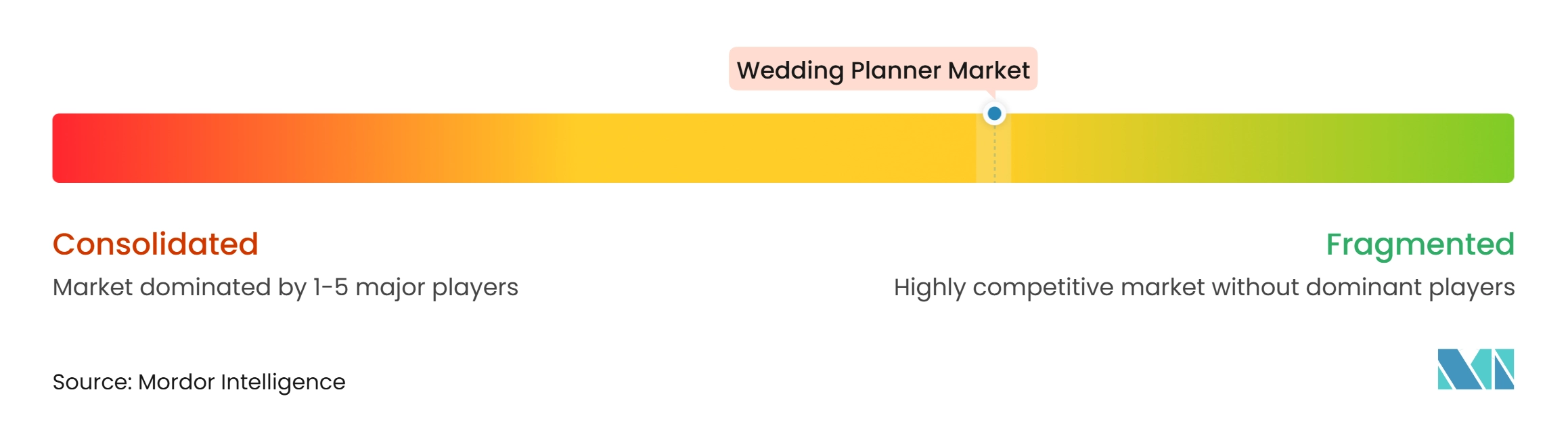
The global wedding planner market is moderately fragmented. Independent planners and boutique agencies remain numerous, and no provider holds a dominant global position. Platform groups compete for consumer discovery and vendor-network participation, while venue-integrated operators combine planning with managed event spaces. Luxury agencies compete through reputation, destination access, and cultural capabilities.
The Knot Worldwide announced an agreement to acquire Zola in October 2026, subject to customary and regulatory clearance. The combined portfolio would span 14 brands across 11 countries, while both companies would continue as separate brands. The Knot launched Make it Yours in September 2025 and reported a 16% higher booking conversion rate among pilot users. These initiatives focus on data, vendor reach, and supplier matching but do not replace planners’ role in managing supplier delivery and client expectations. TJC and Resolute Equity Partners acquired Wedgewood Weddings & Events in June 2025. The business operates more than 75 venues across eight states and coordinates over 11,000 couples annually.
Wedding Planner Industry Leaders
-
The Knot Worldwide
-
Zola, Inc.
-
Joy Life, Inc.
-
WedMeGood (WMG Tech Private Limited)
-
Bridebook Limited
- *Disclaimer: Major Players sorted in no particular order
Wedding Planner Market Companies Covered in this Report
- The Knot Worldwide
- Zola, Inc.
- Joy Life, Inc.
- WedMeGood (WMG Tech Private Limited)
- Bridebook Limited
- Easy Weddings Pty Ltd
- Zzeeh Weddings
- WATABE WEDDING CORPORATION
- Wedgewood Weddings
- DestinationWeddings.com
- Walters Wedding Estates
- Colin Cowie Lifestyle
- Mindy Weiss Party Consultants
- Rafanelli Events
- Marcy Blum Events
- Easton Events
- Michelle Rago Destinations
- BAQAA Glamour Weddings & Events
- Eventures Asia
- Tamarind Global Weddings
Recent Industry Developments in Wedding Planner Market
- October 2026: The Knot Worldwide agreed to acquire Zola, Inc., subject to customary and regulatory approvals. The combined portfolio will include 14 brands across 11 countries, while both brands will operate separately.
- January 2026: Take and Give Needs formalized a strategic venue partnership with RIHGA Royal Hotel Kyoto in January 2026. The property joined its portfolio of about 60 guesthouses and consulting venues, expanding wedding planning and accommodation offerings in Japan.
- June 2025: TJC and Resolute Equity Partners acquired Wedgewood Weddings & Events, which operates more than 75 United States venues across eight states, serves over 11,000 couples annually, and employs about 2,000 people.
- September 2025: The Knot launched Make it Yours, an AI-powered planning tool that analyzes saved inspiration images and recommends local vendors by style and location. Pilot users of Make it Yours were 16% more likely to convert shortlists into confirmed bookings.
Global Wedding Planner Market Report Scope
The global wedding planner market report analyzes professional wedding planning and coordination services worldwide. The market is segmented by planning scope, budget tier, wedding type, booking channel, and geography. The study examines key drivers, including demand for personalized celebrations, growth of destination and multi-day weddings, digital discovery and booking platforms, demand for professional execution, AI-assisted vendor matching, and hospitality partnerships, alongside restraints such as wedding budget inflation, seasonal demand concentration, weather disruptions, free digital planning tools, and cultural and cross-border compliance complexity. It evaluates service availability, pricing, customer acquisition, consumer preferences, spending patterns, and geographic expansion. The report provides market size and growth forecasts, competitive landscape analysis, market share assessment, strategic developments, and profiles of leading providers. It also explores opportunities in integrated destination wedding and guest logistics packages, AI-assisted planning, and verified local vendor networks with cultural intelligence. Market estimates and forecasts are presented in value (USD) across all covered segments.
Segmentation Overview
Key Questions Answered in the Report
Which planning service has the strongest share and growth outlook?
Full-service planning accounted for 55.70% of global share in 2026 and is projected to grow at an 8.30% CAGR through 2032.
What is driving growth in wedding planning market?
Multi-day functions, destination celebrations, and professional coordination needs are important growth factors. CAIT estimated INR 6.5 trillion (USD 72.34 billion) in spending across the November-December 2025 wedding season.
How are digital tools changing wedding planning services?
Digital tools improve supplier discovery and shortlisting, while planners remain important for cultural coordination, supplier management, and event-day execution.
What is the main challenge for professional wedding planners?
Affordability remains a major challenge, as cost-sensitive couples may choose self-planning, limited planning support, or day-of coordination instead of full-service planning.
Why is the Middle East and Africa the fastest-growing region in the global wedding planner market, and what is driving that trajectory?
The Middle East and Africa growth is driven by Gulf destination-wedding investments, expanding hospitality infrastructure, urbanization, rising demand for professional planning, and high guest counts that increase revenue potential.