
Rotary Air Compressor Market Size and Share
Market Overview
| Study Period | 2022 - 2032 |
|---|---|
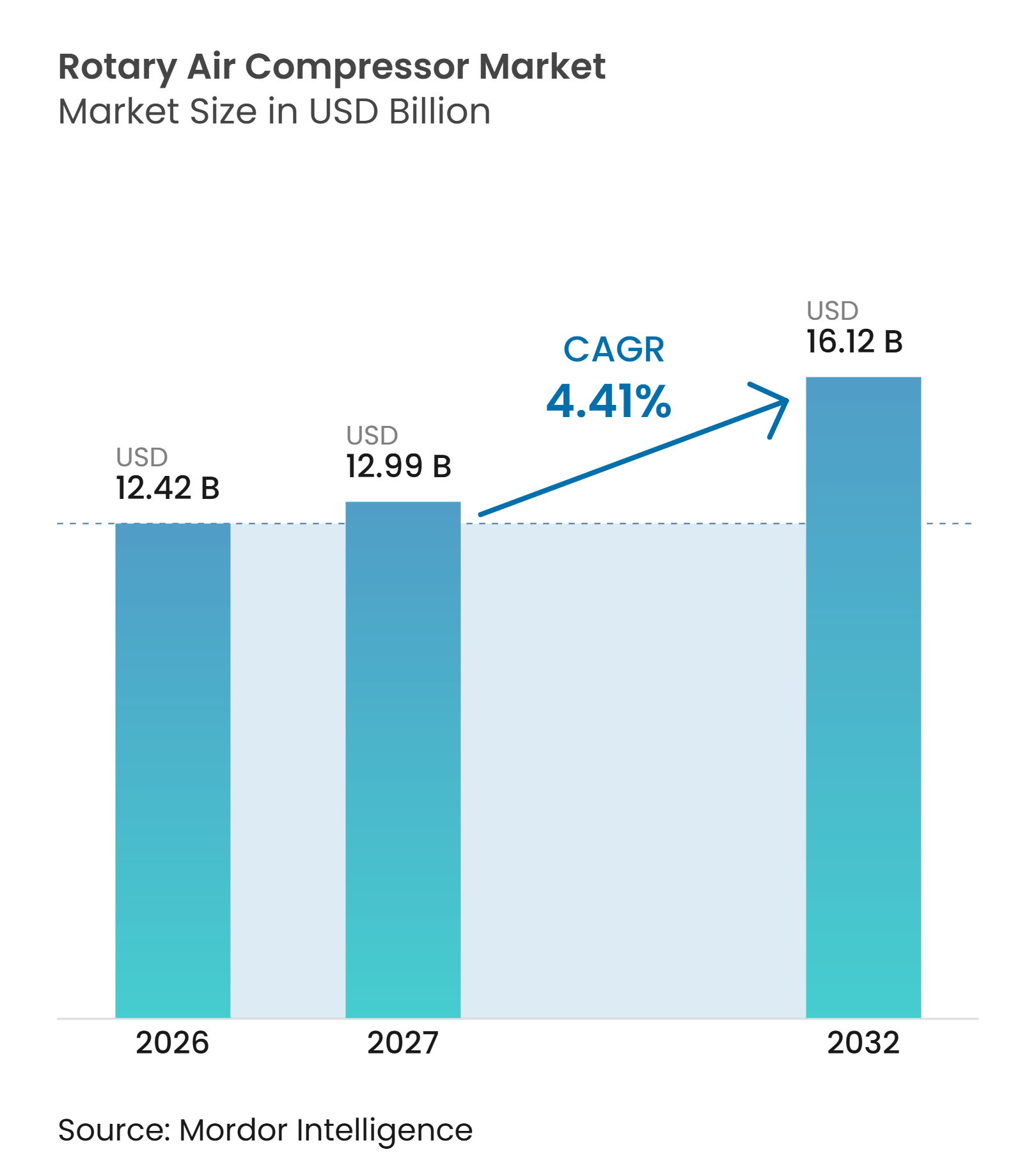
| Market Size (2027) | USD 12.99 Billion |
| Market Size (2032) | USD 16.12 Billion |
| Growth Rate (2027 - 2032) | 4.41 % |
| Fastest Growing Market | Asia-Pacific |
| Largest Market | Asia-Pacific |
| Market Concentration | Medium |
Major Players *Disclaimer: Major Players sorted in no particular order Image © Mordor Intelligence. Reuse requires attribution under CC BY 4.0. | |
Rotary Air Compressor Market Analysis by Mordor Intelligence
The global rotary air compressor market size is projected to grow from USD 12.42 billion in 2026 to USD 16.12 billion by 2032, registering a CAGR of 4.41% between 2027 and 2032. Replacement demand, industrial capacity additions, and the shift from fixed-speed equipment to variable-speed drive systems support this outlook across established plants and new production sites. Continuous-duty users favor rotary designs for their dependable airflow in multi-shift production, with minimal disruption to automated assembly, processing, and utility operations. The installed base generates recurring service and aftermarket revenue for established equipment manufacturers, particularly where uptime commitments influence maintenance decisions. Efficiency regulations, clean-air requirements, and connected maintenance features are reshaping purchasing criteria and increasing the value of service capability. These conditions present opportunities for suppliers in high-purity applications and large industrial projects, while material costs and price sensitivity remain constraints.
Key Report Takeaways
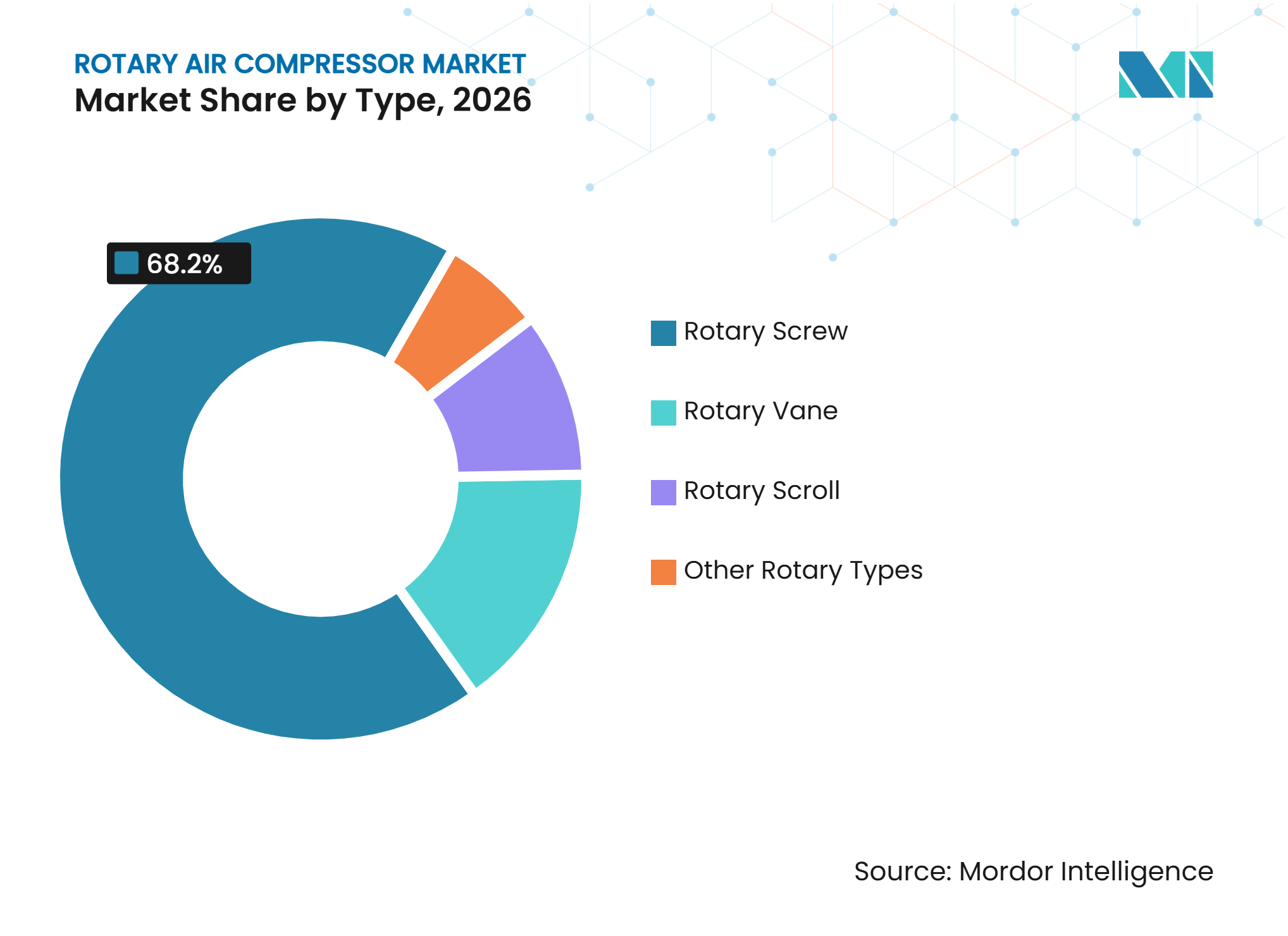
- By type, rotary screw compressors hold 68.2% of the rotary air compressor market share in 2026, while rotary scroll compressors are forecast to grow at a 5.3% CAGR through 2032.
- By technology, oil-flooded systems account for 59.7% of the rotary air compressor market share in 2026, while oil-free systems are forecast to grow at a 5.2% CAGR through 2032.
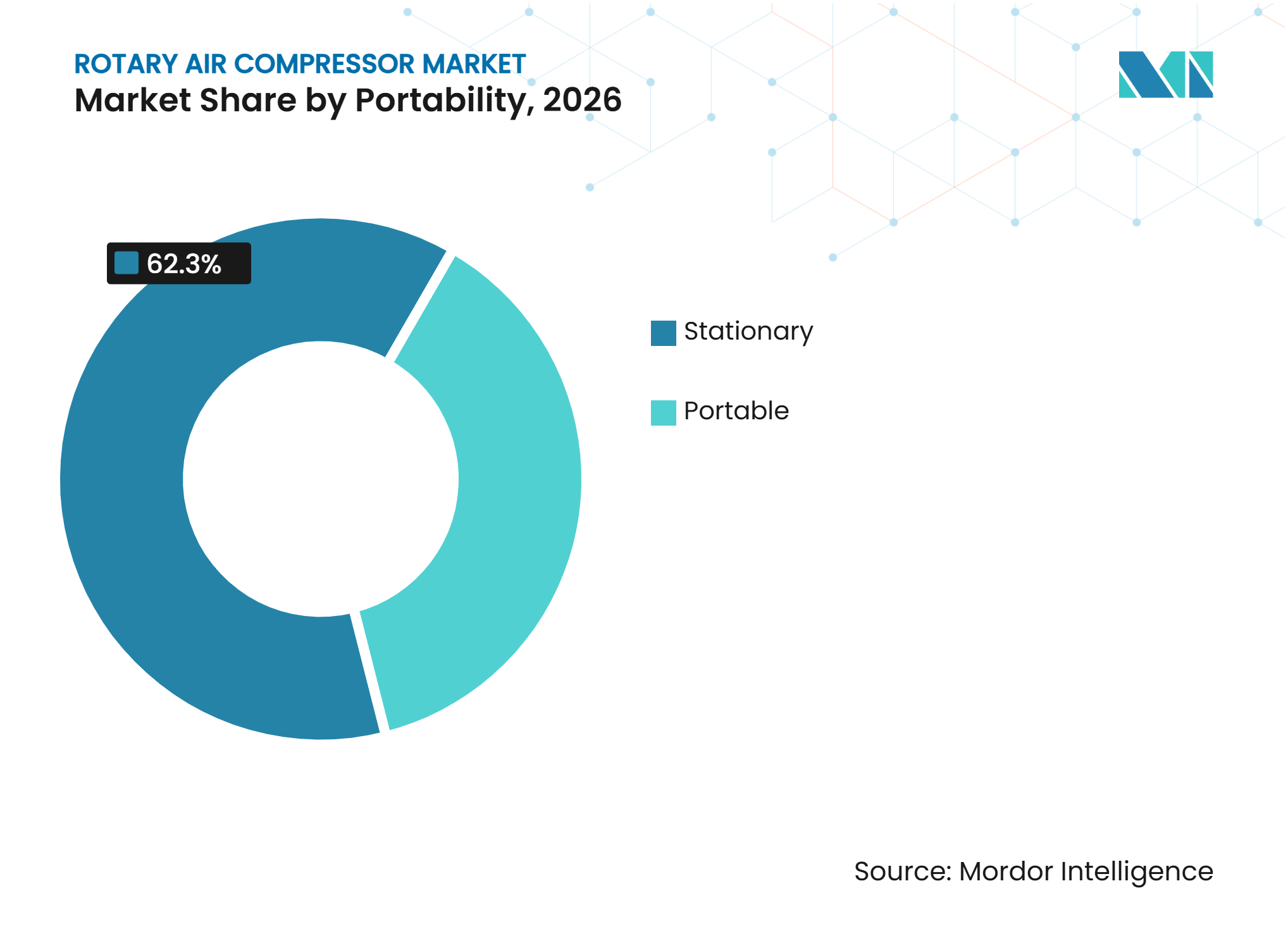
- By portability, stationary systems hold 62.3% of market revenue in 2026, while portable systems are forecast to grow at a 4.9% CAGR through 2032.
- By cooling method, air-cooled systems hold 76.6% of market value in 2026, while water-cooled systems are forecast to grow at a 4.8% CAGR through 2032.
- By power rating, the 101 to 300 kW range holds 38.1% of market revenue in 2026, while above-500 kW systems are forecast to grow at a 5.6% CAGR through 2032.
- By end-user industry, manufacturing holds 39.5% of market revenue in 2026, while healthcare is forecast to grow at a 7.1% CAGR through 2032.
- By geography, Asia-Pacific holds 42.6% of market value in 2026 and is forecast to grow at a 5.7% CAGR through 2032.
Note: Market numbers in this report are based on Mordor Intelligence's proprietary estimation framework, which combines nine months of actuals with Q4 projections for base year 2026.
Market Trends and Insights
Drivers Impact Analysis of Rotary Air Compressor Market*
| Driver | (~) % Impact on CAGR Forecast | Geographic Relevance | Impact Timeline |
|---|---|---|---|
| Industrial Automation and Continuous-Duty Manufacturing | +1.2% | Global, concentrated in North America, Europe, and Asia-Pacific | Medium term (2-4 years) |
| Energy Efficiency Mandates and Variable-Speed Adoption | +0.8% | Global, with the strongest regulatory intensity in the EU, United States, and China | Medium term (2-4 years) |
| Oil-Free Air Demand in Food, Pharmaceutical, and Electronics Production | +0.7% | Global, with Asia-Pacific and North America leading adoption | Long term (≥ 4 years) |
| Asia-Pacific Industrial Capacity Expansion | +0.9% | Asia-Pacific, centered on China, India, Vietnam, and Indonesia, with spillover to the Middle East and Africa | Short term (≤ 2 years) |
| EV Battery and Semiconductor Cleanroom Buildout | +0.5% | Asia-Pacific, especially China and South Korea, and North America | Short term (≤ 2 years) |
| LNG, Hydrogen, and Petrochemical Capacity Additions | +0.4% | Middle East, North America, and Asia-Pacific | Long term (≥ 4 years) |
| Source: Mordor Intelligence | |||
Industrial Automation and Continuous-Duty Manufacturing
Factory automation supports demand for stationary compressed air equipment, as pneumatic actuators, conveyors, and assembly robots require consistent compressed air across multi-shift operations. The rotary air compressor market benefits when factories replace equipment that cannot communicate with plant energy-management systems. Smart-factory programs favor compressors with data connectivity, as operating teams require performance, energy, and maintenance data from the full air system rather than from isolated equipment. A 2025 peer-reviewed study found that gradient-boosting models using real-time screw-compressor data explained 92% of outlet-temperature variance, supporting the use of data-driven condition monitoring. In April 2025, Ingersoll Rand introduced R-Series 90 to 160 kW rotary screw compressors with an onboard platform for continuous real-time monitoring.[1] These features reduce the distinction between standard and higher-specification products for industrial buyers, as connected monitoring is increasingly evaluated alongside air delivery and energy use.
Energy Efficiency Mandates and Variable-Speed Adoption
Energy regulations increase replacement demand because compliance is mandatory for covered equipment. In the United States, rotary lubricated air compressors manufactured from January 10, 2025, must meet minimum package isentropic-efficiency requirements under 10 CFR 431.345. The U.S. Department of Energy made its amended compressor test procedure effective in 2025, with mandatory use beginning July 16, 2025.[2] The European Commission began a formal review of ecodesign requirements for electric motors and variable-speed drives in August 2025, with revised rules targeted for 2029. China also issued 2025 standards for variable-frequency oil-injected screw compressors and for assessing compressed-air-station energy performance. This regulatory alignment supports a shift toward variable-speed systems where compressed-air demand fluctuates during production, particularly in plants that operate multiple lines with changing load profiles.
Oil-Free Air Demand in Food, Pharmaceutical, and Electronics Production
Oil-free rotary systems are required where air purity affects product quality, manufacturing yield, or regulatory compliance. Pharmaceutical cleanrooms and semiconductor facilities use ISO 8573-1 Class 0 as a benchmark for the absence of detectable oil aerosol. The rotary air compressor market is therefore seeing increased demand from sectors where contamination can disrupt output or create quality risks. In July 2025, Atlas Copco introduced oil-free ranges including the ZR/ZT 30-55 FLX, which the company stated reduced energy use by up to 9% and unload power by 70%. Food processors also use oil-free air for product-contact processes and food-safety control, where the air system must fit within wider quality-assurance procedures. Suppliers must maintain both oil-injected and oil-free product lines, as the two technologies address different operating conditions, air-quality requirements, service practices, and price points.
EV Battery and Semiconductor Cleanroom Buildout
Electric-vehicle battery plants and semiconductor facilities create concentrated demand for clean, dry compressed air. In battery production, compressed air supports coating, cell assembly, welding, drying, and leak testing, where contamination can affect product quality. The rotary air compressor market can benefit from these projects, as they require large, reliable utility systems rather than small replacement units. In October 2025, Atlas Copco launched the ZGH 100-200 VSD+ high-pressure oil-free rotary screw booster for applications including semiconductor, pharmaceutical, and PET production. Such projects favor suppliers with documented oil-free capability that can support installations throughout their operating life, including commissioning, monitoring, maintenance, and planned expansion. These projects also strengthen the role of service networks in securing high-value contracts.
Restraints Impact Analysis of Rotary Air Compressor Market*
| Restraint | (~) % Impact on CAGR Forecast | Geographic Relevance | Impact Timeline |
|---|---|---|---|
| High Upfront Cost of Oil-Free and Smart Systems | -0.6% | Global, with greater pressure in price-sensitive Asia-Pacific and South American markets | Medium term (2-4 years) |
| Volatile Steel and Precision-Component Costs | -0.5% | Global, with strong margin pressure in Europe and North America | Short term (≤ 2 years) |
| Low-Load Inefficiency and Inadequate Air-System Sizing | -0.3% | Global, concentrated in general manufacturing small and medium enterprises | Medium term (2-4 years) |
| Specialty-Environment Compliance Burden | -0.2% | North America and Europe, with emerging relevance in urban Asia-Pacific markets | Long term (≥ 4 years) |
| Source: Mordor Intelligence | |||
High Upfront Cost of Oil-Free and Smart Systems
The initial cost of oil-free systems can delay purchases by small and medium manufacturers. Oil-free rotary screw and rotary scroll equipment cost more than oil-flooded alternatives, and variable-speed drives and connected monitoring add to the initial expenditure. This affects the rotary air compressor market most in price-sensitive regions such as Southeast Asia and South America, where buyers often prioritize purchase price over long-term efficiency. Some facilities defer upgrades until a quality issue or regulation requires a higher-specification system. Energy-management agreements can reduce this barrier when a provider funds the equipment and shares energy savings. These arrangements remain more common in large facilities than in smaller businesses, which often have fewer financing options and shorter purchasing approval cycles.
Volatile Steel and Precision-Component Costs
Steel and aluminum costs can reduce margins for equipment manufacturers and increase procurement uncertainty for buyers. The Associated General Contractors of America reported that steel mill product prices rose 17% in 2025 and aluminum mill shape prices increased 30.5% through December 2025. Compressor frames, rotor housings, and screw elements require steel-intensive manufacturing and precision machining. Cost increases are difficult to absorb when suppliers cannot fully pass them through in equipment prices, particularly for standardized products facing strong price competition. Reduced utilization at European mills and high energy costs add uncertainty for specialty alloys. Low-load inefficiency, poor system sizing, and specialty-environment compliance obligations also add cost and complexity for smaller users in the rotary air compressor market.
*Our forecasts treat driver/restraint impacts as directional, not additive. The impact forecasts reflect baseline growth, mix effects, and variable interactions.
Rotary Air Compressor Market Segment Analysis
By Type:
Rotary Screw Holds the Largest Revenue Position While Scroll Expands in Precision SettingsRotary screw compressors hold 68.2% of the rotary air compressor market size in 2026, supported by their use in manufacturing, oil and gas, and utility applications. Their continuous airflow and low pulsation suit processes that require a dependable air supply, including manufacturing lines where pressure consistency affects machine performance. Oil-injected rotary screw units remain widely used because their thermal design supports long service intervals. This compressor type is used across multi-shift factories and larger industrial sites. Rotary scroll compressors are forecast to grow at a 5.3% CAGR through 2032. Their low noise and low vibration support use in medical facilities, laboratories, and electronics assembly.
Rotary vane compressors retain a specialized role in printing, packaging, and automotive service work, where their operating characteristics match specific duty requirements. Smaller-frame screw compressors are increasingly competitive at the lower end of the power range, which places pressure on vane systems. Other rotary designs, including lobe variants, address process-specific operating needs and account for a smaller share of revenue. ISO 8573-1 requirements and national energy standards influence type selection where air purity and energy performance are important. These standards encourage users in regulated applications to consider oil-free screw, tooth, and scroll technologies. The rotary air compressor market requires several design approaches because flow, pressure, noise, purity, and maintenance needs differ by site.



By Technology:
Oil-Flooded Systems Retain the Volume Base While Oil-Free Equipment Gains PriorityOil-flooded systems account for 59.7% of the rotary air compressor market size in 2026. Their position reflects a lower cost per unit of compressed air in general industrial work where high air purity is not required. China issued JB/T 10972-2025 in 2025 for variable-frequency oil-injected screw compressors from 2.2 kW to 630 kW.[3] The standard raises the efficiency baseline for this established technology class and gives domestic buyers clearer technical requirements for equipment evaluation. Permanent-magnet variable-speed systems have become more common in China as suppliers upgrade earlier fixed-speed designs. Manufacturers are also exporting these systems at higher unit values.
Oil-free systems are forecast to grow at a 5.2% CAGR through 2032. Demand comes from pharmaceutical, semiconductor, food-processing, power-generation, renewable-energy, and electronics customers that require clean compressed air. Ingersoll Rand India Limited reported record quarterly production of oil-free rotary E-Series compressors in its Q3 FY2025-26 disclosure. ISO 8573-1 and good manufacturing practice requirements affect procurement decisions across pharmaceutical supply chains. The rotary air compressor market therefore supports parallel demand for cost-focused oil-flooded units and higher-purity oil-free equipment.
By Portability:
Stationary Equipment Supports Plant Systems While Portable Equipment Follows Field WorkStationary systems account for 62.3% of the rotary air compressor market revenue in 2026. Their position reflects their role in fixed compressed-air systems at manufacturing plants, processing sites, and large institutions. These purchases are less frequent but can include larger equipment packages, air-treatment equipment, installation support, and multi-year service agreements. Connected monitoring, predictive maintenance, and remote support are increasingly part of stationary system specifications, shifting the commercial relationship from a single equipment sale toward an ongoing service arrangement. Plant operators use this data to manage energy consumption and schedule maintenance.
Portable systems are forecast to grow at a 4.9% CAGR through 2032. Construction, pipeline work, mining, and emergency-response operations require self-contained compressed-air capacity in remote or temporary locations. In 2025, Kraft Tank Corporation expanded its Gardner Denver partnership in the northeastern United States with warehouse and service support across 11 states. Telematics in towable equipment can help fleet operators monitor utilization, fuel use, maintenance needs, and equipment location across dispersed work sites. Construction and mining projects in Southeast Asia add first-installation demand for portable oil-injected screw compressors. The rotary air compressor market thus combines portable project demand with replacement demand in established industrial locations.

By Cooling Method:
Air-Cooled Equipment Leads Through Simplicity While Water-Cooled Equipment Serves Large SitesAir-cooled systems hold 76.6% of the rotary air compressor industry share in 2026. They do not require a cooling-water loop, water treatment, or water-quality monitoring. This installation simplicity supports their use in standard manufacturing and commercial settings, where owners prefer to avoid water infrastructure and associated operating tasks. Air-cooled models are also common in portable compressor fleets and in locations with limited water availability. Their broad fit across power ranges and end-user segments supports their large installed base. The rotary air compressor market continues to favor this option where process heat loads are moderate.
Water-cooled systems are forecast to grow at a 4.8% CAGR through 2032. LNG facilities, pharmaceutical campuses, and electric-vehicle battery plants can require heat rejection beyond what air cooling can provide for continuous high-power operation. Large facilities may also use recovered heat to improve overall site energy performance, which can strengthen the economic case where heating demand is present. The above-500-kW band is forecast to grow at a 5.6% CAGR, supporting demand for liquid cooling in high-capacity projects. Water-cooled designs are especially relevant when long operating hours and high ambient temperatures affect equipment selection. The rotary air compressor market serves both cooling approaches because utility requirements vary by facility scale and process.
By Power Rating:
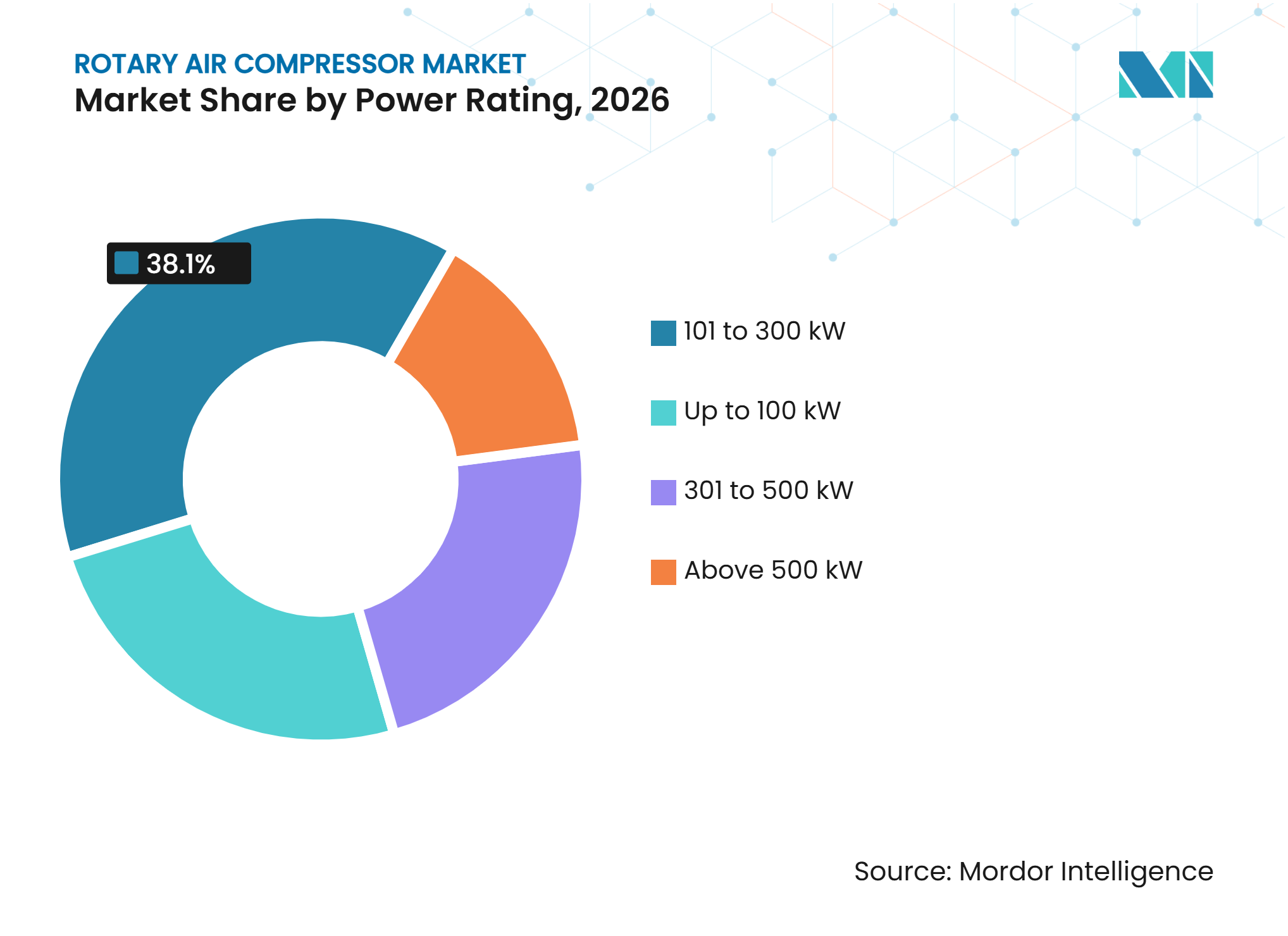
The 101–300 kW Range Anchors Revenue While Above-500-kW Units Serve Process ProjectsThe 101 to 300 kW range accounts for 38.1% of the rotary air compressor market revenue in 2026. It serves mid-size discrete and process manufacturers in automotive components, food processing, textiles, and general engineering. This range has a broad installed base and remains central to replacement demand because it matches common production requirements without the complexity of very large systems. Competition among Atlas Copco AB, Ingersoll Rand Incorporated, Kaeser Kompressoren SE, ELGi Equipments Limited, and Kaishan Compressor Manufacture Company Limited keeps product efficiency and connectivity under active development. The up-to-100 kW range supports smaller industrial operations and emerging-market users, with high unit volume but lower revenue concentration than larger equipment.
Above-500-kW systems are forecast to grow at a 5.6% CAGR through 2032. LNG terminals, hydrogen facilities, and semiconductor fabrication plants require large volumes of continuous utility air. Atlas Copco AB introduced its ZGH 100-200 VSD+ high-pressure oil-free booster in October 2025 with an IE5 permanent-magnet motor and a 20 to 100% load range. This product reflects supplier attention to high-capacity, high-purity applications. The 301 to 500 kW range remains relevant to petrochemical, mining, and steel sites, where demand is more closely tied to capital spending cycles and project timing determines equipment purchases.
By End-User Industry:
Manufacturing Provides the Largest Base While Healthcare Has the Strongest Growth RateManufacturing holds 39.5% of the rotary air compressor market size in 2026. Automotive, metal fabrication, electronics assembly, plastics, rubber, and packaging all use compressed air across a wide range of production tasks. Oil and gas, power generation, chemicals, and petrochemicals form another high-value group for larger stationary and water-cooled units. Mining and construction support demand for portable systems. Food and beverage operations increasingly select oil-free air for product-contact processes, where contamination control is part of routine quality management. This end-user mix keeps demand distributed across several industrial activities.
Healthcare is forecast to grow at a 7.1% CAGR through 2032. Hospital expansion in Asia-Pacific and the Middle East, pharmaceutical capacity additions, and global surgical demand support this rate. ISO 7396-1 establishes requirements for medical gas pipeline systems, including compressed-air quality in hospital central air stations. These requirements support the use of oil-free equipment in medical applications. Older hospitals in North America and Europe generate replacement demand, while new facilities create first-installation demand for central systems designed around current air-quality requirements. The rotary air compressor market benefits from healthcare demand being driven by compliance and infrastructure needs rather than general industrial cycles alone.
Geography Analysis
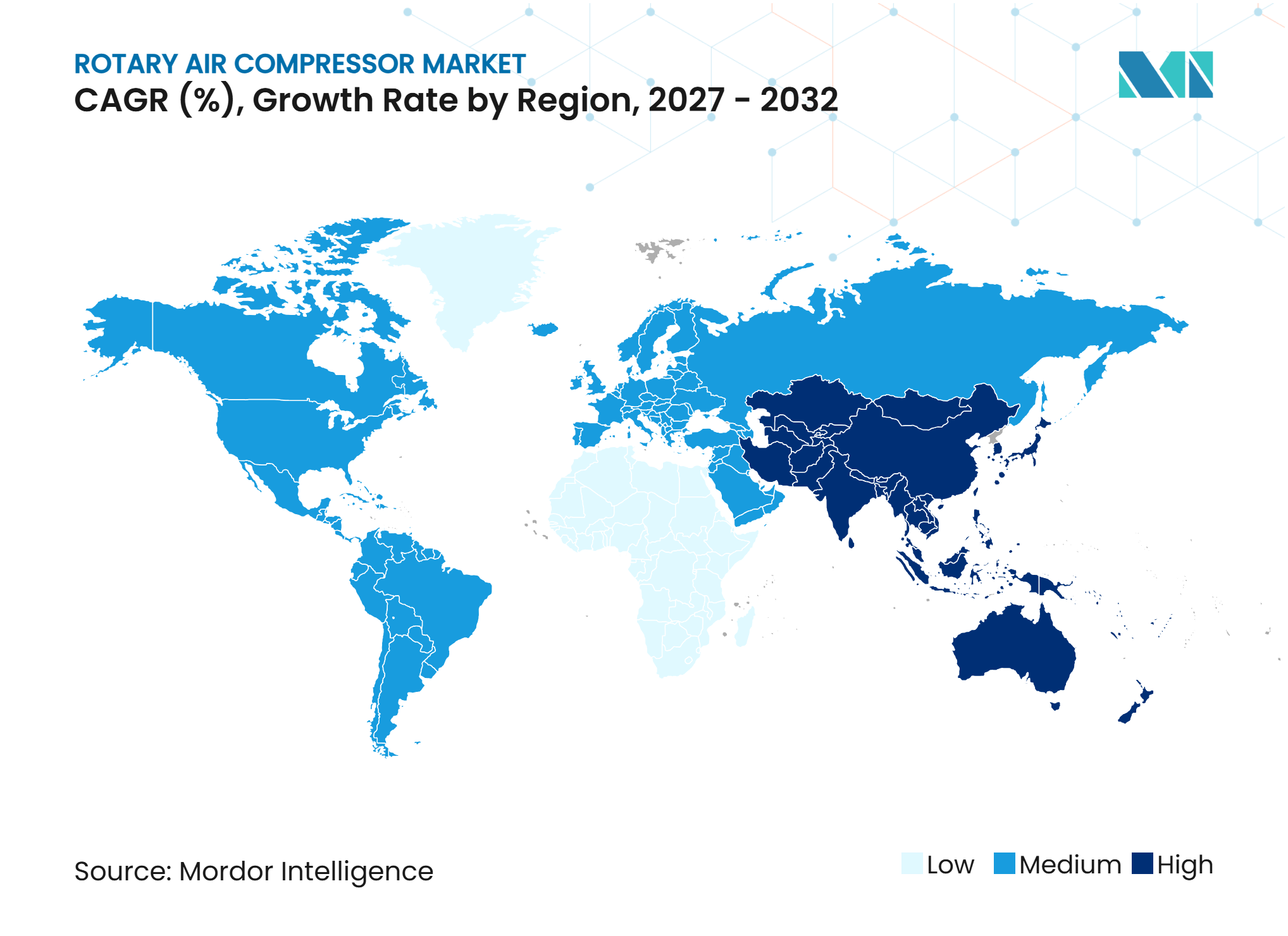
Asia-Pacific held 42.6% of the rotary air compressor market share in 2026 and is forecast to grow at a 5.7% CAGR through 2032. China remains the region's largest market, as efficiency standards are shifting procurement toward variable-speed equipment. China's 2025 standard for evaluating compressed-air-station energy performance reflects greater attention to air-system efficiency. In November 2025, Hitachi Industrial Equipment Systems opened a facility in Gandhi Nagar, Gujarat, to produce stationary oil-flooded screw compressors locally. Local production supports competitive pricing, parts sourcing, after-sales service, and shorter response times for customers in India. Vietnam, Indonesia, and Thailand are also seeing first-installation demand driven by manufacturing relocation in textiles, electronics, and food processing.
North America is a mature rotary air compressor market where energy regulations and variable-speed replacements are important demand factors. U.S. efficiency requirements effective in 2025 influence procurement decisions for covered compressor equipment. Kaeser Compressors began an 80,000-square-foot expansion in Fredericksburg, Virginia, in April 2025 for the assembly of custom compressed-air, blower, and vacuum systems.[4] Semiconductor investments and battery facilities are creating demand for large oil-free systems and multi-unit contracts. Canada and Mexico add demand from automotive and energy applications, with project spending and production investment affecting the timing of new orders. Mexico remains more price-sensitive and has greater use of oil-flooded systems.
Europe's market is shaped by ecodesign policy, energy-performance requirements, and interest in heat recovery from compressed-air plants. The European Commission's review of requirements for motors and variable-speed drives may affect equipment specifications later in the forecast period. Germany, France, the United Kingdom, and Italy remain key markets due to their automotive, chemical, and precision-machinery activity. Elgi Equipments Limited has expanded its two-stage oil-free range in Europe across 75 kW to 160 kW. In South America, Brazil's oil and gas, food-processing, and mining sectors drive demand. The Middle East and Africa are supported by petrochemical additions and healthcare infrastructure investment, diversifying regional demand.
Competitive Landscape
Market Concentration

The global rotary air compressor market is semi-consolidated in premium equipment, while regional suppliers remain active in mid-range and value segments. Atlas Copco, Ingersoll Rand, Kaeser Compressors, and Elgi Equipments Limited compete on oil-free capability, service coverage, and compliance support. Certified clean-air products and national efficiency standards raise requirements for suppliers serving pharmaceutical and semiconductor customers. Atlas Copco inaugurated its Compressor Technique Wuxi Campus in May 2025, a CNY 3 billion investment that includes a logistics center, training center, and customer service hubs. In April 2026, the company began operations at a new Wuxi compressor and power-technique factory with annual capacity of 10,020 compressors. These developments reflect a focus on localized production and proximity to Asia-Pacific customers.
Elgi Equipments Limited is pursuing a two-brand approach that separates premium industrial equipment from its VAYU offering for India's smaller manufacturers. In August 2026, Elgi Equipments Limited launched VAYU with 5 kW to 45 kW fixed- and variable-speed rotary screw compressors for Indian MSMEs. Kaishan Compressor is expanding manufacturing closer to demand centers. Its Izmir, Turkey, compressor plant began production in June 2026, establishing a supply base for Europe and the Middle East. Kaishan Compressor also opened a USD 11 million phase 2 expansion in Alabama in September 2025, which includes oil-free screw-compressor element production and testing lines. The rotary air compressor market rewards both global scale and local channel coverage.
Suppliers are also strengthening their service positions through remote monitoring and predictive maintenance. A 2025 peer-reviewed study found that AI-enabled condition monitoring can support real-time adaptation and early fault detection in compressor systems. Atlas Copco's Elektronikon and Sullair's AirLinx illustrate the broader shift toward connected equipment platforms. Service contracts can be more valuable than equipment-only sales when suppliers demonstrate energy and uptime benefits through documented operating data and reliable maintenance response. Oil-free certification and efficiency compliance remain significant barriers for smaller suppliers that lack test capability.
Rotary Air Compressor Industry Leaders
-
Atlas Copco AB
-
Ingersoll Rand Inc.
-
Kaeser Kompressoren SE
-
Sullair, LLC
-
ELGi Equipments Limited
- *Disclaimer: Major Players sorted in no particular order
Rotary Air Compressor Market Companies Covered in this Report
- ALMiG Kompressoren GmbH
- Atlas Copco AB
- BAUER Kompressoren GmbH
- Boge Kompressoren Otto Boge GmbH & Co. KG
- ELGi Equipments Limited
- FS-Curtis
- Fusheng Industrial Co., Ltd.
- Gardner Denver, Inc.
- Hanbell Precise Machinery Co., Ltd.
- Hitachi Industrial Equipment Systems Co., Ltd.
- Ingersoll Rand Inc.
- Kaeser Kompressoren SE
- Kaishan Compressor Co., Ltd.
- Kirloskar Pneumatic Company Limited
- Kobe Steel, Ltd.
- Mattei Compressors, Inc.
- Quincy Compressor LLC
- Sullair, LLC
- Sullivan-Palatek, Inc.
- Tamrotor Kompressors Oy
Recent Industry Developments in Rotary Air Compressor Market
- August 2026: ELGi Equipments launched VAYU, a Made-in-India compressed air brand targeting India's MSME manufacturing sector. The initial portfolio includes 5-45 kW fixed-speed and variable-speed rotary screw air compressors operating at pressures up to 12.5 bar.
- June 2026: Kaishan Group commissioned a new compressor manufacturing facility in Izmir, Türkiye. The plant includes complete production capabilities for rotary screw compressors, covering airend manufacturing, compressor assembly, and performance testing. It serves as a production hub for European and Middle Eastern markets.
- November 2025: Hitachi Industrial Equipment Systems opened its Gandhi Nagar, Gujarat manufacturing facility and began local production of stationary oil-flooded screw air compressors in India.
- September 2025: Atlas Copco introduced the ZGH 100-200 VSD+, a high-pressure oil-free rotary screw booster compressor capable of delivering pressures up to 30 bar. Designed for semiconductor, pharmaceutical, PET bottle production, and food processing applications, the compressor incorporates an IE5 permanent magnet motor and an integrated variable-speed drive.
Global Rotary Air Compressor Market Report Scope
A rotary air compressor is a positive-displacement machine that uses rotating mechanisms, such as interlocking screws, vanes, or lobes, to continuously trap and compress air within a casing. Unlike reciprocating compressors that rely on pistons moving up and down, these systems provide a smooth, pulse-free flow of pressurized air with minimal vibration and noise. They are highly efficient, require less maintenance, and are widely engineered for demanding, heavy-duty industrial applications that require a continuous and steady supply of compressed air.
The global rotary air compressor market is segmented by type, technology, portability, cooling method, power rating, end-user industry, and geography. By type, the market is segmented into rotary screw, rotary vane, rotary scroll, and other rotary types. By technology, the market is segmented into oil-flooded and oil-free compressors. By portability, the market is segmented into stationary and portable compressors. By cooling method, the market is segmented into air-cooled and water-cooled compressors. By power rating, the market is segmented into up to 100 kW, 101 to 300 kW, 301 to 500 kW, and above 500 kW. By end-user industry, the market is segmented into manufacturing, oil and gas, power generation, chemicals and petrochemicals, mining and construction, food and beverage, healthcare, and other industries. The report also covers the market size and forecasts for the global rotary air compressor market across 26 countries in key regions. For each segment, the market sizing and forecasts are provided on the basis of value (USD).
Segmentation Overview
| Rotary Screw |
| Rotary Vane |
| Rotary Scroll |
| Other Rotary Types |
| Oil-Flooded |
| Oil-Free |
| Stationary |
| Portable |
| Air-Cooled |
| Water-Cooled |
| Up to 100 kW |
| 101 to 300 kW |
| 301 to 500 kW |
| Above 500 kW |
| Manufacturing |
| Oil and Gas |
| Power Generation |
| Chemicals and Petrochemicals |
| Mining and Construction |
| Food and Beverage |
| Healthcare |
| Others |
| North America | United States |
| Canada | |
| Mexico | |
| Europe | Germany |
| France | |
| Italy | |
| Spain | |
| United Kingdom | |
| Poland | |
| Russia | |
| Rest of Europe | |
| Asia-Pacific | China |
| India | |
| Japan | |
| South Korea | |
| Australia | |
| Indonesia | |
| Vietnam | |
| Thailand | |
| Rest of Asia-Pacific | |
| South America | Brazil |
| Argentina | |
| Chile | |
| Rest of South America | |
| Middle East and Africa | Saudi Arabia |
| United Arab Emirates | |
| Egypt | |
| South Africa | |
| Morocco | |
| Rest of Middle East and Africa |
| By Type | Rotary Screw | |
| Rotary Vane | ||
| Rotary Scroll | ||
| Other Rotary Types | ||
| By Technology | Oil-Flooded | |
| Oil-Free | ||
| By Portability | Stationary | |
| Portable | ||
| By Cooling Method | Air-Cooled | |
| Water-Cooled | ||
| By Power Rating | Up to 100 kW | |
| 101 to 300 kW | ||
| 301 to 500 kW | ||
| Above 500 kW | ||
| By End-User Industry | Manufacturing | |
| Oil and Gas | ||
| Power Generation | ||
| Chemicals and Petrochemicals | ||
| Mining and Construction | ||
| Food and Beverage | ||
| Healthcare | ||
| Others | ||
| By Geography | North America | United States |
| Canada | ||
| Mexico | ||
| Europe | Germany | |
| France | ||
| Italy | ||
| Spain | ||
| United Kingdom | ||
| Poland | ||
| Russia | ||
| Rest of Europe | ||
| Asia-Pacific | China | |
| India | ||
| Japan | ||
| South Korea | ||
| Australia | ||
| Indonesia | ||
| Vietnam | ||
| Thailand | ||
| Rest of Asia-Pacific | ||
| South America | Brazil | |
| Argentina | ||
| Chile | ||
| Rest of South America | ||
| Middle East and Africa | Saudi Arabia | |
| United Arab Emirates | ||
| Egypt | ||
| South Africa | ||
| Morocco | ||
| Rest of Middle East and Africa | ||
Key Questions Answered in the Report
What is the forecast for the rotary air compressor market?
The market is projected to grow from USD 12.42 billion in 2026 to USD 16.12 billion by 2032, at a CAGR of 4.41% between 2027 and 2032.
Which compressor type leads demand?
Rotary screw compressors accounted for 68.2% of revenue in 2026, driven by their ability to support continuous industrial airflow requirements.
Which technology is growing faster?
Oil-free systems are forecast to grow at a CAGR of 5.2% through 2032, driven by requirements in the pharmaceutical, food, and semiconductor industries.
Which end-user segment grows fastest?
Healthcare is forecast to grow at a CAGR of 7.1% through 2032, as hospitals and pharmaceutical facilities require compliant, oil-free compressed air systems.
Which region has the largest demand?
Asia-Pacific holds 42.6% of market value in 2026 and is forecast to grow at a CAGR of 5.7% through 2032.
What affects rotary compressor buying decisions?
Equipment selection is shaped by energy efficiency regulations, oil-free air requirements, connected monitoring capabilities, initial cost, and raw material cost volatility.