
Religious Tourism Market Size and Share
Market Overview
| Study Period | 2022 - 2031 |
|---|---|
| Market Size (2026) | USD 257.82 Billion |
| Market Size (2031) | USD 352.45 Billion |
| Growth Rate (2026 - 2031) | 6.45 % |
| Fastest Growing Market | Asia-Pacific |
| Largest Market | Europe |
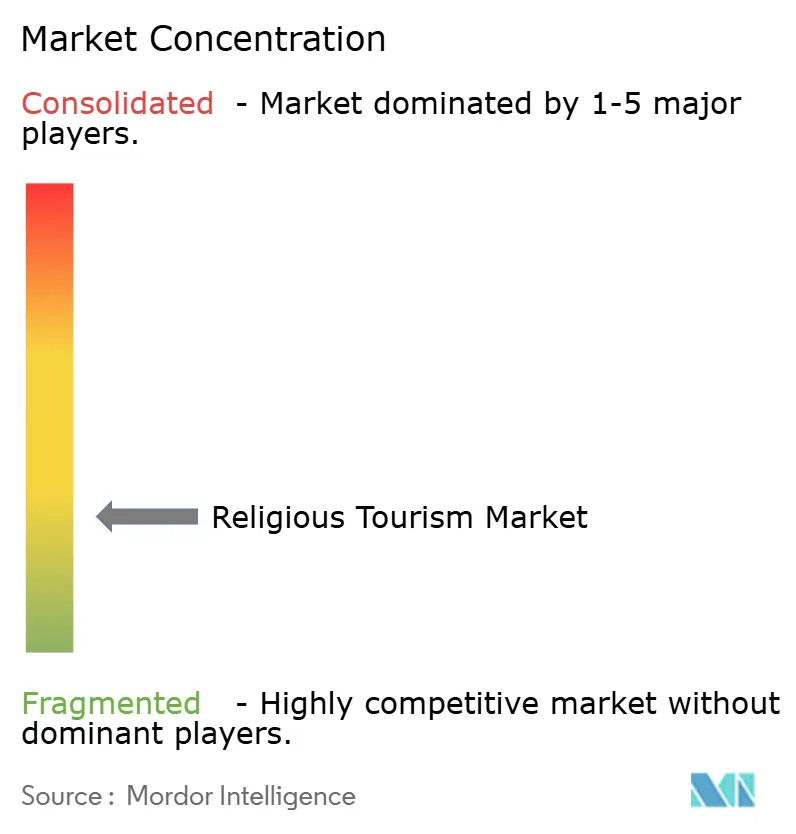
| Market Concentration | Low |
Major Players *Disclaimer: Major Players sorted in no particular order Image © Mordor Intelligence. Reuse requires attribution under CC BY 4.0. | |
Religious Tourism Market Analysis by Mordor Intelligence
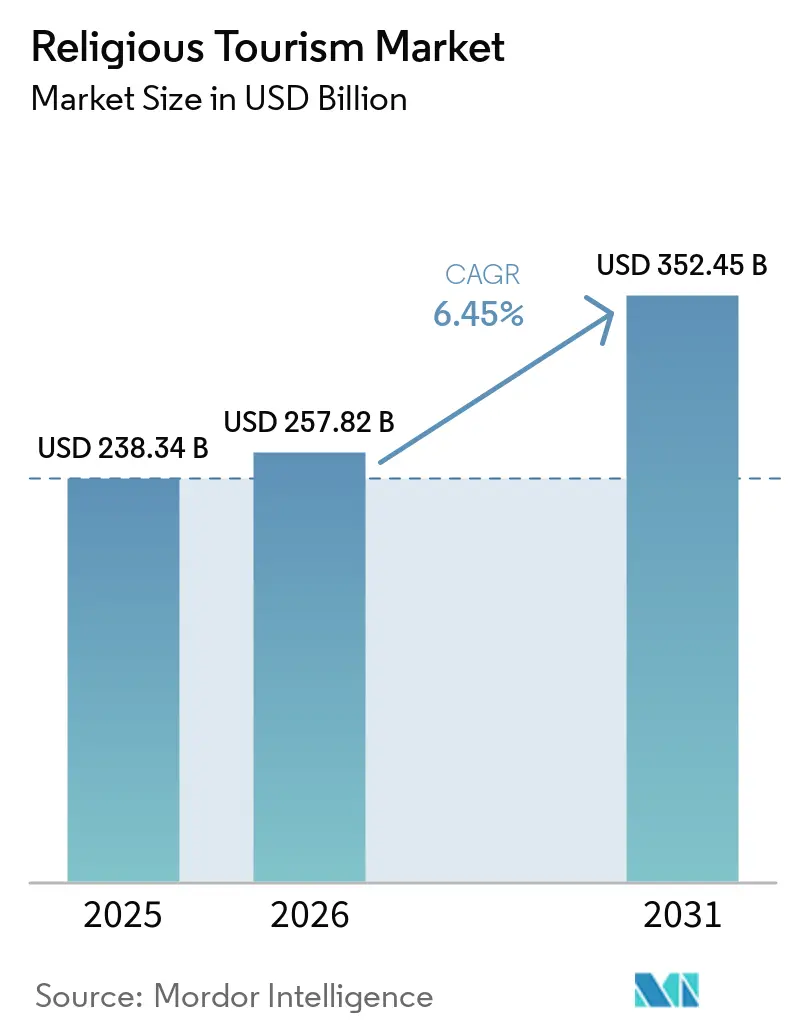
The Religious Tourism Market size is projected to be USD 238.34 billion in 2025, USD 257.82 billion in 2026, and reach USD 352.45 billion by 2031, growing at a CAGR of 6.45% from 2026 to 2031.
The religious tourism market continues to rest on a broad volume base because most pilgrims' travel is still domestic, short-haul, and organized through local religious or community networks rather than through fully international leisure channels. Public investment in access roads, rail links, temple corridors, and pilgrim amenities is widening the usable catchment for sacred destinations, especially in India and Saudi Arabia, and that is improving throughput as well as spend per traveler Digital platforms are also reshaping the religious tourism market because booking, permits, health monitoring, and pilgrim guidance are moving onto integrated systems, which makes distribution faster but also raises the bar for private intermediaries. Large festival cycles and Holy Year events keep demand elevated across the religious tourism market, while premium services such as aerial darshan access, curated itineraries, and higher-end stays are creating more pricing headroom for operators. The main drag on growth remains uneven site resilience, because climate disruption, stricter pilgrimage quotas, and tighter access controls can quickly interrupt volume even when underlying demand remains strong.[1]
Key Report Takeaways
- By religion type, Christianity held 33.1% of the religious tourism market share in 2025, while Islam recorded the fastest projected growth at a 7.2% CAGR through 2031.
- By booking channel, direct booking accounted for 42.2% of the religious tourism market size in 2025, while online travel platforms are forecast to expand at a 7.6% CAGR through 2031.
- By expenditure type, accommodation captured 31.4% of the religious tourism market share in 2025, while transportation is advancing at an 8.8% CAGR through 2031.
- By tourist type, domestic travelers held 73.5% of the religious tourism market size in 2025, while international travelers are projected to grow at an 8.1% CAGR through 2031.
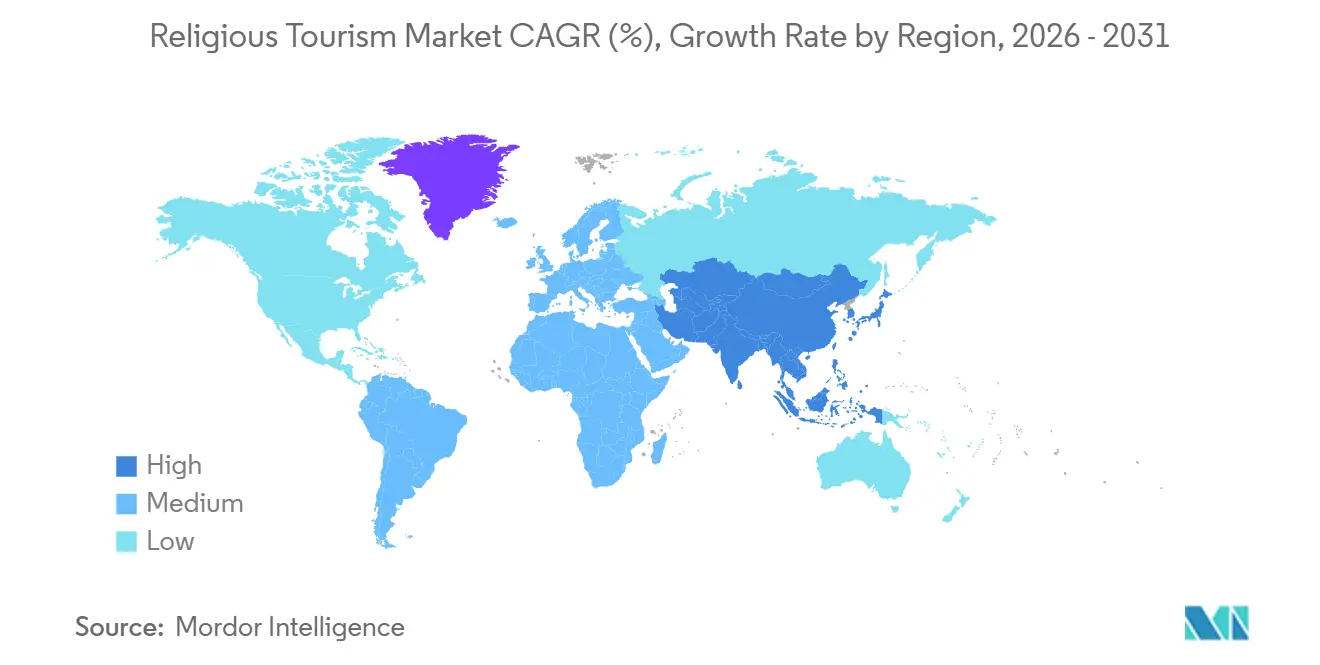
- By geography, Europe led with 32.2% of the religious tourism market share in 2025, while Asia-Pacific is projected to expand at an 8% CAGR through 2031.
Note: Market size and forecast figures in this report are generated using Mordor Intelligence’s proprietary estimation framework, updated with the latest available data and insights as of January 2026.
Market Trends and Insights
Drivers Impact Analysis of Religious Tourism Market*
| Drivers | (~) % Impact on CAGR Forecast | Geographic Relevance | Impact Timeline |
|---|---|---|---|
| Rising Demand for Spiritual Well-being Travel | +1.8% | Global, with early concentration in India, Southeast Asia, and Europe | Medium term (2-4 years) |
| Expansion of Domestic Pilgrimage Corridors | +1.4% | India, Saudi Arabia, Spain, Italy | Short term (≤ 2 years) |
| Government-Led Pilgrimage Infrastructure and Visa Facilitation | +1.1% | India, Saudi Arabia, ASEAN core, spill-over to the Middle East and Africa | Medium term (2-4 years) |
| Digital Booking and Pilgrim Management Platforms | +0.9% | Global, the highest adoption in the Asia-Pacific and Middle East | Short term (≤ 2 years) |
| Festival-Linked Travel Demand | +0.7% | India, Italy, Spain, Indonesia | Short term (≤ 2 years) |
| Group-Based and Family Pilgrimage Travel | +0.5% | India, Southeast Asia, North Africa | Medium term (2-4 years) |
| Source: Mordor Intelligence | |||
Rising Demand for Spiritual Well-being Travel
Spiritual travel is moving beyond strict ritual obligation and is increasingly being planned around rest, meaning, cultural connection, and shared experience. In India, Booking.com data showed that 1 in 3 travelers planned a spiritual trip in 2025, while 32% of Millennials and 34% of Gen Z were already including such destinations in their travel plans, suggesting a broader age mix entering the religious tourism market. The same source also noted that 62% of these travelers wanted premium accommodation at pilgrimage destinations, which suggests that demand is shifting from basic access toward comfort and experience quality. In India, PHDCCI views described spiritual tourism as moving from a ritual-centered activity toward an integrated ecosystem of faith, culture, wellness, and leisure, and that widens monetization across lodging, transport, guided services, and local commerce. This change matters for the religious tourism market because younger travelers are not replacing traditional pilgrims; they are expanding the base and raising expectations for service quality.
Expansion of Domestic Pilgrimage Corridors
Domestic corridor expansion is becoming one of the clearest near-term demand enablers in the religious tourism market, as it reduces journey friction without relying on international traffic. In India, the Uttar Pradesh government allocated INR 4,560 crore (USD 544 million) in FY2025-26 to upgrade road links across Ayodhya, Varanasi, Mathura, Prayagraj, and other major faith destinations. The central government also granted in-principle approval in 2026 for an INR 12,000 crore (USD 1.41 billion) elevated four-lane corridor to Srisailam, which is expected to reduce travel time and improve access through a sensitive forest zone. In Saudi Arabia, the Haramain High-Speed Railway added 2 million seats in 2025 and was already moving nearly 70% of international Umrah pilgrims between Jeddah, Makkah, and Madinah in under 45 minutes, which shows how direct connectivity can reshape pilgrimage throughput for the religious tourism market, corridor development does more than lift footfall, it also extends trip viability for elderly travelers, family groups, and shorter-duration domestic pilgrims.[2]
Government-Led Pilgrimage Infrastructure and Visa Facilitation
Government spending has shifted from a supporting role to a central growth lever in the religious tourism market, especially where pilgrimage is tied to regional development and domestic mobility. In India, more than INR 13,000 crore (USD 1.55 billion) had been deployed across spiritual tourism-linked schemes since 2014, while 54 projects across 28 states were sanctioned under the PRASHAD scheme alone, with an outlay of INR 1,726 crore (USD 206 million). In January 2026, the Ministry of Tourism announced a Cultural Corridor under PRASHAD, which added another policy layer for linked pilgrimage and heritage development across states and union territories. Saudi Arabia has paired physical infrastructure with regulated access management, and that combination has strengthened planning discipline around Hajj and Umrah even while it raises compliance requirements for operators. The result is that the religious tourism market is increasingly shaped by state capacity, because governments now influence access, safety, distribution, and destination readiness at the same time.
Digital Booking and Pilgrim Management Platforms
Digital systems are changing how the religious tourism market is booked, monitored, and serviced across both public and private channels. Saudi Arabia’s Nusuk platform had expanded to 51 million users across 190 countries by April 2026, and annual downloads were growing at 150%, demonstrating how quickly official digital channels can scale when they combine permits, bookings, support, and compliance in a single interface. In India, MakeMyTrip reported that accommodation bookings across 56 pilgrimage destinations rose 19% in FY2024-25, while searches for religious destinations were 46% higher in 2024 than in 2022, and pilgrimage cities accounted for more than 10% of total room nights sold in Q3 FY25. EaseMyTrip’s EasyDarshan expansion across Char Dham, Jyotirlingas, and Shaktipeeths in FY26 shows that private platforms are responding by building more specialized, temple-linked products rather than competing solely on generic travel inventory. That trend matters because the religious tourism market is no longer just adding digital booking; it is moving toward platform-led control over the pilgrim journey from discovery to on-ground assistance.
Restraints Impact Analysis of Religious Tourism Market*
| Restraints | (~) % Impact on CAGR Forecast | Geographic Relevance | Impact Timeline |
|---|---|---|---|
| Visa Tightening and Pilgrimage Quotas | -0.5% | Middle East, ASEAN, North Africa | Short term (≤ 2 years) |
| Security Risks and Religious Tensions | -0.4% | Middle East, parts of Middle East and Africa, South Asia | Medium term (2-4 years) |
| Overcrowding and Heritage Site Wear | -0.3% | Europe, India, Italy | Medium term (2-4 years) |
| Climate And Weather Disruption at Sacred Sites | -0.4% | India, Middle East, Southeast Asia, Spain | Long term (≥ 4 years) |
| Source: Mordor Intelligence | |||
Visa Tightening and Pilgrimage Quotas
Quota systems and tighter visa rules remain a direct supply constraint for the religious tourism market because they limit how much of the underlying demand can actually convert into travel. Saudi Arabia’s Hajj quota structure still allocates access country by country, with Indonesia receiving 221,000 places, Pakistan 179,000, and India 175,000 for 2026, which shows how capacity is managed before operators begin packaging demand. In 2026, the Kingdom also suspended Umrah visas from April 13 through May 31 for non-Hajj visa holders and imposed fines of up to SAR 20,000 (USD 5,333) with 10-year entry bans for violations. These measures support safety and crowd control, but they also increase planning risk for operators that rely on group scheduling, cross-border bookings, and fixed travel windows. In the religious tourism market, quota tightening does not reduce interest, but it does cap near-term conversion and pushes more value toward compliance-driven service providers.
Security Risks and Religious Tensions
Security shocks can quickly disrupt the religious tourism market because pilgrimage flows depend heavily on perceived safety, corridor stability, and official travel confidence. The Holy Land illustrates this clearly, because Christian pilgrimage arrivals were estimated to have dropped significantly from the pre-2020 peak of 4.5 million, with revenue losses in the regional tourism sector exceeding ILS 17.4 billion (USD 5.8 billion) annually due to persistent instability. When security conditions deteriorate, operators face not only fewer travelers but also insurance friction, itinerary changes, and lower willingness among family groups and elderly pilgrims to commit in advance. This effect is especially relevant in the religious tourism market because many routes are tied to fixed sacred sites that cannot be substituted easily with nearby alternatives. Even when global demand remains healthy, localized tensions can redirect flows sharply toward safer destinations with stronger access assurance and better communication systems.
*Our forecasts treat driver/restraint impacts as directional, not additive. The impact forecasts reflect baseline growth, mix effects, and variable interactions.
Religious Tourism Market Segment Analysis
By Religion Type:
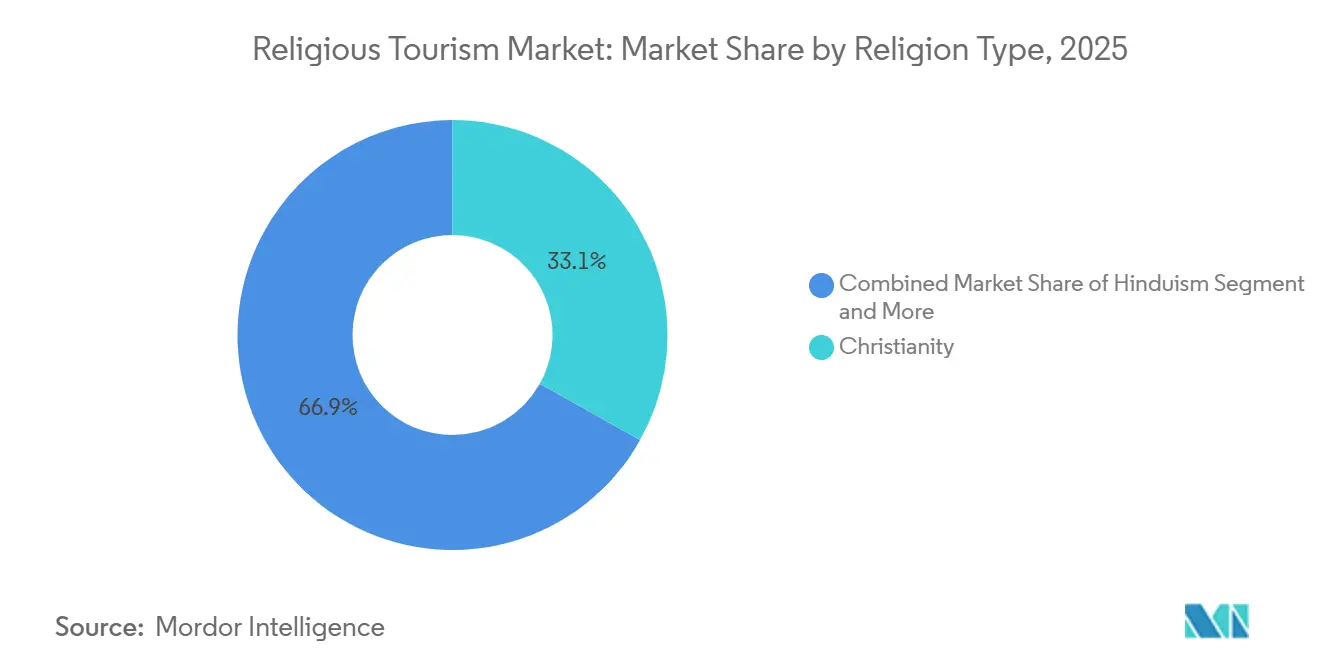
Christianity Anchors Market, Islam Drives Next Growth PhaseChristianity held 33.1% of the religious tourism market share in 2025, which made it the largest religion-based segment by value and traveler concentration. Rome’s Catholic Jubilee Year alone brought in 33.5 million pilgrims from 185 countries, well above the earlier Holy Year record of 25 million, and public preparation for the event included EUR 3.7 billion (USD 4.32 billion) in civic and infrastructure investment. The Lourdes Sanctuary in France also remained a major pilgrimage destination, with 3.2 million pilgrims and visitors recorded in 2024, and broader participation from nationalities such as Indonesian and Polish travelers during the Jubilee period. This leadership reflects the density of established Christian routes, churches, shrines, and municipal support systems across Europe and the Americas. Within the religious tourism market, Christianity benefits from mature route branding, strong repeat visitation, and a wide mix of domestic, regional, and long-haul inbound travelers.
Hinduism remains a major contributor to the religious tourism market, as large domestic circuits and periodic mega-events reinforce demand. The Maha Kumbh Mela 2025 drew 660 million attendees, which confirmed how Hindu pilgrimages can create temporary demand concentrations that few travel categories can match. Buddhism continues to support a strong intra-Asia movement, especially across Thailand, Japan, and Sri Lanka, while multi-faith itinerary design is widening the appeal of combined cultural and spiritual circuits. Islam is the fastest-growing religion in the religious tourism market, and its market size is forecast to grow at a 7.2% CAGR through 2031. Saudi Arabia processed 18.5 million pilgrims in 2024, including 16.9 million Umrah travelers and 1.61 million Hajj pilgrims, while Muslim international arrivals reached 196 million in 2025, providing the Islamic segment with a strong volume runway.

By Booking Channel:
Direct Booking Dominant, OTAs AcceleratingDirect bookings accounted for 42.2% of the religious tourism market in 2025, keeping it ahead of both travel agencies and online travel platforms. This channel remains strong because many pilgrimages are still organized by temple trusts, church groups, dioceses, mosques, pilgrimage committees, and government-backed booking systems that operate within known community structures. In India, that pattern is particularly important because trust, familiarity, and group reassurance still influence booking behavior more strongly than price alone on many circuits. Travel agencies and tour operators remain relevant when international visas, multiple stopovers, language support, and ground coordination increase trip complexity. The religious tourism market, therefore, continues to support a layered channel structure in which direct institutional access dominates volume, but intermediaries still matter for service depth and itinerary management.
Travel agencies and tour operators remain an important middle layer, especially where pilgrims seek comfort upgrades, guided access, or packaged multi-destination travel. Thomas Cook India and SOTC Travel expanded their spiritual offerings in August 2025 with aerial darshans and VIP access programs across Char Dham, Kailash Mansarovar, Ayodhya, Dwarka, Vaishno Devi, and Tirupati, demonstrating how organized sellers are trying to defend their role through differentiated products. Online travel platforms are the fastest-growing booking channel in the religious tourism market and are projected to expand at a 7.6% CAGR through 2031. MakeMyTrip’s rise in pilgrimage searches and room-night share shows that mainstream online channels are now handling a meaningful share of faith-linked accommodation demand in India. The larger shift is that official platforms like Nusuk are collapsing booking and compliance into a single system, which means private intermediaries must compete on better curation, advisory quality, and local execution rather than on access alone.
By Expenditure Type:
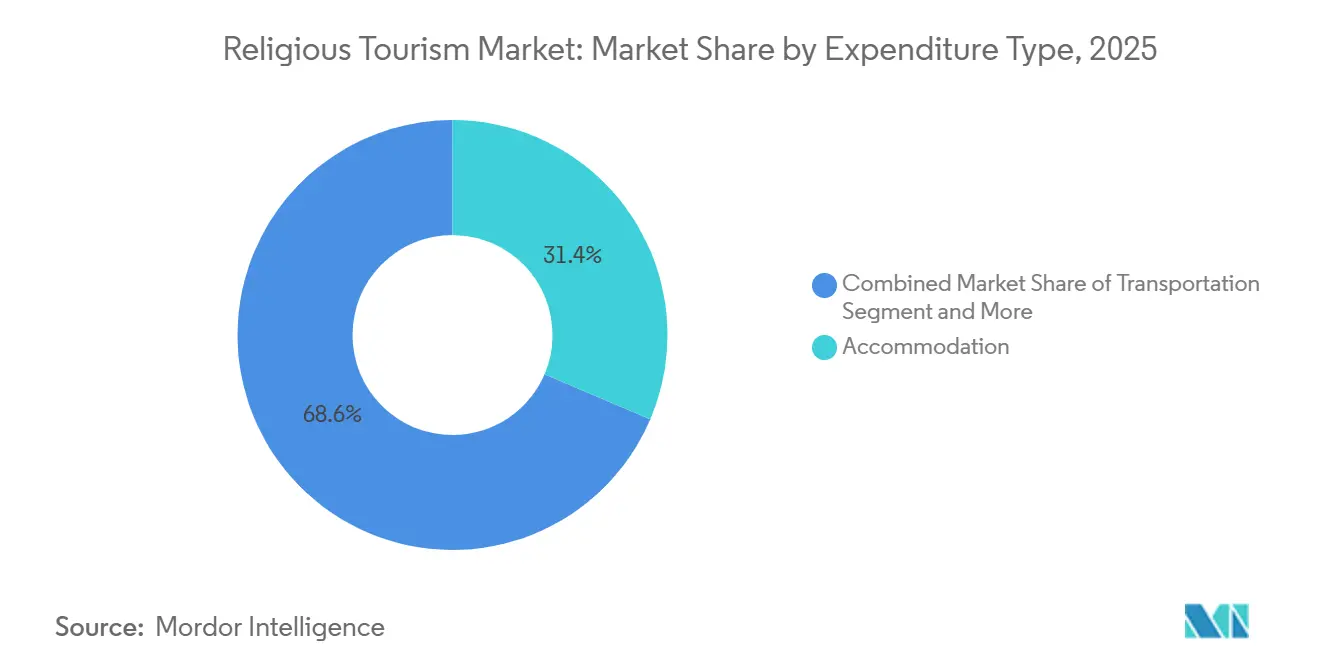
Accommodation Leads, Transportation Rewrites Access EconomicsAccommodation held 31.4% of the religious tourism market share in 2025, which kept lodging as the largest expenditure category across the pilgrim journey. This reflects the importance of site proximity, duration of stay, comfort tier, and the ability to handle group blocks at peak periods. In Saudi Arabia, the Rua Al Madinah development is expected to add more than 47,000 hotel rooms by 2030 and raise simultaneous guest capacity to 149,000, which highlights the scale of investment flowing into faith-linked hospitality. Premium stay preferences are also becoming more visible in India, where more than 60% of spiritual travelers indicated interest in higher-end accommodations, suggesting that pilgrim lodging is shifting beyond a purely functional role. Food and beverage, as well as religious offerings and donations, remain smaller categories in terms of share. Still, they are stable because they are linked closely to ritual practices, local participation, and multi-day travel needs.
Transportation is the fastest-growing expenditure category in the religious tourism market and is projected to rise at an 8.8% CAGR through 2031. That acceleration reflects the investment shift toward road, rail, and corridor-based access, which can unlock larger destination catchments without relying solely on hotel supply to expand. India’s religious tourism market size for transportation is being supported by corridor investments such as the INR 4,560 crore route upgrade program in Uttar Pradesh and the INR 12,000 crore Srisailam elevated corridor in Andhra Pradesh and Telangana. The change is important because easier access expands the pool of feasible travelers to elderly pilgrims, shorter-duration travelers, and family groups who previously faced mobility barriers. Ancillary services such as guided tours, wellness add-ons, and digital pilgrim support are also growing as operators unbundle the experience to match different spending profiles.
By Tourist Type:
Domestic Pilgrims Drive Volume, International Segment Grows FastestDomestic tourists accounted for 73.5% of the religious tourism market in 2025, confirming that local and intra-country journeys remain the backbone of the category. This pattern is especially pronounced in India, Saudi Arabia, and Spain, where dense pilgrimage networks and recurring faith calendars support repeat travel without the friction of visas or long-haul costs. In India, the opportunity in spiritual tourism was estimated at USD 59 billion by 2028, while accommodation bookings across 56 pilgrimage destinations grew by 19% in FY2024-25, underscoring the size of the domestic market. In Spain, ObservaTUR estimated that 15-20 million citizens travel annually for religious purposes, led by the Camino de Santiago, Semana Santa, and major sanctuaries such as El Rocío and Montserrat. For the religious tourism market, strong domestic demand also adds resilience, as local demand often recovers faster than international travel after weather, policy, or geopolitical disruptions.
International tourists are the fastest-growing segment of the religious tourism market and are forecast to expand at a 8.1% CAGR through 2031. The Camino de Santiago welcomed 530,998 pilgrims in 2025 from 198 nationalities, with especially strong growth from Brazil and Mexico, indicating that heritage routes are attracting broader long-haul demand. At the Vatican Jubilee, visitors from the United States formed the second-largest national group after Italians. They accounted for nearly 13% of all registered pilgrims, confirming the strength of outbound religious travel from North America. Italy’s Via Francigena also showed that international walkers now account for 53% of credential recipients, which signals that route branding and multilingual infrastructure are widening the foreign base. The fastest gains in the religious tourism market, therefore, appear where route visibility, access infrastructure, and visitor services improve together rather than in isolation.[3]
Geography Analysis
Europe and North America Religious Tourism Market
Europe led the religious tourism market with 32.2% share in 2025, supported by its dense concentration of shrines, cathedrals, monasteries, heritage corridors, and municipally supported pilgrimage routes. France alone receives 51 million annual visitors to religious sites, including 20 million international travelers. In comparison, Saint Peter's Basilica in Italy draws an estimated 11 million visitors each year, which shows the region's scale and maturity. Rome's 2025 Jubilee then lifted the region further by drawing 33.5 million pilgrims from 185 countries and unlocking EUR 3.7 billion (USD 4.32 billion) in support of public investment. Spain is also strengthening its role through the Camino de Santiago and a run of Jubilee-linked religious milestones leading into Xacobeo 2027, which keeps Europe visible to both domestic and international pilgrims. North America does not lead in destination share, but it remains a significant outbound source, particularly for Rome and the Camino, providing Europe with a stable long-haul feeder base.
APAC and South America Religious Tourism Market
Asia-Pacific is the fastest-growing region in the religious tourism market and is projected to expand at an 8% CAGR through 2031. India is central to that growth, with 19% of Indian travelers planning spiritually motivated trips in 2026, the highest rate among Asian countries covered in Agoda's survey. Indonesia and Malaysia also rank high in spiritual travel intent, underscoring the broader Southeast Asian opportunity tied to Muslim travel and halal-ready infrastructure. South America is still a smaller contributor to the religious tourism market. Still, outbound pilgrim growth from Brazil and domestic Catholic participation in countries such as Peru suggest a gradual broadening of demand despite air connectivity and currency constraints.
MEA Religious Tourism Market
The Middle East and Africa region is shaped by Saudi Arabia's Hajj and Umrah ecosystem, which processed 18.5 million pilgrims in 2024 and remains the world's most systematized pilgrimage platform. The Masar Destination in Makkah had achieved substantial completion of its primary infrastructure phases by the end of 2025, with major hotel and commercial components becoming operational throughout 2026. Hotel markets in Makkah and Madinah also continued to attract new foreign investment in 2026, following reforms that allowed greater overseas participation in property ownership. Africa's role in the religious tourism market remains small, but Hajj quotas, such as Nigeria's 95,000-pilgrim allocation for 2026, underscore the region's outbound importance. Domestic pilgrimage activity across Ethiopia, Egypt, and Morocco is also drawing more attention as analysts track smaller but more locally rooted faith-travel flows.
Competitive Landscape
The religious tourism market remains highly fragmented, with no single operator controlling a dominant cross-segment position across faiths, geographies, and booking channels. Specialist firms built around Catholic pilgrimages, Hajj and Umrah services, and Hindu tirth yatra packages still hold the strongest trust advantage because they understand ritual requirements, group behavior, and destination-specific operating norms. Larger travel brands are responding by creating dedicated spiritual portfolios rather than relying on generic leisure packaging. Thomas Cook India and SOTC Travel expanded spiritual journeys in August 2025 with aerial darshans, VIP access, and premium support layers across major Indian circuits, which shows how branded operators are trying to lift yield per pilgrim instead of only chasing volume. The April 2026 partnership between Eco Hotels and Kesari Tours to expand into Varanasi and Ayodhya points to the same logic, because operators are using shared infrastructure and local demand strength to scale faster in high-footfall sacred cities.
Government-backed digital infrastructure is the most disruptive competitive force in the religious tourism market because it changes both access and distribution at once. Saudi Arabia’s Nusuk platform had reached 51 million users globally by April 2026 and had already absorbed all domestic Hajj package bookings for Hajj 2025, which effectively turned it into both a booking layer and a compliance layer. That makes life harder for private operators whose earlier value rested on documentation support, access coordination, and basic itinerary assembly. To defend their position, operators are moving closer to regulated service niches, charter partnerships, and premium handling capabilities. Akbar Travels’ 2026 memorandum of understanding with Mayfair Jets to co-develop Saudi charter operations is a good example, because it adds controlled air access and a compliance-adjacent capability that is harder to replicate quickly.
The next phase of competition in the religious tourism market is likely to favor players that combine destination access, comfort upgrades, and community trust in one offer. White-space opportunities still exist in faith-based wellness retreats, restoration-linked heritage packages, and multi-faith itineraries, but those formats will need careful curation to avoid diluting religious authenticity. Premiumization is becoming more visible, yet it is not replacing volume travel, because mass domestic pilgrimages still shape the underlying economics of the category. This means the competitive center of gravity remains broad rather than concentrated, with room for both specialist operators and scaled travel platforms. The religious tourism market therefore rewards local partnerships, operational discipline, and route-specific expertise more than simple brand size.
Religious Tourism Industry Leaders
-
Kesari Tours Pvt Ltd.
-
Globus Journeys
-
Catholic Travel Centre
-
206 Tours
-
Thomas Cook
- *Disclaimer: Major Players sorted in no particular order
Religious Tourism Market Companies Covered in this Report
- Thomas Cook
- Kesari Tours Pvt Ltd.
- Holy Voyages Pvt Ltd.
- Holy Land Tours
- Gil Travel Group
- Globus Journeys
- 206 Tours
- Nativity Pilgrimage
- Regina Tours
- Marian Pilgrimages
- Dynamic Catholic Pilgrimages
- Radiant Tours
- Royal Vacations
- Pilgrimage Tours
- Aladdin Tours and Travel
- Abraham Tours
- Shiv Shankar Tirth Yatra
- Akbar Holidays
- AlHaramain Tours
- Al Madina Tour Services
Recent Industry Developments in Religious Tourism Market
- June 2026: The Central Government granted in-principal approval for the INR 12,000 crore (USD 1.2 billion) Srisailam elevated corridor. This 86.74-km four-lane highway linking Andhra Pradesh and Telangana is designed to provide faster access to the Srisailam temple while minimizing ecological impact on the Nallamala forest.
- May 2026: The Maharashtra government reached key administrative milestones for the Nagpur-Goa Shaktipeeth Expressway, including finalization of land acquisition financing through HUDCO, positioning the 802-km project as a major Hindu pilgrimage corridor.
- April 2026: Eco Hotels & Resorts partnered with Kesari Tours to expand its hospitality footprint into Varanasi and Ayodhya, leveraging Kesari’s pilgrimage travel network to meet accelerating demand in these sacred cities.
- January 2026: The Ministry of Tourism reaffirmed its focus on the PRASHAD scheme, emphasizing the ongoing integration of pilgrimage and heritage infrastructure through state-submitted proposals, while clarifying the status of proposed cultural corridors as part of a continuous, merit-based project evaluation process.
Global Religious Tourism Market Report Scope
Segmentation Overview
| Hinduism |
| Christianity |
| Islam |
| Buddhism |
| Other Religion Types |
| Direct Booking |
| Travel Agencies & Tour Operators |
| Online Travel Platforms |
| Accommodation |
| Transportation |
| Food & Beverage |
| Religious Offerings & Donations |
| Other Ancillary Services |
| Domestic Tourists |
| International Tourists |
| North America | United States |
| Canada | |
| Mexico | |
| South America | Brazil |
| Peru | |
| Chile | |
| Argentina | |
| Rest of South America | |
| Europe | United Kingdom |
| Germany | |
| France | |
| Spain | |
| Italy | |
| BENELUX (Belgium, Netherlands, and Luxembourg) | |
| NORDICS (Denmark, Finland, Iceland, Norway, and Sweden) | |
| Russia | |
| Rest of Europe | |
| Asia-Pacific | India |
| China | |
| Japan | |
| Australia | |
| South Korea | |
| South East Asia (Singapore, Malaysia, Thailand, Indonesia, Vietnam, and Philippines) | |
| Rest of Asia-Pacific | |
| Middle East and Africa | United Arab Emirates |
| Saudi Arabia | |
| South Africa | |
| Nigeria | |
| Rest of Middle East and Africa |
| By Religion Type | Hinduism | |
| Christianity | ||
| Islam | ||
| Buddhism | ||
| Other Religion Types | ||
| By Booking Channel | Direct Booking | |
| Travel Agencies & Tour Operators | ||
| Online Travel Platforms | ||
| By Expenditure Type | Accommodation | |
| Transportation | ||
| Food & Beverage | ||
| Religious Offerings & Donations | ||
| Other Ancillary Services | ||
| By Tourist Type | Domestic Tourists | |
| International Tourists | ||
| By Geography | North America | United States |
| Canada | ||
| Mexico | ||
| South America | Brazil | |
| Peru | ||
| Chile | ||
| Argentina | ||
| Rest of South America | ||
| Europe | United Kingdom | |
| Germany | ||
| France | ||
| Spain | ||
| Italy | ||
| BENELUX (Belgium, Netherlands, and Luxembourg) | ||
| NORDICS (Denmark, Finland, Iceland, Norway, and Sweden) | ||
| Russia | ||
| Rest of Europe | ||
| Asia-Pacific | India | |
| China | ||
| Japan | ||
| Australia | ||
| South Korea | ||
| South East Asia (Singapore, Malaysia, Thailand, Indonesia, Vietnam, and Philippines) | ||
| Rest of Asia-Pacific | ||
| Middle East and Africa | United Arab Emirates | |
| Saudi Arabia | ||
| South Africa | ||
| Nigeria | ||
| Rest of Middle East and Africa | ||
Key Questions Answered in the Report
What is the size of the religious tourism sector in 2026?
The religious tourism market size stands at USD 257.82 billion in 2026 and is forecast to reach USD 352.45 billion by 2031 at a 6.45% CAGR.
Which religion segment leads religious tourism revenue?
Christianity led with 33.1% share in 2025, supported by strong pilgrimage traffic across Rome, Lourdes, and wider European Christian heritage routes.
Which booking channel is expanding the fastest in religious travel?
Online travel platforms are growing the fastest, with a projected 7.6% CAGR through 2031, helped by mobile adoption and pilgrimage-focused digital tools.
Why is India important in the growth of religious travel?
India is a major growth driver because it combines very large domestic pilgrimage volumes, corridor spending, major festival demand, and rising digital bookings across sacred destinations.
What is driving transportation spending in pilgrimage trips?
Transportation is projected to grow at an 8.8% CAGR through 2031, mainly because corridor roads, elevated highways, and rail links are improving access to high-footfall sacred sites.
What are the biggest risks to future pilgrimage growth?
The main risks are climate disruption, site overcrowding, tighter pilgrimage quotas, and access controls that can limit traveler throughput even when demand stays strong.