
Pet Spa Market Size and Share
Market Overview
| Study Period | 2022 - 2032 |
|---|---|
| Market Size (2027) | USD 4.37 Billion |
| Market Size (2032) | USD 5.66 Billion |
| Growth Rate (2027 - 2032) | 5.31 % |
| Fastest Growing Market | Asia-Pacific |
| Largest Market | North America |
| Market Concentration | Low |
Major Players *Disclaimer: Major Players sorted in no particular order Image © Mordor Intelligence. Reuse requires attribution under CC BY 4.0. | |
Pet Spa Market Analysis by Mordor Intelligence
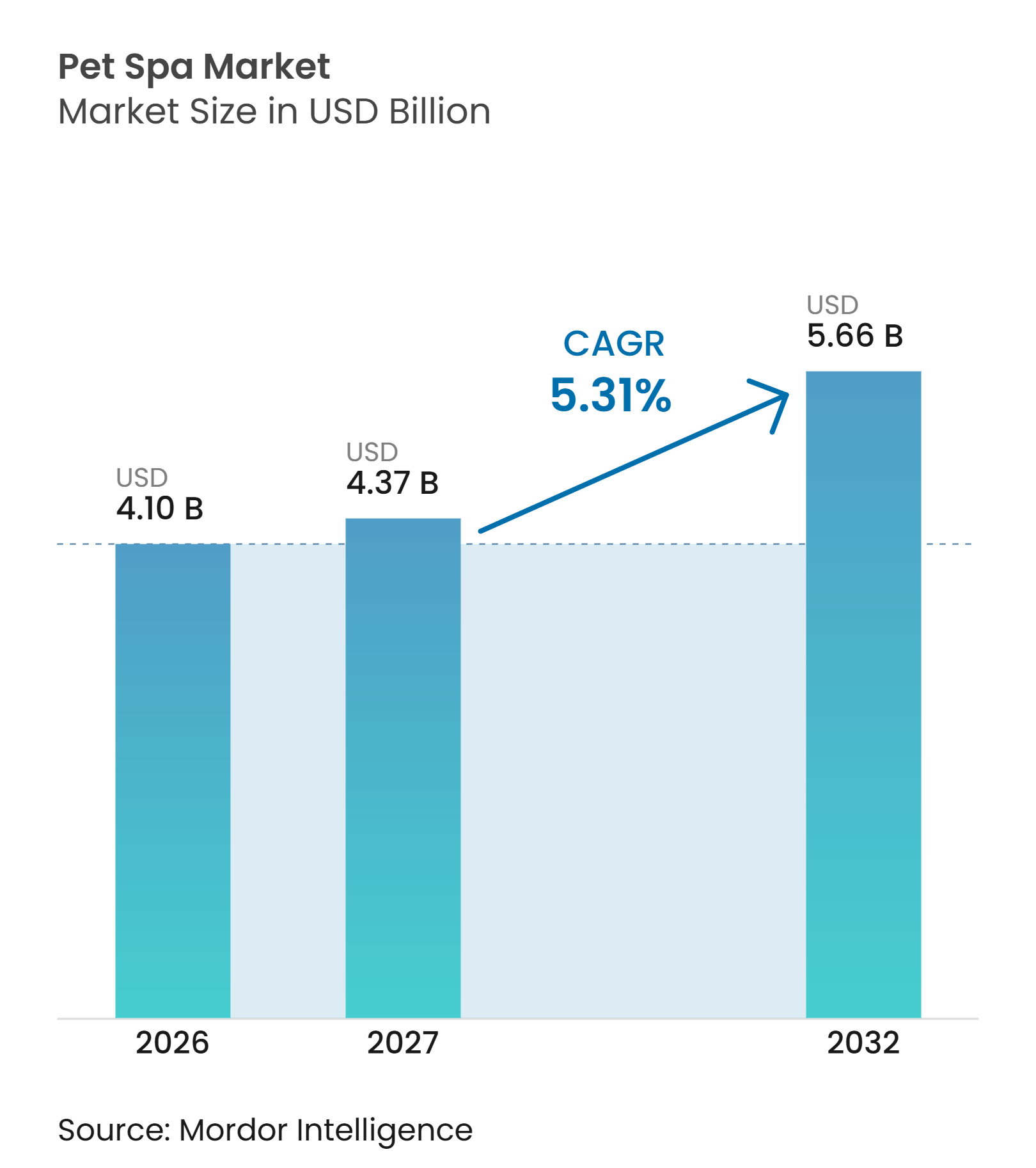
The global pet spa market size was valued at USD 4.10 billion in 2026 and is estimated to grow from USD 4.37 billion in 2027 to reach USD 5.66 billion by 2032, at a CAGR of 5.31% during the forecast period (2027-2032). The global pet spa industry is driven by pet owners who increasingly view companion animals as family members and value professional care. Mars reported that 95% of pet owners consider their pets family members, and its global findings indicated that pets positively affect owners' well-being[1]. This connection encourages spending on grooming, coat care, relaxation treatments, and recovery-focused services, particularly when owners observe health and comfort benefits. The market also benefits from mobile services, digital appointment booking, and bundled offerings that reduce scheduling barriers. Competition remains fragmented, creating opportunities for operators to differentiate through trained staff, safe handling practices, consistent hygiene standards, and partnerships with veterinary clinics or pet daycare providers.
Key Report Takeaways
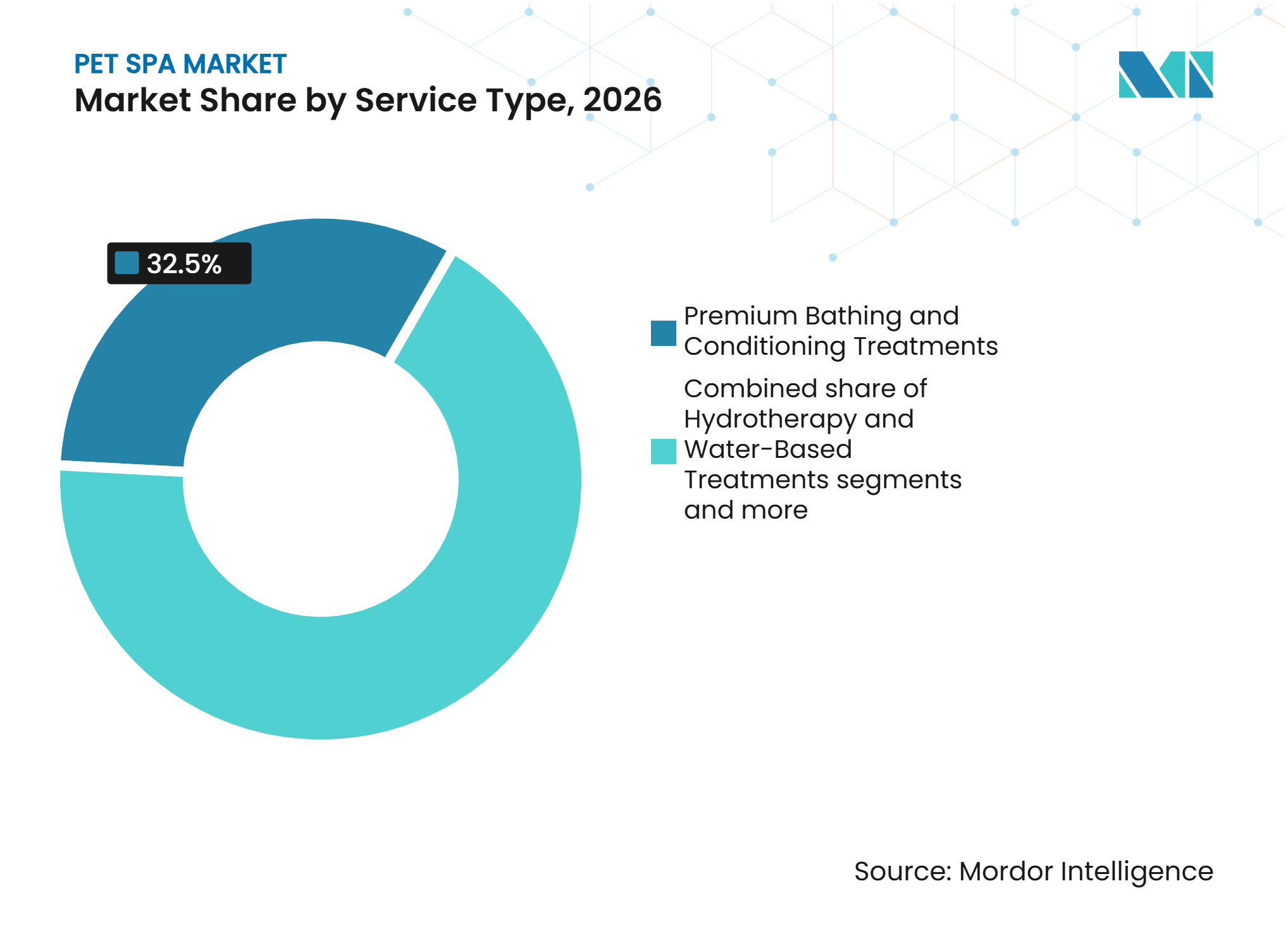
- By service type, Premium Bathing and Conditioning Treatments accounted for 32.50% of the global pet spa market share in 2026, and Hydrotherapy and Water-Based Treatments are projected to grow at a 7.20% CAGR through 2032.
- By pet type, Dogs accounted for 73.50% of the global pet spa market share in 2026, and Cats are projected to grow at a 6.50% CAGR through 2032.
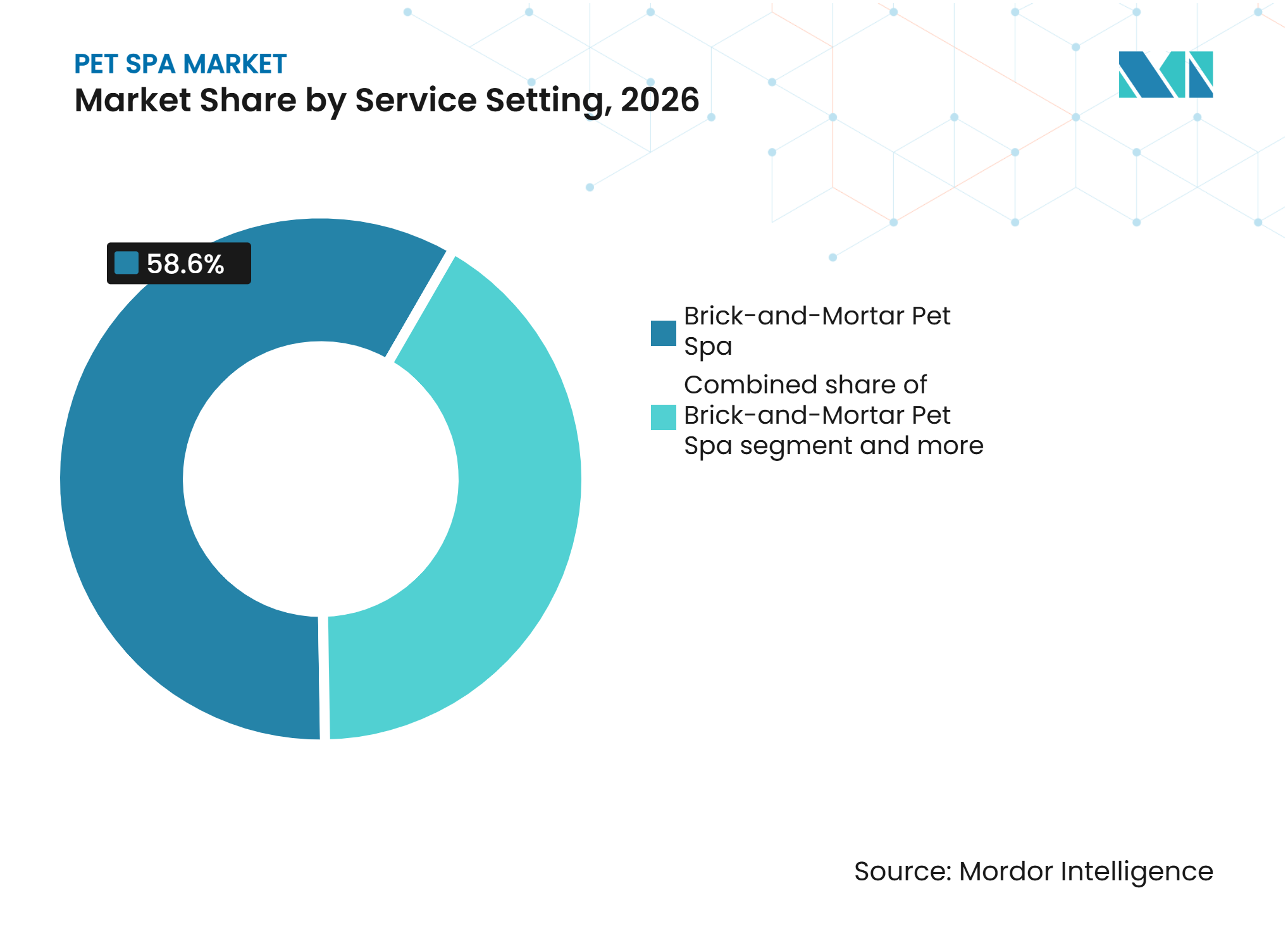
- By service setting, Brick-and-Mortar Pet Spas accounted for 58.60% of the global pet spa market size in 2026, and Mobile Pet Spas are projected to grow at a 6.90% CAGR through 2032.
- By geography, North America accounted for 37.50% of the global pet spa industry share in 2026, and Asia-Pacific is projected to grow at a 7.60% CAGR through 2032.
Note: Market numbers in this report are based on Mordor Intelligence's proprietary estimation framework, which combines nine months of actuals with Q4 projections for base year 2026.
Market Trends and Insights
Drivers Impact Analysis of Pet Spa Market*
| Driver | (~) % Impact on CAGR Forecast | Geographic Relevance | Impact Timeline |
|---|---|---|---|
| Rising Pet Ownership and Humanization of Companion Animals | +1.5% | Global, with greatest intensity in North America and Europe | Long term (≥ 4 years) |
| Growing Spending on Premium Pet Care and Wellness Services | +1.2% | North America and Europe, with rapid adoption in Asia-Pacific | Medium term (2-4 years) |
| Expansion of Mobile and At-Home Pet Grooming Services | +0.8% | North America, Australia, urban Asia-Pacific, and Europe | Short term (≤ 2 years) |
| Subscription-Based and Membership-Led Pet Care Adoption | +0.6% | North America and the United Kingdom, with expansion into Europe and Asia-Pacific | Medium term (2-4 years) |
| Advances in Breed-Specific and Specialized Grooming Services | +0.5% | Global, especially the United States, the United Kingdom, and Germany | Medium term (2-4 years) |
| Integration of Pet Spa Services With Veterinary and Daycare Ecosystems | +0.4% | North America and Australia, with early adoption in Europe | Long term (≥ 4 years) |
| Source: Mordor Intelligence | |||
Rising Pet Ownership and Humanization of Companion Animals
The global pet spa market benefits from the growing link between pet ownership, companionship, and household well-being. Mars reported that 56% of people worldwide own pets, based on a study of more than 35,000 respondents across 20 countries. The findings indicated that many owners consider pets family members, increasing the focus on regular care rather than occasional grooming. In the United States, the American Pet Products Association (APPA) reported 94 million pet-owning households in its 2025 survey, creating a substantial customer base for professional pet care services[2]. This shift encourages owners to seek treatments that support coat quality, hygiene, comfort, and behavior. Consequently, demand in the global pet spa industry is expanding across routine and specialized service offerings.
Growing Spending on Premium Pet Care and Wellness Services
Pet owners continue to prioritize animal care despite rising expenses. MetLife reported that average annual pet ownership costs increased from USD 2,086 in 2024 to USD 2,360 in 2025[3], while 65% of surveyed owners said they would reduce personal lifestyle spending before cutting pet care. This supports opportunities for pet spas offering bathing, conditioning, and skin-care treatments with clearly explained benefits. Transparent pricing, trained staff, and consistent hygiene practices can help providers justify professional service fees and retain budget-conscious customers. Integration with veterinary and daycare services can further improve convenience and repeat engagement. Dogtopia reported nearly 5 million dog visits in 2025, demonstrating the scale of its daycare network, although visits do not represent grooming appointments or unique customers. Providers that coordinate grooming with daycare or veterinary visits can reduce separate trips for owners and create cross-service opportunities. For the global pet spa market, partnerships and integrated service packages support customer retention without relying solely on premium treatment prices.
Expansion of Mobile and At-Home Pet Grooming Services
Mobile delivery is expanding the global pet spa market by bringing grooming and bathing services directly to customers' homes. In 2025, Lucky Dog Mobile Groomers reported 300% year-over-year growth in booked appointments and operated more than 90 vans across over 30 United States markets. The company announced plans to operate 200 vans across 50 markets in 2026. Mobile services reduce transportation requirements for pet owners and offer a convenient option for anxious, elderly, or medically vulnerable pets. They also enable providers to serve suburban and rural areas where fixed-location salons are unavailable. This model is particularly relevant in markets where traditional salons have limited appointment capacity.
Subscription-Based and Membership-Led Pet Care Adoption
Membership structures can provide predictable visit volumes for operators and convenience for pet owners. The American Animal Hospital Association (AAHA) reported that wellness plan subscribers spent 58% more annually and visited 67% more frequently than non-subscribers. These findings apply to recurring pet care and can guide grooming packages that include scheduled coat, skin, and bathing treatments. Regular plans can also help owners identify changes in their pets’ coat condition between appointments, creating opportunities for additional care when professionals identify specific needs. The global pet spa market can use membership models to increase repeat visits rather than relying solely on one-time bookings.
Restraints Impact Analysis of Pet Spa Market*
| Restraint | (~) % Impact on CAGR Forecast | Geographic Relevance | Impact Timeline |
|---|---|---|---|
| High Service Costs and Household Budget Sensitivity | -0.7% | Global, with strongest effects in price-sensitive Asia-Pacific and South America | Medium term (2-4 years) |
| Shortage of Certified Groomers and High Employee Turnover | -0.5% | Global, with strong effects in Australia, the United Kingdom, the United States, and Germany | Long term (≥ 4 years) |
| Animal Safety, Hygiene, and Liability Risks | -0.3% | Global, with active regulatory influence in the United Kingdom, Malta, Taiwan, and the United States | Medium term (2-4 years) |
| Low Service Frequency Among Price-Sensitive Owners | -0.4% | Emerging Asia-Pacific, South America, and rural North America | Short term (≤ 2 years) |
| Source: Mordor Intelligence | |||
High Service Costs and Household Budget Sensitivity
Professional pet spa services compete with other household expenses and are deferred when budgets tighten. The American Pet Products Association (APPA) reported in March 2026 that 22% of United States pet owners spent less on their pets in 2025 than in 2024, while 51% of dog owners shifted routine grooming activities to the home. This behavior affects mid-range services that pet owners consider optional. Providers offering treatments that require specialized equipment or professional expertise face lower exposure than those providing basic grooming services. Therefore, participants in the global pet spa market must communicate practical value and offer services across multiple price points.
Shortage of Certified Groomers and High Employee Turnover
A shortage of skilled groomers limits the number of appointments providers can safely offer. According to the Pet Industry Association of Australia’s 2025 Pet Grooming Survey, 79% of surveyed pet businesses reported extreme difficulty sourcing skilled staff. This suggests that skilled-labor shortages can constrain recruitment and day-to-day service operations[4]. Physically demanding work and the need to manage anxious animals can also hinder employee retention. In June 2025, the Pet Industry Federation and partner organizations published United Kingdom grooming guidelines requiring minimum Level 2 qualifications and pet first-aid certification. The global pet spa market needs training pipelines and career pathways to expand service capacity without compromising quality.
*Our forecasts treat driver/restraint impacts as directional, not additive. The impact forecasts reflect baseline growth, mix effects, and variable interactions.
Consumer Behavior Analysis
Pet owners continue to prioritize animal care, although data show a shift toward value-conscious purchasing. The American Pet Products Association (APPA) reported that United States pet industry spending reached USD 158 billion in 2025, up 3.7%, and projected spending of USD 165 billion for 2026. Pet ownership reached 95 million United States households in 2025. However, 22% of owners reported lower pet spending in 2025, showing that emotional attachment does not eliminate price sensitivity. Pet spas can address this trend through transparent pricing, basic and higher-tier grooming services, and optional add-on treatments based on owner needs and budgets.
Service preferences also vary between professional and at-home care. The Australian Government’s MoneySmart guidance, citing the 2025 Pets in Australia report, listed annual spending on grooming, training, and memberships at AUD 353 (USD 96.10) per dog-owning household, compared with AUD 138 (USD 37.57) per cat-owning household. APPA’s 2025 Dog & Cat Report found that 53% of dog owners and 34% of cat owners gave their pets vitamins or supplements. These differences create opportunities for recurring dog grooming packages and shorter, low-stress, handling-sensitive cat services.
Pet Spa Performance Intelligence
Pet spa performance is influenced by rising pet ownership costs and demand for convenient, reliable services. MetLife’s 2025 Pet Study reported that average annual pet ownership costs increased from USD 2,086 in 2024 to USD 2,360 in 2025, an approximately 13.1% rise. The share of owners budgeting for pet expenses also increased to 48% from 42%. Tiered grooming packages, transparent pricing, and bundled bathing, nail care, and conditioning services can help retain price-conscious customers. The American Pet Products Association reported US pet industry spending of USD 158 billion in 2025, up 3.7%, and projected USD 165 billion for 2026, indicating continued spending potential despite increased value consciousness.
Digital booking and capacity utilization also affect performance. Petco reported that nearly 50% of customers booked grooming appointments online and identified service availability as a retention factor. Visible appointment slots, flexible scheduling, and automated reminders can support recurring visits. Providers can test memberships and prepaid packages while monitoring redemption rates and service-level profitability. However, veterinary wellness-plan results may not directly apply to grooming. Demand forecasting, efficient scheduling, and differentiated service bundles can increase utilization without solely expanding locations.
Pet Spa Market Segment Analysis
By Service Type:
Conditioning Leads While Hydrotherapy Gains Clinical RelevanceBathing and Conditioning Treatments accounted for 32.50% of the global pet spa market in 2026. This segment supports routine coat maintenance and skin-focused care for dogs with varying grooming needs. Professional conditioning is particularly relevant for long-haired, dense-coated, or dermatologically sensitive animals and provides an entry point for pet owners new to professional grooming. Skin and Coat Spa Treatments offer a complementary option for customers seeking targeted care. Together, these services enable providers to combine recurring maintenance with higher-value treatments as needed.
Hydrotherapy and Water-Based Treatments are projected to expand to a 7.20% CAGR through 2032 in the global pet spa market. A 2025 American Journal of Veterinary Research study found that swimming therapy reduced the median limb functional recovery time in dogs after femoral head and neck excision from six months to three months. Another 2025 study reported improved stifle range of motion in dogs receiving underwater treadmill rehabilitation after tibial plateau leveling osteotomy (TPLO) surgery. These findings support aquatic therapy in veterinary rehabilitation when a veterinarian considers it appropriate. Providers need suitable facilities and trained personnel to offer hydrotherapy, which differentiates it from routine grooming services.



By Pet Type:
Dogs Provide the Revenue Base While Cats Expand the Addressable BaseDogs accounted for 73.50% of the global pet spa market size in 2026. Their leading position reflects established grooming routines, broad breed diversity, and demand for services tailored to coat condition and size. Depending on an animal's needs, owners may seek regular bathing, styling, conditioning, massage, and rehabilitation-focused services. Larger dogs and dogs with complex coats often require more time and specialized handling than standard appointments. These dynamics support demand for professional groomers who can provide safe and consistent services. The dog segment remains central to franchise development and operational training across the global pet spa market.
Cats are projected to expand to a 6.50% CAGR through 2032 in the global pet spa market. The Pet Industry Federation's 2025 guidelines state that cat grooming requires a separate and specialized approach. This reflects the fact that facilities and procedures designed for dogs do not always meet feline handling requirements. Providers that develop cat-specific services can address a gap in many existing grooming networks. Other pets, including small mammals, birds, and exotic animals, represent a smaller segment of the global pet spa market. Their service potential depends on species-appropriate training and stringent animal welfare standards.
By Service Setting:
Fixed Facilities Retain Scale While Mobile Services Improve AccessBrick-and-mortar pet spas accounted for 58.60% of revenue in 2026. Fixed facilities accommodate hydrotherapy pools, professional bathing systems, and other equipment that mobile vans cannot easily support. They also enable multi-service appointments combining grooming, conditioning, massage, and coat treatments. Central locations can build repeat customers through reliable staffing and appointment availability. In-home services offer an alternative for animals with transportation stress or limited mobility. Each setting meets distinct convenience, equipment, and animal-handling requirements.
Mobile pet spas services are forecast to grow at a 6.90% CAGR through 2032. Barkbus and GroomBuggy combined in 2025, and the merged business reported more than 200 mobile stations across 15 United States states and over 200,000 service hours. The transaction indicates that mobile grooming has become more structured and scalable. Mobile providers reduce customer travel needs and serve neighborhoods without nearby salons. Route planning, vehicle maintenance, and staffing remain essential for consistent operations. The global pet spa market is likely to use mobile services alongside equipment-intensive fixed facilities.

Geography Analysis
North America accounted for 37.50% of global pet spa market revenue in 2026. APPA reported that United States pet industry expenditure reached USD 158 billion in 2025, including USD 14.3 billion for other services. This category includes grooming, boarding, and related services. Established franchises, familiarity with grooming services, and widespread pet ownership support the regional market. Membership programs, bundled services, and digital booking can improve customer access and convenience when operators have sufficient capacity.
Asia-Pacific is forecast to grow at a CAGR of 7.60% through 2032. Urban pet ownership and acceptance of specialized services in major cities support growth. Australia faces persistent challenges in recruiting skilled groomers, according to the Pet Industry Association Australia. The association also participates in discussions on training and animal welfare standards. In India and urban China, platform-enabled booking and at-home services help providers reach consumers without extensive salon networks. Growth depends on trusted handling standards and a qualified workforce.
Europe has an established grooming base, while service standards continue to formalize. In 2025, United Kingdom industry organizations released voluntary guidelines covering qualifications, hygiene, and cat-specific care. South American demand is concentrated in larger cities. The Middle East and Africa remain early-stage markets, with opportunities centered on urban areas. Providers must align services with local spending power, regulations, and groomer availability.
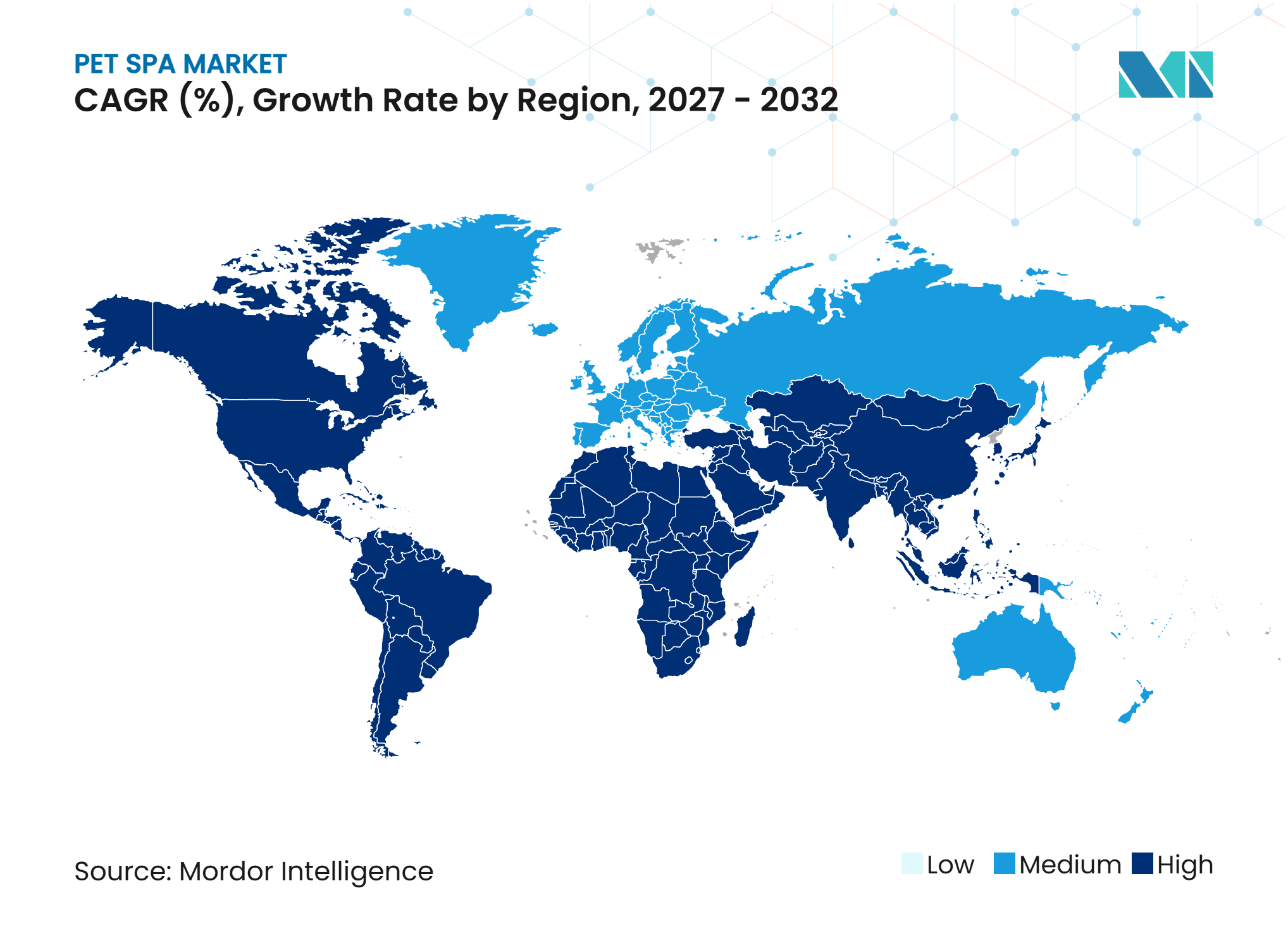
Note: Global Pet Spa Market CAGR (%), Growth Rate by Region
Pet Spa Supply and Development Intelligence
North American pet-care franchises expanded grooming capacity through standardized outlets. Woof Gang Bakery & Grooming opened more than 70 stores in 2025, bringing its network to over 450 locations open or in development. Dogtopia signed 27 franchise agreements and targeted 300 locations in 2026. This expansion widened access to salon grooming and wellness services. However, announced locations did not necessarily translate into operational capacity, as recruitment and training remained critical to converting network growth into completed appointments.
Australia highlights workforce constraints. The Pet Industry Association Australia’s 2025 survey found that 79% of respondents considered sourcing skilled groomers extremely difficult, while 76% supported mandatory animal-care qualifications. Greencross Pet Wellness Company operated 132 grooming salons and 20 mobile dog-wash units alongside veterinary and retail services. Its digital pet profiles supported tailored recommendations and reminders, demonstrating how integrated data could encourage repeat visits but could not replace qualified staff.
Competitive Landscape
Market Concentration
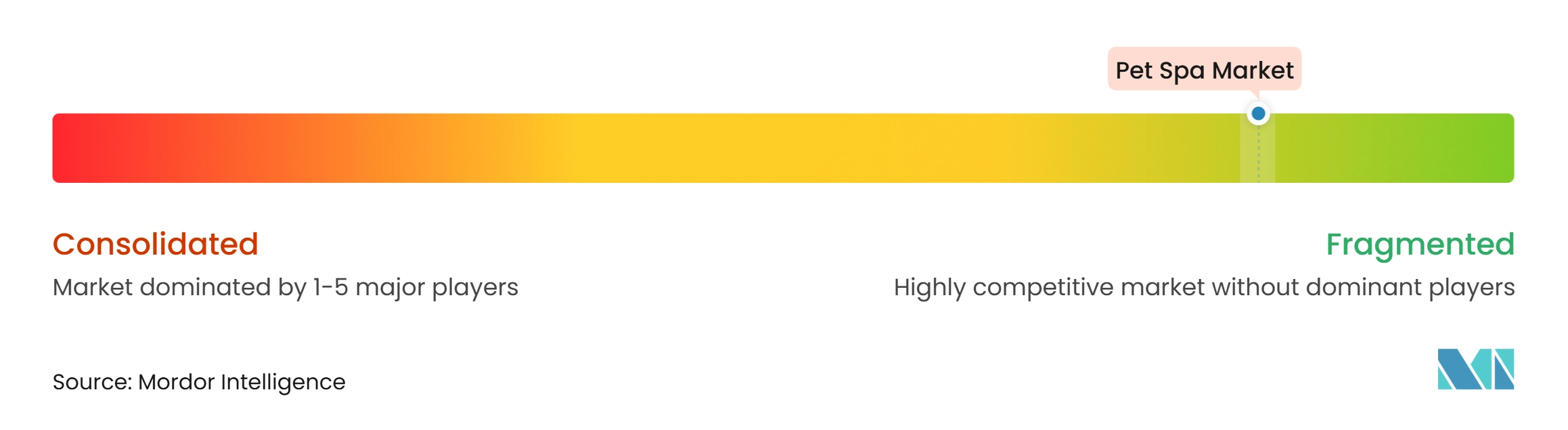
The global pet spa market is highly fragmented. Petco, PetSmart, Aussie Pet Mobile, Woof Gang Bakery & Grooming, and Dogtopia are among the larger participants. Companies compete on appointment availability, location, trained personnel, treatment consistency, and customer trust. Larger companies use brand recognition and established systems to expand, while smaller providers compete through local knowledge and specialized services.
Operators are expanding integrated services and network coverage. Dogtopia combined daycare, wellness, and related services and recorded nearly 5 million dog visits in 2025. Woof Gang Bakery and Grooming expanded into Canada in 2025 and exceeded 450 open or in-development locations across North America. Barkbus and Groombuggy joined forces in 2025, creating a mobile grooming platform operating across 15 United States states. The combined company operates under the Barkbus name, with Groombuggy integrated into its platform. This consolidation highlights the potential for further consolidation in a fragmented mobile grooming market.
Technology and animal-care standards increasingly influence competitive positioning. Greencross deployed its customer data platform across its pet-care network in 2025 to support personalized communication. United Kingom guidelines emphasize qualifications, hygiene practices, and pet first-aid training in professional grooming. Providers that combine safe procedures, convenient booking, and accessible service formats are better positioned to retain customers.
Pet Spa Industry Leaders
-
Petco Health and Wellness Company, Inc.
-
PetSmart LLC
-
Aussie Pet Mobile, Inc.
-
Woof Gang Bakery and Grooming
-
Dogtopia Enterprises
- *Disclaimer: Major Players sorted in no particular order
Pet Spa Market Companies Covered in this Report
- Petco Health and Wellness Company, Inc.
- PetSmart LLC
- Aussie Pet Mobile, Inc.
- Woof Gang Bakery and Grooming
- Dogtopia Enterprises
- Zoomin Groomin
- Furry Land Mobile Grooming
- Pet Supplies Plus
- Pet Valu
- Pet Supermarket
- Petland, Inc.
- The Grooming Company
- Pet Palace
- PetBacker
- Rover Group, Inc.
- Wag! Group Co.
- Chewy, Inc.
- Just Cats Veterinary Services
- Petbarn
- Petstock
Recent Industry Developments in Pet Spa Market
- April 2026: Chewy acquired Modern Animal, which operates 29 veterinary clinics and offers 24/7 virtual care. Separately, Chewy launched Chewy Made, consolidating private-label pet products. These initiatives support its integrated pet-care strategy.
- December 2025: Lucky Dog Mobile Groomers reported 300% year-over-year growth in booked appointments, with 90+ vans across 30+ United States markets and plans to reach 200 vans across 50+ markets in 2026. This highlights mobile grooming scalability and potential to serve areas with limited salon capacity.
- October 2025: Woof Gang Bakery & Grooming entered Entrepreneur’s Fastest-Growing Franchises ranking after opening over 70 stores in 2025, exceeding 450 North American locations open or in development, including Canada.
- August 2025: Woof Gang Bakery & Grooming launched Woof Gang Cosmetics with Hydra in August and a consumer app in November, linking at-home care, appointment management, CRM, loyalty systems, rebooking, and product sales.
Global Pet Spa Market Report Scope
The global pet spa market report analyzes specialized wellness and relaxation services for companion animals, including pet massage, hydrotherapy, aromatherapy, skin and coat treatments, premium bathing, and conditioning. The market is segmented by service type, pet type, service setting, and geography. The study examines drivers such as rising pet ownership and humanization, increased spending on premium pet care, mobile and at-home service expansion, subscription-based offerings, specialized grooming, and integration with veterinary and daycare services, alongside restraints including high service costs, groomer shortages, animal safety and liability risks, and low service frequency among price-sensitive owners. It evaluates service capacity, facility development, utilization rates, average service prices, booking channels, consumer preferences, and pet care spending patterns. The report provides market size and growth forecasts, regional analyses across North America, South America, Europe, Asia-Pacific, and the Middle East and Africa, competitive landscape assessments, market concentration, market shares, strategic developments, and company profiles. It also explores opportunities in premium breed-specific wellness packages and mobile pet spa services across underserved suburban and rural markets. Market estimates and forecasts are presented in value across all covered segments for 2022-2032.
Segmentation Overview
Key Questions Answered in the Report
What is the projected growth rate for the global pet spa market?
The global pet spa market is projected to grow at a 5.31% CAGR from 2027 to 2032, reaching USD 5.66 billion in 2032.
Which service is expected to grow fastest in pet spa care?
Hydrotherapy and Water-Based Treatments are projected to grow at a 7.20% CAGR through 2032. Clinical research has reported recovery benefits for defined canine post-operative cases.
Why do dogs account for the largest share of pet spa services?
Dogs accounted for 73.50% of 2026 revenue because professional grooming is well established across a wide range of breeds and coat-care needs.
Which region is growing fastest for pet spa services?
Asia-Pacific are projected to grow at a 7.60% CAGR through 2032, supported by urban pet ownership and wider use of digital and at-home service formats.
What factors limit professional pet spa adoption?
High service costs, at-home grooming, safety requirements, and a shortage of skilled groomers can limit appointment frequency and service capacity.