
Ornithology Tourism Market Size and Share
Market Overview
| Study Period | 2021 - 2031 |
|---|---|
| Market Size (2026) | USD 3.65 Billion |
| Market Size (2031) | USD 4.94 Billion |
| Growth Rate (2026 - 2031) | 6.24 % |
| Fastest Growing Market | Asia-Pacific |
| Largest Market | North America |
| Market Concentration | Medium |
Major Players *Disclaimer: Major Players sorted in no particular order Image © Mordor Intelligence. Reuse requires attribution under CC BY 4.0. | |
Ornithology Tourism Market Analysis by Mordor Intelligence
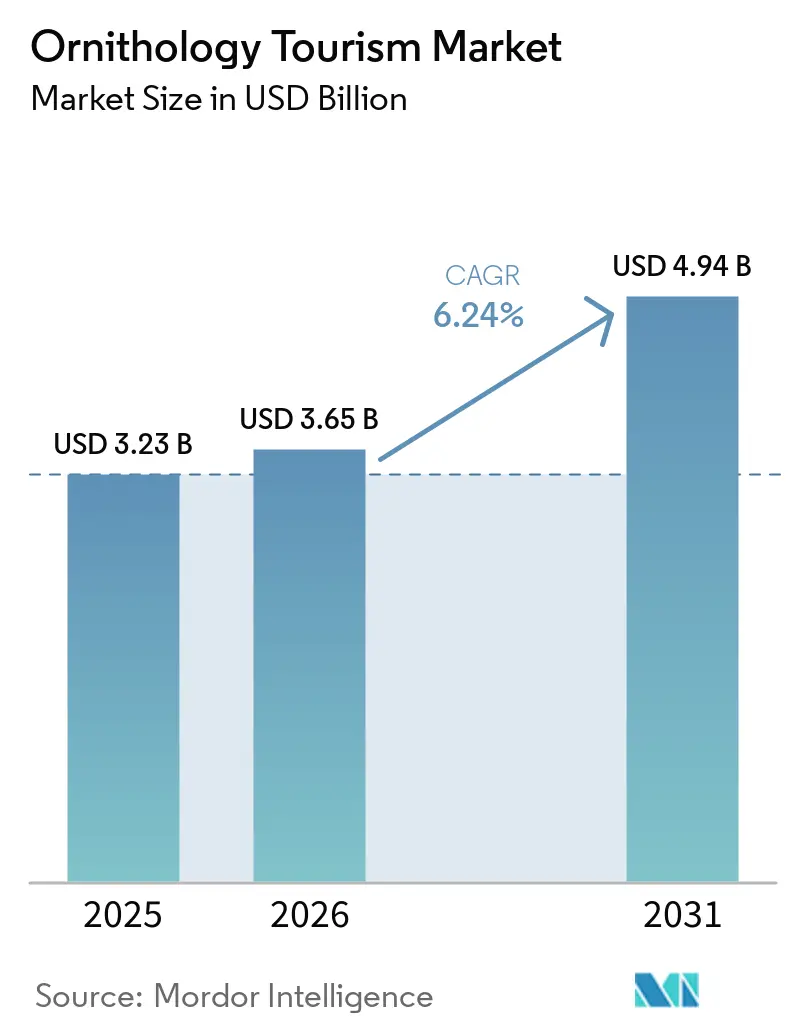
The Global Ornithology Tourism Market is expected to grow from USD 3.23 billion in 2025 and USD 3.65 billion in 2026 to USD 4.94 billion by 2031, with a CAGR of 6.24% between 2026 and 2031. The market has expanded beyond niche enthusiasts, as birdwatching drives spend on travel, lodging, local guiding, and destination services. In the United States, birdwatching activities in 2022 generated USD 279 billion in economic output, supported 1.4 million jobs, and contributed USD 38 billion in tax revenues, reflecting its economic significance. Digital platforms like eBird, which surpassed 2 billion cumulative observations in June 2025, and Merlin, with 16 million active users in 2025, are attracting new travelers to guided birdwatching experiences[1]. North America accounted for 34.67% of the market in 2025, while Asia-Pacific is projected to grow at a CAGR of 8.57% through 2031, driven by established demand and emerging destinations. Conservation-linked partnerships, cross-border product launches, and climate and habitat concerns are shaping competition. Operators with strong destination access, science-based positioning, and diverse itineraries are better positioned to adapt to these trends.
Key Report Takeaways
- By tourism type, domestic ornithology tourism commanded a 53.23% share of the Global Ornithology Tourism Market in 2025, while international ornithology tourism is projected to grow at the highest CAGR of 6.96% by 2031.
- By tour format, scheduled group tours held a 45.72% share of the Global Ornithology Tourism Market in 2025, while photography and specialist birding tours are projected to grow at the highest CAGR of 7.32% by 2031.
- By end user, group travelers accounted for a 62.83% share of the Global Ornithology Tourism Market in 2025, while solo travelers are projected to grow at the highest CAGR of 7.93% by 2031.
- By booking channel, direct booking captured a 40.64% share of the Global Ornithology Tourism Market in 2025, while online travel platforms are projected to grow at the highest CAGR of 9.64% by 2031.
- By geography, North America held a 34.67% share of the Global Ornithology Tourism Market in 2025, while Asia-Pacific is projected to grow at the highest regional CAGR of 8.57% by 2031.
Note: Market size and forecast figures in this report are generated using Mordor Intelligence’s proprietary estimation framework, updated with the latest available data and insights as of January 2026.
Global Ornithology Tourism Market Trends and Insights
Drivers Impact Analysis*
| Driver | (~) % Impact on CAGR Forecast | Geographic Relevance | Impact Timeline |
|---|---|---|---|
| Rising Global Demand for Nature-Based Wildlife and Birdwatching Tourism | +2.0% | Global | Short term (≤ 2 years) |
| Growth of Social Media-Driven Destination Discovery | +1.3% | Global, with Asia-Pacific and Europe leading | Short term (≤ 2 years) |
| Expansion of Conservation-Led Travel Partnerships | +1.0% | Africa and South America, with global spill-over | Medium term (2-4 years) |
| Increasing Disposable Income Allocation Toward Niche Experience Travel | +0.8% | Asia-Pacific core, spill-over to Middle East and Africa | Medium term (2-4 years) |
| Improved Access to Remote Birding Hotspots Through Specialized Operators | +0.5% | South America, Africa, Asia-Pacific | Medium term (2-4 years) |
| Rising Demand for Small-Group, Low-Impact Travel Formats | +0.3% | North America and Europe | Short term (≤ 2 years) |
| Source: Mordor Intelligence | |||
Rising Global Demand for Nature-Based Wildlife and Birdwatching Tourism
Birdwatching has gained economic significance, attracted policy and destination-level attention while provided the Global Ornithology Tourism Market with a stable demand base. According to the State of the Birds 2025 report, which references United States Fish and Wildlife Service data, birding-related expenditures in the United States reach USD 108 billion annually. This activity supports 1.4 million jobs and contributes USD 279 billion to total economic output. Similarly, the National Forestry and Grassland Administration in China reported over 3 billion eco-tourism visitors in 2025, identifying birdwatching as one of the fastest-growing sub-sectors within eco-tourism[2]. The activity now appeals to a broader audience, including photographers, wellness travelers, citizen scientists, and specialist birders, expanding its reach beyond a niche expert community. This diverse demand base enhances tour occupancy rates, facilitates the development of new routes, and strengthens the relevance of birding tourism to local hospitality and transportation providers across various countries.
Growth of Social Media-Driven Destination Discovery
Digital discovery is reshaping how first-time buyers engage with the Global Ornithology Tourism Market, transitioning interest into paid travel. Research highlights that birdwatching is becoming a mainstream activity in trip planning rather than remaining a niche interest. Reports indicate significant growth in the use of birding tools, with a notable increase in active users and detections through identification apps. These tools simplify the learning process for novice birders, enabling them to approach bookings with better awareness of species, improved identification skills, and a clearer understanding of destination value. This evolution allows operators to effectively market specialized trips, photography-focused tours, and guided experiences to individuals who discover birding through digital platforms such as apps, video content, or social media, rather than traditional networks[3].
Expansion of Conservation-Led Travel Partnerships
Conservation-focused partnerships are enhancing the foundation of the Global Ornithology Tourism Market by integrating tourism with scientific research, habitat conservation, and cross-border destination development. Natural Habitat Adventures established a long-term licensing agreement with Earthwatch Institute, resulting in the creation of Earthwatch Expeditions by Nat Hab. This initiative includes participatory science itineraries planned across various destinations. Around the same time, Angola, Botswana, Namibia, Zambia, and Zimbabwe introduced the Great Kavango Zambezi Birding Route at ITB Berlin, offering Africa’s first cross-border avitourism product in a region hosting hundreds of bird species. Additionally, the IUCN reported that the Nature Positive Tourism Partnership is working on frameworks to embed biodiversity outcomes into tourism business models. These efforts aim to enhance the credibility of tourism products, provide structured access to sensitive habitats, and support conservation-focused tourism practices.
Increasing Disposable Income Allocation Toward Niche Experience Travel
The Global Ornithology Tourism Market benefits travelers who value specialist guidance, small-group travel, and immersive field experiences over standard sightseeing options. Reports indicate that expert-led, customized, and small-group itineraries are among the preferred formats in organized adventure travel, aligning closely with the structure of birding trips. This demand supports a model where travelers pay for specialized guide expertise, extended trip durations, specific seasonal opportunities, and access to remote habitats, rather than just transportation and accommodation. Conservation efforts are also becoming integral to these trips. For example, a fee was introduced in Thailand’s Pak Thale sub-district to support habitat conservation for migratory birds, reflecting a trend where travelers contribute to conservation as part of the trip's value chain. As more travelers allocate leisure budgets to nature-focused trips, operators with well-curated offerings, skilled guides, and reliable conservation access are positioned to meet this demand effectively in the Global Ornithology Tourism Market.
Restraints Impact Analysis*
| Restraint | (~) % Impact on CAGR Forecast | Geographic Relevance | Impact Timeline |
|---|---|---|---|
| Seasonal Dependence and Weather Sensitivity of Birding Destinations | -0.8% | Global, especially island and wetland destinations | Short term (≤ 2 years) |
| Limited Accessibility of Prime Habitats and Protected Areas | -0.5% | Africa, South America, Asia-Pacific | Medium term (2-4 years) |
| High Trip Costs for Remote and Multi-Country Birding Itineraries | -0.4% | Global | Short term (≤ 2 years) |
| Permitting Constraints and Visitor Caps in Sensitive Ecosystems | -0.3% | South America, Asia-Pacific, Africa | Medium term (2-4 years) |
| Source: Mordor Intelligence | |||
Seasonal Dependence and Weather Sensitivity of Birding Destinations
Seasonality poses a significant challenge to the Global Ornithology Tourism Market, as many tours rely on short migration periods, breeding cycles, and fluctuating water conditions. Research published in Science of the Total Environment highlights that climate and biodiversity changes are expected to reduce birding suitability across large parts of Africa, with the Kavango-Zambezi region facing notable losses under warming scenarios. Studies from the International Journal of Island Research also reveal that extreme weather in island environments disrupts transportation, lowers species encounter rates, and weakens repeat visitation for avitourism offerings. These factors intensify revenue concentration issues, as operators depend heavily on a narrow seasonal peak to fill costly itineraries[4]. Weather volatility further impacts traveler confidence, local occupancy patterns, and the commercial stability of destinations reliant on a limited number of flagship species.
Limited Accessibility of Prime Habitats and Protected Areas
The Global Ornithology Tourism Market faces persistent access challenges, as many biodiverse bird habitats remain difficult to reach and unsuitable for large-scale commercial operations. Research by Audubon, based on eBird data from numerous countries, indicates that species-rich regions such as the Democratic Republic of Congo, Bolivia, Madagascar, and Papua New Guinea have not fully leveraged their biodiversity for bird tourism. This is largely attributed to inadequate tourism infrastructure. In Colombia, the SENDA digital platform manages protected area visitation, illustrating that access capacity depends on more than demand, with formal systems regulating visitor numbers in ecotourism zones. These limitations restrict route expansion, increase operational complexity, and exclude key birding destinations from mainstream tourism networks. As a result, success in this market often hinges on resolving logistical challenges, including transport, lodging, guide training, and field coordination, rather than focusing solely on promotional efforts.
*Our forecasts treat driver/restraint impacts as directional, not additive. The impact forecasts reflect baseline growth, mix effects, and variable interactions.
Segment Analysis
By Tourism Type: Domestic Stability Supports Volume While International Routes Drive Faster Growth
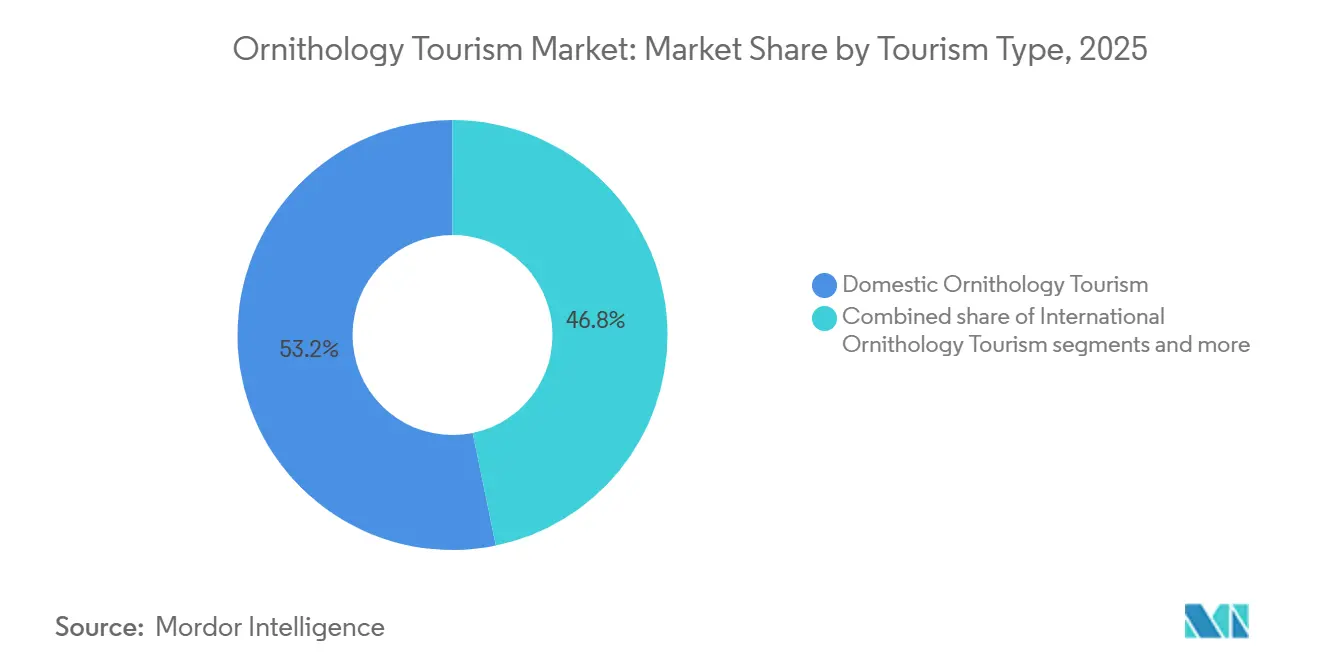
Domestic ornithology tourism held 53.23% of the Global Ornithology Tourism Market share in 2025, making it the largest contributor to market volume. In the United States, 43 million Americans engaged in bird-specific trips in 2022, generating USD 14 billion in expenditures on lodging, food, and transportation, as reported by the United States Fish and Wildlife Service. This robust domestic base strengthens market resilience, enabling operators to rely on steady demand even during challenging long-haul travel conditions. It also supports guiding ecosystems, reserve infrastructure, and local hospitality networks, which later facilitate inbound tourism growth. In established markets, domestic demand remains a stable revenue source for the industry.
International ornithology tourism is the fastest-growing segment, with a projected CAGR of 6.96% through 2031. Colombia demonstrates this growth, with government-backed initiatives by MINCIT and ProColombia promoting avitourism across all 32 departments during the 2025 Global Big Day, when 1,560 bird species were recorded in a single day. Research from Audubon and UC Santa Cruz identified Colombia as the fastest-growing country for tourist birding activity among 155 nations from 2010 to 2022. The 2026 launch of the Kavango Zambezi Birding Route highlights the potential of integrating cross-border conservation areas into unified tourism products. Growth is driven by destinations offering rare species access, public promotion, and coordinated tourism products across expansive landscapes.

By Tour Format: Scheduled Group Tours Lead Revenue While Specialist Formats Expand Faster
Scheduled group tours held the largest format share at 45.72% in 2025, reflecting their operational efficiency and alignment with birding travel behavior. These tours simplify guide allocation, field transport, permit coordination, and accommodation in remote areas where independent planning is challenging. Birdquest’s practice of limiting tours to 6 to 8 participants shows that scheduled formats in the Global Ornithology Tourism Market are carefully curated small-group experiences. This structure balances the social aspect of group travel with a focus on species, field discipline, and manageable group movement in sensitive habitats. Scheduled group tours remain central to the Global Ornithology Tourism Market despite the growing visibility of other formats.
The Global Ornithology Tourism Market for photography and specialist birding tours is projected to grow at a 7.32% CAGR through 2031, making it the fastest-growing format segment. Rockjumper reported in August 2025 that its Bird Photo Tour portfolio was expanding, and its tailor-made division was the company’s fastest-growing unit, indicating demand for customized, image-focused experiences. Birdfy’s launch of OrniSense at CES 2026 supports this trend by enhancing real-time species identification and behavioral analytics for photography-focused travelers and guides. Customized private tours also attract experienced travelers seeking narrower target lists and flexible route planning. These trends highlight industry’s growth through specialization rather than volume expansion.
By End User: Group Travelers Remain the Core Base While Solo Demand Builds Quickly
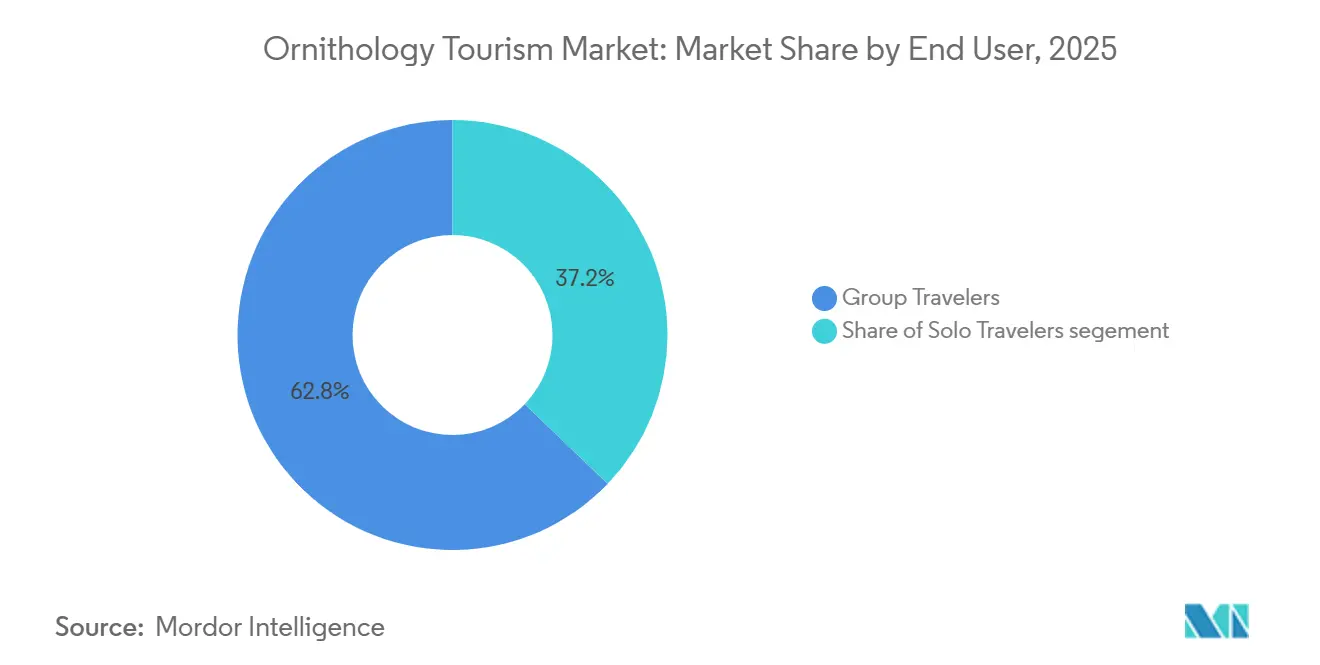
Group travelers accounted for 62.83% of end-user revenue in 2025, highlighting the importance of shared travel in the Global Ornithology Tourism Market. Expert-led, small-group itineraries remained a preferred format for organized nature travel, as noted by the Adventure Travel Trade Association. Group travel reduces per-person logistics costs, optimizes guide utilization, and enhances the collective field experience, particularly on extended and species-intensive trips. It also aligns operators' strategies for managing protected area access, transport schedules, and observation quality in controlled habitats. These factors ensure group-based participation remain the primary revenue driver in the ornithology tourism industry.
Solo travelers are projected to achieve the fastest end-user compound annual growth rate (CAGR) of 7.93% through 2031, despite representing a smaller revenue base than groups. The Cornell Lab of Ornithology reported that the Merlin app reached 16 million active users in 2025, fostering independent birders who may later book guided add-ons or destination-specific tours. Solo birders often avoid fully packaged travel but pay for access, expert guidance, or local logistics in challenging destinations. This has led operators to develop modular offerings, shorter specialist tours, and local extensions instead of relying solely on multi-week programs. Over time, solo traveler growth is expected to diversify the customer base of the Global Ornithology Tourism Market while maintaining the central role of group travel.
By Booking Channel: Direct Consultation Still Leads While Digital Distribution Scales Fast
Direct booking held the largest channel share at 40.64% in 2025, reflecting the specialized nature of the Global Ornithology Tourism Market. Travelers often require route advice, species-specific planning, guide matching, permit clarification, and timing support before committing to trips. This need for consultation keeps direct engagement central to conversions. Operators like Limosa Holidays, Victor Emanuel Nature Tours, and Birdquest have built strong repeat-client relationships through years of direct interaction, which automated channels struggle to replicate complex itineraries. Trust is especially critical for long-haul and remote destinations, where travelers prioritize field reliability and proven operational standards. Direct engagement remains a competitive advantage, even as digital discovery grows.
The Global Ornithology Tourism Market for online travel platforms is projected to grow at a 9.64% CAGR through 2031, making it the fastest-growing booking channel. Research by GetYourGuide in 2026 indicated strong traveler interest in birdwatching trips, showing that digital marketplaces are becoming more relevant in early trip planning. Platforms like eBird and Merlin are engaging birders who explore destinations, species, and field conditions online before consulting operators. This trend strengthens platform-led discovery, particularly for first-time guided travelers who start with general browsing before moving to specialized bookings. A blended channel structure is expected, where direct booking dominates complex trips, while platforms drive early-stage demand generation.
Geography Analysis
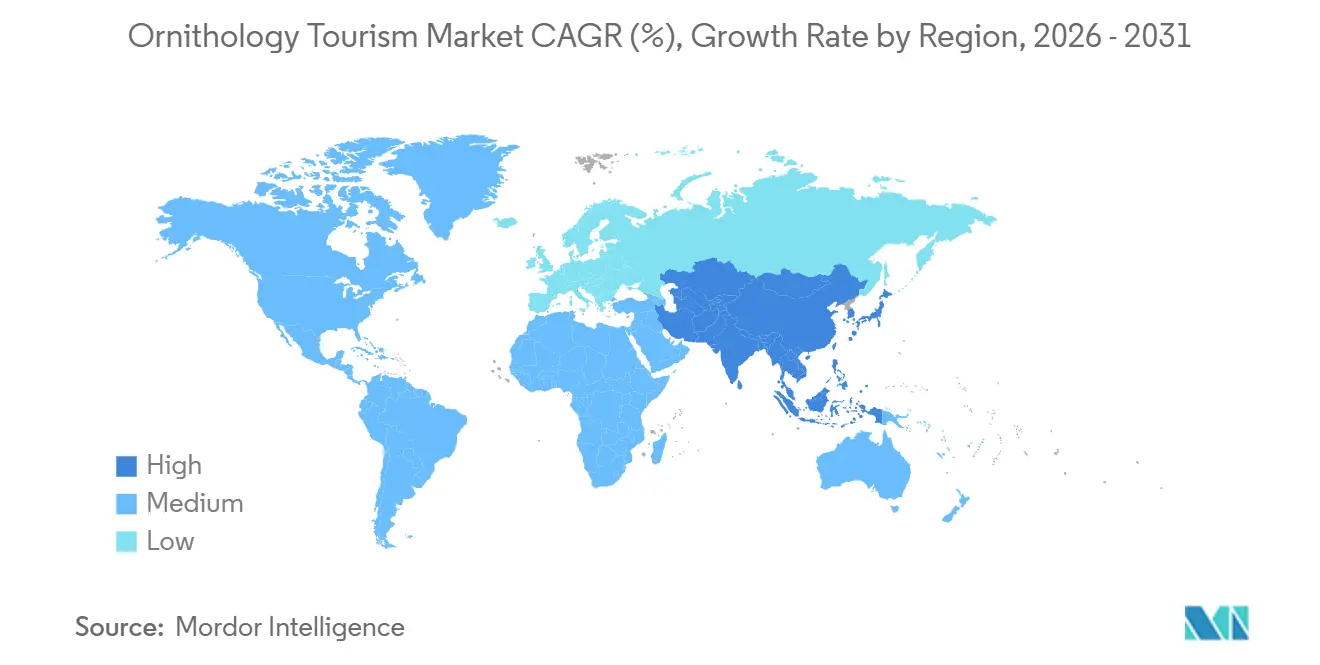
North America held 34.67% of the Global Ornithology Tourism Market share in 2025, with the United States as a key contributor. The United States Fish and Wildlife Service reported 96 million Americans participated in birdwatching in 2022, and 43 million took bird-specific trips. This high domestic participation supports market maturity in guiding networks, reserve visits, and repeat trips. South America shows growth potential, with Colombia excelling due to public promotion, route development, and species richness. Research by Audubon highlighted Colombia’s sharp rise in birding activity among 155 countries, reinforcing its high-growth status.
Asia-Pacific is the fastest-growing region in the Global Ornithology Tourism Market, with a projected 8.57% CAGR through 2031. China drives this growth, with the National Forestry and Grassland Administration reporting over 3 billion eco-tourism visitors in 2025 and birdwatching as a rapidly growing sub-sector. Growth is also supported by India’s rising interest and significant bird habitats in Australia, Indonesia, and Southeast Asia. While commercialization varies, Indonesia’s species richness and underdeveloped birding infrastructure present opportunities for growth.
Europe contributes significantly to revenue, combining a large domestic birding base with steady outbound demand. The United Kingdom anchors this role, with the Royal Society for the Protection of Birds managing over 200 reserves. Spain continues to develop its birding tourism, with Extremadura’s Birding Club reaching 174 members and the 21st International Ornithology Fair set for 2026 at Monfragüe National Park. In the Middle East and Africa, structured multi-country birding products are gaining traction. South Africa’s bird tourism growth and the Great Kavango Zambezi Birding Route highlight this trend. Ayla’s partnership with the Royal Society for the Conservation of Nature in Aqaba further supports birdwatching infrastructure and seasonal programming.
Competitive Landscape
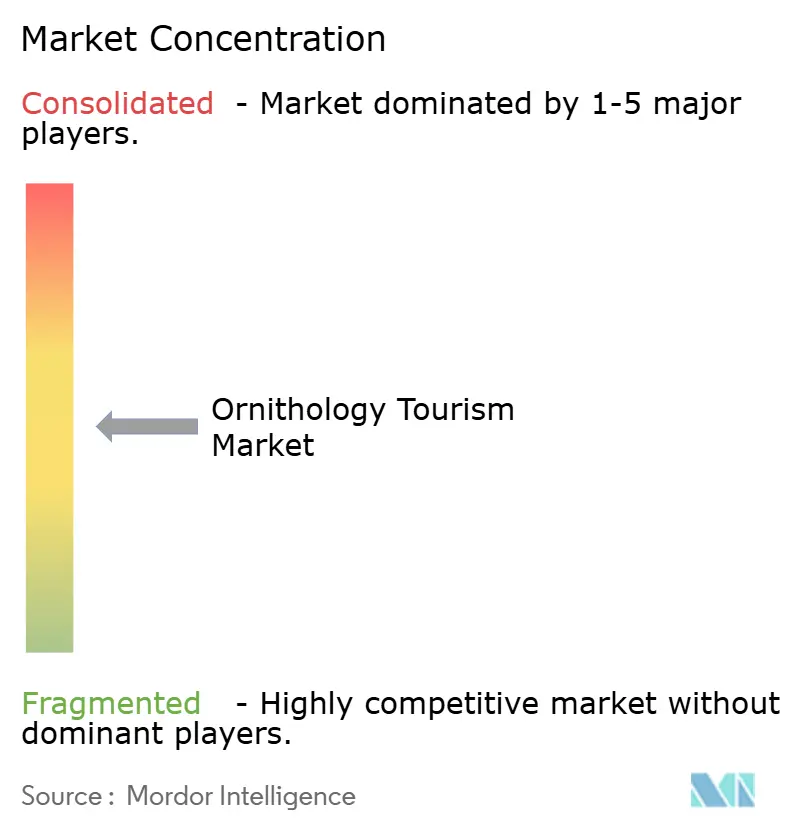
The Global Ornithology Tourism Market is moderately fragmented, with the top five players accounting for a significant share. The remaining market is distributed among regional specialists, destination-focused companies, and newer photography-led entrants, creating a broad competitive landscape. Firms that excel in route depth, destination access, guide quality, and conservation credibility hold an advantage. This fragmentation fosters innovation while emphasizing the importance of trust, operational consistency, and specialization.
Natural Habitat Adventures strengthened its position by launching Earthwatch Expeditions by Nat Hab through a licensing agreement with Earthwatch Institute, enhancing its science-linked offerings. Rockjumper Birding Tours expanded its itineraries and Bird Photo Tour line, with its tailor-made division showing notable growth. Birdquest focuses on specialist expertise and small-group execution, reporting thousands of bird species shown to guests since its inception. These examples highlight that differentiation in the market is driven by expertise, curated routes, and quality field delivery rather than mass distribution.
Technology is becoming a key competitive factor, particularly in specialist and photography-led formats where species detection and learning speed influence traveler satisfaction. Birdfy’s OrniSense introduced real-time species identification and behavioral analytics, though adoption depends on operator integration and traveler interest. Platforms like eBird and Merlin provide smaller operators access to a digitally engaged birding community. Compliance is increasingly critical, as access to conservation-linked products relies on adherence to habitat regulations, permit systems, and science-based partnerships. These factors shape competition in the market.
Ornithology Tourism Industry Leaders
-
Natural Habitat Adventures
-
Birding Ecotours
-
Rockjumper Birding Tours
-
Victor Emanuel Nature Tours
-
Victor Emanuel Nature Tours
- *Disclaimer: Major Players sorted in no particular order
Recent Industry Developments
- February 2026: Natural Habitat Adventures signed a long-term licensing agreement with Earthwatch Institute to launch "Earthwatch Expeditions by Nat Hab," offering 13 participatory science itineraries from 2027 across 20 global destinations.
- February 2026: Angola, Botswana, Namibia, Zambia, and Zimbabwe launched the Great Kavango Zambezi Birding Route at ITB Berlin 2026, introducing Africa's first cross-border avitourism product.
- January 2026: Birdfy introduced OrniSense, an LLM-powered birdwatching AI, at CES 2026, along with the Birdfy Feeder Vista.
- August 2025: Rockjumper Birding Tours has added itineraries to Micronesia, a single-lodge Ecuador Amazon program, and a Relaxed Philippines tour format. It has also expanded its Bird Photo Tour options to address growing demand for photography-focused experiences.
Global Ornithology Tourism Market Report Scope
| Domestic Ornithology Tourism |
| International Ornithology Tourism |
| Cross-Border Regional Ornithology Tourism |
| Scheduled Group Tours |
| Customized Private Tours |
| Photography & Specialist Birding Tours |
| Solo Travelers |
| Group Travelers |
| Direct Booking |
| Travel Agencies |
| Online Travel Platforms |
| Specialty Birding Tour Operators |
| North America | United States |
| Canada | |
| Mexico | |
| South America | Brazil |
| Peru | |
| Chile | |
| Argentina | |
| Rest of South America | |
| Europe | United Kingdom |
| Germany | |
| France | |
| Spain | |
| Italy | |
| BENELUX (Belgium, Netherlands, and Luxembourg) | |
| NORDICS (Denmark, Finland, Iceland, Norway, and Sweden) | |
| Rest of Europe | |
| Asia-Pacific | India |
| China | |
| Japan | |
| Australia | |
| South Korea | |
| South East Asia (Singapore, Malaysia, Thailand, Indonesia, Vietnam, and Philippines) | |
| Rest of Asia-Pacific | |
| Middle East And Africa | United Arab Emirates |
| Saudi Arabia | |
| South Africa | |
| Nigeria | |
| Rest of Middle East And Africa |
| By Tourism Type | Domestic Ornithology Tourism | |
| International Ornithology Tourism | ||
| Cross-Border Regional Ornithology Tourism | ||
| By Tour Format | Scheduled Group Tours | |
| Customized Private Tours | ||
| Photography & Specialist Birding Tours | ||
| By End User | Solo Travelers | |
| Group Travelers | ||
| By Booking Channel | Direct Booking | |
| Travel Agencies | ||
| Online Travel Platforms | ||
| Specialty Birding Tour Operators | ||
| By Geography | North America | United States |
| Canada | ||
| Mexico | ||
| South America | Brazil | |
| Peru | ||
| Chile | ||
| Argentina | ||
| Rest of South America | ||
| Europe | United Kingdom | |
| Germany | ||
| France | ||
| Spain | ||
| Italy | ||
| BENELUX (Belgium, Netherlands, and Luxembourg) | ||
| NORDICS (Denmark, Finland, Iceland, Norway, and Sweden) | ||
| Rest of Europe | ||
| Asia-Pacific | India | |
| China | ||
| Japan | ||
| Australia | ||
| South Korea | ||
| South East Asia (Singapore, Malaysia, Thailand, Indonesia, Vietnam, and Philippines) | ||
| Rest of Asia-Pacific | ||
| Middle East And Africa | United Arab Emirates | |
| Saudi Arabia | ||
| South Africa | ||
| Nigeria | ||
| Rest of Middle East And Africa | ||
Key Questions Answered in the Report
What is the projected value of the Global Ornithology Tourism Market by 2031?
The Global Ornithology Tourism Market is projected to reach USD 4.94 billion by 2031 from USD 3.65 billion in 2026, at a CAGR of 6.24%.
Which region leads to revenue in the Global Ornithology Tourism Market?
North America led with a 34.67% share in 2025, supported by the large United States birding participation base and mature specialist tour infrastructure.
Which region is expected to grow the fastest in ornithology tourism through 2031?
Asia-Pacific is expected to grow the fastest, with an 8.57% CAGR through 2031, supported by rising activity in China, India, and wider regional destination development.
What is driving demand in the Global Ornithology Tourism Market?
The main demand drivers are broader interest in nature-based travel, growing app-based engagement through eBird and Merlin, stronger conservation-linked travel partnerships, and rising spending on specialist experiences.
Which traveler group generates the largest revenue in ornithology tourism?
Group travelers generated the largest revenue share at 62.83% in 2025 because shared travel lowers logistics costs and fits the guided nature of specialist birding itineraries.
Which booking channel is expanding the fastest in the Global Ornithology Tourism Market?
Online travel platforms are growing the fastest, with a projected 9.64% CAGR through 2031, although direct booking still led with a 40.64% share in 2025.