
Film Tourism Market Size and Share
Market Overview
| Study Period | 2022 - 2032 |
|---|---|
| Market Size (2027) | USD 63.34 Billion |
| Market Size (2032) | USD 83.49 Billion |
| Growth Rate (2027 - 2032) | 5.68 % |
| Fastest Growing Market | Asia-Pacific |
| Largest Market | Europe |
| Market Concentration | Low |
Major Players *Disclaimer: Major Players sorted in no particular order Image © Mordor Intelligence. Reuse requires attribution under CC BY 4.0. | |
Film Tourism Market Analysis by Mordor Intelligence
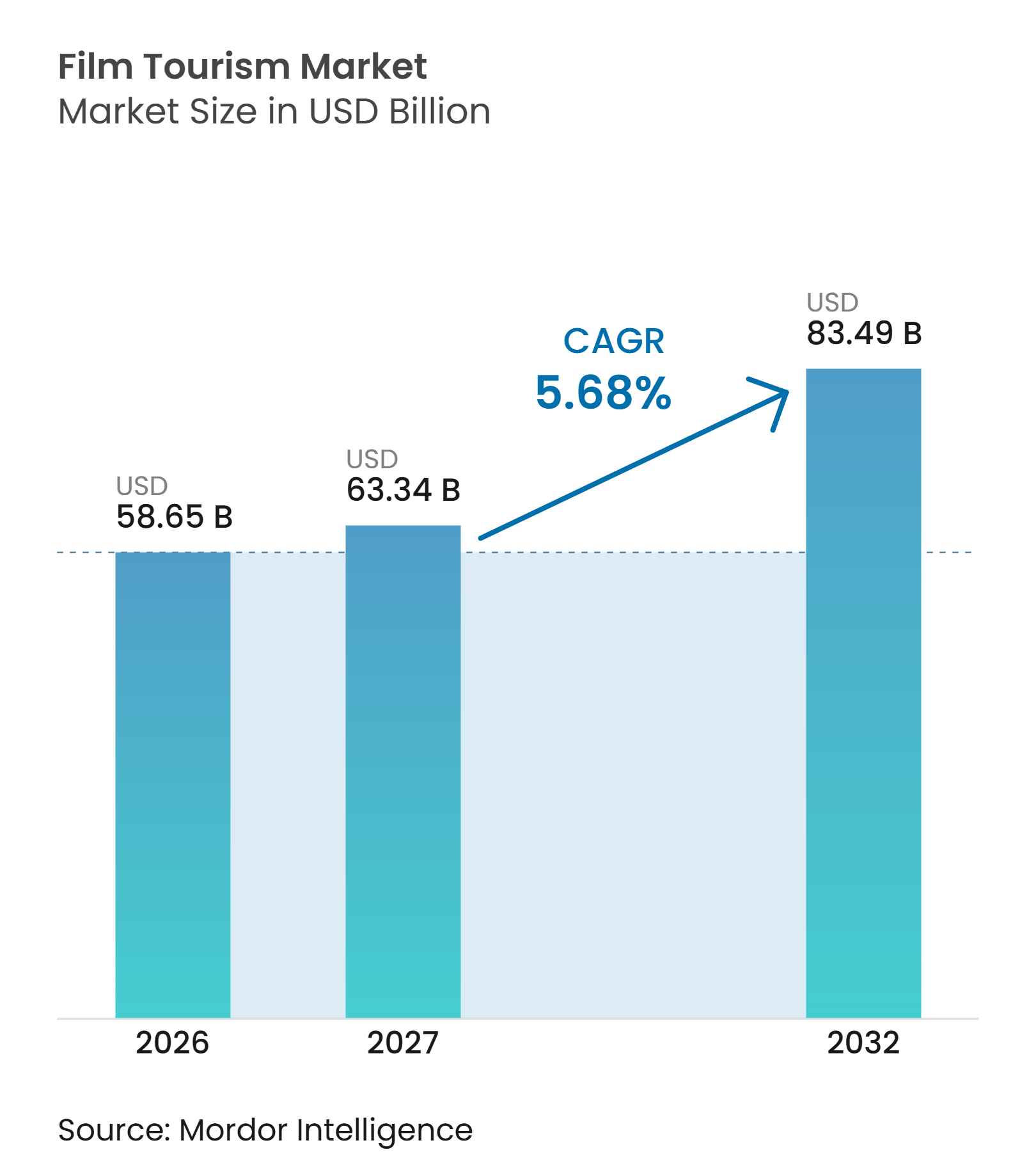
The global film tourism market size was valued at USD 58.65 billion in 2026 and is estimated to grow from USD 63.34 billion in 2027 to reach USD 83.49 billion by 2032, at a CAGR of 5.68% during the forecast period (2027-2032). Screen content increasingly influences destination discovery, while streaming libraries keep locations visible long after a title’s original release. Tourism bodies are shifting from isolated promotions to partnerships that connect productions, travel planning, and local experiences. Permanent studio tours, themed attractions, and digital location trails create products that generate revenue beyond a single film release. However, capacity constraints at heritage sites and uneven conversion of viewer interest into actual travel remain significant challenges. The global film tourism industry favors destinations that can convert screen exposure into well-managed, bookable, and authentic visitor experiences.
Key Report Takeaways
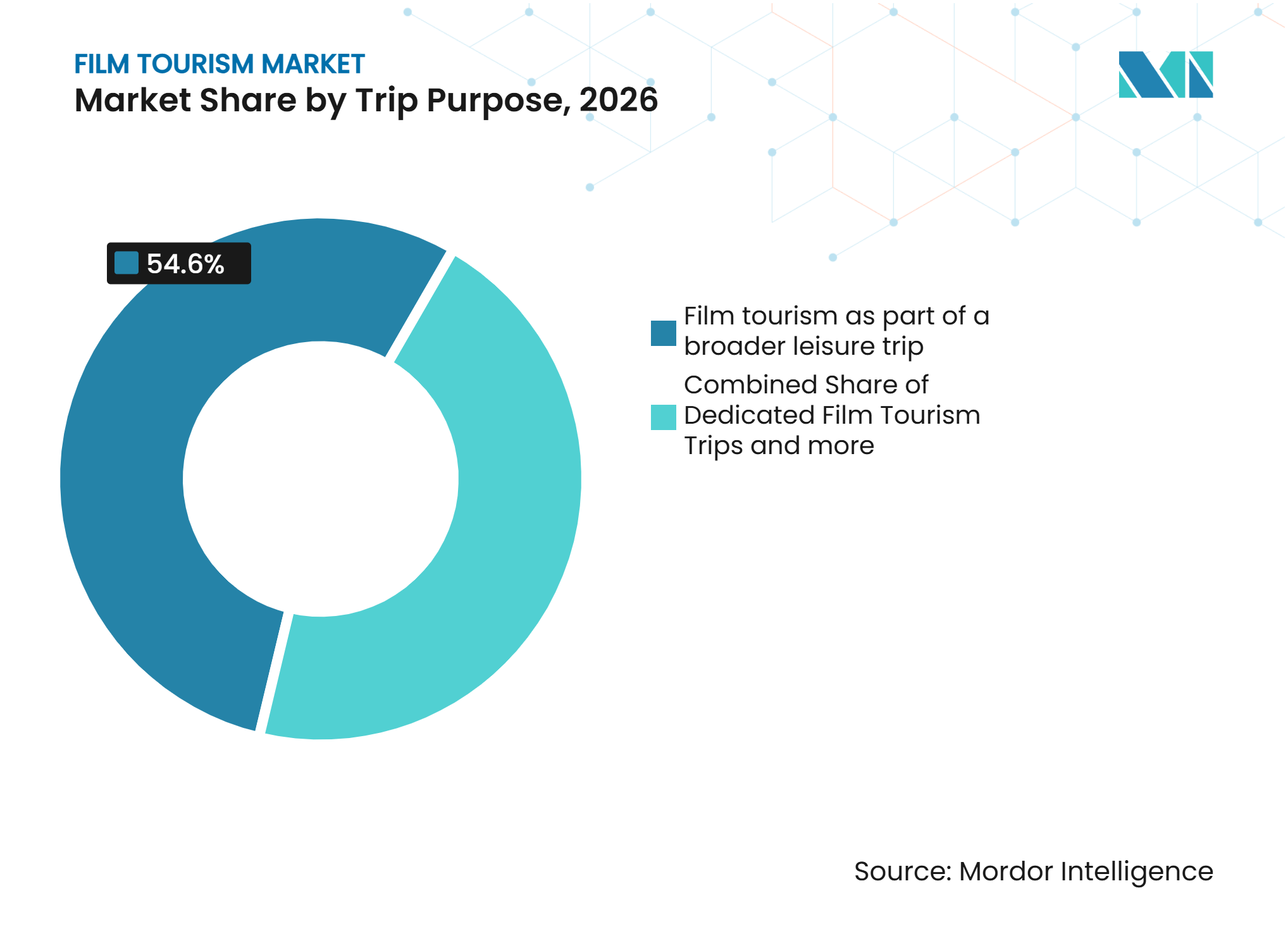
- By trip purpose, film tourism as part of a broader leisure trip accounted for 54.60% of the global film tourism market share in 2026, while dedicated film tourism trips are projected to grow at a 7.60% CAGR through 2032.
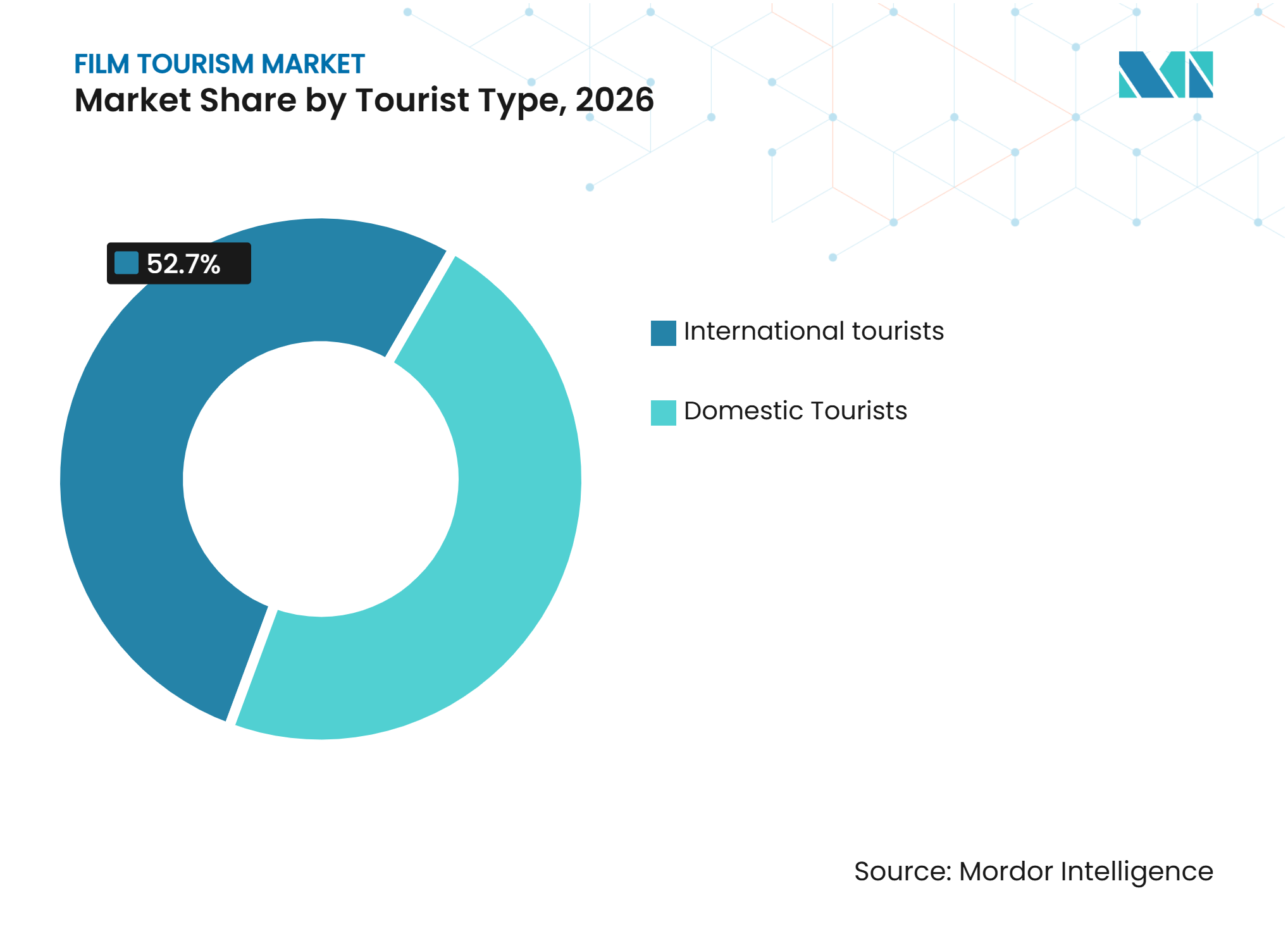
- By tourist type, international tourists accounted for 52.70% of the global film tourism market share in 2026 and are projected to grow at a 6.60% CAGR through 2032.
- By geography, Europe accounted for 33.50% of the global film tourism market share in 2026, while Asia-Pacific is projected to grow at a 7.80% CAGR through 2032.
Note: Market numbers in this report are based on Mordor Intelligence's proprietary estimation framework, which combines nine months of actuals with Q4 projections for base year 2026.
Market Trends and Insights
Drivers Impact Analysis of Film Tourism Market*
| Driver | (~) % Impact on CAGR Forecast | Geographic Relevance | Impact Timeline |
|---|---|---|---|
| Streaming-Led Discovery of Filming Locations | +1.5% | Global | Short term (≤ 2 years) |
| Franchise and Fandom-Based Travel Intent | +1.1% | North America, Europe, and Asia-Pacific | Medium term (2-4 years) |
| Destination Marketing Partnerships With Studios and Platforms | +0.7% | Global | Medium term (2-4 years) |
| Expansion of Immersive, Themed and Behind-the-Scenes Experiences | +0.6% | North America and Europe | Medium term (2-4 years) |
| Social Media Amplification and User-Generated Travel Content | +0.5% | Global, with Asia-Pacific concentration | Short term (≤ 2 years) |
| Film Incentives and Production-to-Tourism Conversion Programs | +0.4% | Asia-Pacific, Europe, and South America | Long term (≥ 4 years) |
| Source: Mordor Intelligence | |||
Streaming-Led Discovery of Filming Locations
Streaming platforms sustain film tourism interest by exposing audiences to destinations through films and series, including older titles in digital libraries. Following the international attention generated by Netflix’s Territory, Tourism Northern Territory launched its Territory - For Real campaign, increasing destination-related searches. In August 2025, the Tourism Authority of Thailand partnered with Universal Pictures Home Entertainment to promote filming locations for Jurassic World: Rebirth across Krabi, Phang-Nga, and Trang[1]. The collaboration shows how destination marketing organizations can convert screen exposure into visitor interest by maintaining location guides, travel itineraries, and tourism information beyond a film’s initial release.
Franchise and Fandom-Based Travel Intent
Franchise-led travel differs from general screen tourism because fan communities can sustain demand across multiple content releases. Supported by continued audience interest in the franchise, the Game of Thrones Studio Tour in Banbridge recorded visitor growth of 35% in 2024 and 28% in 2025[2]. Permanent sets, props, and behind-the-scenes materials provide an engagement level that conventional filming locations cannot easily replicate. These assets enable operators to develop year-round programming around anniversaries, fan events, and specialized tour formats. The global film tourism industry benefits from this model, as proprietary attractions can convert sustained fan engagement into repeat visitation.
Destination Marketing Partnerships with Studios and Platforms
Formal partnerships between tourism organizations and entertainment companies have become an established approach for promoting screen-linked destinations. VisitBritain launched its Starring GREAT Britain campaign in January 2025 across Australia, GCC countries, France, Germany, and the United States. It generated GBP 217 million (USD 292.76 million) in additional visitor spending within six months. Netflix and Brazil’s Embratur partnered in May 2025 and launched a virtual travel guide in November featuring Brazilian production locations. These partnerships provide destinations with new narratives and practical travel content instead of treating each production as a one-time campaign.
Expansion of Immersive, Themed and Behind-the-Scenes Experiences
Purpose-built attractions allow visitors to engage with a franchise rather than simply view a filming location. Disney transformed Walt Disney Studios Park into Disney Adventure World in March 2026 under a EUR 2 billion (USD 2.35 billion) investment plan. The project’s first phase included the opening of World of Frozen, added 1,000 direct jobs, and expanded the park’s visitor infrastructure. Warner Bros. Studio Tour Hollywood offers specialty and VIP formats that differentiate the visitor experience and support higher spending per guest. These formats support the global film tourism market by giving travelers reasons to book in advance and extend their stays.
Restraints Impact Analysis of Film Tourism Market*
| Restraint | (~) % Impact on CAGR Forecast | Geographic Relevance | Impact Timeline |
|---|---|---|---|
| Overtourism and Visitor-Capacity Constraints | -0.8% | Europe, Global | Short term (≤ 2 years) |
| Uneven Conversion From Screen Exposure to Actual Visits | -0.5% | Global | Medium term (2-4 years) |
| Environmental and Heritage-Preservation Costs | -0.3% | Europe, Asia-Pacific | Long term (≥ 4 years) |
| Dependence on Content and Production Cycles | -0.4% | North America, Europe | Medium term (2-4 years) |
| Source: Mordor Intelligence | |||
Overtourism and Visitor-Capacity Constraints at Iconic Locations
Popular screen locations often face physical capacity constraints because they are in historic districts, residential areas, or protected landscapes. Dubrovnik caps the number of visitors within its Old City walls at 11,200 and has introduced advance booking for the city walls in 2026[3]. The city also limits cruise ship arrivals to two per day, with a minimum docking duration of eight hours, to distribute visitor spending more effectively. Dubrovnik is recognized as a good-practice case on the EU Tourism Platform for using digital visitor management tools and the Dubrovnik Pass to improve visitor flow management. While these measures protect the location, they can limit immediate visitor volumes at the global film tourism market's best-known sites.
Uneven Conversion From Screen Exposure to Actual Visits
Screen exposure does not automatically translate into travel bookings, as distance, visa requirements, air connectivity, and household budgets influence travel decisions. A destination may attract global attention while receiving most visitors from nearby source markets. VisitBritain’s campaign targeted Australia, Gulf Cooperation Council (GCC) countries, France, Germany, and the United States, highlighting the importance of focusing on source markets with high travel potential. This creates challenges for destinations that attract viewers but have limited international connectivity or high long-haul travel costs. Operators need destination-specific booking products and distribution partners to convert audience interest into visitation.
*Our forecasts treat driver/restraint impacts as directional, not additive. The impact forecasts reflect baseline growth, mix effects, and variable interactions.
Film Tourism Market Segment Analysis
By Trip Purpose:
Broader Leisure Trips Lead, While Dedicated Travel ExpandsFilm tourism as part of a broader leisure trip accounted for 54.60% of the global film tourism market size in 2026. This share reflects visitors who include a screen-linked attraction in an existing holiday rather than travel solely for a film or television experience. VisitBritain’s screen tourism program integrates film and television locations into broader United Kingdom itineraries. It reports that 7 in 10 leisure visitors visit a screen location during their trip. The segment benefits when destinations combine filming locations with heritage, food, nature, or city experiences. It also helps local tourism bodies distribute visitors across multiple activities rather than concentrate them at one attraction.
Dedicated film tourism trips are projected to grow at a CAGR of 7.60% during 2027-2032, the fastest rate within the trip-purpose segmentation. Studio tours, franchises, festivals, and fan communities provide clear travel motivations. The Game of Thrones Studio Tour recorded 28% visitor growth in 2025, showing how permanent franchise assets support purpose-driven travel. Film festivals, education, research, and industry visits remain smaller purposes but generate demand across seasons and strengthen institutional relationships. This mix reduces the global film tourism market’s reliance on single visitor motivation.



By Tourist Type:
International Travelers Lead Value, and Domestic Travelers Support StabilityInternational tourists accounted for 52.70% of the global film tourism market size in 2026 and are projected to grow at a CAGR of 6.60% through 2032. International demand is particularly important for attractions tied to global franchises, as original sets and studio experiences cannot be replicated in other countries. VisitBritain’s focus on Australia, Gulf Cooperation Council (GCC) countries, France, Germany, and the United States reflects the importance of reaching international travelers who include screen locations in broader travel itineraries. Warner Bros. Studio Tour Hollywood’s international booking mix also highlights the contribution of European source markets. Long-haul visitors can generate substantial revenue, although demand depends on travel connectivity and broader economic conditions.
Domestic tourists accounted for 47.30% of the global film tourism market in 2026. They help sustain visitor volumes outside international travel peaks and during disruptions to long-haul travel. Seasonal programming and accessible ticket options can encourage repeat visits by residents and regional visitors. Domestic visitors also support film trails through short-break travel. A balanced tourist mix helps operators maintain steady year-round demand and operational resilience, even when international visitors account for a larger share of spending.

Geography Analysis
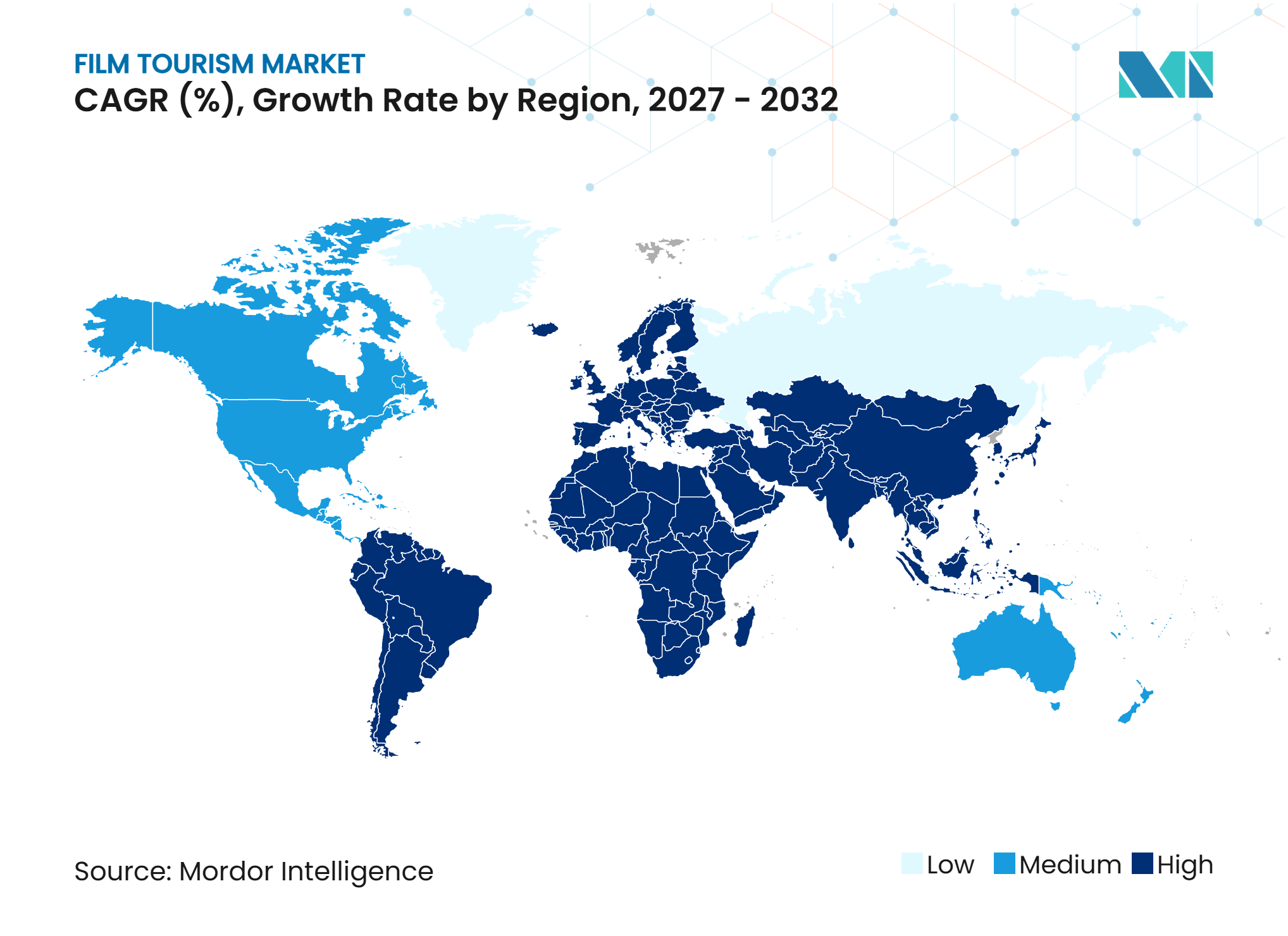
Europe accounted for 33.50% of the global film tourism industry in 2026, supported by screen properties, studios, historic locations, and international access. Northern Ireland’s Game of Thrones Studio Tour recorded 28% visitor growth in 2025. Dubrovnik’s booking rules and visitor controls demonstrate heritage capacity management. Asia-Pacific is forecast to grow at a 7.8% CAGR from 2027 to 2032, the highest geographic rate, driven by K-content, Bollywood travel, anime, and government production programs. Thailand attracted 279 international film productions in the first half of 2025, generating THB 2.866 billion (USD 0.09 billion) in direct revenue, supported by cash rebates of 15%-30% for qualifying productions. South Korea recorded 18.94 million foreign arrivals in 2025, while Seoul’s international visitors increased 23.1% year on year in July[4]. These trends highlight opportunities to connect screen exposure with destination marketing, although production spending and overall tourist arrivals should not be treated as direct measures of film-tourism demand.
North America remains a major franchise source and studio-attraction destination. Universal Epic Universe opened in Orlando in 2025, when North American parks reported attendance growth. British Columbia added Cineventure, offering visitor routes and planning tools. Netflix and Embratur developed guides for Brazilian productions, linking audiovisual content and destination promotion. The Middle East and Africa are expanding screen tourism, though infrastructure remains less mature than in Europe or North America. Growth depends on aligning incentives, visitor services, and sustainable access standards.
Competitive Landscape
Market Concentration
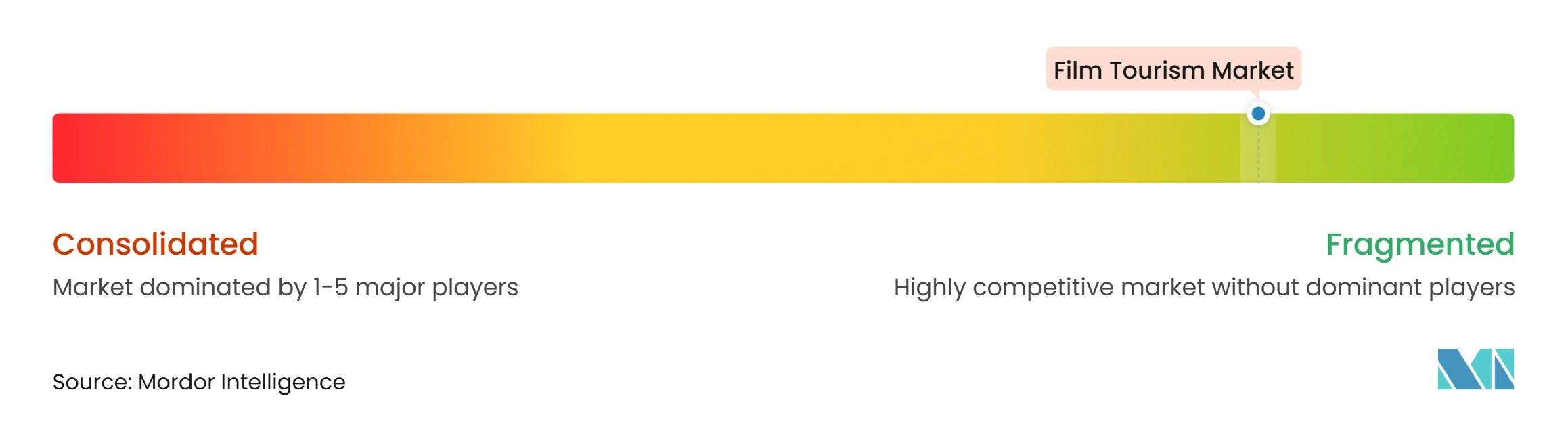
The global film tourism market is fragmented, with studio operators, attraction owners, tour companies, online travel agencies, and destination organizations serving different stages of the visitor journey. The five largest players - The Walt Disney Company, NBCUniversal, Warner Bros. Discovery, GetYourGuide, and Viator - accounted for an estimated 19%-27% of organized film tourism revenue, with no player holding more than 9%. Studio groups benefit from franchise ownership and investment in permanent attractions. Disneyland Paris’s EUR 2 billion (USD 2.35 billion) expansion introduced Disney Adventure World and World of Frozen in March 2026, while Universal Epic Universe opened in May 2025. Warner Bros. Studio Tour Hollywood attracts over 500,000 visitors annually, with GetYourGuide revenue up 21% year-on-year, highlighting demand for immersive, franchise-led experiences and related spending.
Online distribution is increasingly important for film-tourism bookings. GetYourGuide surpassed EUR 4 billion (USD 4.71 billion) in gross merchandise value (GMV) and achieved adjusted profitability in 2025. In August 2026, Airbnb partnered with Tripadvisor, Inc. to offer selected tours and attractions through its platform. Meanwhile, Destination Vancouver’s AR experience and Creative BC’s 25 Cineventure routes show how digital tools can connect screen locations with bookable, self-guided itineraries.
Film Tourism Industry Leaders
-
The Walt Disney Company
-
NBCUniversal
-
Warner Bros. Discovery
-
GetYourGuide Tours & Tickets GmbH
-
Viator
- *Disclaimer: Major Players sorted in no particular order
Film Tourism Market Companies Covered in this Report
- Warner Bros. Discovery
- NBCUniversal
- The Walt Disney Company
- Paramount Skydance Corporation
- Sony Pictures Entertainment
- Village Roadshow Theme Parks
- Parques Reunidos
- Ushakiron Movies Private Limited (Ramoji Film City)
- Bavaria Film GmbH
- Filmpark Babelsberg GmbH
- Cinecittà World S.p.A.
- Linen Mill Studios Limited
- Rings Scenic Tours Ltd. (Hobbiton Movie Set)
- Brit Tours Limited (Brit Movie Tours)
- On Location Tours, Inc.
- Secret Group Limited (Secret Cinema)
- SetJetters
- GetYourGuide Tours & Tickets GmbH
- Klook Travel Technology Pte. Ltd.
- Viator
Recent Industry Developments in Film Tourism Market
- September 2026: Walt Disney World opened The Magic of Disney Animation at Disney’s Hollywood Studios in Orlando, featuring Drawn to Wonderland, Off the Page!, Olaf Draws!, and the Once Upon a Studio Theater.
- August 2026: Tripadvisor, Inc. announced a partnership with Airbnb to make selected tours, activities, and attractions from Tripadvisor and Viator bookable through Airbnb later in 2026.
- March 2026: Disneyland Paris opened Disney Adventure World, featuring World of Frozen, Adventure Way, World Premiere, new dining and retail experiences. The EUR 2 billion (USD 2.35 billion) transformation is expected to create over 1,000 direct jobs.
- May 2025: Destination Vancouver launched Survive Vancouver on May 27, 2025, a free, browser-based augmented reality experience inspired by HBO’s The Last of Us, spanning four filming locations, including Chinatown, Gastown, and the Orpheum Theatre.
Global Film Tourism Market Report Scope
The global film tourism market report examines travel demand and visitor experiences shaped by movies, television series, streaming/OTT content, filming locations, and entertainment franchises worldwide. The market is segmented by trip purpose (Dedicated Film Tourism Trips, Film Tourism as Part of a Broader Leisure Trip, Film Festivals and Events, and Education, Research, and Film Industry Visits); tourist type (Domestic Tourists and International Tourists); and geography (North America, South America, Europe, Asia-Pacific, and the Middle East and Africa, including key countries and regional groups).
The study analyzes market drivers, including streaming-led discovery of filming locations, franchise and fandom-based travel, destination marketing partnerships with studios and platforms, immersive and behind-the-scenes experiences, social media influence, and film incentives. It also assesses restraints, such as overtourism, visitor-capacity constraints, uneven conversion of screen exposure into actual visits, environmental and heritage-preservation costs, and dependence on volatile content and production cycles. The report evaluates the value chain, regulatory landscape, technological outlook, Porter’s Five Forces Analysis, market size and growth forecasts, competitive landscape, market concentration, strategic developments, market share, and company profiles. It also identifies white-space opportunities, unmet needs, AI-personalized film-to-travel commerce, sustainable regional film-trail networks, and the future market outlook. The report offers market size and forecasts for the global film tourism market in value (USD) for all the above segments.
Segmentation Overview
| Dedicated Film Tourism Trips |
| Film Tourism as Part of a Broader Leisure Trip |
| Film Festivals and Events |
| Education, Research and Film Industry Visits |
| Domestic Tourists |
| International Tourists |
| North America | United States |
| Canada | |
| Mexico | |
| South America | Brazil |
| Peru | |
| Chile | |
| Argentina | |
| Rest of South America | |
| Europe | United Kingdom |
| Germany | |
| France | |
| Spain | |
| Italy | |
| BENELUX (Belgium, Netherlands, and Luxembourg) | |
| NORDICS (Denmark, Finland, Iceland, Norway, and Sweden) | |
| Rest of Europe | |
| Asia-Pacific | India |
| China | |
| Japan | |
| Australia | |
| South Korea | |
| South East Asia (Singapore, Malaysia, Thailand, Indonesia, Vietnam, and the Philippines) | |
| Rest of Asia-Pacific | |
| Middle East | United Arab Emirates |
| Saudi Arabia | |
| South Africa | |
| Nigeria | |
| Rest of the Middle East and Africa |
| By Trip Purpose | Dedicated Film Tourism Trips | |
| Film Tourism as Part of a Broader Leisure Trip | ||
| Film Festivals and Events | ||
| Education, Research and Film Industry Visits | ||
| By Tourist Type | Domestic Tourists | |
| International Tourists | ||
| By Geography | North America | United States |
| Canada | ||
| Mexico | ||
| South America | Brazil | |
| Peru | ||
| Chile | ||
| Argentina | ||
| Rest of South America | ||
| Europe | United Kingdom | |
| Germany | ||
| France | ||
| Spain | ||
| Italy | ||
| BENELUX (Belgium, Netherlands, and Luxembourg) | ||
| NORDICS (Denmark, Finland, Iceland, Norway, and Sweden) | ||
| Rest of Europe | ||
| Asia-Pacific | India | |
| China | ||
| Japan | ||
| Australia | ||
| South Korea | ||
| South East Asia (Singapore, Malaysia, Thailand, Indonesia, Vietnam, and the Philippines) | ||
| Rest of Asia-Pacific | ||
| Middle East | United Arab Emirates | |
| Saudi Arabia | ||
| South Africa | ||
| Nigeria | ||
| Rest of the Middle East and Africa | ||
Key Questions Answered in the Report
What is the projected value of the global film tourism market by 2032?
The global film tourism market is projected to reach USD 83.49 billion by 2032, from USD 63.34 billion in 2027, at a 5.68% CAGR.
Which trip purpose leads film-related travel?
Film tourism as part of a broader leisure trip accounted for 54.60% share in 2026, while dedicated trips are projected to grow fastest at a 7.60% CAGR through 2032.
Which region is growing fastest for screen-related travel?
Asia-Pacific is forecast to grow at a 7.80% CAGR from 2027 to 2032, supported by entertainment exports and production incentive programs.
Why are franchise attractions important for visitor demand?
They provide permanent access to sets, props, and behind-the-scenes material, helping operators attract repeat visitors and support dedicated travel.
How do online travel platforms influence film tourism bookings?
Platforms expand international distribution, support reservations, and help operators manage timed capacity at high-demand attractions.
What limits growth at famous filming locations?
Overtourism, heritage protection, access limitations, and the gap between viewer interest and actual travel bookings can restrict visitor growth.