
Event Planning Services Market Size and Share
Market Overview
| Study Period | 2022 - 2032 |
|---|---|
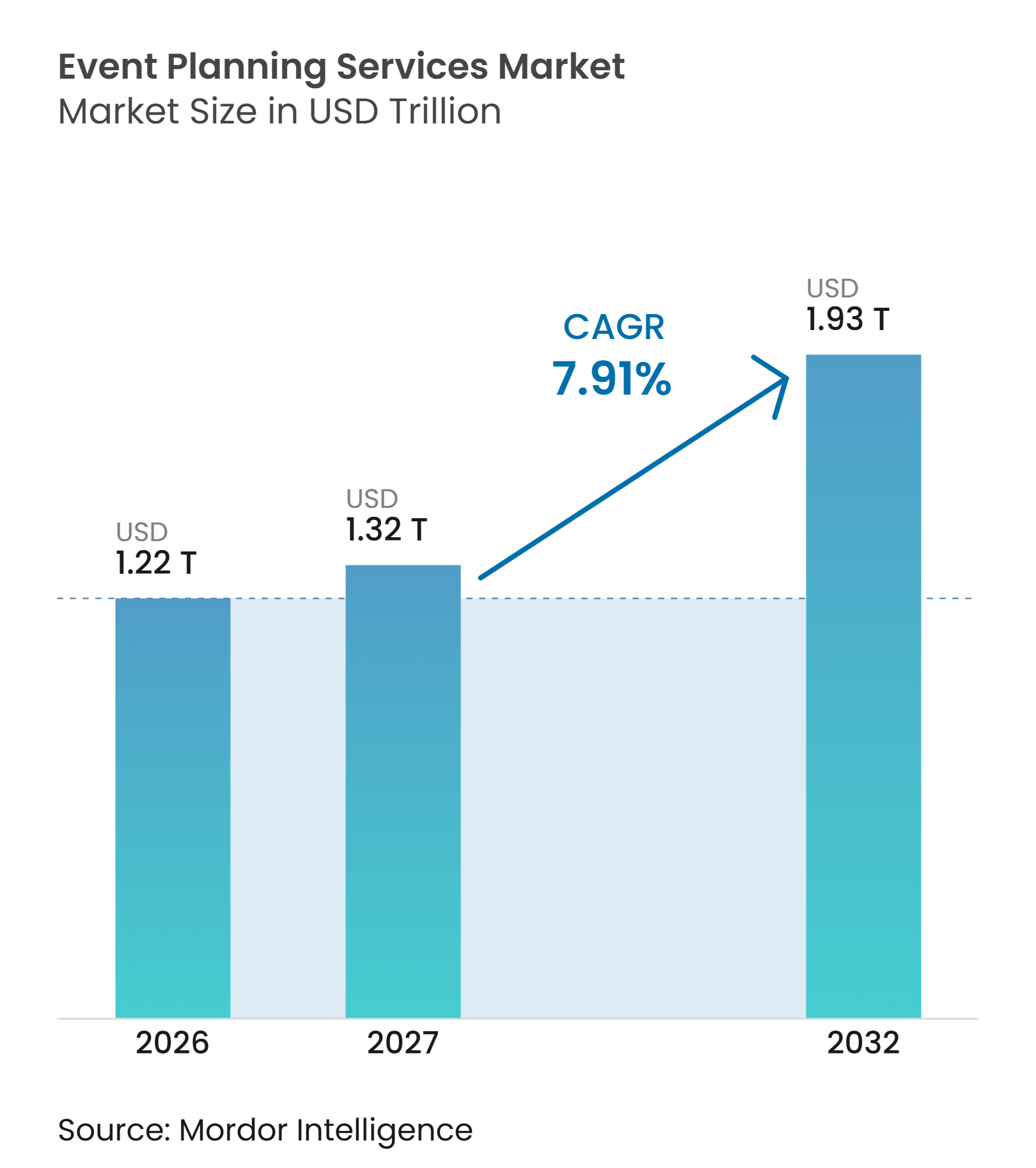
| Market Size (2027) | USD 1.32 Trillion |
| Market Size (2032) | USD 1.93 Trillion |
| Growth Rate (2027 - 2032) | 7.91 % |
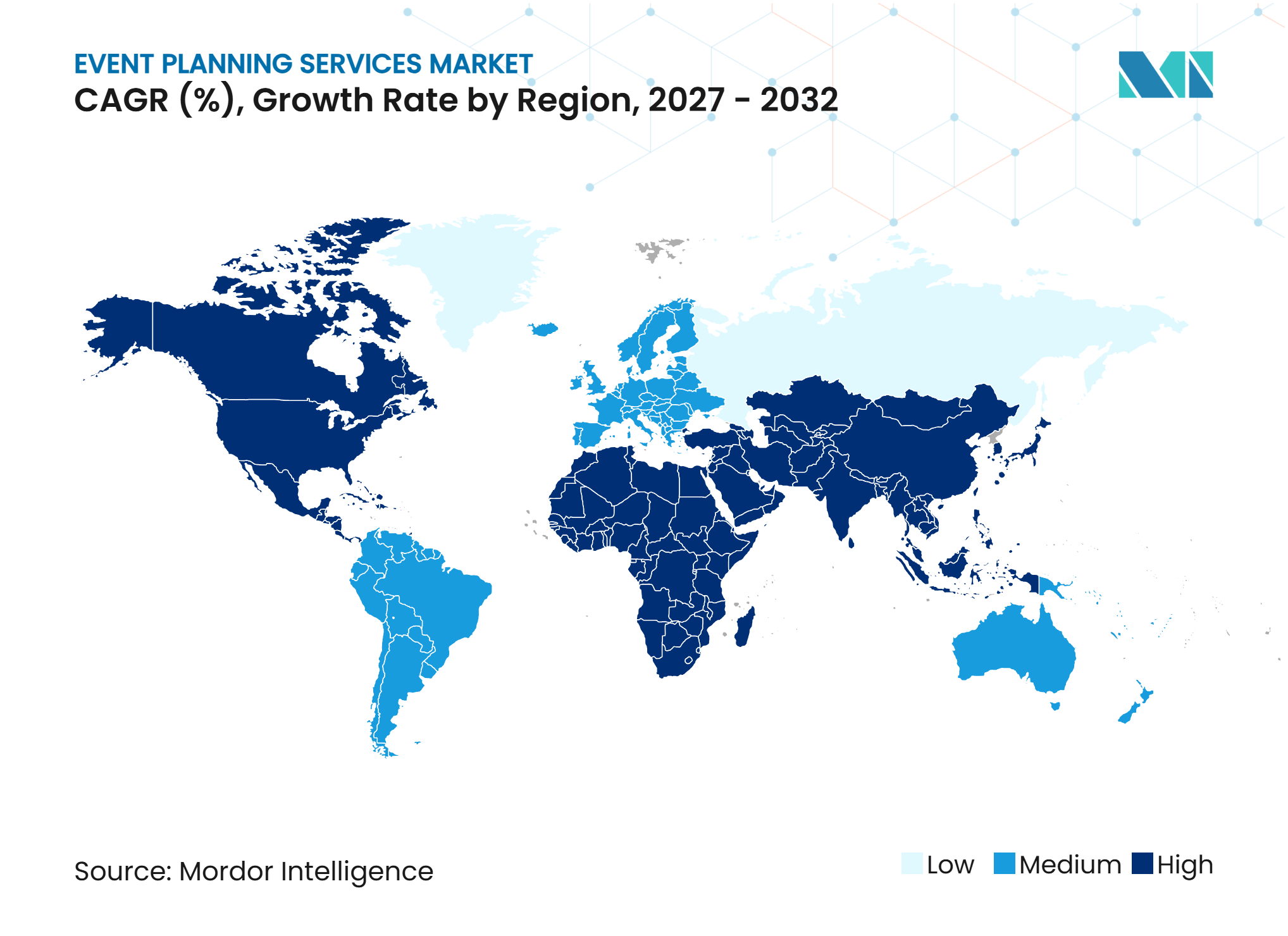
| Fastest Growing Market | Asia-Pacific |
| Largest Market | North America |
| Market Concentration | Low |
Major Players *Disclaimer: Major Players sorted in no particular order Image © Mordor Intelligence. Reuse requires attribution under CC BY 4.0. | |
Event Planning Services Market Analysis by Mordor Intelligence
The global event planning services market was valued at USD 1.223 trillion in 2026 and is estimated to grow from USD 1.319 trillion in 2027 to reach USD 1.930 trillion by 2032, at a CAGR of 7.91% during the forecast period (2027-2032). Corporate buyers increasingly use live programs to support revenue generation, relationship building, and employee engagement rather than treating them as discretionary expenditures. The Events Industry Council recorded USD 1.3 trillion in direct business-event spending and 1.65 billion participants in 2025, supporting demand for planning, production, venue, and attendee services[1]. The global event planning services market benefits from the growing adoption of hybrid formats, which extend content lifecycles and expand sponsorship inventory through digital access. Demand is shifting toward data capture, personalized attendee experiences, and measurable commercial outcomes. However, cost inflation, fragmented measurement systems, privacy obligations, and pressure on sponsor budgets remain significant constraints for the global event planning services market.
Key Report Takeaways
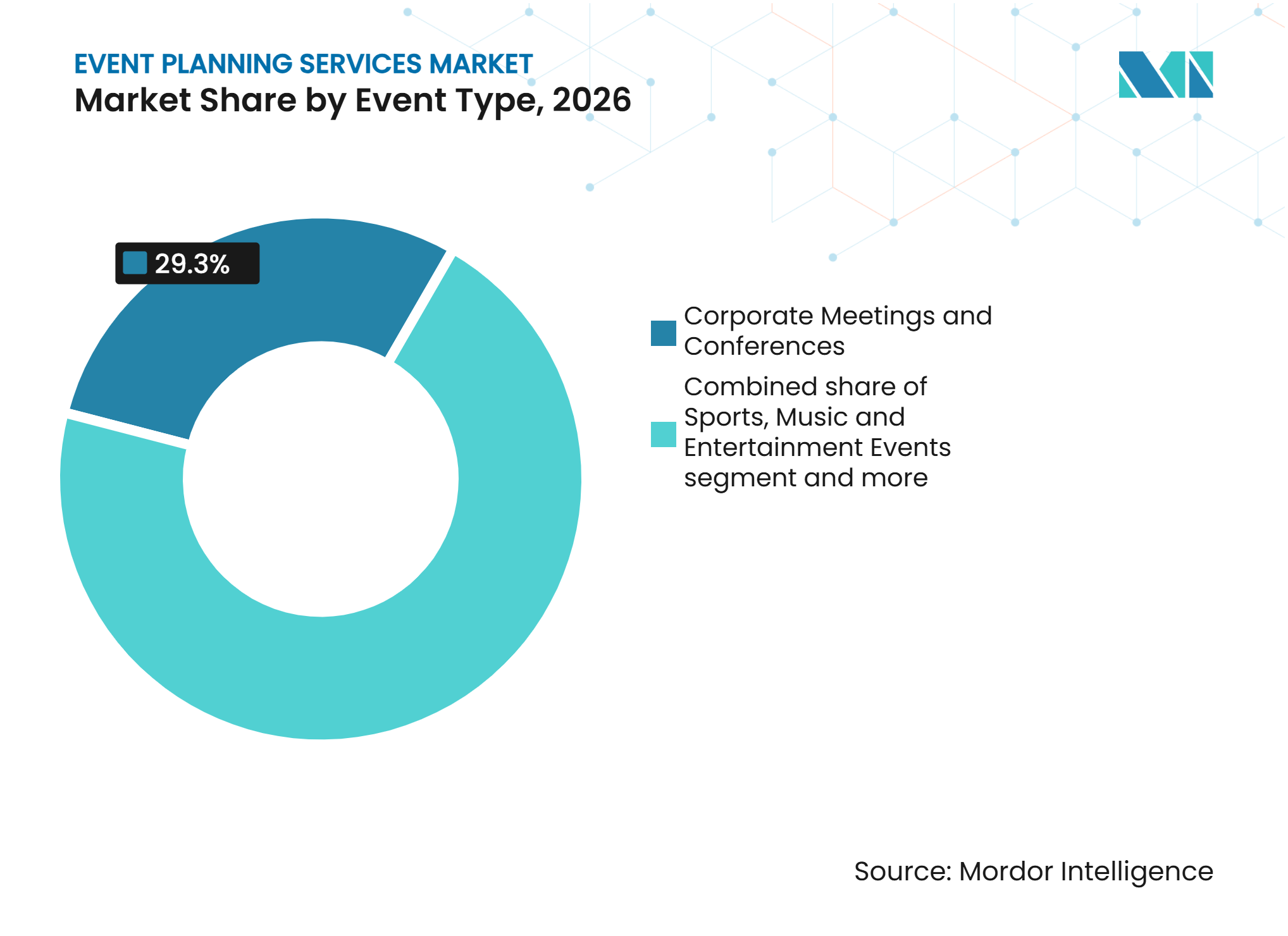
- By event type, Corporate Meetings and Conferences accounted for 29.30% of the global event planning services market share in 2026, while Sports, Music and Entertainment Events are forecast to grow at an 8.75% CAGR through 2032.
- By service type, Venue and Logistics Management accounted for 38.70% of the global event planning services market share in 2026, while Registration and Attendee Management is forecast to grow at a 10.50% CAGR through 2032.
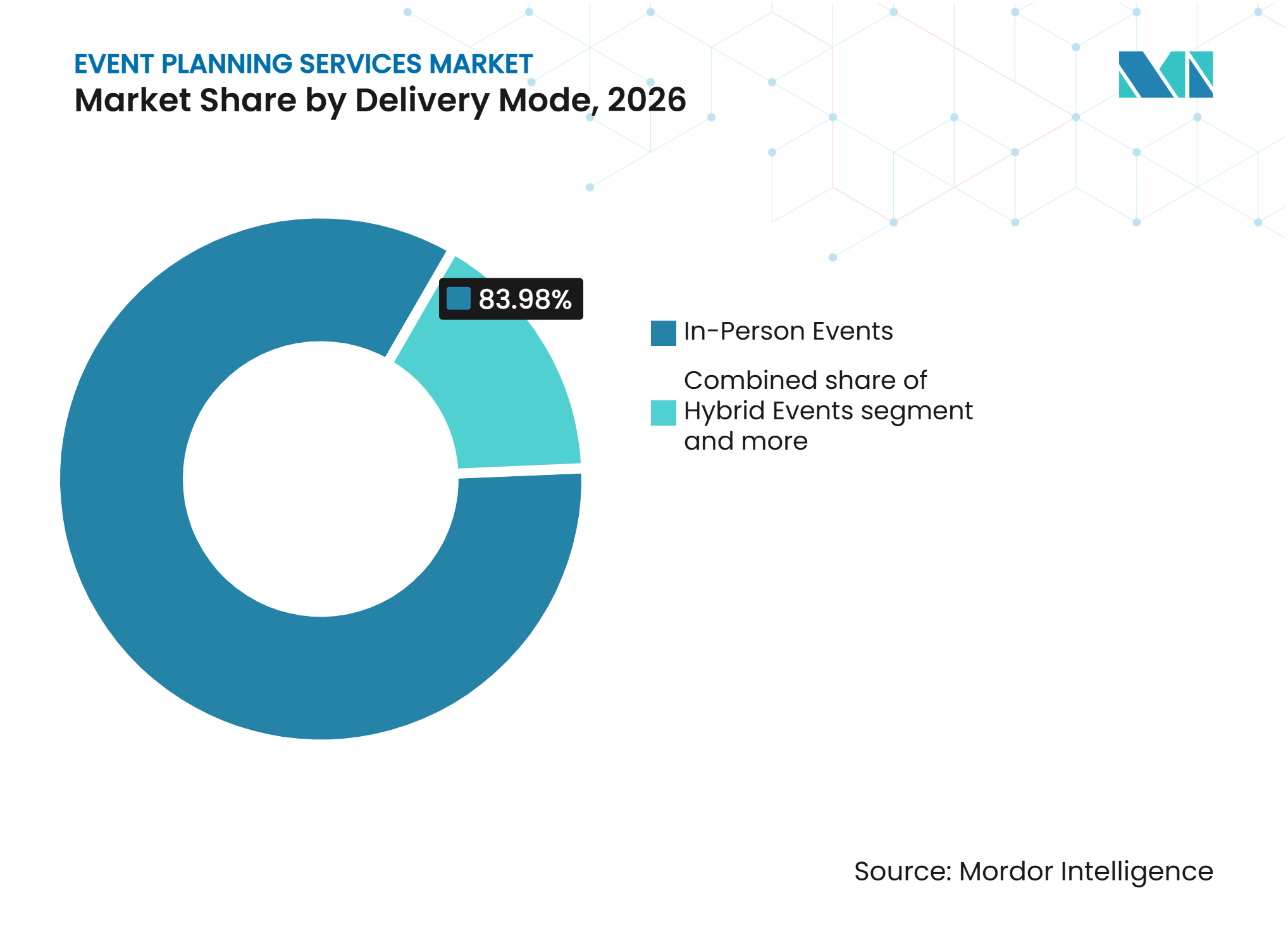
- By delivery mode, In-Person Events accounted for 83.98% of the global event planning services market share in 2026, while Hybrid Events are forecast to grow at a 10.20% CAGR through 2032.
- By end user, Corporates and Businesses accounted for 47.60% of the global event planning services market share in 2026, while Educational Institutions are forecast to grow at a 9.64% CAGR through 2032.
- By geography, North America accounted for 31.60% of the global event planning services market share in 2026, while Asia-Pacific is forecast to grow at a 9.47% CAGR through 2032.
Note: Market numbers in this report are based on Mordor Intelligence's proprietary estimation framework, which combines nine months of actuals with Q4 projections for base year 2026.
Market Trends and Insights
Drivers Impact Analysis of Event Planning Services Market*
| Driver | (~) % Impact on CAGR Forecast | Geographic Relevance | Impact Timeline |
|---|---|---|---|
| Rising Corporate Demand for Branded Experiential Events | +2.5% | Global, led by North America and Western Europe | Medium term (2-4 years) |
| Hybrid Event Monetization and Extended Audience Reach | +1.8% | Global, with strongest acceleration in Asia-Pacific | Long term (≥ 4 years) |
| AI-Enabled Personalization, Matchmaking, and Sponsorship Valuation | +1.2% | Global, initially concentrated in North America and Western Europe | Long term (≥ 4 years) |
| First-Party Attendee Data and Measurable Event ROI | +0.9% | Global | Medium term (2-4 years) |
| Expansion of Women's Sports and Purpose-Led Sponsorships | +0.7% | North America and Western Europe, with early gains in Asia-Pacific | Medium term (2-4 years) |
| Growth of Short-Lead, Pop-Up, and Micro-Event Activations | +0.6% | Global, with strong traction in Tier-1 urban markets | Short term (≤ 2 years) |
| Source: Mordor Intelligence | |||
Rising Corporate Demand for Branded Experiential Events
Corporations use live programs to support client retention, employee engagement, and relationship development. Navan reported 13.8% year-on-year growth in its business travel activity index in Q4 2025[2]. Hilton found that 49% of attendees cited networking and team bonding as a main reason for attending work events, while 84% valued local cultural experiences. Corporate and business events generated USD 566 billion in direct global spending in 2025, the largest category in the Events Industry Council study. This demand benefits providers that align event design with commercial, workforce, and account management objectives. It also supports higher-value services in destination selection, production, content design, and attendee experience across the global event planning services market.
Hybrid Event Monetization and Extended Audience Reach
Hybrid programs are evolving beyond basic streaming toward structured physical and digital service delivery. Association Laboratory reported that 51% of respondents identified investment in technology infrastructure supporting hybrid meetings as a priority in 2021. Organizers can offer in-person, virtual-only, and on-demand access options for audiences with varying budgets and travel constraints. Digital sessions also create additional sponsor inventory and measurable engagement data. This model can extend content value beyond the live program. Consequently, the global event planning services market can develop services related to pricing architecture, platform configuration, content production, and digital sponsor reporting.
AI-Enabled Personalization, Matchmaking, and Sponsorship Valuation
Artificial intelligence is increasingly being applied to attendee services, event-planning workflows, and on-site analytics. On January 20, 2026, RainFocus introduced Nexus, a system of specialized AI agents for event marketing. Its Configuration Agent automates event setup, potentially reducing time to launch by up to 50%, while its Concierge Agent supports attendee scheduling and recommendations[3]. Growth and On-Site agents were planned for subsequent rollout. In June 2026, Navan launched Navan Events, integrating venue sourcing, hotel requests for proposals (RFPs), attendee registration, travel coordination, and budget tracking. Hilton's 2026 research found that 67% of attendees agreed that AI assistance at work events helps them maximize their experience by saving time and effort. These capabilities can help event organizers personalize attendee services, facilitate networking, and improve access to event performance data, potentially strengthening sponsor reporting.
First-Party Attendee Data and Measurable Event ROI
Consent-based attendee data is becoming more important as sponsors seek clearer evidence of audience quality. Cvent's 2025 Planner Sourcing Report found that 28% of planners considered event ROI an important measure of event success. Registration forms, session selections, meeting requests, and content engagement generate valuable records when collected with explicit consent. These records help organizers identify attendance patterns, develop relevant sponsor reports, and integrate event data with customer relationship management and marketing systems. Providers in the global event planning services market can differentiate through data governance, permission management, and reporting capabilities that link attendee activity to defined commercial objectives.
Restraints Impact Analysis of Event Planning Services Market*
| Restraint | (~) % Impact on CAGR Forecast | Geographic Relevance | Impact Timeline |
|---|---|---|---|
| Rising Venue, Labor, and Production Costs | -1.1% | Global, most acute in North America and Western Europe | Short term (≤ 2 years) |
| Measurement Fragmentation Across Offline and Digital Touchpoints | -0.7% | Global | Medium term (2-4 years) |
| Data Privacy, Consent, and Cybersecurity Complexity | -0.5% | Europe and North America primarily | Long term (≥ 4 years) |
| Sponsor Budget Reallocation Toward Performance Marketing | -0.6% | Global, particularly in North America | Medium term (2-4 years) |
| Source: Mordor Intelligence | |||
Rising Venue, Labor, and Production Costs
Venue, labor, food, and technical production costs can pressure margins for planners and buyers. Professionals International reported that per-person incentive travel spending reached USD 5,100 globally and USD 6,000 in North America in 2025. The organization also reported that 25% of buyers planned to reduce program quality by shortening trips or selecting lower-cost destinations. To protect client budgets, planners may standardize production, use repeatable supplier packages, or redesign programs. This risk is particularly pronounced in North America and Western Europe, where venue and specialist labor costs are high. Providers that cannot demonstrate cost discipline may lose business to simplified program formats or lower-cost destinations.
Measurement Fragmentation Across Offline and Digital Touchpoints
Measurement remains challenging when registration data, badge scans, digital session engagement, sales activity, and sponsor reporting are not integrated. Bizzabo's 2025 State of Events and Industry Benchmarks found that 70% of respondents faced difficulties demonstrating ROI from in-person conferences, summits, and conventions[4]. The study also found that 24% identified sales pipeline growth as the highest priority objective for these events. These findings highlight the importance of connecting event engagement data with business outcomes. Without consistent key performance indicators and agreed-upon attribution methodologies, event planning firms may struggle to justify budgets, compare event performance with other customer acquisition channels, and demonstrate sponsor value during renewal discussions.
*Our forecasts treat driver/restraint impacts as directional, not additive. The impact forecasts reflect baseline growth, mix effects, and variable interactions.
Consumer Preferences & Spending Patterns
FCM’s 2026 Global Trends Report found that medium-sized events (50-150 attendees) accounted for 36.6% of corporate meetings and events spending priorities in 2025, compared with 27.8% for large events and 19.1% for small meetings. This trend supports demand for modular planning services that balance scale with personalized engagement. Hilton’s 2026 research found that 76% of respondents enjoyed employer-organized wellness activities, while 67% reported lower engagement without downtime. Event planners can differentiate through balanced agendas, wellness programs, and networking opportunities.
The Events Industry Council reported global direct business-event spending of USD 1.3 trillion in 2025, up 12.2% from 2019, across 1.65 billion participants. The 2025 Incentive Travel Index recorded average incentive-program spending of USD 5,100 per person, up 4% year over year. These figures indicate opportunities for outsourced planning, production services, and enhanced experiences. However, rising hotel, airfare, and catering costs make transparent budgeting essential.
Service Market Performance Intelligence
Northstar Meetings Group’s 2026 Independent Planner Pricing Survey, covering more than 370 independent planners, found that 39% primarily charged flat or project fees, 25% markups, 12% percentage-of-budget fees, 11% commissions and 10% time-based fees. Additionally, 66% reported hourly rates of USD 50-149. These findings highlight demand for transparent, scope-based pricing, particularly when clients compare planning, production and technology services. Itemized hybrid-event costs and clearly defined supplier expenses can improve budget control and reduce disputes.
FCM’s 2026 Trends Report found that 92% of respondents expected meetings and events budgets to remain stable or increase, while 35% anticipated increases exceeding 10%. MPI’s Q1 2026 Outlook reported that 57% expected favorable business conditions. These findings indicate potential demand opportunities, but do not directly measure client acquisition costs. Demonstrable delivery capabilities, safety procedures and reliable supplier networks can help providers compete for corporate contracts.
Event Planning Services Market Segment Analysis
By Event Type:
Corporate Meetings Support Scale, Entertainment Extends GrowthCorporate meetings and conferences accounted for 29.30% of the global event planning services market share in 2026. According to the Events Industry Council, corporate events generated USD 566 billion in direct spending in 2025, while conferences and congresses generated USD 383.2 billion. These programs require coordinated venue, production, registration, travel, and content services, supporting recurring work for full-service planners and specialized suppliers.
Sports, music, and entertainment events are forecast to grow at a CAGR of 8.75% through 2032. Reuters reported that India hosted 27,000 live entertainment events in the first 11 months of 2024, a 35% year-on-year increase. This category benefits from ticketing, hospitality, sponsor activation, and venue operations. Weddings and private social programs provide stable local demand, while exhibitions and trade shows connect suppliers with buyers. Purpose-led activations and incentive travel create specialized work requiring experience design and stakeholder management.



By Service Type:
Logistics Holds the Largest Position, Registration Gains MomentumVenue and Logistics Management accounted for 38.70% of the global event planning services market share in 2026. This service supports physical events through venue selection, supplier coordination, access management, transportation planning, and on-site execution. It also involves significant responsibility for security, accessibility, and schedule management. Large corporate events and exhibitions often require coordination among multiple suppliers. Venue expertise and local operational capabilities therefore provide value to service providers.
Registration and Attendee Management is projected to grow at a CAGR of 10.50% through 2032. The service is expanding beyond ticket issuance to include identity management, access permissions, communications, matchmaking, and attendance analytics. RainFocus Nexus and Navan's meetings platform demonstrate how registration systems can integrate with broader event planning and commercial workflows. Event Production and Technical Services remain important for shaping live event experiences and supporting hybrid content delivery. Event Marketing and Sponsorship services are gaining relevance as organizers seek to package audience access and engagement data for partners.
By Delivery Mode:
In-Person Programs Retain Scale While Hybrid Programs Add ReachIn-person events accounted for an 83.98% share of the global event planning services market in 2026. Physical programs support relationship building, live entertainment, hospitality, and structured networking. Meeting Professionals International reported in its first-quarter 2026 outlook that 60% of respondents expected favorable in-person attendance trends over the following year. Hilton’s research highlighted the role of intentional experience design and planned downtime in driving engagement. These requirements sustain demand for venue, production, hospitality, and on-site management capabilities.
Hybrid events are projected to grow at a CAGR of 10.20% through 2032. They combine physical attendance with remote access, recorded content, and digital sponsor activities. This format provides ticketing flexibility and extends programs beyond venue capacity. It also generates session-level data for sponsor reporting and content planning. Virtual programs continue to support lower-cost outreach, lead generation, and community engagement. The global event planning services market requires providers that can tailor each format to buyers’ audience, data, and commercial priorities.

By End User:
Corporate Buyers Lead While Education Broadens DemandCorporates and businesses accounted for a 47.60% share in 2026. According to FCM Meetings & Events, employee engagement and training were the primary event objectives for 74% of corporate buyers, followed by learning and development and business management, each cited by 62%. Government and public-sector organizations also procured conferences, exhibitions, and stakeholder events. Associations required support for meetings, membership engagement, sponsor programs, and content delivery. These buyers often needed providers capable of meeting formal procurement, security, accessibility, and governance requirements.
Educational institutions are projected to grow at a CAGR of 9.64% through 2032. Universities and professional training bodies use hybrid formats for learner communities, recruitment programs, alumni activities, and professional events. Their requirements differ from those of corporate buyers, as accessibility, campus coordination, and academic calendars influence delivery. Nonprofit organizations and private clients generate recurring demand for fundraising, social, and community events. This broader end-user base creates opportunities for regional providers to offer compliance-ready, scalable services and reduces dependence on corporate buyers within the global event planning services market.
Geography Analysis
North America accounted for 31.60% of the global event planning services market in 2026. The region generated USD 487.7 billion in direct business-event spending in 2025, the highest regional total in the Events Industry Council study. Extensive venue infrastructure and established supplier networks support corporate meetings, conventions, sports programs, and exhibitions. FCM reported that 63% of North American companies surveyed expected year-on-year growth in meetings and events spending in 2026. Navan reported that corporate hotel and flight booking volumes in 2026 FIFA World Cup host cities increased by 46% in the United States and 295% in Canada compared with the same period in 2025.
Asia-Pacific is forecast to grow at a 9.47% CAGR through 2032. Corporate travel spending is projected to reach USD 701 billion in 2026, exceeding 40% of global expenditure. Singapore's Tourism 2040 strategy supports Meetings, Incentives, Conferences, and Exhibitions (MICE) receipts and international events. Macao targets up to 2,500 MICE events by 2028. India's expanding live entertainment calendar and concert spending also support demand.
Europe generated USD 328 billion in direct business-event spending in 2025. The Middle East, Africa, and South America generated USD 21.1 billion, USD 25.8 billion, and USD 42.6 billion, respectively. Informa International, established by Dubai World Trade Centre and Informa in March 2025, targets revenue above USD 700 million. ISO 20121 may influence supplier selection for sustainability-focused events in Europe.
Service Provider Network & Expansion Intelligence
The global event planning services market comprises full-service organizers, production specialists, and experiential agencies. Encore operates in 21 countries, serves more than 2,200 hotels and venues, and reaches 25 million people annually. Its acquisition of FIRST added more than 800 team members and a corporate delivery model supporting over 15,000 events annually. In the Middle East, Informa and Dubai World Trade Centre combined more than 40 B2B brands, targeting revenue above USD 650 million in 2026. These expansions extend global reach and create opportunities for local production and destination management partners.
Technology adoption is reshaping service delivery. RainFocus Nexus reduces event launch times by up to 50% through automated configuration. Navan Events integrates planning workflows with travel management and provides access to more than 500,000 properties. Macao hosted 1,861 MICE events in 2025, compared with 1,160 in 2023, and targets 2,000-2,500 events annually by 2028. Higher event volumes and automation are increasing demand for scalable platforms and reliable local delivery networks.
Competitive Landscape
Market Concentration
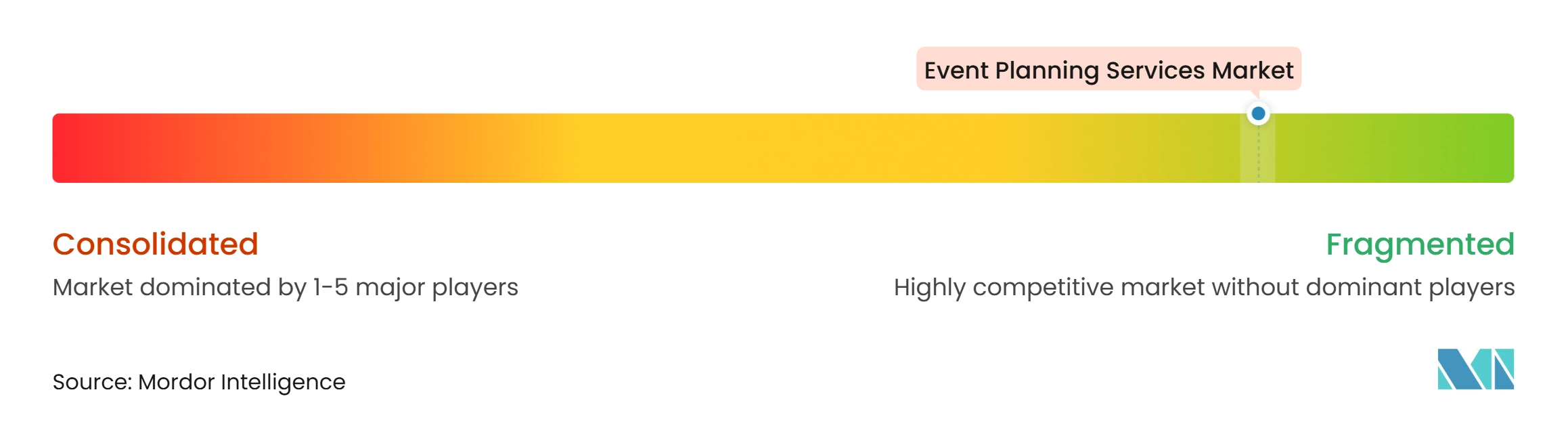
The global event planning services market is fragmented, with organizers, production suppliers, experiential agencies, destination management firms, and regional providers serving different parts of the value chain. Informa has a broad portfolio of business-to-business brands. In October 2026, Informa announced its acquisition of Clarion Events from Blackstone for an enterprise value of GBP 2.24 billion (USD 3.02 billion), adding more than 100 business-to-business event brands. The transaction highlights the value of scale in specialist event portfolios, data, and cross-border commercial relationships. However, it does not create a single dominant provider across the full planning services value chain.
Encore has expanded beyond venue production into brand experience and embedded program support. During 2026, the company acquired FIRST, a global brand experience agency, and Eclipse, a United Kingdom-based production company, expanding its United Kingdom capabilities. These acquisitions combine technical production, client-site delivery, and experiential services. They also reflect buyer demand for fewer operational handoffs in complex international programs.
Technology providers compete through planning automation, data integration, attendee services, and sponsor reporting. RainFocus and Navan have introduced platforms that integrate elements of the event workflow with broader marketing, travel, and finance processes. Smaller agencies compete through destination expertise, specialized production, sustainable event delivery, and local supplier networks. ISO 20121 certification can strengthen credentials for providers serving public-sector and association clients in sustainability-sensitive procurement processes. Competition is based on service specialization, geographic reach, data capabilities, and consistent delivery across event formats.
Event Planning Services Industry Leaders
-
Informa PLC
-
Freeman Company, LLC
-
Encore Global
-
GL events SA
-
RX Global Ltd.
- *Disclaimer: Major Players sorted in no particular order
Event Planning Services Market Companies Covered in this Report
- Informa PLC
- Freeman Company, LLC
- Encore Global
- GL events SA
- RX Global Ltd.
- American Express Global Business Travel
- ATPI Ltd.
- BCD Group
- DRPG Group Ltd.
- George P. Johnson Experience Marketing
- Jack Morton Worldwide
- MCI Group
- Maritz Global Events
- PRA Events
- Hargrove
- Production Resource Group
- Questex LLC
- Comexposium Group SAS
- Easyfairs Group
- Emerald Holding, Inc.
Recent Industry Developments in Event Planning Services Market
- October 2026: Informa PLC agreed to acquire Clarion Events from Blackstone for an enterprise value of GBP 2.24 billion (USD 3.02 billion), adding more than 100 business-to-business event brands, including IFA Berlin, DSEI, and ICE Barcelona. Completion is expected toward the end of Q4 2026, subject to regulatory approvals.
- July 2026: GL events completed the acquisition of MCO Congrès, a Marseille-based professional congress organiser specialising in scientific and medical conferences. The acquisition strengthened GL events Exhibitions' Health & Science division and expanded its capacity to organise professional congresses for associations and scientific communities in France and internationally.
- June 2026: Navan launched Navan Events, a unified corporate meetings and events platform integrating venue sourcing, hotel requests for proposals (RFPs), attendee registration, travel management, and budget tracking and approval workflows.
- December 2025: Encore announced the acquisition of FIRST, a global brand experience agency, expanding its in-venue event production capabilities through embedded corporate event management and project-based planning and production services across North America, Europe, the Middle East, Africa, and Asia-Pacific.
Global Event Planning Services Market Report Scope
The global event planning services market report examines services supporting the planning, coordination, production, marketing, and management of events worldwide. The market is segmented by event type (Corporate Meetings and Conferences, Exhibitions and Trade Shows, Weddings and Private Social Events, Sports, Music and Entertainment Events, and Others), service type (Event Planning and Coordination, Event Production and Technical Services, Event Marketing and Sponsorship, Venue and Logistics Management, and Registration and Attendee Management), delivery mode (In-Person, Virtual, and Hybrid Events), end user (Corporates and Businesses, Government and Public-Sector Organizations, Associations and Professional Bodies, Educational Institutions, and Nonprofit Organizations and Private Clients), and geography. The study evaluates key drivers, including corporate demand for branded events, hybrid event monetization, AI-enabled personalization, measurable event ROI, purpose-led sponsorships, and micro-event activations, alongside restraints such as rising venue and production costs, fragmented measurement, data privacy concerns, and shifts toward performance marketing. It assesses service provider networks, pricing, client acquisition costs, event spending, outsourcing trends, regulatory developments, technology adoption, and competitive forces. The report provides market size and growth forecasts, regional analysis, market concentration, market shares, strategic developments, and company profiles. It also examines opportunities in hybrid event services for SMEs and sustainable event packages with carbon accounting and ROI reporting. Market estimates and forecasts are presented in value (USD) across all covered segments.
Segmentation Overview
Key Questions Answered in the Report
What is the projected value of global event planning services in 2032?
The global event planning services market is projected to reach USD 1.930 trillion by 2032, growing at a 7.91% CAGR from 2027.
Which event type holds the largest share in 2026?
Corporate Meetings and Conferences accounted for the largest share at 29.30% in 2026.
Which service is growing fastest through 2032?
Registration and Attendee Management is forecast to grow at a 10.50% CAGR through 2032.
Why are hybrid programs gaining adoption?
Hybrid programs provide wider access, recorded content, digital sponsor inventory, and engagement data while retaining an in-person experience.
Which region is growing fastest through 2032?
Asia-Pacific is projected to grow at a 9.50% CAGR through 2032, supported by corporate travel, venue investment, and MICE development.
How concentrated is the event planning services sector?
The sector is fragmented because global organizers, production firms, experiential agencies, destination-management providers, and regional specialists operate across different service layers.