
Capsule Hotel Market Size and Share
Market Overview
| Study Period | 2022 - 2032 |
|---|---|
| Market Size (2027) | USD 345.23 Million |
| Market Size (2032) | USD 522.19 Million |
| Growth Rate (2027 - 2032) | 8.63 % |
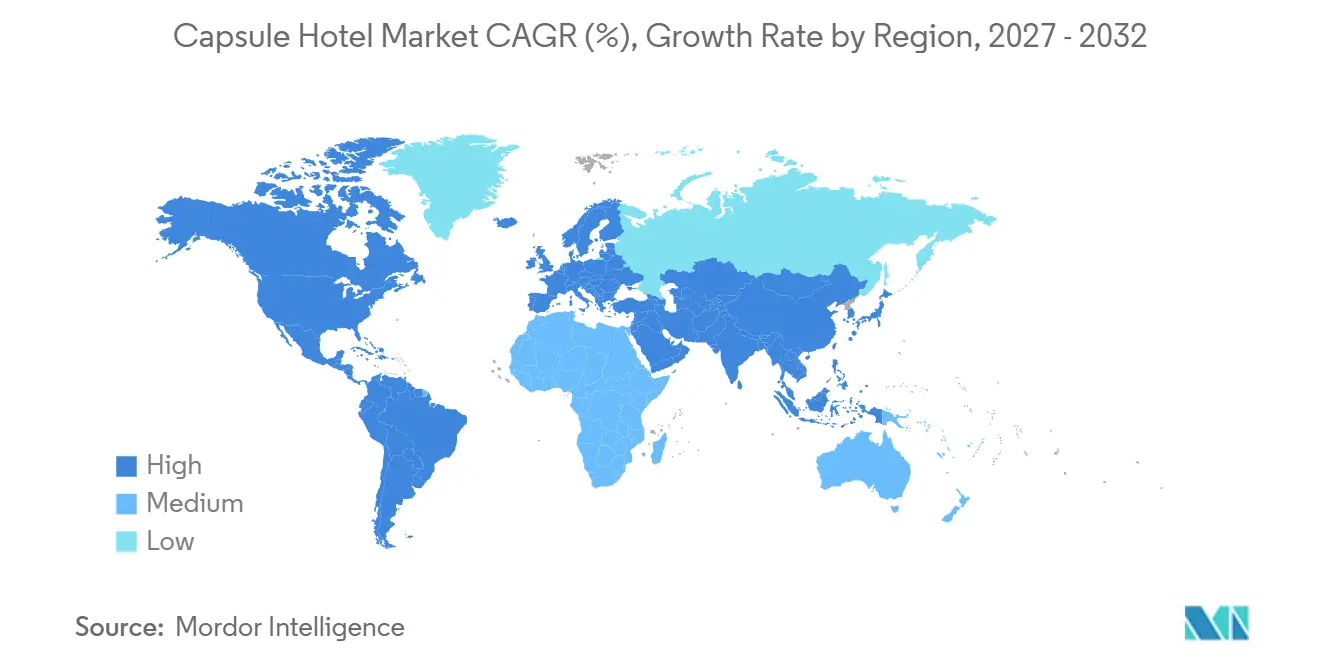
| Fastest Growing Market | North America |
| Largest Market | Asia-Pacific |
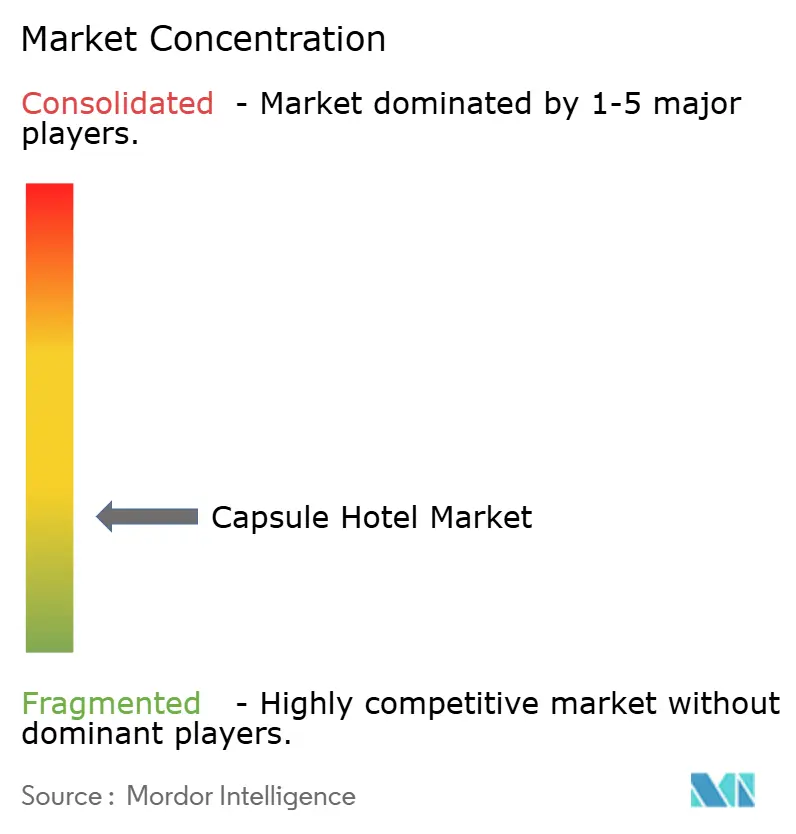
| Market Concentration | Low |
Major Players *Disclaimer: Major Players sorted in no particular order Image © Mordor Intelligence. Reuse requires attribution under CC BY 4.0. | |
Capsule Hotel Market Analysis by Mordor Intelligence
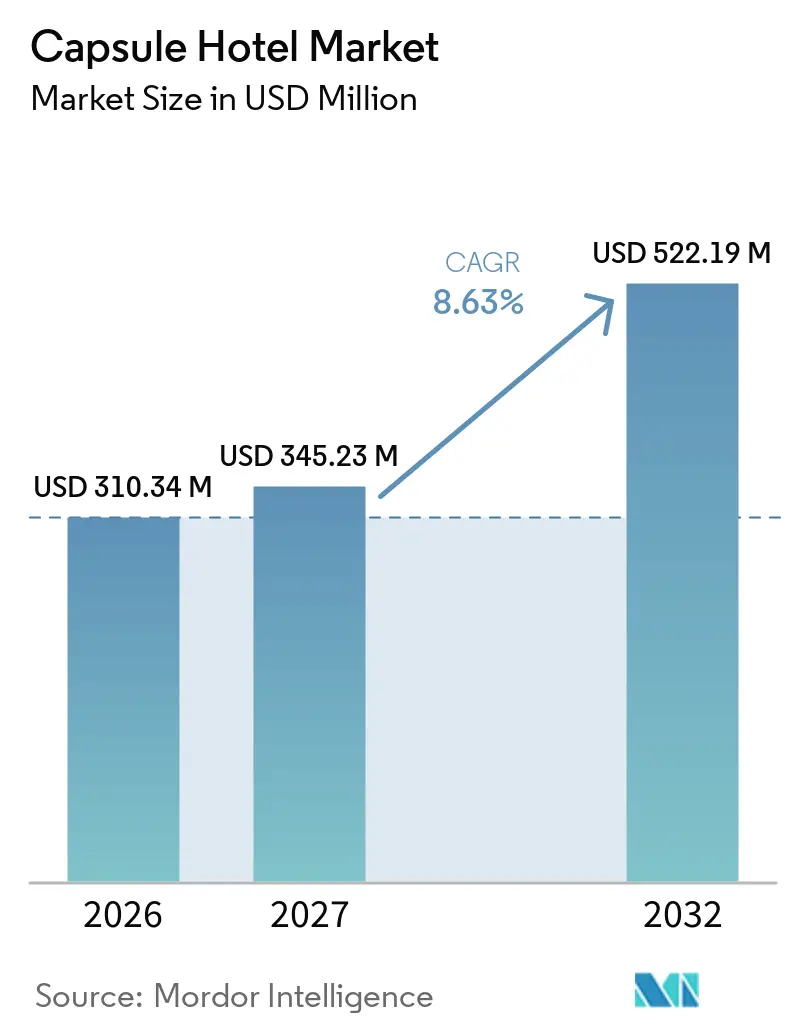
The global capsule hotel market was valued at USD 310.34 million in 2026 and is estimated to grow from USD 345.23 million in 2027 to reach USD 522.19 million by 2032, at a CAGR of 8.63% during the forecast period (2027–2032). The global capsule hotel market is evolving as operators balance affordability, space efficiency, privacy, technology, and guest comfort. Japan remains a key market, with Nine Hours and First Cabin offering sleep-focused environments, compact private cabins, and urban locations. CityHub reflects expansion into European cities, where high accommodation costs and limited space support pod-based stays. Solo travelers, budget-conscious tourists, and short-stay visitors drive demand. Operators are improving digital check-in, secure storage, sound insulation, and shared lounges. Compact layouts require effective ventilation, cleanliness, noise control, and privacy management.
Key Report Takeaways
- By traveler type, solo travelers accounted for 72.12% of the global capsule hotel market share in 2026, while group travelers are projected to grow at a 9.86% CAGR through 2032.
- By capsule type, single capsules accounted for 70.31% of the global capsule hotel market share in 2026, while premium / deluxe capsules are projected to grow at a 9.57% CAGR through 2032.
- By booking channel, Online Travel Agencies accounted for 40.73% of the global capsule hotel market share in 2026 and are projected to grow at a 9.98% CAGR through 2032.
- By application, leisure travel accounted for 54.23% of the global capsule hotel market share in 2026, while transit and layover stays are projected to grow at a 10.12% CAGR through 2032.
- By geography, Asia-Pacific accounted for 43.41% of the global capsule hotel market share in 2026, while North America is projected to grow at a 9.57% CAGR through 2032.
Note: Market numbers in this report are based on Mordor Intelligence's proprietary estimation framework, which combines nine months of actuals with Q4 projections for base year 2026.
Market Trends and Insights
Drivers Impact Analysis of Capsule Hotel Market*
| Driver | ~% Impact on CAGR Forecast | Geographic Relevance | Impact Timeline |
|---|---|---|---|
| Rising Demand for Affordable, Centrally Located Accommodation | +1.8% | Global, with highest impact in Asia-Pacific and Europe | Short term (≤ 2 years) |
| Expansion of Solo Travel and Short-Stay Travel Accommodation Demand | +1.5% | Global; highest in Asia-Pacific and Western Europe | Short term (≤ 2 years) |
| Urban Land Scarcity and Adoption of Space-Efficient Hotel Designs | +1.3% | North America, Europe, and Asia-Pacific Tier-1 Cities | Medium term (2-4 years) |
| Growth in Airport, Rail and Transit-Hub Accommodation Demand | +1.1% | Asia-Pacific, Middle East and Africa (hub airports), and Europe | Medium term (2-4 years) |
| Digital Guest Journeys and Smart-Pod Operational Efficiency | +0.9% | Global; highest in tech-forward Asia-Pacific and North America | Medium term (2-4 years) |
| Experience-Led Travel and Innovative Accommodation Formats Among Younger Travelers | +0.7% | Europe, North America, and Asia-Pacific | Long-term (≥ 4 years) |
| Source: Mordor Intelligence | |||
Affordable Central Accommodation and Solo Short-Stay Demand
Affordable accommodation drives demand in the global capsule hotel market, particularly in high-cost cities where travelers spend more time outside their accommodations. UN Tourism reported 5% growth in international tourism receipts in 2025, while accommodation costs influenced booking decisions. Zedwell Piccadilly Circus offers nearly 1,000 pods from GBP 30 (USD 40.47) per night, providing an alternative to lower-priced central London hotel rooms. Operators offer privacy screens, locks, sound insulation, biometric access, and climate controls. Reports found that 66% of solo travelers were aged 18-30 and 60% were female. Solo-accommodation searches in Asia grew by 16% in 2025, including 72% growth in Indonesia, supporting single-occupancy formats in high-volume tourism destinations.
Space-Efficient Urban Development and Transit-Hub Demand
The global capsule hotel market benefits from urban development conditions that favor compact accommodation and adaptive reuse. Space-efficient designs allow developers to increase room capacity within existing buildings, improving the use of constrained urban properties. CityHub plans to convert Hamburg’s 52-unit Hotel Pacific into a 110-key property, with an opening targeted for 2027. This approach highlights the potential to repurpose existing hotel assets while adding accommodation capacity[1]. Airports and railway hubs also offer opportunities to serve travelers seeking convenient options for short stays, layovers, and early-morning or late-night departures. First Cabin opened its Naha Airport property on October 1, 2025, introducing the airport’s first hotel with 72 cabins, alongside lounge and shower facilities. Such developments demonstrate how capsule-style accommodation can serve transit demand while addressing space constraints and affordability in high-traffic urban locations.
Digital Guest Journeys and Smart-Pod Efficiency
Digital processes support the global capsule hotel market, where properties manage many small units with limited on-site staff. App-based reservations, QR-code entry, self-check-in, digital access, and occupancy management reduce capsule assignment and turnover time. Online travel agencies enable independent properties to display real-time availability for travelers booking close to arrival, particularly for short transit stays requiring immediate confirmation and location details. Digital systems also allow operators to adjust pricing based on occupancy and manage service needs by pod rather than floor. These capabilities help operators maintain consistent service across multiple units while controlling costs and delivering a reliable guest experience.
Experience-Led Travel and New Accommodation Formats
Experience-led travel supports the global capsule hotel market as guests prioritize activities over larger rooms used mainly for sleep. National Geographic reported that operators such as LyLo and CityHub identify solo travelers as a key customer group. CityHub’s co-founder noted that guests often prefer experiences over accommodation spending. Distinctive design, shared lounges, local activity information, and co-working spaces help capsule hotels compete beyond price, particularly in city-center districts serving younger domestic and international visitors. Hotelbeds reported that 76% of Gen Z and Millennial travelers plan solo trips, while 56% prefer short weekend trips[2]. These trends support demand for flexible, social, short-stay accommodation.
Restraints Impact Analysis of Capsule Hotel Market*
| Restraint | ~% Impact on CAGR Forecast | Geographic Relevance | Impact Timeline |
|---|---|---|---|
| Building-Code, Fire-Safety and Accessibility Compliance Complexity | -1.3% | North America, Europe; highest in markets with strict fire codes | Medium term (2-4 years) |
| Privacy Concerns, Claustrophobia and Limited Personal Space | -1.0% | Global; most acute in the Middle East and Africa, South America, and mature hotel markets | Short-to-Medium term |
| Competition from Hostels, Budget Hotels and Alternative Lodging | -0.8% | Global; highest in established Asia-Pacific and European cities | Short term (≤ 2 years) |
| Cultural Acceptance and Guest Preferences for Shared Facilities | -0.7% | South America, Middle East and Africa, and first-entry European markets | Long term (≥ 4 years) |
| Source: Mordor Intelligence | |||
Building Code, Fire-Safety, and Accessibility Compliance Complexity
Building requirements can constrain the global capsule hotel market, as compact lodging layouts must meet fire safety, egress, accessibility, and material standards. Compliance is often more complex when operators retrofit older buildings in North America and Europe. UL Solutions updated UL 962 in 2025 to include electrical, egress, and fire safety requirements for prefabricated privacy booths and sleep capsules. Although the update provides a clearer compliance pathway, suppliers must specify compliant products before opening. Operators may need to modify corridor layouts, ventilation, accessible units, alarms, and materials to meet local regulations. These requirements increase pre-opening costs and extend development timelines, particularly for brands entering new markets.
Privacy, Limited Space, Shared-Facility Preferences, and Competing Lodging
Privacy concerns and limited personal space can constrain the global capsule hotel market, as some travelers are uncomfortable with enclosed sleeping units, shared bathrooms, and communal lounges. This issue is particularly significant for first-time guests comparing capsule accommodation with hostel beds and private budget-hotel rooms. Operators address these concerns through blackout screens, individual locks, soundproof panels, separate ventilation controls, and gender-segregated zones where appropriate. However, these upgrades increase operating costs and reduce the price difference from conventional rooms. Strong competition from hostels, budget hotels, and alternative lodging in established Asian and European cities further affects market positioning. Cultural preferences for private facilities can also complicate expansion into new regions.
*Our forecasts treat driver/restraint impacts as directional, not additive. The impact forecasts reflect baseline growth, mix effects, and variable interactions.
Consumer Behavior Analysis
Consumer demand in the global capsule hotel market is driven by affordability, location, privacy, and cleanliness. Travelers prioritize proximity to transportation hubs and tourist attractions, secure luggage storage, and clean shared facilities. Hilton’s 2026 Trends Report reported that 74% of surveyed travelers prefer booking with familiar, trusted brands, emphasizing consistent service, guest reviews, and transparent policies.
Digital convenience also influences demand, with 73% of travelers in Hilton’s 2026 survey valuing digital check-in. Operators can meet this preference through mobile reservations, contactless check-in, real-time availability, transparent pricing, flexible bookings, and local dining and activity recommendations while maintaining cost-effective accommodations.
Capsule Hotel Performance Intelligence
Lower prices, compact inventory, and demand from cost-sensitive guests drive capsule hotel performance. Zedwell Piccadilly Circus offers nearly 1,000 pods in central London, with rates from GBP 30 (USD 40.47) per night, competing with hostels and shorter stays. Operators manage rates by location, availability, and booking timing, while large unit counts spread fixed costs across more sellable units than conventional hotels.
Japan provides a property-level reference point. In August 2025, Ichigo Hotel REIT’s 27-property portfolio recorded an ADR of JPY 11,230 (USD 71.89) and RevPAR of JPY 9,528 (USD 64.59), up 6.9% and 4% year over year, respectively. Strong locations and consistent visitor demand supported rate growth. Digital check-in, flexible pricing, and rapid turnover can improve efficiency for single-night and last-minute bookings.
Capsule Hotel Market Segment Analysis
By Traveler Type:
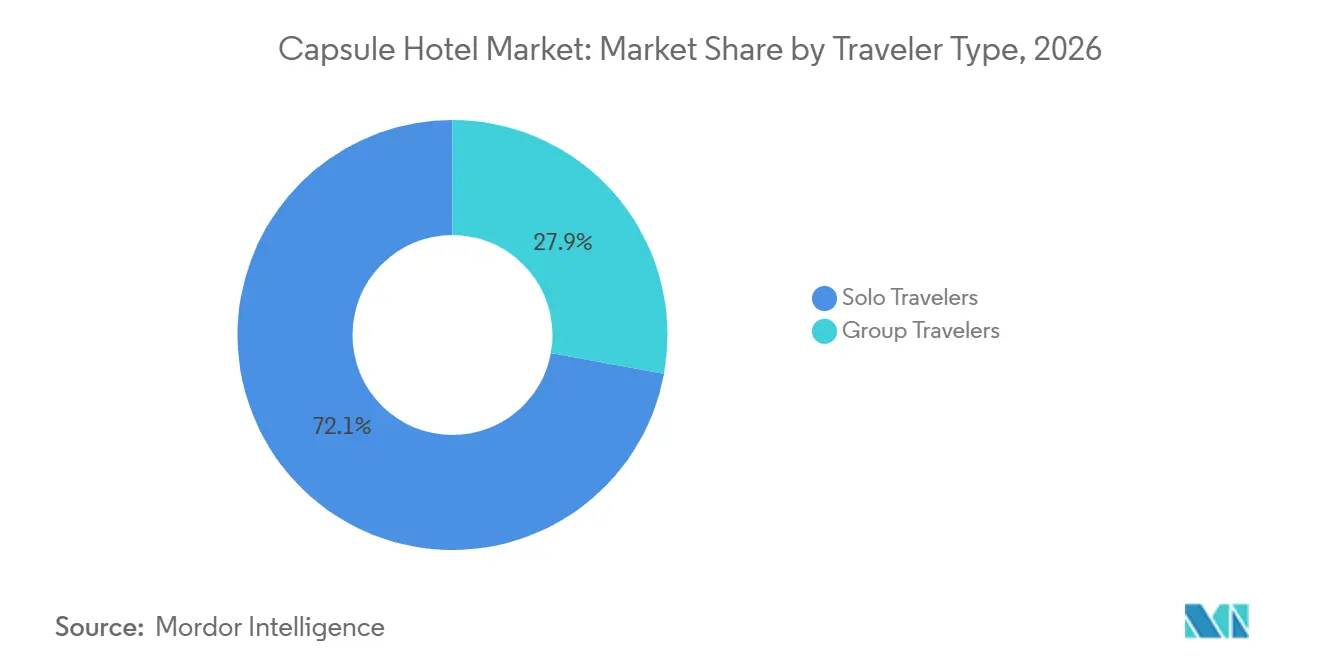
Solo Travelers Anchor Demand While Group Bookings ExpandSolo travelers held 72.12% of the global capsule hotel market share in 2026. The format serves individual occupants, making it suitable for travelers who do not require a full hotel room. Solo guests often select centrally located pods to reduce accommodation costs during short city breaks. Rising solo travel searches reported by Agoda across Asia support this demand pattern. A Report data also indicates that solo travelers include a substantial female traveler population rather than a narrow customer group. These factors make individual pods practical in tourist centers, business districts, and transit locations.
The group traveler segment is forecast to grow at a CAGR of 9.86% through 2032, faster than the overall global capsule hotel market. Operators can offer adjacent pods under one reservation for friends, small tour groups, and travel companions. Guests can share a base location while retaining individual sleeping spaces, creating a distinct alternative to dormitories. Japan received 9.46 million South Korean arrivals in 2025, up 7.3% year over year. Capsule hotels can target groups with Korean-language bookings, shared lounges, and localized services. In contrast, double capsules may attract couples and companions beyond solo travelers[3].
By Capsule Type:
Single Capsules Lead While Premium Units Improve Revenue PotentialSingle capsules account for 70.31% of global revenue in 2026. They provide the unit density operators require at city centre and airport-adjacent locations. Their simple layout offers a secure sleeping space for guests who do not need larger rooms. Single capsules also suit short stays, as guests require limited storage and service space. Their continued relevance reflects the core design logic of the global capsule hotel market. Offering entry-level units alongside higher-priced formats helps operators maintain accessibility.
Higher-tier and deluxe capsules are forecast to grow at a CAGR of 9.57% through 2032. First Cabin opened its Waikiki property in April 2025 with 103 pods across economy, business, and first-class tiers, demonstrating how one compact property can serve multiple price points[4]. These units offer more space, improved finishes, added controls, and quieter environments. Double capsules address the needs of couples and close travel partners seeking shared accommodation. UL 962 provides a compliance reference for prefabricated sleep capsules in markets with formal product and safety requirements. Higher-tier units enable operators to improve average rates while retaining the compact accommodation model.
By Booking Channel:
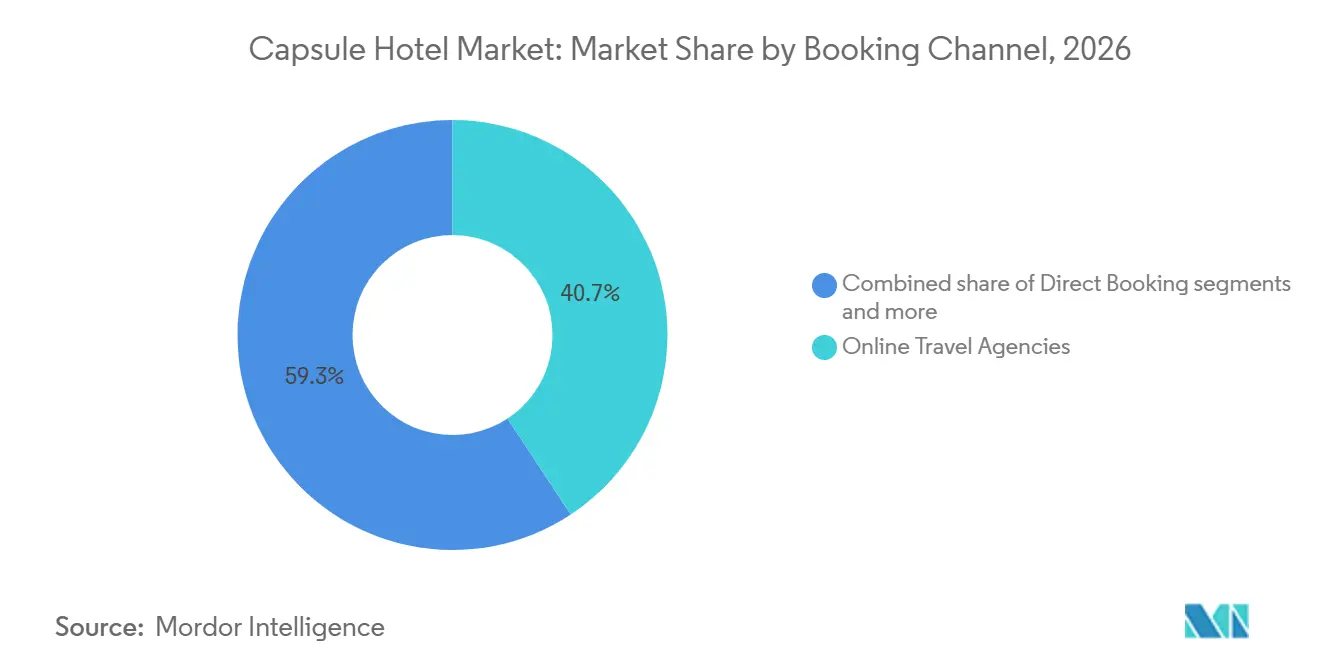
Online Travel Agencies Combine Reach and GrowthOnline travel agencies are expected to account for 40.73% of global revenue in 2026. They provide small and independent properties with visibility among travelers unfamiliar with local capsule hotel brands. The channel is particularly useful for last-minute bookings, when guests need clear information on pricing, access, and location. OTA listings enable operators to display room types and real-time availability across multiple distribution markets. This support is important because capsule hotel loyalty programs remain less developed than those of large hotel chains. OTAs can also help newly opened properties build awareness quickly.
Online travel agencies are projected to grow at a CAGR of 9.98% through 2032, supported by demand for instant confirmation, flexible search options, and real-time inventory among leisure and transit travelers. However, commission costs encourage larger operators to invest in direct booking websites and loyalty features. Direct channels are relevant when guests return to the same brand or discover properties through social media. Travel agents and tour operators remain useful for group travel and corporate transit arrangements, as they can coordinate pod clusters under one booking. The global capsule hotel market is likely to maintain a mixed distribution model, with OTAs supporting reach and direct channels protecting margins.

By Application:
Leisure Travel Holds the Largest Base While Transit Stays AdvanceLeisure travel accounts for 54.23% of global revenue in 2026. City-break travelers use pods as lower-cost accommodation between sightseeing, dining, and local activities. This application benefits from travelers’ growing preference to spend on experiences rather than rooms. The format also appeals to domestic travelers taking short weekend trips in dense urban areas. Shared lounges, local recommendations, and accessible locations add value to these guests. Consequently, leisure travel remains the primary revenue base for the global capsule hotel market.
Transit and layover stays are forecast to grow at a CAGR of 10.12% through 2032. Demand arises from travelers at airports, rail stations, and hub districts who require secure, short-duration accommodation. UN Tourism reported 307 million international tourist arrivals in the first quarter of 2026, 6 million more than in the first quarter of 2025, supporting international route traffic. First Cabin’s Naha Airport opening demonstrates how in-airport properties address this demand. Other applications include rest facilities for healthcare workers, university-adjacent stays, and event-related short stays. Nine Hours’ development near Nagoya University Hospital illustrates expansion beyond leisure and conventional business travel.
Geography Analysis
APAC Capsule Hotel Market
Asia-Pacific is projected to hold 43.41% of the global capsule hotel market in 2026. Japan remains the category’s operational center, supported by tourism demand in Tokyo, Osaka, Nagoya, and Okinawa. Japan is expected to receive 42.68 million international visitors in 2025, up 15.8% from 2024. Arrivals from India are expected to increase by 35.2%, improving visibility among Indian travelers seeking centrally located, compact stays. Southeast Asia offers expansion potential due to high domestic travel and demand for lower-cost accommodation.
Europe and North America Capsule Hotel Market
Europe is the second-largest regional market, supported by high city-center hotel costs and adaptive reuse opportunities. CityHub’s Hamburg conversion demonstrates the repurposing of an existing hotel building. North America is forecast to grow at a 9.57% CAGR through 2032. First Cabin’s Waikiki opening illustrates a Japanese-style capsule hotel with multiple service tiers. High gateway-city room rates support demand, although code compliance and guest familiarity may constrain expansion.
MEA and South America Capsule Hotel Market
The Middle East and Africa and South America remain smaller, early-stage markets. Middle East tourist arrivals are expected to grow 3% in 2025 and remain 39% above 2019 levels, according to UN Tourism. Dubai and Abu Dhabi could support transit-oriented properties. South America has potential in São Paulo and Lima, subject to developer interest, adaptable property stock, and secure positioning.
Capsule Hotel Supply & Development Intelligence
The global capsule hotel market is expanding through purpose-built properties and the conversion of existing commercial and hotel assets. Conversion projects enable operators to introduce compact accommodation in central locations without requiring undeveloped land. CityHub’s Hamburg project illustrates this approach, converting the former 52-room Hotel Pacific into a planned 110-key property featuring its modular Hub-room design. Although redevelopment was initially scheduled to begin in late 2025, subsequent heritage-related issues have affected the project timeline. The property is currently planned to open in 2027. This development model can shorten time to market and enable operators to leverage established urban locations with strong transport connectivity and visitor demand.
Nine Hours announced plans for Nine Hours Nagoya Sakae in July 2025, featuring approximately 180 capsules in an eight-story building acquired by Meitetsu City Design in Nagoya’s Sakae district, near Nagoya University Hospital. First Cabin opened its Naha Airport property in October 2025 and expanded internationally with First Cabin Seoul Myeongdong in 2026.
Competitive Landscape
The global capsule hotel market remains highly fragmented, with no operator accounting for more than 5% of global revenue, and the top five players collectively hold less than 30%. This structure creates opportunities for independent brands and consolidation among operators able to finance multi-city expansion. Nine Hours maintains a Japan-focused presence and uses partnerships to expand. Its Nagoya Sakae property, developed with Meitetsu City Design near Nagoya University Hospital, adds a healthcare-linked location. First Cabin serves a higher-value niche through economy, business, and first-class cabin tiers. Its 2025 Waikiki opening and Naha Airport launch expanded its urban and airport presence.
CityHub offers digitally controlled rooms, shared community spaces, and modular deployment. In September 2025, it appointed Remco Gerritsen as chief executive officer and announced plans to double its network across major European cities. In October 2025, it announced its first hotel conversion and German entry, converting Hotel Pacific in Hamburg from 52 units to 110 keys. Zedwell focuses on large-scale central-city pod inventory and low entry prices.
Operators compete through location, privacy, design, digital access, rates, and guest comfort. Opportunities remain in airport, rail-linked, and dense urban locations. Digital systems can reduce staffing needs, while higher-tier capsules can increase revenue. Clear digital booking, reliable access instructions, privacy features, and public transport access support travelers during international trips.
Capsule Hotel Industry Leaders
-
Nine Hours, Inc.
-
First Cabin HD Co., Ltd.
-
Book and Bed Tokyo
-
CityHub
-
The POD Boutique Capsule Hotel
- *Disclaimer: Major Players sorted in no particular order
Capsule Hotel Market Companies Covered in this Report
- Nine Hours, Inc.
- First Cabin HD Co., Ltd.
- CityHub
- Book and Bed Tokyo
- The POD Boutique Capsule Hotel
- The O Pod Hotel
- Urbanpod
- Pangea Pod Hotel
- The Millennials
- Pod Inn
- De Bedstee
- Capsule Inn Osaka
- The Bed KLCC
- Petra Capsule Hostel
- Inbox Capsule Hotel
- Nadeshiko Hotel
- Anshin Oyado
- BAY HOTEL Group
- Centurion International Co., Ltd.
- Code Pod Management Ltd.
Recent Industry Developments in Capsule Hotel Market
- June 2026: Nine Hours opened its 206-room Shinjuku-North facility in Tokyo, including a collaboration space developed with Tokyo Women’s Medical University to integrate capsule accommodation with sleep, health, and wellness initiatives.
- August 2026: Opened First Cabin Seoul Myeongdong in South Korea, featuring 144 cabins across multiple classes. The launch expanded the brand’s international presence and introduced its compact accommodation concept to a major shopping and tourism district.
- October 2025: CityHub announced its entry into Germany through the conversion of Hamburg’s Hotel Pacific, in partnership with Kohler & von Bargen. The redevelopment will increase capacity from 52 to 110 keys using modular Hub rooms, with opening planned for 2027.
- April 2025: First Cabin International Hawaii opened Hawaiʻi’s first Japanese-style capsule hotel on the 14th floor of Waikīkī Business Plaza in Honolulu. The USD 6 million project features 103 single-occupancy pods across first-class, business-class, and premium-economy categories.
Global Capsule Hotel Market Report Scope
The global capsule hotel market report examines space-efficient accommodation providers serving travelers across major hospitality markets worldwide. The market is segmented by traveler type (Solo and Group Travelers), capsule type (Single, Double, and Premium/Deluxe Capsules), booking channel, application, and geography. The study analyzes key drivers, including demand for affordable, centrally located accommodation, growth in solo and short-stay travel, urban space constraints, transit-hub accommodation needs, digital guest services, and innovative lodging preferences. Restraints include building-code and fire-safety requirements, privacy concerns, competition from budget hotels and hostels, and preferences regarding shared facilities. The report evaluates capsule supply and inventory, occupancy rates, average daily rates, traveler preferences, booking behavior, the regulatory landscape, technological outlook, and competitive intensity using Porter’s Five Forces Analysis. It provides market size and growth forecasts, competitive landscape analysis, market concentration, strategic moves, market share analysis, and profiles of leading capsule hotel operators. The study also assesses opportunities in transit-hub micro-stays and smart, sustainable, premium capsule offerings. The report offers market size and forecasts for the global capsule hotel market in value (USD) across all the above segments.
Segmentation Overview
Key Questions Answered in the Report
What is driving demand for capsule hotels?
Affordable central stays, growth in solo travel, transit demand, and digital booking access are supporting demand. The category is forecast to grow at an 8.63% CAGR from 2027 to 2032.
Which traveler group is most important for capsule hotels?
Solo travelers are the largest group, with 72.12% of 2026 revenue. Group travelers are the fastest-growing traveler type at a 9.86% CAGR through 2032.
Why are airport capsule hotels gaining attention?
They serve travelers with layovers and early departures who need convenient short-duration lodging. Transit and layover stays are forecast to grow at a 10.12% CAGR through 2032.
Which region leads to capsule hotel demand?
Asia-Pacific leads with 43.41% of 2026 revenue, supported by Japan’s established capsule hotel base and regional tourism activity.
What are the main barriers to capsule hotel expansion?
Fire-safety and accessibility requirements, guest privacy concerns, limited personal space, and competition from budget hotels and hostels can slow new projects.
How are capsule operators competing with conventional hotels?
Operators use central locations, digital access, upgraded privacy features, premium pod tiers, and lower entry prices to serve short-stay travelers.