
Away From Home Snacking Market Size and Share
Market Overview
| Study Period | 2022 - 2032 |
|---|---|
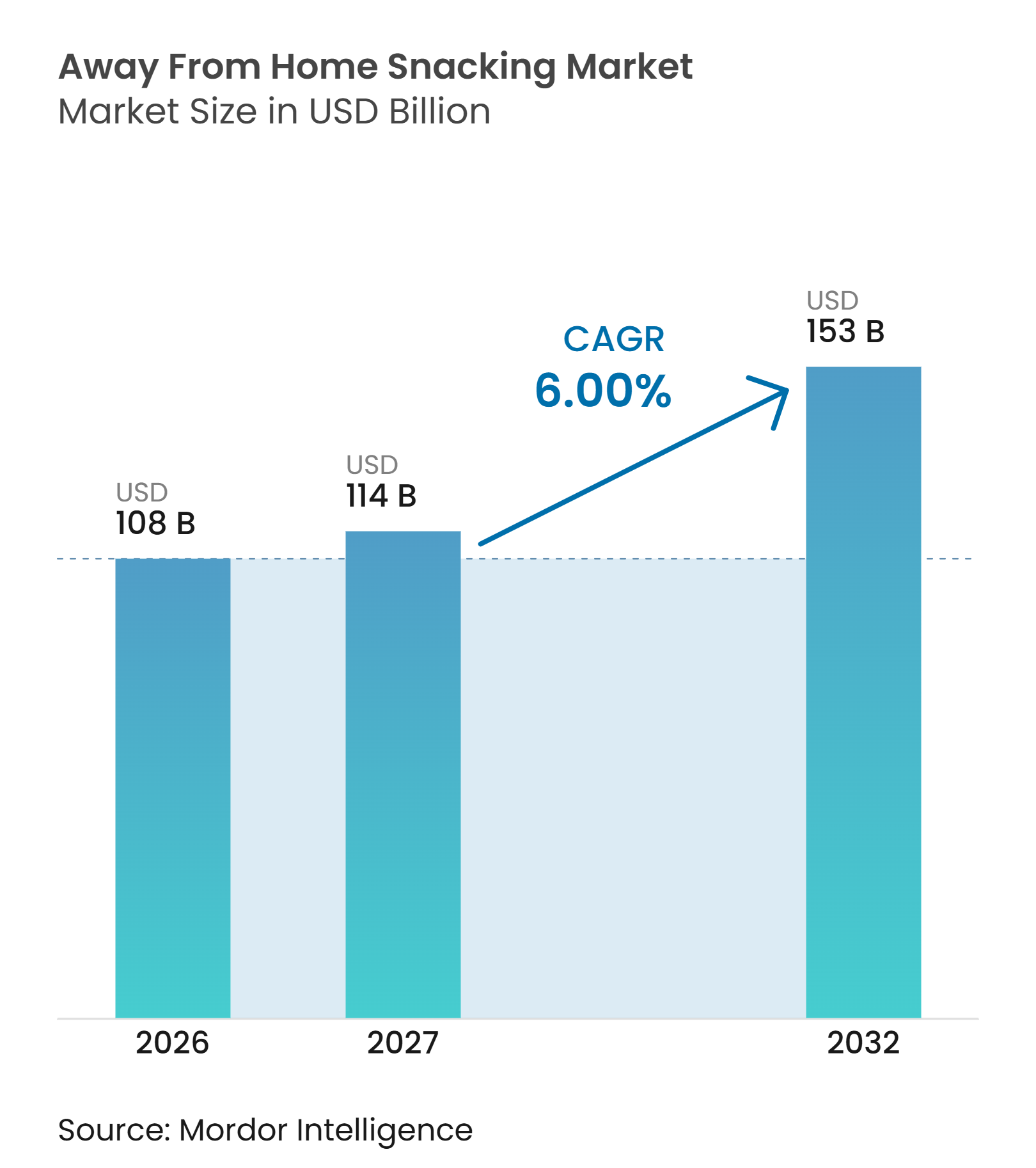
| Market Size (2027) | USD 114 Billion |
| Market Size (2032) | USD 153 Billion |
| Growth Rate (2027 - 2032) | 6.00 % |
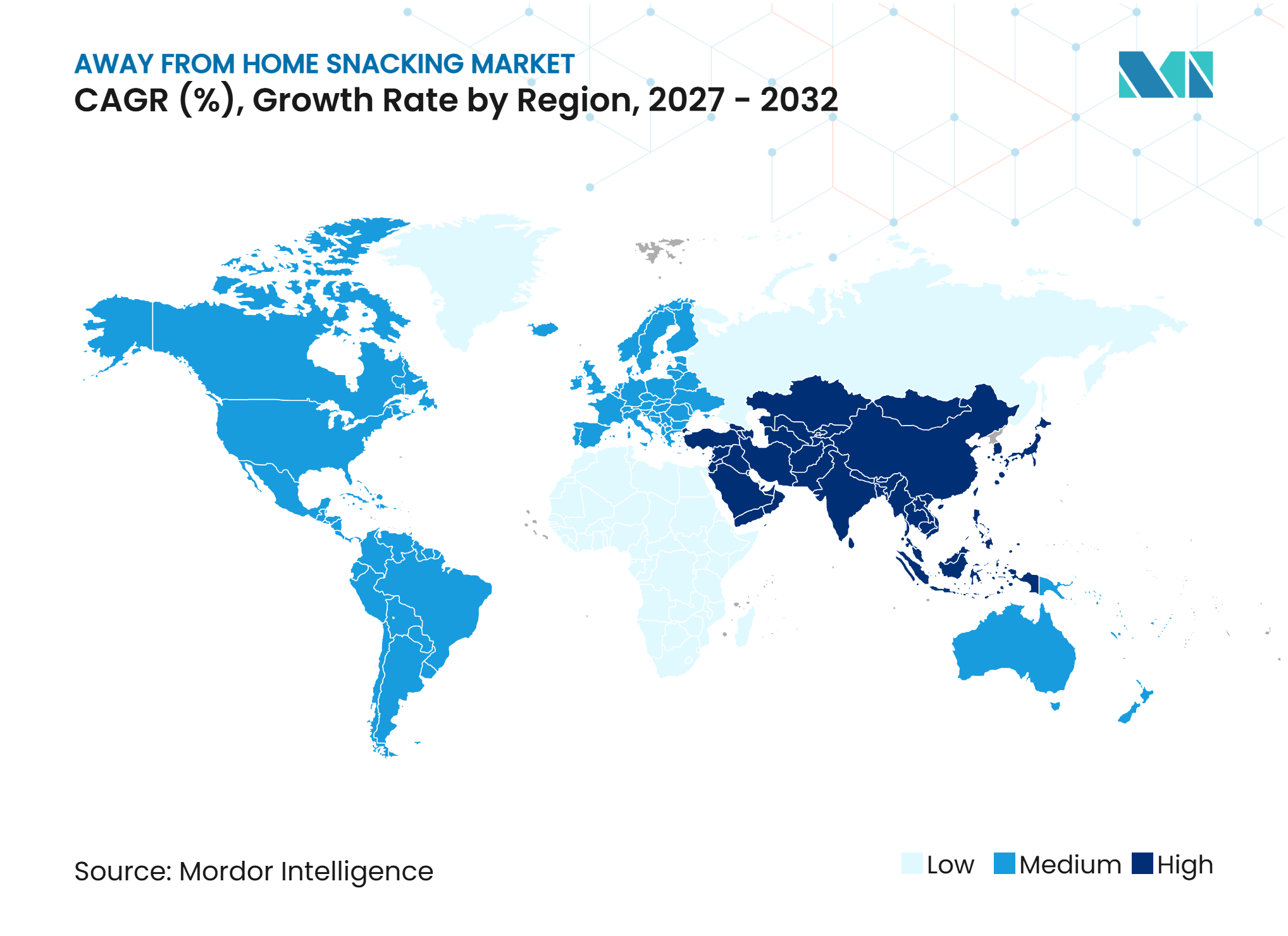
| Fastest Growing Market | Asia-Pacific |
| Largest Market | North America |
| Market Concentration | Low |
Major Players *Disclaimer: Major Players sorted in no particular order Image © Mordor Intelligence. Reuse requires attribution under CC BY 4.0. | |
Away From Home Snacking Market Analysis by Mordor Intelligence
The away-from-home snacking market size is expected to grow from USD 108 billion in 2026 to USD 114 billion in 2027 and is forecast to reach USD 153 billion by 2032 at a 6% CAGR over 2027-2032. The away-from-home snacking market is supported by changing consumer preferences for convenient food options and flexible eating occasions. Consumers increasingly incorporate snacks into their daily routines, expanding demand across foodservice outlets, convenience stores, travel locations, and entertainment venues. This shift is encouraging suppliers and operators to focus on product accessibility, portion suitability, and convenient consumption formats. The return of commuting, travel, and social dining is strengthening snack purchasing opportunities across out-of-home channels, while digital ordering is improving access to restaurant and convenience food options
Key Report Takeaways
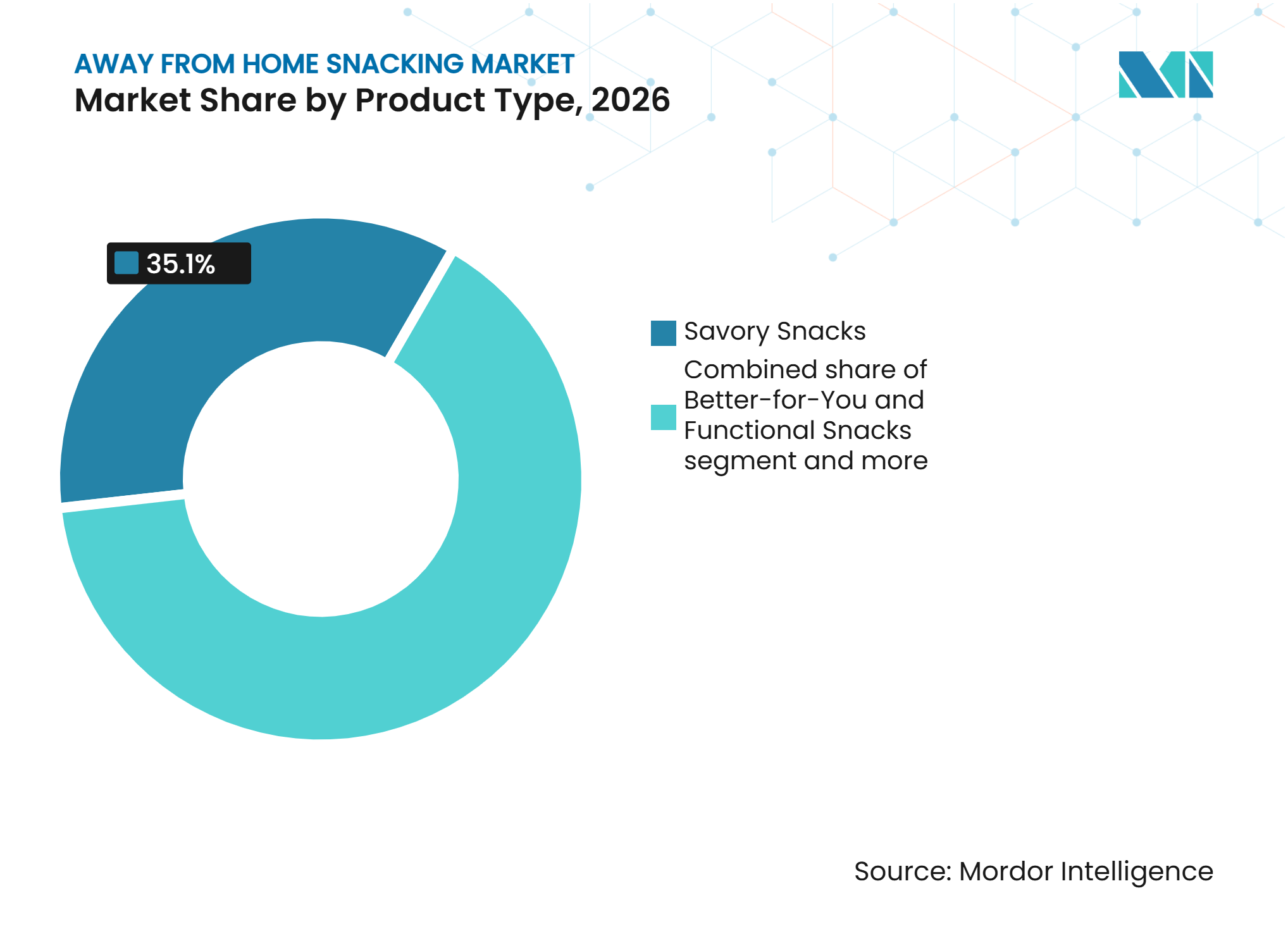
• By product type, savory snacks held 35.12% of the away-from-home snacking market share in 2026, while better-for-you and functional snacks are forecast to expand at a CAGR of 8.01% through 2032.
• By storage channel, ambient held 75.11% of the away-from-home snacking market share in 2026, while chilled/ frozen are forecast to expand at a CAGR of 7.21% through 2032.
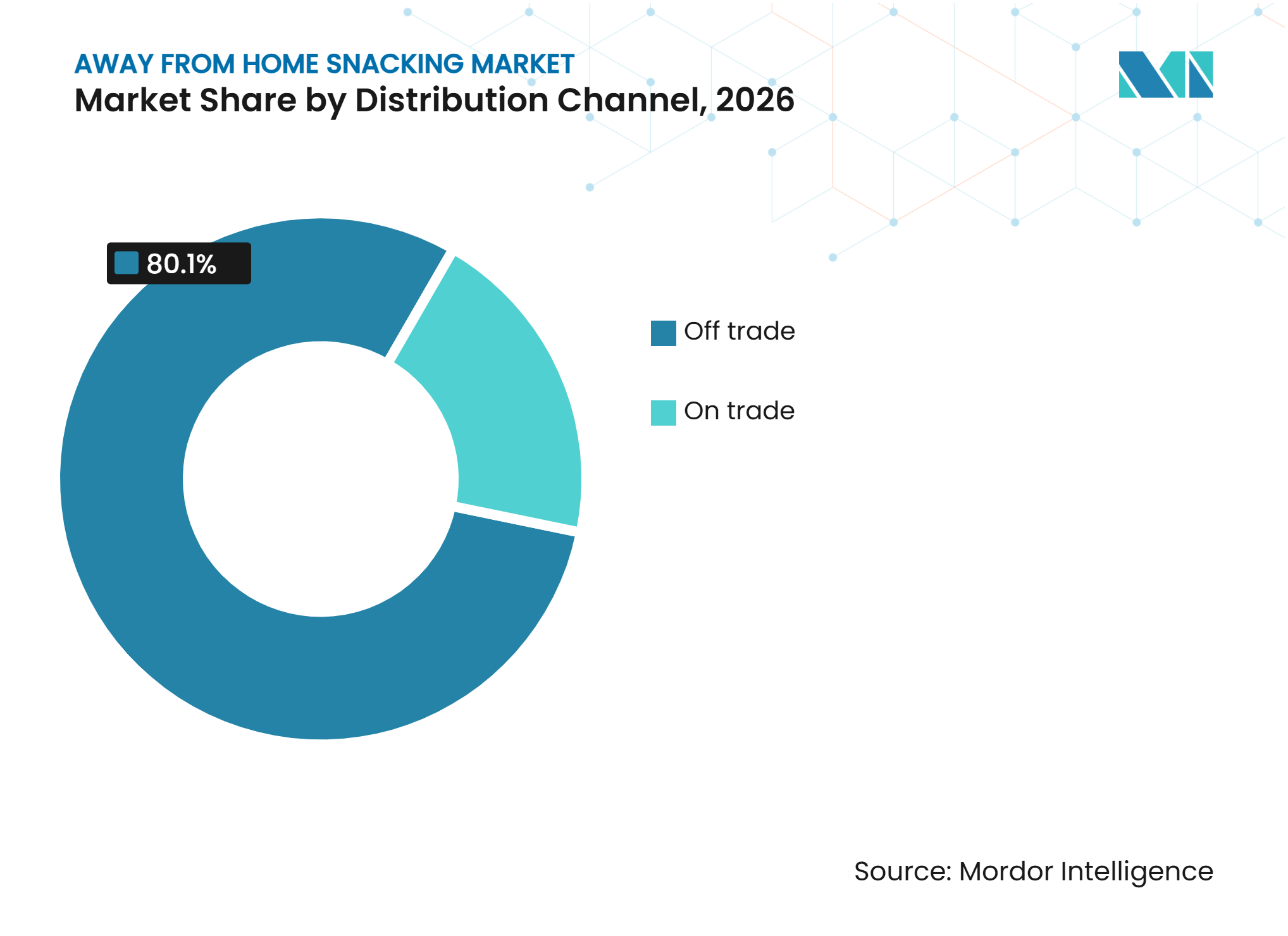
• By distribution channel, off-trade held 80.11% of the away-from-home snacking market share in 2026, while on-trade is forecast to expand at a CAGR of 8.31% through 2032.
• By geography, North America held 31.21% of the away-from-home snacking market share in 2026, while Asia-Pacific is forecast to expand at a CAGR of 6.82% through 2032.
Note: Market numbers in this report are based on Mordor Intelligence's proprietary estimation framework, which combines nine months of actuals with Q4 projections for base year 2026.
Market Trends and Insights
Drivers Impact Analysis of Away-from-Home Snacking Market of Away From Home Snacking Market*
| Driver | (~) % Impact on CAGR Forecast | Geographic Relevance | Impact Timeline |
|---|---|---|---|
| Expansion of away-from-home consumption occasions and snackification | +1.8% | Global | Short term (≤ 2 years) |
| Convenience-led outlet and format innovation | +1.2% | Global, strongest in Asia-Pacific and North America | Medium term (2–4 years) |
| Rising consumer demand for premium and innovative snacks | +0.9% | Global, strongest in North America and Europe | Medium term (2–4 years) |
| Growth of digital ordering, delivery and loyalty ecosystems | +1.1% | Asia-Pacific and North America | Short term (≤ 2 years) |
| Rising demand for convenient meal-replacement and substantial snacks | +0.7% | Global | Medium term (2–4 years) |
| Foodservice adoption of ready-to-serve and heat-and-serve snack solutions | +0.8% | Global, strongest in North America and Europe | Medium term (2–4 years) |
| Source: Mordor Intelligence | |||
Expansion of Away-From-Home Consumption Occasions and Snackification
The away-from-home snacking market is gaining momentum as consumers increasingly incorporate snacks into their daily eating routines and explore alternatives to conventional meals, encouraging foodservice operators and snack manufacturers to expand convenient offerings and cater to diverse out-of-home eating occasions. For instance, in 2025, the National Restaurant Association's State of the Restaurant Industry found that 64% of United States adults are increasingly likely to replace traditional meals with snacks during the day, increasing to 72% among millennials and 70% among Gen Z adults. The report also indicated that 76% of consumers would visit quick-service restaurants, snack places, delis, or coffee shops more frequently, while 81% showed similar interest in visiting table-service restaurants[1].
Convenience-Led Outlet and Format Innovation
Retailers and foodservice operators are introducing new purchasing formats and improving access to ready-to-eat snack products, driving expansion in the away-from-home snacking market. For instance, in March 2026, the National Automatic Merchandising Association Foundation reported that 65% of operators cited client requests for healthier product assortments, while 59% considered better-for-you products a growth opportunity[2]. The adoption of vending machines, micro-markets, and smart coolers is further expanding access to food and beverage products across different locations. Product innovation is also supporting this opportunity. For instance, in September 2025, Stryve Foods expanded its better-for-you snacking portfolio with convenient, protein-rich meat snack products designed for on-the-go consumption.
Rising Consumer Demand for Premium and Innovative Snacks
Consumers are increasingly prioritizing snack quality, distinctive flavors, and freshness when making purchasing decisions, creating opportunities for premium offerings in the away-from-home snacking market. For instance, in May 2025, the National Association of Convenience Stores (NACS) reported that 68.8% of consumers purchased premium snacks for quality and/or flavor, while 61.5% considered premium snacks worth paying extra for. The report also highlighted growing interest in fresh, high-quality, and minimally processed snacks, with 64.1% of consumers actively seeking snacks that offer health benefits[3]. These preferences are encouraging retailers and foodservice operators to expand premium snack assortments with better-quality ingredients, distinctive flavors, and healthier product options
Growth of Digital Ordering, Delivery and Loyalty Ecosystems
The growing adoption of digital ordering platforms, food delivery services, and loyalty programs is transforming away-from-home snacking purchases by making product discovery, ordering, and repeat purchases more convenient. Foodservice operators and retailers are strengthening their digital presence through mobile applications, online ordering platforms, and integrated delivery services to improve accessibility and streamline purchasing experiences. These digital channels also enable businesses to offer personalized recommendations, targeted promotions, and customized loyalty rewards based on consumer preferences and purchasing behavior. The integration of digital ordering and loyalty ecosystems is improving customer engagement, encouraging repeat purchases, and expanding access to snack products across workplaces, transit locations, and other away-from-home consumption settings.
Restraints Impact Analysis of Away-from-Home Snacking Market of Away From Home Snacking Market*
| Restraint | (~) % Impact on CAGR Forecast | Geographic Relevance | Impact Timeline |
|---|---|---|---|
| Inflation-driven price sensitivity and reduced purchase volumes | -0.5% | North America and Europe | Medium to long term (2–5 years) |
| Rising labor, energy and cold-chain operating costs | -0.4% | North America, Europe and Asia-Pacific | Medium to long term (2–5 years) |
| Stricter nutrition regulations and reformulation requirements | -0.3% | Europe and North America | Long term (≥ 4 years) |
| GLP-1 adoption and changing consumer appetite patterns | -0.2% | North America, with spillover to Europe | Long term (≥ 4 years) |
| Source: Mordor Intelligence | |||
Inflation-Driven Price Sensitivity and Reduced Purchase Volumes
Inflationary pressures are increasing the cost of food, packaging, transportation, and other essential goods, making consumers more price-conscious when purchasing away-from-home snacks. Rising living expenses are encouraging consumers to prioritize essential purchases, limit discretionary spending, and become more selective about the frequency and value of their snack purchases. Higher snack prices can also shift demand toward lower-cost alternatives and reduce consumer willingness to pay for premium products. At the same time, foodservice operators and retailers face pressure to manage rising procurement and operating costs while maintaining competitive prices, which can affect profit margins, product affordability, and overall sales volumes.
Rising Labor, Energy and Cold-Chain Operating Costs
Rising labor, energy, and cold-chain operating costs are increasing the financial burden on foodservice operators, retailers, and snack distributors across the away-from-home snacking market. Higher wages, electricity expenses, refrigeration requirements, and transportation costs are putting pressure on overall operating budgets. Maintaining temperature-controlled storage and distribution systems for perishable and fresh snack products further increases operational complexity and cost exposure. These expenses can reduce profit margins, limit investments in outlet expansion and equipment upgrades, and make it more challenging for businesses to maintain affordable pricing while ensuring consistent product quality and availability.
*Our forecasts treat driver/restraint impacts as directional, not additive. The impact forecasts reflect baseline growth, mix effects, and variable interactions.
Away From Home Snacking Market Segment Analysis
By Product Type:
Savory Snacks Lead While Better-for-You and Functional Formats Gain MomentumSavory snacks held 35.12% of the away-from-home snacking market share in 2026. Savory snacks hold the leading position in the global away-from-home snacking market due to their broad appeal across foodservice outlets, convenience stores, vending machines, and travel retail channels. Their portability, single-serve packaging, and compatibility with beverages make them suitable for consumption during commuting, traveling, and workplace breaks. These products also cater to both impulse purchases and smaller meal occasions, supporting their widespread availability across different consumption settings.
Better-for-you and functional snacks are projected to expand at a CAGR of 8.01% through 2032. Functional and better-for-you snacks are experiencing the fastest growth among product types in the global away-from-home snacking market, supported by increasing consumer interest in products that combine convenience with nutritional benefits. Product innovation is increasingly focused on protein-rich, probiotic-enhanced, and reduced-sugar formulations that cater to consumers seeking more purposeful snacking options. Growing awareness of nutritional quality is encouraging manufacturers to develop portion-controlled products with identifiable functional benefits while maintaining taste and convenience.



By Storage Channel:
Ambient Formats Anchor Distribution While Chilled and Frozen Products ExpandAmbient accounted for 75.11% of the away-from-home snacking market share in 2026. Ambient and shelf-stable snacks hold the leading position among storage types in the global away-from-home snacking market due to their longer shelf life, easier distribution, and suitability for high-traffic retail and foodservice locations. Their reduced dependence on refrigeration simplifies inventory management, minimizes spoilage risks, and supports product availability across outlets with limited cold-storage facilities. These characteristics make ambient products particularly suitable for vending machines, convenience stores, airports, railway stations, and other locations with varying consumer traffic. Ready-to-eat and heat-and-serve formats further improve operational convenience for foodservice operators by reducing storage and handling requirements.
Chilled/ frozen are forecast to expand at a CAGR of 7.21% through 2032. Frozen snacks are gaining traction in the away-from-home snacking market as foodservice operators increasingly adopt convenient formats that simplify preparation and ensure consistent product portions. These products enable restaurants, cafeterias, and other foodservice outlets to expand menu variety while improving kitchen efficiency and serving consistency. The availability of heated display cases and grab-and-go equipment is further expanding opportunities for frozen snack products across foodservice settings. Prepared savory items also provide consumers with more substantial snack options that cater to smaller meal occasions. Continued improvements in cold-chain infrastructure, storage facilities, and heating equipment are supporting wider adoption among foodservice operators.
By Distribution Channel:
Off-Trade Holds the Broad Base While On-Trade Builds FasterOff-trade held 80.11% of the away-from-home-snacking market share in 2026. Off-trade channels maintain a strong position in the global away-from-home snacking market through their extensive retail networks, broad product assortments, and convenient purchasing options. These channels improve access to ready-to-eat snacks across travel, workplace, and other high-traffic locations. The integration of online retail platforms further enhances product discovery, purchasing flexibility, and consumer convenience. Established distribution networks and widespread product availability enable suppliers to reach diverse consumer groups and maintain consistent access to branded snack products across different consumption settings.
On-trade is forecast to expand at a CAGR of 8.31% through 2032. On-trade channels are experiencing faster growth in the global away-from-home snacking market as foodservice operators increasingly incorporate snack offerings into their menus and service formats. Quick-service restaurants, full-service restaurants, hotels, cafeterias, and vending operators are expanding convenient food options to cater to consumers seeking accessible snacks across different consumption occasions. The integration of branded snack products and ready-to-serve formats is further strengthening product visibility and expanding distribution opportunities.

Geography Analysis
North America
North America held 31.21% of the away-from-home-snacking market share in 2026. North America maintains a strong position in the global away-from-home snacking market, supported by its well-established quick-service restaurant network, extensive convenience-store coverage, and developed food delivery infrastructure. The widespread availability of foodservice outlets and digital ordering platforms provides consumers with convenient access to snacks across commuting, workplace, travel, and leisure occasions. Established distribution networks and strong partnerships between snack manufacturers and foodservice operators further support product availability and brand visibility. The region also offers opportunities for suppliers to expand consumption occasions through convenient product formats, diversified snack offerings, and evolving nutritional preferences.
Asia-Pacific
Asia-Pacific is forecast to expand at a CAGR of 6.82% through 2032. Asia-Pacific is experiencing the fastest growth in the away-from-home snacking market, supported by rapid urbanization, rising disposable incomes, and the expansion of foodservice and modern retail infrastructure. Growing access to quick-service restaurants, convenience stores, food delivery platforms, and other organized foodservice channels is increasing the availability of portable, ready-to-eat snack products. The region's diverse food preferences also create opportunities for manufacturers to introduce locally adapted flavors, innovative product formats, and convenient purchasing options. The expanding digital ordering ecosystem and increasing consumer preference for accessible food choices are further supporting market growth across both established and emerging economies.
Europe, South America, and the Middle East and Africa
Europe offers growth opportunities through expanding foodservice channels, evolving snacking habits, and increasing consumer interest in convenient, fresh, and better-for-you products. Regulatory emphasis on nutritional quality and transparent product labeling is also influencing snack development and positioning. South America presents opportunities through the expansion of convenience retail and foodservice outlets, with local flavor preferences and affordability shaping product demand. Meanwhile, the Middle East and Africa offer growth potential as modern retail, quick-service restaurants, and travel-related foodservice infrastructure develop, improving access to packaged and ready-to-eat snacks.
Competitive Landscape
Market Concentration
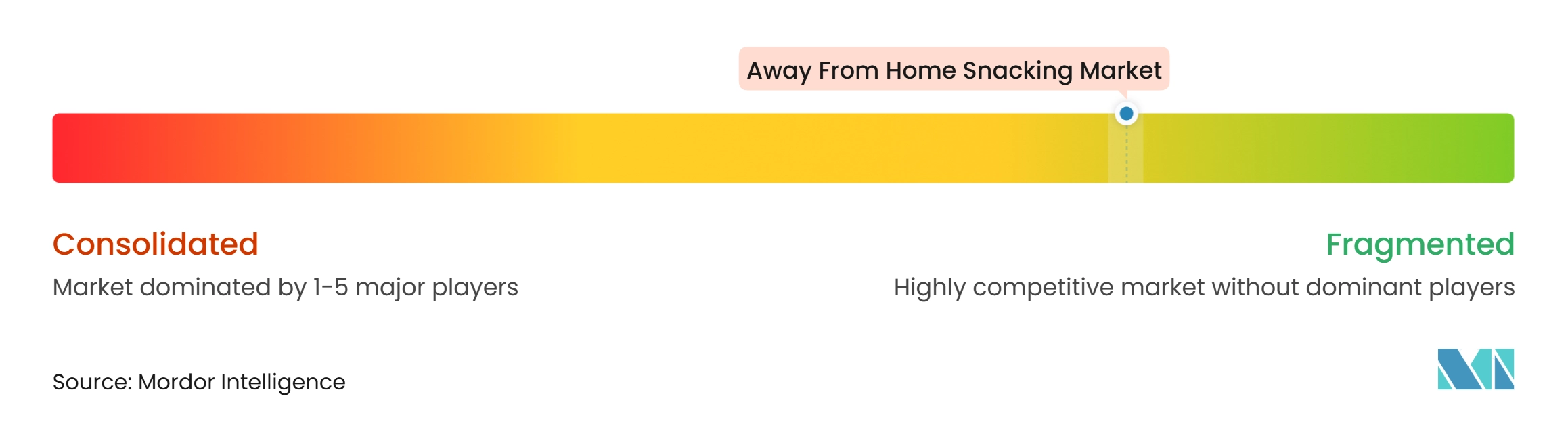
The away-from-home snacking market is fragmented, comprising multinational manufacturers, regional brands, and channel-focused suppliers that compete on brand recognition, product diversity, and distribution capabilities. Large manufacturers benefit from extensive portfolios and established relationships across convenience, foodservice, travel, and hospitality channels. The fragmented market structure also provides opportunities for smaller suppliers to differentiate through regional flavors, functional ingredients, and specialized product formats.
Competition is increasingly shaped by product innovation, distribution reach, and the ability to respond to changing consumer preferences. Acquisitions are strengthening competitive positioning by enabling manufacturers to expand product portfolios, enter additional categories, and reach new consumer segments. These strategies support broader offerings across savory, sweet, and better-for-you snack categories while strengthening distribution capabilities across foodservice, convenience, and hospitality channels.
Partnerships, product innovation, and brand-building initiatives are further shaping competitive activity. Manufacturers are strengthening relationships with hospitality operators and foodservice providers to improve product placement and brand visibility. Product development increasingly focuses on differentiated flavors, nutritional attributes, convenient formats, and evolving consumer preferences. While multinational companies benefit from established distribution networks, regional suppliers maintain their presence through localized offerings and specialized product propositions, reinforcing the market's fragmented competitive structure.
Away From Home Snacking Industry Leaders
-
PepsiCo, Inc. (Lay's)
-
Mondelēz International, Inc. (Oreo)
-
Mars, Incorporated (Snickers)
-
General Mills, Inc. (Nature Valley)
-
The Campbell's Company (Goldfish)
- *Disclaimer: Major Players sorted in no particular order
Away From Home Snacking Market Companies Covered in this Report
- PepsiCo, Inc. (Lay's)
- Mondelēz International, Inc. (Oreo)
- Mars, Incorporated (Snickers)
- General Mills, Inc. (Nature Valley)
- The Campbell's Company (Goldfish)
- The Hershey Company (Reese's)
- Nestlé S.A. (KitKat)
- Ferrero International S.A. (Kinder)
- Conagra Brands, Inc. (Slim Jim)
- Grupo Bimbo, S.A.B. de C.V. (Takis)
- Intersnack Group GmbH & Co. KG (Chio)
- Calbee, Inc. (Jagabee)
- ITC Limited (Bingo!)
- Britannia Industries Limited (Good Day)
- Parle Products Private Limited (Hide & Seek)
- Haldiram's (Aloo Bhujia)
- McCain Foods Limited (McCain Potato Bites)
- Monde Nissin Corporation (SkyFlakes)
- Tyson Foods, Inc. (Any'tizers)
- J&J Snack Foods Corp. (SuperPretzel)
Recent Industry Developments in Away From Home Snacking Market
- June 2026: King's Hawaiian introduced Original Hawaiian Sweet Soft Pretzel Bites in a single-serve format at Sheetz convenience stores. The launch expanded the brand's presence in convenience retail and provides a portable snack option for on-the-go consumption. The product is also distributed nationally through DOT Foods.
- June 2026: PepsiCo partnered with chef Gordon Ramsay to expand Doritos Loaded through new recipes and foodservice collaborations. The initiative included restaurant and hospitality operators, food trucks, and Formula 1 fan-zone activations, extending the use of Doritos products across out-of-home dining and snacking occasions.
- March 2025: PRETZELIZED expanded into the foodservice channel with the launch of single-serve Pretzel Snackers in Sea Salt and Cheddar flavors. The products were introduced in portable packs designed for fast-casual dining and grab-and-go environments, extending the brand's reach beyond retail into away-from-home snacking occasions.
Global Away From Home Snacking Market Report Scope
The away-from-home snacking market includes ready-to-eat and convenient snack products consumed outside the home across retail, foodservice, and other commercial settings. The market is segmented by Product Type, Storage Channel, Distribution Channel, and Geography. Product types include Savory Snacks, Sweet Snacks, Better-for-You and Functional Snacks, and Other Product Types. Based on Storage Channel, the market is divided into Ambient and Chilled/Frozen snacks. Distribution channels include On-trade and Off-trade, with off-trade further categorized into Supermarkets and Hypermarkets, Convenience Stores, Online Retail, and Other Distribution Channels. Geographically, the market covers North America, Europe, Asia-Pacific, South America, and the Middle East and Africa, including key countries within each region. Market forecasts are provided in terms of value (USD).
Segmentation Overview
| Savory Snacks |
| Sweet Snacks |
| Better-for-You and Functional Snacks |
| Other Product Types |
| Ambient |
| Chilled/Frozen |
| On-trade | |
| Off-trade | Supermarkets and Hypermarkets |
| Convenience Stores | |
| Online Retail | |
| Other Distribution Channels |
| North America | United States |
| Canada | |
| Mexico | |
| Rest of North America | |
| Europe | Germany |
| United Kingdom | |
| Italy | |
| France | |
| Spain | |
| Netherlands | |
| Poland | |
| Belgium | |
| Sweden | |
| Rest of Europe | |
| Asia-Pacific | China |
| India | |
| Japan | |
| Australia | |
| Indonesia | |
| South Korea | |
| Thailand | |
| Singapore | |
| Rest of Asia-Pacific | |
| South America | Brazil |
| Argentina | |
| Colombia | |
| Chile | |
| Peru | |
| Rest of South America | |
| Middle East and Africa | South Africa |
| Saudi Arabia | |
| United Arab Emirates | |
| Nigeria | |
| Egypt | |
| Morocco | |
| Turkey | |
| Rest of Middle East and Africa |
| By Product Type | Savory Snacks | |
| Sweet Snacks | ||
| Better-for-You and Functional Snacks | ||
| Other Product Types | ||
| By Storage Channel | Ambient | |
| Chilled/Frozen | ||
| By Distribution Channel | On-trade | |
| Off-trade | Supermarkets and Hypermarkets | |
| Convenience Stores | ||
| Online Retail | ||
| Other Distribution Channels | ||
| By Geography | North America | United States |
| Canada | ||
| Mexico | ||
| Rest of North America | ||
| Europe | Germany | |
| United Kingdom | ||
| Italy | ||
| France | ||
| Spain | ||
| Netherlands | ||
| Poland | ||
| Belgium | ||
| Sweden | ||
| Rest of Europe | ||
| Asia-Pacific | China | |
| India | ||
| Japan | ||
| Australia | ||
| Indonesia | ||
| South Korea | ||
| Thailand | ||
| Singapore | ||
| Rest of Asia-Pacific | ||
| South America | Brazil | |
| Argentina | ||
| Colombia | ||
| Chile | ||
| Peru | ||
| Rest of South America | ||
| Middle East and Africa | South Africa | |
| Saudi Arabia | ||
| United Arab Emirates | ||
| Nigeria | ||
| Egypt | ||
| Morocco | ||
| Turkey | ||
| Rest of Middle East and Africa | ||
Key Questions Answered in the Report
What is the market size of away-from-home-snacking market?
The away-from-home snacking market is estimated to reach USD 1,080 billion in 2026 and increase to USD 1,145 billion in 2027. The market is projected to reach USD 1,532 billion by 2032, registering a CAGR of 6.00% during 2027–2032.
Which product category has the largest position in away-from-home snacking?
Savory snacks lead product types with a 35.12% share in 2026. Their single-serve portability supports use in convenience, travel, and quick-service channels.
Which snack category is expected to grow the fastest?
Better-for-you and functional snacks are forecast to expand at a CAGR of 8.01% through 2032, supported by demand for protein-forward and reduced-sugar formats.
Which region leads away-from-home snack consumption?
North America is the largest regional segment, with a 31.21% share in 2026. Its established restaurant, delivery, and convenience infrastructure supports demand.