
Glass Mat Market Size and Share
Market Overview
| Study Period | 2021 - 2031 |
|---|---|
| Market Size (2026) | USD 1.62 Billion |
| Market Size (2031) | USD 2.07 Billion |
| Growth Rate (2026 - 2031) | 5.02 % |
| Fastest Growing Market | Asia-Pacific |
| Largest Market | Asia-Pacific |
| Market Concentration | Medium |
Major Players *Disclaimer: Major Players sorted in no particular order Image © Mordor Intelligence. Reuse requires attribution under CC BY 4.0. | |
Glass Mat Market Analysis by Mordor Intelligence
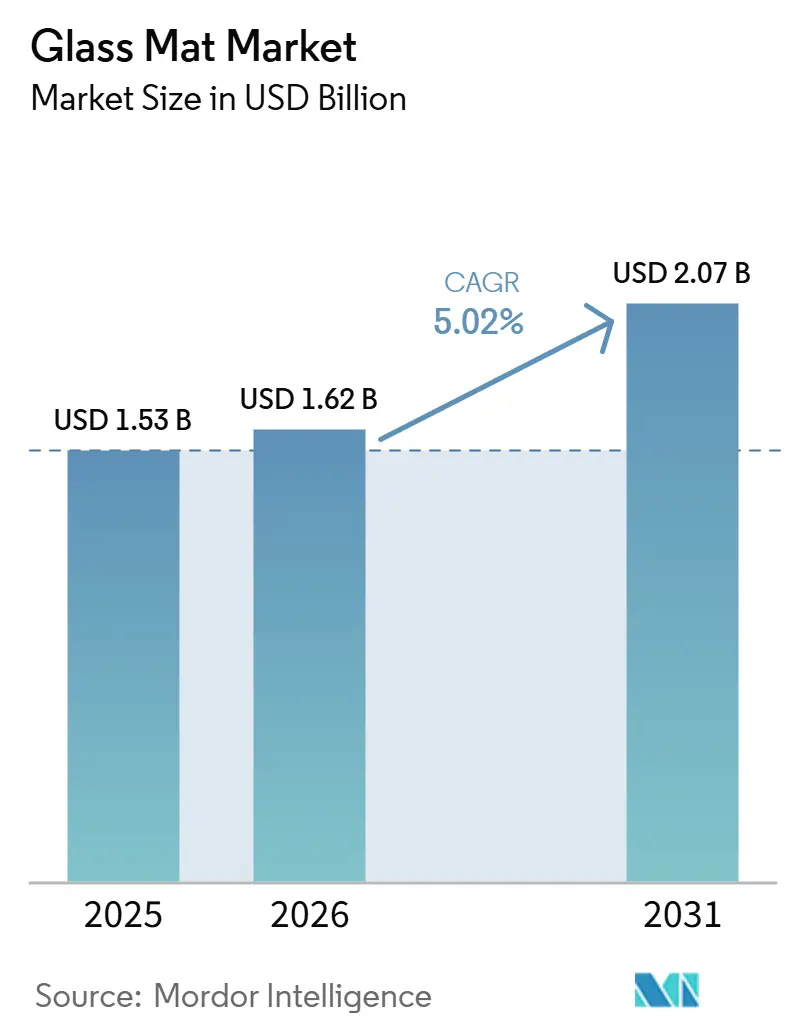
The Glass Mat Market size is expected to increase from USD 1.53 billion in 2025 to USD 1.62 billion in 2026 and reach USD 2.07 billion by 2031, and is expected to grow at a CAGR of 5.02% over 2026-2031. The glass mat market benefits from its broad application across construction products, transport composites, and renewable energy fabrication, which reduces dependence on any single end-use. The market remains attractive due to its cost position, which is more accessible than woven reinforcement fabrics in many volume applications, while remaining compatible with both manual and automated production routes. Demand is shifting as wind blade designs, battery enclosure requirements, and closed-mold fabrication methods place greater emphasis on product consistency, resin flow, and production speed, supporting demand for higher-value mat formats. This shift is reflected in competitive activity, with integrated producers holding stronger positions in specialty grades and regional suppliers facing tighter pricing in commodity chopped strand products. The market continues to face margin pressure from feedstock volatility and the risk of substitution in demanding structural applications, keeping supplier strategy focused on product mix, process control, and long-term customer contracts.
Key Report Takeaways
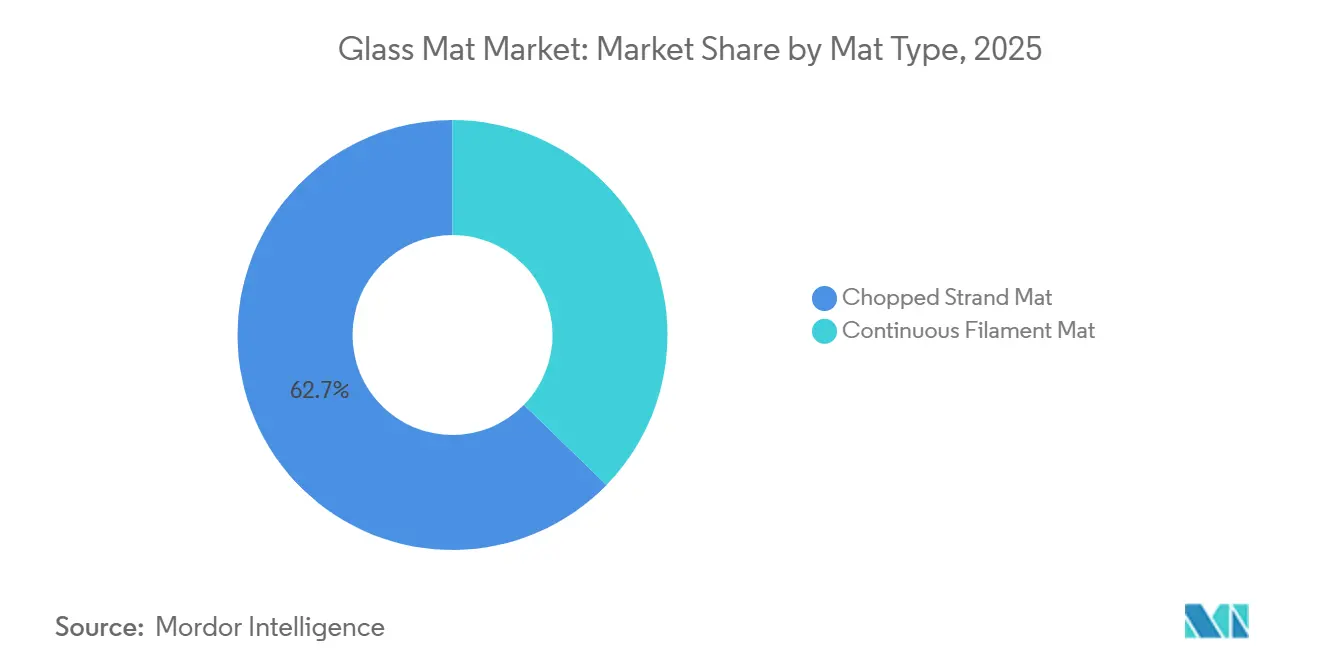
- By mat type, chopped strand mats held 62.70% share in 2025, while continuous filament mats are forecast to expand at an 8.33% CAGR through 2031.
- By binder type, emulsion-bonded glass mats accounted for 58.72% of the glass mat market size in 2025, while powder-bonded glass mats are expected to grow at a CAGR of 7.84% through 2031.
- By manufacturing process, the chopped strand process led with a 47.25% share in 2025, while the continuous filament process is projected to grow at an 8.51% CAGR through 2031.
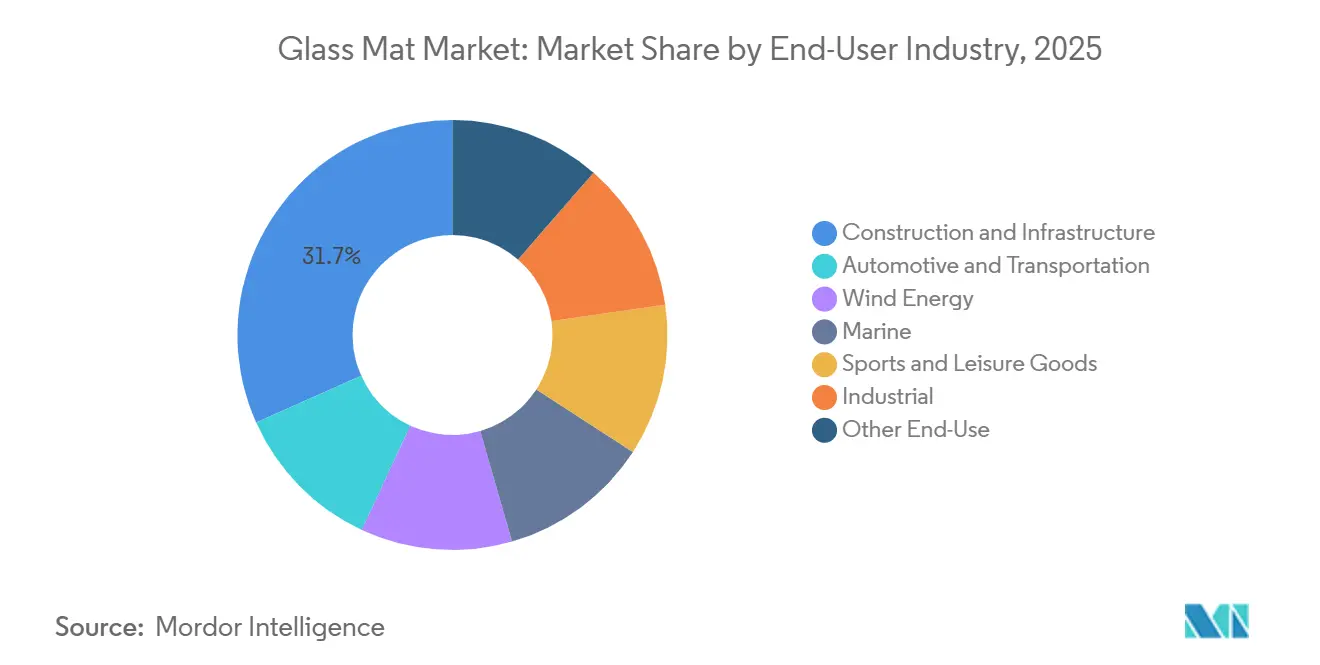
- By end-user industry, construction and infrastructure held 31.68% of the glass mat market share in 2025, while wind energy is set to grow at the highest CAGR of 7.42% through 2031.
- By geography, Asia-Pacific represented 46.94% of the glass mat market share in 2025 and is projected to grow at the fastest regional CAGR of 8.22% through 2031.
Note: Market size and forecast figures in this report are generated using Mordor Intelligence’s proprietary estimation framework, updated with the latest available data and insights as of January 2026.
Market Trends and Insights
Drivers Impact Analysis of Glass Mat Market*
| Drivers | (~) % Impact on CAGR Forecast | Geographic Relevance | Impact Timeline |
|---|---|---|---|
| Construction and Infrastructure Expansion | +2.0% | Global, concentrated in Asia-Pacific and North America | Long term (≥ 4 years) |
| Expansion of Wind Energy Installations | +1.2% | Asia-Pacific, Northern Europe, North America | Medium term (2-4 years) |
| Rising Adoption of Lightweighting in Automotive and Transportation Composites | +0.9% | North America, Europe, and China are electric vehicle (EV) manufacturing hubs | Medium term (2-4 years) |
| Shift Toward Continuous Filament Production and Automation-Compatible Mat Formats | +0.5% | China, Europe, North America | Long term (≥ 4 years) |
| Growing Demand for Composite Materials Across Industrial and Specialty Applications | +0.3% | Global, with emerging growth in South America, the Middle East, and Africa | Long term (≥ 4 years) |
| Source: Mordor Intelligence | |||
Construction and Infrastructure Expansion
Construction remains the largest demand segment for the glass mat market. The material is used in gypsum board reinforcement, roofing membrane substrates, and glass fiber-reinforced concrete panels. In the United States, infrastructure spending has continued to support applications that require lighter reinforced panels with strong durability in demanding service conditions[1]Staff, “Infrastructure Investment and Jobs Act – Bridge Replacement Program,” Federal Highway Administration, fhwa.dot.gov. This demand profile is significant because the glass mat market does not rely solely on high-visibility structural composites; it also benefits from recurring building product demand that tends to be more stable and widely distributed. Buyers in architectural and panel applications are placing greater emphasis on surface finish, lower areal weight, and tighter fiber uniformity, which shifts part of the demand base toward better-controlled product grades. For the glass mat market, volume growth in construction can increasingly support product mix improvement rather than relying solely on low-value commodity sales. This also strengthens the position of suppliers that can align mat output with building product manufacturers that value continuity, quality consistency, and localized supply reliability.
Expansion of Wind Energy Installations
Wind energy is the fastest-growing end-use segment in the glass mat market, driven directly by larger blade formats that require more reinforcement material per installed turbine. Continuous filament formats benefit the most, as blade applications require dimensional stability, structural consistency, and repeatable laminate performance. This raises the importance of long-run production quality, not just nominal capacity, because blade manufacturers require products that meet tighter approval and process requirements. The glass mat market is seeing demand shift toward supply agreements that favor producers with specialty capability, established qualification history, and reliable line control. In Europe, policy support for expanded wind deployment continues to reinforce sustained composite consumption in blade manufacturing. Across regions, the glass mat market benefits not only from higher turbine installation volumes, but also from the greater material intensity associated with blade scaling and more demanding offshore designs.
Rising Adoption of Lightweighting in Automotive and Transportation
Automotive and transportation applications are expanding the addressable market for glass mat through interior parts, body components, and battery enclosure structures. In electric vehicles, the material is relevant because reinforcement, heat management, and production efficiency must be combined within a single laminate system. Conventional vehicles continue to provide a stable outlet, as headliners, trim parts, and covers use glass mat to reduce weight compared to metal alternatives in cost-sensitive designs. This keeps the glass mat market linked to both established vehicle programs and electric vehicle platforms, broadening demand exposure rather than concentrating it within a single technology cycle. Supplier differentiation is also shifting toward binder chemistry and compliance readiness, as original equipment manufacturer (OEM) audits increasingly consider environmental management systems and formulation choices in sourcing decisions. For the glass mat market, automotive growth is meaningful not only in terms of volume, but also because it rewards suppliers that can combine performance, manufacturability, and regulatory alignment.
Shift Toward Continuous Filament Production and Automation-Compatible Mat Formats
The glass mat market is gradually separating into a commodity tier and a specialty tier as automated fabrication methods gain share in wind and advanced transport applications. Continuous filament mat supports improved resin flow and more uniform laminate formation during vacuum infusion, making it suited to process-stable, machine-oriented manufacturing lines. This trend is significant because the capital and process discipline required for continuous filament production are considerably higher than in standard chopped strand operations. As a result, the glass mat market increasingly favors integrated suppliers that can maintain fiber tension control, binder consistency, and approval status for structural composite programs. The broader move toward automation also reduces the relative appeal of commodity formats in the most demanding structural applications. Over time, this should support stronger pricing and more stable customer relationships for producers serving the precision end of the glass mat market.
Restraints Impact Analysis of Glass Mat Market*
| Restraints | (~) % Impact on CAGR Forecast | Geographic Relevance | Impact Timeline |
|---|---|---|---|
| Volatility in Glass Fiber Feedstock Prices | -0.7% | Global, most pronounced in Europe and among non-integrated Asian producers | Short term (≤ 2 years) |
| Substitution by Alternative Composite Materials in High-Performance Segments | -0.5% | North America, Europe, Japan | Medium term (2-4 years) |
| Limited End-Of-Life Recycling Pathways | -0.2% | Europe, North America | Long term (≥ 4 years) |
| Source: Mordor Intelligence | |||
Volatility in Glass Fiber Feedstock Prices
Feedstock price movements remain an immediate pressure point for the glass mat market, as conversion margins are exposed when producers do not control upstream fiber capacity. This issue is particularly relevant in segments where customers expect commodity pricing, but fiber input costs move faster than contract reset cycles. The effect is not uniform across suppliers, as integrated manufacturers can absorb or manage volatility more effectively than independent converters. In practical terms, market conditions become more challenging for smaller and non-integrated participants when buying conditions tighten or when inventory must be built at elevated cost. This can narrow flexibility in customer pricing, reduce willingness to pursue volume, and favor suppliers with stronger furnace linkages or long-term supply arrangements. Strategic control of raw material access remains a central competitive factor in the glass mat market, even when downstream demand conditions are supportive.
Substitution by Alternative Composite Materials
Substitution pressure in the glass mat market is concentrated in high-performance applications rather than spread evenly across all end uses. Carbon fiber systems can displace glass-based reinforcements in blade spars and structural vehicle parts where stiffness and mass targets are strict. Natural fiber and other alternative composite systems are gaining attention in semi-structural interior parts where circularity goals and lower density are part of procurement criteria. The glass mat market retains a cost and performance advantage across construction, marine, and general industrial applications, where replacement economics remain less compelling. Suppliers can defend a larger share of their addressable base by focusing on thinner specialty grades designed for infusion and process-specific fabrication routes.
*Our forecasts treat driver/restraint impacts as directional, not additive. The impact forecasts reflect baseline growth, mix effects, and variable interactions.
Glass Mat Market Segment Analysis
By Mat Type:
Continuous Filament Mat Reshapes Premium Structural ApplicationsChopped strand mat retained 62.70% of mat-type demand in 2025, making it the volume foundation of the glass mat market across construction, marine, and general industrial uses. Its established position stems from compatibility with common polyester and vinyl ester resin systems, as well as production economics that support broad output across many product specifications. Fabricators continue to rely on chopped strand products where open-mold processing, cost control, and material familiarity matter more than precision structural performance. This keeps the segment deeply embedded in roofing panels, pipe sections, boat components, and general-purpose reinforced plastic parts. Within the glass mat market, this large installed base provides resilience, as replacement cycles and recurring fabrication needs persist even as higher-growth applications receive more attention.
Continuous filament mat is projected to grow at an 8.33% CAGR through 2031, making it the fastest-growing product format in the glass mat industry for structural and machine-driven fabrication routes. Its gains are strongest in wind blades and automotive structural panels, where fiber continuity and dimensional control directly affect laminate behavior and process reliability. Demand in this segment is less exposed to daily spot pricing because customer qualification, certification requirements, and long-run process stability give approved suppliers a stronger hold on accounts. The supplier pool is also narrower, since these products require tighter process windows, better forming consistency, and more disciplined quality control than commodity alternatives. As the glass mat market continues to shift toward automation and structural composite use, continuous filament formats are expected to gain further importance, even if chopped strand mat remains the larger revenue base over the forecast period.



By Binder Type:
Powder-Bonded Mats Benefit from Closed-Mold Fabrication GrowthEmulsion-bonded glass mat led the binder segment with 58.72% share in 2025, reflecting its long-standing use in hand lay-up processes across marine, construction, and panel applications. Its established position stems from its softness and drapeability, which help fabricators conform the material to complex shapes without increasing the risk of air entrapment. This makes emulsion-bonded products a practical fit for boat hulls, curved panels, and other geometries where manual handling still drives process choice. The segment also benefits from customer familiarity, as many established fabrication shops already run resin systems and workflows optimized for this format. In the glass mat market, the installed processing base helps protect emulsion-bonded demand even as newer process routes expand.
Powder-bonded glass mat is projected to grow at a 7.84% CAGR through 2031, supported by a better fit with closed-mold and continuous production systems. The format is favored where faster wet-out and higher resin permeability support cycle-time discipline, particularly in resin transfer molding, compression molding, and continuous panel production. Powder binder chemistry also offers greater hydrolytic stability, which is beneficial in chemical storage and submerged-service applications that require resistance to moisture-related degradation. The broader shift toward lower emissions and more controlled molding conditions provides additional support, as those priorities align more closely with the characteristics of powder-bonded products than with traditional open-mold methods. As a result, the binder mix in the glass mat market is likely to evolve in line with manufacturing methods rather than through a straightforward replacement of older products across all applications.
By Manufacturing Process:
Bifurcation Between Commodity and Precision ManufacturingThe chopped strand process accounted for 47.25% of segment demand in 2025, giving it the largest share among manufacturing methods used across the glass mat market. This reflects production flexibility, as these lines can supply a broad range of areal weights and serve multiple end-use categories without the precision constraints required by premium formats. For many suppliers, this process remains the primary route for serving construction panels, marine products, and general-purpose reinforced plastic components. The method also supports the commodity side of the glass mat market, where price competitiveness and production adaptability often matter more than performance certification. Wet-laid production maintains a smaller but distinct role in roofing substrates and absorbent glass mat battery separators, where uniform fiber dispersion at low basis weights is particularly important.
The continuous filament process is forecast to grow at an 8.51% CAGR through 2031, making it the fastest-growing process technology in the glass mat market. Its momentum comes from direct exposure to wind energy composites and structural automotive parts, which represent the most process-sensitive and specification-heavy demand segments. Capacity expansion is less straightforward in this area because stable melt viscosity, tighter forming control, and consistent sizing chemistry are more important than in standard chopped strand output. This raises barriers to new entrants and allows established operators to defend pricing and customer retention through technical competence rather than scale alone. Ahlstrom's February 2026 launch of an advanced Absorbent Glass Mat (AGM) battery separator platform also demonstrates that specialized wet-laid formats continue to open adjacent growth opportunities, particularly as energy storage performance requirements become more demanding.
By End-User Industry:
Wind Energy Accelerates, Construction Anchors the Revenue BaseConstruction and infrastructure accounted for 31.68% of end-user demand in 2025, making it the largest revenue base in the glass mat market. Its position reflects breadth rather than growth rate, as usage spans gypsum board facing, fiberglass-reinforced roofing shingles, insulation facing, and glass fiber-reinforced concrete (GFRC) architectural panels. This wide application base reduces reliance on any single project cycle and gives the segment a stable, recurring consumption profile. The glass mat market size tied to construction tends to reflect a broad mix of building product replenishment and infrastructure-linked specification demand. That stability is a key reason construction remains the core volume anchor even as other end uses grow faster.
Wind energy is projected to advance at a 7.42% CAGR through 2031 and is the fastest-growing end-user category in the glass mat market. The segment is reshaping demand because a single large turbine requires substantial reinforcement volume in blade laminate structures, and that intensity increases as rotor systems grow larger. Automotive and transportation remain the second-largest end-use category, with demand driven by interior components, battery enclosures, and structural body parts tied to lightweighting requirements. Marine, sports and leisure, and industrial uses continue to diversify the revenue base, reducing the glass mat market's dependence on any single composite value chain. These smaller segments can support margin opportunities where corrosion resistance, durability, or application-specific processing requirements matter more than price alone.
Geography Analysis
APAC Glass Mat Market
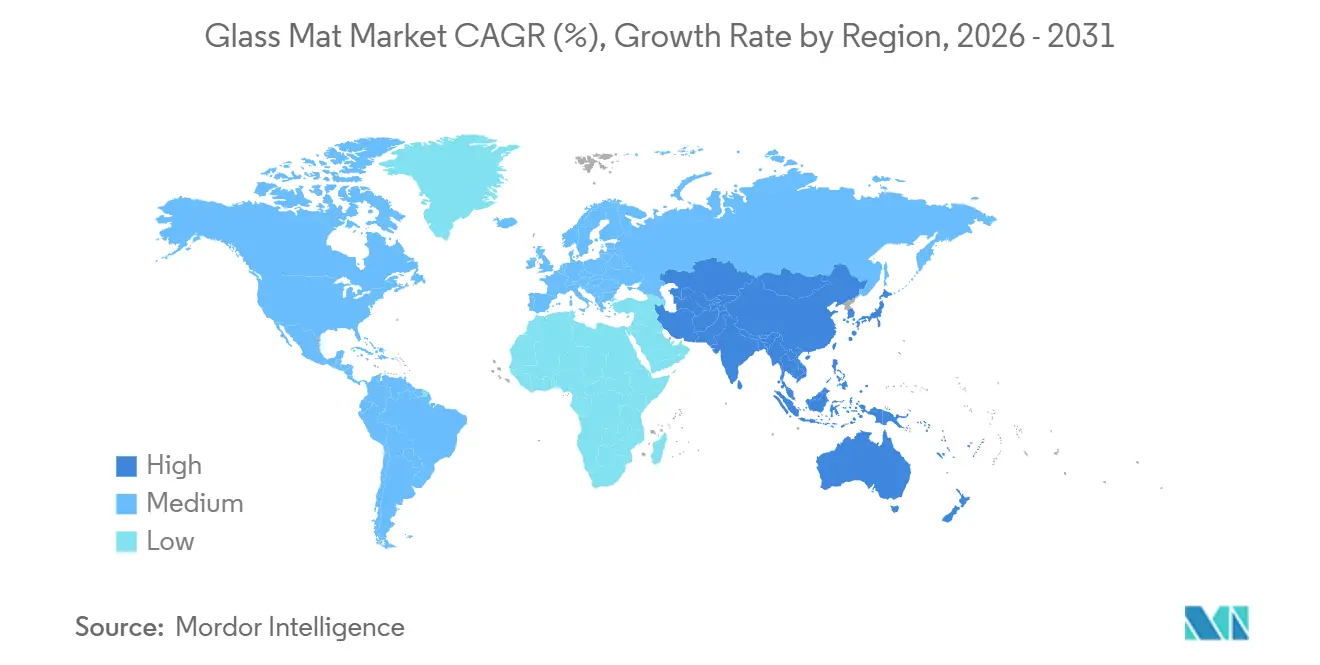
Asia-Pacific accounted for 46.94% of global demand in 2025 and is projected to grow at an 8.22% CAGR through 2031, making it the largest and fastest-growing regional market for glass mats. The region benefits from a dense composite manufacturing ecosystem, a strong wind equipment base, and close linkages between glass fiber supply and downstream fabrication. China remains central to this position, as its integrated supply chain and large-scale reinforcement manufacturing footprint support both cost efficiency and regional availability[2]Staff, “China Jushi Kicks Off Production at World’s Largest Electronic-Grade Glass Fiber Plant,” Shanghai Stock Exchange, sse.com.cn. Capacity additions and investment activity by Chinese glass fiber producers reinforce the region's importance for downstream mat availability and product development. Japan and South Korea contribute through more technology-intensive production and specialty-material capabilities, supporting the higher-performance end of regional demand.
North America Glass Mat Market
North America remains a stable and strategically important regional market, as building products continue to absorb a meaningful share of glass mat volumes through gypsum board, shingles, and reinforced construction panels. The regional market also benefits from efforts to secure local supply, reducing reliance on long-distance sourcing for critical reinforcement inputs. The April 2026 transfer of Owens Corning's glass reinforcements business to Praana Group has changed the operating landscape; the business now operates as Original Composites and Fibers, creating a new standalone competitor with North American assets. This change may influence how customers evaluate supply continuity, portfolio direction, and future investment across the region. Wind energy remains a smaller but expanding regional outlet, and domestic suppliers are positioning for higher-performance composite demand tied to future blade and offshore project requirements.
EMEA and South America Glass Mat Market
Europe holds a meaningful position in the glass mat market through wind blade manufacturing, construction composites, and a regulatory environment that increasingly values process control and sustainability. The region's procurement mix is becoming more selective as recyclability and end-of-life handling gain visibility in industrial decision-making, particularly for wind-related composites. South America, the Middle East, and Africa remain smaller markets, but all three regions offer room for expansion where infrastructure activity, industrial diversification, and renewable energy projects are increasing composite use. The geographic profile of the glass mat market therefore combines a dominant Asia-Pacific core with steady North American demand and a Europe-led specialty base that is increasingly shaped by sustainability requirements and technical qualification standards.

Competitive Landscape
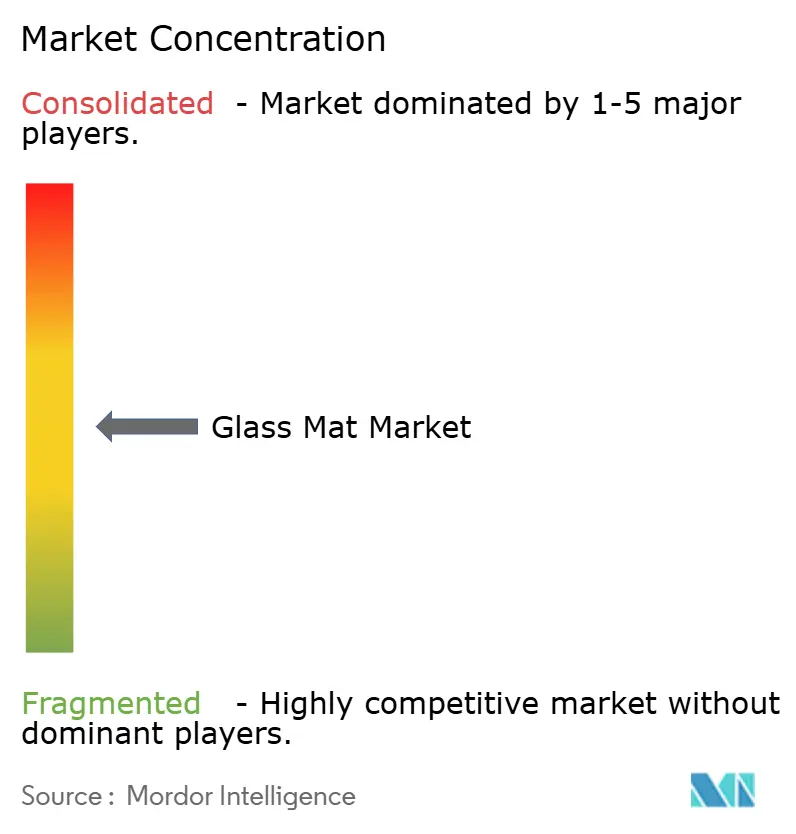
The glass mat market is moderately fragmented, with a small group of integrated global producers controlling much of the specialty and high-performance capacity, while regional suppliers remain active in commodity chopped strand products. China Jushi, Taishan Fiberglass, Saint-Gobain, Johns Manville, and Nittobo are the companies most closely associated with scale, technical capability, and supply relevance in higher-value categories. This structure creates a two-tier competitive pattern, where commodity volumes remain price-led, but specialty grades are shaped more by qualification status, process stability, and customer approvals. A supplier's position can also vary significantly by product tier, as strength in low-cost standard mat does not automatically translate into share in wind or advanced transport programs. The glass mat market, therefore, favors companies that combine scale with specialty execution rather than relying solely on furnace-linked volume.
Recent strategic moves illustrate how competition is developing. Owens Corning completed the sale of its glass reinforcements business to Praana Group in April 2026, and the divested operation now runs as Original Composites and Fibers. Ahlstrom launched an advanced absorbent glass mat (AGM) battery separator platform in February 2026 and expanded its energy storage offering in July 2026 with FortiCell glass fiber tissue solutions. Johns Manville advanced its sustainability efforts in 2025 by launching a thermal recycling unit for glass fiber waste in Trnava, Slovakia. These actions indicate that companies are competing not only on output, but also through portfolio repositioning, adjacent product development, and recycling capability to strengthen customer relevance. In the glass mat market, this broadens competition beyond price and capacity into lifecycle positioning and application-led innovation.
Technology direction is also becoming a stronger competitive differentiator. Suppliers that can support automation-compatible formats, tighter tolerances, and compliance-ready formulations are better positioned in wind and automotive sourcing cycles. Recycling and circularity are also moving from a secondary consideration to a procurement criterion, particularly in Europe, where project activity is already validating routes for reprocessing decommissioned wind-blade glass into nonwoven materials. This does not immediately change the volume hierarchy of the glass mat market, but it does influence which suppliers appear more future-ready to OEMs and large industrial buyers. Over the medium term, competitive advantage is likely to rest with companies that can combine secure access to raw materials, specialty process control, and demonstrable progress on recyclability and product stewardship.
Glass Mat Industry Leaders
Owens Corning
Saint-Gobain
China Jushi Co., Ltd.
China Beihai Fiberglass Co., Ltd.
Taishan Fiberglass Inc.(CTG)
- *Disclaimer: Major Players sorted in no particular order
Glass Mat Market Companies Covered in this Report
- 3B - the fibreglass company
- Ahlstrom
- China Beihai Fiberglass Co., Ltd.
- China Jushi Co., Ltd.
- Chongqing Polycomp International Corporation
- Fibretech Industries
- Jiangsu Changhai Composite Materials Co., Ltd.
- Johns Manville
- Nippon Electric Glass Co., Ltd.
- Nittobo
- Owens Corning
- Saint-Gobain
- Superior Huntingdon Composites Co., LLC
- Taishan Fiberglass Inc.(CTG)
- Taiwan Glass Ind Corp.

Recent Industry Developments in Glass Mat Market
- April 2026: Owens Corning completed the sale of its glass reinforcements business to Praana Group at a revised enterprise value of USD 645 million. The divested business now operates as Original Composites and Fibers (OCF).
- March 2026: Johns Manville presented updates to its Evalith fiberglass mat product line at JEC World 2026 in Paris. The updates included Bisphenol A (BPA)-free composite solutions and reinforcement options for High-Density Polyethylene (HDPE) systems, targeting automotive and construction customers managing regulatory transitions related to bisphenol-A in composite materials.


Global Glass Mat Market Report Scope
A glass mat is a non-woven fabric made from short, uniformly distributed fiberglass strands bonded together by a resin. It is primarily used as a reinforcement layer in construction and manufacturing applications, including roofing, waterproofing, and drywall, due to its resistance to heat, fire, moisture, and mildew.
The glass mat market is segmented by mat type, binder type, manufacturing process, end-user industry, and geography. By mat type, the market is segmented into chopped strand mat and continuous filament mat. By binder type, the market is segmented into powder bonded glass mat and emulsion bonded glass mat. By manufacturing process, the market is segmented into wet-laid process, continuous filament process, and chopped strand process. By end-user industry, the market is segmented into construction and infrastructure, automotive and transportation, wind energy, marine, sports and leisure goods, industrial, and other end-use. The report also covers market size and forecasts for glass mat across 16 countries in major regions. The market sizes and forecasts are provided in terms of value (USD).
| Chopped Strand Mat |
| Continuous Filament Mat |
| Powder Bonded Glass Mat |
| Emulsion Bonded Glass Mat |
| Wet-Laid Process |
| Continuous Filament Process |
| Chopped Strand Process |
| Construction and Infrastructure |
| Automotive and Transportation |
| Wind Energy |
| Marine |
| Sports and Leisure Goods |
| Industrial |
| Other End-Use |
| Asia-Pacific | China |
| India | |
| Japan | |
| South Korea | |
| Rest of Asia-Pacific | |
| North America | United States |
| Canada | |
| Mexico | |
| Europe | Germany |
| United Kingdom | |
| France | |
| Italy | |
| Russia | |
| Rest of Europe | |
| South America | Brazil |
| Argentina | |
| Rest of South America | |
| Middle-East and Africa | Saudi Arabia |
| South Africa | |
| Rest of Middle-East and Africa |
| By Mat Type | Chopped Strand Mat | |
| Continuous Filament Mat | ||
| By Binder Type | Powder Bonded Glass Mat | |
| Emulsion Bonded Glass Mat | ||
| By Manufacturing Process | Wet-Laid Process | |
| Continuous Filament Process | ||
| Chopped Strand Process | ||
| By End-User Industry | Construction and Infrastructure | |
| Automotive and Transportation | ||
| Wind Energy | ||
| Marine | ||
| Sports and Leisure Goods | ||
| Industrial | ||
| Other End-Use | ||
| By Geography | Asia-Pacific | China |
| India | ||
| Japan | ||
| South Korea | ||
| Rest of Asia-Pacific | ||
| North America | United States | |
| Canada | ||
| Mexico | ||
| Europe | Germany | |
| United Kingdom | ||
| France | ||
| Italy | ||
| Russia | ||
| Rest of Europe | ||
| South America | Brazil | |
| Argentina | ||
| Rest of South America | ||
| Middle-East and Africa | Saudi Arabia | |
| South Africa | ||
| Rest of Middle-East and Africa | ||


Key Questions Answered in the Report
What is current market size of Glass Mat Market?
The Glass Mat Market size is expected to increase from USD 1.53 billion in 2025 to USD 1.62 billion in 2026 and reach USD 2.07 billion by 2031, growing at a CAGR of 5.02% over 2026-2031.
Which end-user segment leads to demand for glass mat products?
Construction and infrastructure led demand, accounting for 31.68% in 2025, as usage is spread across gypsum board, roofing, insulation facings, and Glass Fiber Reinforced Concrete (GFRC) panels.
Which application area is growing fastest through 2031?
Wind energy is the fastest-growing end-user category, with a projected 7.42% CAGR, supported by larger blades and higher reinforcement intensity per turbine.
Why is Asia-Pacific so important in this space?
Asia-Pacific held a 46.94% share in 2025 and also led growth at an 8.22% CAGR, as it combines strong manufacturing depth, wind equipment demand, and close upstream-downstream integration.
Page last updated on:





