
Glass Fiber Reinforced Polymer (GFRP) Rebar Market Size and Share
Market Overview
| Study Period | 2022 - 2032 |
|---|---|
| Market Size (2027) | USD 0.87 Billion |
| Market Size (2032) | USD 1.47 Billion |
| Growth Rate (2027 - 2032) | 11.07 % |
| Fastest Growing Market | Asia-Pacific |
| Largest Market | North America |
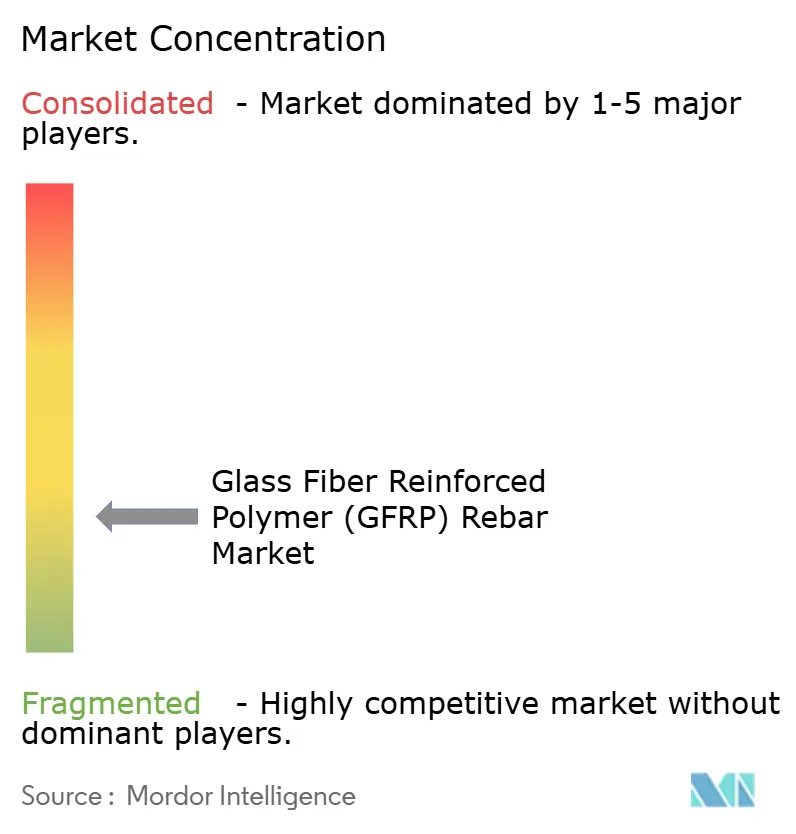
| Market Concentration | Low |
Major Players *Disclaimer: Major Players sorted in no particular order Image © Mordor Intelligence. Reuse requires attribution under CC BY 4.0. | |
Glass Fiber Reinforced Polymer (GFRP) Rebar Market Analysis by Mordor Intelligence
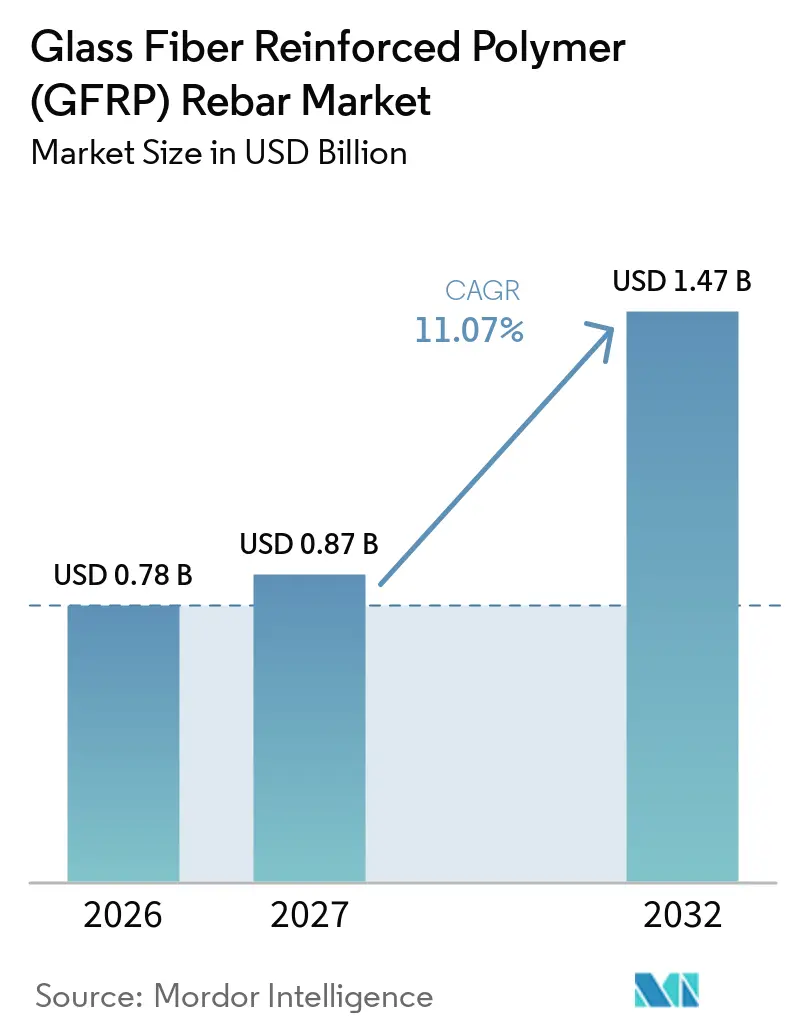
The Glass fiber reinforced polymer (GFRP) rebar market size was valued at USD 0.78 billion in 2026 and is estimated to grow from USD 0.87 billion in 2027 to USD 1.47 billion by 2032, at a CAGR of 11.07% during the forecast period (2027-2032). Demand is expanding beyond specialized projects as infrastructure owners place greater emphasis on corrosion risk, service life, maintenance requirements, and future repair costs. GFRP reinforcement supports long design lives in chloride-exposed structures, where conventional steel often requires earlier repair or replacement once water and salts reach the reinforcement. Updated design standards and a broader record of field performance have increased project teams' willingness to specify composite reinforcement for bridges, waterfront assets, and other exposed structures. The Glass Fiber Reinforced Polymer (GFRP) rebar market also benefits when public procurement evaluates lifecycle outcomes alongside initial material and installation costs. This shift creates opportunities for suppliers that can meet certification requirements, maintain local availability, support engineers during design and installation, and provide contractors with clear guidance on handling.
Key Report Takeaways
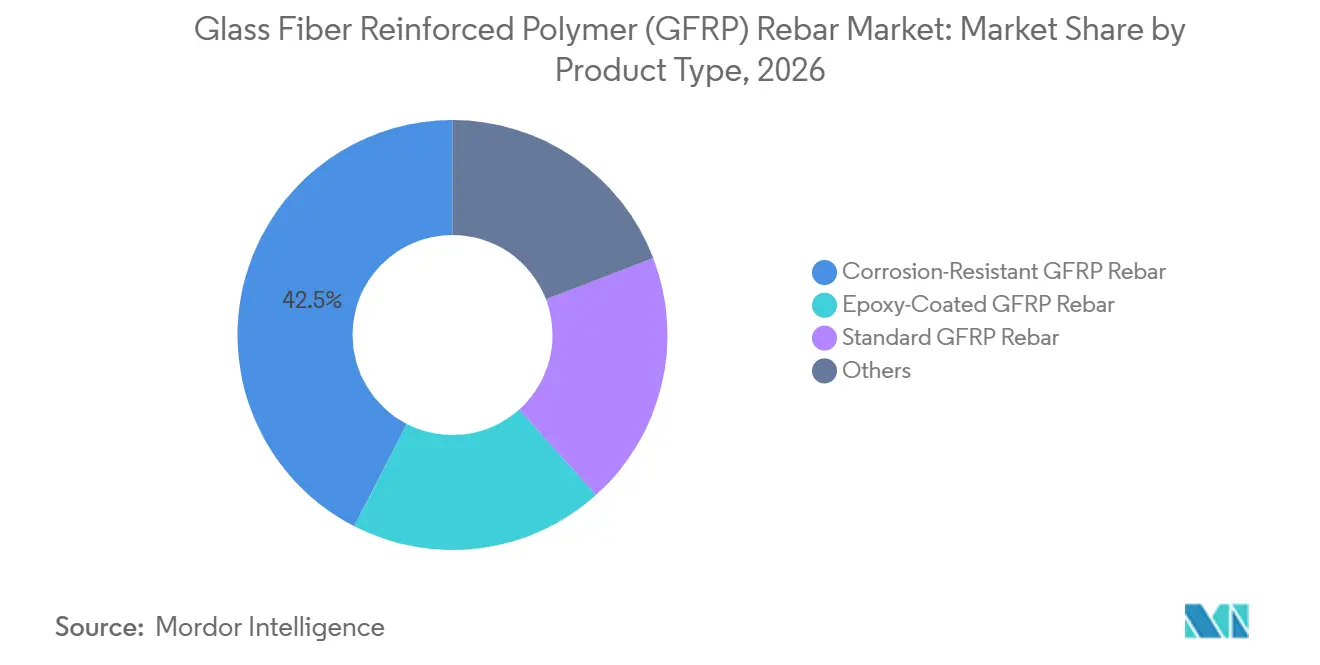
- By product type, Corrosion-Resistant GFRP Rebar held 42.45% market share in 2026 and is forecast to expand at a CAGR of 11.45% through 2032.
- By resin type, Vinyl Ester held a 55.12% market share in 2026 and is forecast to expand at an 11.67% CAGR through 2032.
- By diameter, the 10-20 mm category held a 53.78% market share in 2026 and is forecast to expand at an 11.91% CAGR through 2032.
- By tensile strength, Medium Strength GFRP Rebar held 50.32% market share in 2026, while High Strength GFRP Rebar is forecast to expand at an 11.85% CAGR through 2032.
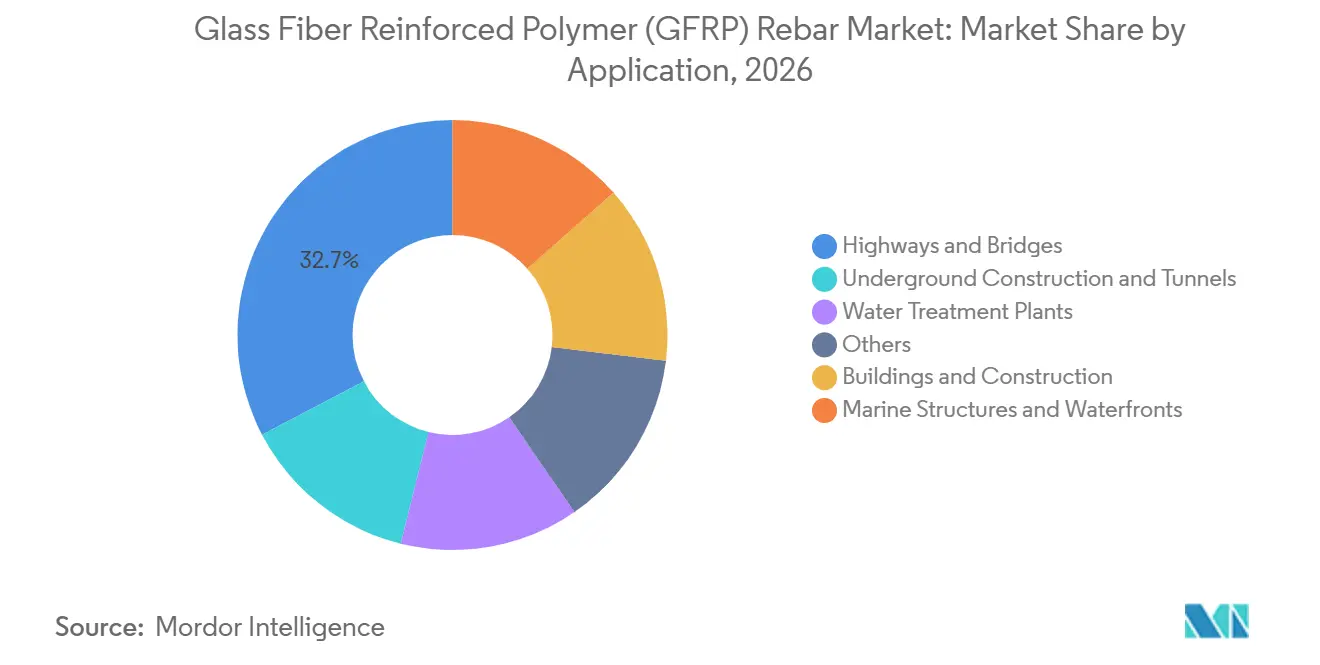
- By application, Highways and Bridges held 32.67% market share in 2026, while Marine Structures and Waterfronts are forecast to expand at a 12.14% CAGR through 2032.
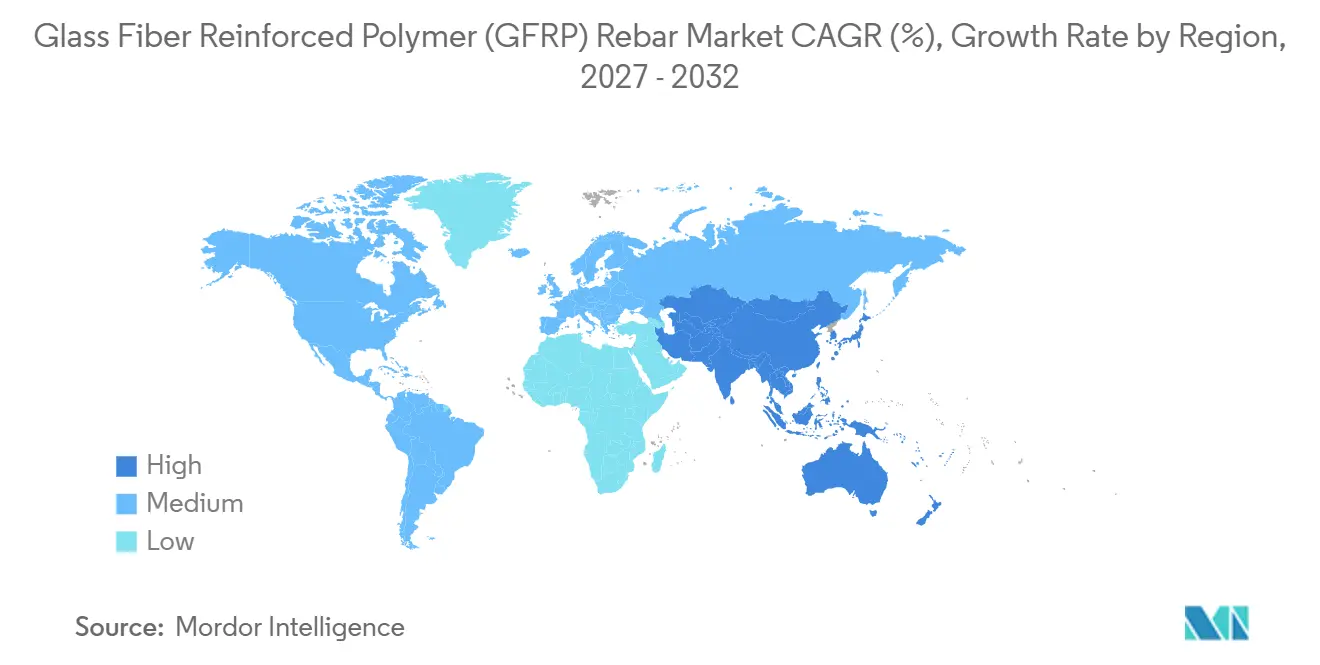
- By geography, North America held 38.23% market share in 2026, while Asia-Pacific is forecast to expand at an 11.75% CAGR through 2032.
Note: Market numbers in this report are based on Mordor Intelligence's proprietary estimation framework, which combines nine months of actuals with Q4 projections for base year 2026.
Market Trends and Insights
Drivers Impact Analysis of Glass Fiber Reinforced Polymer (GFRP) Rebar Market*
| Drivers | (~) % Impact on CAGR Forecast | Geographic Relevance | Impact Timeline |
|---|---|---|---|
| Corrosion-Driven Lifecycle Economics | +3.5% | Global, concentrated in North America and the Asia-Pacific coastal zones | Medium term (2-4 years) |
| Infrastructure Rehabilitation and Bridge Replacement | +2.8% | North America and Europe, with spillover to South Asia | Short term (≤ 2 years) |
| Green Building and Low-Carbon Procurement | +1.5% | Europe, North America, and core Asia-Pacific markets | Medium term (2-4 years) |
| Code and Specification Adoption | +1.2% | North America and Europe, with early gains in Saudi Arabia and Australia | Long term (≥ 4 years) |
| Non-Magnetic and Electrically Insulating Use Cases | +0.8% | Global, concentrated in developed markets | Long term (≥ 4 years) |
| Source: Mordor Intelligence | |||
Corrosion-Driven Lifecycle Economics
Steel corrosion places a substantial cost burden on infrastructure owners, particularly where concrete is exposed to deicing salts, seawater, humidity, or water-treatment chemicals. Corrosion can weaken reinforcement, damage surrounding concrete, and create repair needs that disrupt public infrastructure services and complicate long-term budget planning. A 2025 lifecycle assessment found that GFRP reinforcement produced a lifecycle cost advantage of more than 20% over steel under standard service-life assumptions, rising to 37% when longer asset life was included. Florida transportation analyses cited by ACI Committee 440 identified a USD 38 saving per linear foot over 20 years in marine-adjacent settings, where the exposure profile tends to make conventional reinforcement repairs more frequent. The glass fiber reinforced polymer (GFRP) rebar market has a basis for linking material selection to maintenance budgets, planned renewal cycles, bridge availability, and the cost of repeated repair work.
Infrastructure Rehabilitation and Bridge Replacement
The United States has more than 42,000 structurally deficient bridges, keeping rehabilitation demand in focus for transportation agencies, municipalities, and local asset owners. The Federal Highway Administration allocates USD 5.5 billion each year through the Bridge Formula Program under the Bipartisan Infrastructure Law. These programs encourage durable material choices for assets that face recurring exposure to moisture, salt, traffic, and temperature over long operating lives. India's 2025-26 road and highway allocation of INR 2.76 lakh crore (equivalent to USD 33 billion) also supports a long procurement pipeline for reinforcement products. For the glass fiber reinforced polymer (GFRP) rebar market, large bridge programs can build design familiarity among agencies, designers, contractors, material distributors, and maintenance teams that manage these assets over time.
Green-Building and Low-Carbon Procurement
Construction remains a major source of energy-related emissions, making embodied carbon an increasingly visible factor in project selection, investment review, and financing discussions. The World Steel Association reports emissions indicators for the steel sector, while the United Nations Environment Program tracks the broader emissions profile of buildings and construction. A 2025 peer-reviewed study of coastal high-rise columns found a 33.7% reduction in cradle-to-gate emissions for GFRP-reinforced columns compared with steel-reinforced alternatives, along with an 8.25% cost saving while maintaining structural compliance. The glass fiber reinforced polymer (GFRP) rebar market can benefit when lenders and owners apply embodied-carbon criteria in construction financing, procurement reviews, and project reporting, rather than relying solely on voluntary certification.
Code and Specification Adoption
American Concrete Institute (ACI) CODE 440.11-22 provides structural engineers with a unified U.S. framework for the design of concrete reinforced with GFRP bars[1]. The code reduces the need for separate project-by-project approvals, which had slowed specification decisions, delayed procurement, and made material choices less predictable. American Association of State Highway and Transportation Officials (AASHTO) GFRP bridge design guidance is also used in transportation design and procurement. Australia's AS 5204:2023 provides a standard for manufacture and use that aligns with established reinforced-concrete practice, and Saudi Arabia has codified GFRP reinforcement for Seismic Design Categories B and C. These standards make the glass fiber reinforced polymer (GFRP) rebar market more accessible to engineers, public buyers, insurers, contractors, and project reviewers who require a clear compliance route.
Restraints Impact Analysis of Glass Fiber Reinforced Polymer (GFRP) Rebar Market*
| Restraints | (~) % Impact on CAGR Forecast | Geographic Relevance | Impact Timeline |
|---|---|---|---|
| Higher Upfront Price Compared with Steel Rebar | -1.8% | Global, most acute in price-sensitive South and Southeast Asia | Short term (≤ 2 years) |
| Established Steel-Rebar Supply and Installation Ecosystem | -1.2% | Global, concentrated in emerging markets | Medium term (2-4 years) |
| Linear-Elastic Behavior and Lower Fire and Seismic Tolerance | -0.7% | North American Seismic Zones and European fire-code jurisdictions | Long term (≥ 4 years) |
| Source: Mordor Intelligence | |||
Higher Upfront Price Compared with Steel Rebar
GFRP rebar has a higher initial material cost than mild steel, which can limit its use in projects evaluated solely on capital expenditure or the lowest immediate bid. The cost premium is 1.5 to 2 times the per-unit steel price, before accounting for avoided repairs, reduced maintenance interventions, or longer service life. A 2025 study of concrete shear walls found that the optimized GFRP design cost 1.5 times as much as the steel option on a material-only basis. The study also noted that this comparison excluded long-term corrosion repair costs[2]. ASTM D7957 and ISO 10406 qualification requirements can add costs for manufacturers seeking formal approval. The GFRP rebar market faces its clearest challenge when owners have restricted budgets, short planning horizons, and procurement processes that separate construction spending from maintenance responsibilities.
Established Steel-Rebar Supply and Installation Ecosystem
Steel reinforcement has a mature manufacturing, distribution, and installation base in most construction markets. The existing workforce is familiar with steel tying, bending, lap splicing, welding procedures, material availability, established suppliers, and long-standing construction schedules. This makes it more difficult for composite products to enter projects without adequate training, contractor support, early design coordination, and confidence in the installation sequence. Thermoset GFRP cannot be field-bent after pultrusion, although the University of Maine reported research on field-bendable thermoplastic FRP rebar in September 2025. The GFRP rebar market must therefore pair product availability with installation guidance, cutting plans, design support, and contractor training. Improved field handling could reduce a barrier rooted in established construction practice rather than material performance alone.
*Our forecasts treat driver/restraint impacts as directional, not additive. The impact forecasts reflect baseline growth, mix effects, and variable interactions.
Glass Fiber Reinforced Polymer (GFRP) Rebar Market Segment Analysis
By Product Type:
Corrosion-Resistant Grade Anchors Specification LeadershipCorrosion-resistant GFRP rebar held 42.45% of 2026 revenue and registered the highest forecast CAGR of 11.45% through 2032. This position reflects its direct role in projects where chloride-induced corrosion poses material risks to concrete durability and asset availability. The GFRP rebar market share for this grade is driven by bridge decks, coastal structures, port assets, and marine slabs that require extended service life. It is especially relevant where deicing salts, seawater, wet-dry cycles, or chemical exposure can penetrate concrete and reach conventional reinforcement during normal long-term service. Specifications calling for 75-100-year design lives favor materials that can perform under these aggressive conditions. The grade helps owners reduce the likelihood of corrosion-driven repairs, lane closures, and disruptions to critical infrastructure. Its position also reflects why durability has become central to product selection in the GFRP rebar market.
The GFRP rebar industry uses corrosion-resistant grades as its strongest case for replacing conventional reinforcement. Epoxy-coated GFRP rebar serves engineers transitioning from familiar steel epoxy-coating specifications toward composite solutions with different corrosion behavior. Standard GFRP rebar remains suitable for interior structural work and for projects where magnetic neutrality is more important than maximum corrosion resistance. Each product choice depends on exposure conditions, required tensile capacity, bar geometry, available certifications, and the engineer's selected design standard. Suppliers that offer certified grade options can support both highly exposed civil assets and less demanding building applications. This range of offerings allows the GFRP rebar market to serve several specification pathways without treating every project as a marine application.

By Resin Type:
Vinyl Ester Retains Dominance, Epoxy Carves a Precision NicheVinyl ester accounted for 55.12% of 2026 revenue and is forecast to grow at an 11.67% CAGR through 2032. Its position is associated with chemical resistance in concrete pore solutions, marine environments, and water-treatment settings. A 2025 review in Materials and Structures identified vinyl ester-based bars as the most widely used GFRP format globally. The resin can meet the durability requirements of bridge decks, highway pavements, waterfront structures, and other exposed concrete systems. Its cost position relative to carbon fiber alternatives also supports use in civil projects that require a durable product at a workable cost. The vinyl ester category, therefore, provides the GFRP rebar market with a practical resin platform for its broadest infrastructure applications.
Epoxy resin-based GFRP plays a secondary role in applications requiring close tolerances, electromagnetic neutrality, and reliable performance in controlled environments. The laboratory floors at the Max Planck Institute for Solid State Research and the Center for Applied Quantum Technology in Stuttgart are examples of such settings. These cases show how material selection can be driven by both sensitivity to magnetic interference and corrosion resistance. Polyester resin products are used in more cost-sensitive interior applications where exposure conditions are less severe. Resin selection affects chemical resistance, mechanical behavior, durability, and the product's fit with the service environment. The GFRP rebar market will therefore rely on matching resin chemistry with project conditions, rather than applying a single formulation across all uses.
By Diameter:
Mid-Range Bar Sizes Drive Commercial OutputThe 10-20 mm category accounted for 53.78% of 2026 revenue and registered the highest projected CAGR of 11.91% through 2032. This range aligns with common bridge-deck, marine slab, parking structure, and highway pavement reinforcement requirements. The segment's GFRP rebar market size is supported by bar sizes that correspond closely with common #4 through #6 steel designations. That alignment allows engineers to use familiar reinforcement layouts and helps contractors work within established formwork and spacing practices. The category also covers a large share of routine civil reinforcement requirements without requiring the largest bar diameters. Its commercial position reflects that the GFRP rebar market is currently strongest in applications with repeatable, standardizable reinforcement designs.
Bars below 10 mm address specialized geotechnical work, including tunnel soft-eye diaphragm walls and soil nails. Delhi Metro's use of more than 20 tunnel boring machines illustrates the practical scale of tunnel-related applications. In these settings, GFRP can be cut by a tunnel boring machine, where steel would require a different approach. Bars above 20 mm are used in heavy civil components such as bridge piles, pier caps, foundations, and other heavily loaded members. Their expansion is moderated by conservative ductility provisions for larger FRP members under ACI CODE 440.11-22. The GFRP rebar market can grow across each diameter group, but near-term output remains concentrated in mid-range products that fit established civil designs.
By Tensile Strength:
Medium Strength Anchors the Market, High Strength AcceleratesMedium-strength GFRP rebar, with a tensile strength of 1,000-2,000 MPa, commanded 50.32% of 2026 revenue. It serves a broad range of applications, including bridge decks, building slabs, marine breakwaters, highway pavements, and other civil concrete elements. The category balances performance requirements with the practical needs of projects that use standard reinforcement configurations. High-strength GFRP rebar, above 2,000 MPa, is forecast to record the segment's fastest CAGR of 11.85% through 2032. Designers use higher tensile capacity when seeking thinner structural sections and reduced concrete quantities. The position of medium-strength products reflects their fit with the requirements of mainstream infrastructure construction.
A 2025 study in the Alexandria Engineering Journal found that hybrid glass, carbon, and basalt fiber rebars achieved tensile strength of up to 1,013 MPa. The research also reported 36% higher moment capacity and 49% greater ductility than standard GFRP in the tested system. These results support the product-development path for high-strength grades and hybrid reinforcement options. Low-strength GFRP retains a smaller role in nonstructural work, ground stabilization, temporary soil reinforcement, and precast decorative elements. The GFRP rebar market, therefore, combines a broad, medium-strength base with growing interest in products that enable material-efficient structural designs.
By Application:
Bridge Decks Lead, Marine Segment AcceleratesHighways and bridges held 32.67% of 2026 revenue, making the segment the largest application for composite reinforcement. Public bridge rehabilitation programs support this position because deck corrosion is a persistent maintenance concern in roads exposed to salt, moisture, and heavy use. The GFRP rebar market size for this application is supported by design guidance, agency-approved product systems, and the need to extend deck service life. Bridge owners can use corrosion-resistant reinforcement as part of a broader approach to reduce recurring repair needs. Buildings and construction are the second-largest application, including coastal high-rise foundations, parking garage slabs, and water-treatment basins. These uses extend the GFRP rebar market beyond transportation assets into structures where corrosion resistance and long service life are also priorities.
Marine structures and waterfronts are expected to grow at the highest CAGR of 12.14% through 2032. Port expansion in Southeast Asia and the Gulf supports demand for reinforcement capable of performing in saltwater conditions and during extended exposure cycles. Pultron Composites used Mateenbar GFRP rebar in the Tauranga Bridge Marina breakwater project during 2024-2025. The project reduced each panel's weight by 2 tons and extended the design life to more than 100 years. Underground construction and tunnels benefit from GFRP's non-magnetic properties and its compatibility with tunnel boring machine cutting. Water treatment plants remain the smallest application, but chemical resistance supports continued interest in cases where steel would require costly protective systems.
Geography Analysis
North America Glass Fiber Reinforced Polymer (GFRP) Rebar Market
North America accounted for 38.23% of 2026 revenue, giving the region the largest share of the GFRP rebar market. US demand is supported by bridge rehabilitation needs and the Federal Highway Administration's USD 5.5 billion annual Bridge Formula Program. The Build America, Buy America requirement applies to fiberglass rebar as of October 2025, strengthening the case for domestic production and local supply. Pultrall opened its 127,000-square-foot facility in Edon, Ohio, in March 2026, doubling its North American output. Canada contributes through the Canadian Standards Association (CSA) S807:19 and decades of GFRP pavement experience in Quebec and Ontario, while Mexico is adopting the material incrementally through coastal resort and port infrastructure. These conditions give the GFRP rebar market a wider regional base beyond major US bridge programs.
APAC Glass Fiber Reinforced Polymer (GFRP) Rebar Market
Asia-Pacific is forecast to expand at an 11.75% CAGR through 2032, representing the fastest regional growth rate. China's glass fiber-reinforced plastics output rose by more than 25% year over year through January–September 2025, supporting upstream supply readiness. India's road and highway allocation provides a sustained project pipeline for corrosion-resistant materials. Neuvokas and SBPIL established a five-line GatorBar licensing arrangement in January 2026, while Olectra Greentech entered the segment in April 2025. Australia's AS 5204:2023 supports coastal and remedial specifications, giving engineers a clearer route for use in exposed structures. Standards-based specifications that reduce approval uncertainty can benefit the GFRP rebar market in this region.
EMEA and South America Glass Fiber Reinforced Polymer (GFRP) Rebar Market
Europe has a measured growth profile, but Germany's EUR 500 billion infrastructure package and the forthcoming second edition of the DAfStb guideline are expanding project opportunities. Nordic adoption is stronger where deicing salts and lifecycle-focused public procurement increase the value of corrosion-resistant reinforcement. The GFRP rebar market is well-suited to these conditions, as durability is a factor in public purchasing decisions. South America is an emerging market through port infrastructure, coastal residential construction, and water treatment projects in Brazil and Argentina, although limited local manufacturing capacity and fiscal conditions constrain adoption. The Middle East and Africa are gaining importance due to Saudi Arabia's Vision 2030 program, new GFRP seismic design provisions, and Bekaert's October 2025 memorandum of understanding with IKK Mateenbar for hybrid systems across the MENA region.
Competitive Landscape
The glass fiber reinforced polymer (GFRP) rebar market is fragmented. Dextra Group, Pultron Composites, and PULTRALL hold positions through certified product portfolios, production reach, and relationships with infrastructure agencies. Their offerings are supported by approvals and standards, including ICC-ES AC521, ACI 440, and ASTM D7957, which are common entry requirements for public projects. Dextra achieved ICC-ES AC521 certification for its Durabar+ GFRP rebar in 2025. Regional manufacturers in India, South Africa, and Southeast Asia are adding downstream capacity and expanding local supplier options, which increases the potential for local service, shorter lead times, and project support.
Competition centers on code compliance, domestic production, distribution, and engineering support rather than price alone. PULTRALL's March 2026 Edon facility is a strategic response to Buy America requirements and demand for shorter local supply chains. In January 2026, Neuvokas, ExxonMobil Proxxima, and SBPIL announced a collaboration to license up to five GatorBar production lines in India. In February 2025, Owens Corning agreed to sell its glass reinforcements business to Praana Group for USD 755 million. This transaction signals a shift in the upstream glass fiber supply structure that may influence raw material access and supplier relationships.
The GFRP rebar market presents opportunities in Southeast Asian ports, Sub-Saharan water treatment construction, and field-bendable thermoplastic rebar. The University of Maine's September 2025 research on field-bendable fiber reinforced thermoplastic (FRTP) rebar highlights a product development path that could address installation constraints. Schöck Bauteile GmbH combines ComBAR GFRP rebar with thermal-break technology to address structural and building energy requirements in Europe. New entrants need to establish compliance credentials and reliable contractor support, while established suppliers retain an advantage through project-specific technical assistance.
Glass Fiber Reinforced Polymer (GFRP) Rebar Industry Leaders
-
Dextra Group
-
Pultron Composites
-
PULTRALL
-
Hughes Brothers
-
Schöck Bauteile GmbH
- *Disclaimer: Major Players sorted in no particular order
Glass Fiber Reinforced Polymer (GFRP) Rebar Market Companies Covered in this Report
- ARC Insulations & Insulator Ltd.
- Armastek
- Dextra Group
- Fibrolux GmbH
- FRT TUF-BAR
- Hughes Brothers
- Jindal Advanced Materials
- Kodiak Fiberglass Rebar
- Neuvokas Corporation
- Owens Corning
- PULTRALL
- Pultron Composites
- Röchling
- Schöck Bauteile GmbH
- SIREG GEOTECH S.r.l.
Recent Industry Developments in Glass Fiber Reinforced Polymer (GFRP) Rebar Market
- March 2026: PULTRALL launched a 127,000-square-foot V-ROD Glass Fiber Reinforced Polymer (GFRP) rebar production facility in Edon, Ohio, doubling its North American production capacity and creating more than 60 new jobs. The facility meets US "Build America, Buy America" requirements, which formally applied to GFRP rebar in October 2025.
- January 2026: Neuvokas Corporation, ExxonMobil Proxxima, and Shri Bajrang Power and ISPAT Limited (SBPIL / Goel TMT) announced a collaboration enabling SBPIL to license up to five GatorBar production lines using Neuvokas' US Glass Fiber Reinforced Polymer (GFRP) rebar manufacturing platform, targeting India's infrastructure rebar market. ExxonMobil holds exclusive overseas sub-licensing rights for the process.
Global Glass Fiber Reinforced Polymer (GFRP) Rebar Market Report Scope
GFRP (Glass Fiber Reinforced Polymer) rebar is a non-metallic composite reinforcement rod made from high-strength glass fibers bound in a polymer resin matrix (such as vinyl ester or epoxy). It serves as a corrosion-resistant alternative to traditional steel rebar in concrete and infrastructure projects. GFRP rebar does not corrode, rust, or conduct electricity, making it suitable for use in environments exposed to moisture, chemicals, and extreme temperatures.
The glass fiber reinforced polymer (GFRP) rebar market is segmented by product type, resin type, diameter, tensile strength, application, and geography. By product type, the market is segmented into corrosion-resistant GFRP rebar, epoxy-coated GFRP rebar, standard GFRP rebar, and others. By resin type, the market is segmented into vinyl ester, epoxy, polyester, and other resin types. By diameter, the market is segmented into less than 10 mm, 10-20 mm, and more than 20 mm. By tensile strength, the market is segmented into low strength (less than 1,000 MPa), medium strength (1,000-2,000 MPa), and high strength (more than 2,000 MPa). By application, the market is segmented into highways and bridges, buildings and construction, marine structures and waterfronts, underground construction and tunnels, water treatment plants, and others. The report also covers market sizes and forecasts for glass fiber reinforced polymer (GFRP) rebar across 15 countries in major regions. The market sizes and forecasts are provided in terms of value (USD).
Segmentation Overview
| Corrosion-Resistant GFRP Rebar |
| Epoxy-Coated GFRP Rebar |
| Standard GFRP Rebar |
| Others |
| Vinyl Ester |
| Epoxy |
| Polyester |
| Other Resin Types |
| Less Than 10 mm |
| 10-20 mm |
| More Than 20 mm |
| Low Strength (Less Than 1,000 Mpa) |
| Medium Strength (1,000-2,000 Mpa) |
| High Strength (More Than 2,000 Mpa) |
| Highways and Bridges |
| Buildings and Construction |
| Marine Structures and Waterfronts |
| Underground Construction and Tunnels |
| Water Treatment Plants |
| Others |
| Asia-Pacific | China |
| India | |
| Japan | |
| South Korea | |
| ASEAN Countries | |
| Rest of Asia-Pacific | |
| North America | United States |
| Canada | |
| Mexico | |
| Europe | Germany |
| United Kingdom | |
| France | |
| Italy | |
| NORDIC Countries | |
| Rest of Europe | |
| South America | Brazil |
| Argentina | |
| Rest of South America | |
| Middle East and Africa | Saudi Arabia |
| South Africa | |
| Rest of Middle East and Africa |
| By Product Type | Corrosion-Resistant GFRP Rebar | |
| Epoxy-Coated GFRP Rebar | ||
| Standard GFRP Rebar | ||
| Others | ||
| By Resin Type | Vinyl Ester | |
| Epoxy | ||
| Polyester | ||
| Other Resin Types | ||
| By Diameter | Less Than 10 mm | |
| 10-20 mm | ||
| More Than 20 mm | ||
| By Tensile Strength | Low Strength (Less Than 1,000 Mpa) | |
| Medium Strength (1,000-2,000 Mpa) | ||
| High Strength (More Than 2,000 Mpa) | ||
| By Application | Highways and Bridges | |
| Buildings and Construction | ||
| Marine Structures and Waterfronts | ||
| Underground Construction and Tunnels | ||
| Water Treatment Plants | ||
| Others | ||
| By Geography | Asia-Pacific | China |
| India | ||
| Japan | ||
| South Korea | ||
| ASEAN Countries | ||
| Rest of Asia-Pacific | ||
| North America | United States | |
| Canada | ||
| Mexico | ||
| Europe | Germany | |
| United Kingdom | ||
| France | ||
| Italy | ||
| NORDIC Countries | ||
| Rest of Europe | ||
| South America | Brazil | |
| Argentina | ||
| Rest of South America | ||
| Middle East and Africa | Saudi Arabia | |
| South Africa | ||
| Rest of Middle East and Africa | ||
Key Questions Answered in the Report
What is current market size of Glass Fiber Reinforced Polymer (GFRP) Rebar Market?
The Glass fiber reinforced polymer (GFRP) rebar market size was valued at USD 0.78 billion in 2026 and is estimated to grow from USD 0.87 billion in 2027 to USD 1.47 billion by 2032, at a CAGR of 11.07% during the forecast period (2027-2032).
Which GFRP rebar application is growing fastest?
Marine Structures and Waterfronts are forecast to grow at 12.14% CAGR through 2032.
Which region is expanding fastest for GFRP reinforcement?
Asia-Pacific is forecast to record the fastest regional CAGR at 11.75% through 2032.
Why does vinyl ester lead GFRP rebar demand?
Vinyl ester accounts for 55.12% of revenue in 2026 due to its chemical resistance in civil, marine, and water-related projects.