
Glass Bubbles Market Size and Share
Market Overview
| Study Period | 2021 - 2031 |
|---|---|
| Market Size (2026) | USD 2.74 Billion |
| Market Size (2031) | USD 3.39 Billion |
| Growth Rate (2026 - 2031) | 4.34 % |
| Fastest Growing Market | Asia-Pacific |
| Largest Market | Asia-Pacific |
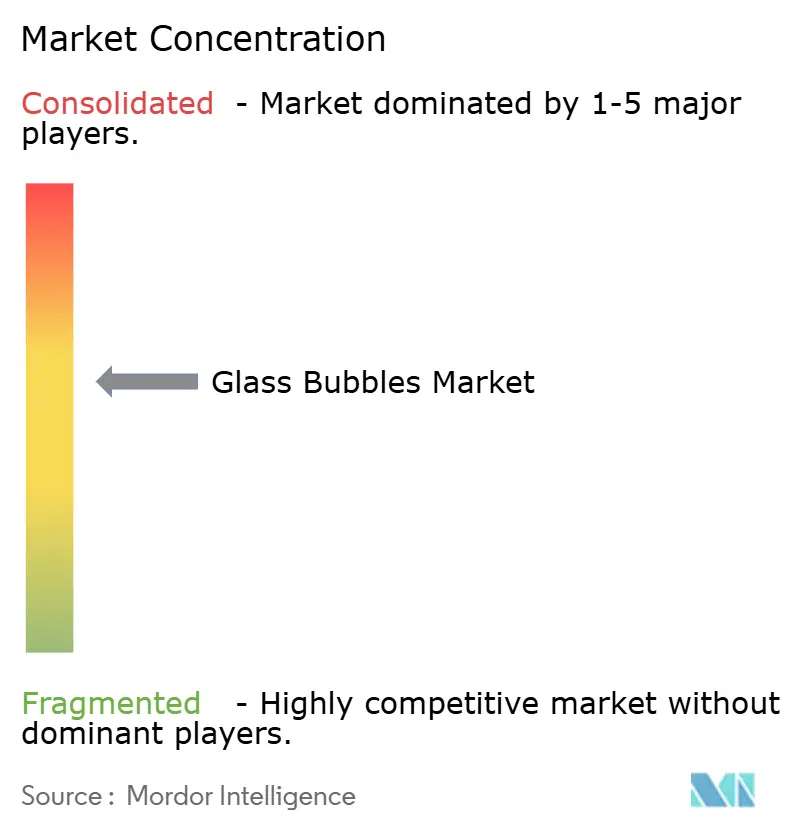
| Market Concentration | Medium |
Major Players *Disclaimer: Major Players sorted in no particular order Image © Mordor Intelligence. Reuse requires attribution under CC BY 4.0. | |
Glass Bubbles Market Analysis by Mordor Intelligence
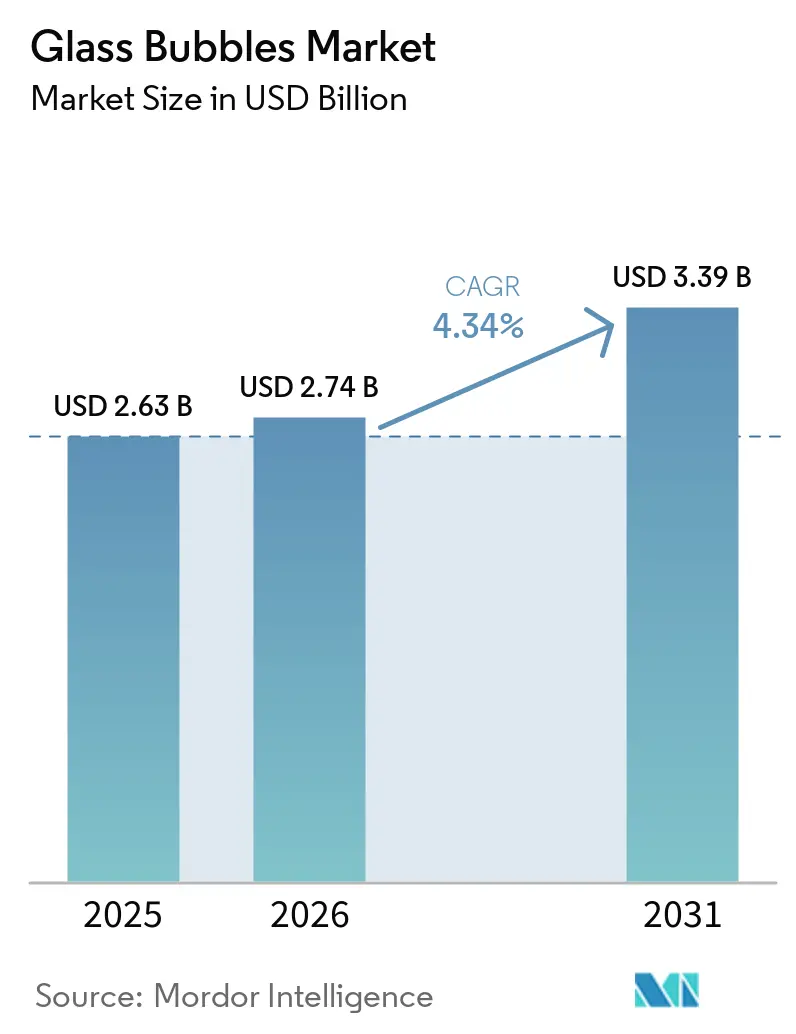
The Glass Bubbles Market size was valued at USD 2.63 billion in 2025 and is estimated to grow from USD 2.74 billion in 2026 to reach USD 3.39 billion by 2031, at a CAGR of 4.34% during the forecast period (2026-2031). The glass bubbles market is supported by material demand from automotive, aerospace, oil and gas, construction, and other applications that require lower density or thermal insulation. Automotive and aerospace manufacturers are placing more weight on lightweight components as fuel economy, emissions, and operating requirements shape material selection. Hollow glass microspheres can lower density while retaining processability, surface finish, and dimensional stability in selected polymer and composite parts. Their spherical shape can reduce melt viscosity and permit higher filler loadings, which gives formulators an option beyond glass fiber and talc. The glass bubbles market also benefits when manufacturers need a single filler to support mechanical, thermal, acoustic, or dielectric performance in the same component.
Key Report Takeaways
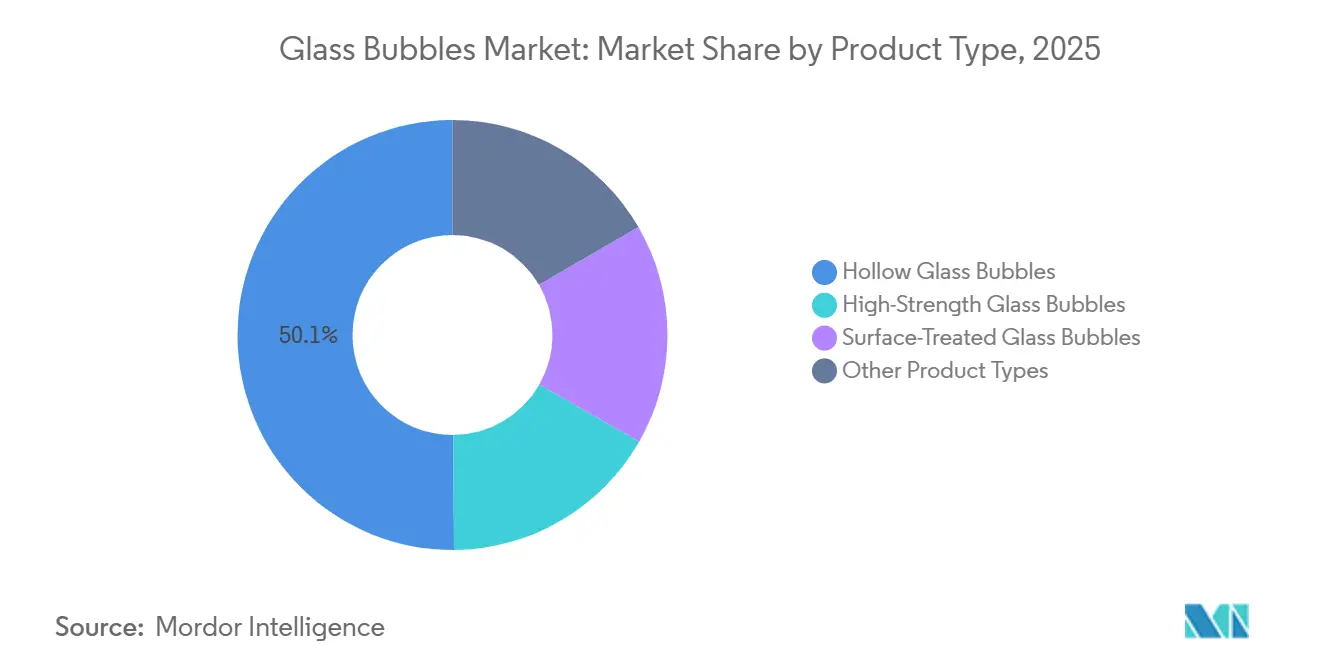
- By product type, hollow glass bubbles held 50.11% of the glass bubbles market share in 2025 and are projected to advance at a 5.22% CAGR through 2031.
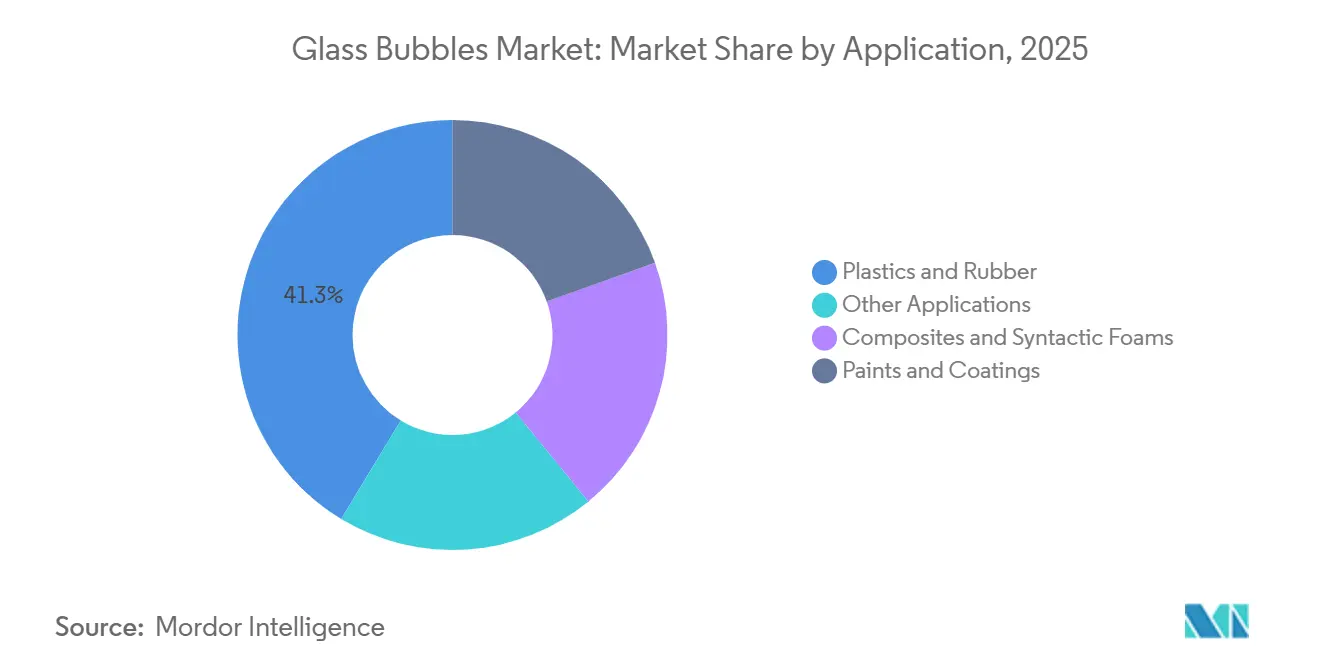
- By application, plastics and rubber held 41.34% of the glass bubbles market share in 2025, while composites and syntactic foams are projected to advance at a 5.46% CAGR through 2031.
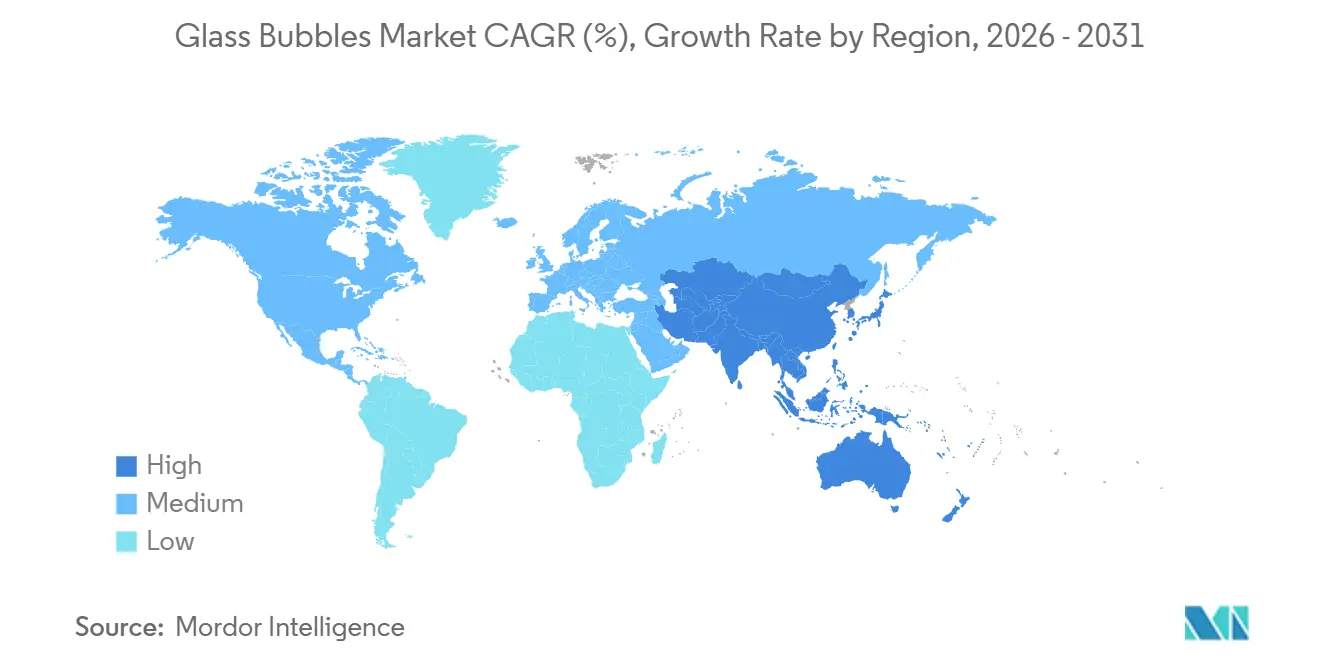
- By geography, Asia-Pacific held 35.65% of the glass bubbles market share in 2025 and is projected to advance at a 5.13% CAGR through 2031.
Note: Market size and forecast figures in this report are generated using Mordor Intelligence’s proprietary estimation framework, updated with the latest available data and insights as of January 2026.
Market Trends and Insights
Drivers Impact Analysis of Glass Bubbles Market*
| Driver | (~) % Impact on CAGR Forecast | Geographic Relevance | Impact Timeline |
|---|---|---|---|
| Automotive and Aerospace Lightweighting | +1.5% | Global, with concentration in North America, Europe, and APAC automotive hubs | Medium term (2-4 years) |
| Thermal Insulation and Energy-Efficiency Requirements | +1.2% | Europe (EPBD-driven), North America, APAC construction markets | Short term (≤ 2 years) |
| Expansion of Lightweight Oil and Gas Drilling Fluids | +0.9% | Middle-East and Africa, North America, South America | Medium term (2-4 years) |
| Growth of High-Performance Composite Manufacturing | +0.8% | Global, with APAC and North America leading composite output | Long term (≥ 4 years) |
| EV Battery Housing and Thermal-Management Qualification | +0.6% | APAC core (China, South Korea, Japan), spillover to North America and Europe | Medium term (2-4 years) |
| Source: Mordor Intelligence | |||
Automotive and Aerospace Lightweighting
Lightweighting has become a regulatory and design requirement in automotive and aerospace manufacturing. 3M stated that its glass bubbles can reduce the weight of injection-molded thermoplastic parts by 15% and sheet-molded composites by up to 40%[1]. The materials can lower composite density below 1.0 g/cm³ while retaining Class A paintable finishes in relevant formulations. Hollow glass microspheres can be compounded using standard melt-processing equipment, which can reduce the need for material-process changes during validation. Airbus is pursuing HEMERA and HELIOS research programs that address higher-rate composite industrialization for future aircraft structures. These programs support a larger role for lightweight functional fillers in composite core and sandwich-panel applications as aircraft production needs increase.
Thermal Insulation and Energy-Efficiency Requirements
Thermal insulation requirements support demand for glass bubbles in renders, plasters, coatings, and related building materials. Directive (EU) 2024/1275 established a zero-emission building category and set requirements for the energy performance of buildings[2]. Ireland’s 2026 regulations implemented national measures under the energy-performance framework. A 2024 scientific study reported that hollow glass microsphere composites achieved thermal conductivities of 25.87 to 35.84 mW·m⁻¹·K⁻¹ under the specified cryogenic test conditions. Lower-density fillers can therefore help formulators meet insulation targets without relying only on conventional mineral fillers. The glass bubbles market can benefit where energy-performance decisions place greater value on thermal function and lifecycle cost than on the lowest initial material cost.
Expansion of Lightweight Oil and Gas Drilling Fluids
Lightweight drilling fluids are relevant in depleted reservoirs and fractured formations where high-density fluid columns can raise formation damage and nonproductive time risks. Hollow glass bead fluids offer a way to reduce fluid density for pressure-managed drilling applications. The glass bubbles market benefits because this material approach can provide more uniform density at downhole pressure than aerated or foamed systems. It can also reduce reliance on specialized gas-management equipment at the rig site. In October 2025, 3M introduced 3M Glass Bubbles HGS7K32N for drilling, completion, and workover fluids in moderate-to-deep wells. The product had a nominal density of 0.32 g/cc and an isostatic crush strength of 7,000 psi, which addresses performance requirements for pressure-rated applications.
Growth of High-Performance Composite Manufacturing
High-performance composite manufacturing supports the use of hollow glass microspheres in syntactic foams for buoyancy modules and subsea equipment. These materials are used where low density must be retained under substantial hydrostatic pressure. A 2025 review found that properly dispersed hollow glass microspheres can improve tensile, flexural, thermal, acoustic, and dielectric properties in fiber-reinforced polymer composites. This combination of functions can make the filler useful beyond simple weight reduction. Trelleborg AB’s Eccofloat DS syntactic foam was qualified for 6,000 m service depth and continuous use of up to 2 years. The glass bubbles market can gain from rising depth requirements because those requirements favor pressure-rated microsphere grades and specialized composite systems.
Restraints Impact Analysis of Glass Bubbles Market*
| Restraint | (~) % Impact on CAGR Forecast | Geographic Relevance | Impact Timeline |
|---|---|---|---|
| High Production Cost Compared With Conventional Fillers | -0.4% | Global, most acute in Europe and North America | Short term (≤ 2 years) |
| Lengthy Qualification Cycles for Binder Compatibility and Crush Strength | -0.2% | Global | Medium term (2-4 years) |
| High-End Grade Dependence on Cross-Border Supply Chains | -0.1% | North America & Europe (import-reliant on premium APAC-origin grades) | Medium term (2-4 years) |
| Source: Mordor Intelligence | |||
High Production Cost Compared with Conventional Fillers
Glass bubble production requires tightly controlled processing temperatures and high-purity borosilicate feedstocks. These requirements create a higher cost base than that of fillers such as calcium carbonate or talc. Energy use is an important part of the manufacturing cost structure because glass production requires controlled thermal processing. The premium can be justified in components that need lower density, insulation, or pressure resistance. It can be harder to justify in price-sensitive construction and general-polymer applications where solid mineral fillers remain familiar alternatives. The glass bubbles market, therefore, faces a cost barrier when users do not place sufficient value on the application-specific performance benefits.
Lengthy Qualification Cycles for Binder Compatibility and Crush Strength
Aerospace, deep-sea, and electric vehicle applications require microsphere grades to meet defined crush-strength, compatibility, and batch-consistency requirements. Suppliers must demonstrate performance with specific binder systems before high-value applications can move into regular use. This work can include testing, documentation, samples, and process validation. A grade qualified for one customer’s proprietary binder may require additional qualification for another customer’s formulation. The process can delay revenue even when end-market demand is present. It also benefits suppliers with established qualification records and can make entry harder for new producers.
*Our forecasts treat driver/restraint impacts as directional, not additive. The impact forecasts reflect baseline growth, mix effects, and variable interactions.
Glass Bubbles Market Segment Analysis
By Product Type:
Hollow Glass Bubbles Lead Broad Processing UsesHollow glass bubbles held 50.11% of the glass bubbles market share in 2025. Their position reflected use across a broad range of processing methods and applications, from injection molding to deep-sea syntactic foam. Commercial products are available across a wide range of crush strengths and densities, allowing formulators to choose grades suited to the processing load and end-use requirement. Existing original equipment manufacturer material databases and formulation libraries are often aligned with established hollow glass bubble grades.
A 2025 scientific review reported that hollow glass bubbles, when properly dispersed with silane coupling agents, can improve tensile strength, thermal insulation, acoustic absorption, and dielectric performance in fiber-reinforced polymer composites. Within the glass bubbles market, high-strength glass bubbles serve applications that expose the material to severe processing shear or elevated pressure. Surface-treated glass bubbles can reduce the need for a separate silane coupling agent step during compounding. This can lower mixing complexity for manufacturers that use surface-modified variants at scale. Other product types include conductive glass bubbles and specialty glass bubbles for applications that require dielectric control, specialized surfaces, or other functions. European and North American buyers also consider ISO 9001:2015 quality management certification and European Union Restriction of Hazardous Substances compliance as purchase requirements for qualified suppliers.

By Application:
Plastics and Rubber Provide the Broadest Demand BasePlastics and rubber held 41.34% of the glass bubbles market share in 2025. The application’s broad installed base includes automotive injection-molded parts, underbody coatings, and seam sealers. Glass bubbles can reduce density in these applications while supporting processability and component finish. Electric vehicle designs are changing the mix of plastic and rubber components used in vehicles.
Composites and syntactic foams are projected to advance at a 5.46% CAGR through 2031. Deep-sea infrastructure, offshore energy, unmanned aerial vehicle and remotely operated vehicle manufacturing, and higher composite content in aerospace platforms support this application. Greater operating depth raises the pressure requirements for syntactic foam components. This supports demand for higher-grade, higher-margin hollow glass microspheres. MO SCI, LLC identifies engineered glass microspheres for battery-potting applications, where spherical geometry can minimize orientation effects during molding and support isotropic insulation. Within the glass bubbles market, paints and coatings remain associated with solar-reflective roofs and cool-wall finishes, while other applications include oil and gas drilling and cementing, adhesives and sealants, construction materials, and specialty formulations.
Geography Analysis
APAC Glass Bubbles Market
Asia-Pacific held 35.65% of the glass bubbles market share in 2025 and is projected to advance at a 5.13% CAGR through 2031. The region combines a large consumer base with a substantial production base for hollow glass microspheres. China’s automotive manufacturing, oil and gas drilling activity, construction demand, and domestic producer base support this position. Demand also comes from India’s construction-insulation and automotive-composites activity. Japan’s precision-manufacturing base supports demand for tight-tolerance grades used in electronics and semiconductor applications.
North America and Europe Glass Bubbles Market
Within the glass bubbles market, North America and Europe represent an important concentration of demand for premium grades. North American producers benefit from access to regional borosilicate glass supply and manufacturing capability. In 2025, U.S. tariff measures on imported glass microspheres encouraged sourcing diversification among importers and domestic producers. European building demand is connected to energy-performance rules for new and existing buildings. Restriction of Hazardous Substances and Registration, Evaluation, Authorisation and Restriction of Chemicals compliance requirements can reduce the pool of qualified suppliers for European buyers.
South America and MEA Glass Bubbles Market
South America, and Middle-East and Africa are growth-oriented regions that largely depend on imports for premium grades. Brazil’s pre-salt deepwater activity supports demand for pressure-rated hollow glass microspheres used in drilling fluids and cementing slurries. Saudi Arabia supports regional demand through oil and gas drilling and construction activity. Argentina’s Vaca Muerta formation provides another demand point for lightweight drilling-fluid applications. These regions can offer opportunities for specialty agents and technical distributors that provide application support beyond commodity supply.
Competitive Landscape
The glass bubbles market is moderately concentrated, with the top five players including 3M, Potters Industries LLC, Trelleborg AB, SINOSTEEL MAANSHAN NEW MATERIAL TECHNOLOGY, and Mo-Sci, LLC. 3M’s portfolio includes grades designed for different processing pressures and matrix chemistries. Trelleborg AB focuses on specialized buoyancy and syntactic-foam systems for marine and subsea uses. Its Eccofloat solutions are designed for demanding subsea environments, including service depths of up to 6,000 m for the cited range.
Potters Industries LLC is broadening its role in industrial and performance materials. In November 2025, Macquarie Asset Management and co-investors agreed to acquire a majority stake in Potters Industries LLC from TJC, L.P., subject to regulatory approvals. The transaction was expected to close in the first half of 2026 and involved a business with 26 production and logistics sites. In December 2024, Brenntag Specialties expanded its exclusive distribution agreement with 3M for Glass Bubbles to France and Iberia, effective January 1, 2025. The expansion added formulation support and technical advice through Brenntag’s Innovation and Application Centers in those territories.
Within the glass bubbles market, Chinese producers, including SINOSTEEL MAANSHAN NEW MATERIAL TECHNOLOGY, Zhengzhou Hollowlite Materials Co., Ltd., Zhongke Huaxing New Materials Co., Ltd., Anhui Triumph Base Material Technology Co., Ltd., and Shanxi Hainuo Technology Co., Ltd., compete across a range of grades. Their focus includes coatings, construction, and general composites, where cost can carry more weight in procurement decisions. They also seek to improve crush strength and purity for oil and gas and aerospace qualification channels. Surface-functionalized grades for electric vehicle battery potting, conductive microspheres for 5G dielectric applications, and bio-functional grades are areas of product development. Established qualification positions can make rapid supplier replacement difficult in these applications.
Glass Bubbles Industry Leaders
-
3M
-
Potters Industries LLC
-
Trelleborg AB
-
SINOSTEEL MAANSHAN NEW MATERIAL TECHNOLOGY
-
MO SCI, LLC
- *Disclaimer: Major Players sorted in no particular order
Glass Bubbles Market Companies Covered in this Report
- 3M
- Anhui Triumph Base Material Technology Co., Ltd.
- Cospheric LLC
- Envirospheres Pty Ltd
- Geocon Products
- MO SCI, LLC
- Potters Industries LLC
- Shanxi Hainuo Technology Co., Ltd.
- Sigmund Lindner GmbH
- SINOSTEEL MAANSHAN NEW MATERIAL TECHNOLOGY
- Sphere One, Inc.
- Trelleborg AB
- Zhengzhou Hollowlite Materials Co., Ltd.
- Zhongke Huaxing New Materials Co., Ltd.
Recent Industry Developments in Glass Bubbles Market
- November 2025: Macquarie Asset Management, along with UniSuper and Partners Capital, acquired a majority stake in Potters Industries LLC from TJC, LP. The investment is expected to support product expansion and capacity development across Potters Industries' global manufacturing network, strengthening its capabilities in specialized glass microsphere applications.
- October 2025: 3M launched the next-generation 3M Glass Bubbles S32HSN for syntactic foams and HGS7K32N for deep-sea buoyancy, underwater pipe insulation, and oil and gas drilling fluids. The launches expand 3M's glass bubble portfolio in demanding applications, offering cost advantages over comparable products and supporting adoption where lightweighting, buoyancy, insulation, and well-fluid performance are required.
Global Glass Bubbles Market Report Scope
Glass bubbles are lightweight, hollow glass microspheres used as functional additives and fillers to reduce material density while maintaining desirable mechanical, thermal, and processing properties. They are valued for their ability to improve weight efficiency, insulation, buoyancy, dimensional stability, and overall material performance across various industrial formulations.
The Glass Bubbles Market is segmented by product type, application, and geography. By product type, the market is segmented into hollow glass bubbles, high-strength glass bubbles, surface-treated glass bubbles, and other product types (conductive glass bubbles and specialty glass bubbles). By application, the market is segmented into plastics and rubber, composites and syntactic foams, paints and coatings, and other applications (oil and gas drilling and cementing, adhesives and sealants, construction materials, personal care and specialty formulations). The report also covers the market size and forecasts for glass bubbles in 15 countries across major regions. For each segment, the market sizing and forecasts have been done on the basis of value (USD).
Segmentation Overview
| Hollow Glass Bubbles |
| High-Strength Glass Bubbles |
| Surface-Treated Glass Bubbles |
| Other Product Types (Conductive Glass Bubbles and Specialty Glass Bubbles) |
| Plastics and Rubber |
| Composites and Syntactic Foams |
| Paints and Coatings |
| Other Applications (Oil and Gas Drilling and Cementing, Adhesives and Sealants, Construction Materials, Personal Care and Specialty Formulations) |
| Asia-Pacific | China |
| India | |
| Japan | |
| South Korea | |
| ASEAN Countries | |
| Rest of Asia-Pacific | |
| North America | United States |
| Canada | |
| Mexico | |
| Europe | Germany |
| United Kingdom | |
| France | |
| Italy | |
| NORDIC Countries | |
| Rest of Europe | |
| South America | Brazil |
| Argentina | |
| Rest of South America | |
| Middle-East and Africa | Saudi Arabia |
| South Africa | |
| Rest of Middle-East and Africa |
| By Product Type | Hollow Glass Bubbles | |
| High-Strength Glass Bubbles | ||
| Surface-Treated Glass Bubbles | ||
| Other Product Types (Conductive Glass Bubbles and Specialty Glass Bubbles) | ||
| By Application | Plastics and Rubber | |
| Composites and Syntactic Foams | ||
| Paints and Coatings | ||
| Other Applications (Oil and Gas Drilling and Cementing, Adhesives and Sealants, Construction Materials, Personal Care and Specialty Formulations) | ||
| By Geography | Asia-Pacific | China |
| India | ||
| Japan | ||
| South Korea | ||
| ASEAN Countries | ||
| Rest of Asia-Pacific | ||
| North America | United States | |
| Canada | ||
| Mexico | ||
| Europe | Germany | |
| United Kingdom | ||
| France | ||
| Italy | ||
| NORDIC Countries | ||
| Rest of Europe | ||
| South America | Brazil | |
| Argentina | ||
| Rest of South America | ||
| Middle-East and Africa | Saudi Arabia | |
| South Africa | ||
| Rest of Middle-East and Africa | ||
Key Questions Answered in the Report
What is the size of the glass bubbles market?
The glass bubbles market stands at USD 2.74 billion in 2026 and is projected to reach USD 3.39 billion by 2031.
What is driving demand for glass bubbles?
Automotive and aerospace lightweighting, insulation requirements, drilling fluids, composite manufacturing, and electric vehicle battery qualification support demand.
Which product type led glass bubble demand in 2025?
Hollow glass bubbles held 50.11% of the glass bubbles market share in 2025.
Which application is projected to grow fastest through 2031?
Composites and syntactic foams are projected to advance at a 5.46% CAGR through 2031.