
Germany Fruit Juice Market Size and Share
Market Overview
| Study Period | 2021 - 2031 |
|---|---|
| Forecast Data Period | 2026 - 2031 |
| Base Year Market Size (2025) | USD 6.96 Billion |
| Market Size (2026) | USD 7.13 Billion |
| Market Size (2031) | USD 8.43 Billion |
| Growth Rate (2026 - 2031) | 3.41 % |
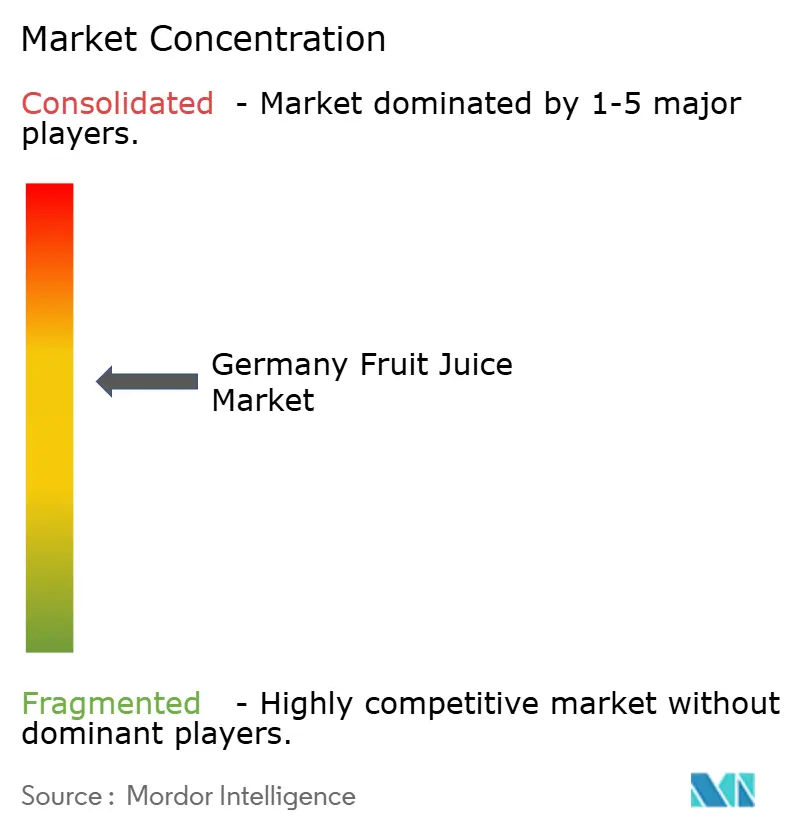
| Market Concentration | Medium |
Major Players
*Disclaimer: Major Players sorted in no particular order Image © Mordor Intelligence. Reuse requires attribution under CC BY 4.0. |
|
Germany Fruit Juice Market Analysis by Mordor Intelligence
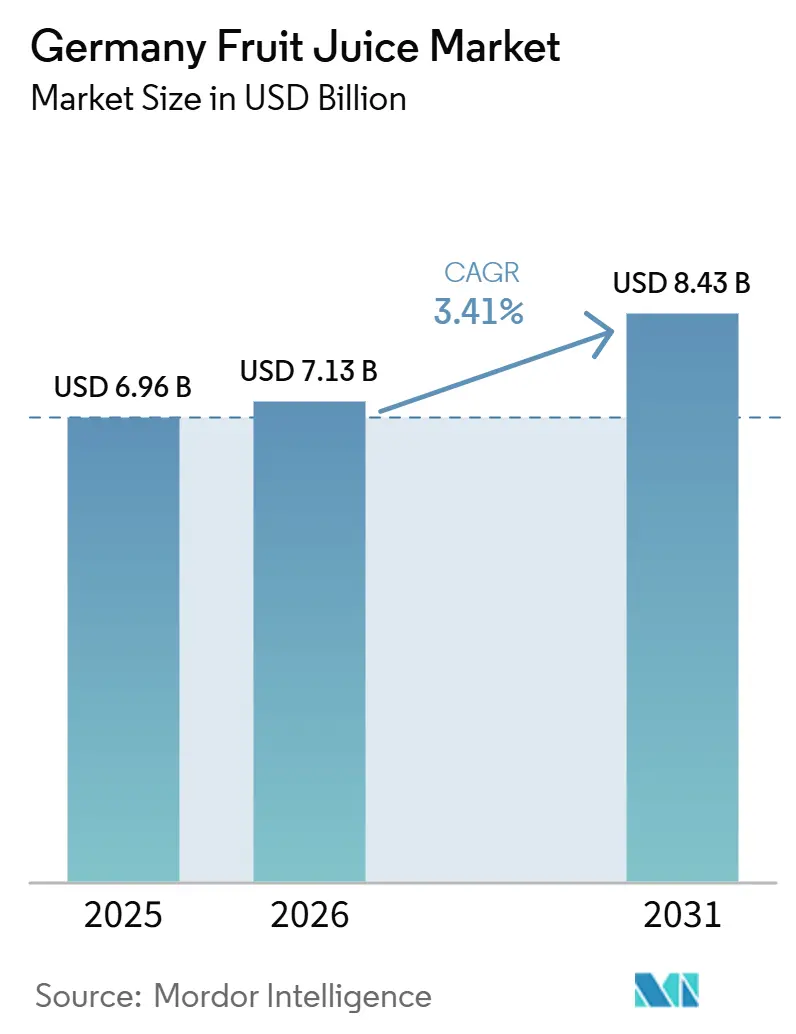
The Germany fruit juice market was valued at USD 6.96 billion in 2025 and is estimated to reach USD 7.13 billion in 2026, anticipated to grow to USD 8.43 billion by 2031, registering a CAGR of 3.41% during the forecast period. The market is driven by growing consumer preference for health-oriented beverages, rising demand for clean-label and natural ingredients, increasing popularity of functional fruit juices, and strong demand for convenient on-the-go beverage formats. Shifting consumer awareness around sugar content and artificial additives has further accelerated the transition toward cold-pressed, not-from-concentrate, and fortified juice variants. Germany's well-established fruit processing industry, robust domestic apple production, advanced manufacturing capabilities, and extensive retail distribution network further support market growth.
Key Report Takeaways
- By product type, 100% Fruit Juice held 52.83% of the Germany fruit juice market share in 2025, while Fruit Nectar is forecast to expand at a 4.76% CAGR through 2031.
- By nature, Conventional fruit juice held 88.31% of the Germany fruit juice market share in 2025, while Organic fruit juice is forecast to grow at a 5.03% CAGR through 2031.
- By packaging material, Tetra Pak cartons accounted for 56.12% of the Germany fruit juice market size in 2025, while PET bottles are forecast to advance at a 4.29% CAGR through 2031.
- By distribution channel, Off-Trade held 73.45% of the Germany fruit juice market size in 2025, while On-Trade is forecast to grow at a 4.34% CAGR through 2031.
Note: Market size and forecast figures in this report are generated using Mordor Intelligence’s proprietary estimation framework, updated with the latest available data and insights as of January 2026.
Germany Fruit Juice Market Trends and Insights
Drivers Impact Analysis*
| Driver | (~) % Impact on CAGR Forecast | Geographic Relevance | Impact Timeline |
|---|---|---|---|
| Growing consumer preference for health-oriented beverages | +0.7% | Germany-wide; stronger uptake in urban centers (Berlin, Munich, Hamburg) | Medium term (2-4 years) |
| Strong demand for clean-label and natural ingredients | +0.5% | Germany-wide; disproportionate in organic trade and specialty retail | Long term (≥ 4 years) |
| Demand for convenient, on-the-go juice options | +0.5% | Urban cores and transport hubs; spill-over to suburban retail formats | Short term (≤ 2 years) |
| Growing popularity of functional fruit juices | +0.6% | Germany-wide; accelerating in fitness and wellness retail | Medium term (2-4 years) |
| Continuous product innovation with reduced-sugar formulations | +0.4% | Germany-wide; Europe-wide regulatory framework amplifies reach | Long term (≥ 4 years) |
| Increasing preference for locally sourced and regional fruits | +0.3% | Bavaria, Baden-Württemberg, Lower Saxony (apple-growing regions) | Long term (≥ 4 years) |
| Source: Mordor Intelligence | |||
Growing consumer preference for health-oriented beverages
Growing consumer preference for health-oriented beverages is a major driver of the Germany fruit juice market, as consumers increasingly seek products that align with healthier lifestyles and clean-label preferences. Health-oriented consumption has evolved from a consumer trend into established purchasing behavior, influencing product innovation and portfolio diversification across the juice category. According to the United States Department of Agriculture (USDA) Food Processing Ingredients Annual (Germany, 2025), a growing share of German consumers considers food and beverage purchases an expression of personal health and lifestyle values, with increasing demand for products that are non-GMO, vegan, natural, and functionally positioned [1]Source: United States Department of Agriculture (USDA), "Food Processing Ingredients Annual", usda.gov. This shift is encouraging manufacturers to expand their offerings of 100% fruit juices, organic variants, not-from-concentrate (NFC) juices, and products fortified with vitamins, minerals, and botanical ingredients.
Strong demand for clean-label and natural ingredients
Strong demand for clean-label and natural ingredients is driving growth in the Germany fruit juice market, as consumers increasingly prefer beverages made with recognizable ingredients, free from artificial additives, preservatives, and synthetic flavors. This shift is encouraging manufacturers to emphasize natural formulations, shorter ingredient lists, and organically certified fruit juices, while expanding product portfolios that align with clean-label expectations. According to the German Federal Ministry of Food and Agriculture (BMEL), 7,252 companies were producing or marketing products carrying the organic label in Germany as of 2025, reflecting the country's well-established organic food ecosystem. The expanding availability of certified organic products and growing manufacturer participation have strengthened consumer confidence in natural beverages, encouraging greater adoption of organic and minimally processed fruit juices.
Demand for convenient, on-the-go juice options
Demand for convenient, on-the-go juice options is driving growth in the Germany fruit juice market as increasingly busy lifestyles encourage consumers to choose portable, resealable beverages suitable for consumption outside the home. Rising demand for single-serve packs, PET bottles, and compact carton formats is prompting manufacturers to introduce packaging innovations that maintain product quality and shelf life. The expansion of convenience stores, travel retail, vending machines, cafés, and quick-service food outlets has further improved the accessibility of ready-to-drink fruit juices across commuting, workplace, and leisure occasions. Additionally, the growing popularity of grab-and-go meal solutions and healthy snack pairings has increased fruit juice consumption as a convenient refreshment option.
Growing popularity of functional fruit juices
The growing popularity of functional fruit juices reflects consumers' increasing preference for beverages that provide health benefits beyond basic nutrition. Manufacturers are expanding their portfolios with juices fortified with vitamins, minerals, probiotics, antioxidants, plant extracts, and immunity-supporting ingredients to address rising demand for wellness-focused products. Functional positioning is gaining traction particularly in categories targeting immune health, digestive wellness, energy, hydration, and overall well-being. Additionally, the incorporation of superfruits, botanical extracts, and naturally occurring bioactive compounds is enabling companies to differentiate their offerings while meeting consumer demand for healthier beverage alternatives. As innovation in fortified and value-added fruit juice products continues to grow, functional fruit juices are becoming an important premium segment.
Restraints Impact Analysis*
| Restraint | (~) % Impact on CAGR Forecast | Geographic Relevance | Impact Timeline |
|---|---|---|---|
| Growing consumer concerns over natural sugar content | -0.5% | Germany-wide; amplified by NRI compliance factors and health messaging from BMEL | Short term (≤ 2 years) |
| Increasing competition from alternative healthy beverages | -0.4% | Urban centers; national via discounter shelf expansion of kombucha, plant-based drinks | Medium term (2-4 years) |
| Stringent food labeling and nutrition regulations | -0.2% | Applied uniformly across Germany; regulatory influence spans labeling and claims | Long term (≥ 4 years) |
| Volatility in fruit harvests due to climate change | -0.3% | Germany-wide; concentrated exposure in orange and tropical fruit supply | Short term (≤ 2 years) |
| Source: Mordor Intelligence | |||
Growing consumer concerns over natural sugar content
Growing consumer concerns over the natural sugar content of fruit juices are restraining the Germany fruit juice market, as increasing awareness of sugar intake influences beverage purchasing decisions. Although 100% fruit juices contain no added sugar, they naturally contain free sugars, prompting many health-conscious consumers to moderate their consumption. The German Nutrition Society recommends limiting free sugar intake to less than 10% of total daily energy intake, in line with World Health Organization (WHO) guidance, with free sugars including those naturally present in fruit juices. As a result, consumers are increasingly opting for lower-sugar alternatives such as diluted juice spritzers, flavored water, and unsweetened drinks, reducing overall fruit juice consumption and putting downward pressure on market growth.
Increasing competition from alternative healthy beverages
Increasing competition from alternative healthy beverages is restraining the Germany fruit juice market as consumers diversify their beverage choices beyond traditional fruit juices. Growing demand for products such as flavored and infused water, kombucha, ready-to-drink teas, functional beverages, plant-based drinks, coconut water, and probiotic beverages has intensified competition within the non-alcoholic beverage market. These alternatives are often perceived as offering lower sugar content, hydration benefits, digestive support, or added functional ingredients, making them attractive to health-conscious consumers. Continuous product innovation, premium positioning, and expanding retail availability of these beverages have further strengthened their market presence.
*Our forecasts treat driver/restraint impacts as directional, not additive. The impact forecasts reflect baseline growth, mix effects, and variable interactions.
Segment Analysis
By Product Type: Nectar Gains Traction as 100% Juice Faces Volume Pressure
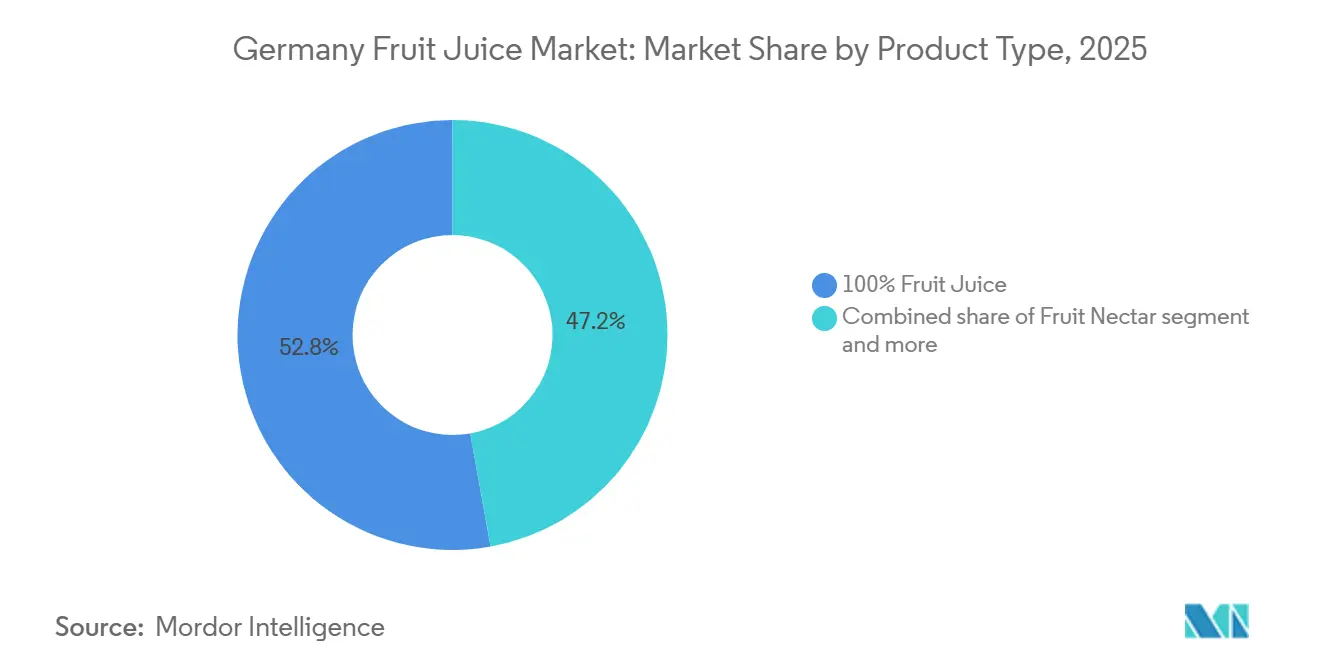
100% Fruit Juice accounted for 52.83% of the Germany fruit juice market by product type in 2025, reflecting its well-established position in the beverage industry and the maturity of its production ecosystem. The segment is supported by efficient fruit sourcing, advanced juice extraction and preservation technologies, and an integrated processing infrastructure that ensures consistent product quality and year-round availability. Standardized manufacturing practices enable producers to maintain uniform taste, color, and nutritional characteristics across production batches, strengthening consumer confidence and encouraging repeat purchases. The widespread availability of diverse fruit varieties, multiple pack sizes, and extensive retail shelf presence further enhances product accessibility and purchasing convenience.
Fruit Nectar is projected to expand at a CAGR of 4.76% during 2026–2031, making it the fastest-growing product type in the Germany fruit juice market. The segment benefits from its formulation flexibility, which enables the use of fruits with naturally high pulp content, tartness, or lower juice yield while maintaining a smooth and consistent sensory profile. This allows manufacturers to introduce a broader range of fruit varieties and seasonal flavor combinations that would be difficult to commercialize as pure juice. Fruit nectar also offers greater scope for product innovation through texture variation, fruit blend diversification, and balanced flavor development, supporting continuous portfolio expansion. The increasing availability of premium and exotic fruit-based nectar products has further strengthened consumer interest. Additionally, the 0.5-liter increase in per capita nectar consumption recorded in 2024, according to the German Fruit Juice Industry Association (VdF), reflects the segment's growing acceptance and reinforces its growth trajectory over the forecast period [2]Source: German Fruit Juice Industry Association (VdF), "2025 Pressing Season", fruchtsaft.de.



By Nature: Conventional Maintains Scale While Organic Builds Critical Mass
Conventional fruit juice accounted for 88.31% of the Germany fruit juice market by nature in 2025, supported by its well-established production ecosystem and broad raw material availability, which enable stable, large-scale manufacturing throughout the year. The segment benefits from mature procurement networks, optimized processing efficiencies, and standardized quality control systems that ensure consistent product characteristics across production batches. Its ability to accommodate a wide range of fruit varieties and maintain reliable supply volumes allows manufacturers to optimize production costs and improve inventory management. Additionally, extensive retail penetration, diversified packaging formats, and long-standing consumer purchasing patterns have reinforced high product turnover and continuous shelf availability, enabling conventional fruit juice to maintain its dominant position in the market.
Organic fruit juice is projected to register the fastest CAGR of 5.03% during 2026–2031 in the Germany fruit juice market by nature. The segment is gaining momentum as the organic food ecosystem continues to expand, strengthening the availability of certified organic ingredients and encouraging greater investment across the organic value chain. According to the German Federation of Organic Food Producers (BÖLW), Germany's organic food and beverages market grew from EUR 16.99 billion in 2024 to EUR 18.23 billion in 2025, reflecting robust growth in certified organic food purchasing [3]Source: German Federation of Organic Food Producers (BÖLW), "Revenue from organic food in Germany", boelw.de. This expanding organic marketplace has improved retail shelf allocation for certified beverages, accelerated the introduction of new organic fruit juice offerings, and enhanced the efficiency of certified sourcing and processing networks.
By Packaging Material: Aseptic Cartons Lead as PET Advances on Convenience Demand
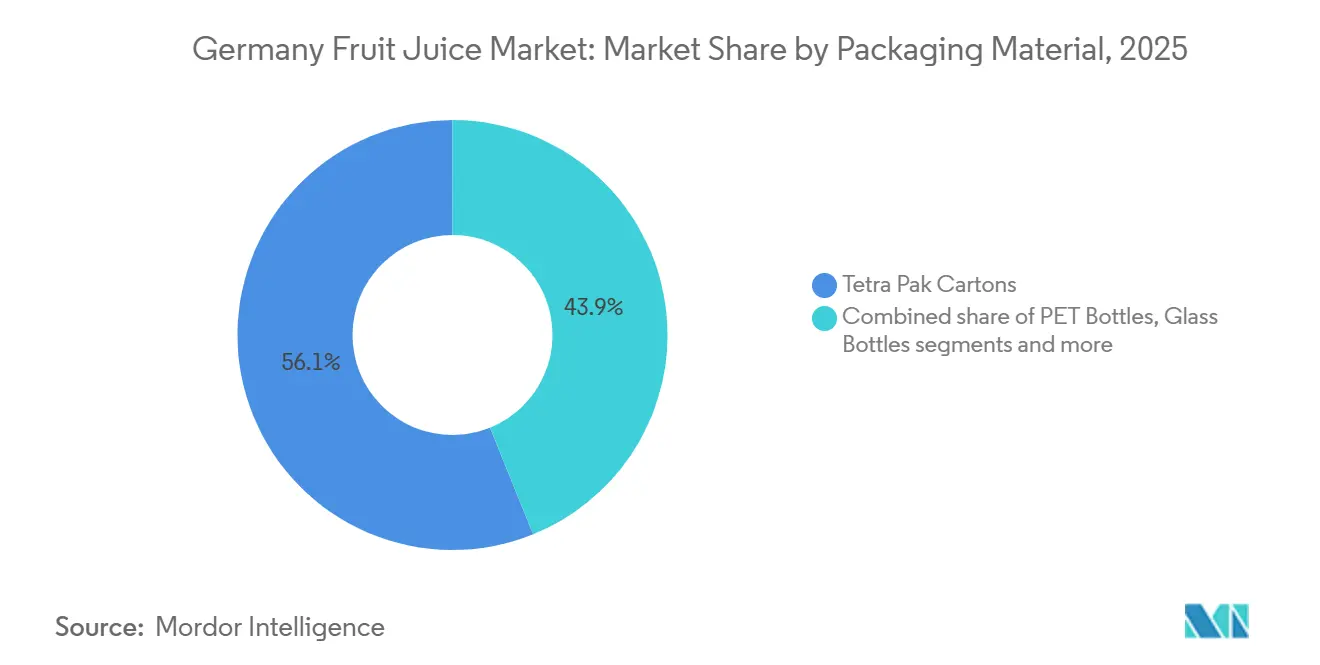
Tetra Pak cartons accounted for 56.12% of the Germany fruit juice market by packaging material in 2025, supported by their widespread adoption across the country's highly developed aseptic beverage packaging industry. Germany's position as Europe's largest aseptic beverage packaging market has driven extensive investments in filling infrastructure, high-speed processing lines, and carton recycling systems, making Tetra Pak cartons the preferred packaging format for large-scale juice production. Their ability to provide extended shelf life without refrigeration before opening, while protecting products from light, oxygen, and microbial contamination, helps preserve product quality throughout distribution.
PET bottles are projected to register the fastest CAGR of 4.29% during 2026–2031 in the Germany fruit juice market by packaging material. The segment is benefiting from continuous advancements in lightweight bottle manufacturing, improved barrier technologies, and higher recycled PET (rPET) incorporation, enabling manufacturers to enhance packaging performance while reducing material usage. PET bottles also offer greater design flexibility, resealability, and durability, making them well suited for on-the-go consumption and transportation. Their compatibility with chilled distribution networks and automated high-speed bottling lines has encouraged broader adoption across retail formats.
By Distribution Channel: Off-Trade Anchors Volume as On-Trade Captures Premium Growth
Off-trade channels accounted for 73.45% of the Germany fruit juice market by distribution channel in 2025, driven by extensive retail infrastructure and strong integration with consumers' routine grocery purchasing habits. The segment benefits from widespread availability across supermarkets, hypermarkets, discount stores, convenience outlets, and online grocery platforms, ensuring broad product accessibility across the country. Established retail networks provide manufacturers with high product visibility, efficient inventory replenishment, and year-round shelf presence, while centralized procurement and sophisticated distribution systems support consistent product availability across multiple package sizes and price points.
On-trade distribution is projected to register the fastest CAGR of 4.34% during 2026–2031 in the Germany fruit juice market. The channel is benefiting from the continued expansion of cafés, restaurants, hotels, bakeries, juice bars, and foodservice establishments that are increasingly incorporating fruit juice into their beverage portfolios. Growth is further supported by rising demand for freshly served beverages, breakfast menus, brunch offerings, and premium non-alcoholic drink options within hospitality venues. The increasing adoption of fruit juice as a base for mocktails, smoothies, and specialty beverages has also broadened menu offerings and encouraged higher consumption through foodservice outlets.
Geography Analysis
Southern Germany represents the largest regional market for fruit juice, supported by its strong agricultural base, advanced beverage manufacturing infrastructure, and high concentration of premium consumers. Bavaria and Baden-Württemberg are among Germany's leading apple-growing regions, providing a reliable domestic raw material base for juice processors. According to the German Fruit Juice Industry Association (VdF), Germany produced approximately 216.5 million liters of apple juice in 2025, reinforcing the importance of domestic fruit cultivation to the country's juice industry. The region also hosts several major beverage manufacturers and processing facilities, enabling efficient sourcing, production, and distribution across Germany.
Western Germany is characterized by its mature retail landscape and dense population, making it a key consumption hub for fruit juice. North Rhine-Westphalia, Hesse, and Rhineland-Palatinate benefit from extensive supermarket, discount retail, and foodservice networks that ensure broad product availability. Major metropolitan areas such as Frankfurt and Cologne exhibit strong demand for premium, functional, and organic fruit juices, supported by affluent consumers, a well-developed hospitality sector, and widespread availability of value-added beverage offerings. The region's central logistics infrastructure further facilitates nationwide distribution and supports high product turnover.
Northern and Eastern Germany are emerging as important growth regions, supported by expanding organized retail, improving distribution infrastructure, and evolving consumer preferences. Lower Saxony, one of Germany's key apple-producing states, strengthens domestic fruit supply, while major urban centers including Berlin, Hamburg, and Leipzig are witnessing increasing adoption of organic, cold-pressed, not-from-concentrate (NFC), and functional fruit juices. Berlin, in particular, has become a focal point for premium beverage innovation due to its concentration of health-conscious consumers, specialty retailers, cafés, and juice bars. Continued investments in modern retail formats and foodservice expansion are expected to further strengthen fruit juice consumption across Northern and Eastern Germany.
Competitive Landscape
The Germany fruit juice market is moderately concentrated, with competition among established international beverage companies, domestic juice manufacturers, regional producers, and private-label suppliers. Companies such as Eckes-Granini Group GmbH, PepsiCo, Inc., riha WeserGold Getränke GmbH & Co. KG, Valensina GmbH, and The Coca-Cola Company hold significant market positions through broad product portfolios, established distribution networks, and strong relationships with modern retail chains. Regional manufacturers also maintain a notable presence by leveraging local fruit sourcing, regional brand recognition, and proximity to key fruit-growing areas.
Competition is increasingly shifting beyond price toward product differentiation and premiumization. Manufacturers are expanding portfolios with 100% fruit juices, not-from-concentrate (NFC) juices, organic, cold-pressed, functional, and vitamin-fortified beverages to meet evolving consumer preferences for healthier and clean-label products. Organic and functional beverage specialists have emerged as active competitive disruptors by focusing on certified organic ingredients, plant-based nutrition, immunity-support formulations, reduced-sugar recipes, and sustainable sourcing practices. The growth of private-label offerings from major German retailers has also intensified competition by providing high-quality juice products at competitive price points.
Technological innovation has become a key competitive strategy across the market. Companies are investing in advanced aseptic processing, high-pressure processing (HPP), AI-enabled quality control systems, automated bottling lines, and lightweight sustainable packaging solutions to enhance product quality, extend shelf life, and improve manufacturing efficiency. In parallel, manufacturers are increasing the use of recycled PET (rPET), recyclable Tetra Pak cartons, digital traceability systems, and smart production technologies to strengthen sustainability credentials while optimizing operational performance.
Germany Fruit Juice Industry Leaders
-
Eckes-Granini Group GmbH
-
PepsiCo, Inc.
-
riha WeserGold Getränke GmbH & Co. KG
-
Valensina GmbH
-
The Coca-Cola Company
- *Disclaimer: Major Players sorted in no particular order

Recent Industry Developments
- October 2025: Niehoffs Vaihinger Fruchtsaft GmbH has launched "Youce by Vaihinger," a beverage that blends tropical fruit flavors with oat notes. The product is offered in a 750ml carton format.
- January 2025: Coca-Cola Europacific Partners (CCEP) plans to invest around EUR 150 million into its operations in Germany. Most of the funding will be directed toward the group's facility in Halle, eastern Germany.


Germany Fruit Juice Market Report Scope
Fruit juice is the liquid naturally contained in fruit, obtained by extraction or pressing. The Germany fruit juice market is segmented by product type, nature, packaging material, and distribution channel. Based on product type, the market is segmented into 100% fruit juice, fruit nectar, and juice drinks. Based on nature, the market is segmented into conventional and organic. Based on packaging material, the market is segmented into Tetra Pak cartons, PET bottles, glass bottles, pouches, and others. Based on distribution channel, the market is segmented into on-trade and off-trade. The off-trade segment is further categorized into supermarkets and hypermarkets, convenience/grocery stores, online retail stores, and other distribution channels. For each segment, the market sizing and forecast have been done based on the value (in USD million).
| 100% Fruit Juice |
| Fruit Nectar |
| Juice Drinks |
| Conventional |
| Organic |
| Tetra Pak Cartons |
| PET Bottles |
| Glass Bottles |
| Pouches |
| Others |
| On-Trade | |
| Off-Trade | Supermarkets and Hypermarkets |
| Convenience/Grocery Stores | |
| Online Retail Stores | |
| Other Distribution Channel |
| By Product Type | 100% Fruit Juice | |
| Fruit Nectar | ||
| Juice Drinks | ||
| By Nature | Conventional | |
| Organic | ||
| By Packaging Material | Tetra Pak Cartons | |
| PET Bottles | ||
| Glass Bottles | ||
| Pouches | ||
| Others | ||
| By Distribution Channel | On-Trade | |
| Off-Trade | Supermarkets and Hypermarkets | |
| Convenience/Grocery Stores | ||
| Online Retail Stores | ||
| Other Distribution Channel | ||


Key Questions Answered in the Report
What is the forecast for the Germany fruit juice market through 2031?
The category is forecast to grow from USD 7.13 billion in 2026 to USD 8.43 billion by 2031 at a 3.4% CAGR.
Which product type is growing fastest in Germany?
Fruit Nectar is forecast to grow at a 4.76% CAGR through 2031, while 100% Fruit Juice held the largest 52.83% share in 2025.
Why are reduced-sugar fruit juice products becoming important?
Consumer concerns over natural sugar and the EU reduced-sugar juice category are increasing the need for products that reduce sugar without sweeteners.
Which packaging format leads fruit juice sales in Germany?
Tetra Pak cartons accounted for 56.12% of sales in 2025, supported by ambient shelf life and established filling infrastructure.
Page last updated on:





