
Germany DIN Rail-Mounted Signal Processing Solutions Market Size and Share
Market Overview
| Study Period | 2021 - 2032 |
|---|---|
| Forecast Data Period | 2027 - 2032 |
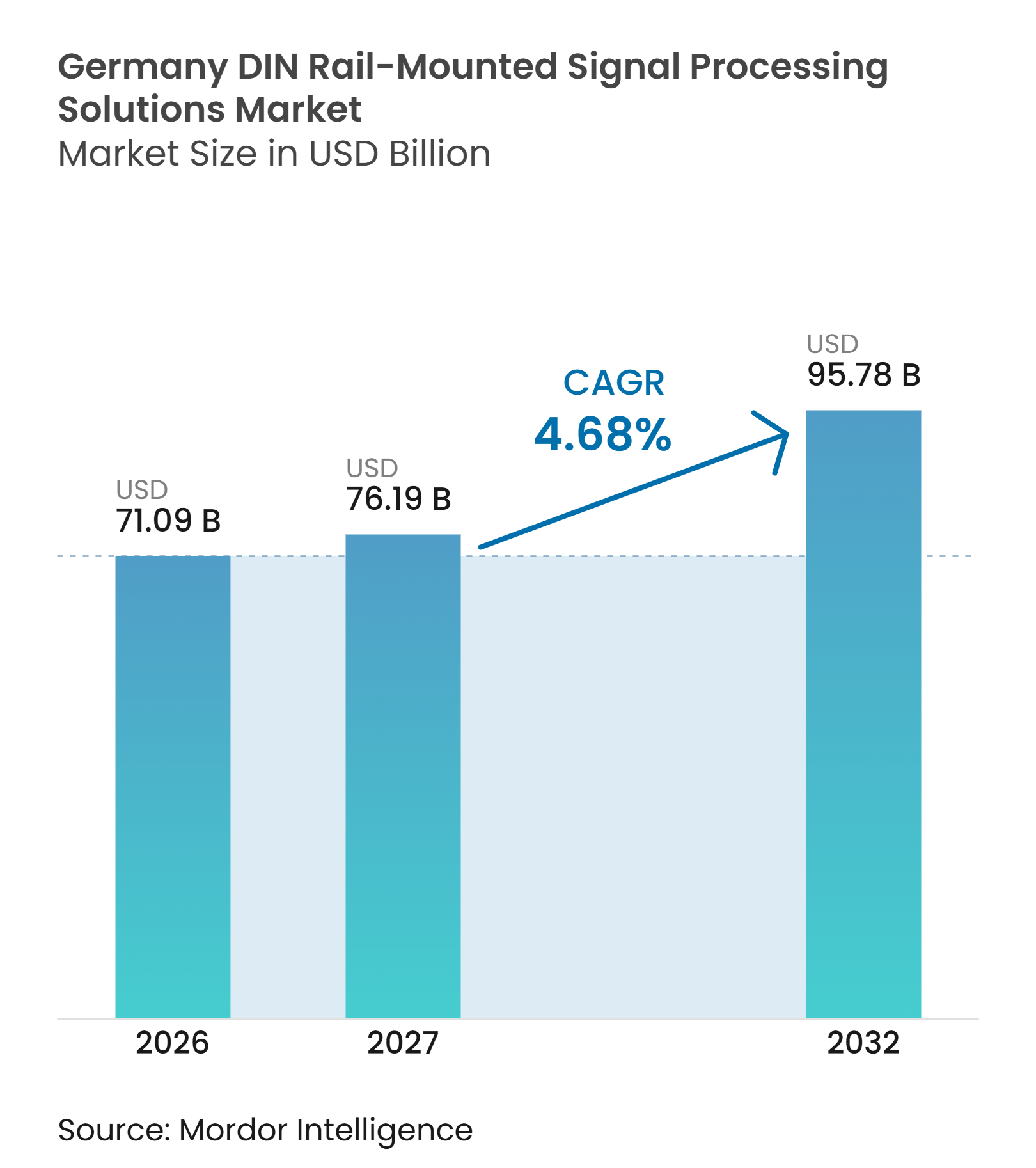
| Base Year Market Size (2026) | USD 71.09 Billion |
| Market Size (2027) | USD 76.19 Billion |
| Market Size (2032) | USD 95.78 Billion |
| Growth Rate (2027 - 2032) | 4.68 % |
| Market Concentration | Medium |
Major Players *Disclaimer: Major Players sorted in no particular order Image © Mordor Intelligence. Reuse requires attribution under CC BY 4.0. | |
Germany DIN Rail-Mounted Signal Processing Solutions Market Analysis by Mordor Intelligence
The Germany DIN rail-mounted signal processing solutions market size is USD 71.09 billion in 2026 and is projected to reach USD 95.78 billion by 2032, expanding at a CAGR of 4.68% during 2027-2032. Demand is supported by Germany’s large process industries, established panel-building base, and investment in digital plant systems. Replacement work in aging control cabinets is likely to remain a dependable source of orders because operators can modernize individual interface layers without rebuilding an entire facility. Grid upgrades and renewable power projects are broadening demand beyond traditional chemical plants and into substations, battery systems, and related control cabinets. Competition remains strong because German suppliers offer a wide range of standard, safety-certified, and hazardous-area products. Integrated remote I/O platforms may limit demand for stand-alone devices in new plants, while long capital spending cycles can delay purchasing decisions.
Key Report Takeaways
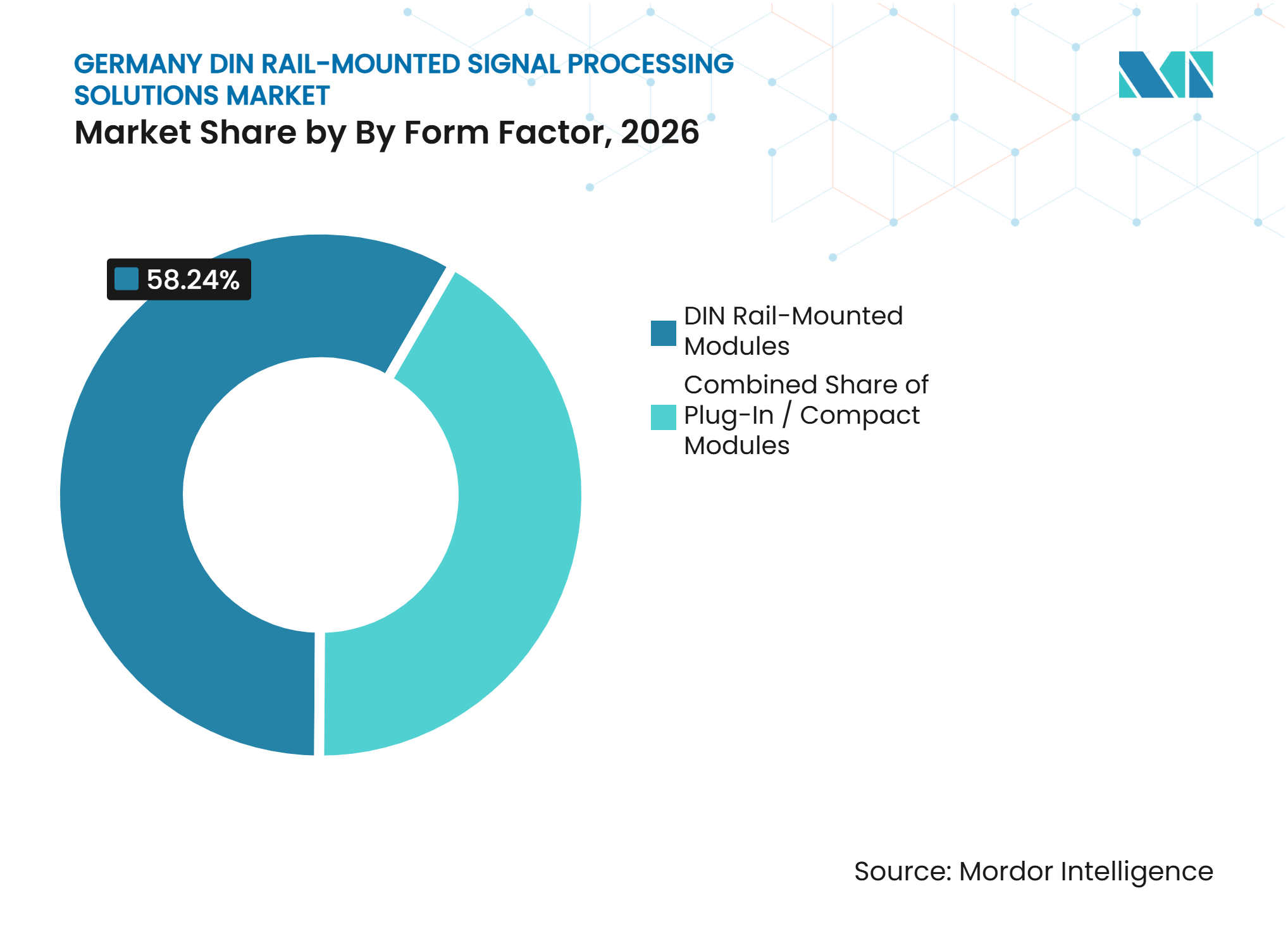
- By form factor, DIN rail-mounted modules held 58.24% of the Germany DIN rail-mounted signal processing solutions market share in 2026, while plug-in and compact modules are projected to expand at a 5.48% CAGR through 2032.
- By signal and input type, process voltage and current inputs held 35.22% of the 2026 market, while temperature inputs are projected to expand at a 4.82% CAGR through 2032.
- By output signal, analog current output held 41.46% of the 2026 market, while HART-transparent and networked output is projected to expand at a 5.14% CAGR through 2032.
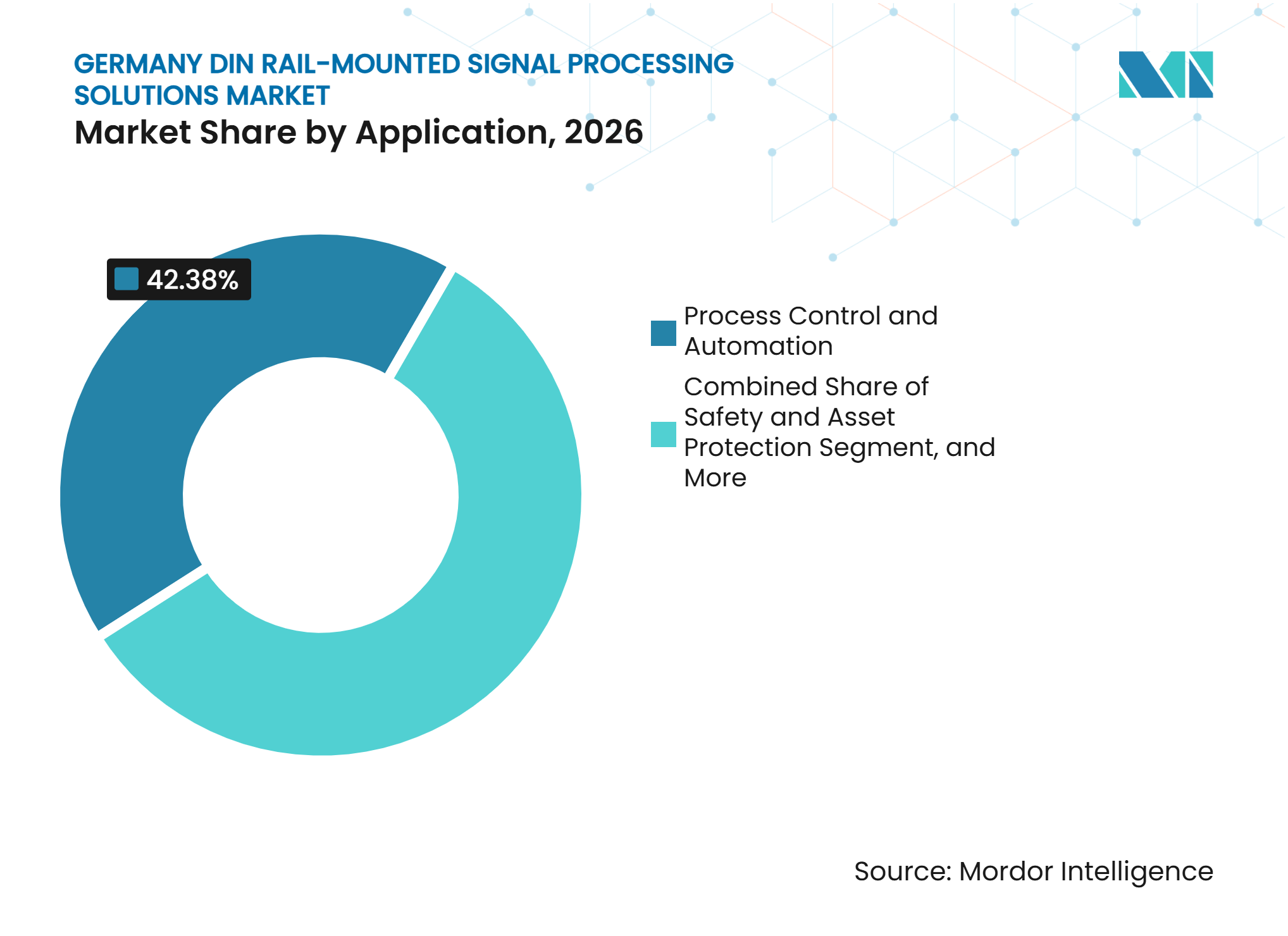
- By application, process control and automation held 42.38% of the 2026 market in Germany DIN rail-mounted signal processing solutions, while condition monitoring and predictive maintenance is projected to expand at a 4.97% CAGR through 2032.
- By end-user industry, chemical and petrochemical held 21.47% of the 2026 Germany DIN rail-mounted signal processing solutions market, while power generation and utilities, including renewable energy, is projected to expand at a 5.18% CAGR through 2032.
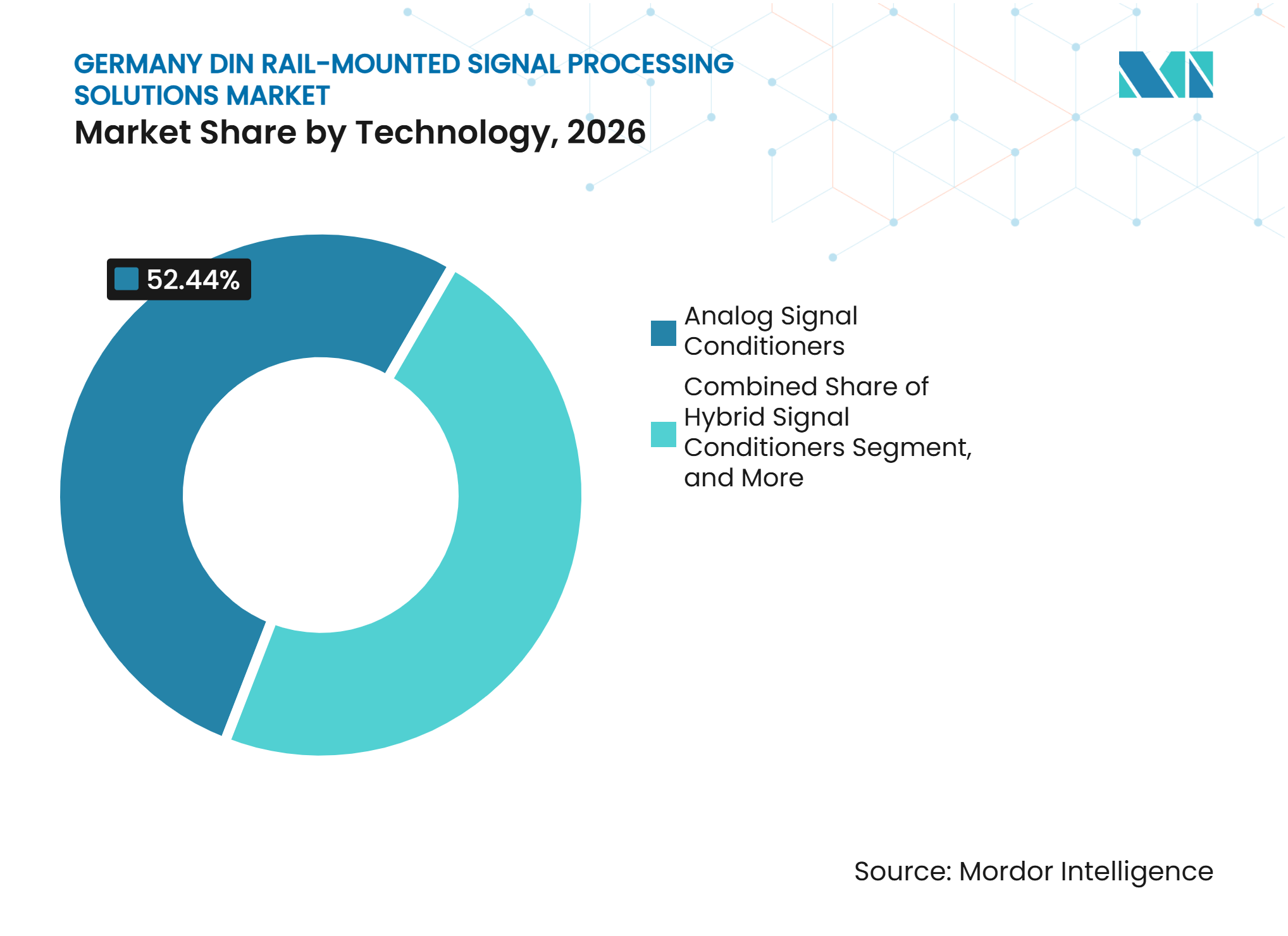
- By technology, analog signal conditioners held 52.44% of the 2026 market, while edge-connected and IIoT-enabled signal conditioners are projected to expand at a 5.27% CAGR through 2032.
- By safety and certification, general-purpose modules held 58.71% of the 2026 market, while SIL-rated and functional-safety modules are projected to expand at a 5.33% CAGR through 2032.
Note: Market numbers in this report are based on Mordor Intelligence's proprietary estimation framework, which combines nine months of actuals with Q4 projections for base year 2026.
Market Trends and Insights
Drivers Impact Analysis of Germany DIN Rail-Mounted Signal Processing Solutions Market*
| Driver | (~) % Impact on CAGR Forecast | Geographic Relevance | Impact Timeline |
|---|---|---|---|
| Industrial Automation, Industry 4.0, and IIoT Adoption | +1.4% | Global, strongest in Bavaria, Baden-Württemberg, and North Rhine-Westphalia industrial corridors | Medium term (2-4 years) |
| Brownfield DCS, PLC, and Control-Cabinet Modernization | +1.1% | Rhine-Ruhr chemical triangle, North Sea energy installations, and Bavaria | Short term (≤ 2 years) |
| Renewable Power, Grid Modernization, and Energy Storage Projects | +0.8% | Northern and eastern Germany, Lower Saxony, and North Rhine-Westphalia grid expansion zones | Medium term (2-4 years) |
| Functional-Safety and Hazardous-Area Compliance Requirements | +0.6% | Chemical, oil and gas, and pharmaceutical clusters nationwide | Medium term (2-4 years) |
| Replacement of Aging 1995-2010 Interface Hardware | +0.4% | National, concentrated in chemical and power generation installations | Short term (≤ 2 years) |
| High-Density Signal Processing for Battery and Semiconductor Plants | +0.3% | Lower Saxony, Saxony, Bavaria, and North Rhine-Westphalia | Long term (≥ 4 years) |
| Source: Mordor Intelligence | |||
Industrial Automation, Industry 4.0, and IIoT Adoption
Germany’s industrial digitalization spending is strengthening the need for dependable links between sensors, control cabinets, and supervisory systems. The eco Association expected industrial IoT sales in Germany to reach EUR 50 billion in 2025, indicating a substantial investment base for connected industrial equipment.[1] Each added sensing point can require isolation, conversion, or signal routing before data reaches a controller or analytics platform, particularly where the project combines older instrumentation with newer asset-management software. This change favors configurable products that can support both legacy analog signals and newer digital communications without requiring operators to redesign every cabinet connection. Pepperl+Fuchs announced safety I/O modules in November 2025 that combine safe inputs and outputs with IO-Link ports in one fieldbus module, showing how suppliers are combining functions in cabinet hardware. The Germany DIN rail-mounted signal processing solutions market benefits when these projects require higher-value devices with diagnostics, configuration features, clear documentation, and compatibility with the installed control environment, especially where users want to add digital capabilities without interrupting established production processes or replacing every element of a working control system.
Brownfield DCS, PLC, and Control-Cabinet Modernization
Many German process facilities retain control cabinets installed between 1995 and 2010, making staged refurbishment more practical than full plant replacement. Modernization programs commonly update field barriers, isolators, converters, and diagnostic connections as part of a wider DCS or PLC project, while preserving field wiring that would be costly or disruptive to replace. Weidmüller presented expanded automation and IIoT offerings for panel-building and cabinet modernization at SPS 2025, confirming the commercial importance of installed-base projects. The work is especially relevant in the Rhine-Ruhr chemical corridor, North Sea energy facilities, and Bavarian manufacturing sites, where shutdown schedules can determine the timing and scope of purchases. Replacement projects can add channels for new sensors and diagnostic outputs rather than merely replicate older layouts. This pattern supports the Germany DIN rail-mounted signal processing solutions market because individual cabinet upgrades can proceed during scheduled shutdowns and can be organized around specific production, safety, or maintenance requirements, allowing operators to align investment with turnaround plans and avoid the operational risk of broad, simultaneous equipment replacement.
Renewable Power, Grid Modernization, and Energy Storage Projects
Grid infrastructure spending is creating new applications for monitoring and protection hardware in substation and energy-storage cabinets. TenneT Germany invested EUR 10.047 billion, equivalent to USD 10.9 billion, in grid expansion and modernization during 2025, a 46% increase from the preceding year.[2] The European Investment Bank provided EWE AG with a EUR 450 million credit facility, equivalent to USD 486 million, in April 2025 to support more than 2,600 km of underground lines and 1,100 new or upgraded substations in Lower Saxony through 2028.[3] Such projects use monitoring for current, voltage, temperature, and equipment status across distributed assets, and they need equipment that remains dependable in cabinets exposed to demanding operational conditions. The Germany DIN rail-mounted signal processing solutions market gains from these installations because protection and control panels need reliable interface hardware that is suitable for long asset lifecycles. Growing storage deployment also increases the need for temperature and voltage measurement in battery systems, where many sensing points can be concentrated in a limited footprint and where operators need reliable data to manage operating conditions across interconnected equipment.
Functional-Safety and Hazardous-Area Compliance Requirements
Safety requirements continue to shape purchasing decisions in chemical, oil and gas, pharmaceutical, battery, and hydrogen facilities. IEC 61511 and the ATEX Directive 2014/34/EU require validated safety systems and traceable assessments for relevant applications, meaning procurement teams must consider documentation as well as hardware specifications. The DKE Functional Safety Conference in 2025 addressed the forthcoming revisions to IEC 61508 and IEC 61511, including assessor independence and semiconductor classification topics. Phoenix Contact launched its MINI Analog Pro Ex range in June 2025 with SIL 3 certification, a 6.2 mm housing, and an integrated current-loop test function. These compliance factors make certified product portfolios important when operators replace equipment in hazardous zones or expand processes into new areas. The Germany DIN rail-mounted signal processing solutions market therefore has a route to premium demand where standard components do not meet required safety documentation, test records, or approval conditions, particularly when project teams need proven equipment that can be accepted within an existing safety-management process.
Restraints Impact Analysis of Germany DIN Rail-Mounted Signal Processing Solutions Market*
| Restraint | (~) % Impact on CAGR Forecast | Geographic Relevance | Impact Timeline |
|---|---|---|---|
| Integrated Remote I/O and Multifunction I/O Substitution | -0.8% | National, most acute in greenfield semiconductor, battery, and large DCS projects | Medium term (2-4 years) |
| Certification, EMC Testing, and Requalification Costs | -0.5% | National, heightened in ATEX, SIL, and marine approval corridors | Long term (≥ 4 years) |
| Long Industrial Capital-Expenditure Cycles | -0.4% | Chemical and petrochemical clusters with 5-10-year turnaround intervals | Medium term (2-4 years) |
| Protocol Fragmentation and Vendor-Specific Configuration | -0.2% | National, with spillover into cross-border EPC project procurement | Medium term (2-4 years) |
| Source: Mordor Intelligence | |||
Integrated Remote I/O and Multifunction I/O Substitution
Remote I/O and multifunction devices can consolidate acquisition and basic conditioning tasks that once needed separate modules. This is most relevant in greenfield battery, semiconductor, and large DCS projects where cabinet designs start from a clean sheet and engineers can determine the preferred architecture before wiring is installed. Beckhoff’s EtherCAT Box range includes compact analog input modules, demonstrating the continuing expansion of distributed I/O options. Stand-alone conditioners remain important in older chemical and refining facilities because retrofits must fit existing wiring, field instruments, testing procedures, and control architectures. The result is a split pattern in which replacement programs sustain discrete module volumes while new facilities reduce modules per cabinet. This substitution effect can temper the Germany DIN rail-mounted signal processing solutions market in projects where integrated control hardware is technically and commercially suitable, even though it will not eliminate demand in the installed base or in applications that require separate isolation, safety, or hazardous-area functions.
Certification, EMC Testing, and Requalification Costs
Signal conditioners must meet EMC, low-voltage, hazardous-area, and functional-safety requirements when their applications call for those approvals. The EMC Directive 2014/30/EU, Low Voltage Directive 2014/35/EU, and ATEX Directive 2014/34/EU can add testing, technical-file preparation, and documentation work for suppliers. Smaller specialists can face higher certification costs for each unit than broad-portfolio manufacturers, which can limit their ability to refresh low-volume product lines. End users may also need to reapprove revised equipment in safety loops, including new SIL calculations and internal engineering review where necessary. These obligations can extend the use of established, preapproved product families and slow the introduction of alternatives. The restraint affects the Germany DIN rail-mounted signal processing solutions market by lowering replacement frequency in applications where compliance documentation, validated design records, and continuity of approval have high value, because changing a component can require engineering review that outweighs the benefit of a small product improvement.
*Our forecasts treat driver/restraint impacts as directional, not additive. The impact forecasts reflect baseline growth, mix effects, and variable interactions.
Germany DIN Rail-Mounted Signal Processing Solutions Market Segment Analysis
By Form Factor:
DIN Rail Enclosures Lead, Compact Formats AdvanceDIN rail-mounted modules held 58.24% of the Germany DIN rail-mounted signal processing solutions market share in 2026. Their position reflects widespread use of DIN 35 mm rail systems in German process cabinets and the practical need for quick replacement during maintenance. Chemical, water treatment, and power facilities depend on this mounting style because it supports dense layouts and familiar wiring practices. Panel builders also prefer standard rail-mounted products because they simplify design, stocking, and field service. The segment benefits from a large installed base that requires compatible replacements over long operating lives.
Plug-in and compact modules are projected to expand at a 5.48% CAGR through 2032 as control cabinets face tighter space limits. Battery production, semiconductor testing, rail applications, and renewable power installations all place value on narrow housings and flexible wiring. LÜTZE TRANSPORTATION introduced a 6.2 mm multi-range analog converter in September 2026 for rail vehicles, with 1.5 kV(rms) three-way galvanic isolation. Rack, backplane, stand-alone, and panel-mounted equipment retain roles in specialized test systems and legacy data acquisition. Their slower momentum reflects the wider preference for space-efficient cabinet architectures in the Germany DIN rail-mounted signal processing solutions market.



By Signal and Input Type:
Process Current Leads, Temperature Inputs AdvanceProcess voltage and current inputs accounted for 35.22% of the Germany DIN rail-mounted signal processing solutions market size in 2026. The 4-20 mA loop and 0-10 V standards remain common across process industries because of their long-established field transmitter base. Replacing all connected transmitters and I/O cards would require far more capital than replacing a failed or obsolete conditioner. Frequency, pulse, and AC RMS inputs serve energy metering and power-quality applications. Strain gauge, load-cell, LVDT, and RVDT devices remain relevant to precision measurement in test and manufacturing settings.
Temperature inputs are projected to expand at a 4.82% CAGR through 2032. Battery formation and testing depend on close temperature control, while brownfield upgrades are adding temperature transmitters to existing plants. Hazardous electrolyte-handling areas can need intrinsically safe RTD conditioning in ATEX Zone 2 applications. Pepperl+Fuchs expanded its M-LB-2000 portfolio in March 2025 with M-LB-2600 modules for 3-wire transmitters and low-voltage temperature signals. This combination of precision measurement and safety requirements supports higher specification levels for the category.
By Output Signal:
Analog Current Anchors Demand, Networked Outputs Gain GroundAnalog current output held 41.46% of the 2026 market. The 4-20 mA convention continues to link field equipment with DCS analog input cards in chemical and energy installations. Operators often retain working analog infrastructure because replacement can disrupt production and require wider system validation. Analog voltage outputs support certain machinery and test applications. Digital, pulse, frequency, relay, and alarm outputs serve motor control, power metering, and older annunciator systems.
HART-transparent and networked output is projected to expand at a 5.14% CAGR through 2032. These devices can preserve digital diagnostics from HART-enabled transmitters when a legacy control system does not directly support the protocol. This approach can extend the usefulness of existing DCS equipment while giving maintenance teams improved field information. R. STAHL reported successful field tests for its Ethernet-APL field switches in July 2025, supporting hazardous-area deployment in Zone 1 and Zone 2 applications. Networked products are therefore becoming relevant in the Germany DIN rail-mounted signal processing solutions market where operators want greater visibility without a full control-system replacement.
By Application:
Process Control Anchors Demand, Predictive Monitoring RisesProcess control and automation accounted for 42.38% of the 2026 market. Signal conditioning remains central to feedback loops that connect field instruments with controllers in German process facilities. DCS migrations commonly require an assessment of the interface layer between sensors and analog I/O cards. This work can involve direct replacement, revised specifications, or extra channels for diagnostics. Data acquisition and test measurement continue to serve laboratory, quality, machinery, and automotive applications.
Condition monitoring and predictive maintenance is projected to expand at a 4.97% CAGR through 2032. Operators are adding vibration, temperature, and current monitoring points on rotating equipment and process assets. The added channels support maintenance platforms that assess equipment condition using operating data. Monitoring is moving beyond primary equipment to include pumps, fans, and heat exchangers. Energy and power-quality monitoring also has a role as facilities track consumption by process area. Safety and asset-protection applications continue to rely on certified hardware in critical loops.

By End-User Industry:
Chemical Sector Leads, Utility Projects Reshape DemandChemical and petrochemical accounted for 21.47% of the 2026 market. Germany’s fine chemicals, specialty chemicals, and polymer facilities create a large installed base across the Rhine-Ruhr region and Saxony-Anhalt. ATEX Zone 1 and Zone 2 designations in many plant areas support demand for intrinsically safe and explosion-protected devices. Oil and gas applications include storage and refinery infrastructure. Water and wastewater facilities also require replacements as municipal systems age and drinking-water requirements evolve.
Power generation and utilities, including renewable energy, is projected to expand at a 5.18% CAGR through 2032. Grid expansion, wind control systems, battery storage, and substation automation create new positions for current, voltage, and temperature signals. TenneT’s 2025 grid investment illustrates the scale of the infrastructure pipeline supporting this end-user group. The Germany DIN rail-mounted signal processing solutions industry also serves food and beverage, metals, mining, and other manufacturers through their regular capital spending cycles. Their requirements are generally steadier than those of fast-changing energy projects.
By Technology:
Analog Conditioning Holds Share, IIoT-Enabled Formats ExpandAnalog signal conditioners held 52.44% of the 2026 market. They remain cost-effective when an application only needs isolation, scaling, or conversion before an analog I/O connection. Existing process plants often still use analog cards as the final destination for conditioned signals. Digital and hybrid products add configuration, diagnostics, and protocol support where users value those functions. The pace of DCS migration will influence how quickly facilities move from pure analog to more connected equipment.
Edge-connected and IIoT-enabled signal conditioners are projected to expand at a 5.27% CAGR through 2032. Their purpose is to make process variables available to edge analytics systems with less dependence on a central DCS path. Beckhoff highlighted measurement chains from sensor connection to cloud integration at SENSOR+TEST 2026. Products that combine sensing interfaces, software configuration, and data publishing can meet these newer requirements. The Germany DIN rail-mounted signal processing solutions industry is therefore shifting toward devices that perform both conversion and data-handling roles.
By Safety and Certification:
General-Purpose Modules Dominate, Functional Safety ExpandsGeneral-purpose modules held 58.71% of the 2026 market. Standard process control, data acquisition, and machine-monitoring applications account for much of this volume. Buyers often compare these products by price per channel, channel density, configuration effort, and established supplier relationships. Intrinsically safe and hazardous-area products maintain a stable place in chemical and refining operations. The balance between standard and certified equipment reflects the varied risk profiles of German industrial sites.
SIL-rated and functional-safety modules are projected to expand at a 5.33% CAGR through 2032. Safety instrumented systems are extending into battery production, hydrogen infrastructure, and pharmaceutical fill-and-finish lines. DKE’s 2025 conference on functional safety discussed the forthcoming changes to IEC 61508 and IEC 61511. These changes may make established, certified portfolios more important when customers evaluate replacements. Marine- and transportation-approved modules continue to serve rail and shipbuilding applications. The Germany DIN rail-mounted signal processing solutions market has a clear opportunity in applications where documented safety performance is essential.
Geography Analysis
Bavaria and Baden-Württemberg
Bavaria and Baden-Württemberg form a technology-intensive manufacturing belt with automotive, machinery, semiconductor, and specialty equipment operations. These industries support steady demand for strain-gauge, LVDT, and high-accuracy RTD conditioning in test benches and production equipment. Panel builders in the region also specify compact and configurable products for advanced manufacturing projects. The Germany DIN rail-mounted signal processing solutions market size is supported by this concentration of precision applications, even when project spending differs by customer. IEC 61326-1 provides a relevant electromagnetic-compatibility framework for measurement and control equipment used in these settings.
North Rhine-Westphalia
North Rhine-Westphalia has a dense chemical, petrochemical, refining, and specialty-gas base, making it a major location for ATEX-certified and SIL-rated devices. The Rhine-Ruhr cluster includes many facilities built in the 1990s and 2000s that are approaching refurbishment cycles. This installed base supports cabinet modernization because new systems must often work with existing wiring and field instruments. Fraunhofer FFB began the second construction phase of its battery cell production research facility in Münster in October 2025 and targets operation in 2028. This addition points to a longer-term need for precise sensing and control hardware in battery manufacturing development.
Northern and Eastern Germany
Northern and eastern Germany are gaining importance through grid, renewable energy, battery, semiconductor, and maritime activity. The EIB-backed EWE program in Lower Saxony covers underground lines and substation upgrades through 2028, creating a clear procurement pipeline for automation and monitoring hardware. Saxony contributes advanced semiconductor activity, while Hamburg supports maritime automation and Thuringia has specialized manufacturing. ATEX compliance remains relevant where energy storage, chemicals, or combustible materials create hazardous-area conditions.
Competitive Landscape
Market Concentration
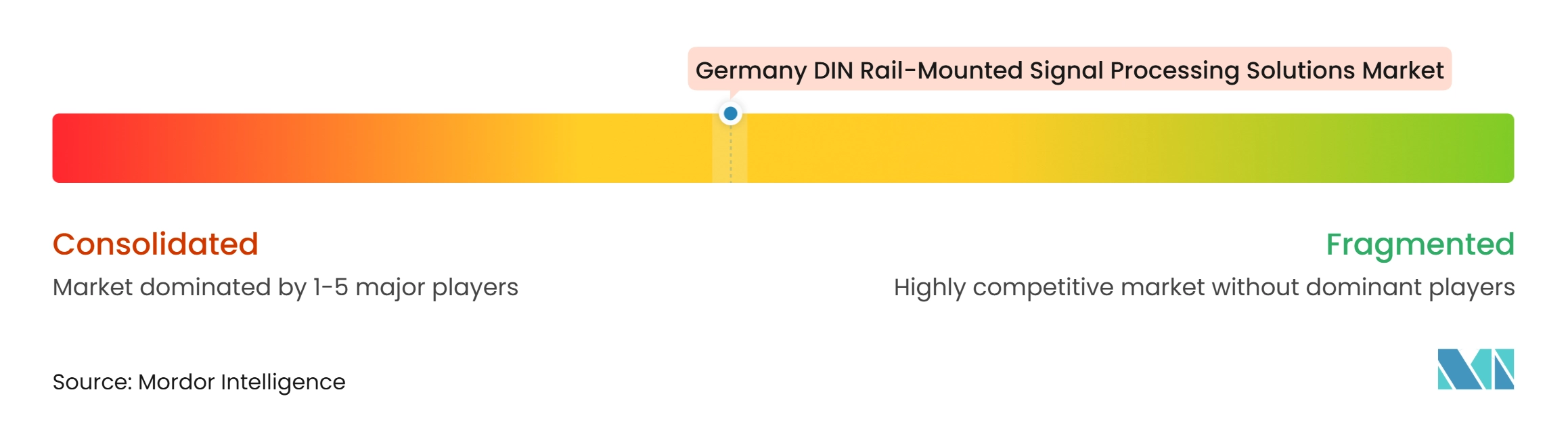
The Germany DIN rail-mounted signal processing solutions market is moderately concentrated around domestic specialists including Phoenix Contact, Weidmüller, Pepperl+Fuchs, Turck, Knick, and R. STAHL. Siemens, ABB, Rockwell Automation, and Schneider Electric also compete through their wider DCS and PLC ecosystems. German suppliers benefit from proximity to panel builders and their familiarity with national process-industry requirements. This advantage matters when specifications are set during cabinet design rather than after products have been selected. Buyers nevertheless have several qualified choices across general-purpose, hazardous-area, and functional-safety categories.
Suppliers are responding to digitalization by combining safety, communication, and configuration capabilities in fewer devices. Pepperl+Fuchs’ 2025 safety I/O module launch combined safe signals with IO-Link connectivity, reducing the need for separate hardware in relevant designs. Phoenix Contact’s MINI Analog Pro Ex launch added SIL 3-certified intrinsically safe products in a compact housing. Weidmüller and Power Plus Communications introduced the EEBUS Relay Converter in February 2026 to connect digital EEBUS control signals with analog relay equipment. These moves show that compliance and connectivity are becoming central product-development priorities.
Specialists such as Knick and PR electronics can compete in high-accuracy and low-drift applications where technical performance affects selection. Pure-play conditioner suppliers also face pressure from integrated remote I/O suppliers, particularly in new battery and semiconductor facilities. Functional-safety requirements favor suppliers that already hold recognized certifications and can provide established documentation. No combined share for leading companies was provided, so concentration can only be described qualitatively rather than quantified by vendor share.
Germany DIN Rail-Mounted Signal Processing Solutions Industry Leaders
-
Phoenix Contact GmbH & Co. KG
-
Weidmüller Interface GmbH & Co. KG
-
Pepperl+Fuchs SE
-
Siemens AG
-
WAGO GmbH & Co. KG
- *Disclaimer: Major Players sorted in no particular order
Germany DIN Rail-Mounted Signal Processing Solutions Market Companies Covered in this Report
- Phoenix Contact GmbH & Co. KG
- Weidmuller Interface GmbH & Co. KG
- Pepperl+Fuchs SE
- Siemens AG
- WAGO GmbH & Co. KG
- Turck GmbH & Co. KG
- Rockwell Automation GmbH
- ABB Automation GmbH
- Schneider Electric GmbH
- Beckhoff Automation GmbH & Co. KG
- Endress+Hauser (Deutschland) GmbH+Co. KG
- Knick Elektronische Messgerate GmbH & Co. KG
- R. STAHL Schaltgerate GmbH
- Eaton Industries GmbH
- Emerson Process Management GmbH & Co. OHG
- PR electronics A/S
- M-System Co., Ltd.
- Acromag, Inc.
- Dataforth Corporation
- Moore Industries-International, Inc.
- G.M. International s.r.l.
- Status Instruments Ltd.
- Red Lion Controls, Inc.
- OMEGA Engineering, Inc.
Recent Industry Developments in Germany DIN Rail-Mounted Signal Processing Solutions Market
- September 2026: LÜTZE TRANSPORTATION, based in Weinstadt, Germany, introduced a multi-range analog converter in its new LCIS Rail housing for rail vehicle applications, featuring a 6.2 mm width, three-way galvanic isolation at 1.5 kV(rms), and compliance with EN 50155, EN 45545-2, and EBA EMC 06. The product expands signal conditioning coverage into rolling-stock environments where space constraints and certification requirements previously limited the addressable market.
- September 2026: Phoenix Contact introduced its VIP I/O-Marshalling system, a modular plug-and-play signal-routing solution for Universal I/O control systems. It combines signal conditioning and signal marshalling in a compact architecture, reducing the need for conventional marshalling cabinets. The system supports parallel project planning, installation and testing, with the company indicating potential project execution time reductions of up to 30%.
- April 2026: Phoenix Contact updated the technical documentation for its MINI MCR-SL-U-I-4 input signal conditioner, a compact DIN-rail-mounted module designed to convert voltage signals into standardized 4–20 mA current outputs. The 6.2 mm-wide module supports industrial signal conversion and control-cabinet integration. This is a technical documentation update, not confirmation of a new product launch.
- February 2026: Weidmüller and Power Plus Communications AG jointly launched the EEBUS Relay Converter at E-World, enabling analog relay hardware to receive digital EEBUS control commands from smart meter gateways and comply with Section 14a of Germany’s Energy Industry Act and Section 9 of the Renewable Energy Sources Act, with series product delivery commencing in mid-2026.
Germany DIN Rail-Mounted Signal Processing Solutions Market Report Scope
The Germany DIN Rail-Mounted Signal Processing Solutions Market refers to the national market for compact, modular electronic devices, signal conditioners, isolators, transmitters, converters, splitters, and limit alarms designed to be snap-mounted on standard 35 mm DIN rails within industrial control cabinets, automation panels, and process control systems across Germany.
The Germany DIN Rail-Mounted Signal Processing Solutions Market Report is Segmented by Form Factor (DIN Rail-Mounted Modules, Rack and Backplane-Mounted Modules, Stand-Alone and Panel Modules, and Plug-In and Compact Modules), Signal and Input Type (Temperature Inputs (RTD Inputs and Thermocouple Inputs), Process Voltage and Current Inputs (4-20 mA Inputs and 0-10 V and Related Standard Analog Inputs), Frequency, Pulse, and AC RMS Inputs, Strain Gauge, Load Cell, and Bridge Inputs, LVDT, RVDT, and Displacement Inputs, and Other Signal and Input Types), Output Signal (Analog Current Output, Analog Voltage Output, Digital, Pulse, and Frequency Output, Relay and Alarm Output, and HART-Transparent and Networked Output), Application (Data Acquisition and Test Measurement, Process Control and Automation, Condition Monitoring and Predictive Maintenance, Energy and Power-Quality Monitoring, and Safety and Asset Protection), End-User Industry (Oil and Gas, Chemical and Petrochemical, Water and Wastewater, Power Generation and Utilities, Including Renewable Energy, Food and Beverage, Metals and Mining, and Other End-User Industries), Technology (Analog Signal Conditioners, Digital Signal Conditioners, Hybrid Signal Conditioners, and Edge-Connected and IIoT-Enabled Signal Conditioners), and Safety and Certification (General-Purpose Modules, Intrinsically Safe and Hazardous-Area Modules, SIL-Rated and Functional-Safety Modules, and Marine- and Transportation-Approved Modules). The Market Forecasts Are Provided in Terms of Value (USD).
Segmentation Overview
| DIN Rail-Mounted Modules |
| Rack / Backplane-Mounted Modules |
| Stand-Alone / Panel Modules |
| Plug-In / Compact Modules |
| Temperature Inputs | RTD Inputs |
| Thermocouple Inputs | |
| Process Voltage and Current Inputs | 4-20 mA Inputs |
| 0-10 V and Related Standard Analog Inputs | |
| Frequency, Pulse and AC RMS Inputs | |
| Strain Gauge, Load Cell and Bridge Inputs | |
| LVDT/RVDT and Displacement Inputs | |
| Rest of Signal / Input Types |
| Analog Current Output |
| Analog Voltage Output |
| Digital, Pulse and Frequency Output |
| Relay and Alarm Output |
| HART-Transparent and Networked Output |
| Data Acquisition and Test Measurement |
| Process Control and Automation |
| Condition Monitoring and Predictive Maintenance |
| Energy and Power-Quality Monitoring |
| Safety and Asset Protection |
| Oil and Gas |
| Chemical and Petrochemical |
| Water and Wastewater |
| Power Generation and Utilities, Including Renewable Energy |
| Food and Beverage |
| Metals and Mining |
| Rest of End-User Industries |
| Analog Signal Conditioners |
| Digital Signal Conditioners |
| Hybrid Signal Conditioners |
| Edge-Connected and IIoT-Enabled Signal Conditioners |
| General-Purpose Modules |
| Intrinsically Safe and Hazardous-Area Modules |
| SIL-Rated and Functional-Safety Modules |
| Marine- and Transportation-Approved Modules |
| By Form Factor | DIN Rail-Mounted Modules | |
| Rack / Backplane-Mounted Modules | ||
| Stand-Alone / Panel Modules | ||
| Plug-In / Compact Modules | ||
| By Signal / Input Type | Temperature Inputs | RTD Inputs |
| Thermocouple Inputs | ||
| Process Voltage and Current Inputs | 4-20 mA Inputs | |
| 0-10 V and Related Standard Analog Inputs | ||
| Frequency, Pulse and AC RMS Inputs | ||
| Strain Gauge, Load Cell and Bridge Inputs | ||
| LVDT/RVDT and Displacement Inputs | ||
| Rest of Signal / Input Types | ||
| By Output Signal | Analog Current Output | |
| Analog Voltage Output | ||
| Digital, Pulse and Frequency Output | ||
| Relay and Alarm Output | ||
| HART-Transparent and Networked Output | ||
| By Application | Data Acquisition and Test Measurement | |
| Process Control and Automation | ||
| Condition Monitoring and Predictive Maintenance | ||
| Energy and Power-Quality Monitoring | ||
| Safety and Asset Protection | ||
| By End-User Industry | Oil and Gas | |
| Chemical and Petrochemical | ||
| Water and Wastewater | ||
| Power Generation and Utilities, Including Renewable Energy | ||
| Food and Beverage | ||
| Metals and Mining | ||
| Rest of End-User Industries | ||
| By Technology | Analog Signal Conditioners | |
| Digital Signal Conditioners | ||
| Hybrid Signal Conditioners | ||
| Edge-Connected and IIoT-Enabled Signal Conditioners | ||
| By Safety and Certification | General-Purpose Modules | |
| Intrinsically Safe and Hazardous-Area Modules | ||
| SIL-Rated and Functional-Safety Modules | ||
| Marine- and Transportation-Approved Modules | ||
Key Questions Answered in the Report
What is the size of the Germany DIN rail-mounted signal processing solutions market?
The market is valued at USD 71.09 million in 2026 and is projected to reach USD 95.78 million by 2032, expanding at a 4.68% CAGR during 2027-2032. Cabinet modernization, digitalization, grid investment, and safety-certified applications underpin this demand outlook.
Which form factor leads demand in Germany?
DIN rail-mounted modules lead with 58.24% share in 2026 because they fit the installed base of German process and control cabinets. Their standard mounting approach also supports maintenance and replacement work.
Which end-user segment is expected to expand fastest?
Power generation and utilities, including renewable energy, is projected to expand at a 5.18% CAGR through 2032 as grid and storage projects add control and monitoring equipment. Substation upgrades create additional demand for sensing interfaces.
Why are safety-certified signal conditioners important in Germany?
Chemical, energy, pharmaceutical, battery, and hydrogen sites need equipment that meets applicable ATEX and functional-safety requirements. Certification records are important when equipment is replaced in validated safety loops.
What is driving demand for IIoT-enabled signal conditioners?
Operators are adding connected sensing and diagnostics, increasing demand for products that route process variables to edge analytics and digital control systems. Configurable products help connect newer data requirements with installed analog systems.
What could limit demand for stand-alone signal conditioners?
Integrated remote I/O and multifunction platforms can perform some conditioning tasks, particularly in newly designed battery, semiconductor, and DCS projects. Discrete devices remain relevant where existing cabinet layouts and safety functions require them.