
Germany Container Homes Market Size and Share
Market Overview
| Study Period | 2021 - 2032 |
|---|---|
| Forecast Data Period | 2027 - 2032 |
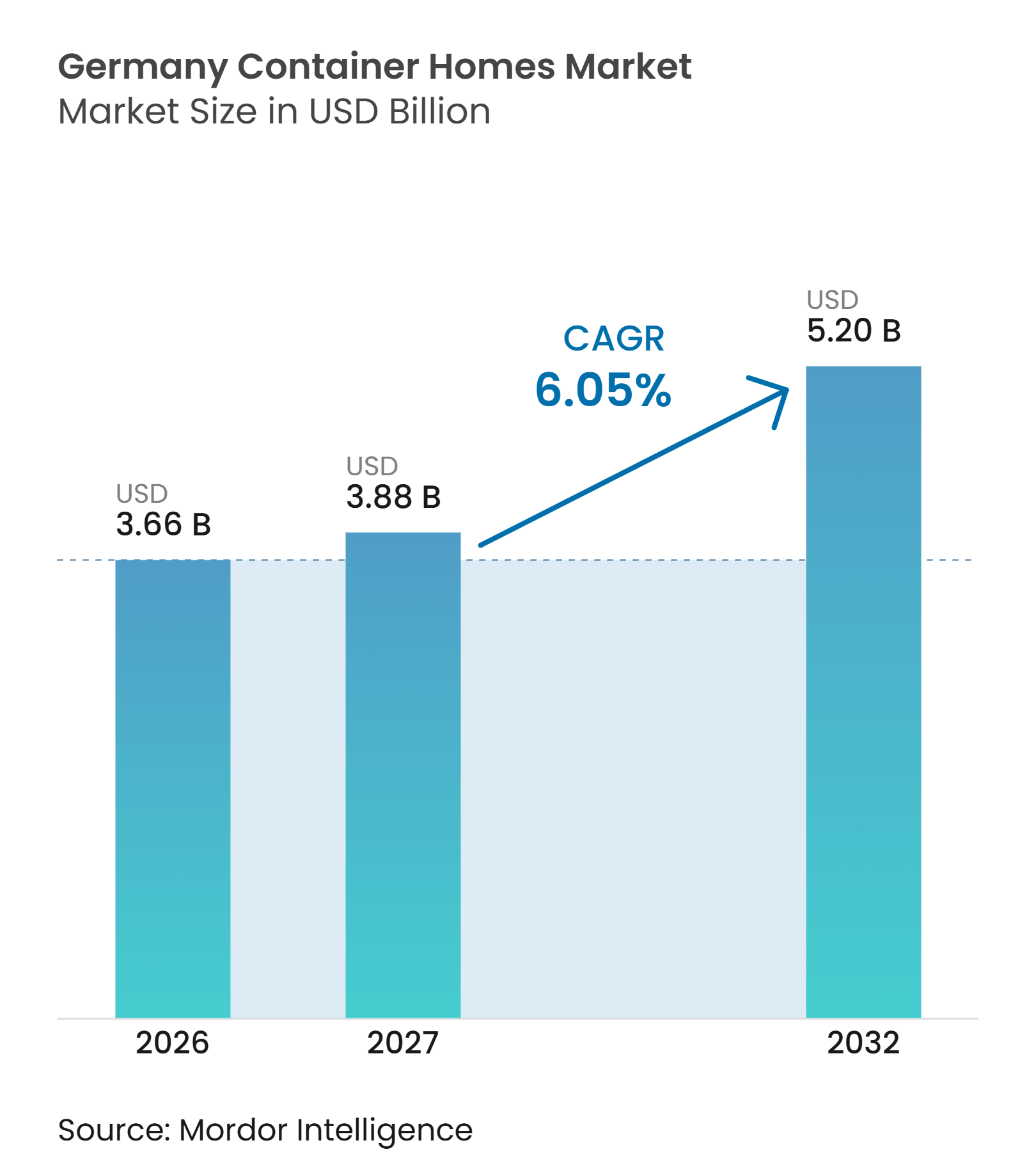
| Base Year Market Size (2026) | USD 3.66 Billion |
| Market Size (2027) | USD 3.88 Billion |
| Market Size (2032) | USD 5.20 Billion |
| Growth Rate (2027 - 2032) | 6.05 % |
| Market Concentration | Medium |
Major Players *Disclaimer: Major Players sorted in no particular order Image © Mordor Intelligence. Reuse requires attribution under CC BY 4.0. | |
Germany Container Homes Market Analysis by Mordor Intelligence
The Germany Container Homes Market size was valued at USD 3.66 billion in 2026 and is projected to reach USD 3.88 billion in 2027 and USD 5.20 billion by 2032, registering a CAGR of 6.05% during 2027–2032.
Housing delivery remains the central demand factor, since Germany needs 320,000 new homes annually but is expected to complete fewer homes in 2026. Serial construction can help buyers respond to this gap because factory work and site preparation can proceed at the same time. Demand for container homes in Germany is also supported by temporary accommodation, education, workplace, defense, and social infrastructure requirements. Federal approvals and energy standards are increasing the value of systems that can show consistent factory quality. This setting favors established suppliers with certified designs, national service coverage, and a flexible rental fleet.
Key Report Takeaways
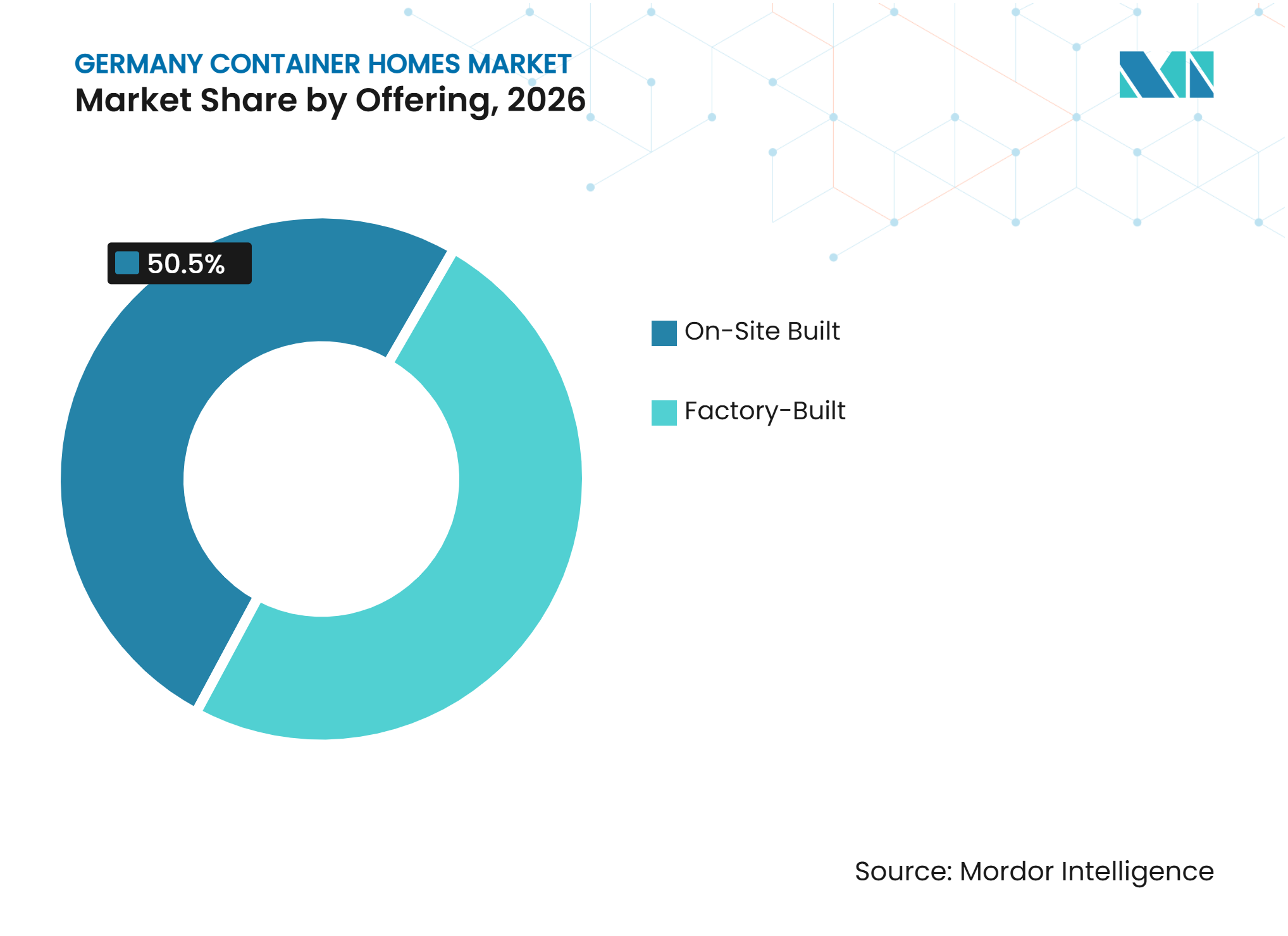
- By offering, on-site built units held 50.5% of the Germany container homes market share in 2026, while factory-built units are forecast to grow at a 6.85% CAGR through 2032.
- By construction type, fixed units held 57.5% of the Germany container homes market share in 2026, while movable units are forecast to grow at a 7.2% CAGR through 2032.
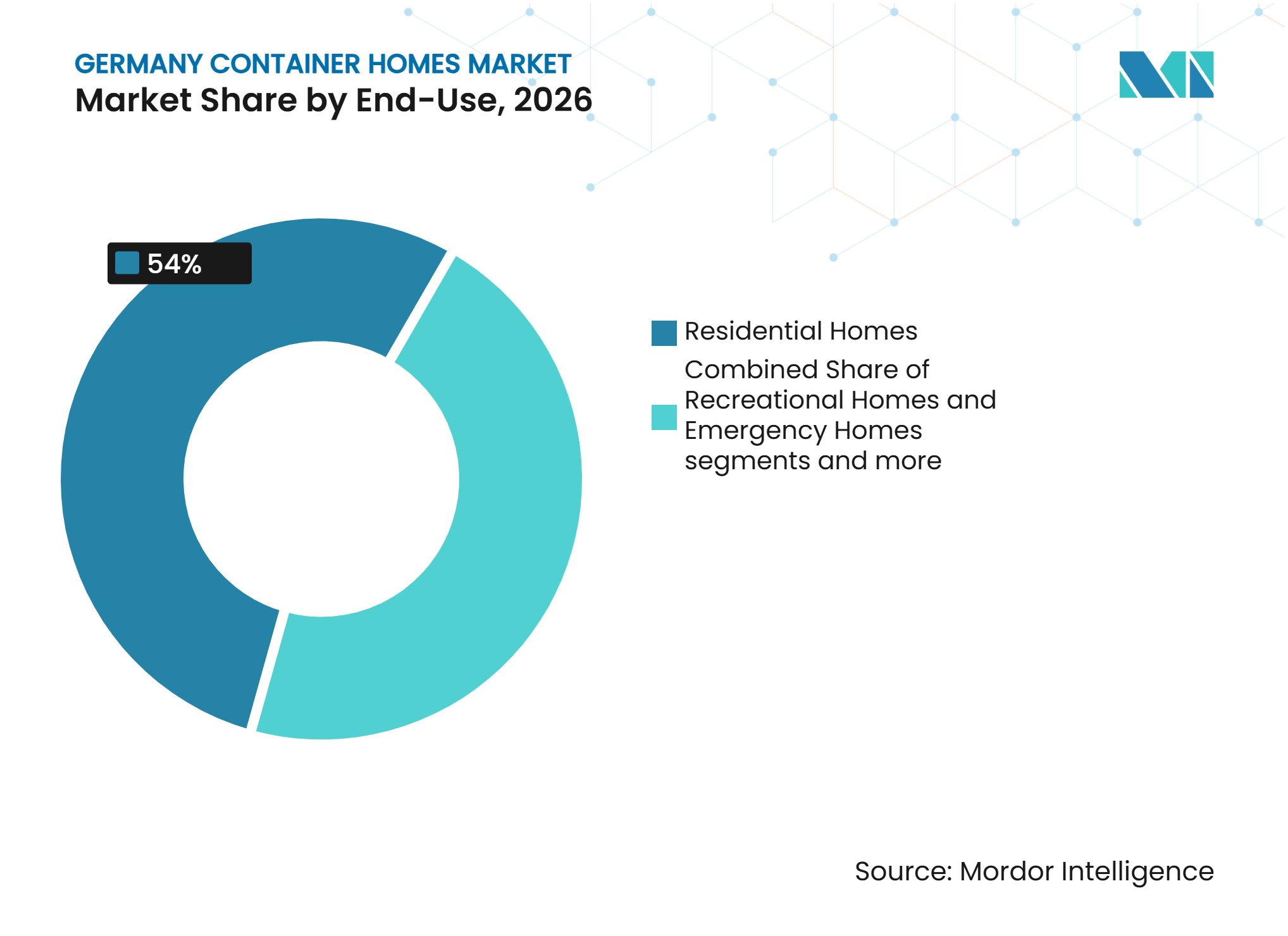
- By end use, residential homes held 54% of the Germany container homes market size in 2026, while emergency homes are forecast to grow at a 7.3% CAGR through 2032.
- By city, Berlin accounted for 14.5% of the Germany container homes market size in 2026, while Munich is forecast to grow at a 7.05% CAGR through 2032.
Note: Market numbers in this report are based on Mordor Intelligence's proprietary estimation framework, which combines nine months of actuals with Q4 projections for base year 2026.
Market Trends and Insights
Drivers Impact Analysis of Germany Container Homes Market*
| Drivers | (~) % Impact on CAGR Forecast | Geographic Relevance | Impact Timeline |
|---|---|---|---|
| Housing Completions Below Target | +2.0% | National, with strong need in Berlin, Munich, Frankfurt, and Hamburg | Short term (≤ 2 years) |
| Established Modular and Container Industry Base | +1.2% | National, with manufacturing activity in North Rhine-Westphalia, Lower Saxony, and Baden-Württemberg | Medium term (2-4 years) |
| Energy-Performance Rules and Circular Construction | +0.9% | National, with strong compliance focus in Baden-Württemberg and Bavaria | Medium term (2-4 years) |
| Refugee, Student, and Temporary Social Accommodation | +0.8% | National, concentrated in Berlin, Hamburg, Munich, and North Rhine-Westphalia | Short term (≤ 2 years) |
| Tiny-House, Holiday-Home, and Garden-Unit Demand | +0.7% | Bavaria, Baden-Württemberg, Lower Saxony, and coastal states | Medium term (2-4 years) |
| Source: Mordor Intelligence | |||
Housing Completions Below Target
Germany container homes market growth is closely tied to the difference between housing need and housing delivery. GdW expects 200,000 homes to be completed in 2026, against an annual requirement of 320,000 homes, leaving a gap of 120,000 units. GdW also expects new-build investment by its socially oriented member companies to fall 26% in 2026, which keeps pressure on affordable supply. This environment makes faster, repeatable construction methods relevant for public bodies and housing providers. The Germany container homes industry can benefit where projects need standardized units, predictable schedules, and controlled factory production. The demand case is strongest in cities where land constraints and housing queues make conventional project timelines less workable.
Established Modular and Container Industry Base
Germany container homes market suppliers benefit from an established base of modular construction companies, rental operators, and specialist assembly teams. Factory production gives suppliers greater control over materials, artistry, and handover documentation than dispersed site work. FAGSI received a general type approval from the Deutsches Institut für Bautechnik for its ProENERGY container construction system, designated Z-19.33-2748. The approval covers tested construction elements and removes the need for project-specific approval for this system across Germany[1]. This gives certified suppliers a practical advantage when buyers need repeatable designs across several locations. It also raises the entry threshold for smaller fabricators that lack documented systems, fire performance evidence, or nationwide service capability.
Energy-Performance Rules and Circular Construction
Energy compliance is becoming a more important part of purchasing decisions in the Germany container homes industry. Suppliers can install insulation, ventilation, photovoltaic equipment, and other building systems within a controlled factory setting before site delivery. Factory production also improves the consistency of energy documentation needed by public buyers and long-term users. FAGSI states that its ProENERGY system meets Gebäudeenergiegesetz requirements and can be provided with an energy certificate depending on the period of use. Reuse is also becoming more visible in temporary housing, where modules can be dismantled, transported, repaired, and assembled again. The combination of repeatable components and longer service life supports a stronger case for container systems in public procurement.
Refugee, Student, and Temporary Social Accommodation
Temporary social accommodation provides a steady source of Germany container homes market demand because public bodies often need units within short delivery periods. In November 2026, Fördern & Wohnen opened a Bergedorf facility with 122 places after rebuilding five container buildings from its existing stock[2]. The five buildings contain 24 modules each and are intended to operate until the end of April 2029. Berlin has paused some new refugee container sites, although its existing modular refugee accommodation projects remain scheduled for completion. This creates a mixed demand picture, where operators must balance new orders with fleet reuse and the renewal of existing sites. Student, workforce, and emergency accommodation can help sustain occupancy when refugee demand differs by location.
Restraints Impact Analysis of Germany Container Homes Market*
| Restraints | (~) % Impact on CAGR Forecast | Geographic Relevance | Impact Timeline |
|---|---|---|---|
| Fragmented State Building Codes and Permitting | -1.1% | National, with strong effects in Bavaria, Baden-Württemberg, and North Rhine-Westphalia | Long term (≥ 4 years) |
| Limited Mortgage, Insurance, and Valuation Infrastructure | -0.7% | National, strongest in rural markets and for movable units | Medium term (2-4 years) |
| Energy-Compliance and Cold-Climate Envelope Costs | -0.5% | National, with higher pressure in Northern Germany and Alpine foothills | Medium term (2-4 years) |
| Competition from Timber-Frame and Volumetric Modular Homes | -0.4% | Baden-Württemberg, Bavaria, and Lower Saxony | Long term (≥ 4 years) |
| Source: Mordor Intelligence | |||
Fragmented State Building Codes and Permitting
Permitting remains a meaningful constraint on the Germany container homes industry because permanent dwellings require project, site, and local infrastructure reviews. A nationally recognized system approval can reduce repeated technical checks, but it does not remove local decisions on land use, fire safety, accessibility, or connections. FAGSI notes that its general type approval eliminates a former project-specific review process that could last several months. The remaining local steps can still slow multi-site programs when a provider works across different German states. Smaller buyers may be affected more heavily because they have fewer resources to manage approvals and technical records. The Germany container homes market therefore rewards suppliers that can provide standardized documentation and early planning support.
Limited Mortgage, Insurance, and Valuation Infrastructure
Private residential demand can be restricted when lenders, insurers, and appraisers treat container homes differently from conventional dwellings. A permanent foundation, a building permit, and energy documents are often important for establishing a building's long-term status. These requirements are easier to address for certified fixed units than for movable or unconventional formats. The financing process can therefore add cost and time even when the physical structure is suitable for occupation. This reinforces the position of fixed, factory-built units in owner-occupied projects and limits the range of buyers for mobile products. Competition from timber-frame systems and higher envelope requirements in colder areas creates additional pressure, since buyers can choose other prefabricated formats with more familiar finance and insurance pathways.
*Our forecasts treat driver/restraint impacts as directional, not additive. The impact forecasts reflect baseline growth, mix effects, and variable interactions.
Germany Container Homes Market Segment Analysis
By Offering:
Factory-Built Quality Standards Narrow the On-Site AdvantageOn-site built units held 50.5% of the Germany container homes market share in 2026, reflecting the continued need for site-specific installation and adaptation. This method remains relevant for retrofits, small projects, and locations where a standard module needs local adjustment. It also suits projects that repurpose existing modules and require work around constrained sites. The installed base of temporary facilities, construction support units, and institutional accommodation supports the continued use of on-site assembly. These conditions explain why on-site built systems remain important even as factory systems gain a stronger compliance position.
Factory-built units are forecast to grow at a 6.85% CAGR through 2032, supported by repeatable quality control and shorter work at the destination site. The Germany container homes market size for factory-built systems benefits where buyers need consistent documentation across several buildings. FAGSI says its approved ProENERGY system is factory-produced and can be assembled on site in a few days[3]. Factory production also allows suppliers to coordinate insulation, fire protection, internal fittings, and energy features before modules arrive. On-site built systems retain an advantage where design flexibility matters more than standardized output.


By Construction Type:
Movable Formats Reshape the Lease EconomyFixed structures held 57.5% of the Germany container homes market share in 2026 because permanent accommodation typically requires stable foundations and conventional building documentation. Fixed units are suited to long-term residential use, student accommodation, care extensions, and institutional space. Their format also aligns more closely with energy certificates and the documentation expected for permanent buildings. This gives buyers a clearer route when the project is expected to remain at one location for many years. The segment's scale reflects the need for durable housing capacity rather than only short-term emergency space.
Movable units are forecast to grow at a 7.2% CAGR through 2032, supported by rental models that let users expand, relocate, or return space when needs change. Algeco introduced its NEXXO 275 unit in May 2026 with a 2.75-meter internal height for schools, childcare centers, and offices. This product points to a wider use of movable formats in settings that need better interior quality than basic site accommodation. ALHO's Bundeswehr agreement also shows the relevance of standardized building capacity for public users, even though specific sites will be determined later. Movable systems can serve these needs when providers have the fleet size, logistics capability, and service teams to support repeated deployment.
By End Use:
Residential Homes Lead the Market, Emergency Homes Record the Fastest GrowthResidential homes held 54% of the Germany container homes market share in 2026, supported by the need for more affordable and scalable urban housing. Berlin's Landsberger Allee development is a significant example of industrialized residential construction, with 1,548 planned apartments using more than 3,000 modules. The project is planned to serve low- and middle-income households, with 85% of apartments subject to rent and occupancy restrictions. It shows why housing providers are considering standardized systems for larger portfolios. The underlying housing shortage supports a stable base of residential demand.
Emergency homes are forecast to grow at a 7.3% CAGR through 2032 as municipalities continue to require quickly available temporary capacity. Germany container homes market size for emergency use is supported by the ability to relocate and reuse modules between sites. Fördern & Wohnen's 2026 Bergedorf project reused modules from a closed accommodation site and required only limited repair work before reopening. Recreational and care-related applications can add demand, but their role depends on planning rules and local project economics. Residential and emergency demand together make product reliability, internal comfort, and compliance evidence central purchasing criteria.


Geography Analysis
Berlin
Berlin held 14.5% of the Germany container homes market share in 2026, supported by high urban housing need and public accommodation requirements. The Berlin Senate suspended additional sites under Wohncontainerprogramm 2.0, except for an operating site at Grünauer Straße. Still, it confirmed that planned modular refugee accommodation projects in MUF 1.0 and MUF 2.0 will continue. This requires suppliers to distinguish between conventional container sites and broader modular accommodation programs. The Landsberger Allee development provides a major reference point for residential modular construction in Berlin, with 1,548 apartments planned using more than 3,000 factory-produced modules. Developed by Gewobag and Daiwa House Modular Europe, the project incorporates photovoltaic installations, green roofs, rainwater management, and recyclable, recoverable building components.
Munich
Munich is forecast to grow at a 7.05% CAGR through 2032, supported by land constraints and demand for flexible, high-quality space. The city and its surrounding area require suppliers to address both temporary accommodation and semi-permanent institutional uses. Buyers are likely to place greater value on design, internal comfort, and reliable delivery because the local property environment is more expensive. Factory-built systems can be attractive where they bring consistent specifications and minimize disruption at constrained sites. The regional opportunity also depends on local approvals and the ability to demonstrate that a unit meets applicable energy and building requirements.
Frankfurt, Hamburg, and Rest of Germany
Frankfurt supports demand through corporate, infrastructure, and institutional requirements, which can favor leased movable systems. Hamburg has a distinct social accommodation base, illustrated by the reopened 122-place Bergedorf facility using rebuilt modules from existing stock. The project shows that reuse can extend a module's working life when transport, repairs, and reassembly are planned carefully. Secondary markets also include defense-related projects, agricultural accommodation, and recreational uses, each with different project durations and technical needs. ALHO's framework agreement covers around 330 buildings at approximately 130 Bundeswehr properties between 2027 and 2031, providing a large, standardized construction requirement across several locations. This broad demand base reduces dependence on a single city, although permitting and procurement timing can still differ widely by location.
Competitive Landscape
Market Concentration
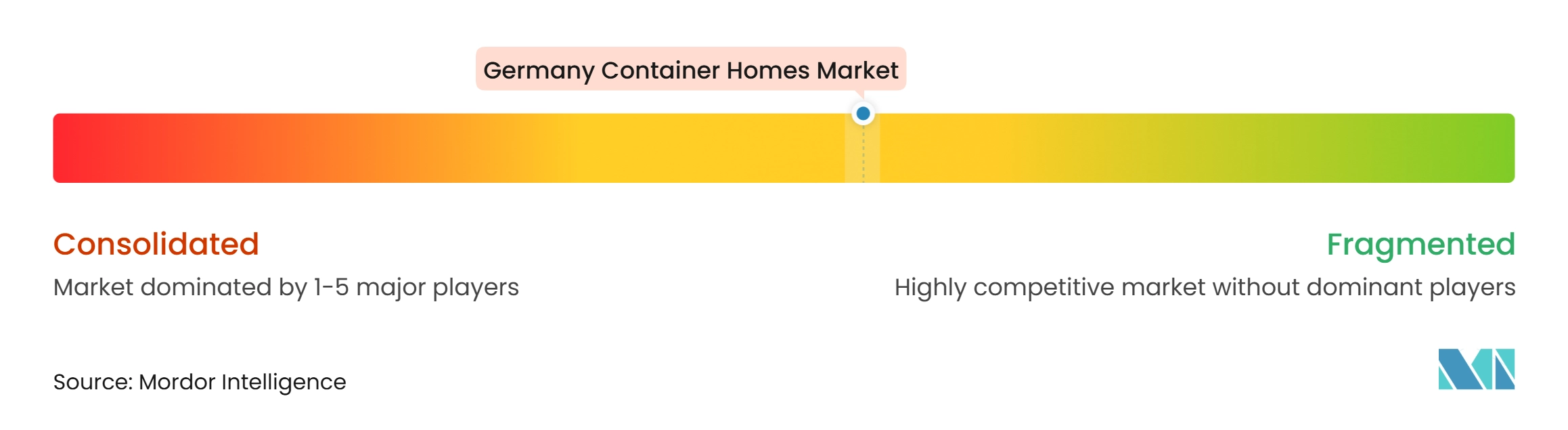
The Germany container homes market includes large full-service operators, regional modular builders, rental specialists, and smaller fabricators. ELA Container GmbH, Kleusberg GmbH & Co. KG, Algeco GmbH, and ALHO Unternehmensgruppe are among the established operators named in the supplied research. Their position rests on national operations, rental capacity, project delivery experience, and standardized product lines. Smaller specialists can compete in local projects, custom work, and the reuse of shipping containers. The Germany container homes industry therefore combines scale advantages in public tenders with space for niche providers that can offer responsive local service.
Certification and repeatability are becoming more important strategic tools. FAGSI's general type approval for ProENERGY removes project-specific approval for the approved system and gives the company a clear planning advantage. ALHO signed its Bundeswehr framework agreement on August 27, 2026, with construction planned at about 130 properties from 2027 to 2031. Algeco's NEXXO 275 launch adds a premium option for schools, childcare centers, and offices. These actions show that leading suppliers are competing through approvals, industrial capacity, product quality, and access to major institutional programs.
Reuse and lifecycle management are another area of differentiation within the Germany container homes market. Fördern & Wohnen rebuilt five existing container buildings into a 122-place facility, showing how public operators can use existing stock instead of procuring entirely new units. ELA Container highlighted a project with 214 containers supporting energy-transition infrastructure in its 2026 company news. These examples support a competitive focus on module condition, transport processes, refurbishment capacity, and the ability to redeploy assets. Larger firms are better positioned to manage these activities across a broad fleet, while specialized providers can compete where customers need customized designs or local installation support.
Germany Container Homes Industry Leaders
-
ELA Container GmbH
-
CONTAINEX Container-Handelsgesellschaft mbH
-
ALHO Unternehmensgruppe
-
SÄBU Morsbach GmbH
-
Acker Raum-Systeme GmbH
- *Disclaimer: Major Players sorted in no particular order
Germany Container Homes Market Companies Covered in this Report
- ELA Container GmbH
- CONTAINEX Container-Handelsgesellschaft mbH
- ALHO Unternehmensgruppe
- SÄBU Morsbach GmbH
- Acker Raum-Systeme GmbH
- BCS Containersysteme
- Kleusberg GmbH & Co. KG
- Algeco GmbH
- Cadolto
- SMS Containermodule Deutschland GmbH
- Comma Container
- Conliving
- CONTAINER-XXL
- MT Container
- NORDCLIFF GmbH
- Sun Container
- Xcontainer
- Villex Container GmbH
- FAGSI (ALHO Group)
- Containerwerk
Recent Industry Developments in Germany Container Homes Market
- November 2026: Fördern & Wohnen opened a temporary accommodation facility at Sander Damm in Hamburg-Bergedorf, with capacity for 122 people, using five two-story container buildings relocated from an earlier site. The modules had been in use for approximately three years and required only minor refurbishment before redeployment.
- May 2026: Algeco GmbH launched the NEXXO 275, a new generation of premium modular units featuring a 2.75-meter internal ceiling height and multi-story configuration capability, targeting schools, childcare, and office tenants in Germany's modular rental market.
- May 2026: Gewobag and Daiwa House Modular Europe celebrated the placement of the final module at the Landsberger Allee project in Berlin-Lichtenberg, one of Europe's largest modular housing developments delivering 1,548 apartments from more than 3,000 steel-concrete hybrid modules, with 85% of units targeting low-to-moderate income households.
Germany Container Homes Market Report Scope
Segmentation Overview
| Factory-Built |
| On-Site Built |
| Fixed |
| Movable |
| Residential Homes |
| Recreational Homes |
| Emergency Homes |
| Nursing Homes |
| Berlin |
| Munich |
| Frankfurt |
| Hamburg |
| Rest of Germany |
| By Offering | Factory-Built |
| On-Site Built | |
| By Construction Type | Fixed |
| Movable | |
| By End-Use | Residential Homes |
| Recreational Homes | |
| Emergency Homes | |
| Nursing Homes | |
| By City | Berlin |
| Munich | |
| Frankfurt | |
| Hamburg | |
| Rest of Germany |
Key Questions Answered in the Report
What is driving demand for container homes in Germany?
The housing shortfall is a central factor. Germany needs 185,000 new homes annually but is expected to complete 200,000 in 2026.
What is the projected growth rate for container homes in Germany?
The Germany container homes market is projected to grow at a 6.05% CAGR between 2027 and 2032.
Which application leads demand for container homes in Germany?
Residential homes lead with a 54% share in 2026, supported by pressure for more affordable and scalable housing capacity.
Why are factory-built container systems gaining demand?
Factory-built units are projected to grow at a 6.85% CAGR through 2032 because they offer repeatable quality control and stronger compliance documentation.
Which German city has the strongest demand for container homes?
Berlin leads with a 14.5% share in 2026, supported by housing demand and continuing modular accommodation programs.
How do suppliers compete in Germany's container homes sector?
Suppliers compete through certified systems, fleet scale, factory quality, project delivery, refurbishment capacity, and support for public procurement.