
Geosynthetic Cementitious Composite Mats Market Size and Share
Market Overview
| Study Period | 2021 - 2031 |
|---|---|
| Market Size (2026) | USD 106.24 Million |
| Market Size (2031) | USD 159.16 Million |
| Growth Rate (2026 - 2031) | 8.42 % |
| Fastest Growing Market | Asia-Pacific |
| Largest Market | North America |
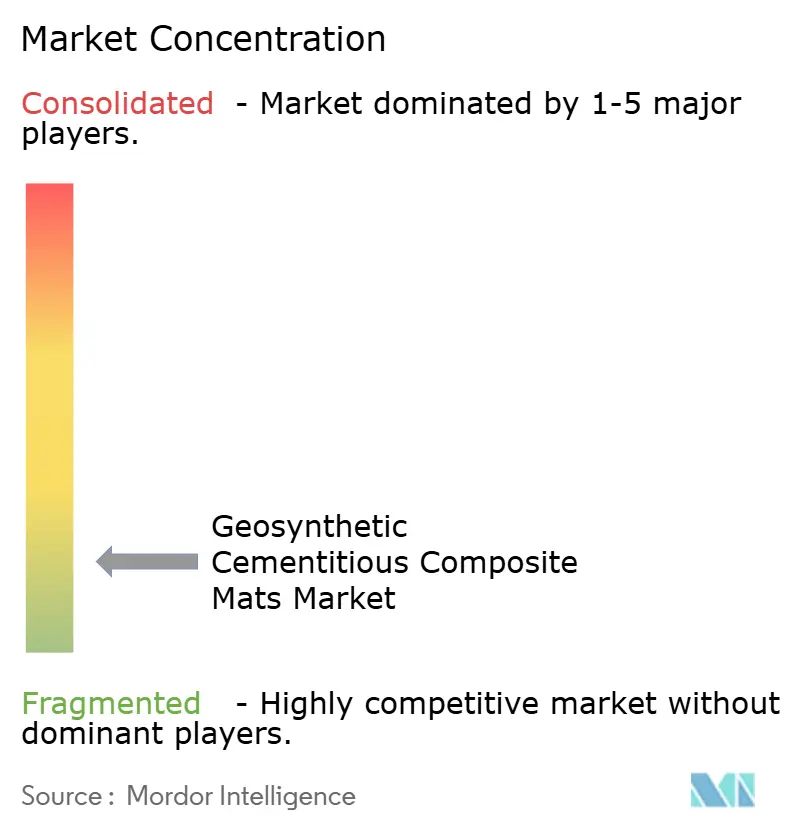
| Market Concentration | Low |
Major Players *Disclaimer: Major Players sorted in no particular order Image © Mordor Intelligence. Reuse requires attribution under CC BY 4.0. | |
Geosynthetic Cementitious Composite Mats Market Analysis by Mordor Intelligence
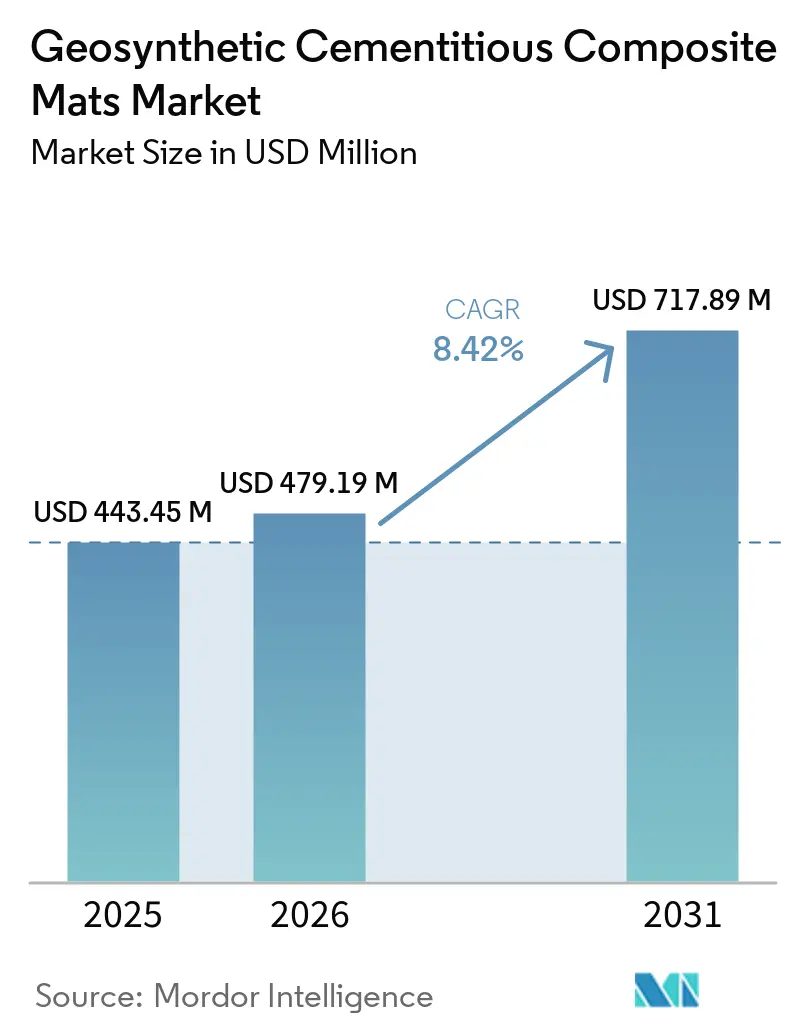
The Geosynthetic Cementitious Composite Mats Market size is expected to increase from USD 98.37 million in 2025 to USD 106.24 million in 2026 and reach USD 159.16 million by 2031, at a CAGR of 8.42% over 2026-2031. The geosynthetic cementitious composite mats market is supported by the need to rehabilitate drainage channels, embankments, canals, and other linear infrastructure with limited closure time, particularly where erosion, seepage, and surface damage affect asset reliability. Geosynthetic cementitious composite mats (GCCMs) combine a dry cementitious layer with geotextile layers and are hydrated on-site to form a thin, waterproof concrete layer that can be placed across irregular terrain and existing infrastructure surfaces. This installation method reduces the need for formwork, mixing equipment, specialist spray operators, and the longer curing sequence associated with conventional poured-concrete work. Climate adaptation spending and water-management programs are increasing demand for durable erosion and seepage-control materials in vulnerable infrastructure corridors, while the need to protect exposed transport, energy, and water assets supports more resilient material choices. Product suppliers are also competing through tested performance, certification, regional supply capacity, and technical support rather than material price alone, because project owners need confidence in both material quality and reliable field installation.
Key Report Takeaways
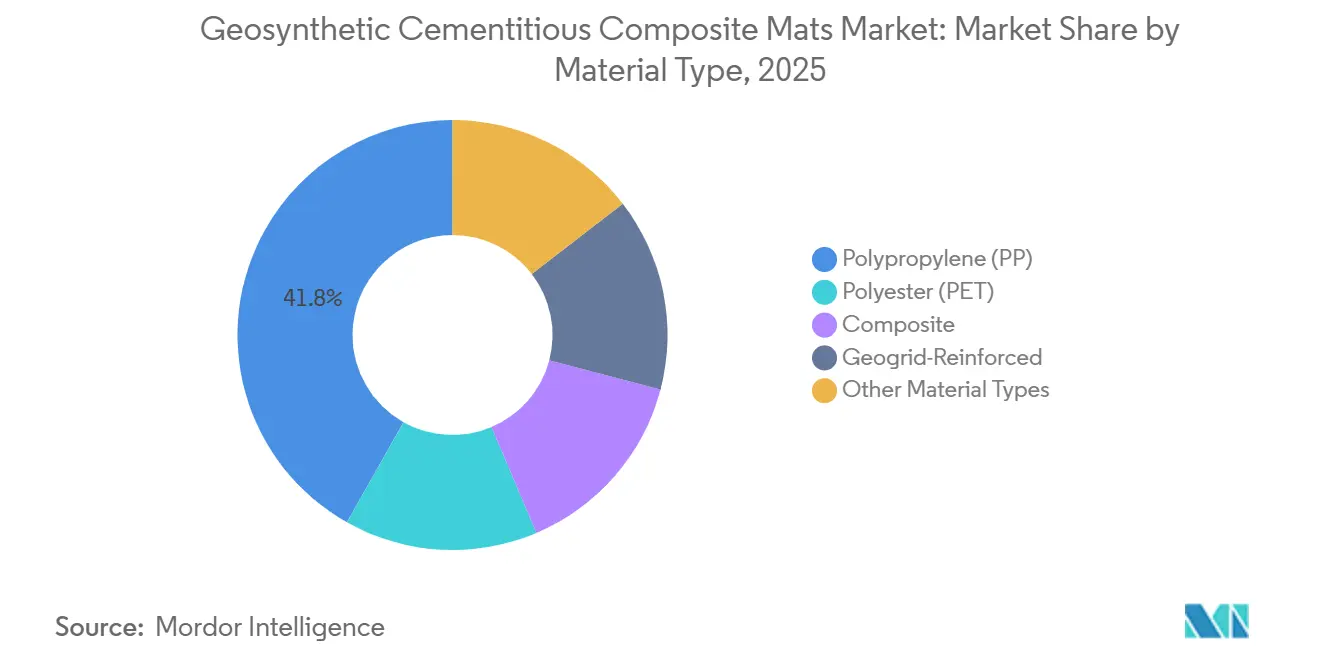
- By material type, polypropylene held 41.84% of the geosynthetic cementitious composite mats market share in 2025, while composite is projected to grow at an 8.91% CAGR through 2031.
- By form, wide rolls held 43.56% of the geosynthetic cementitious composite mats market share in 2025, while panels are forecast to expand at an 8.78% CAGR through 2031.
- By application, erosion control accounted for 32.06% of the geosynthetic cementitious composite mats market share in 2025, while ground reinforcement is projected to expand at a 9.12% CAGR through 2031.
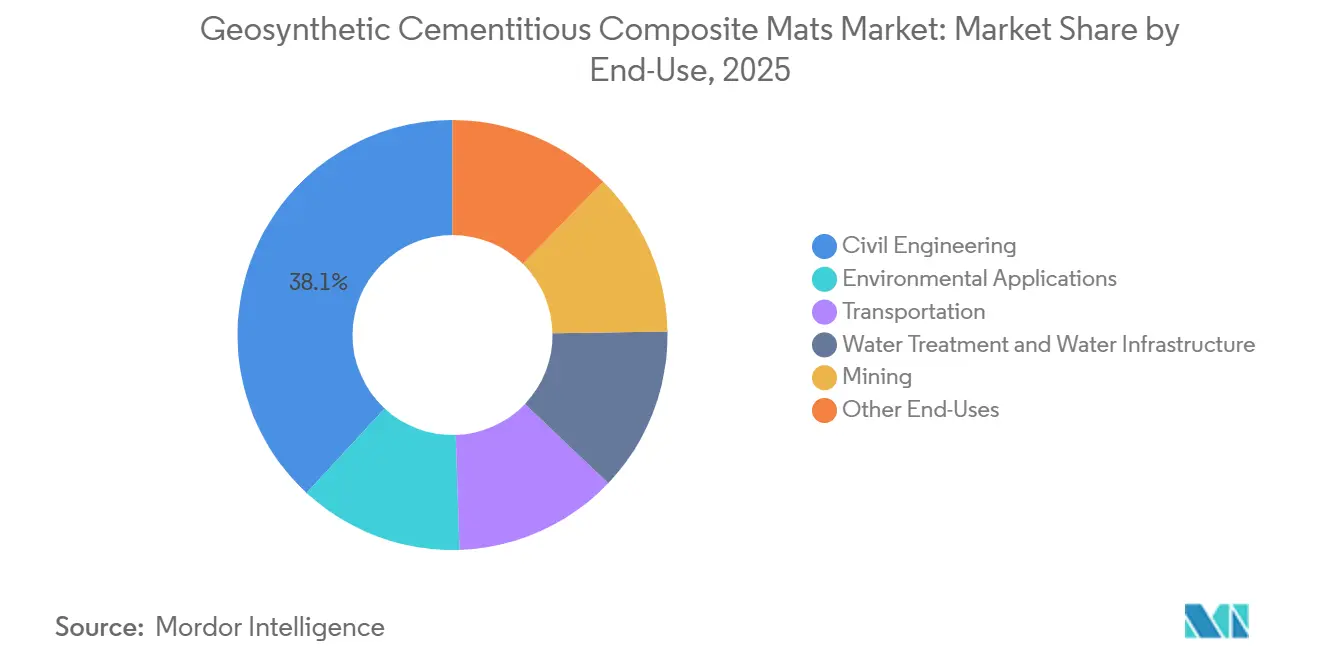
- By end-use, civil engineering held 38.13% of the geosynthetic cementitious composite mats market share in 2025, while water treatment and water infrastructure is forecast to grow at a 9.23% CAGR through 2031.
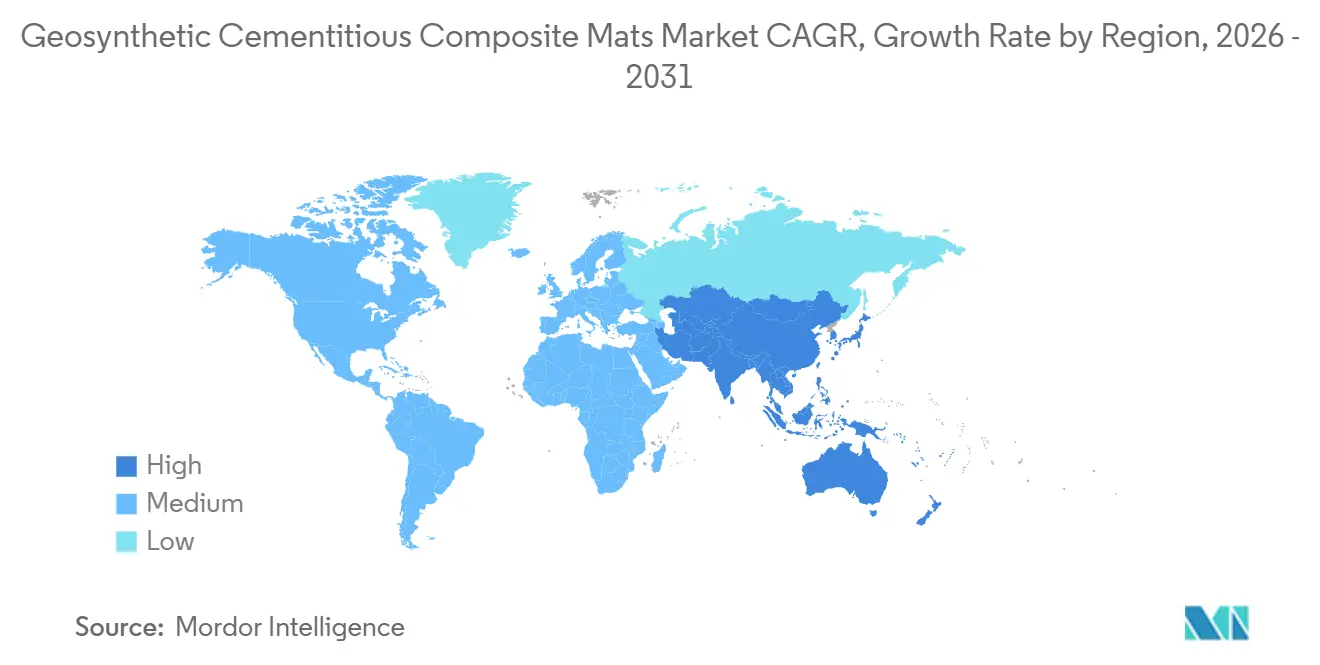
- By geography, North America held 36.40% of the geosynthetic cementitious composite mats market share in 2025, while Asia-Pacific is projected to expand at an 8.98% CAGR through 2031.
Note: Market size and forecast figures in this report are generated using Mordor Intelligence’s proprietary estimation framework, updated with the latest available data and insights as of January 2026.
Market Trends and Insights
Drivers Impact Analysis of Geosynthetic Cementitious Composite Mats Market*
| Driver | (~) % Impact on CAGR Forecast | Geographic Relevance | Impact Timeline |
|---|---|---|---|
| Infrastructure Rehabilitation and Resilience Spending | +2.4% | Global | Medium term (2–4 years) |
| Faster Installation and Lower Project Labor Requirements | +1.5% | North America & Europe | Short term (≤2 years) |
| Rising Demand for Erosion and Slope Protection | +1.8% | Global | Medium term (2–4 years) |
| Water-Management and Canal-Rehabilitation Investments | +1.2% | APAC, MEA | Medium term (2–4 years) |
| Remote-Site Deployment and Reduced Equipment Requirements | +0.7% | APAC, South America, MEA | Long term (≥4 years) |
| Lower Material Use and Embodied-Carbon Advantages | +0.6% | Europe, North America | Long term (≥4 years) |
| Source: Mordor Intelligence | |||
Infrastructure Rehabilitation and Resilience Spending
Infrastructure rehabilitation spending supports the geosynthetic cementitious composite mats market because many public assets need repair without lengthy service interruptions. Transport, drainage, water, and energy corridors are exposed to weather-related damage that can disrupt communities and economic activity. The Coalition for Disaster Resilient Infrastructure reported that transport and energy assets accounted for 78% of hazard-exposed infrastructure assets, increasing attention on resilient protection systems[1]Coalition for Disaster Resilient Infrastructure, “Global Infrastructure Resilience 2025: Capturing the Resilience Dividend,” Coalition for Disaster Resilient Infrastructure, cdri.world. GCCMs are suited to linear assets where access, lane closures, and dewatering schedules limit the use of conventional poured concrete. A protected channel, slope, or embankment can remain an essential part of a wider transport or water system, so project owners often need an approach that fits within a restricted maintenance period. This makes delivery timing an important part of material selection, not simply a construction detail. ASTM D8364/D8364M-21(2026) provides a recognized specification framework for GCCM materials, which supports technical review during procurement. The geosynthetic cementitious composite mats market can therefore benefit when project owners prioritize repair methods that combine rapid installation with defined product performance.
Faster Installation and Lower Project Labor Requirements
Faster installation is a practical advantage for the geosynthetic cementitious composite mats market, especially on sites with short work windows. GCCMs arrive as factory-assembled materials and avoid on-site concrete mixing and conventional formwork. Their handling approach can reduce equipment needs on difficult terrain, remote canals, railway drainage routes, and road embankments. This matters where contractors face constrained access or limited time for lane closures and canal dewatering. ASTM requirements help contractors and owners compare material classes against defined performance properties rather than rely solely on established methods. The benefit is strongest where a smaller work crew and a shorter installation sequence can reduce disruption to essential infrastructure.
Rising Demand for Erosion and Slope Protection
Erosion and slope protection remain core uses within the geosynthetic cementitious composite mats market. Severe weather and related infrastructure exposure are expanding the number of drainage, embankment, canal-bank, and slope projects that require durable surface protection. GCCMs provide a hardened surface after hydration while retaining flexibility during placement. This can suit slopes and channels that would be difficult to protect with rigid concrete sections. Public agencies and engineering consultants increasingly use recognized test and classification standards when selecting geosynthetic materials. The geosynthetic cementitious composite mats market gains from this shift because product certification can reduce uncertainty during technical review.
Water-Management and Canal-Rehabilitation Investments
Water-management investment is creating a separate demand channel for the geosynthetic cementitious composite mats market. Unlined irrigation canals can lose 30–50% of conveyed water through seepage, making lining projects relevant to water efficiency and food security. GCCMs can be installed in locations where conventional construction materials are difficult to transport or place. The material can provide a continuous protective layer for irrigation canals, drainage systems, and water-conveyance infrastructure. The World Irrigation Forum documented the use of GCCM in remote agricultural irrigation canals, highlighting portability as an important site consideration. The geosynthetic cementitious composite mats market is therefore positioned to benefit from canal rehabilitation programs in water-stressed regions.
Restraints Impact Analysis of Geosynthetic Cementitious Composite Mats Market*
| Restraint | (~) % Impact on CAGR Forecast | Geographic Relevance | Impact Timeline |
|---|---|---|---|
| Competition from Shotcrete, Geotextiles, Riprap and Vegetative Systems | -1.2% | Global | Short term (≤2 years) |
| Installation Quality and Contractor Skill Gaps | -0.8% | APAC, South America, MEA | Medium term (2–4 years) |
| GCCM Specification, Certification and Procurement Familiarity Gaps | -0.6% | Global | Medium term (2–4 years) |
| Cementitious Formulation and Polymer-Backing Exposure to Circularity Requirements | -0.4% | Europe | Long term (≥4 years) |
| Source: Mordor Intelligence | |||
Competition from Shotcrete, Geotextiles, Riprap and Vegetative Systems
The geosynthetic cementitious composite mats market faces different competing materials across project types and geographies. Shotcrete may remain suitable for structural slope work that requires high compressive strength. Riprap can retain a cost advantage on broad riverbank protection projects where land access is available. Geotextile-only systems remain relevant when filtration and drainage are the main project objectives rather than hard armor. Vegetative systems may be selected where biodiversity and visual landscape goals carry greater weight than hydraulic protection needs. GCCM suppliers need to demonstrate where certified cementitious composites offer a stronger fit for hydraulic loads, surface durability, and short installation windows.
Installation Quality and Contractor Skill Gaps
Installation quality can limit adoption in the geosynthetic cementitious composite mats market when contractors lack experience with hydration, joint sealing, and anchoring. A poorly installed system can create performance issues that owners may associate with the material rather than the installation process. ASTM D8364/D8364M-21(2026) addresses product classification and minimum material performance, but it does not establish a universal installer credential system[2]ASTM International, “D8364/D8364M Standard Specification for Geosynthetic Cementitious Composite Mat Materials,” ASTM International, store.astm.org. This issue is more significant in fast-growing regions where product distribution has expanded faster than local training capacity. Public procurement teams may prefer traditional solutions when they have established inspection procedures and familiar contractor qualifications. Supplier-led training and clearer installation guidance can reduce this barrier and improve confidence among engineers and contractors.
*Our forecasts treat driver/restraint impacts as directional, not additive. The impact forecasts reflect baseline growth, mix effects, and variable interactions.
Geosynthetic Cementitious Composite Mats Market Segment Analysis
By Material Type:
Polypropylene Leads Revenue While Composite Grows FasterPolypropylene held 41.84% of the geosynthetic cementitious composite mats market share in 2025. Its position reflects UV stability, compatibility with dry Portland cement formulations, and broad availability across major producing regions. Polypropylene provides a practical balance between performance and raw material cost for established applications. It is used where the cementitious layer requires a stable geotextile backing and reliable handling properties. The material is relevant to a wide range of erosion-control, channel-lining, and civil engineering projects.
Composite is projected to grow at a CAGR of 8.91% through 2031 in the geosynthetic cementitious composite mats market. It combines fiber, geogrid, drainage, tensile-load-transfer, or chemical-resistance functions within one installed layer. It is suited to projects that need more than surface protection, such as ground reinforcement and applications with chemical or structural exposure. Polyester backings continue to serve tensile-critical requirements where fiber stiffness can reduce creep under sustained hydraulic load. This capability is relevant when project teams would otherwise need separate layers to provide drainage, reinforcement, and protective cover. Integrated products can simplify the installed system and reduce interfaces that require field coordination. Research presented at EuroGeo 8 found that recycled polypropylene from managed recycling streams can be technically suitable for high-performance geosynthetic uses. Fraunhofer CCPE also reported that recycled polypropylene and polyester can be processed into geotextiles meeting industrial requirements, supporting future interest in recycled-content formulations.



By Form:
Wide Rolls Retain Scale While Panels Support Constrained RehabilitationWide rolls accounted for 43.56% of the geosynthetic cementitious composite mats market share in 2025. This format is suited to extensive slopes, embankments, and channels where long, continuous coverage reduces seams and installation effort. Wide rolls can be deployed with standard plant equipment on open infrastructure sites. Their use is particularly relevant to large drainage and erosion-control contracts where material continuity and rapid coverage influence procurement decisions. The format also remains practical for long-distance canal and roadside applications.
Panels are projected to expand at a CAGR of 8.78% through 2031 in the geosynthetic cementitious composite mats market. Their growth reflects demand for modular solutions in constrained urban drainage, water treatment, and rehabilitation projects. Panels can offer more precise dimensional control and easier material handling in confined spaces. Preformed mats address irregular culvert profiles, bridge abutments, and nonstandard canal geometries where site cutting could create waste or quality risks. Batched rolls serve municipal stormwater and transportation projects that need a middle ground between wide-roll coverage and customized units. Panel and preformed formats can also make material staging easier where crews have restricted access to the work area. They allow project teams to select a form that fits the geometry and handling limitations of a given site. These form options extend use beyond open sites and support maintenance work in space-constrained infrastructure.
By Application:
Erosion Control Leads While Ground Reinforcement ExpandsErosion control held 32.06% of the geosynthetic cementitious composite mats market share in 2025. Highway embankment protection, railway drainage lining, stormwater channels, and exposed canal banks support the application. It remains the established procurement base for GCCMs in most regions. The installed material can protect surfaces that face hydraulic flow, rainfall runoff, and localized erosion. This role gives the geosynthetic cementitious composite mats market a broad base across transportation, water, and civil works.
Ground reinforcement is projected to grow at a CAGR of 9.12% through 2031 in the geosynthetic cementitious composite mats market. Growth is linked to urban utility corridors, pipeline bedding, sub-foundation protection, and applications exposed to chemical conditions or differential settlement. Type III products under ASTM D8364/D8364M-21(2026) support higher-strength applications that require more demanding performance properties. Slope stabilization remains another important application because GCCMs can be handled before hydration and form a rigid protective layer afterward. Canal lining is expanding through irrigation and seepage-control projects in remote agricultural settings. In these applications, buyers value a material that can combine surface protection with practical handling before the cementitious layer is activated. This helps extend GCCM use into sites where surface protection alone does not resolve the full engineering requirement. Containment systems, mining vent walls, and surface protection broaden the addressable base into industrial and resource applications.
By End-Use:
Civil Engineering Holds the Largest Base While Water Treatment and Water Infrastructure Grow FasterCivil engineering held 38.13% of the geosynthetic cementitious composite mats market share in 2025. Public investment in road and rail slope management, drainage rehabilitation, and embankment protection supports this large end-use position. These projects commonly require hard-wearing surface protection over long linear distances. The value proposition centers on installation speed, reduced equipment requirements, and defined material performance. Civil engineering, therefore, provides a steady demand base for the geosynthetic cementitious composite mats market.
Water treatment and water infrastructure is projected to grow at a CAGR of 9.23% through 2031 in the geosynthetic cementitious composite mats market. Irrigation modernization, stormwater management, and water conveyance rehabilitation drive this end-use segment. A University of Kentucky water-conveyance proceeding reported a GCCM design life exceeding 50 years and carbon reductions above 60% compared with conventional hard armor. These characteristics are relevant for utilities that must consider reliability, installation time, and material use within a single procurement decision. They are also relevant when existing canals or drainage systems must remain available for most of the construction period. Environmental applications include landfill capping, contaminated-site protection, and coastal erosion work, where regulatory and engineering requirements shape material selection. Transportation users create sustained demand through highway and rail maintenance programs. Mining also uses rapid-install materials for water diversion, sump lining, vent walls, and surface runoff management.
Geography Analysis
North America Geosynthetic Cementitious Composite Mats Market
North America held 36.40% of the geosynthetic cementitious composite mats market share in 2025. The region benefits from established use of GCCMs in transportation, stormwater management, drainage, and water infrastructure. Recurring rehabilitation needs in highways, embankments, and drainage systems support demand for materials that can be installed with limited service disruption. ASTM D8364/D8364M-21(2026) provides a recognized material specification that supports technical procurement in the United States and Canada. Western water districts also provide a relevant opportunity because irrigation systems need durable canal lining and seepage-control solutions. The region has a mature project-delivery environment in which documentation, contractor familiarity, and performance testing can affect material selection. This supports demand for suppliers that can provide technical evidence and responsive local availability.
APAC Geosynthetic Cementitious Composite Mats Market
Asia-Pacific is projected to expand at a CAGR of 8.98% through 2031, making it the fastest-growing geography in the geosynthetic cementitious composite mats market. Irrigation canal rehabilitation, rail embankment construction, flood protection, and mining infrastructure support regional demand. Remote agricultural canal projects in Indonesia have demonstrated how portability can influence material selection, where conventional inputs are difficult to transport. India and Southeast Asia offer opportunities through water management and infrastructure programs. China remains significant because of its large civil engineering base and need for slope and drainage protection. Japan, South Korea, and ASEAN countries add demand for higher-specification products in hydraulic and seismically active applications. The regional mix includes both large public works and remote local projects, which creates demand for several material forms and performance classes. Local technical support is therefore important for converting broad infrastructure needs into project-level specifications.
EMEA and South America Geosynthetic Cementitious Composite Mats Market
Europe remains important to the geosynthetic cementitious composite mats market because rail operators, motorway agencies, and waterway authorities require materials for maintenance and rehabilitation. Product selection in the region increasingly considers performance documentation and lower material use. South America provides demand through waterway investment, road rehabilitation, and irrigation networks in dry agricultural areas. The Middle-East and Africa are supported by canal lining, water-conveyance infrastructure, and mining site protection. The International Finance Corporation (IFC) reported that natural hazards cause USD 390 billion in annual losses in low- and middle-income countries, reinforcing the value of resilient infrastructure investment. These regions may see further adoption as procurement frameworks become more familiar with ASTM-based GCCM specifications. Their outlook depends on how quickly engineers, contractors, and procurement teams become comfortable specifying and installing GCCM materials. Water scarcity, erosion exposure, and infrastructure access limitations provide practical reasons for considering rapid-install lining solutions.

Competitive Landscape
The geosynthetic cementitious composite mats market is highly fragmented, with the top five players including Concrete Canvas Ltd., Eurobent Sp. z o.o., terrafix Geosynthetics, Titan Environmental, and Geofabrics Australasia Pty Ltd. Concrete Canvas has a broad GCCM patent portfolio, including Japanese Patent No. 5736024 for second-generation hydration-control technology. Patent coverage can differentiate Type II and Type III materials, where curing control and tested product performance are important. The wider distribution and installation landscape remains fragmented across regional contractors and specialty distributors. This structure means established suppliers must combine product development with technical support and local project capability. Price-focused producers remain active in emerging markets where Type I compliance and basic erosion-protection needs shape buying decisions.
Officine Maccaferri is expanding its manufacturing footprint to improve local supply and shorten lead times. In March 2026, the company announced an expansion of its Fort Lawn, South Carolina facility, with the site planned to cover 133,690 square feet and eight product families when fully operational in September 2026. In July 2026, Maccaferri announced a manufacturing plant in Khandale, India, of nearly 400,000 square feet, intended to serve domestic demand and export markets. These investments show that production location and technical availability are becoming central elements of competition. Suppliers with direct manufacturing capacity can respond more quickly to project requirements and distributor demand.
Several competitive gaps remain visible within the geosynthetic cementitious composite mats market. A widely adopted installer certification framework has not yet emerged, despite the importance of correct hydration, joint sealing, and anchoring. Suppliers that establish credible training and assessment programs could build an advantage with conservative public procurement teams. Recycled-content GCCM formulations also remain an opportunity, as research and industrial projects have shown that polypropylene and polyester recyclates can meet relevant geotextile requirements. Underdeveloped technical-sales coverage in rural South and Southeast Asia, Central Asia, and Sub-Saharan Africa also creates distribution opportunities for suppliers that can demonstrate installed performance. Suppliers that invest in testing, training, and regional technical support could build durable positions in markets where the product category is still developing. These investments would help convert product awareness into specifications and repeat project use.
Geosynthetic Cementitious Composite Mats Industry Leaders
Concrete Canvas Ltd.
Eurobent Sp. z o.o.
terrafix Geosynthetics
Titan Environmental
Geofabrics Australasia Pty Ltd.
- *Disclaimer: Major Players sorted in no particular order
Geosynthetic Cementitious Composite Mats Market Companies Covered in this Report
- Amplified Concrete Solutions Global, LLC
- Bermüller & Co GmbH
- Changzhou Pioneer Textile Technology Co.,Ltd.
- Concrete Canvas Ltd.
- Eurobent Sp. z o.o.
- Geofabrics Australasia Pty Ltd.
- Kenviro
- PGATech Group of Companies
- Shandong Longxiang New Materials Co., Ltd.
- terrafix Geosynthetics
- Titan Environmental

Recent Industry Developments in Geosynthetic Cementitious Composite Mats Market
- July 2026: Officine Maccaferri Spa announced a new manufacturing plant in Khandale, India, covering nearly 400,000 square feet to serve domestic infrastructure projects and export markets in Southeast Asia and the Middle-East. The investment expands the company's geosynthetics manufacturing capacity, strengthening regional supply and supporting demand for advanced geosynthetic solutions used in infrastructure applications, including geosynthetic cementitious composite mats.
- February 2026: ASTM International reaffirmed ASTM D8364/D8364M-21(2026), maintaining the active standard specification for Geosynthetic Cementitious Composite Mats. The reaffirmation reinforces standardized material performance and quality requirements, supporting product adoption and specification across infrastructure and erosion control projects.


Global Geosynthetic Cementitious Composite Mats Market Report Scope
Geosynthetic cementitious composite mats (GCCMs) are flexible, fabric-based materials impregnated with a cementitious mixture that hardens upon hydration to form a durable concrete layer. They provide rapid installation, erosion control, surface protection, and long-term durability, making them suitable for civil engineering, mining, water infrastructure, and environmental applications.
The Geosynthetic Cementitious Composite Mats Market is segmented by material type, form, application, end-use, and geography. By material type, the market is segmented into polypropylene (PP), polyester, composite, geogrid-reinforced, and other material types. By form, the market is segmented into wide rolls, preformed mats, batched rolls, and panels. By application, the market is segmented into erosion control, slope stabilization, ground reinforcement, canal lining, containment systems, mining vent walls and surface protection, and other applications. By end-use, the market is segmented into civil engineering, environmental applications, transportation, water treatment and water infrastructure, mining, and other end-uses. The report also covers the market size and forecasts for geosynthetic cementitious composite mats in 15 countries across major regions. For each segment, the market sizing and forecasts have been done on the basis of value (USD).
| Polypropylene (PP) |
| Polyester |
| Composite |
| Geogrid-Reinforced |
| Other Material Types |
| Wide Rolls |
| Preformed Mats |
| Batched Rolls |
| Panels |
| Erosion Control |
| Slope Stabilization |
| Ground Reinforcement |
| Canal Lining |
| Containment Systems |
| Mining Vent Walls and Surface Protection |
| Other Applications |
| Civil Engineering |
| Environmental Applications |
| Transportation |
| Water Treatment and Water Infrastructure |
| Mining |
| Other End-Uses |
| Asia-Pacific | China |
| India | |
| Japan | |
| South Korea | |
| ASEAN Countries | |
| Rest of Asia-Pacific | |
| North America | United States |
| Canada | |
| Mexico | |
| Europe | Germany |
| United Kingdom | |
| France | |
| Italy | |
| NORDIC Countries | |
| Rest of Europe | |
| South America | Brazil |
| Argentina | |
| Rest of South America | |
| Middle-East and Africa | Saudi Arabia |
| South Africa | |
| Rest of Middle-East and Africa |
| By Material Type | Polypropylene (PP) | |
| Polyester | ||
| Composite | ||
| Geogrid-Reinforced | ||
| Other Material Types | ||
| By Form | Wide Rolls | |
| Preformed Mats | ||
| Batched Rolls | ||
| Panels | ||
| By Application | Erosion Control | |
| Slope Stabilization | ||
| Ground Reinforcement | ||
| Canal Lining | ||
| Containment Systems | ||
| Mining Vent Walls and Surface Protection | ||
| Other Applications | ||
| By End-Use | Civil Engineering | |
| Environmental Applications | ||
| Transportation | ||
| Water Treatment and Water Infrastructure | ||
| Mining | ||
| Other End-Uses | ||
| By Geography | Asia-Pacific | China |
| India | ||
| Japan | ||
| South Korea | ||
| ASEAN Countries | ||
| Rest of Asia-Pacific | ||
| North America | United States | |
| Canada | ||
| Mexico | ||
| Europe | Germany | |
| United Kingdom | ||
| France | ||
| Italy | ||
| NORDIC Countries | ||
| Rest of Europe | ||
| South America | Brazil | |
| Argentina | ||
| Rest of South America | ||
| Middle-East and Africa | Saudi Arabia | |
| South Africa | ||
| Rest of Middle-East and Africa | ||


Key Questions Answered in the Report
What is the size of the geosynthetic cementitious composite mats market?
The Geosynthetic Cementitious Composite Mats Market size is expected to increase from USD 98.37 million in 2025 to USD 106.24 million in 2026 and reach USD 159.16 million by 2031, at a CAGR of 8.42% over 2026-2031.
Which material type held the largest share in 2025?
Polypropylene held 41.84% of the material type segment in 2025. Its leading position reflects UV stability, compatibility with dry Portland cement formulations, and a cost-performance balance suited to established applications.
Which application is expected to grow fastest through 2031?
Ground reinforcement is projected to grow at a 9.12% CAGR through 2031. Demand is linked to utility corridors, pipeline bedding, sub-foundation protection, and applications where combined protection and reinforcement are required.
Which region is expected to grow fastest through 2031?
Asia-Pacific is projected to expand at an 8.98% CAGR through 2031. Irrigation rehabilitation, rail embankments, flood protection, and mining infrastructure support the regional outlook.
Page last updated on:


 Your data is secure and never sold or shared.


