
Geopipes Market Size and Share
Market Overview
| Study Period | 2021 - 2031 |
|---|---|
| Market Size (2026) | USD 2.76 Billion |
| Market Size (2031) | USD 4.33 Billion |
| Growth Rate (2026 - 2031) | 9.45 % |
| Fastest Growing Market | Asia-Pacific |
| Largest Market | Asia-Pacific |
| Market Concentration | Medium |
Major Players *Disclaimer: Major Players sorted in no particular order Image © Mordor Intelligence. Reuse requires attribution under CC BY 4.0. | |
Geopipes Market Analysis by Mordor Intelligence
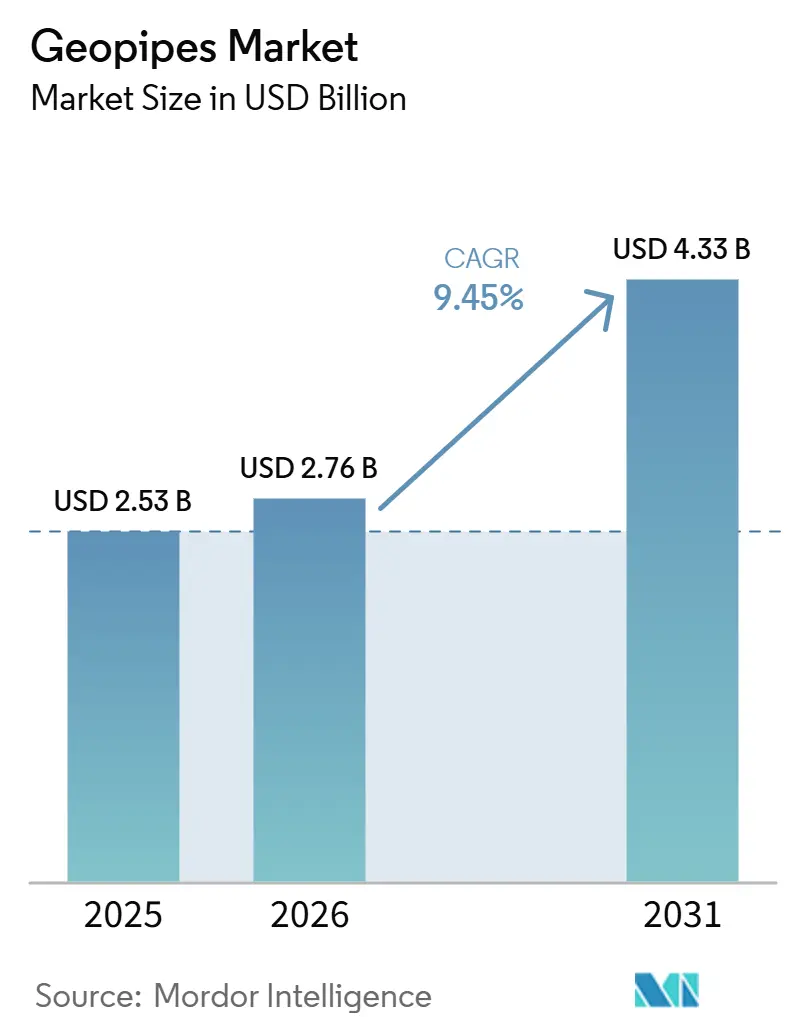
The geopipes market size was estimated at USD 2.53 billion in 2025 and is estimated to grow from USD 2.76 billion in 2026 to USD 4.33 billion by 2031, at a CAGR of 9.45% during the forecast period (2026-2031). The geopipes market is supported by replacement work in mature utility systems and first-time network construction in developing economies. Water, sewer, and stormwater systems require longer planning periods, giving producers better visibility than many short-cycle construction categories and helping suppliers align capacity decisions with public investment schedules. U.S. municipal sewer, water, and stormwater construction and rehabilitation spending is projected to reach USD 26.9 billion in 2026, while federal support for water and wastewater state revolving funds increased from USD 2.7 billion annually to USD 11.4 billion annually between 2022 and 2026. The geopipes market is also supported by public buyers assessing pipe durability, installation disruption, and maintenance requirements rather than purchase price alone, particularly when underground work takes place beneath busy roads and established neighborhoods. Competitive positioning increasingly depends on local production capacity, certified product portfolios, and the ability to meet utility specifications, reducing opportunities for suppliers that compete only on resin price. These conditions also support demand for suppliers that can provide drainage, water conveyance, fittings, and technical services as an integrated package for complex public projects.
Key Report Takeaways
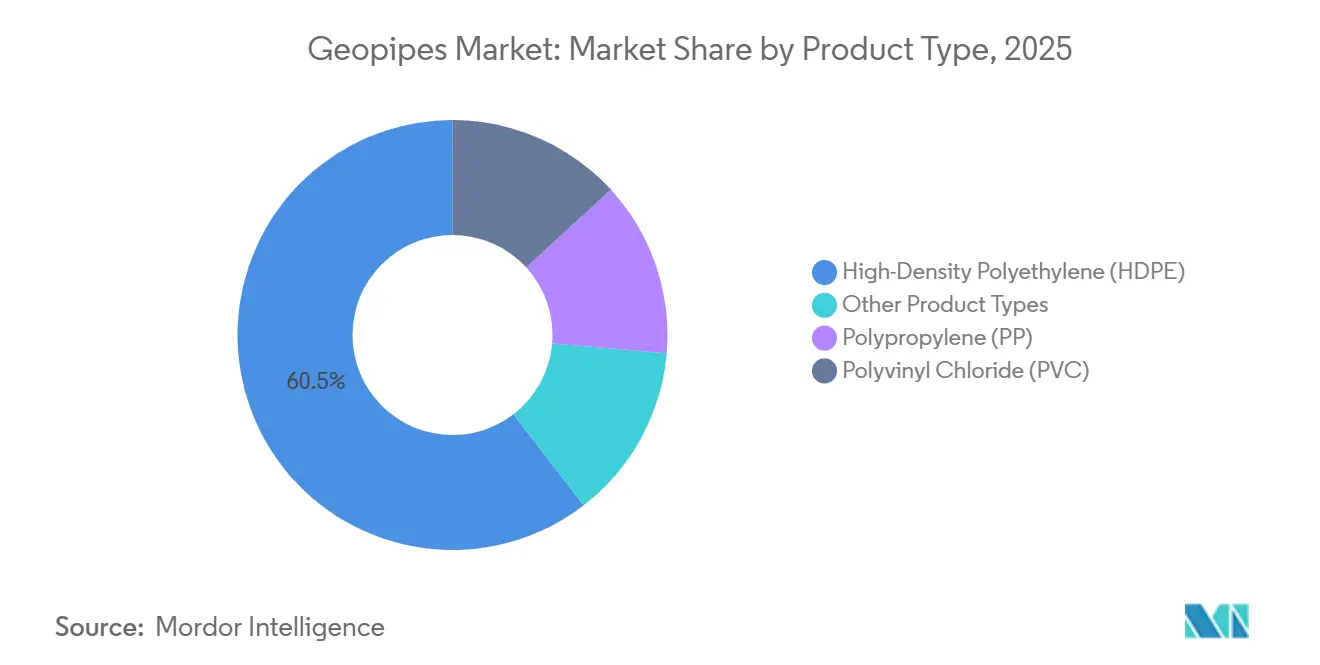
- By product type, High-Density Polyethylene (HDPE) held 60.45% of global geopipes demand in 2025, while polypropylene is forecast to grow at a CAGR of 10.35% through 2031.
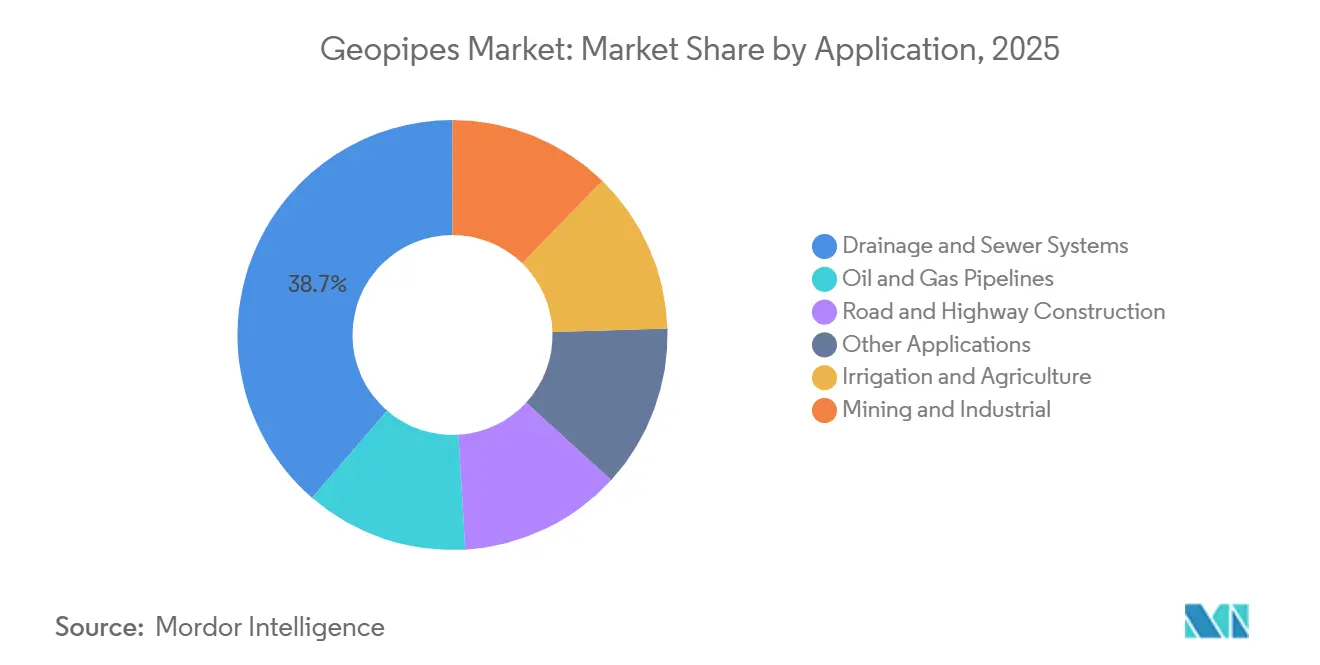
- By application, drainage and sewer systems accounted for 38.67% of global geopipes demand in 2025, while irrigation and agriculture are forecast to grow at a CAGR of 9.87% through 2031.
- By geography, Asia-Pacific held 44.12% of global geopipes demand in 2025 and is projected to grow at a CAGR of 10.13% through 2031.
Note: Market size and forecast figures in this report are generated using Mordor Intelligence’s proprietary estimation framework, updated with the latest available data and insights as of January 2026.
Global Geopipes Market Trends and Insights
Drivers Impact Analysis*
| Drivers | (~) % Impact on CAGR Forecast | Geographic Relevance | Impact Timeline |
|---|---|---|---|
| Global Water and Wastewater Infrastructure Renewal | +2.8% | Global | Short term (≤ 2 years) |
| Agricultural Irrigation Modernization and Water Conservation | +1.5% | Asia-Pacific, Middle-East and Africa, and South America | Medium term (2-4 years) |
| Urban Stormwater and Flood-Resilience Investment | +1.2% | Global, concentrated in Asia-Pacific and North America | Medium term (2-4 years) |
| Lightweight, Corrosion-Resistant, and Low-Maintenance Piping Demand | +1.5% | Global | Medium term (2-4 years) |
| Expansion of Mining, Industrial, and Energy Infrastructure | +0.8% | Asia-Pacific, South America, Middle-East and Africa | Long term (≥ 4 years) |
| Smart Drainage and Predictive Infrastructure Monitoring | +0.4% | North America and Europe, with spillover to the Asia-Pacific | Long term (≥ 4 years) |
| Source: Mordor Intelligence | |||
Global Water and Wastewater Infrastructure Renewal
Municipal utilities in OECD economies are entering a major renewal cycle, placing the geopipes market near funded water, sewer, and stormwater projects. U.S. municipal sewer, water, and stormwater construction and rehabilitation spending is projected to reach USD 26.9 billion in 2026, including USD 6 billion from the final installment of the Infrastructure Investment and Jobs Act. The Infrastructure Investment and Jobs Act allocated USD 43.4 billion to state revolving funds for water and wastewater from 2022 to 2026, increasing annual funding from USD 2.7 billion to USD 11.4 billion. A 2025 assessment by the Plastics Industry Pipe Association (PIPA) found that polyethylene (PE) pipe systems had a lower global warming potential than cement-lined ductile iron alternatives under comparable functional units. The geopipes market gains demand when procurement rules recognize lifecycle performance, as polymer systems address corrosion, maintenance, and surface restoration concerns. Per- and polyfluoroalkyl substances (PFAS) removal deadlines and lead-service line replacement requirements also limit utilities’ ability to defer essential network work.
Agricultural Irrigation Modernization and Water Conservation
Water scarcity is increasing demand for pressurized pipe irrigation across MENA, South Asia, and Sub-Saharan Africa, supporting the geopipes market. Irrigation accounted for 70% of global freshwater withdrawals in the source material, highlighting the role of efficient conveyance in food security programs. Closed-pipe networks reduce losses associated with open channels and support drip and sprinkler systems. Jain Irrigation Systems Ltd. reported INR 1,994.61 crore (USD 236 million) in revenue from its plastic division in FY2026, indicating continued agricultural piping activity in South Asia. Subsidized irrigation programs in India and Gulf Cooperation Council states direct public funding toward polypropylene (PP) and HDPE pipe procurement, reducing reliance on commercial construction cycles. The geopipes market, therefore, has an additional demand source where agricultural investment is tied to water conservation and rural development objectives.
Urban Stormwater and Flood-Resilience Investment
Urban flood events are moving stormwater networks from deferred maintenance to capital programs, supporting demand in the geopipes market. In February 2026, Dubai Municipality awarded AED 2.5 billion (USD 681 million) for five stormwater expansion projects under Phase Two of the Tasreef Program. The projects cover 430 million square meters and form part of the program aligned with the Dubai 2040 Urban Master Plan. New York City is investing USD 95 million in a cloudburst project in Brooklyn’s Homecrest neighborhood, and the city is applying this format across six flood-prone districts[1]City of New York, “Mayor Mamdani Announces USD 95 Million Cloudburst Project to Manage Flooding in Homecrest, Brooklyn,” NYC Mayor’s Office, nyc.gov. Such projects use large-diameter HDPE systems because their flexibility supports installation beneath built-up areas with uneven subsurface conditions. This project mix gives established suppliers opportunities to combine pipe supply with engineering, drainage design, and installation support.
Lightweight, Corrosion-Resistant, and Low-Maintenance Piping Demand
Infrastructure agencies using total cost-of-ownership models are increasingly selecting polymer pipes, supporting the geopipes market in urban and maintenance-sensitive projects. HDPE systems have a stated design life of 50 to 100 years in buried applications, compared with 30 to 50 years for conventional steel in the source material. Trenchless horizontal directional drilling can reduce surface disruption, especially on roads, utilities, and densely developed sites where excavation is costly. The geopipes market gains demand when procurement processes consider installation and maintenance costs alongside material prices. ISO 4427 for PE water pipes and ISO 15494 for PP industrial piping provide a technical basis for product qualification in major utility systems. This specification base can support durable supplier relationships because new entrants must demonstrate comparable product quality, certification, and application performance.
Restraints Impact Analysis*
| Restraints | (~) % Impact on CAGR Forecast | Geographic Relevance | Impact Timeline |
|---|---|---|---|
| Volatility in Ethylene, Propylene, and Other Resin Feedstock Costs | -1.2% | Global, amplified in Europe and Asia | Medium term (2-4 years) |
| Freight Inefficiency and Regional Manufacturing Requirements | -0.6% | Asia-Pacific as the core, with spillover to Middle-East and Africa, and South America | Medium term (2-4 years) |
| Competition from Concrete, Metal, and Conventional PVC Systems | -0.9% | Global, concentrated in price-sensitive emerging markets | Short term (≤ 2 years) |
| Plastic Circularity, Microplastic, and End-of-Life Compliance Pressure | -0.5% | North America and Europe | Long term (≥ 4 years) |
| Source: Mordor Intelligence | |||
Volatility in Ethylene, Propylene, and Other Resin Feedstock Costs
Resin economics remain the most direct cost risk for the geopipes market, as polymer materials account for 60% to 70% of pipe manufacturing costs. The source material indicates that ethylene and propylene prices declined across several regional benchmarks during 2025, as global demand softened and supply remained elevated. It also notes a 9.5% single-month decline in U.S. Gulf Coast propylene prices in October 2025. Buyers may seek price reductions quickly when resin costs decline, while contract prices may adjust more slowly when input costs recover. This timing gap can affect margins and complicate decisions on new extrusion capacity. China’s expanding ethylene capacity adds further uncertainty to PE and PP resin pricing, particularly for manufacturers in price-sensitive regions.
Freight Inefficiency and Regional Manufacturing Requirements
Geopipes are volume-intensive products, and transport costs can limit the viable distance between an extrusion plant and its customers. The source material places the practical transport range at 500 to 800 km, making local production and distribution important competitive factors. Limited road and port infrastructure can increase landed costs in emerging economies and create supply gaps in secondary cities. Polypropylene (PP) geopipes face an additional challenge because extrusion capacity remains less widely distributed outside Europe and major APAC economies. For the geopipes market, regional joint ventures can offer a practical route into Sub-Saharan Africa and Central Asia when exports and local tolling are uneconomic. However, these arrangements can take longer to establish and may require more capital than direct exports, slowing the response to new demand.
*Our forecasts treat driver/restraint impacts as directional, not additive. The impact forecasts reflect baseline growth, mix effects, and variable interactions.
Segment Analysis
By Product Type: HDPE Commands the Installed Base, PP Captures Specialty Growth
HDPE held 60.45% of the geopipes market share by product type in 2025, reflecting its established role in municipal water, drainage, and large-diameter industrial systems. Its corrosion resistance, long service life, and compatibility with horizontal directional drilling supported this position. Advanced Drainage Systems, Inc. reported net sales of USD 3,050.4 million for fiscal year 2026, while its wastewater segment reached USD 653 million, up 13% year over year. These results indicated continued downstream demand in drainage and conveyance systems. HDPE also remained suitable for environments that require fused joints and flexibility due to difficult ground conditions. The material’s broad use across public networks gives producers a large installed base to serve through new projects and system rehabilitation.
Polypropylene represents the fastest-growing product type, with the geopipes market size for this segment projected to grow at a CAGR of 10.35% from 2026 to 2031. PP is gaining use in mining slurry, industrial process piping, chemical transport, and high-temperature agricultural fertigation applications, where HDPE has thermal limitations. PVC continues to serve road culverts and smaller municipal or residential drainage installations, especially where procurement practices favor its lower material cost. Wavin launched PVC+ in France in January 2026 after three years of research and consultation with more than 1,500 installers. Other product types include composite and GRP pipes used in desalination, major water transmission, and mining applications. Amiblu’s additional GRP capacity in Morocco is intended to serve water and irrigation projects in North Africa and Sub-Saharan Africa. According to the source material, trenchless installation grew faster than open-cut installation in 2025, favoring HDPE in applications that require joint continuity and flexibility.



By Application: Municipal Drainage Leads, While Irrigation Supports Growth
Drainage and sewer systems accounted for 38.67% of global geopipes demand in 2025, making them the largest application area. Aging combined sewer systems require separation, capacity expansion, and condition-based rehabilitation across many established cities. Yorkshire Water plans to roll out more than 92,000 monitoring devices by 2030 under a GBP 53 million (USD 68 million) program that integrates sewer telemetry into network operations. The use of monitoring equipment adds specification requirements and can favor suppliers with established technical support. Genuit Group’s U.K. drainage portfolio generated GBP 246.8 million (USD 316 million) in revenue in 2025, an increase of 6.5% year over year. The source material attributes part of that performance to gains following a competitor’s exit from the U.K. market. Mining and industrial applications also require High-Density Polyethylene (HDPE) and Polypropylene (PP) for slurry, tailings, and process water conveyance, particularly in copper and iron ore operations.
Irrigation and agriculture represent the fastest-growing application area, with the geopipes market segment projected to expand at a CAGR of 9.87% from 2026 to 2031. Food security policies, subsidized drip and sprinkler programs, and the shift from surface irrigation to pressurized water delivery are supporting this demand. Rural programs use pipe networks to deliver water closer to farms, linking procurement to broader efforts to improve crop reliability in water-stressed areas. Oil and gas pipeline applications provide stable demand through city gas distribution and protective conduits for fiber-optic projects in APAC and MENA. Road and highway projects require culvert and subsurface drainage systems as networks expand across South and Southeast Asia. Public tenders increasingly use EN 13476 and ISO 4435, reinforcing the value of certified systems in sewer applications. The application mix allows producers to balance large municipal contracts with smaller agricultural, industrial, and road drainage orders across multiple end-use settings.
Geography Analysis
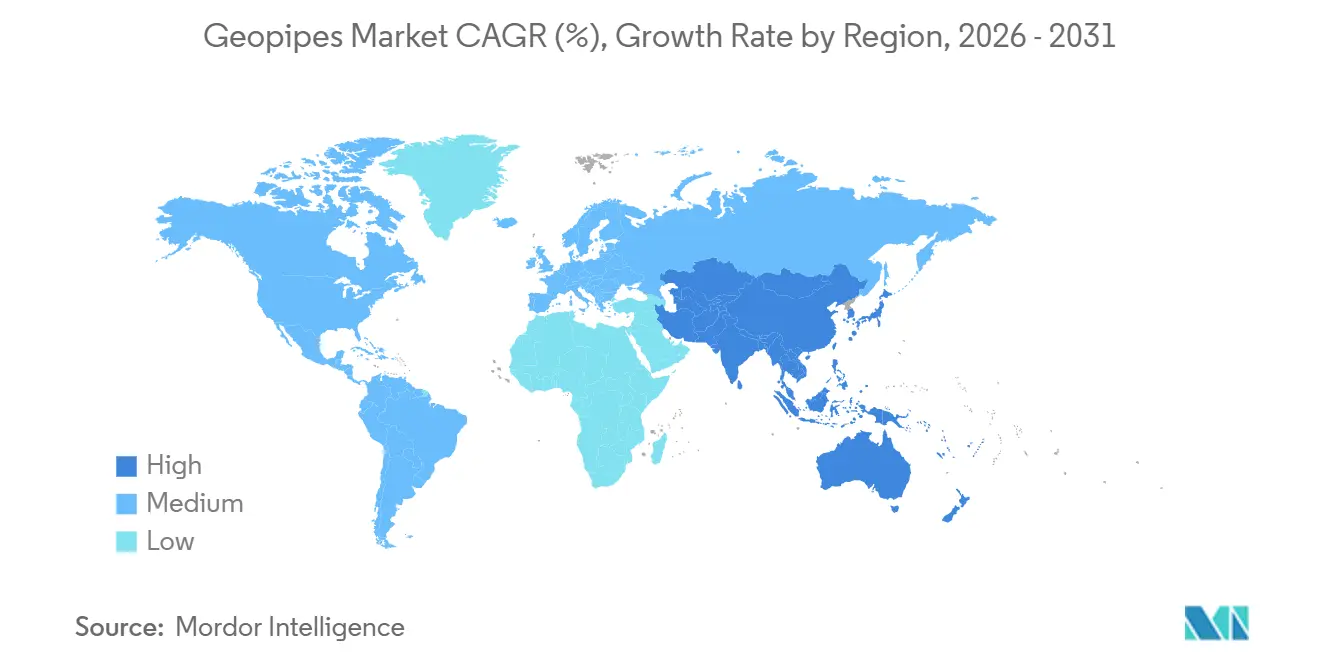
Asia-Pacific held 44.12% of the geopipes market share in 2025 and is projected to expand at a CAGR of 10.13% from 2026 to 2031. The region combines a large demand base with rapid infrastructure development, particularly in India and Southeast Asia. China’s 15th Five-Year Plan targets the construction and renovation of 770,000 km of urban underground pipelines, with investments exceeding CNY 5 trillion (USD 1.03 trillion)[2]China Financial Information Network, “CNY 5 Trillion Underground Pipeline Investment Program Launched,” China Financial Information Network, cnfin.com. This program establishes a multi-year pipeline for HDPE and PP products at a scale unmatched by any single national program. India generates additional demand through rural piped-water connections and urban drainage programs under the Jal Jeevan Mission and Smart Cities Mission. Japan, South Korea, and ASEAN markets support demand through industrial, mining, and flood-resilience projects. Vietnam, the Philippines, and Indonesia remain relevant markets as water utility networks continue to develop over the long term.
North America holds a strong position in the geopipes market, with demand shaped by U.S. funding and compliance requirements. U.S. municipal sewer and water construction spending is projected to reach USD 26.9 billion in 2026. Federal support for water and wastewater infrastructure has strengthened demand for base replacement, while PFAS remediation and lead-service line replacement create additional mandated work. Canada supports HDPE use through oil sands and mining infrastructure. Mexico generates demand from industrial corridors and irrigated agricultural areas that use PVC and HDPE systems. Europe benefits from investment requirements for drinking water and wastewater infrastructure, although the source material describes plastic pipe consumption as emerging from a prolonged period of stagnation. Across these markets, replacement projects and trenchless rehabilitation provide recurring use cases for established polymer pipe suppliers.
South America, the Middle-East, and Africa provide varied sources of demand in the geopipes market. Brazil’s sanitation investments and Argentina’s irrigation modernization support large-diameter HDPE water transmission systems and pressurized irrigation systems made of PP. Chile and Peru use HDPE and PP products for mining applications as copper and lithium extraction expands. In the Middle-East and Africa, the Tasreef Program supports stormwater drainage work, while Saudi Arabia’s Vision 2030 infrastructure pipeline supports demand for HDPE and GRP systems. Amiblu inaugurated a third GRP production line in Casablanca in July 2026, adding localized capacity for drinking water, desalination, and irrigation projects. Local production can reduce import dependence and shorten project lead times in North African markets. These conditions make proximity manufacturing a relevant component of regional competition.

Competitive Landscape
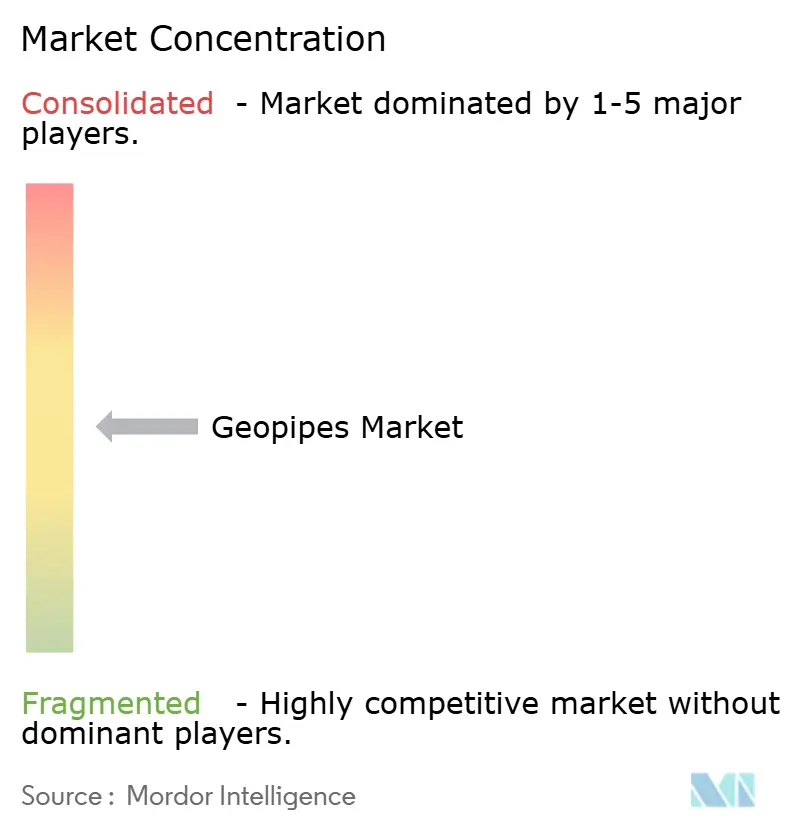
The geopipes market is moderately fragmented. Advanced Drainage Systems, Wavin, Pipelife International, and JM Eagle operate across broad product portfolios, while smaller suppliers often compete through local manufacturing capabilities and application expertise. Advanced Drainage Systems generated USD 3.05 billion in revenue in fiscal year 2026, representing a 5% year-over-year increase. The company completed the acquisition of National Diversified Sales on February 2, 2026, expanding its Allied Products segment and targeting annual cost savings of more than USD 25 million. The transaction broadened its stormwater and wastewater treatment offering and enabled the company to address adjacent products used with drainage systems. Wavin uses product identification technology at its Hammel facility in Denmark, where PE pipes carry a matrix code linked to lifecycle information. This approach supports the company’s preparation for Digital Product Passport requirements and differentiates its offering through traceability, product documentation, and accessible information for asset owners.
In the geopipes market, mid-sized and regional manufacturers often maintain their positions by offering shorter delivery distances and tailored engineering support. Jain Irrigation Systems serves APAC agricultural drainage, while Prinsco serves the US Midwest farm drainage segment through regional logistics. Amiantit and Amiblu use localized supply and project engineering capabilities in MENA. Advanced Drainage Systems purchased 391 million pounds of recycled plastic in fiscal year 2026, supporting its sustainability position for institutional procurement. Recycled content may gain importance in public tenders that assess material circularity alongside durability and cost, particularly when suppliers must show how their material choices align with public environmental requirements. Smart monitoring technology for blockages and leaks is also emerging in high-density polyethylene (HDPE) and polypropylene (PP) systems used for mining slurry and utility water transmission. These capabilities can add value for suppliers that integrate pipe production with digital asset information and support operators after installation.
The geopipes market offers opportunities in Sub-Saharan Africa and Central Asia, where formal supply chains are still developing. Manufacturers entering these areas must assess the benefits of early capacity investment against difficult freight economics and uneven local demand. Joint ventures and localized plants can provide better economics than long-distance exports, but they require longer commitments and coordination with local contractors, distributors, and project owners. In the geopipes market, competitive advantage rests on product certification, local availability, installation support, and the capacity to serve large public projects. Demand remains spread across municipal water, drainage, irrigation, mining, industrial systems, and road construction, limiting any single supplier’s ability to dominate all applications. Product, application, and geographic specialization will continue to shape the competitive structure of the geopipes market.
Geopipes Industry Leaders
Advanced Drainage Systems
Wavin B.V.
Genuit Group
PIPELIFE INTERNATIONAL GmbH
Jain Irrigation Systems Ltd.
- *Disclaimer: Major Players sorted in no particular order

Recent Industry Developments
- July 2026: Amiblu Holding GmbH inaugurated its third Glass Reinforced Plastic (GRP) pipe production line at its Casablanca, Morocco, facility, with an investment of MAD 160 million (USD 17 million). The expansion increased the maximum producible diameter from DN2600 to DN3200 and raised fittings production capacity by 25%. The facility serves drinking water, desalination, and irrigation infrastructure projects across North Africa and Sub-Saharan markets.
- February 2026: Dubai Municipality awarded AED 2.5 billion (USD 681 million) in contracts for five stormwater drainage expansion projects under Phase Two of the Tasreef Program. The projects cover 430 million square meters and include a main stormwater tunnel with a diameter of up to 4 meters. They are part of the AED 30 billion Tasreef Program, aligned with the Dubai 2040 Urban Master Plan.


Global Geopipes Market Report Scope
Geopipes are perforated or solid-wall polymeric pipes used for underground drainage, fluid transport, and civil engineering applications. Manufacturers commonly use materials such as PVC or HDPE to produce geopipes.
The geopipes market is segmented by product type, application, and geography. By product type, the market is segmented into high-density polyethylene (HDPE), polypropylene (PP), polyvinyl chloride (PVC), and other product types. By application, the market is segmented into drainage and sewer systems, irrigation and agriculture, mining and industrial, oil and gas pipelines, road and highway construction, and other applications. The report also covers market size and forecasts for geopipes across 17 countries in major regions. The market sizes and forecasts are provided in terms of value (USD).
| High-Density Polyethylene (HDPE) |
| Polypropylene (PP) |
| Polyvinyl Chloride (PVC) |
| Other Product Types |
| Drainage and Sewer Systems |
| Irrigation and Agriculture |
| Mining and Industrial |
| Oil and Gas Pipelines |
| Road and Highway Construction |
| Other Applications |
| Asia-Pacific | China |
| India | |
| Japan | |
| South Korea | |
| ASEAN Countries | |
| Rest of Asia-Pacific | |
| North America | United States |
| Canada | |
| Mexico | |
| Europe | Germany |
| United Kingdom | |
| France | |
| Italy | |
| Spain | |
| NORDIC Countries | |
| Russia | |
| Rest of Europe | |
| South America | Brazil |
| Argentina | |
| Rest of South America | |
| Middle-East and Africa | Saudi Arabia |
| South Africa | |
| Rest of Middle-East and Africa |
| By Product Type | High-Density Polyethylene (HDPE) | |
| Polypropylene (PP) | ||
| Polyvinyl Chloride (PVC) | ||
| Other Product Types | ||
| By Application | Drainage and Sewer Systems | |
| Irrigation and Agriculture | ||
| Mining and Industrial | ||
| Oil and Gas Pipelines | ||
| Road and Highway Construction | ||
| Other Applications | ||
| By Geography | Asia-Pacific | China |
| India | ||
| Japan | ||
| South Korea | ||
| ASEAN Countries | ||
| Rest of Asia-Pacific | ||
| North America | United States | |
| Canada | ||
| Mexico | ||
| Europe | Germany | |
| United Kingdom | ||
| France | ||
| Italy | ||
| Spain | ||
| NORDIC Countries | ||
| Russia | ||
| Rest of Europe | ||
| South America | Brazil | |
| Argentina | ||
| Rest of South America | ||
| Middle-East and Africa | Saudi Arabia | |
| South Africa | ||
| Rest of Middle-East and Africa | ||


Key Questions Answered in the Report
What is current market size of Geopipes Market?
The geopipes market size was estimated at USD 2.53 billion in 2025 and is estimated to grow from USD 2.76 billion in 2026 to USD 4.33 billion by 2031, at a CAGR of 9.45% during the forecast period (2026-2031).
Which product type leads to global demand?
HDPE led the market by product type, with a 60.45% share in 2025, due to its widespread use in municipal water, drainage, and industrial applications.
Which application is expanding fastest?
Irrigation and agriculture are projected to grow at a 9.87% CAGR through 2031 as governments support water-efficient farming systems.
Which region has the strongest outlook?
Asia-Pacific held a 44.12% share in 2025 and is projected to grow at a 10.13% CAGR through 2031. China’s planned urban pipeline construction and renovation program, along with water network development in India and Southeast Asia, supports the region’s scale.
Page last updated on:





